Since the pioneering work of Selye (Reference Selye1936), the association between stress and hypothalamic–pituitary–adrenal (HPA) axis activation has been extensively addressed in animal models and in humans at all developmental periods and as part of both normative and maladaptive processes. Specifically, stress-induced elevations in cortisol, the primary hormonal product of the HPA axis, have been well documented. As part of the body's interconnected set of physiological systems for managing physical, cognitive, and psychosocial challenges, the HPA axis is particularly sensitive to situations that involve novelty, uncontrollability, or social threat (Dickerson & Kemeny, Reference Dickerson and Kemeny2004). Chronically elevated cortisol has also figured prominently in models of allostatic load, or the “wear and tear” on the body that can occur with repeated activation of the body's adaptive systems as a result of repeated stress over time (McEwen & Stellar, Reference McEwen and Stellar1993). However, at least as early as 1998 definitions of allostatic load have included both over- and underactivation of the HPA axis (McEwen, Reference McEwen1998). Critical to the concept of allostasis is the notion of balance, in particular quick recovery to an optimal level of functioning following a perturbation. In the case of the HPA axis we know that both too much and too little cortisol contribute to disease states. Nevertheless, hypercortisolism has received the vast majority of research attention. In the following study we examined the relationship between a constellation of risk factors (comprising stress exposure, maternal depression, and attenuated basal and stress reactive cortisol), and internalizing symptoms in two samples of children. Utilizing the key principles of a developmental psychopathology approach, we seek to clarify the interplay among physiologic, psychologic, and contextual factors as they transact across development (Cicchetti & Toth, Reference Cicchetti and Toth2009). We begin by reviewing the relevant literature on hypocortisolism including the evidence demonstrating low cortisol in children. We then discuss measurement and interpretation issues and conclude by proposing that hypocortisolism may be an important marker of allostatic load in children, particularly for psychopathology outcomes.
In the past decade both Hellhammer and colleagues (Fries, Hesse, Hellhammer, & Hellhammer, Reference Fries, Hesse, Hellhammer and Hellhammer2005; Heim, Ehlert, & Hellhammer, Reference Heim, Ehlert and Hellhammer2000) and Gunnar and Vasquez (Reference Gunnar and Vazquez2001, Reference Gunnar and Vazquez2006) have highlighted a number of studies demonstrating both abnormally low basal cortisol and underreactive cortisol responses to a stressor in vulnerable populations. Whereas Hellhammer and colleagues have focused on understanding low basal and stress reactive cortisol in patient populations (e.g., patients with posttraumatic stress disorder [PTSD] as well as chronic fatigue and fibromyalgia), Gunnar and Vasquez (Reference Gunnar and Vazquez2001, Reference Gunnar and Vazquez2006) have called for increased attention to hypocortisolism in children, cautioning that the presence of low cortisol in childhood may challenge our longstanding assumptions about how the HPA axis responds to stress. Beginning with the pioneering work of, for example, Yehuda, Giller, Southwick, Lowy, and Mason (Reference Yehuda, Giller, Southwick, Lowy and Mason1991), demonstrating hypocortisolism in individuals with PTSD a number of authors have attempted to integrate low cortisol into our understanding of the effects of chronic stress. The prevailing opinion is that low cortisol likely results from previous periods of high stress, and may reflect serious dysregulation (Miller, Chen, & Zhou, Reference Miller, Chen and Zhou2007). As such, low cortisol may be an important and understudied marker of allostatic load.
Low Cortisol in Children
Relatively few studies have focused on hypocortisolism in children; however, low cortisol has been reported in maltreated children, children experiencing high stress, and in children at risk for antisocial personality disorder (ASPD). For example, children who were raised under conditions of institutional neglect showed dysregulated basal cortisol patterns as indicated by lower than expected morning values and flat daytime patterning (Carlson & Earls, Reference Carlson and Earls1997). Similarly, maltreated children with clinical depression have sometimes been observed to have flat diurnal cortisol patterns (Cicchetti, Rogosch, Gunnar, & Toth, Reference Cicchetti, Rogosch, Gunnar and Toth2010; Kaufman, Reference Kaufman1991), although higher cortisol in maltreated children, particularly those who have experienced multiple comorbid subtypes of maltreatment, has also been documented (e.g., Cicchetti & Rogosch, Reference Cicchetti and Rogosch2001). Blunted cortisol has also been observed in children whose parents suffer from psychopathology (Fernald, Burke, & Gunnar, Reference Fernald, Burke and Gunnar2008) and who live near the epicenter of an earthquake (Goenjian et al., Reference Goenjian, Yehuda, Pynoos, Steinberg, Tashjian and Yang1996). Last, as is true of adult antisocial personality disorder, hypocortisolism has been demonstrated in children at risk for ASPD (Susman, Reference Susman2006). Low cortisol has also been examined as a possible correlate of externalizing symptoms; however, a recent meta-analysis of 101 studies concluded that there is not clear evidence of an association between externalizing behaviors and low cortisol in children (Alink et al., Reference Alink, van IJzendoorn, Bakermans-Kranenburg, Mesman, Juffer and Koot2007).
Interpreting Low Cortisol in Adults and Children
Although the mechanisms through which high stress (and higher cortisol) could subsequently result in hypocortisolism are not yet fully clarified, possible explanations include changes in the biosynthesis of HPA axis hormones and/or availability and functioning of their receptors at all levels of the HPA axis (for discussion, see Heim et al., Reference Heim, Ehlert and Hellhammer2000). In order to understand whether and how low cortisol results from previous periods of high cortisol, potential early and intergenerational effects must be considered, and the possibility of multifinality cannot be ignored. It is often difficult to study highly stressed populations before the stressors occur, and therefore it is difficult to know whether individuals who face a trauma have predisposing risks in these systems or if the posttrauma differences result from the trauma itself (see, e.g., Glibertson et al., 2002, on hippocampal atrophy in noncombat exposed identical twins of veterans with PTSD). Furthermore, animal models highlight the importance of intergenerational transmission of differences in expression of glucocorticoid receptor genes (Francis, Diorio, Liu, & Meaney, Reference Francis, Diorio, Liu and Meaney1999). This work suggests that a full understanding of individual differences in stress reactivity, including how individuals become hypo- or hypercortisolemic, would require a multigenerational approach. Although it is not yet known whether attenuated cortisol always results from previous high stress and is therefore itself a clear indicator of allostatic load, there is sufficient evidence to warrant attention to whether low cortisol is a risk factor for particular disease states, particularly early in life and longitudinally while tracking stress exposure.
An interesting question in studies of hypocortisolism is determining at what level and under what conditions lower cortisol is problematically low. When participants, particularly those from vulnerable populations, do not respond physiologically to a lab-based stress manipulation the most parsimonious explanation may be that they simply did not find the manipulation stressful compared to the backdrop of their lives. However, in the situation where even the basal rhythm is attenuated it is clear that the individual is not responding to the environment normally. Gunnar and Vasquez (Reference Gunnar and Vazquez2001) go so far as to say that “nowhere is there evidence that loss of the daily rhythm in cortisol production is associated with resilient adaptation to stressful life circumstances” (p. 532).
At this point we simply do not know under what circumstances, for whom, and at what developmental periods under- versus overactivation of stress systems are most likely (and when both stress systems are concomitantly versus discordantly under- or overactivated). Although we suspect that underactivation of the HPA axis may be a reflection of more severe stress exposure and have more serious consequences than hyperactivation (Gunnar & Vasquez, Reference Gunnar and Vazquez2001), the longitudinal work with human populations necessary to clarify these mechanisms has not yet been done. One notable exception was recently provided by Trickett, Noll, Susman, Shenk, and Putnam (Reference Trickett, Noll, Susman, Shenk and Putnam2010) utilizing a sample of women originally studied between 6 and 16 years of age after documented sexual abuse and matched controls. Both groups were followed for five subsequent time points. This longitudinal cohort design spanned 6 to 30 years of age, and demonstrated that initially (near the time of the abuse) abused girls had higher cortisol levels midmorning (one sample between 9 and 10 a.m.). Subsequently, both groups showed increasing cortisol across late childhood and early adulthood, but by the fifth time point women with abuse histories had lower morning cortisol than nonabused control women. This suggests that the low cortisol sometimes seen in women with abuse histories may have been preceded by higher cortisol nearer to the time of the abuse.
In work with adults, low cortisol is typically described as an end state that results from previous periods of high stress or from some predisposing factor rather than as an adaptation that could be modified with changing circumstances. When we consider infants and children, it is possible that low cortisol could also result from previous high cortisol, even prenatally (Charmandari, Kino, Souvatzoglou, & Chrousos, Reference Charmandari, Kino, Souvatzoglou and Chrousos2003). Nevertheless, the presence of attenuated cortisol in young children and the concern that this dysregulation may be particularly serious points to the need to understand whether low cortisol in childhood changes with maturation or via deliberate or natural environmental changes. Incorporating this perspective would help answer the call put forth by Cicchetti and Toth to integrate measures from multiple systems including biological systems in our examinations of resilience (Cicchetti & Toth, Reference Cicchetti and Toth2009). Our recent pre- to postpubertal data demonstrated blunted cortisol reactivity to a stressor in prepubertal dysphoric youth, but exaggerated cortisol reactivity to a stressor in postpubertal dysphoric adolescents (Hankin, Badanes, Abela, & Watamura, Reference Hankin, Badanes, Abela and Watamura2010). Based on these findings, we propose that prior to puberty, children facing significant and inescapable stress related to their family system may show attenuated cortisol in their normal environments and when facing a stress manipulation in the presence of their caregivers as a temporary and partially adaptive (although not cost-free) response. This attenuation would prevent the child from mounting a cortisol response to most repeated and uncontrollable stressors. Although in some cases attenuation might put them in danger (as cortisol elevations help manage threat), it would protect the child facing chronic inescapable stress from repeated activations and the resultant accumulated damage to the body when they are simply too young to engage with or escape the threat. At puberty, when the child matures past complete dependence on caregivers, children with chronic stress exposure may then become hyperreactive to stress. This hyperactivation might support the postpubertal child to actively engage with or escape the threat. More stressful family environments have been linked to early pubertal onset (e.g., Ellis & Garber, Reference Ellis and Garber2003). As has been seen in PTSD, perhaps individuals who exhibit attenuated cortisol after puberty continue to live in situations that are interpreted physiologically as inescapably threatening, either through the maintenance of stressful or traumatic experiences via rumination or by continued exposure to danger or abuse.
Low Cortisol as a Marker of Allostatic Load
The current special issue examines the role of allostatic load during development as risk for psychopathology. This is a relevant and timely question. A recent review of socioeconomic status (SES) gradients in markers of allostatic load (Seeman, Epel, Gruenewald, Karlamangla, & McEwen, Reference Seeman, Epel, Gruenewald, Karlamangla and McEwen2010) illustrated that at least some allostatic load markers show an SES gradient before age 5. The HPA axis has figured prominently in allostatic load models. However, despite awareness that underreactive cortisol is an important type of cortisol dysregulation, to our knowledge only high cortisol (upper quartile urinary 24-hr cortisol) has thus far been used as a marker of allostatic load in children (Evans, Reference Evans2003). To address this, we elected to examine the role of attenuated cortisol as a possible marker of allostatic load in preschool and school-age children and youth. We selected this approach based on the theoretical and empirical contributions reviewed above that suggest that low cortisol may be more reflective of chronic and serious stress than high cortisol, especially when the basal rhythm is disrupted. The concept of allostatic load has long included the notion that wear and tear on the body can result in both over- and underactivation of stress systems, and that both states are associated with disease (McEwen, Reference McEwen2004). Underactivation of the HPA axis puts the individual at risk because in its normal role the HPA axis regulates the immune system and protects against exaggerated immune responses, such as those seen in inflammatory (Chrousos, Reference Chrousos1995) and autoimmune disease (Sternberg, Reference Sternberg2001). However, although contextual stress has been associated with low cortisol in children (e.g., Goenjian et al., Reference Goenjian, Yehuda, Pynoos, Steinberg, Tashjian and Yang1996), whether low cortisol in children is related to psychopathology (other than in the case of the relatively small number of children at risk for antisocial personality disorder; e.g., Susman, Reference Susman2006) has not been well studied. We hypothesize that low cortisol may be seen not only following an acute stressor like an earthquake, but also as an adaptation to highly stressful and inescapable family stress. Working from this hypothesis, we turned our attention to whether low cortisol would be related to the most common stress-associated psychopathologies, namely, symptoms of internalizing disorders.
Known Risk Factors for Internalizing Disorders in Children and Adolescents
Exposure to stressful life events is one of the most widely studied risk factors for depression, with robust evidence suggesting that stressful life events predict or “trigger” the development of depression across the life span. Both retrospective and prospective studies have consistently found higher levels of significant stressors prior to the onset of depression. Mazure (Reference Mazure1998) demonstrated that patients with major depression were nearly 2.5 times more likely to have experienced at least one major adverse life event prior to onset than were controls. This association has been confirmed by several other researchers (e.g., Kessler, Reference Kessler1997; Tennant, Reference Tennant2002). Prevailing models of developmental psychopathology now recognize the importance of psychosocial stress in the etiology and maintenance of internalizing disorders in youth (e.g., Cicchetti & Toth, Reference Cicchetti, Toth, Cicchetti and Toth1991; Haggerty, Sherrod, Garmezy, & Rutter, Reference Haggerty, Sherrod, Garmezy and Rutter1994). Although major life events such as the death of a parent or severe abuse and neglect are commonly linked to depression in youth (Kendler, Kuhn, & Prescott, Reference Kendler, Kuhn and Prescott2004; Williamson, Birmaher, Dahl, & Ryan, Reference Williamson, Birmaher, Dahl and Ryan2005), less traumatic events and daily hassles can also lead to an increase in depressive symptoms (O'Sullivan, Reference O'Sullivan2004). For example, a large epidemiological sample of adolescents revealed that regardless of gender, a recent breakup with a romantic partner heightened the likelihood of the occurrence of a first major depressive episode (Monroe, Rohde, Seeley, & Lewinsohn, Reference Monroe, Rohde, Seeley and Lewinsohn1999). Other stressors or hassles common in the lives of youth include conflicts within the home or with peers, behavioral problems at school, health problems, neighborhood safety issues, and academic pressures.
In addition to stressful life events, maternal depression has also been widely recognized as a risk factor for psychopathology in youth. Prevalence rates of psychiatric disorders among children of depressed parents have been estimated to be two to five times higher than in youth without depressed parents (Beardslee, Versage, & Gladstone, Reference Beardslee, Versage and Gladstone1998). Several possible explanations exist for the intergenerational transmission of maternal depression and adverse child outcomes including shared genetics (Goodman, Reference Goodman2004), insensitive parenting behaviors (Lovejoy, Graczyk, O'Hare, & Neuman, Reference Lovejoy, Graczyk, O'Hare and Neuman2000), and fetal exposure to stress hormones or toxins (Essex, Klein, Cho, & Kalin, Reference Essex, Klein, Cho and Kalin2002). Of particular relevance to the current study, others have also suggested that children of depressed mothers may experience more stressful life events (Goodman & Gotlib, Reference Goodman and Gotlib1999; Hammen, Reference Hammen1991).
Although depression is a classic multifactorial and heterogeneous disorder with many risk factors and processes contributing to the likelihood of an individual exhibiting symptoms, stress exposure, history of maternal depression, and physiological stress processes are among the most well-studied and potent risks to depression in youth (Abela & Hankin, Reference Abela, Hankin, Abela and Hankin2008). Developmental psychopathology principles espouse the notion of developmental pathways, especially multifinality and equifinality, and research investigating the ontogeny of depression across the life span has supported this perspective. Among the numerous theories on the development of depression, Goodyer (Reference Goodyer2008) explicitly adopts a developmental psychopathology perspective and highlights two potential pathways, which involve genetic, neural, cognitive, and physiological factors, processes, and systems, that may lead to depression.
The Current Study
The following paper utilized data from two separate studies to examine the hypothesis that low cortisol may function as one marker of risk for internalizing disorders, particularly in combination with stress exposure and maternal depression. We selected these two studies for examination because we had previously found pre- to postpubertal differences in the association between cortisol reactivity to a stressor and internalizing symptoms in these children (Hankin et al., Reference Hankin, Badanes, Abela and Watamura2010). Specifically, greater internalizing symptoms were associated with low cortisol reactivity to a stressor prior to puberty, but to high cortisol reactivity after puberty. In the current analyses, we focused on low cortisol as a possible marker of allostatic load in children and youth, and therefore examined its relations with both family risk factors and mental health. These analyses build on the previous work not only by including family risk, but also by including both basal and stress reactive cortisol in Study 1, and in Study 2 by looking at the change in internalizing symptoms over time for youth with low cortisol at the initial assessment. In Study 1, we worked with a sample of high risk preschoolers and examined whether known significant stressors impacting the family system (maternal depression and serious financial strain) predicted which children exhibited attenuated cortisol across the day in two normal environments (home and child care) and across a stress paradigm presented to the child in the presence of the mother or lead teacher. Further, we examined whether in this high-risk sample cortisol attenuation was associated with internalizing symptoms. We expected that attenuated cortisol would predict internalizing problems above and beyond the direct effects of parent-reported stress. We did not have any theoretical reason to expect that low cortisol would serve as a mechanistic link between stress and internalizing problems. However, given the possible mechanistic role of high cortisol (which these children may have experienced previously), we tested these data for mediation. In a second study, we worked with a community sample of third, sixth, and ninth graders, collecting data initially during a lab visit and subsequently every 3 months for 1 year to determine whether having lower cortisol at Time 1 could be a risk factor for later depressive symptoms. Again, we examined whether low cortisol mediated the effect of stress on psychopathology with the expectation that it would increase risk but would not itself be a mechanistic link.
Study 1
Method
Participants
Participants were 110 preschoolers (53% female) enrolled in one of 14 full-day child care classrooms. The children were 2 to 6 years of age (M = 4.03, SEM = 0.07). Seventy-five percent of children were identified by parents as White and 25% as non-White (15% African American/Black, 8% Asian American/Asian, and 2% American Indian/Alaskan). In addition, 45% of those identifying as White were also identified as non-Hispanic, with 55% identifying as Hispanic. Because of potential differences in allostatic load by nativity and our deliberate attempts to recruit Mexican-origin families, we further characterized Hispanic children according to whether or not their mother was born in Mexico (24%). Parents were given the option of completing all of the questionnaires in either English or Spanish (14% chose Spanish). These data were part of a larger study approved by the Institutional Review Board at the University of Denver. Families were compensated $100 for this portion of their participation, whereas teachers were compensated $20 for each child participating in their classroom.
Measures
In this study, we examined whether a stressful home environment (as measured by stress exposure, financial strain, and maternal depression), was related to allostatic load (as indexed by HPA axis hypoactivation), and whether stress and load independently predicted internalizing symptoms in preschool children. Further, we were interested in whether the effect of stress on the health outcome of internalizing symptoms was partially mediated by load.
Cortisol
Basal cortisol was assessed via saliva samples at both child care and at home at approximately 10 a.m. and 4 p.m. Stress reactivity was also assessed with salivary cortisol at three time points of 20-min intervals across a 20-min mild stressor at both child care and at home. For the first nine children, unstimulated saliva samples were obtained using a 1.5-in. cotton dental roll that was then expressed into a vial. It has been established that cotton fibers retain cortisol, particularly samples with low volume (de Weerth, Graat, Buitelaar, & Thijssen, Reference de Weerth, Graat, Buitelaar and Thijssen2003). To allow inclusion of the samples collected with cotton, the values were corrected by a factor of 1.4 nmol/l based on the retention of known cortisol concentrations using cotton rolls from the same lot used in this study. For the remaining 101 children, saliva samples were obtained via synthetic salivette collection devices (Sarstedt, Nuembrecht, Germany). Saliva was extracted by centrifuging for 4 min at 2500 rpm. Vials and salivettes were frozen at −20°C until data collection was complete. Samples were then defrosted and batched for assay in groups of 36 and were assigned to batches so that classroom and batch were not confounded, and so that all samples from the same child were analyzed in the same batch. Samples were sent to the Biochemical Laboratory, Psychobiology, University of Trier, Germany, to be assayed. Cortisol levels were determined by employing a competitive solid phase time-resolved fluorescence immunoassay with fluorometric end-point detection (dissociation-enhanced lanthanide fluorescent immunoassay; Hoferl, Krist, & Buchbauer, Reference Hoferl, Krist and Buchbaur2005). For samples retained in the analyses described below for Study 1 and Study 2, the mean interassay coefficients of variation for controls were 6.6% to 8.5%. For duplicates of the samples used in this study, the intraassay coefficient of variation was 5%.
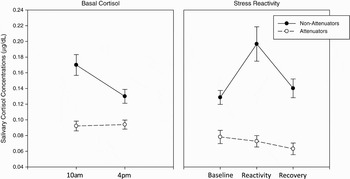
Cortisol assays for each sample were performed in duplicate and the duplicates were averaged. Participants could have up to a total of 16 cortisol samples (6 at child care, 4 at home, and 6 across the two interactions, see procedure below; M = 14.6; range = 9–16). Of the 110 participants, 54% had 16 samples, 20% had 15 samples, 8% had 14 samples, and the remaining 18% had between 9 and 13 samples. Participants were coded as an attenuator if all of their available samples were at or below 0.10 µg/dl (see Figure 1 for means for each available time point).
Mean cortisol levels in attenuated and nonattenuated preschoolers across the day and across the stressor.

Stress paradigm
Children participated in a 20-min semistructured mild stressor with the support of their lead teacher at child care and of a parent at home. Adapted from the NICHD Early Child Care Research Network's (1998) three-box task, the interaction was designed to mimic normative challenges that children face. During the interaction, the dyad was presented with four different sets of materials for 5 min each in the following order: a set of books as a warmup activity, two hand puppets to elicit child-directed play, a scary robot to elicit fear, and a box with an attractive toy that was difficult to open to elicit frustration.
Financial strain
Financial strain was assessed with the Family Finances Questionnaire adapted from the NICHD Study of Early Child Care (2000) and consisted of one item addressing family size, two items assessing sources of income, one question asking about amount of income earned, and five items asking about insecurity of critical resources. For this study we used these latter five items as we felt it was the best reflection of experienced poverty without requiring our judgment of what income level impacts basic household resources. Items asked whether in the past 12 months the following was true or false for the family: (a) your family went without a telephone, (b) you did not pay all or part of the rent/mortgage because you did not have enough money, (c) your family was evicted for failure to pay, (d) You did not pay all or part of the gas/electric/oil bill, and (e) you had your oil/gas/electricity turned off for failure to pay. This data were available for 95 families, with 59 families experiencing none of these events, 14 experiencing 1, 11 experiencing 2, 7 experiencing 3, 4 experiencing 3, and 1 experiencing all 5. Because of the considerable skew, we created a dichotomous variable indicating whether families did or did not experience the loss of housing or at least one utility due to financial strain.
Maternal depression
Maternal depression was assessed using the Center for Epidemiological Depression Scale (CES-D; Radloff, Reference Radloff1977). The CES-D is a 20-item self-report scale that measures symptoms of depression. It is one of the most widely used and validated measures of depressive symptomatology for nonclinical samples (Orme, Reis, & Herz, Reference Orme, Reis and Herz1986) with internal consistency of 0.85 in a nonclinical sample and 0.90 in a clinical sample (Roberts, Reference Roberts1980). For the current sample α = 0.78. We used the standard cutoff of 16 to create a dichotomous variable indicating whether mothers did or did not report clinical levels of depressive symptoms at the time of the study.
Recent stress exposure
A modified version of the Multicultural Events Schedule for Adolescents (MESA; Gonzales, Gunnoe, Samaniego, & Jackson, Reference Gonzales, Gunnoe, Samaniego and Jackson1995) adapted for preschoolers was used to assess family stress. The MESA is a list of 54 stressful daily hassles and life events commonly experienced by low-SES families. For the current sample α = 0.88. Even in this high-risk sample, the occurrence of serious stressors in the last 3 months was relatively low. We therefore created a variable to indicate whether at least one major stressor was or was not reported to have occurred in the past 3 months.
Internalizing symptoms
Parents and lead teachers completed the 100-item Child Behavior Checklist for ages 1.5 to 5 (CBCL; Achenbach, Reference Achenbach1997) designed to assess behavioral and emotional problems in preschool children. The internalizing score is the sum of the items addressing emotional reactivity, anxiety, depression, somatic complaints, and withdrawing behavior. The Cronbach alpha for the 29 items for parent report was good at 0.78 and excellent for teacher report at 0.91. The externalizing score is the sum of the items addressing attention problems and aggressive behavior. The Cronbach alpha for the 24 items for both parent and teacher report was excellent at 0.85 and 0.94. Using the CBCL software (version 6.10) a dichotomous variable was created where children scoring at our above the clinical cutoff for internalizing or externalizing symptoms as rated by mother, lead teacher, or both, were represented with a 1 and those scoring below the cutoff were represented with a 0.
Additional measures
Parents were asked to report their child's demographic characteristics. In all models we used the child's sex (coded 0 = boys, 1 = girls); age in years calculated by subtracting the first saliva sampling date from the child's birth date reported by parents (for 6 children, no birth date was available and therefore age in years as provided by teachers was used); the child's race using NIH categories (coded as 0 = White/Caucasian and 1 = other); and the child's ethnicity (0 = non-Hispanic or 1 = Hispanic) and nativity (0 = mother was not born in Mexico, 1 = mother was born in Mexico). Overall none of the demographic variables made independent contributions; however, 21% (11) of boys versus 11% (6) of girls, χ2 (1) = 2.33, p = .10, were classified as attenuated.
For the purpose of examining or excluding possible confounds, we also asked parents if their child used an inhaler for asthma or other reasons; whether their child had any allergies; if their child took any other medications on a regular basis (and what they were); if their child was currently ill; and whether their child had any other medical conditions that were not addressed in any of the other items. Six children were excluded from the analyses because they took medications expected to interfere with the cortisol assay (inhaler for asthma, n = 4; allergy medication, n = 2). In addition, 12 individual samples were excluded due to dairy contamination or because the cortisol values were extremely high for the total sample (>3 SD of the sample mean for that time point) and unrepresentative of that child's other values, suggesting contamination. Two children refused saliva sampling. Last, parents were asked if their child was adopted (and if yes at what age), as in our previous work we noted lower cortisol levels in adopted children (Watamura, Kryzer, & Robertson, Reference Watamura, Kryzer and Robertson2009). Of the six adopted children, one was classified as an attenuator and five were not (7% vs. 6%), therefore we retained these children in the models according to their attenuation classification regardless of adoption status. Children were weighed and measured by research assistants in their classrooms. We used height, weight, age, and sex to calculate body mass index (BMI) percentages for each child. Average BMI did not differ according to whether or not the child was classified as attenuated, t (103) = 0.67, ns, not attenuated: 16.24, attenuated: 15.84). Attenuated children had slightly lower average BMI percentage, but this was not significant (56.64% vs. 52.53%). Attenuated children were also no more likely than nonattenuated children to be normal weight versus underweight (bottom 5%), or overweight/obese (top 15%). Although not significant, two of the five underweight children were classified as attenuators, meaning that 12.5% of attenuated children were underweight but only 3% of nonattenuated children were underweight. We ran all models controlling and not controlling for BMI, and the results did not differ. Results without BMI controlled are presented here, BMI results are available from the authors (S.E.W.).
Procedures
As part of a lager study, families were recruited from the child's classroom at child care. Lead teachers completed CBCL questionnaires on all 110 children in the study. Of our total sample, 99 primary caregivers (99% mother) completed the CBCL, a background health questionnaire, financial strain, the MESA, and the CES-D.
Classroom saliva sampling
Classroom saliva collections occurred on a small group basis over 4–6 days. Samples were collected midmorning and midafternoon, as close to 10:00 a.m. (M = 9:50, SEM = 0.03, range = 9:11 to 10:40) and 4:00 p.m. (M = 3:34, SEM = 0.05, range = 2:25 to 4:37) as possible. Both morning and afternoon samples were taken before snack or at least 30 min after snack or breakfast, and afternoon samples were taken at least 30 min after nap time and lunch. After each morning sampling, child temperature was obtained using a GeniusTM2 IR Tympanic Thermometer. Samples on days where the child's temperature was at or above 99.5 were not used in analyses.
Home saliva sampling
After completing the classroom portion of the study, parents were given their home saliva sampling materials and instructions. Parents were asked to collect saliva samples on 2 weekend days as close to 10 a.m. (M = 10:07 a.m., SEM = 0.07, range = 8:17 a.m. to 12:45 p.m.) and 4 p.m. (M = 4:19 p.m., SEM = 0.10, range = 3:00 p.m. to 6:34 p.m.) as possible. Materials for weekend sampling were stored in boxes that automatically recorded opening and closing times. Parents were asked to only open the boxes when sampling so that this information would accurately represent sampling times. They were also asked to refrain from giving their child dairy products at least 30 min prior to sampling, and not to sample on days when their child was sick. Parents were asked to store labeled salivettes in the refrigerator and to return the samples to the child care center. Compliance data revealed that recorded versus reported times differed by a median of 3 min (range = 0–145 min).
Interaction sampling
Three saliva samples were collected across both the classroom and the home interactions in 20-min intervals: at baseline before the task began, at the end of the interaction assumed to reflect cortisol reactivity to the task, and 20 min after the task ended assumed to reflect recovery to the task.
Results
A series of hierarchical binary logistic regression models were computed first predicting internalizing problems (0, 1 above the clinical cutoff for internalizing symptoms as rated by mother, teacher, or both) from all of the available demographic control variables, the family risk variables, and the potential allostatic load marker of hypocortisolemia. In Block 1 we entered the demographic controls (including sex [0, 1], age [years], ethnicity [Mexican, Hispanic, or non-Hispanic represented by two dummy-coded variables], and race [0, 1, majority vs. minority]). In Block 2, three family risk variables were added, maternal depression (0, 1 above the clinical cutoff of 16), financial strain resulting in the loss of housing or utilities (0, 1), and whether or not the family was exposed to a major stressor in the past 3 months (0, 1). Finally, in Block 3 we added our potential allostatic load marker, namely, whether or not the child exhibited an attenuated cortisol profile (0, 1, <0.10 µg/dl at all time points including basal and stress reactive).
Internalizing problems
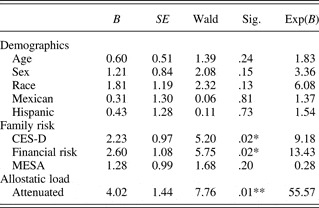
Twenty children (21.5%) in this high-risk sample were above the clinical cutoff for internalizing problems on the CBCL as rated by mothers (n = 8), teachers (n = 7), or both (n = 5). Our full model showed good fit, χ2 (1, 9) = 34.44, p < .001. We entered the demographic controls in Block 1, the family risk variables in Block 2, and attenuated cortisol in Block 3 (see Table 1). None of the demographic variables entered in Block 1 made independent contributions. With the addition of family risk in Block 2, financial strain was predictive of child internalizing symptoms (β = 1.54, p = .04), and there was a trend for maternal depression (β = 1.42, p = .06). In Block 3, with the addition of attenuated cortisol, maternal depression (β = 2.22, p = .02), financial risk (β = 2.60, p = .02), and attenuated cortisol (β = 4.02, p = .005) were all predictive of clinical levels of internalizing symptoms. Forty-six mothers (46%) in our sample reported current depressive symptoms above the clinical cutoff of 16. Thirty-five percent of these women also had a child with internalizing symptoms compared to 7% of children of nondepressed mothers, χ2 (1) = 11.33, p < .001. Looked at another way, 16 (80%) of children with clinical levels of internalizing symptoms also had a mother reporting high levels of current depressive symptoms. Similarly, 14 (70%) of children with internalizing symptoms had also experienced financial strain resulting in the loss of housing or at least one utility, χ2 (1) = 11.10, p < .001. Less striking but also highly significant in the regression model, 35% of children with attenuated cortisol also had internalizing symptoms as compared to 16% of children without attenuated cortisol, χ2 (1) = 3.33, p = .07.
Regression coefficients for demographic, family risk, and allostatic load variables for internalizing symptoms

Note: CES-D, Center for Epidemiological Studies Depression Scale; MESA, Multicultural Events Schedule for Adolescents.
*p < .05. **p < .01.
Externalizing problems
Our a priori hypothesis, based on our previous work and our working hypothesis regarding the role of attenuated cortisol in young children in high stress environments, was that children with more family risk and attenuated cortisol would be at increased risk for early internalizing symptoms. However, previous work sometimes suggests that attenuated cortisol may be a risk factor for externalizing problems and of course externalizing and internalizing symptoms are frequently comorbid. In this sample, eight (40%) of the children with internalizing symptoms also had externalizing symptoms. Therefore, we repeated our above analyses predicting externalizing problems in these same children.
Thirteen children (14%) met clinical criteria for externalizing symptoms according to their mother (n = 5) or their teacher (n = 8). In Block 1 with only demographic controls, boys were more likely to be rated as externalizing (β = −1.52, p = .047). In Block 2, adding maternal depression, financial strain, and whether or not a major stressor was experienced in the past 3 months, child sex continued at the trend level (β = −1.54, p = .05), but no family risk variables made independent contributions. Finally, adding attenuated cortisol in Block 3, child sex continued at the trend level (β = −1.67, p = .07) and attenuated cortisol was statistically significant (β = 2.56, p = .02). Thus, although the overall model fit was acceptable, χ2 (1, 9) = 21.85, p = .01, only attenuated cortisol was clearly related to children's externalizing symptoms with 25% versus 13% of children with attenuated cortisol exhibiting externalizing symptoms. However, controlling for internalizing symptoms, attenuated cortisol no longer predicted externalizing symptoms (β = 1.86, p = .12). Notably, controlling for externalizing symptoms in the model predicting internalizing did not reduce the effect of attenuated cortisol on internalizing symptoms (β = 3.85, p = .02).
Mediation versus preexisting or concurrent risk
Although current theories make the argument that allostatic load is itself one direct mechanism leading to physical and mental health problems, we did not expect attenuated cortisol in early childhood to mediate the effects of family stress on concurrent health outcomes. We hypothesized that in this age range attenuated cortisol would reflect the child's physiologic appraisal of the environment and would be somewhat independent of parent reported stress. However, to test whether attenuated cortisol was serving as a mediator of stress on internalizing symptoms we followed Baron and Kenny (Reference Baron and Kenny1986). Although stress (in this case only financial strain) predicted attenuated cortisol, χ2 (1) = 4.01, p = .04, both financial strain and maternal depression predicted internalizing symptoms (see results above), and attenuated cortisol predicted internalizing symptoms (see results above), the effect of stress on internalizing symptoms was not reduced with the inclusion of attenuated cortisol in the model. This suggests that rather than serving as a causative mechanism or a mediator of stress on internalizing symptoms, attenuated cortisol is a marker of high stress and may even be a preexisting risk factor, perhaps resulting from genetic predispositions or very early stress exposure (prenatal or in the first 2 years of life).
Discussion
The results from Study 1 support our hypothesis that stress within a high-risk sample early in development is associated with HPA axis attenuation. Specifically, the data illustrate that serious financial strain is related to both blunted basal cortisol and attenuated stress reactivity in preschoolers. Previous work has indicated associations between financial strain and both higher (Lupien, King, Meaney, & McEwen, Reference Lupien, King, Meaney and McEwen2001) and lower cortisol (Fernald et al., Reference Fernald, Burke and Gunnar2008) when compared to higher income families. It may be the case that more serious financial strain is associated with blunted cortisol, whereas income that is low but not resulting in interruption of basic services is associated with higher cortisol. Families with average or high income might be most likely to have cortisol levels in the middle (and likely optimal) range. Our children exhibited blunted cortisol including both basal and stress reactive time points; thus, it seems reasonable that this profile would be associated with more serious financial strain. Although we ruled out some confounding factors that might have accounted for attenuated cortisol (asthma, medications, BMI, adoption), we did not assess every factor that could contribute to blunted cortisol; for example, we did not assess prenatal or early postnatal dexamethasone treatment, or stress exposure across the lifetime of the child. Another limitation is that although we did collect basal samples in two contexts, we did not assess the most sensitive time of day (wakeup), which may have revealed an ability to elevate cortisol to meet the challenges of the day although cortisol levels at other times of day were very low.
After controlling for demographic characteristics (age, sex, race, ethnicity, and nativity), financial strain, maternal depression, and cortisol attenuation across all measured time points were associated with higher internalizing symptoms in this sample of preschoolers, although stress exposure in the past 3 months was not. In our working model, children in these high stress environments are experiencing serious financial strain, and also have reduced support because their mothers are experiencing current high levels of depressive symptoms. This combination exposes them to repeated and inescapable stress, and perhaps their hypocortisolism is an adaptation this environment. Accompanying internalizing symptoms fit this interpretation. Alternatively, children with depressed mothers may simply have more internalizing symptoms due to their shared genetic and environmental risk (e.g., Goodman & Gotlib, Reference Goodman and Gotlib1999), and hypocortisolism could be a feature of the child's own depressogenic profile. It is interesting that stress exposure in the past 3 months was not associated significantly with either hypocortisolism or internalizing symptoms. We elected to retain this variable in our model to control the effect of recent stress exposure, as we were more interested in chronic exposure rather than transitory disruptions. However, although the families in our sample were in general very high risk, even for this population the frequency of major life stressors in the past 3 months was quite low. This low prevalence perhaps masked cortisol elevations related to acute stress exposure.
Although a recent meta-analysis (Alink et al., Reference Alink, van IJzendoorn, Bakermans-Kranenburg, Mesman, Juffer and Koot2007) revealed no consistent stress reactive cortisol differences for children with more externalizing symptoms, they did find slightly higher basal cortisol for preschoolers and slightly lower basal cortisol for school-age children with higher externalizing symptoms. In our data, children with attenuated cortisol also were more likely to have clinical levels of externalizing symptoms; however, when we controlled for internalizing symptoms in the model, these finding were accounted for, likely by the high comorbidity between internalizing and externalizing symptoms. In contrast, family risk and attenuation continued to relate to internalizing symptoms when controlling for externalizing symptoms. Thus, attenuated cortisol in these high-risk preschoolers was specifically related to clinical levels of internalizing symptoms. Our lack of association between externalizing symptoms and attenuated cortisol does not inherently contradict the body of work reporting associations between ASPD and low cortisol, including in children at high risk for ASPD (e.g., male offspring of a father with ASPD), as ASPD is quite rare and is only loosely predicted by externalizing symptoms in young children (Widom, Reference Widom, Stoff, Breiling and Maser1997).
Finally, attenuation status did not mediate the relationship between stress and concurrent internalizing symptoms. This lack of mediation will be addressed in the general discussion.
Study 2
Introduction
To further examine the possible connections among stress exposure, attenuated cortisol, and internalizing symptoms, we utilized a community sample of third, sixth, and ninth grade youth initially assessed during a laboratory visit and subsequently followed every 3 months for 1 year. This sample and procedure differed in a number of ways from Study 1. A strength of this study compared to Study 1 is its longitudinal design, allowing an assessment of whether attenuated cortisol serves as a vulnerability for later depressive symptoms. Further, as the children were older we utilized youth and parent reports of stress and symptoms rather than parent and teacher reports. However, a limitation is that in this sample we did not assess basal cortisol, so rather than attempting to characterize children as attenuators versus nonattenuators, we used their mean cortisol level across all samples taken during the lab visit, which included a stress reactivity paradigm.
Method
Participants
Children and adolescents were recruited by letters sent home to families with a child in third, sixth, and ninth grades of public schools. Interested parents called the laboratory and responded to a brief phone screen that established that both the parent and child were fluent in English, and the child did not carry an autism spectrum or psychotic disorder and had an IQ of >70.
Participants were 166 youth ranging in age from 9 to 15 years (M = 11.4, SD = 2.27). The sample was approximately evenly divided by sex (boys: 44%, girls: 56%) and grade (41% third grade, 28% sixth grade, 31% ninth grade). Ethnicity was as follows: Caucasian: 68%, African American: 22%, Latino: 5%, Asian/Pacific Islander: 3%, other/mixed race: 2%. Sex and ethnicity did not differ and were approximately evenly distributed across grades. Parents of the youth were predominantly mothers (87%), and 72% were married, 10% single, 17% divorced or separated, and 1% widowed. Median annual parental income was $74,000 (range = $10,000–$200,000), and 21% of the youth received free/reduced lunch at school.
Measures
Depressive symptoms
The Children's Depression Inventory (CDI; Kovacs, Reference Kovacs1985) assessed youths' depressive symptoms. Both the child (CDI-C) and parent (CDI-P) reported on the child's level of depressive symptoms to enable multiple informants of depression, consistent with Rutter's (Reference Rutter2005) recommendation for rigorous developmental psychopathology methods. CDI-C and CDI-P were given at all five assessments. CDI-C and CDI-P scores were moderately correlated (rs = .34 to .44, ps < .001), so they were standardized and averaged together to form an overall depressive symptoms score at each wave. The CDI has good reliability and validity (Klein, Dougherty, & Olino, Reference Klein, Dougherty and Olino2005). Internal consistency (α) was above 0.80 at all waves. The range of CDI scores from this sample (child report: mean CDI = 6.54, SD = 5.3, range = 0–35; parent report: mean CDI = 5.76, SD = 5.8, range = 0–23) was comparable to published norms (Kovacs, Reference Kovacs1985) and prior research with general community samples (Petersen et al., Reference Petersen, Compas, Brooks-Gunn, Stemmler, Ey and Grant1993). Using recommended clinical cutoffs for the CDI revealed that 12.4% of youth-report and 9.8% of parent report were above cut scores for the CDI.
The Beck Depression Inventory—II (BDI-II; Beck, Steer, & Brown, Reference Beck, Steer and Brown1996), assessed levels of depressive symptoms with 21 items that are rated on a scale from 0 to 3, with scores ranging from 0 to 63. Higher scores reflect more depressive symptoms. Parents completed the BDI-II at baseline. The BDI-II is a reliable and well-validated measure of depressive symptomatology (Beck et al., Reference Beck, Steer and Brown1996), although it does not enable clinical diagnoses of depression. The coefficient α for the BDI-II was 0.87. Using recommended clinical cutoffs for the BDI-II showed that 28.2% of parents were above cut-scores.
Family stress
The Adolescent Life Events Questionnaire (ALEQ; Hankin & Abramson, Reference Hankin and Abramson2002) consists of 37 items that assess the number of stressors occurring within the past 3 months. The ALEQ assesses a broad range of negative life events that typically occur among adolescents, including school, friendship, romantic, and family events ranging from mild to severe. Respondents indicated whether the event occurred within the past 3 months, such that ALEQ scores are best considered as a count of stressors over the last 3 months. Unlike many other self-report stress checklists, the ALEQ includes concrete, specific anchors, and descriptions of events, rather than overly general subjective event descriptions. Based on methodological recommendations for assessing stress and adversity (e.g., Brewin, Andrews, & Gotlib, Reference Brewin, Andrews and Gotlib1993), this approach should reduce overreporting of trivial events or misinterpretation of events due to personality, mood, or memory bias. Both the child (ALEQ-C) and parent (ALEQ-P) reported on the child's exposure to stressors by indicating whether or not a stressor occurred within the last 3 months. ALEQ-C and ALEQ-P were given at all five assessments. ALEQ-C and ALEQ-P scores were moderately correlated (rs = .37 to .41, ps < .001), so they were standardized and averaged together to form an overall score at each wave. Scores for ALEQ-C ranged from 0 to 35 (M = 16.5, SD = 7.5), and ALEQ-P scores ranged from 2 to 37 (M = 17.2, SD = 7.3). The ALEQ has demonstrated good validity in past research (Hankin, Stone, & Wright, Reference Hankin, Stone and Wright2010). In addition, validity of the ALEQ is supported by significant correlations with objective ratings of episodic stressors (r = .44, p < .001) from the contextual stress interview (Rudolph & Flynn, Reference Rudolph and Flynn2007).
The contextual stress interview for this study was a semistructured interview adapted from Rudolph and Hammen's (Reference Rudolph and Hammen1999) Child Episodic Life-Stress Interview. Children and adolescents were asked to report on their experience of stressful life events during their lifetime. In addition to a general probe about stressors, inquiries about the following specific domains of stress were made: behavioral, peer, parent–child, adult marital, romantic, household, academic, body image, health of self, health of important others, financial, neighborhood, discrimination, and activities. Information gathered from this interview includes both the chronicity and severity of a given domain. Severity scores could range from 0 to 3, where 0 = little/none or average, 1 = moderate, 2 = serious, and 3 = severe. Chronicity scores could range from 1 to 3 where 1 = less than 6 months, 2 = 6 months to a year, and 3 = greater than 1 year. For each domain, the severity and chronicity scores were multiplied to create a stress score for that specific domain. Finally, all 14 domains were summed to create an overall chronic stress score.
Stress paradigm
The stress paradigm was structured around a 15- to 20-min psychosocial challenge. This included a 5- to 10-min parent–child discussion concerning a recent fight or argument. Then, youth auditioned for a “reality TV show” by giving a speech directly into a video camera while their parent watched; youth were instructed that judges would evaluate their performance. As there is no current consensus on stress/challenge paradigms that elicit cortisol reactivity across different ages (Gunnar, Talge, & Herrera, Reference Gunnar, Talge and Herrera2009), we selected this laboratory challenge task as it was likely to be developmentally appropriate across third, sixth, and ninth graders, and it involved the essential elements (e.g., threat of social rejection and social evaluation, anticipatory and processive stress) known to activate cortisol response across the life span (Lupien, McEwen, Gunnar, & Heim, Reference Lupien, McEwen, Gunnar and Heim2009).
Procedures
The parent and youth visited the laboratory for the baseline assessment. The initial baseline assessment consisted of a battery of questionnaires completed by youth and parents about the child, diagnostic interviewing, and collection of youth cortisol via saliva (synthetic salivette without the use of stimulants). Parents provided informed written consent for their participation and for their child; youth provided written assent. After an hour in the laboratory where the youth completed questionnaires and interviews, the pair completed the stress paradigm. For 45 min after the challenge, youth quietly completed additional questionnaires. Youth were debriefed at the end of the lab visit. On average, the majority of the first cortisol samples were collected at 5 p.m. after the family had been in the lab for 1 hr (range = 4 p.m. to 6:30 p.m.). Subsequent samples were taken every 15 min, at 75, 90, 105, and 120 min after arrival. Cortisol sample collection, preparation, storage, assay procedures, and coefficients of variation were identical to that of Study 1 as samples were analyzed together. Contextual stress interviewing occurred over the phone within 1 week after the baseline laboratory visit. Regular follow-up assessments over the phone with parent and youth occurred every 3 months over a 1-year period (five waves of data) to assess stressors and symptoms. The Institutional Review Board approved all procedures. Youth and parents were each reimbursed $30 for participation at baseline and $10 for each follow-up.
Assessment of depression and diagnostic interviews
Mothers and youth were interviewed separately with the Kiddie Schedule for Affective Disorders and Schizophrenia (K-SADS; Kaufman et al., Reference Kaufman, Birmaher, Brent, Rao, Flynn and Moreci1997a). Of the total sample, 3% of youth met criteria for current clinical depressive disorder and 16% for past disorder; none met criteria for any bipolar or psychotic disorder. Diagnostic interviewers, who all had a minimum of a bachelors degree and most were advanced graduate students in clinical psychology, completed an intensive training program for administering the K-SADS interview and for assigning DSM-IV diagnoses. The training program consisted of attending a minimum of 40 hr of didactic instruction, listening to audiotaped interviews, and conducting practice interviews. One author (B.L.H.) held weekly supervision sessions for the interviewers and reviewed interviewers' notes and tapes in order to confirm the presence or absence of a diagnosis. To assess interrater reliability, an independent trained rater who was blind to parent or child diagnostic status, randomly evaluated 20% of the K-SADS interviews. Reliability was good (κ = 0.87), and presence/absence of current major depressive disorder in youth was confirmed.
Results
Preliminary analyses
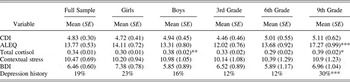
Table 2 shows descriptive statistics, as an average across time and across informants, for the whole sample and by grade and sex. No sex differences were observed for CDI, ALEQ, BDI, contextual stress levels, or depression history. Grade differences were noted for stressors and depressive disorder such that older youth reported more stressors on average over time and greater history of prior clinical depression. Total cortisol level was created as the average of the five cortisol assessments taken across the laboratory visit. As seen in Table 2, significant sex and grade differences were observed. Boys' exhibited higher overall cortisol levels compared with girls, and ninth graders had higher overall cortisol levels than sixth or third graders.
Descriptive statistics overall and by sex and grade group

Note: CDI, Children's Depression Inventory; ALEQ, Adolescent Life Events Questionnaires; BDI, Beck Depression Inventory. CDI and ALEQ are composites of parent and child report and are averaged across the five time points. Chronic stress is a combination of severity and chronicity ratings for all stress domains.
*p < .05. **p < .01. *** p < .001.
Cortisol level, parent depression, youth depression, and chronic stress associations
We used a chronic stress variable composed of the domains of peer and parent–child conflict and financial strain (excluded domains not overlapping with Study 1) to examine correlations among cortisol level, chronic stress, youths' depressive symptoms, and parental depressive symptoms. Average cortisol levels across the laboratory visit were negatively correlated with contextual stress (r = −.14, p < .05) and positively correlated with parental depressive symptoms as measured by the BDI (r = .17, p < .05). Youths' baseline depressive symptoms were positively correlated with greater stress (r = .38, p < .001) and parental depressive symptoms (r = .39, p < .001) and negatively correlated with average cortisol levels (r = −.18, p < .05). We then proceeded to longitudinal analyses aimed at investigating whether lower cortisol levels might reduce youths' efficacy at responding optimally to ongoing stressors and eventuate in elevated levels of depressive symptoms over time.
Statistical approach: Longitudinal analysis of cortisol, stress, and symptoms
Hierarchical linear modeling (HLM 5.04; Raudenbush, Bryk, & Congdon, Reference Raudenbush, Bryk and Congdon2001) was used to investigate the primary hypothesis that lower total cortisol level would interact with stressors assessed over time to predict elevations in depressive symptoms over the 1-year follow-up. Depressive symptoms at Time T served as the dependent variable in the hierarchical linear modeling analysis, and stressors at Time T were included in Level 1 as a time-varying covariate. Total cortisol level from the baseline assessment (Time 1) was entered at Level 2 as a main effect and as a cross-level interaction with within-person stressors. This analysis tests the hypothesis that total cortisol level moderates the association over time between stressors and depressive symptoms. We hypothesized that cortisol reactivity, as a physiological marker of allostatic load, would interact with greater exposure to stressors over time to predict depressive symptoms. In addition, in various models, we included other important etiological influences in Level 2, including parental depressive symptoms (BDI), youth history of clinical depression (K-SADS lifetime diagnosis of depression), and chronic stress levels (contextual stress ratings).
Hypocortisolism interacts with stressors to predict depressive symptoms
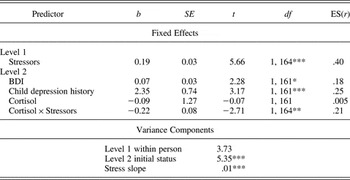
Lower levels of average cortisol interacted with greater stress exposure across the five time points over 1 year to predict elevations in depressive symptoms over time. This cross-level interaction between cortisol reactivity and stressors predicting depressive symptoms was found when parental depressive symptoms was entered, when youths' history of clinical depression and parental depressive symptoms were entered, and when youths' chronic stress, youths' lifetime clinical depression, and parental depressive symptoms were controlled (see Table 3). As expected, these etiological covariates (BDI, youths' lifetime clinical depression, and chronic stress levels) were all associated with greater levels of youth depressive symptoms. Thus, support was obtained for our biological vulnerability to stress hypothesis but not for the mediation hypothesis because parental depressive symptoms and youth stress levels were maintained as significant predictors of depressive symptoms when cortisol levels were included in the model.
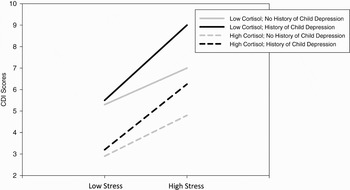
Baseline Cortisol Level × Prospective Stressors interaction predicted elevated depressive symptoms over 1 year

Note: BDI, Beck Depression Inventory; ES(r), effect size r.
*p < .05. **p < .01. ***p < .001.
This Cortisol × Stress interaction effect is shown in Figure 2 with stressors depicted at 1 SD above and below the mean for ALEQ scores for the final model with all covariates entered (bottom portion of Table 3). Youth with lower total cortisol levels who experienced more stressors over time exhibited the highest elevations in depressive symptoms. Figure 2 also shows that youth with a history of clinical depression reported higher baseline levels of depressive symptoms, as would be expected, and that the Cortisol × Stress interaction holds within both groups of depression (i.e., present and absent prior depression).
Increasing CDI scores as a function of previous low cortisol and stress exposure in third, sixth, and ninth graders.

Discussion
In Study 2 we assessed whether we could extend our findings from Study 1 on the relationship between stress, cortisol attenuation, and internalizing to a longitudinal investigation with a community sample of older children. Looking first at the concurrent assessments taken at Time 1, experienced stress was associated with lower cortisol across a laboratory stress paradigm, whereas maternal depression was associated with higher cortisol across the lab visit. Child stress, maternal depression and lower cortisol levels were all associated with elevated depressive symptoms in these youth. These results parallel those from Study 1, except that for these older children maternal depression was predictive of elevated, not lowered cortisol. The fact that those children and youth who exhibited low cortisol to the lab stressor at time 1 and who subsequently experienced more stressors in the following year showed the greatest elevations in depressive symptoms suggests that the underactivation at Time 1 may be a marker of risk.
General Discussion
The results from these two studies provide evidence that hypocortisolism in children is associated with both family risk and internalizing symptoms. The results from Study 1 suggest that hypocortisolism can be found in early childhood, at least for children experiencing high-risk environments. With this sample we were able to classify children as exhibiting attenuated cortisol across the day in two environments and across a stress paradigm with two caregivers. Although the cutoff we selected was arbitrary (<0.10 µg/dl at all time points), it captured 15% (or 1.5 SD) of the children studied, and as illustrated in Figure 1, these children are markedly different from their peers who showed a normal diurnal decline across the day (high levels in the morning) and both reactivity and recovery to the stress paradigm. We are currently in the process of an 18-month follow-up study with these attenuated children and a matched group of nonattenuators selected from the same sample to investigate (among other things) whether they show a normal cortisol awakening response and bedtime decline. Although the midmorning and midafternoon data presented here are suggestive, a lack of a cortisol awakening response would provide definitive evidence of attenuation. We are also collecting data on prenatal or early postnatal exposure to synthetic glucocorticoids to address this possible confound. However, we were able to rule out BMI, asthma, medications, chronic health conditions, and adoption status.
Although we continue to pursue the question of the causes, correlates, and outcomes of true attenuation in early childhood, data from Study 2 suggests that low cortisol relative to one's peers may be a vulnerability for the development of depressive symptoms even in the absence of full attenuation. Despite the rich literature documenting hypercortisolemia in adults with depression, including data indicating that hypercortisolemia precedes major depressive episodes (Holsboer, Reference Holsboer2001) and remediates with successful antidepressant treatment (Holsboer & Barden, Reference Holsboer and Barden1996), relations between cortisol and internalizing symptoms in prepubertal children have been surprisingly understudied. Adolescents with depression have been shown to have higher cortisol much like in the adult literature (Dahl et al., Reference Dahl, Ryan, Puig-Antich, Nguyen, Al-Shabbout and Meyer1991). However, our data suggest that risk for depression prior to puberty, especially in the context of environmental stress, may be associated with hypocortisolism. Using cross-sectional data we have reported pre- to postpubertal differences in the relation between cortisol and internalizing symptoms (Hankin et al., Reference Hankin, Badanes, Abela and Watamura2010). Specifically, in prepubertal children low cortisol was associated with internalizing symptoms while high cortisol was associated with internalizing symptoms in postpubertal children. We are currently following the children from Study 2 and will be able to longitudinally assess whether hypocortisolism prepuberty switches to hypercortisolism postpuberty as suggested by the cross-age comparisons.
The association between low cortisol and internalizing symptoms in children raises the question of how to conceptualize HPA axis dysregulation as a marker of allostatic load in childhood. The prevailing view is that depression results from the interaction of predisposing risk factors (genetic and environmental) and stress exposure over time. The consistent association of high cortisol with depressive symptoms in adults (Thase, Jindal, & Howland, Reference Thase, Jindal, Howland, Gotlib and Hammen2002) further suggests that the way individuals with depression manage stress physiologically is important. This leads naturally to the question of whether hyperreactive stress responsivity may be a mechanism contributing to risk for major depression via central and peripheral changes accruing over time because of these repeated exaggerated stress responses. This would fit with a classic allostatic load model, and of course decades of research has elucidated exactly how HPA axis activation results in accumulated wear and tear on the body (McEwen, Reference McEwen1998). However, our work suggests that, at least in childhood, hypocortisolism, not hypercortisolism, is associated with both early family stress and clinical levels of internalizing symptoms. We also find the postpubertal association between high cortisol and internalizing symptoms reported by others (e.g., Burke, Davis, Otte, & Mohr, Reference Burke, Davis, Otte and Mohr2005). Therefore, we suggest that hypocortisolism may switch postpuberty to a hyperreactive profile. If our finding is replicated, particularly with longitudinal assessments of cortisol across development, it would suggest a more complicated trajectory for children in high-stress environments at risk for depression. Although this more complicated picture will require careful attention to methods and analytic techniques, it is exciting to have a new window on the complexity inherent to how children manage the multiple internal and contextual demands they face, and in how differences in this interplay might reflect trajectories toward adaptive and maladaptive outcomes. We argue based on these data that hypocortisolism in childhood should be evaluated as one marker of allostatic load. Of course, work with adults and children suggests that allostatic load is best assessed with indicators from multiple systems, including cardiovascular, metabolic, immunologic, and stress response systems (Evans, Kim, Ting, Tesher, & Shannis, Reference Evans, Kim, Ting, Tesher and Shannis2007). Although we did not include additional markers of allostatic load in these studies, we hope that this work will support inclusion of hypocortisolism in cumulative indices of allostatic load, at least in children.
In both studies, maternal depression was an important independent predictor of child internalizing symptoms as has been reported by a number of authors (Beardslee et al., Reference Beardslee, Versage and Gladstone1998). In Study 1, 80% of young children with clinical levels of internalizing symptoms also had a mother with current depressive symptoms. Of importance, in both samples, multiple informants were used. Therefore, whether or not children were classified as internalizing was not simply driven by mother's depressive symptoms. For example in Study 1, 60% of the children classified as internalizing were rated as such by their teachers.
For the children and youth in both studies there appeared to be a particular constellation of environmental stress exposure, maternal depression, and low cortisol that together predicted increased risk for symptoms of internalizing disorders. Perhaps this constellation operates transactionally and accumulates over time, consistent with a developmental cascade model (e.g., Hankin et al., Reference Hankin, Badanes, Abela and Watamura2010; Masten et al., Reference Masten, Roisman, Long, Burt, Obradovic and Riley2005) and increasingly disposes children and youth with these risk factors toward depression.
It is also common to both studies, although more appropriately tested in Study 2 due to its longitudinal nature, that hypocortisolism did not mediate the effects of stress on internalizing symptoms. We tested for mediation to examine whether our data supported the idea that hypocortisolism might serve as a mechanism (although not yet explicated) through which stress leads to internalizing symptoms. We did not expect mediation and did not find any indication of it. Rather, in both studies the unique effects of the stressors we measured were as strong or stronger when the effect of hypocortisolism was included. We suggest that rather than serving as a mechanism, hypocortisolism is an important marker of the child's internal representation of the chronic stressfulness of their environment and their inability to actively manage that stress. As such, hypocortisolism provides an important indicator above and beyond reported stress exposure. Alternatively, hypocortisolism could be a preexisting vulnerability (possibly the result of genetic or early environmental factors) that makes it difficult for the child to actively cope with the stressors they experience. Without that physiologic support to manage stress, the child may be more likely to develop depressive symptoms through the repeated experience of failing to manage stress appropriately.
An open question is why the children in these two studies exhibited low cortisol, whereas work with maltreated children has demonstrated higher cortisol, particularly in maltreated children with depressive symptoms (Hart, Gunnar, & Cicchetti, Reference Hart, Gunnar and Cicchetti1996; Kaufman et al., Reference Kaufman, Birmaher, Perel, Dahl, Moreci and Nelson1997b). Unfortunately, we did not assess maltreatment history in our studies. Of interest, much of the neuroendocrine work with maltreated children has been conducted in the novel and supportive environment of camp or in foster care. In our data, we see greater risk for internalizing symptoms for children who have low cortisol assessed at home, at child care, and to a stress manipulation in the presence of their regular caregivers. We do not know whether these same children would show higher cortisol in a novel and more supportive environment without their caregivers, and we are not aware of any published work with maltreated children examining cortisol in the presence of the maltreating caregiver. Thus, although we cannot address this speculation, it could be that the downregulation we report is directly related to the context in which we assessed cortisol, namely, in the child's typical environments (or in the lab with their primary caregivers). These environments and caregiving relationships are characterized by higher stress and maternal depression. In support of this speculation, Fernald et al. (Reference Fernald, Burke and Gunnar2008) found lower cortisol in Mexican children exposed to extreme poverty when assessed during a home visit.
Although necessarily preliminary, these data suggest some implications for prevention and intervention. Whether low cortisol is a predisposing factor or an outcome of stress exposure, teaching adaptive coping strategies may be a useful intervention for children with the constellation of low cortisol, maternal depression, and high-stress exposure. They also suggest that prevention and intervention approaches may benefit from assessing basal and stress reactive cortisol to determine whether children are approaching challenge with an under- versus an overactivation style. When considered in light of the possibility of a pre- to postpubertal switch in stress reactivity, these data suggest that youth transitioning across puberty may be particularly in need of support in developing appropriate skills for engaging safely but effectively with a high-stress environment, and that including physiologic assessments in prevention and intervention efforts will help inform and tailor these approaches.
Both studies suffer from some limitations. Most notably for this issue on allostatic load only one physiologic system is assessed. This leaves open the important questions of how psychopathology risk is differentially affected by alternative cumulative and interactive profiles across systems. Further, although there were many similarities across Study 1 and Study 2, we were not able to analyze the data together, and each study had its particular limitations (Study 1 was a single time point and Study 2 did not include basal cortisol). Both studies are hampered by the inability to rule out some possible nonpsychosocial reasons for hypocortisolemia, including prenatal or early postnatal glucocorticoid exposure, and both studies are unable to assess the possible role of maltreatment.
The data presented here and in Hankin et al. (Reference Hankin, Badanes, Abela and Watamura2010), suggest that hypocortisolism may not always be an end state, but rather may sometimes be a malleable indicator of risk. This is an important reminder of the dynamic and context-dependent nature of stress-system activity and of the fact that the adaptive goals for an individual are likely not achieved in the same way irrespective of the environment.