Introduction
The number of people living with dementia is expected to grow by approximately 40% in the next decade to reach 75 million individuals worldwide (Alzheimer's Disease International, 2015). The World Health Organization (2020) has ranked dementia as the third leading cause of death in Western countries. Currently, one in three seniors in North America dies with dementia (Canadian Academy of Health Sciences, 2019; Alzheimer's Association, 2020). Although most people living with dementia would prefer to die at home (Wiggins et al., Reference Wiggins, Droney and Mohammed2019), about two thirds die in long-term care (LTC) facilities (Mitchell et al., Reference Mitchell, Teno and Miller2005; Reyniers et al., Reference Reyniers, Deliens and Pasman2015). Ensuring optimal quality of dying for LTC residents with dementia is a health priority for many countries (Kane, Reference Kane2012; Livingston et al., Reference Livingston, Sommerlad and Orgeta2017; Estabrooks et al., Reference Estabrooks, Straus and Flood2020) and really important to family members (De Roo et al., Reference De Roo, van der Steen and Galindo Garre2014; Vandervoort et al., Reference Vandervoort, Houttekier and Vander Stichele2014; Bolt et al., Reference Bolt, Verbeek and Meijers2019b).
There is a lack of consistency and clarity in the literature regarding the quality-of-dying construct due, in part, to it being a subjective experience of the person facing the process of dying (Patrick et al., Reference Patrick, Engelberg and Curtis2001). A systematic review by Hales et al. (Reference Hales, Zimmermann and Rodin2008) identified seven broad dimensions that are consistently reported by patients, families, and healthcare providers as being central to capturing the quality of dying; these are (1) physical, (2) psychological, (3) social, (4) spiritual and existential experience; (5) the nature of healthcare; (6) life closure and death preparation; and (7) the circumstances of death. Standardized and validated instruments have been used to evaluate the quality of dying in various care settings (Hales et al., Reference Hales, Zimmermann and Rodin2010; De Roo et al., Reference De Roo, Albers and Deliens2015; Gutiérrez Sánchez et al., Reference Gutiérrez Sánchez, Pérez Cruzado and Cuesta-Vargas2018), and more specifically at the end of life of people living with dementia (Volicer et al., Reference Volicer, Hurley and Blasi2001), reflecting the wide range of measures used to capture this concept. In late-stage dementia, when LTC residents typically lack the ability to communicate, the quality of dying is most often assessed by family members (van Soest-Poortvliet et al., Reference van Soest-Poortvliet, van der Steen and Zimmerman2011), given their major involvement in healthcare decision-making at the end of their relative's life (Shanley et al., Reference Shanley, Fetherstonhaugh and McAuliffe2017).
Having a high-quality dying experience is universally regarded as a goal at the end of life. Freedom from pain and suffering is considered an important dimension by patients, families, and healthcare practitioners across a wide range of care settings (Steinhauser et al., Reference Steinhauser, Clipp and McNeilly2000; Meier et al., Reference Meier, Gallegos and Thomas2016; Krikorian et al., Reference Krikorian, Maldonado and Pastrana2019). However, studies have shown that nearly half of LTC residents with dementia do not die peacefully, according to family members (De Roo et al., Reference De Roo, van der Steen and Galindo Garre2014, Reference De Roo, Albers and Deliens2015), an indicator of poor quality dying. Family assessments of the quality of dying relate to symptoms experienced by the resident in the last weeks of life. In a study by De Roo et al. (Reference De Roo, Albers and Deliens2015), dying peacefully, as judged by family members, was more prevalent among residents who exhibited less discomfort, restlessness, and choking in the last week of life, as well as less psychological distress (e.g., anxiety, depression, and agitation) in the last month of life. However, according to some studies, many residents with dementia suffer in their last weeks of life (Vandervoort et al., Reference Vandervoort, Van den Block and van der Steen2013; Pivodic et al., Reference Pivodic, Smets and van den Noortgate2018), despite efforts by healthcare providers to minimize suffering and discomfort (Aminoff and Adunsky, Reference Aminoff and Adunsky2005; van der Steen, Reference van der Steen2010).
The family's perception of the quality of communication with the healthcare team is another factor that has been shown to influence their assessment of the quality of dying (Patrick, Reference Patrick2003; Yamaguchi et al., Reference Yamaguchi, Maeda and Hatano2017). For example, Lee et al. (Reference Lee, Sussman and Kaasalainen2020) explored the relationship between families’ perceptions of end-of-life care in LTC and a good resident death, an indicator of the quality of dying. Their findings suggest that good communication between family members and the healthcare team has an important impact on families’ perceptions of a good death. Bolt et al. (Reference Bolt, Verbeek and Meijers2019b) recently explored family caregivers’ unpleasant experiences with end-of-life care, specifically involving LTC residents with dementia, and the extent to which these experiences affected their assessments of the quality of dying. In qualitative interviews, family members reported that healthcare professionals often did not inform them about the process of dying or the care provided, which negatively affected their assessments of the quality of dying.
Despite the paucity of research in this area, current studies suggest that symptoms present at the end of life as well as the quality of communication with the healthcare team both impact families’ perceptions of the quality of dying of their relative with dementia. However, to our knowledge, no study has yet investigated the relative weights of these two factors in family assessments. Assuming that families’ grief might be affected by their experience during the final days of their relative's life (Arruda and Paun, Reference Arruda and Paun2016), there is a need to determine which of these two factors has a greater impact on family assessments of the quality of dying of LTC residents with dementia. This knowledge could be used to prioritize interventions most likely to improve the experience for family members visiting a loved one at the end of life and thus ease their grieving process.
This study thus sought to determine the relative contributions of two factors known to influence the quality of dying of LTC residents with dementia — the frequency of symptoms they experience at the end of life and the quality of communication with the healthcare team — to family perceptions of the quality of dying.
Methods
Study design and population
This is a secondary analysis of data collected as part of a mortality follow-back study, which has been described in more detail elsewhere (Bravo et al., Reference Bravo, Arcand and Wilchesky2021). Briefly, the study was conducted within the Quebec Observatory on End-of-Life Care for People with Dementia, with prior approval from the Research Ethics Board (REB) of the CIUSSS de l'Estrie — CHUS (reference # MP-22-2016-576). The study aimed to describe LTC residents who had died in the context of dementia, the quality of the care they had received toward the end of life, and the quality of dying. The mortality follow-back study involved 13 LTC facilities in 3 of the largest cities in the province of Quebec, Canada. Following the death of a resident, a designated staff member from each facility was responsible for determining whether the decedent met the following inclusion criteria: (1) had received a clinical diagnosis of dementia, (2) had been admitted to the facility at least 30 days prior to death, (3) had spent at least 15 of the last 30 days of life in the facility, (4) had either died in the facility or spent no more than 3 days before their death in an acute care setting, and (5) had been visited at least once during the week preceding death by a close relative known to the facility. The mortality follow-back study ran from April 2016 to March 2018. A total of 172 eligible residents were enrolled during that period.
Data collection
The data used in this paper came from two sources. The first was the resident's medical chart from which an experienced research assistant extracted demographic and clinical information (e.g., gender, type of dementia, and age at death). The second source was a paper questionnaire mailed to the family member who visited the resident most often during the last week of life according to the designated staff member. The questionnaire was mailed 1 month after the resident's death followed by a thank you/reminder postcard two weeks later. The questionnaire comprised three main sections. The section “Introduction” collected information about the respondents themselves (e.g., gender, relationship to resident, and number of visits in the month preceding death), while the section “Methods” focused on the deceased residents (e.g., persons present at their death). The section “Results” included two standardized tools, i.e., Symptom Management (SM) (Volicer et al., Reference Volicer, Hurley and Blasi2001) and Family Perceptions of Physician-Family Caregiver Communication (FPPFC) (Biola et al., Reference Biola, Sloane and Williams2007), used to measure respondents’ perceptions of the frequency of symptoms experienced by the resident at the end of life and the quality of communication with the healthcare team. Of the 172 residents enrolled in the mortality follow-back study, a designated family member returned the questionnaire for 95 of them for a response rate of 55%. One respondent did not answer the question used to measure the dependent variable (described below). Consequently, the analysis was based on an effective sample size of 94 residents.
Variables and measures
Dependent variable: quality of dying
In the “Results” section of the questionnaire, relatives were asked: “Today, how would you describe the conditions of your loved one's death?” Responses were provided on a 4-point Likert scale ranging from very good to very poor, with the option of checking “I would rather not give an opinion”. For analysis purposes, we dichotomized the 4-level quality score and modeled very good quality of dying as our dependent variable (i.e., as compared with the other rating scores).
Independent variables
The SM scale (Volicer et al., Reference Volicer, Hurley and Blasi2001) was used to capture the resident's symptomatology at the end of life. This scale quantifies the frequency of physical or psychological signs of distress (e.g., shortness of breath, agitation, and resistance to care) exhibited by the resident in the month before death. Frequency is quantified on a 6-point Likert scale ranging from 0 (daily) to 5 (never). Summing ratings on individual items generates a total score ranging from 0 to 45, with higher scores indicating better symptom control. In this sample, Cronbach's alpha was good (α = 0.74).
For the same time window, the FPPFC scale (Biola et al., Reference Biola, Sloane and Williams2007) was used to assess family members’ perceptions of the quality of communication with the healthcare team (e.g., family was kept informed, received information about what to expect, and had the opportunity to ask questions) in the month preceding the resident's death. This scale consists of seven items, each scored on a 4-point Likert scale from 0 (strongly disagree) to 3 (strongly agree). Total scores range from 0 to 21, with higher scores indicating better perceived quality of communication. Internal consistency of the FPPFC was high (α = 0.93). In the present study, the word “physician” was replaced by “healthcare team” in all seven items.
Demographic variables included the resident's gender, age at death, type of dementia, and the respondent's age. Other demographic information, such as respondent's gender, relationship to deceased resident, and number of visits to the resident during the last month of life, were used for descriptive purposes and as control variables. These variables have been used as controls in other studies exploring informal caregivers’ perceptions of a peaceful (De Roo et al., Reference De Roo, Albers and Deliens2015; Bolt et al., Reference Bolt, Verbeek and Meijers2019b) or good resident death (Lee et al., Reference Lee, Sussman and Kaasalainen2020). Whether the respondent was present at the time of death was also included as a potential confounder, based on previous findings that this may affect how family members define and assess the quality of end-of-life care and the quality of dying (Granda-Cameron and Houldin, Reference Granda-Cameron and Houldin2012; Beckstrand et al., Reference Beckstrand, Hadley and Luthy2017).
Statistical analyses
Means ± standard errors or absolute frequencies (percentages) were used to describe the characteristics of the deceased residents and relatives. Since the outcome (quality of dying) was binary (very good versus not very good), logistic regression analyses were performed to investigate its association with the main independent variables (frequency of symptoms and quality of communication with the healthcare team). First, a univariate analysis was performed to estimate the separate effect of each potential predictor. Second, we conducted a multivariate logistic regression analysis to determine the relative contributions of the two main independent variables after controlling for potential confounders (four of the respondents’ sociodemographic characteristics). Interpretation was based on an alpha value of 0.05. Results are reported using odds ratios (ORs) and 95% confidence intervals (CIs). All analyses were conducted with IBM SPSS Statistics Version 25 and considered the clustering of residents within facilities.
Results
Description of the sample
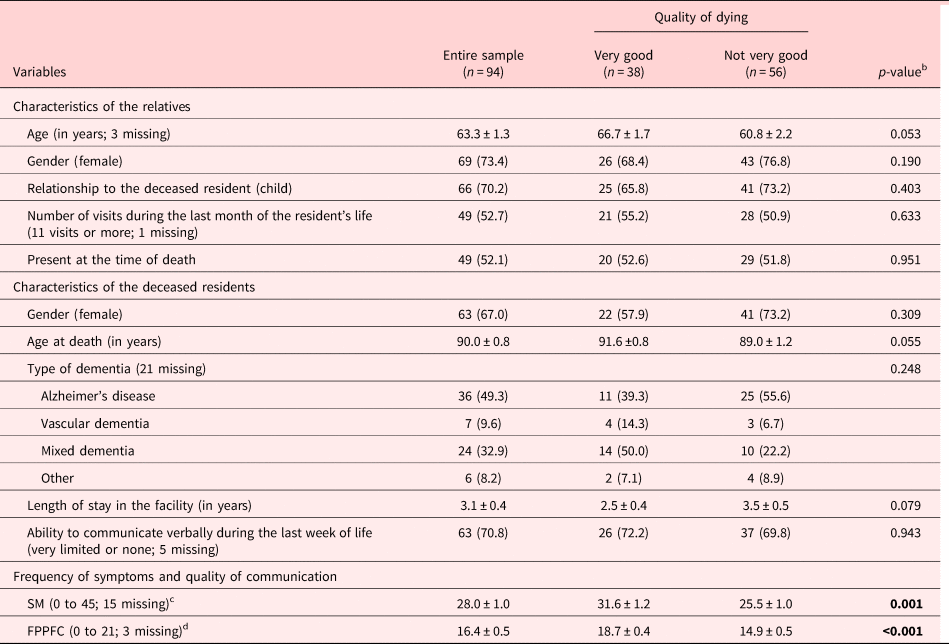
Characteristics of the relatives and residents are summarized in Table 1 and compared according to whether the relative rated the quality of dying of the resident as very good or not. The majority (73%) of family respondents were female and children of the residents (70%). Just over half of the respondents had visited the deceased resident more than 10 times before their death, and 52% were present at the time of death. The deceased residents were mostly female (67%), and 49% had Alzheimer's disease according to their medical file. The residents’ mean age at death was 90 years. Additional demographic information on relatives and residents can be found in Bravo et al. (Reference Bravo, Arcand and Wilchesky2021).
Characteristics of the sample and study variablesa

a Data reported as mean ± standard error of the mean or frequency with percentage in parentheses.
b Derived from a two-sample t-test or the χ 2 statistic.
c Higher scores reflect a perception of better SM.
d Higher scores indicate a greater perceived quality of communication.
The bold values indicates the significance of p < 0.05.
As shown in Table 1, none of the characteristics of the relatives or residents were significantly related to the relatives’ ratings of the quality of dying, although the ages of the relatives and residents were marginally significant. On the other hand, the two independent variables of primary interest (frequency of symptoms and quality of communication) clearly distinguish between the two subgroups of relatives, with both p-values being smaller than 0.001. Relatives who rated the quality of dying of their loved one as very good considered both SM and the quality of communication significantly better than those who did not.
Association of the frequency of symptoms and the quality of communication with the quality of dying
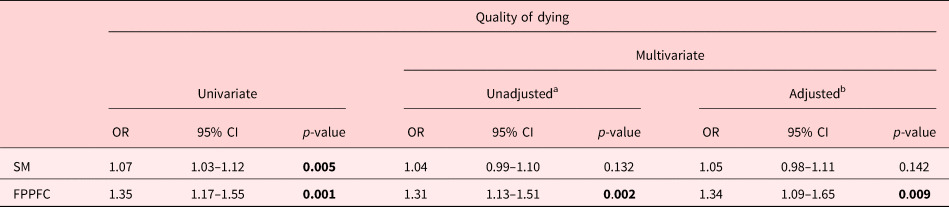
Table 2 presents the results from the univariate and multivariate logistic regression analyses. As in Table 1, univariate analysis revealed that the frequency of symptoms (OR: 1.07; 95% CI = 1.03–1.21; p = 0.005) and the quality of communication (OR: 1.35; 95% CI = 1.17–1.55; p = 0.001) were both associated with the quality of dying. However, when including both independent variables in a single model without further adjustment (multivariate, unadjusted results), the quality of communication was significantly associated with the outcome (OR: 1.31; 95% CI = 1.13–1.51; p = 0.002), while the SM was not (OR: 1.04; 95% CI = 0.99–1.10; p = 0.131). After adjusting for potential confounding variables, the quality of communication remained significant (OR: 1.34; 95% CI = 1.09–1.65; p = 0.009). We also tested the model by including the ages of relatives and residents since these variables were marginally significant between the two subgroups. However, since they did not contribute to the model, these variables were not retained.
Associations between the frequency of symptoms, quality of communication, and the quality of dying (n = 78)

SM, symptom management; FPPFC, Family Perceptions of Physician-Family Caregiver Communication; OR, odds ratio; CI, confidence interval.
a Only SM and FPPFC included as independent variables.
b Adjusted for four socio-demographic characteristics of the relatives: Gender, relationship to the deceased resident, number of visits during the last month of the resident's life, and present at the time of death.
The bold values indicates the significance of p < 0.05.
Discussion
The aim of this study was to determine the relative effects of the frequency of symptoms experienced at the end of life and the quality of communication with the healthcare team on the quality of dying of LTC residents with dementia as assessed by their families. Our findings, which could help to address current scientific and clinical gaps, suggest that families’ perception of the quality of dying is much more associated with the quality of communication they had with the healthcare team than with the frequency of symptoms experienced by the resident.
The importance of good communication between staff and family members at the end of life is in line with results of Lee et al. (Reference Lee, Sussman and Kaasalainen2020) who found a significant relationship between this variable and caregivers’ perceptions of a good resident death. This result also concurs with a study by Vandervoort et al. (Reference Vandervoort, Houttekier and Vander Stichele2014), showing that family members’ conversations with professional caregivers about the resident's care preferences at the end of life, based on a written advance care plan, may positively impact their perception of the quality of dying of their loved one with dementia. Family carers of residents with dementia dying in LTC facilities often experience anticipatory grieving at a time when they need to make difficult decisions on behalf of their relative regarding care and treatment near the end of life. Since this situation is unfamiliar to most family members, they feel unprepared, especially when making decisions regarding the end-of-life care (Forbes et al., Reference Forbes, Bern-Klug and Gessert2000; Hennings et al., Reference Hennings, Froggatt and Keady2010). During this stressful period, family members really feel a need to meet frequently with professional caregivers (Caron et al., Reference Caron, Griffith and Arcand2005). These meetings help families to understand changes in their loved one's condition, answer their questions (Caron et al., Reference Caron, Griffith and Arcand2005), and provide emotional and decision-making support (Forbes et al., Reference Forbes, Bern-Klug and Gessert2000; Lopez, Reference Lopez2009), aspects that family caregivers truly value (Bolt et al., Reference Bolt, van der Steen and Schols2019a). In their review, Broady et al. (Reference Broady, Saich and Hinton2018) found that greater knowledge of the trajectory of dementia and the resident's condition often helped family carers to accept the imminent loss of their loved one and made them more aware of important aspects surrounding the process of dying. Talking with the healthcare team and being kept informed of the resident's condition may thus give families a better understanding of what to expect at the end of their loved one's life. Open communication, appropriate information, and sufficient attention from the healthcare team may also foster a more peaceful experience for family members (Hennings et al., Reference Hennings, Froggatt and Keady2010).
The advanced stages of dementia are characterized by an increase in symptom distress (Mitchell et al., Reference Mitchell, Teno and Kiely2009). Pharmacological treatments, such as opioids, anxiolytics, and acetaminophen, are primarily used to reduce pain and make residents more comfortable (Hendriks et al., Reference Hendriks, Smalbrugge and Galindo-Garre2015). Our results confirmed that a low frequency of symptoms had a positive impact on families’ perceptions of the quality of dying of their relative, in line with a study by De Roo et al. (Reference De Roo, Albers and Deliens2015). However, our findings also suggest that enhancing LTC healthcare providers’ abilities to communicate with family caregivers about aspects surrounding the end of life, more than the frequency of symptoms, may improve families’ perceptions of the quality of dying of their relative. This conclusion supports the results of Hendriks et al. (Reference Hendriks, Smalbrugge and Hertogh2014), suggesting that pharmacological treatments may not improve residents’ quality of life in their last week of life. This emphasizes the importance of not neglecting communication while using other approaches, such as pharmacological, because the quality of death could be improved by communicating about the goals of care and decisions regarding the end-of-life treatment.
Since families place a high value on communication, especially in the last month of the resident's life, conversations with healthcare professionals around death and dying should be prioritized. To do this, healthcare providers must be able to establish a relationship of trust with the families. As family carers want to respect their relative's wishes, a relationship in which the values and beliefs of everyone involved are recognized should foster better communication with the healthcare team about treatments offered at the end of life (Caron et al., Reference Caron, Griffith and Arcand2005). A positive and collaborative relationship between families and care teams is also important to support families at these difficult times as well as to build consensus around complex care decisions (Caron et al., Reference Caron, Griffith and Arcand2005; Broady et al., Reference Broady, Saich and Hinton2018). However, the end-of-life discussions in LTC facilities are rarely initiated by healthcare staff as they do not always know how to start this conversation (Towsley et al., Reference Towsley, Hirschman and Madden2015; Morin et al., Reference Morin, Johnell and Van den Block2016). Shared decision-making tools have been developed and used to help healthcare professionals who involve patients and family caregivers in end-of-life care conversations and treatment decisions (Giguere et al., Reference Giguere, Lawani and Fortier-Brochu2018; Légaré et al., Reference Légaré, Adekpedjou and Stacey2018; Goossens et al., Reference Goossens, Sevenants and Declercq2020). By increasing the engagement of residents and family carers in care decisions while residents with dementia are still able to communicate, shared decision-making can lead to better quality decisions that reflect residents’ needs and wishes, and provide greater satisfaction for residents, families, and staff (Légaré et al., Reference Légaré, Adekpedjou and Stacey2018). Booklets and brochures, including a description of the expected signs and symptoms of dementia, as well as a few questions to prompt further reflection, can help healthcare providers to have a conversation with families about what to expect at the end of life. Such resources have been found to be an acceptable means of transmitting information and activating end-of-life discussions with families (Arcand et al., Reference Arcand, Monette and Monette2009, Reference Arcand, Brazil and Nakanishi2013; Sussman et al., Reference Sussman, Kaasalainen and Lee2019).
Limitations
This study has some limitations that should be considered. First, the variables included in our analyses were measured cross-sectionally (after the resident's death) rather than longitudinally. This feature of the study design precludes establishing the direction of effects and also raises the possibility of a recall bias. Second, while the percentage of relatives who returned the questionnaire is comparable to that of other studies (Vandervoort et al., Reference Vandervoort, Van den Block and van der Steen2013; van der Steen et al., Reference van der Steen, Ribbe and Deliens2014; Lee et al., Reference Lee, Sussman and Kaasalainen2020), the relationships between the frequency of symptoms, the quality of communication, and the quality of dying found in this study may differ from those of non-participants. Third, while well-established tools were used to measure the frequency of symptoms and quality of communication (Kiely et al., Reference Kiely, Volicer and Teno2006; van Soest-Poortvliet et al., Reference van Soest-Poortvliet, van der Steen and Zimmerman2012, Reference van Soest-Poortvliet, van der Steen and Zimmerman2013), only one item assessed the quality of dying. A multi-item measure of the outcome variable may have generated different results. Fourth, the sample size was relatively small, especially for multivariate analyses, mainly due to missing SM data. For this reason, we chose to restrict statistical adjustments to respondent characteristics identified in previous research as confounders (De Roo et al., Reference De Roo, Albers and Deliens2015; Bolt et al., Reference Bolt, Verbeek and Meijers2019b; Lee et al., Reference Lee, Sussman and Kaasalainen2020) but did not include resident characteristics in the final model. Residual confounding, therefore, cannot be excluded. Future studies involving larger samples and controlling for wider arrays of covariates are warranted. With larger samples, it would also be possible to identify effect modifiers. Gender, for instance, could influence relatives’ perception of the quality of dying of their loved one as female caregivers have reported more emotional distress and higher levels of depressive symptoms due to caregiving than males (Thompson et al., Reference Thompson, Lewis and Murphy2004; Xiong et al., Reference Xiong, Biscardi and Astell2020). Lastly, for analysis purposes, the nine respondents who checked “I would rather not give an opinion” were lumped together with those who rated the quality of dying as not very good based on our belief that these relatives were unlikely to have been very satisfied with the dying process of their loved one. To further support this decision, sub-analyzes were carried out to verify that the withdrawal of these nine respondents did not modify the results of the study, which was confirmed.
Conclusion
Although SM has been found to be related to a better quality of dying of residents with dementia in LTC, our study filled a clinical and scientific knowledge gap by highlighting the greater contribution to this outcome of having healthcare providers who engage in end-of-life conversations with families. By keeping family caregivers informed about what to expect at the end of life and by offering sufficient support, healthcare professionals may enhance family carers’ perception that their relatives died under good conditions, which could improve their experience as a caregiver and ease their grieving process. Additional research is required to specifically target aspects of communication that are really important to families caring for a person with dementia dying in LTC. This knowledge could guide the prioritization of interventions most likely to enhance the abilities of healthcare providers to engage in end-of-life conversations with families and thus improve the latters’ perception of the quality of dying.
Acknowledgments
The authors would like to thank all participating facilities in the Observatory as well as the families who contributed to the study data. The authors would also like to acknowledge three additional members of the End-of-Life Care in Dementia Research Group: Marcel Arcand, MD, MSc, Department of Family Medicine, Faculty of Medicine and Health Sciences, Université de Sherbrooke, Sherbrooke, QC, Canada; Nathalie Champoux, MD, MSc, Department of Family Medicine and Emergency Medicine, Faculty of Medicine, Université de Montréal, Montreal, QC, Canada; and René Verreault, MD, PhD, Faculty of Medicine, Université Laval, Quebec, QC, Canada.
Funding
The Quebec Observatory on End-of-Life Care for People with Dementia was funded by the Research Centre on Aging of the CIUSSS de l'Estrie – CHUS, the Vitae Foundation, the Quebec Network for Research on Aging, and the Donald Berman Maimonides Medical Research Foundation.
Conflict of interest
None declared.