

Introduction
Conservation of biodiversity is a critical global challenge, as countless species face extinction due to human-related threats, including land-use change, overexploitation, toxification, the spread of invasive species, and climate change (Dirzo et al. Reference Dirzo, Ceballos and Ehrlich2022). Biodiversity is fundamental to ecosystem function and stability, as the variety of life forms strengthens ecosystem resilience and adaptability, influencing essential processes like water purification, climate regulation, and nutrient cycling (Cardinale et al. Reference Cardinale, Duffy, Gonzalez, Hooper, Perrings and Venail2012; Hill et al. Reference Hill, Devault, Beasley, Rhodes and Belant2018). Obligate avian scavengers, including members of the New World vultures (Cathartidae) and Old World vultures (Accipitridae), are essential to ecosystem health, facilitating carcass decomposition, nutrient distribution, and prevention of infectious diseases (Ives et al. Reference Ives, Brenn-White, Buckley, Kendall, Wilton and Deem2022; Ogada et al. Reference Ogada, Torchin, Kinnaird and Ezenwa2012; Santangeli et al. Reference Santangeli, Lambertucci, Margalida, Carucci, Botha and Whitehouse-Tedd2024). Unfortunately, these birds are among the most endangered groups on Earth, threatened by several factors impacting their survival (Buechley and Şekercioğlu Reference Buechley and Şekercioğlu2016; Collar et al. Reference Collar, Baral, Batbayar, Bhardwaj, Brahma and Burnside2017; McClure et al. Reference McClure, Westrip, Johnson, Schulwitz, Virani and Davies2018; Safford et al. Reference Safford, Andevski, Botha, Bowden, Crockford and Garbett2019).
One significant challenge for large avian scavengers in some regions is the global decline in food availability, due to the reduction of natural carcasses and regulatory changes impacting carcass availability (Donázar et al. Reference Donázar, Margalida, Carrete and Sánchez-Zapata2009; Lambertucci et al. Reference Lambertucci, Trejo, Di Martino, Sánchez-Zapata, Donázar and Hiraldo2009; Margalida et al. Reference Margalida, Donázar, Carrete and Sánchez-Zapata2010). To address this and other conservation challenges, feeding stations – commonly referred to as “vulture restaurants” – have been established. These stations have been used in conservation programmes for over half a century, not only to help stabilise food sources but also to manage and monitor vulture populations effectively, including conducting health checks to monitor toxic exposure (Cortés-Avizanda et al. Reference Cortés-Avizanda, Blanco, Devault, Markandya, Virani and Brandt2016; Moreno-Opo et al. Reference Moreno-Opo, Trujillano, Arredondo, González and Margalida2015; Piper Reference Piper2006). However, this practice is not without controversy. Concerns include potential interference with natural selection processes, attraction of predators, diminished foraging ranges, and environmental maladaptation (Carrete et al. Reference Carrete, Donázar, Donázar and Margalida2006; Cortés-Avizanda et al. Reference Cortés-Avizanda, Blanco, Devault, Markandya, Virani and Brandt2016). Despite these controversies, in the case of condors, studies show that they continue to exploit natural resources, suggesting that supplementary feedings complement rather than replace their natural diet (Finkelstein et al. Reference Finkelstein, Doak, George, Burnett, Brandt and Church2012; Rivers et al. Reference Rivers, Johnson, Haig, Schwarz, Glendening and Burnett2014b). Moreover, supplementary feeding programmes are critical for supporting released birds, which are essential for maintaining population growth in reintroduced California Condor Gymnogyps californianus populations (Bakker et al. Reference Bakker, Finkelstein, Doak, Kirkland, Brandt and Welch2024). Additionally, these programmes serve as valuable tools for facilitating monitoring efforts and reducing the risk of bird poisoning from contaminated carcasses (Margalida et al. Reference Margalida, Colomer and Oro2014).
The California condor, one of the most endangered scavengers, is an iconic species and one of the largest flying birds in North America. Listed as “Critically Endangered” on the IUCN Red List (BirdLife International 2024), condors faced near extinction in the early 1980s, with only a handful remaining in the wild. To prevent the species from disappearing entirely, all remaining wild condors were captured and placed into a carefully managed captive breeding programme (Snyder and Snyder Reference Snyder, Snyder and Power1989). By 1987, California Condors were considered “Extinct in the Wild” (Walters et al. Reference Walters, Derrickson, Fry, Haig, Marzluff and Wunderle2010). Through the collaborative efforts of captive breeding and reintroduction programmes conducted by the Los Angeles Zoo (LAZ), the San Diego Wild Animal Park (WAP), the World Center for Birds of Prey (BOP), the Oregon Zoo, and Mexico’s Chapultepec Zoo (ChZ), condor populations have slowly been recovering. As of 31 December 2022, an estimated 347 free-flying condors were recorded in their primary regions of occupation, including Arizona, California, Utah, and Baja California, reflecting the positive impact of extensive conservation efforts (U.S. Fish & Wildlife Service 2023).
Despite the notable progress in population recovery, condors still face significant threats that continue to challenge conservation efforts. In the USA, documented causes of condor mortalities include lead poisoning, predation, electrocution from powerlines, illegal shootings, ingestion of trash and rodenticides, exposure to wildfires, and recent outbreaks of Highly Pathogenic Avian Influenza (HPAI) (Finkelstein et al. Reference Finkelstein, Kuspa, Welch, Eng, Clark and Burnett2014; Herring et al. Reference Herring, Eagles-Smith, Wolstenholme, Welch, West and Rattner2022; Kelly et al. Reference Kelly, Rideout, Grantham, Brandt, Burnett and Sorenson2015; Plaza and Lambertucci Reference Plaza and Lambertucci2019; Poessel et al. Reference Poessel, Brandt, Mendenhall, Braham, Lanzone and McGann2018; Puryear and Runstadler Reference Puryear and Runstadler2024; Rideout et al. Reference Rideout, Stalis, Papendick, Pessier, Puschner and Finkelstein2012; U.S. Fish & Wildlife Service 2023). To combat these threats, recovery efforts have involved a coordinated approach by multiple organisations. These efforts include not only captive breeding and release programmes but also initiatives such as mitigating lead poisoning, enhancing habitat protection, and expanding educational outreach programmes, all of which are vital for boosting public awareness, thereby supporting condor survival and recovery (Garvin et al. Reference Garvin, Slabe and Cuadros Díaz2020; Schulz et al. Reference Schulz, Totoni, Stanis, Li, Morgan and Hall2023; Walters et al. Reference Walters, Derrickson, Fry, Haig, Marzluff and Wunderle2010). However, while scientific knowledge about California Condor populations in the USA has increased in recent years, published information about the California Condor population in Baja California remains limited (see Alarcón and Lambertucci Reference Alarcón and Lambertucci2018; Ives et al. Reference Ives, Brenn-White, Buckley, Kendall, Wilton and Deem2022; Plaza and Lambertucci Reference Plaza and Lambertucci2019).
Historically, condors in Baja California were found in the Sierra San Pedro Mártir, with the last sighting recorded in July 1937 (Wilbur and Kiff Reference Wilbur and Kiff1980). By 1980, concerns grew that the species had become locally extinct in this area. In 2002, the first captive-bred condors were reintroduced into the Parque Nacional Sierra de San Pedro Mártir (PNSSPM) through a binational recovery programme established between the federal governments of Mexico and the USA, San Diego Zoo Global, and the U.S. Fish & Wildlife Service (Ruiz-Miranda et al. Reference Ruiz-Miranda, Vilchis and Swaisgood2020). As of 2025, there are over 40 condors in the wild in this area, 18 of which hatched on remote cliffs within Sierra San Pedro Mártir. Over the past 20 years, these condors have been monitored and have received frequent supplemental feedings inside the park. These feedings typically occur several times per month and have consisted mainly of cow (Bos taurus), horse (Equus caballus), and sheep (Ovis aries) carcasses.
Monitoring the use of protected areas, such as the PNSSPM, is an essential step in species reintroduction programmes. Protected areas play a critical role in conserving threatened and endangered species worldwide (Pulido-Chadid et al. Reference Pulido-Chadid, Virtanen and Geldmann2023), however, many lack comprehensive monitoring programmes, limiting our ability to evaluate their impact on species recovery (Duckworth and Altwegg Reference Duckworth and Altwegg2018). Data from tracking equipment are invaluable for understanding how animals use their environment (Pearce and Boyce Reference Pearce and Boyce2006). For example, the tracking of immature African White-backed Vultures Gyps africanus in southern Africa revealed that, while these vultures travelled widely across several countries, they spent limited time in protected areas, leaving them vulnerable to threats in unprotected regions (Phipps et al. Reference Phipps, Willis, Wolter and Naidoo2013). Understanding spatial use helps to identify priority areas for protection, particularly for species at risk of extinction, such as the Bearded Vulture Gypaetus barbatus and Egyptian Vulture Neophron percnopterus (Cerecedo-Iglesias et al. Reference Cerecedo-Iglesias, Bartumeus, Cortés-Avizanda, Pretus, Hernández-Matías and Real2023; Goldingay Reference Goldingay2021; Mayor et al. Reference Mayor, Schneider, Schaefer and Mahoney2009; Margalida et al. Reference Margalida, Pérez-García, Afonso and Moreno-Opo2016). Moreover, tracking individual animals can reveal movement patterns related to factors such as sex, age or seasonal changes, providing crucial insights for evidence-based conservation strategies (Apolloni et al. Reference Apolloni, Grüebler, Arlettaz, Gottschalk and Naef-Daenzer2018; Morant et al. Reference Morant, Arrondo, Sánchez-Zapata, Donázar, Cortés-Avizanda and De La Riva2023).
This study seeks to enhance our understanding of the California Condor’s home range and evaluate the significance of the PNSSPM for the population in Baja California. Specifically, we asked: (1) what is the percentage of time that condors spend within the PNSSPM, and how do environmental and biological factors – such as seasonality, age, and sex – along with food supplementation, influence this distribution?; (2) how does food provision and season impact crop visibility?; (3) what is the impact of seasonality, age, and sex on condor home range sizes? By addressing these key questions, we hope to contribute to the existing literature gap on condors in Baja California and provide valuable insights that can inform future conservation strategies and management decisions.
Methods
Study area and species
We studied 34 California Condors from the Baja California population, which consisted of a total of 38 birds in 2020. The individuals in our study, the only ones fitted with tracking equipment, ranged in age from 1 to 20 years and were either reintroduced as juveniles at a release site within the PNSSPM or hatched naturally in the wild (see Table 1). The captive-bred condors came from four distinct facilities: LAZ and WAP in California, BOP in Boise, Idaho, and ChZ in Mexico City, Mexico (Table 1).
Summary of California Condors included in the study, detailing their unique identifiers (Id), sex, age (in years), birthplace, and the telemetry equipment used for tracking. BOP = World Center for Birds of Prey; ChZ = Chapultepec Zoo; GPS = Global Positioning System; LAZ = Los Angeles Zoo; WAP = San Diego Wild Animal Park; VHF = Very High Frequency

The PNSSPM, covering 72,911 ha, is located approximately 130 km south-east of Ensenada, between the coordinates 30°44’ and 31°10’N latitude and 115°13’ and 115°44’W longitude (CONANP 2009). This area was first established as a forest reserve in 1932 and later upgraded to a National Park in 1947 (Minnich et al. Reference Minnich, Franco-Vizcaíno, Sosa-Ramirez, Burk, Barry and Barbour1997). Within the park, permanent structures include the Observatorio Astronómico Nacional San Pedro Mártir (OAN-SPM), which was established in 1967. Additionally, there is a ranger station located at the park’s entrance and the remotely situated Condor Recovery Field Station, completed in 2010 in a restricted area.
Picacho del Diablo, the tallest peak on the Baja California peninsula at 3,096 m above sea level, is a prominent feature of the PNSSPM (Rivera-Huerta et al. Reference Rivera-Huerta, Safford and Miller2016). Apart from Picacho del Diablo, elevations within the park vary from 1,800 m above sea level in the southern areas to 2,600 m in the northern regions (Skinner et al. Reference Skinner, Burk, Barbour, Franco-Vizcaíno and Stephens2008). The region experiences a Mediterranean climate, characterised by mild and wet winters, alongside warm and dry summers. However, monsoon seasons, bringing rainfall and thunderstorms, may occur during the summer months (Dunbar-Irwin and Safford Reference Dunbar-Irwin and Safford2016).
The vegetation within the PNSSPM includes monotypic Jeffrey pine (Pinus jeffreyi) forests on plateaus above 1,500 m in the south, transitioning to mixed conifer forests of white fir (Abies concolor), Jeffrey pine, and sugar pine (Pinus lambertiana) above 2,100 m in the north (Minnich et al. Reference Minnich, Barbour, Burk and Sosa-Ramírez2000). An outstanding characteristic of the park’s mixed-coniferous forest is its untouched state; it has neither been harvested nor subjected to an anthropogenic fire regime, although natural fires have occurred. This lack of human alteration has kept it relatively pristine (Bojórquez-Tapia et al. Reference Bojórquez-Tapia, De La Cueva, Díaz, Melgarejo, Alcantar and Solares2004; Minnich et al. Reference Minnich, Franco-Vizcaíno, Sosa-Ramirez, Burk, Barry and Barbour1997; Skinner et al. Reference Skinner, Burk, Barbour, Franco-Vizcaíno and Stephens2008).
The park hosts a diverse array of wildlife, including notable species such as bighorn sheep (Ovis canadensis), mule deer (Odocoileus hemionus), bobcat (Lynx rufus), mountain lion (Puma concolor), grey foxes (Urocyon cinereoargenteus), coyote (Canis latrans), Golden Eagle Aquila chrysaetos, Turkey Vulture Cathartes aura, and Peregrine Falcon Falco peregrinus (Bojórquez-Tapia et al. Reference Bojórquez-Tapia, De La Cueva, Díaz, Melgarejo, Alcantar and Solares2004; authors’ personal observations).
Feeding stations
In 2020, as part of the long-term food supplementation programme for condors in Baja California, carcasses of Pelibüey and Dorper sheep (Ovis aries) were provided at three feeding stations within the park on 131 days throughout the year. Feedings occurred several times per month (x̅ = 12 carcasses per month, range 9–14), but did not follow a fixed schedule. Feeding frequency was consistent across seasons (spring, summer, autumn, and winter), with no significant differences detected in the number of carcasses provided (Kruskal–Wallis test: P = 0.44). Approximately 94% of supplementations took place at the primary feeding station, Punta San Pedro, which is considered the safest site for condors. On rare occasions, when predators such as mountain lions, coyotes or bobcats were detected at Punta San Pedro, food supplementation was relocated to two alternative feeding sites.
Data collection
VHF and GPS data
We monitored condor movements over 12 consecutive months in 2020 using both Very High Frequency (VHF) telemetry and Global Positioning System (GPS) telemetry. VHF telemetry was conducted with the R-1000 system using handheld Yagi antennas from Communications Specialists, Inc. (Orange, CA, USA), while GPS telemetry was performed with PTT-100 50 g Solar Argos tags by Microwave Telemetry Inc. (Columbia, MD, USA). Each condor was equipped with either VHF transmitters, GPS transmitters or both, as detailed in Table 1.
We recorded VHF data almost daily at established monitoring stations within the park to confirm the presence (signal detected) or absence (no signal detected) of condors, with readings taken every 30–60 minutes for up to eight hours per day. However, data collection was occasionally interrupted by adverse weather conditions (e.g. electrical storms, heavy snowfalls or forest fires) or logistical challenges requiring the replenishment of supplies and equipment, including supplementary food for the condors. We primarily used a main monitoring station located approximately 100 m from the Punta San Pedro supplementary feeding site. However, during adverse weather or road blockages, we relied on a secondary station at the Condor Biological Station. On rare occasions when food supplementation was relocated due to predator activity at the main feeding site, visual observations were conducted near the alternative feeding stations.
We used GPS telemetry to obtain spatial location coordinates, with data recorded at set intervals of approximately every two hours. This equipment provided comprehensive spatial data, enabling consistent monitoring of condor movements across larger geographical areas.
Visual observations
Visual observations were conducted alongside VHF telemetry to monitor condors visiting the feeding sites. During each observation, we used binoculars and/or telescopes to identify condors by their unique wing tag numbers, which were fitted prior to release or after capture in the case of wild-hatched individuals. We also estimated each bird’s crop size using a categorical scale where “zero” indicated no visible crop, and progressively larger sizes were noted as “one” (small), “two” (medium), and “three” (large). This scale reflects the amount of food stored in the crop, though crop size can sometimes appear inflated due to factors such as air.
Home range estimation
We estimated home ranges using autocorrelated kernel density estimation (AKDE), a method that accounts for temporal autocorrelation in movement data and improves accuracy compared with traditional methods, particularly when dealing with irregular sampling, missing data or small sample sizes (Silva et al. Reference Silva, Fleming, Noonan, Alston, Folta and Fagan2022).
To implement this, we applied AKDE with perturbative hybrid REML (pHREML) for robust estimation of the autocorrelated KDE model and used area correction (AKDEc) to address biases in area estimates caused by temporal autocorrelation in the GPS data (Silva et al. Reference Silva, Fleming, Noonan, Alston, Folta and Fagan2022). We filtered the GPS data to obtain monthly observations for each EntityID (a unique identifier assigned to each tracked individual) and randomly sampled 5,000 points per month for individuals with more than 5,000 observations. This approach ensures consistency across months while still retaining sufficient data for robust AKDE estimation and prevents overrepresentation of months with disproportionately high sampling rates. We calculated AKDE at the individual level, not for the population as a whole. We projected the data using the UTM system (Zone 11N, WGS84 datum) and converted into the appropriate format using the ctmm package in R (Fleming and Calabrese Reference Fleming and Calabrese2023; Silva et al. Reference Silva, Fleming, Noonan, Alston, Folta and Fagan2022). Variograms were constructed to detect autocorrelation, and movement models were selected using the “ctmm.select” function. For each entity–month combination, we estimated home range areas and bandwidths using AKDE with pHREML and weighted AKDEc (wAKDEc), deriving 95% confidence intervals for the home ranges.
In addition to the AKDE analysis, we also calculated minimum convex polygon (MCP) and standard KDE home range estimates at 95% and 50% KDE levels. Reporting these traditional methods alongside AKDE allows for direct comparisons with previous studies and future research, particularly given the widespread and historical use of MCP and standard KDE in vulture research (Alarcón and Lambertucci Reference Alarcón and Lambertucci2018). To compute MCP and KDE, we employed the “mcp” and “kernelUD” functions from the adehabitatHR package in R (Calenge and Fortmann-Roe Reference Calenge and Fortmann-Roe2023; R Core Team 2024).
Statistical analyses
All statistical analyses were performed using R (v4.4.1) in RStudio 2024.04.2 “Chocolate Cosmos” (R Core Team 2024). We used linear mixed models (LMMs) and generalised linear mixed models (GLMMs) to examine the effects of environmental and biological factors on condor presence/absence, crop size, and home range. To account for individual variation and repeated measures, we included condor ID as a random effect in all models.
Environmental factors included seasonality for all models, and food supplementation (quantified as the number of carcasses provided per day) for presence/absence and crop size models. We defined seasons by calendar months: spring (March–May), summer (June–August), autumn (September–November), and winter (December–February), grouping data accordingly. Unfortunately, due to the COVID-19 pandemic, weather stations were not activated to collect meteorological data, and therefore, we could not include these data in our study.
We initially included age, sex, and place of birth in all models. However, diagnostics showed high Variance Inflation Factor (VIF) values (>4) for “age” and “place of birth”, indicating multicollinearity. As “age” is more biologically relevant and well supported in the literature (Alarcón and Lambertucci Reference Alarcón and Lambertucci2018), we excluded “place of birth”. This decision also led to lower Akaike information criterion (AIC) scores in the presence/absence (8,838.68 vs 8,841.15) and crop size models (4,489.97 vs 4,494.11) and was preferable for home range models due to the smaller sample size. In cases where age was significant and visualisations suggested a potential non-linear relationship, we also tested age as a quadratic term.
Presence/absence model
For the presence/absence analysis, we used VHF data collected from 30 condors (11 females and 19 males). To avoid autocorrelation from numerous repeated measures taken within the same day, we included only one observation per bird per day in our analysis. We assigned a “1” (presence) if the condor was detected at least once during any VHF reading on a given day, and a “0” (absence) if no signal was detected, ensuring each bird had one daily observation while accurately reflecting its daily presence or absence during the monitoring period. We fitted GLMMs with a binomial distribution and a logit link function to model presence/absence. The base model was specified as: glmer (presence_absence ~ season + food + sex + age + (1 | id), family = binomial).
Crop size model
We used crop size observations collected from 30 condors (11 females and 19 males). The majority of observations fell into the “not visible” category (n = 2,030) and “large” (n = 1,387), while the “medium” (n = 187) and “small” (n = 33) categories had very few observations. Due to the limited sample sizes in the “small” and “medium” categories, we reclassified crop size as a binomial variable: “zero” for no visible crop and “one” for any visible crop (small, medium or large). This reclassification allowed for a statistically robust analysis while retaining the biological relevance of crop visibility. The base model for crop size was specified as: glmer (crop_size ~ season + age + sex + food + (1 | id), family = binomial).
Home range model
We used AKDE home range estimates from 16 condors (5 females and 11 males). For this analysis, we employed an LMM assuming a normal distribution. Since the AKDE values were not normally distributed, we applied a log transformation to normalise the data. The transformed variable was then used in the base model: lmer (log_AKDE ~ age + sex + season + (1 | id))
All models were run using the lme4 (Bates et al. Reference Bates, Maechler, Bolker and Walker2015) and glmmTMB (Brooks et al. Reference Brooks, Kristensen, van Benthem, Magnusson, Berg and Nielsen2017) packages, with model selection and averaging performed using the MuMIn package (Bartón Reference Bartón2024). The best model for each response variable was identified based on AICc differences (Supplementary Material Table S1), utilising the “dredge” function in MuMIn. Reference categories for categorical variables (e.g. season and sex) are specified in the notes accompanying each table presenting model results and are explicitly mentioned in the Results section for clarity.
Results
Our data indicate that condors frequently occupied the protected areas of the PNSSPM. Specifically, 54.25% of the radio-telemetry readings (3,879 out of 7,150) reliably indicated the birds’ presence within the park. However, it is important to note that landscape features, such as cliffs, could have occasionally interfered with VHF signal detection, potentially leading to underestimation of condor presence. In comparison, GPS data, which provide more precise spatial information, showed that 64.44% of the recorded coordinate points (29,320 out of 43,611) were within park boundaries. However, it is important to consider that this difference may also be influenced by the fact that not all birds equipped with VHF telemetry had GPS, and vice versa, meaning that the samples of individual birds differed between the two methods (Table 1).
Results from the presence/absence model revealed significant relationships between condor presence in the park and both food supplementation (P <0.0001) and season (P <0.0001), including their interaction (Table 2). The presence of food was associated with an increased probability of condors being present across all seasons, with this effect particularly pronounced in spring (the reference category) and summer, and less so during winter (Figure 1). In winter, condor presence remained relatively high even without food supplementation. Additionally, condor presence tended to rise with the number of sheep provided, though the increase from two to three sheep was less pronounced in autumn compared with other seasons (Figure 1). Neither age nor sex, nor their interaction, had a significant effect on condor presence.
Results from the best-fitting presence/absence model showing the significant relationship between condor presence in the park and the variables: season, food supplementation, and their interaction

* indicates statistical significance at P <0.05. Spring was used as the reference category for season.
Relationship between condor presence in the park and food supplementation across different seasons. Each line represents a different season: winter (blue line with stars), spring (green line with triangles), summer (grey line with squares), and autumn (orange line with circles). We created this figure with the help of AI.

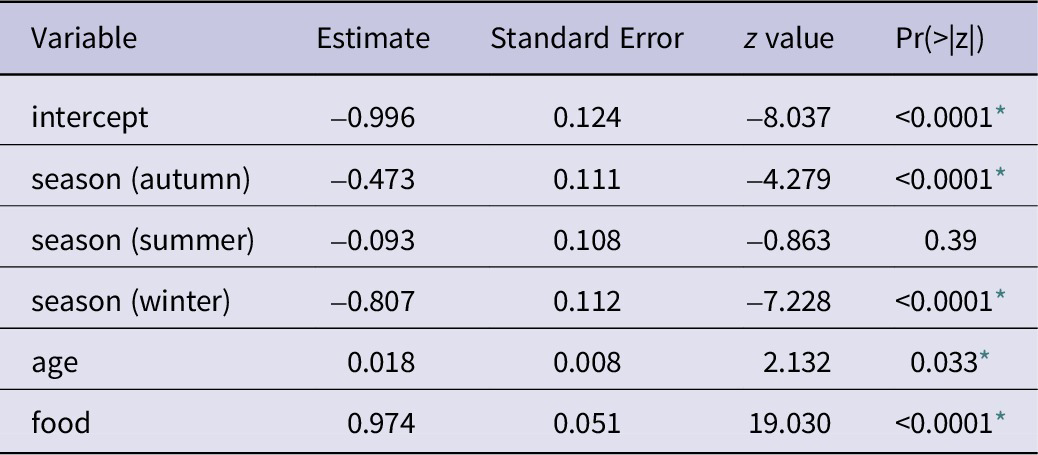
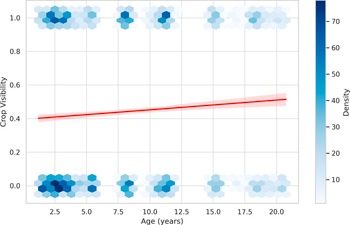
Our analysis of crop size (visible vs not visible) revealed a highly significant relationship with food supplementation (P <0.0001; Table 3). The proportion of visible crops was higher when food was supplemented compared with when it was not. Additionally, there was a significant seasonal effect on crop visibility. Spring (the reference category) displayed a higher proportion of visible crops compared with autumn (P <0.0001) and winter (P <0.0001) but not compared with summer (P = 0.39). Given the significant seasonal effect and the binomial nature of the crop size variable, we conducted pairwise post hoc comparisons to further explore differences between seasons. These comparisons revealed that winter had a significantly lower proportion of visible crops compared with spring (P <0.0001), summer (P <0.0001), and autumn (P = 0.001). These results highlight the seasonal variability in crop visibility, with winter showing the lowest proportions, even though supplementary feeding remained consistent across seasons (Figure S1), The influence of age on crop visibility was statistically significant (P = 0.033), indicating an increase in crop visibility with advancing age (Figure 2). Neither sex nor any interactions showed a significant effect.
Results from the best-fitting crop visibility model showing the significant relationship between crop visibility and the variables: season, food supplementation, and age

* indicates statistical significance at P <0.05. Spring was used as the reference category for season.
Relationship between age and crop visibility in condors. The red line represents a linear trend, with shaded areas indicating the 95% confidence intervals. The hexagonal bins indicate the density of data points, with darker shades of blue representing higher concentrations of observations. We created this figure with the help of AI.

The home range model revealed significant seasonal influences on home range sizes. Using summer as the reference category, winter showed a significantly smaller home range size (P = 0.017; Table 4). Post hoc comparisons using Tukey’s honest significant difference (HSD) test further indicated that winter differed significantly from all other seasons, with smaller home ranges observed in winter compared with spring (P <0.0001), autumn (P = 0.0001), and summer (P = 0.0013; Figure 3). Additionally, we detected a significant interaction between season and sex on home range size, indicating that the effect of season could also vary depending on the sex of the condors (Table 4 and Figure 3). To further investigate this interaction, we performed Tukey’s HSD post hoc tests, which revealed that male condors had significantly larger home ranges than female condors during spring (P = 0.044; Figure 3). No significant differences were observed between sexes during summer, autumn or winter. Age, and its interaction with other variables including sex, did not have a significant relationship with home range size.
Results from the best-fitting autocorrelated kernel density estimation (AKDE) model showing the significant relationship between home range size and the variables: sex, season, and their interaction

* indicates statistical significance at P <0.05. Female and summer were used as reference categories for sex and season.
Seasonal variations in home range size (autocorrelated kernel density estimation [AKDE]) of California Condors by sex and for all individuals. Boxplots display the estimated home range sizes (AKDE, in km²) for all condors (top panel), female condors (middle panel), and male condors (bottom panel) across the four seasons: spring, summer, autumn, and winter. We created this figure with the help of AI.

In 2020, the average annual AKDE home range size for individual condors was 1,815 km² (Figure 4). In comparison, the MCP home range estimates were considerably larger, with an average size of 5,294 km². The core areas of condor activity, represented by the 50% KDE, averaged 269 km², while the 95% KDE, which encompass broader home range areas, averaged 2,436 km².
Spatial distribution of California Condor home ranges in the Sierra San Pedro Mártir, Baja California, for the year 2020. Home ranges were estimated using the autocorrelated kernel density estimate (aKDE) method with perturbative hybrid REML (pHREML) and area correction (AKDEc). Blue polygons represent male condors and red polygons represent female condors. Solid-coloured polygons denote the 95% aKDE home range for each individual condor. The white diagonal polygon represents the protected area Parque Nacional Sierra de San Pedro Mártir (PNSSPM). Each number corresponds to the individual condor ID. We created this map in QGIS with the help of AI.

Discussion
In this study, we explored the spatial presence and home range size of California Condors in Baja California, with a focus on their use of the PNSSPM and monthly variations in home range size. We analysed how factors, including food supplementation, seasonality, sex, and age, influenced these spatial patterns. Our findings provide important insights into the range behaviour and space-use behaviour of condors, both within and beyond the boundaries of the PNSSPM.
We found that these birds spent a substantial portion of their time – over half – within the boundaries of the PNSSPM, suggesting that the park serves as a core area for their activities and survival. When condors moved outside the park, they primarily remained in a buffer zone surrounding the PNSSPM (authors’ unpublished data). This movement pattern is consistent with findings from several studies documenting how various animals (Ferreira et al. Reference Ferreira, Thomas, Ingram, Bevan, Madsen and Thanet2023; Martínez et al. Reference Martínez, Pagán, Palazón and Calvo2007; Massara et al. Reference Massara, Maria de Oliveira Paschoal, Bailey, Doherty, Hirsch and Chiarello2018; Paolino et al. Reference Paolino, Versiani, Pasqualotto, Rodrigues, Krepschi and Chiarello2016; Schoeman and Foord Reference Schoeman and Foord2021), including other avian scavengers (Buechley et al. Reference Buechley, Girardello, Santangeli, Daka Ruffo, Ayalew and Abebe2022; Kane et al. Reference Kane, Monadjem, Aschenborn, Bildstein, Botha and Bracebridge2022; Peters et al. Reference Peters, Kendall, Davies, Bracebridge, Nicholas and Mgumba2023; Restrepo-Cardona et al. Reference Restrepo-Cardona, Narváez, Kohn, Pineida and Vargas2024), extend their activities beyond protected areas and release sites. For example, in the USA, condors released in the Big Sur Condor Sanctuary occasionally moved between Big Sur and southern California in the early years of the reintroduction programme, while those released in Pinnacles National Park regularly moved between Pinnacles and Big Sur (Kelly et al. Reference Kelly, Grantham, George, Welch, Brandt and Burnett2014) and continue to do so in current times. These behaviours highlight the importance of both protected areas and adjacent buffer zones in maintaining the availability of suitable habitats.
Seasonality had a significant effect on condor presence within the park, with the probability of detection peaking during winter. Notably, despite heavy snowfall, condors were observed in more than 75% of VHF readings in December (range: 56.7–96.7%; Figure S2). December might present poorer foraging conditions in this region due to factors such as reduced carrion availability and harsher weather that could limit flight and foraging opportunities. For instance, local livestock are often sheltered in winter (rather than free roaming), which may reduce scavenging opportunities for condors. Indeed, condors had smaller crop sizes during this season despite consistent food supplementation. Consequently, they may rely more on supplementary feedings in December. However, while our data indicate that food supplementation increases signal probabilities year-round, its effect in December was relatively modest compared with other months – possibly because condors were already highly present in the park (Figure 1). The probability of detecting condors decreased in the spring, with a dramatic drop observed in March when detections in the park fell to approximately 25% of readings (range: 0–71.4%). This decline might be partially related to breeding activity, as nesting condors travel longer distances (Hall et al. Reference Hall, Hong, Poessel, Braham, Brandt and Burnett2021), and condors from Baja California tend to select nesting sites in remote canyons far from the park’s boundaries. Additionally, based on our extensive observations of this population, we speculate that subadults may roam more widely in search of nesting territory during spring, which could contribute to this pattern.
Food supplementation had a positive effect on both the presence and crop visibility of condors across all age groups and sexes within the park, with the increase in crop visibility being more pronounced in adult birds than in juveniles (Figure 2). Although newly released condors are almost exclusively juveniles, they too benefit from supplementary feedings, consistent with observations in other condor populations where supplementary feedings support newly released birds and facilitate population monitoring (Bakker et al. Reference Bakker, Smith, Copeland and Finkelstein2017; Cortés-Avizanda et al. Reference Cortés-Avizanda, Blanco, Devault, Markandya, Virani and Brandt2016; Walters et al. Reference Walters, Derrickson, Fry, Haig, Marzluff and Wunderle2010). The larger increase in crop visibility observed in adult condors likely reflects the feeding hierarchy seen in the Baja California condor population and other condor populations, where older condors dominate younger individuals during feeding interactions (Hall et al. Reference Hall, Grantham, Posey, Mee, Mee and hall2007; Moreno-Opo et al. Reference Moreno-Opo, Trujillano and Margalida2020; Sheppard et al. Reference Sheppard, Walenski, Wallace, Velazco, Porras and Swaisgood2013). Although Sheppard et al. (Reference Sheppard, Walenski, Wallace, Velazco, Porras and Swaisgood2013) found that dominance hierarchies did not affect feeding frequency or duration, the lower crop visibility in younger birds in our study may suggest otherwise. This discrepancy may be attributed to differences in population size and food resources between the studies. Notably, the population size averaged only 19 birds during Sheppard’s three-year study compared with 38 in 2020, and the type of supplemented food also differed, as their study included cow and donkey legs in addition to sheep, whereas we provided only sheep. The larger population in our study may have intensified competition for food, reducing feeding opportunities for younger birds.
Our study revealed a notable decrease in home range size for California Condors during the winter season (Figure 3). This decrease in home range size coincided with an increased presence of condors within the PNSSPM during the same period, suggesting a seasonal shift in space use. This seasonal variation also aligns with the findings of Rivers et al. (Reference Rivers, Johnson, Haig, Schwarz, Burnett and Brandt2014a), who also reported smaller condor home ranges in winter months in the USA. The reduction in home range size during winter might be explained by several ecological and environmental factors. Rivers et al. (Reference Rivers, Johnson, Haig, Schwarz, Burnett and Brandt2014a) and Hall et al. (Reference Hall, Hong, Poessel, Braham, Brandt and Burnett2021) both noted that seasonal variations in solar radiation influence the flight patterns of California Condors. Rivers et al. (Reference Rivers, Johnson, Haig, Schwarz, Burnett and Brandt2014a) indicated that during winter, reduced solar radiation weakens thermal updraughts and shorter days limit foraging time, restricting travel distances. Similarly, Hall et al. (Reference Hall, Hong, Poessel, Braham, Brandt and Burnett2021) observed that condors travel longer distances in summer, benefiting from optimal flight conditions and increased solar radiation. Likewise, this pattern of seasonal variation in home range size has been observed in other vulture species. For instance, Guido et al. (Reference Guido, Cecchetto, Plaza, Donázar and Lambertucci2023) reported that Andean Condors Vultur gryphus also exhibited larger home ranges during warmer months compared with colder months. Similarly, Tobajas et al. (Reference Tobajas, Iglesias-Lebrija, Delepoulle, Álvarez, Oliva-Vidal and Margalida2024) found that Cinereous Vultures Aegypius monachus showed significant seasonal differences in movement patterns, with longer distances travelled during the warmer breeding season compared with the cooler non-breeding season.
At the individual level, male condors had larger AKDE home ranges than females during spring, but this difference was not significant in other seasons (Figure 3). Additionally, there was no significant effect of age or interaction between age and sex. These findings contrast with previous studies, however, it is worth noting that the sample size for females was smaller, and two individuals had relatively small home ranges. Rivers et al. (Reference Rivers, Johnson, Haig, Schwarz, Burnett and Brandt2014a) reported no sex-based difference in the KDE home range sizes of California Condors in the USA but found that mean monthly home ranges were significantly larger for adults compared with immatures and varied significantly throughout the annual cycle. Similarly, Guido et al. (Reference Guido, Cecchetto, Plaza, Donázar and Lambertucci2023) found that in Andean Condors the influence of sex on home range size changes with age, with sub-adult males exhibiting the largest home ranges based on KDE for the core use areas (95% and 50% contour areas). Age differences in our study may have been negligible due to a smaller sample size of 16 birds and a shorter study duration of one year, compared with the study by Rivers et al. Reference Rivers, Johnson, Haig, Schwarz, Burnett and Brandt2014a which included 74 birds over seven years. Additionally, the influence of a two-year-old male condor (ID = 920), who accounted for 4 of the 10 largest monthly home ranges observed (Figure 4), may have further contributed to the lack of a significant relationship.
Data analysed using a 95% KDE showed that in 2020, condors in Baja California had average monthly home ranges of 1,622 km². In contrast, data on USA condors, collected between July 2003 and December 2010 and analysed using a 99% KDE, indicated smaller home ranges (Rivers et al. Reference Rivers, Johnson, Haig, Schwarz, Burnett and Brandt2014a). Specifically, immature condors in the USA had home ranges of 413 km², while adults had home ranges of 563 km² (Rivers et al. Reference Rivers, Johnson, Haig, Schwarz, Burnett and Brandt2014a). However, when compared with other vulture species reviewed by Alarcón and Lambertucci (Reference Alarcón and Lambertucci2018), including Andean Condors, the condors in our study exhibited smaller than average home ranges. It is important to note that home range size comparisons between studies are challenging because differences in sample size, estimation methods, and temporal scale can introduce variability and complicate direct comparisons (Tobajas et al. Reference Tobajas, Iglesias-Lebrija, Delepoulle, Álvarez, Oliva-Vidal and Margalida2024). Variations in vulture home range sizes may be explained by biological factors such as species type and individual traits like age and sex, as well as environmental factors including seasonal fluctuations and food availability related to habitat type (Alarcón and Lambertucci Reference Alarcón and Lambertucci2018; DeVault et al. Reference DeVault, Reinhart, Brisbin and Rhodes2004). For condors, factors such as larger flock sizes, greater age diversity among individuals, and the age of recovery programmes may positively influence home range sizes by enhancing the discovery of food sources through information transfer (Bakker et al. Reference Bakker, Smith, Copeland and Finkelstein2017). By the start of 2020, the Baja California condor recovery programme had been active for over 17 years, and the 38 free-ranging condors had an average age of 9.15 years, ranging from 1 to 20 years. In comparison, at the start of the Rivers et al. (Reference Rivers, Johnson, Haig, Schwarz, Burnett and Brandt2014a) study in 2003, their recovery programmes were younger, had smaller or similar population sizes at each site, and used categorical age data, making direct age comparisons challenging.
Our study offers important insights into the spatial ecology of California Condors in Baja California, emphasising the critical role of the PNSSPM as a core habitat and highlighting how seasonality and food supplementation influence their movement patterns. By demonstrating that condors frequently utilise areas both within and outside the protected area, we emphasise the necessity for conservation strategies that extend beyond park boundaries. This use of unprotected areas raises concerns about potential risks. Given that lead poisoning from hunting activities is the primary cause of mortality in California Condors in the USA, and that lead intoxication – though less frequent – has also been detected in Baja California condors, assessing these and other threats outside the PNSSPM is crucial for the effective management and recovery of the Baja California population.
Future research should aim for longer-term data collection, as this study was limited by its temporal scope, covering only one year. This period coincided with the COVID-19 pandemic. The pandemic likely influenced socio-environmental factors that could have affected both condor behaviour and our data collection efforts, although these impacts were not directly assessed. It will also be crucial in future studies to incorporate detailed weather data to better understand how meteorological conditions influence condor movement and behaviour. Ultimately, our findings underscore the importance of continued monitoring and management, including food supplementation, for the California Condors in Baja California. By demonstrating how supplemental feeding increases condor presence and crop visibility across all age groups, our results emphasise that such management measures remain essential to support this population as it recovers and expands into historically used areas.
Acknowledgements
We would like to thank Mohamed Mahmoud Saad Luna, Manuel Delfino Valdez Alarcón, José Hiram Licona Hernández, and Gonzalo de Leon Giron for their logistical support. We also thank Heryen Judiely Collins Paredes, Valeria Ruiz Lizarraga, Yara Alejandra Reyes Osio, Samantha Ibarra Ruiz, and Judith Esther Baird Lujano for their assistance in data capturing. We are also grateful to two anonymous reviewers for their valuable comments and suggestions that helped improve the quality of this manuscript. This study was partially financed by the Secretaria de Educación Pública (Programa de Apoyo a la incorporación de Nuevos Profesores de Tiempo Completo 2019, UABC-PTC-795). The authors declare that the present study complies with the current laws and ethical standards of animal research in Mexico. In the preparation of this manuscript, we used artificial intelligence (AI), specifically OpenAI’s ChatGPT 4, to improve various aspects of our writing including grammar, clarity, and structure. In this process, we iteratively evaluated AI-generated suggestions and selectively incorporated them into the manuscript. For our statistical analyses, specifically in developing and debugging R code for GLMMs, ChatGPT 4 served as a consultative tool. It provided suggestions for code optimisation, troubleshooting, and data visualisation, thereby facilitating the clear presentation of our findings through improved visual representations. We declared the assistance from AI in the captions of the respective figures. We did not use AI to generate text or to analyse or extract insights from data or other materials.
Supplementary material
The supplementary material for this article can be found at http://doi.org/10.1017/S0959270925000085.