Introduction
Lentil (Lens culinaris Medik.) is a food legume grown across a wide range of environments and traditionally consumed where it was grown (McNeil et al. Reference McNeil, Hill, Materne and McKenzie2007). World production has increased from less than 1,000 million kg in the early 1960s to 4,800 million kg in 2014, with approximately 40% from the developed countries of Canada, Australia, and the United States (FAO 2015). Weed competition is a major limitation to lentil production worldwide due to its slow early growth rate, short stature, and lack of protective canopy development (Knott and Halila Reference Knott and Halila1988; Muehlbauer et al. Reference Muehlbauer, Kaiser, Clement and Summerfield1995; Hanson and Thill Reference Hanson and Thill2001). Grain yield losses of up to 84% have been attributed to weed competition in lentil (Swanton et al. Reference Swanton, Harker and Anderson1993; Mohamed et al. Reference Mohamed, Nourai, Mohamed, Mohamed and Saxena1997; Elkoca et al. Reference Elkoca, Kantar and Zengin2005; McDonald et al. Reference McDonald, Hollaway and McMurray2007). Chemical control using herbicides is the major method of weed management in lentil in developed countries and is becoming increasingly popular in many developing countries (Brand et al. Reference Brand, Yaduraju, Shivakumar and McMurray2007; Yenish et al. Reference Yenish, Brand, Pala, Haddad, Erskine, Muehlbauer, Sarker and Sharma2009). Until the release of imidazolinone (IMI; acetohydroxyacid synthase [AHAS] inhibitors) herbicide–tolerant lentil cultivars in North America in 2006 (Muehlbauer et al. Reference Muehlbauer, Mihov, Vandenberg, Tullu and Materne2009) and Australia in 2012 (Materne et al. Reference Materne, McMurray, Brouwer, Bretag, Brand, MacLean and Hawthorne2011), limited safe and effective in-crop herbicide options were available for controlling broadleaf weeds. However, an overreliance on these herbicides both in lentil and other IMI-tolerant crops grown in rotation such as canola (Brassica napus L.), wheat (Triticum aestivum L.), and in Australia, barley (Hordeum vulgare L.), has resulted in the evolution of IMI-tolerant weeds in these systems (Beckie and Tardif Reference Beckie and Tardif2012; Boutsalis et al. Reference Boutsalis, Gill and Preston2016). For lentil to remain a viable pulse crop in these systems, alternative chemical weed control strategies are required as part of a sustainable integrated weed management system.
Development and registration of new herbicides in minor crops like lentil are likely to be problematic due to the high costs involved relative to the size of the industry (Devine Reference Devine2005; Duke Reference Duke2005). An alternative approach is to improve crop tolerance to existing herbicides where a lack of selectivity exists between crop and weeds. Metribuzin is a broad-spectrum herbicide recommended in many countries for controlling a range of grass and broadleaf weeds in lentil. It is an aminotriazinone or asymmetrical triazine (Hatzios and Penner Reference Hatzios and Penner1988) and a photosystem II inhibitor (Devine et al. Reference Devine, Duke and Fedtke1992). The rates and timing of metribuzin application to lentil vary across countries due to the potential for severe crop phytotoxicity on soils low in organic matter, under continued wet soil conditions, or where application of metribuzin to dry soil is followed by heavy rainfall (Muehlbauer et al. Reference Muehlbauer, Kaiser, Clement and Summerfield1995; Yasin et al. Reference Yasin, Al-Thahabi, Abu-Irmaileh, Saxena and Haddad1995; Elkoca et al. Reference Elkoca, Kantar and Zengin2005). Metribuzin is used as a PRE or POST application in the United States (North Dakota State University 2014) and as a PRE or early-POST application in Canada (Saskatchewan Ministry of Agriculture 2014). In Australia, it is only used PRE, as severe crop phytotoxicity and subsequent yield loss occurs from POST application (White Reference White2015). In all these cases, there are many application regulations surrounding crop safety. These include restrictions around soil type, clod and crop residue level, soil moisture content, ambient temperature, rainfall postapplication, light intensity, crop growth stage, and sowing depth. Furthermore, some recently released Australian lentil cultivars exhibit increased sensitivity to metribuzin when compared with existing cultivars and incur grain yield losses of up to 35% PRE and 52% POST to label application rates in herbicide tolerance response trials (GRDC 2015). The development of lentil germplasm with higher levels of metribuzin tolerance would reduce crop phytotoxicity, improve crop safety, and provide an alternative broadleaf weed control option to the AHAS inhibitors, alleviating herbicide-resistant weed issues.
Some level of genetic variation for tolerance to metribuzin has been identified using various screening methods in many crop species. These include soybean [Glycine max (L.) Merr.] (Hardcastle Reference Hardcastle1974; Mangeot et al. Reference Mangeot, Slife and Rieck1979; Barrentine et al. Reference Barrentine, Hartwig, Edwards and Kilen1982), tomato (Solanum lycopersicum L.) (Souza Machado et al. Reference Souza Machado, Nonnecke and Phatak1978; Gawronski Reference Gawronski1983), potato (Solanum tuberosum L.) (Ivany Reference Ivany1979; Gawronski et al. Reference Gawronski, Haderlie, Callihan and Dwelle1985), sweetpotato [Ipomoea batatas (L.) Lam.] (Harrison et al. Reference Harrison, Jones and Dukes1985; Motsenbocker and Monaco Reference Motsenbocker and Monaco1993), cowpea [Vigna unguiculata (L.) Walp.] (Harrison Reference Harrison1988), field pea (Pisum sativum L.) (Al Khatib et al. 1997), barley (Caldwell and O’Sullivan Reference Caldwell and O’Sullivan1985; Gawronski et al. Reference Gawronski, Haderlie and Stark1987), wheat (Runyan and McNeil Reference Runyan and McNeil1982; Schroeder et al. Reference Schroeder, Banks and Nichols1985; Kleemann and Gill Reference Kleemann and Gill2007; Bhoite et al. Reference Bhoite, Si, Stefanova, Siddique and Yan2017), lentil (McMurray et al. Reference McMurray, Dare, Materne and Eckermann2009; Meier Reference Meier2016; Sharma et al. Reference Sharma, Singh, Aggarwal, Kushwah and Kumar2017), and narrowleaf lupin (Lupinus angustifolius L.) (Si et al. Reference Si, Sweetingham, Buirchell, Bowran and Piper2006). Generally, only up to a 3-fold increase in metribuzin tolerance between tolerant and susceptible cultivars was identified, and in the case of lentil, no cultivar with an agronomically useful level of tolerance has been reported. A higher level of improved metribuzin tolerance (4- to 6-fold) was also developed through induced mutation and subsequent field selection in the presence of the herbicide in narrowleaf lupin (Si et al. Reference Si, Buirchell and Sweetingham2009). As genetic variability to metribuzin tolerance in lentil exists, and previous research has identified improved levels in other crop species, agronomically useful levels of tolerance could be developed in lentil. This study aimed to identify and validate lentil germplasm with improved tolerance to metribuzin compared with existing Australian and Canadian cultivars through using both controlled-environment germplasm screening and induced-mutagenesis field-selection approaches.
Materials and Methods
Germplasm Screening
Approximately 750 lentil accessions were obtained from the Australian Grains Genebank and Pulse Breeding Australia (PBA), Horsham, VIC, for comparison of tolerance to metribuzin against the standard cultivar ‘PBA Flash.’ The PBA lentil genotypes 99-088L*02H037 and 96-047L*99R099, which have the highest and lowest reported tolerance to metribuzin in Australia, respectively (McMurray et al. Reference McMurray, Dare, Materne and Eckermann2009), were used as controls. Six growth room experiments using randomized block designs and two replicates and consisting of between 71 and 266 accessions each, depending upon availability of growth room space, were conducted using a sand-pot assay derived from DeJong (Reference DeJong1983). Eight seeds of each line were scarified with a knife and imbibed in water for a period of 24 h to promote even germination. Pots (4.5-cm diameter, 9-cm depth) were filled with 30 g of prewashed blue metal stone on the bottom followed by 50 g of coarse Waikerie sand (more than 90% sand) and watered to field capacity. Four seeds of each line were sown in each pot at a depth of 2 cm. Pots were randomized and suspended in customized racks to allow free drainage without contamination of solution leaching from the bottom of each pot and placed in a growth room at a day/night temperature setting of 20/5 C with 16-h daylight. Pots were watered with 25% Hoagland’s nutrient solution to 100% of water-holding capacity every 2 or 3 d. At 7 d after sowing (DAS), seedlings were thinned to 2 uniform seedlings pot−1. At 12 DAS (2- to 3-aboveground node stage), all pots were watered to 100% of water-holding capacity with deionized water. Immediately following this, all pots were treated with 20 ml of metribuzin (750 g ai kg−1, Mentor®, Farm Oz, St Leonards, NSW, Australia) at 3,900 µg L−1, which allowed the solution to leach out of the bottom of pots. This rate of metribuzin applied as a soil drench was found to repeatedly and reliably lead to high levels of damage in the tolerant control under controlled-environment conditions. Metribuzin solution was applied using a wide-mouthed beaker to rapidly flood the entire soil surface, avoiding contact with leaves but enabling complete saturation of the sand medium. Pots were irrigated with 40 ml of 25% strength Hoagland’s solution at 24 h after herbicide treatment to leach all metribuzin from pots. Complete removal of metribuzin from the medium was confirmed through the subsequent growing of susceptible control plants in pots without any herbicide-damage symptoms appearing. Normal watering resumed 3 d after the herbicide flushing, and plants were assessed 12 to 14 d after treatment (DAT) for herbicide injury or plant death. Plant injury was scored as the percentage of necrotic plant tissue, with a score of 90% or greater considered as plant death.
Development of Mutagenized Population
Approximately 670,000 seeds of lentil PBA Flash were mutagenized with ethyl-methanesulfonate (EMS) in 2010. Seeds were first rinsed twice in water to remove dust particles, then soaked for 12 h in reverse osmosis (RO) water inside four sealable 20-L containers and shaken periodically. Seeds were decanted and rinsed in RO water, returned to containers, and soaked in 0.04% EMS solution for a further 12 h in darkness and shaken gently. Sodium thiocyanate 100 g L−1 was then added to seed solution for 30 min before seed was rinsed with water eight times. Mutagenized (M) M1 seed was sown in a field near Maitland, SA, Australia (34.433°S, 137.632°E) with an experimental small plot cone seeder at a targeted rate of 100 seeds m−2 over approximately 0.7 ha. The resulting M1 plants were bulk harvested at maturity with an experimental small plot harvester. A clean M2 seed yield of 1,350 kg was achieved and mixed thoroughly using a small commercial cement mixer before being separated into two 600-kg lots and two 60-kg lots. One 60-kg M2 seed lot was multiplied near Maitland in the 2011 growing season as per the previous year, returning 2,800 kg of cleaned M3 seed.
Mutagenized Population Screening
Initial mass field and large glasshouse progeny screens were used to identify putative metribuzin-tolerant lines from the large mutagenized population. An estimated 9,500,000 M2 PBA Flash seeds from one 600-kg retained seed lot were sown in 2011 on a Calcic Calcaresol (Isbell Reference Isbell2016) soil type near Sunnyvale, SA, Australia (34.145°S, 137.797°E) using a field-selection method based on Si et al. (Reference Si, Buirchell and Sweetingham2009). A commercial seeder was used to sow the seed at a targeted rate of 100 viable seeds m−2 over approximately 14 ha. Plants were sprayed POST at the 5- to 6-node stage with metribuzin at an aggregated rate of 1,300 g ha−1, greater than six times the recommended PRE rate to achieve a high level of crop phytotoxicity. The herbicide was applied by a commercial self-propelled spray rig in two passes, each at a water application rate of 100 L ha−1, but from opposite directions to improve plant coverage. At 21 DAT, surviving plants were identified and transplanted from the field to pots. Plants were grown through to seed either in a glasshouse at SARDI Field Crop Centre, Clare, SA, Australia (33.835°S, 138.614°E) or a shade house at the Waite Research Precinct, Urrbrae, SA, Australia (34.965°S, 138.634°E). A total of 48 plants set viable seed and were harvested individually and multiplied in a glasshouse over the summer. The field screen was repeated near the 2011 site in 2012 with an estimated 10,000,000 M3 PBA Flash seeds from the 2011 M2 multiplication, with 47 M3 plant selections collected.
A progeny metribuzin screen was conducted in a glasshouse at Waite Research Precinct to allow further identification of putatively tolerant lines. The glasshouse was maintained at day/night temperatures of 25/10 C. Four scarified seeds per pot were sown into 10 pots (10-cm diameter) filled with >90% coarse sand (Waikerie sand) for each line. The 10 pots were arranged into four by three 12-pot trays with two additional pots, located in the center of each tray, sown to PBA Flash as a susceptible check. All pots received 100 ml of water after sowing and then twice weekly. Plants were thinned to 2 uniform seedlings pot−1 before POST metribuzin treatment with a single rate of 112.5 g ha−1 at 14 DAS at the 4- to 5-node growth stage. This rate of metribuzin resulted in greater than 90% plant injury in PBA Flash when applied postemergence under glasshouse conditions (L McMurray, D Mao, C Preston, J Paull unpublished data). Herbicide was applied using a laboratory track applicator with a twin nozzle (110° flat fan) moving boom situated 30 cm above the top of the plants and delivering 103 L ha−1 at 1 m s−1 and 250 kPa. Plants were watered immediately before herbicide treatment and 24 h after with 50 ml of water, and then twice-weekly watering with 25% Hoagland’s nutrient solution was resumed. Plant injury was recorded on individual plants at 21 DAT as for the germplasm screen. Surviving lines were initially harvested as single plants but later bulked as M2- and M3-derived lines.
Dose–Response Experiments: Australia and Canada
Experiments were located in controlled-environment growth room facilities at the Waite Research Precinct and the University of Saskatchewan, Saskatoon, SK, Canada in 2014 to enable comparisons with elite germplasm from both countries. Day length was 14/10-h day/night in both countries; however, other conditions varied. In Australia, temperatures were 20/10 C day/night, light intensity of 1,100 μmol m−2 s−1, and relative humidity (RH) was maintained at 90%. In Canada, temperatures were 21/15 C day/night, light intensity was 540 μmol m−2 s−1, and RH was 40%. Both experiments were designed as a randomized complete block design with four replicates of six plants in Australia; however, three replicates of two plants each were used in Canada, due to space constraints. The Australian experiment consisted of the four most putatively tolerant mutant lines and the two most putatively tolerant germplasm lines from the progeny and germplasm screens, respectively. PBA Flash was included as the control cultivar. All seeds were scarified and sown into pots and watered as for glasshouse screening, except that a potting mix of 90% composted pine bark and 10% sand was used due to its improved suitability for growing lentils compared with the sand medium under growth room conditions. Metribuzin treatment was as for glasshouse screening, with rates of 0, 142.5, 285, 570, 855, 1,140, 2,280, and 4,560 g ha−1 applied. Plant damage (as for germplasm screen) was recorded at 7, 14, and 21 DAT, and all plants were harvested for dry weight (DW) after the final recording. Plant DW samples were combined within experimental units and dried at 80 C for 48 h in a laboratory oven.
The Canadian study followed the procedure used in Australia with the following modifications. The Australian genotypes were reduced to PBA Flash, the two highly tolerant mutants, and SP1333. The cultivar ‘CDC Maxim,’ which is currently Canada’s most widely grown red lentil, and ‘CDC Greenstar,’ a recently released large-seeded green lentil, were included for comparison. A custom soil mix of 60% Sunshine 3 (Sun Gro Horticulture, Seba Beach, AB, Canada) and 40% coarse sand was used. Pots were watered with 25% Hoagland’s nutrient solution from sowing onward. Metribuzin (Sencor®, 750 g ai kg−1, Bayer Crop Science, Calgary, AB, Canada) was applied using a laboratory track applicator with a single even flat spray nozzle (Lechler, St Charles, IL, USA) 8001 EVS delivering 108 L ha−1 at 240 kPa. Eight doses were applied at rates of 0, 100, 150, 225, 337, 506, 759, 1,138, 1,707, and 2,560 g ha−1 in all genotypes except the two mutant lines, for which the rates of 100, 150, and 225 were replaced with rates of 3,840, 5,761, and 8,641 g ha−1, respectively, based on the Australian dose–response findings.
Field Validation: Canada
A field experiment was conducted near Saskatoon, SK, Canada (52.135°N, 106.621°W) in 2014 to validate the metribuzin-tolerant lines identified in the dose–response experiments against Australian and Canadian genotypes. The trial site was in the Dark Brown Chernozemic soil zone with a typical soil organic matter content of 3.5% to 4.5%. Rainfall received at the field site from May to September in 2014 was 313 mm, compared with the long-term average of 236 mm. The experiment was sown on June 4 with a row-seeder into cultivated soil with no crop residue present. Twenty-four lentil genotypes representing diverse commercial germplasm from Australia and Canada, known metribuzin-sensitive types, and the lines from the Canadian dose–response trial, were sown in a split-split-plot randomized complete block design with three replicates. Plots were first blocked by shade or no shade and then by metribuzin rate with genotype as the sub-subplot. Shade was applied with 75% polypropylene shade cloth supported 0.6 m above the ground by a wire frame for 72 h before metribuzin treatment to decrease the plant tolerance to metribuzin (Pritchard and Warren Reference Pritchard and Warren1980). All genotypes except for the two mutants were sown at 40 seeds linear m−1 of row at 0.3-m row spacing. Due to limited seed supply, the two mutant lines were sown at 20 seeds 0.5 m−1 row, and interplant spacing was kept consistent in all rows. Group F granular inoculum was applied with seed, which was sown at a depth of 3 to 4 cm. Metribuzin at rates of 0, 150, 300, 600, and 1,200 g ha−1 was applied at the 4- to 5-node stage at 20 d POST with a handheld sprayer at 100 L ha−1 using four Air Mix 110-015 low-pressure nozzles on 0.5-m spacing at an operating pressure of 240 kPa. Plant damage scores were recorded on a row basis at 10 and 20 DAT by estimating the percentage of necrotic tissue in the row. Plant DW estimates at 20 DAT occurred by sampling 10 random plants in each row and oven-drying them at 80 C for 48 h.
Statistical Analysis
Germplasm screens were analyzed with ANOVA using GenStat v. 14.1 (VSN International, Hemel Hempstead, Hertfordshire, UK). Initial general linear mixed-model ANOVA of square-root-transformed plant DW data from the field validation trial identified a significant three-way interaction among shade, metribuzin rate, and genotype and was further analyzed within shade environments as described later. Plant DWs obtained from dose–response analysis and the field validation experiment were analyzed with nonlinear regression using the dose–response curve drc package in the statistical analysis software R (R Development Core Team 2014). Estimates of growth reduction (GR50), the effective dose of metribuzin required to reduce the growth of the dependent variable by 50%, were obtained from all models, and the selective index SI command of the drc package was used to compare the relative differences of the GR50 values from the control genotype PBA Flash.
Results and Discussion
Germplasm Screening
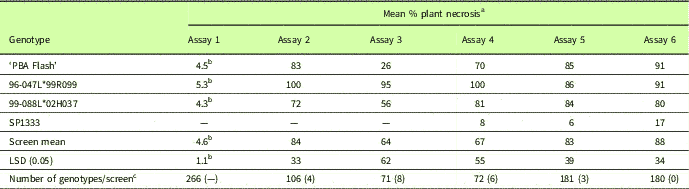
High levels of metribuzin injury occurred in all germplasm screens, allowing the identification of a small number of lines with improved metribuzin tolerance. The control line 99-088L*H037 had greater than 50% necrotic damage in all screens and performed similarly to PBA Flash and better than the known sensitive line 96-047L*99R099, which averaged greater than 85% necrosis in all screens (Table 1). Across all screens, less than 5% of lines showed plant necrosis of 15% or less, a figure considered agronomically acceptable. The green lentil line SP1333 from Argentina consistently showed a lower level of plant damage than 99-088L*H037, and along with a reselected line from USSR-05-05, which segregated for expression of tolerance, was used in subsequent dose–response experiments.
Number of lentil genotypes screened and plant damage (% necrosis) of selected lines from six metribuzin herbicide sand-pot assays.

a Each result is the mean of two replicates.
b Plant damage score of 0–6 used in the first screen.
c Figures in parentheses indicate the number of lines identified in each screen with a plant necrosis score of 15% or less.
Initial Line Screening of Mutant Field Selections
The four PBA Flash check plants incurred plant damage scores of 100% necrosis in all 95 trays of the glasshouse progeny screen (unpublished data). The two mutant lines, PBA Flash-EMS10-11SVHM043 (M043) from the 2011 M2 screen and PBA Flash-EMS10-11SK-12PAHM009 (M009) from the 2012 M3 screen exhibited no symptoms of damage (0%) on all 20 plants within their respective trays. All other mutant lines tested showed severe plant damage (greater than 80% necrosis) on all 20 plants. PBA Flash-EMS10-11SVHM062 (M062) and PBA Flash-EMS10-11SVHM091 (METD) showed improved levels of visual plant recovery posttreatment compared with all other mutant lines, except for M043 and M009. These four mutant lines were therefore examined further in dose–response experiments.
Dose–Response Experiments
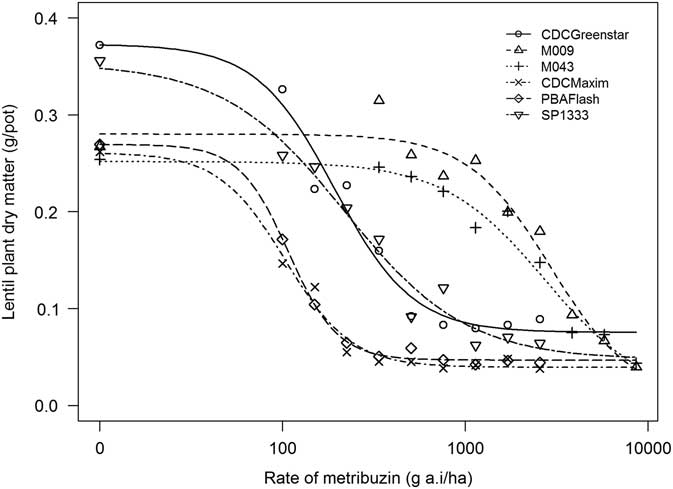
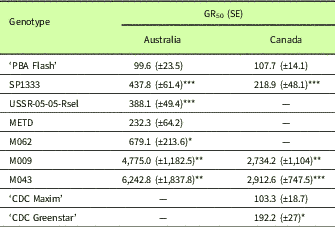
Logistic dose–response curves were fit for plant DW to explain the response of lentil genotypes to metribuzin rate in both experiments. A three-parameter log-logistic model best explained the relationship between metribuzin rate and plant biomass in the Australian experiment and was required to fix the lower asymptote at zero. The model converged in drc with a nonsignificant lack-of-fit test achieved (0.33). All lines incurred reductions in plant DW to applied metribuzin as measured by GR50 (Table 2). Mutant genotypes M043 and M009 performed similarly and had statistically greater tolerance to metribuzin than all other genotypes, with GR50 values 62 and 48 times greater than that of PBA Flash (100 g ha−1), respectively (Table 2). The other four putatively tolerant genotypes exhibited an intermediate level of tolerance to metribuzin, two to seven times greater than PBA Flash. In the Canadian experiment, in which comparisons with Canadian genotypes occurred, a four-parameter log-logistic model best described the effects of metribuzin on plant DW, and the models converged in drc. The addition of very high rates (3,840, 5,761, and 8,641 g ha−1) in this experiment allowed for improved parameter estimates to be obtained for the highly tolerant mutant types (Figure 1) compared with the Australian experiment. Consequently, a higher nonsignificant lack-of-fit test statistic was achieved (0.98). Plant DW of untreated PBA Flash was approximately four times higher in the Australian experiment compared with the Canadian experiment, most likely reflecting more favorable growth conditions due to higher light intensity and lower sand content in the soil medium used in the former. However, the GR50 of PBA Flash was similar in both experiments (approximately 100 g ai ha−1), suggesting a high level of repeatability in herbicide phytotoxicity in this susceptible line across experiments. GR50 values of the mutant lines and SP1333 were lower in the Canadian experiment compared with the Australian experiment (Table 2), most likely due to the higher sand content in the Canadian potting media resulting in reduced binding of the herbicide to organic matter and increased availability (Savage Reference Savage1976). Furthermore, the lower light intensities in the Canadian experiment may have led to reduced metribuzin metabolism, resulting in greater plant injury (Caldwell and O’Sullivan Reference Caldwell and O’Sullivan1985). Despite some variation in the observed level of metribuzin tolerance across the dose responses in SP1333, M043, and M009, a high level of repeatability in the relative tolerance levels of these genotypes compared with PBA Flash occurred between experiments. M043 and M009 again exhibited the highest level of metribuzin tolerance, with GR50 values of 2,734 and 2,913 g ha−1, respectively. These rates of metribuzin are approximately 10 times higher than the maximum postsowing PRE label rate for lentil in Australia, and over 13 times higher than the maximum label rate for POST application in lentil in Canada. SP1333 again showed an intermediate response, with a GR50 for plant DW two times higher than PBA Flash and similar to the Canadian cultivar CDC Greenstar (192 g ha−1). The other Canadian genotype, CDC Maxim, performed similarly to PBA Flash.
Dose–response curves of aboveground plant dry weight at 21 d after treatment with POST metribuzin herbicide of six lentil lines varying in herbicide tolerance under controlled-environment conditions in Canada.

Estimates of GR50 (the rate required to reduce dry weight 50%) values from logistic curves for plant dry weight (g plant−1) of lentil genotypes treated with metribuzin herbicide in controlled-environment room experiments in Australia and Canada.
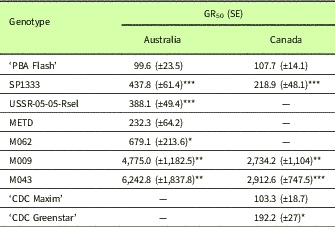
*P≤0.05, **P≤0.01, and ***P≤0.001 for significance compared with PBA Flash within each experiement using pairwise comparison (SI function in drc).
Field Validation
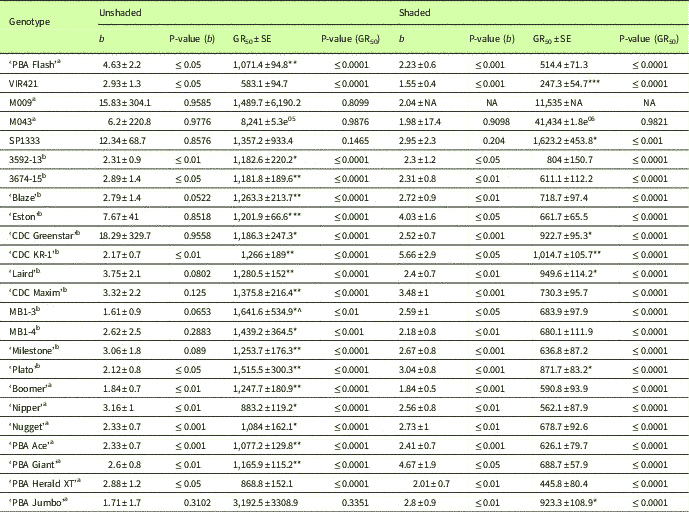
A three-parameter log-logistic model best explained the relationship between lentil genotypes and metribuzin rate for plant DW under the two field environments of shade and no shade. The model converged in drc, and a nonsignificant lack-of-fit test was achieved (0.54). Estimates of regression parameters and GR50 values for plant DW showed large differences in the response of genotypes to metribuzin rate under both environments (Table 3). Nonsignificant parameter estimates for GR50 were associated with high levels of standard error and occurred due to insufficient biomass reduction at the highest application rate leading to a poor fit of the model. In the unshaded treatment, 18 of the 24 genotypes had higher GR50 values than PBA Flash shaded, including PBA Flash unshaded. These ranged from the Canadian line MB1-3 to the metribuzin-sensitive Australian cultivar ‘Nipper’ (GRDC 2015), with GR 50 values 3.2 and 1.7 times greater than PBA Flash shaded, respectively. Of the other six genotypes, the known metribuzin-sensitive lines of VIR421 (Meier Reference Meier2016) and ‘PBA Herald XT’ (GRDC 2015) had lower and equal GR50 values compared with PBA Flash shaded, respectively. GR50 values were not significant for ‘PBA Jumbo,’ SP1333, M043, and M009, as the lower limit could not be estimated at the range of rates evaluated. All genotypes with significant GR50 values under unshaded conditions had lower GR50 values when shaded, suggesting that metribuzin damage was accentuated in lentil under conditions of shade before herbicide application. A similar effect was observed in tomato by Pritchard and Warren (Reference Pritchard and Warren1980). Under shade, all genotypes, except for M009, M043, and SP1333, had significant parameter estimates and GR50 values within the range of rates evaluated. In shade, 15 genotypes had equal or lower GR50 values than PBA Flash shaded (Table 3). However, the Australian cultivar PBA Jumbo (1.8 times higher), the Canadian cultivars ‘Plato’ (1.7), ‘Laird’ (1.8), CDC Greenstar (1.8), and ‘CDC KR-1’ (2.0), and the germplasm line SP1333 (3.2) all had higher GR50 values than PBA Flash shaded, indicating an improved level of metribuzin tolerance in these cultivars. This observed range in metribuzin tolerance among existing Australian and Canadian cultivars is relatively small and strongly influenced by environmental factors that increase metribuzin phytotoxicity. The increase in metribuzin tolerance of SP1333 over PBA Flash under shaded conditions was similar to that observed in the controlled-environment experiments. GR50 values could not be calculated for M009 and M043, as insufficient biomass reduction occurred at the rates used, even in the more damaging environment of induced shade. This result was not surprising, as GR50 values in the controlled-environment dose responses were at least two times greater than the highest field rate used, which in turn is five times greater than the label rate for metribuzin in lentil in Canada. The lack of response of the mutant lines to metribuzin under two field environments supports the controlled-environment results that showed they have a superior level of herbicide tolerance compared with all other genotypes evaluated. Further supporting the controlled-environment findings was the observation that no herbicide-damage symptoms (0% necrosis) occurred in M009 and M043 under the most damaging field treatment (shade plus metribuzin at 1,200 g ha−1), unlike in all other genotypes (28% to 97% necrosis) (unpublished data). The DW GR50 values of PBA Flash were higher under field conditions in Canada than those achieved in both controlled-environment dose–response experiments. This apparently greater genotype tolerance may be explained by favorable variation in variables such as soil organic content (Savage Reference Savage1976), herbicide incorporation into the soil due to inconsistent rainfall after application (Schroeder et al. Reference Schroeder, Banks and Nichols1985; Muehlbauer et al. Reference Muehlbauer, Kaiser, Clement and Summerfield1995), positional evasion of herbicide by crop roots (Coble and Schrader, Reference Coble and Schrader1973), temperature (Caldwell and O’Sullivan Reference Caldwell and O’Sullivan1985), and light intensity (Pritchard and Warren Reference Pritchard and Warren1980) in the field when compared with controlled-environment pot experiments. However, the same relative trends in genotype tolerance between the mutant lines, SP1333 and the control lines PBA Flash, CDC Maxim, and CDC Greenstar persisted between the experiments and across conditions.
Estimates of regression parameter b (slope±SE) and GR50 (the rate required to reduce dry weight 50%) (±SE) for plant dry weight (g plant−1) of lentil genotypes treated with metribuzin herbicide (0, 150, 300, 600, and 1,200 g ha−1) under environments of induced shade (Shaded) and no shade (Unshaded) for 72 h before spray application at a field site in Saskatoon, SK, Canada, in 2014.
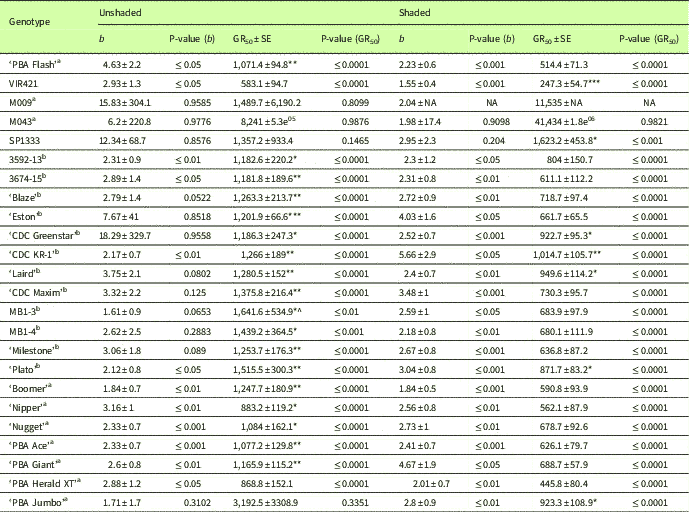
*P≤0.05, **P≤0.01, and ***P≤0.001 for significance compared with PBA Flash shaded using pairwise comparison (SI function in drc); *^P=0.053.
a Australian lentil-breeding program origin.
b Canadian lentil-breeding program origin.
This study identified and validated a high level of metribuzin tolerance in two mutated genotypes and an intermediate level of tolerance in the germplasm line SP1333 compared with the original mutant parent cultivar across controlled and field environments. The intermediate tolerance level in SP1333 is similar to that of the Canadian green lentil CDC Greenstar but superior to all Australian genotypes under field conditions and comparable to that found in a range of crops for which GR50 or equivalent measures have been used to determine tolerance improvements. These include a 2- to 3-fold improvement in tolerance between the susceptible and the most improved genotypes in winter wheat (Kleemann and Gill Reference Kleemann and Gill2007), 3-fold improvement in soybean (Barrentine et al. Reference Barrentine, Hartwig, Edwards and Kilen1982), 2-fold improvement in cowpea (Harrison Reference Harrison1988), 3-fold improvement in barley (Gawronski et al. Reference Gawronski, Haderlie and Stark1987), and 2-fold improvement in narrowleaf lupin (Si et al. Reference Si, Sweetingham, Buirchell, Bowran and Piper2006). In the only previously reported case of mutagenesis used for discovering metribuzin tolerance, two separately induced mutants of narrowleaf lupin were identified with four and six times tolerance over the original wild type in controlled-environment conditions (Si et al. Reference Si, Buirchell and Sweetingham2009). In another study, the authors showed a further 5-fold increase in tolerance was achieved in F2 plants from a cross between these tolerant mutants in glasshouse studies (Si et al. Reference Si, Pan and Sweetingham2011). The two highly tolerant mutant lines of lentil in this study exhibited greater than 25 times the tolerance of the parent cultivar and, importantly, no plant damage symptoms or biomass reductions at field rates approximately four times the label rate. At these levels, all 20 Australian and Canadian genotypes incurred high levels of plant damage. The estimated induced mutation rate in this study was 9.4×10⁻⁸ based on the one highly tolerant plant found in the M2 generation compared with a lower estimated rate of 2.5×10⁻⁵ in the narrowleaf lupin study by Si et al. (Reference Si, Buirchell and Sweetingham2009).
Despite first being discovered in 1968, metribuzin remains a significant herbicide of choice in many farming systems in both the Southern and Northern Hemisphere, due in large part to its broad-spectrum grass and broadleaf weed control. However, more recently, it has been identified as having potential to control IMI-resistant broadleaf weeds such as wild mustard (Sinapis arvensis L.) in Canada (Beckie and Tardif Reference Beckie and Tardif2012) and oriental mustard (Sisymbrium orientale L.), African mustard (Brassica tournefortii Gouan), and wild radish (Raphanus raphanistrum L.) in Australia (Boutsalis et al. Reference Boutsalis, Gill and Preston2016). It also has a lower risk for weed herbicide-resistance selection than the AHAS inhibitor group (Beckie and Tardif Reference Beckie and Tardif2012), potentially delaying the onset of herbicide resistance in weed populations. The availability of lentil genotypes with high levels of metribuzin tolerance will provide breeding programs with an alternative or complementary herbicide tolerance trait to IMI and improve weed control options for growers. Further agronomic evaluation of this herbicide-tolerance trait in lentil is required, including grain yield assessments on soils varying in sand content to quantify its potential agronomic impact. An understanding of the heritability and the mechanisms of herbicide tolerance, along with identification of any associated fitness penalty or other deleterious mutations will be required to allow plant breeders to effectively incorporate this high level of tolerance. M043 and M009 were identified from the M2 and M3 field screens, respectively, and exhibited different morphological plant habits that may or may not be beneficial to plant breeders.
Mutagenesis and large-scale field selection proved to be an effective technique for generating a high level of metribuzin tolerance in lentil. While the in situ germplasm-screening approach was quicker and more cost-efficient, only a lower level of tolerance was identified. The mutagenesis approach generated a far greater level of metribuzin tolerance and had the benefits of the researcher being able to use an elite cultivar as the parent. Alternative approaches to generating herbicide-tolerant crops such as transformation techniques remain problematic in pulses, and it is unlikely that these approaches would ever lead to commercial cultivars in a minor crop like lentil, due to low return on investment and potential international trade issues (Devine Reference Devine2005).
Acknowledgments
The Grains Research Development Corporation (GRDC), the South Australian Research and Development Institute (SARDI), and the University of Adelaide provided financial support for this study. No conflicts of interest have been declared. Technical assistance was provided by Shi Ying Yang, Patrick Krolikowski, Paul Swain, Sam Catt, and Ian Roberts of the University of Adelaide; Kathy Fischer and Michael Lines of SARDI; and Brent Barlow, Devini De Silva, Chandra Bandara, Kevin Mikituk, Kirk Blomquist, Shermy Badana Mudiyanselage, Jaret Horner, Scott Ife, Donna Lindsay, Gerry Stuber, Adam Harrison, Stacey Wagenhoffer, Anoja Weerasinghe, Tao Chen, and Thiago Prado from the University of Saskatchewan, Saskatoon. Eric Johnson, Monika Lulsdorf, and Vladimir Pajic, University of Saskatchewan, Saskatoon, provided local scientific input into the Canadian experiments. Michael Materne and Mirella Butsch, Agriculture Victoria, provided seed from Pulse Breeding Australia Lentil, and Robert Redden, Agriculture Victoria, provided accessions from the Australian Grains Genebank for the germplasm-screening experiments.