Introduction
The surge in global pork consumption demand is driving the growth in artificial insemination (AI) pig farming. Currently, AI with liquid semen is the most widely used assisted reproduction technique worldwide, due to its ease of storage and the ability to achieve reproductive results similar to natural mating (Pezo et al., Reference Pezo, Romero, Zambrano and Sánchez2019). Normally, boar sperm can only maintain viability in vitro for a few hours, but this has been altered by the use of extenders that allows sperm to live and be fertile for up to several days (Johnson et al., Reference Johnson, Weitze, Fiser and Maxwell2000).
As a rule, most commercial extenders consist of (1) nutrients to maintain sperm metabolic processes, (2) buffer solutions to regulate pH, (3) mineral ions to maintain osmotic pressure, and (4) antibiotics to inhibit bacterial growth (Johnson et al., Reference Johnson, Weitze, Fiser and Maxwell2000; Gadea, Reference Gadea2003; Pezo et al., Reference Pezo, Romero, Zambrano and Sánchez2019). These promote sperm survival to some extent, but there are still deficiencies, such as a lack of antioxidants. Boar sperm are particularly susceptible to oxidative stress as their plasma membranes are rich in polyunsaturated fatty acids, which generates excess ROS that can severely affect sperm function (Žura Žaja et al., Reference Žura Žaja, Samardžija, Vince, Vilić, Majić-Balić, Đuričić and Milinković-Tur2016; Pei et al., Reference Pei, Yang, Wu, He, Geng, Xu, Chen and Li2018; Feng et al., Reference Feng, Zhu, Bai, Li, Zheng, Tian, Wu, Lu, Wang and Zeng2020). In addition, the over-reliance on antibiotics in extenders has led to an increasing number of drug-resistant bacteria produced in liquid-stored boar semen (Hensel et al., Reference Hensel, Jakop, Scheinpflug, Mühldorfer, Schröter, Schäfer, Greber, Jung and Schulze2020), which can impair sperm quality due to the toxic effects of bacteria (Kuster and Althouse, Reference Kuster and Althouse2016), and can also seriously jeopardize the health and reproductive capacity of sows, such as causing endometritis or impairing fertility rates (Shaoyong et al., Reference Shaoyong, Li, Ren, Wei, Chu, Dong, Yang and Pang2019b). Clearly, there is an urgent need to improve the existing extenders to address these deficiencies.
SP is a complex fluid secreted mainly by the accessory glands of males during ejaculation (Parrilla et al., Reference Parrilla, Martinez, Gil, Cuello, Roca, Rodriguez-Martinez and Martinez2020), which not only provides nutrition to spermatozoa, but also appropriate physiological conditions in terms of pH and osmotic pressure to maintain activity, viability, metabolism and capacitation processes (Recuero et al., Reference Recuero, Fernandez-Fuertes, Bonet, Barranco and Yeste2019). In addition, it has been reported that some components of SP also play a role in anti-oxidative stress (Sabeti et al., Reference Sabeti, Pourmasumi, Rahiminia, Akyash and Talebi2016) and inhibition of bacterial growth (Schulze et al., Reference Schulze, Czirják, Müller, Bortfeldt, Jung and Jakop2019). As far as antioxidants are concerned, both sperm and SP possess antioxidant molecules and protective enzymes against oxidative stress (Tavilani et al., Reference Tavilani, Goodarzi, Vaisi-raygani, Salimi and Hassanzadeh2008). However, spermatozoa themselves predominantly process in enzymatic antioxidant (Griveau et al., Reference Griveau, Dumont, Renard, Callegari and Le Lannou1995), and possess minimum antioxidant enzymes (Sabeti et al., Reference Sabeti, Pourmasumi, Rahiminia, Akyash and Talebi2016). Therefore, enzymatic and non-enzymatic antioxidants of SP are essential to protect sperm from oxidative stress (Barranco et al., Reference Barranco, Padilla, Tvarijonaviciute, Parrilla, Martínez, Rodriguez-Martinez, Yeste and Roca2019). SP contains many ROS scavengers such as superoxide dismutase, catalase, glutathione peroxidase (Parrilla et al., Reference Parrilla, Martinez, Gil, Cuello, Roca, Rodriguez-Martinez and Martinez2020), and some antioxidant molecules such as vitamin C, vitamin E, beta carotene, carotenoids, flavonoids and metal binding proteins (e.g. albumin, ferritin and myoglobin), which act as non-enzymatic antioxidants by deactivating pro-oxidant transition metal ions (Sabeti et al., Reference Sabeti, Pourmasumi, Rahiminia, Akyash and Talebi2016). Moreover, some metal ions in SP, such as Mg, Cu, Zn, and Se, are also involved in antioxidant effects as enzymatic components (Juyena and Stelletta, Reference Juyena and Stelletta2012; Parrilla et al., Reference Parrilla, Martinez, Gil, Cuello, Roca, Rodriguez-Martinez and Martinez2020). With regard to the anti-bacterial activity, a previous study demonstrated that the SP can fight against a variety of bacterial species, and it is therefore hypothesized that the anti-bacterial activity of SP could play an important role in protecting sperm prior to and during insemination (Schulze et al., Reference Schulze, Czirják, Müller, Bortfeldt, Jung and Jakop2019), which is supported by several studies in which some antimicrobial active substances, such as Zn (Juyena and Stelletta, Reference Juyena and Stelletta2012; Mårdh and Colleen, Reference Mårdh and Colleen1975), Mg (Mårdh and Colleen, Reference Mårdh and Colleen1975) and lysozyme (Rowe et al., Reference Rowe, Czirják, Lifjeld and Giraudeau2013) were found to be present in SP fractions. In total, SP contains components such as antioxidants and antimicrobial substances that may promote sperm quality during liquid storage.
In practice, raw semen is often over-diluted to increase the availability of high genetic value boars, which will produce a ‘dilution effect’ that greatly disrupts the binding of SP with sperm cells and affects sperm quality (Schulze et al., Reference Schulze, Ammon, Schaefer, Luther, Jung and Waberski2017). In addition, over-dilution of semen may have an impact on fertilization outcomes, as there is sufficient SP in the natural insemination process to interact with the female reproductive tract, modulate immunity, and regulate fertilization and subsequent embryonic development, but the effect of SP is diminished in over-diluted semen (Recuero et al., Reference Recuero, Fernandez-Fuertes, Bonet, Barranco and Yeste2019). Therefore, retaining the appropriate amount of SP in the extender may not only be beneficial in improving sperm quality during storage, but also improve reproductive performance.
To date, the concentration of SP that is most beneficial for sperm storage remains unknown. Therefore, the aim of this study was to compare the effects of different levels of SP on boar sperm quality, antioxidant capacity and bacterial concentration to determine an optimal SP level for liquid-stored semen at 17°C.
Materials and methods
Chemicals and extenders
Unless otherwise stated, all reagents used in this study were purchased from Sigma-Aldrich (St. Louis, MO, USA). BTS is used as a diluent extender containing 37.15 g/l glucose, 1.25 g/l EDTA, 6.00 g/l disodium citrate, 1.25 g/l sodium bicarbonate, and 0.75 g/l potassium chloride (Johnson et al., Reference Johnson, Weitze, Fiser and Maxwell2000).
Preparation of Luria-Bertani medium
Liquid medium was prepared as described by Sezonov et al. (Reference Sezonov, Joseleau-Petit and D’Ari2007). Briefly, 10 g of tryptone, 5 g of yeast extract, and 10 g of NaCl were added to 950 ml of deionized water and the vessel was shaken until the solute was dissolved, then the pH was adjusted to 7.0 with 5 mol/l NaOH. Finally, the volume was fixed to 1 litre with deionized water and the vessel was steam sterilized at 15 psi for 21 min.
Semen collection and processing
Boars were routinely used for AI, received commercial feed (pellets) and were housed individually in pens equipped with nipple drinkers. Eight ejaculations from healthy Guanzhong-black boars (age: 20 ± 2 months; body weight: 187.5 ± 3.6 kg) were collected by the gloved hand method, and the pre-seminal and gel fractions were discarded during collection. Semen samples were used in the study only if they met the criteria: ≥5.0 × 10⁸ sperm/ml, ≥80% total motility, and ≥80% normal morphology (Shaoyong et al., Reference Shaoyong, Li, Ren, Xiao, Diao, Yang and Pang2019a).
Experimental design
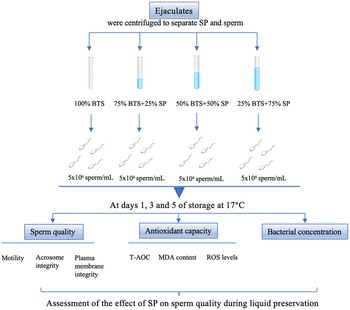
As shown in Figure 1, raw semen was centrifuged at 600 g for 5 min to separate SP and sperm as described in a previous study (Zeng and Terada, Reference Zeng and Terada2001). SP was then collected and redistributed with BTS to different levels of 0, 25, 50 and 75% (v/v). The values of selected SP components and T-AOC of the SP were determined. Sperm pellets were resuspended and washed twice in BTS, at 600 g for 5 min, and subsequently diluted with BTS containing different levels of SP with a sperm concentration of 5 × 10⁶ sperm/ml. Each 10-ml aliquot of semen sample was stored at 17°C. During days 1, 3 and 5 of storage, sperm quality, antioxidant capacity of sperm and bacterial concentrations in extended semen were assessed. Each treatment was performed in at least three technical replicates throughout the experiment.
Flow chart of the experimental design.

Assessment of total motility, progressive motility and sperm dynamics
Total motility, progressive motility and sperm dynamics were accessed using the CASA system (Hamilton Thorne Research, Beverly, MA, USA). Briefly, each 10 µl semen sample was placed in a preheated chamber at 37°C for 30 s, and at least 200 sperm were recorded per sample. The recorded CASA parameters included linear velocity (VSL, μm/s), curvilinear velocity (VCL, μm/s), average path velocity (VAP, μm/s), linearity coefficient (LIN, %), Wobble coefficient (WOB, %), straightness coefficient (STR, %), mean amplitude of lateral head displacement (ALH, μm), beat cross frequency (BCF, Hz). As described in a previous study (Hensel et al., Reference Hensel, Jakop, Scheinpflug, Mühldorfer, Schröter, Schäfer, Greber, Jung and Schulze2020), when ALH > 1.0 μm and VCL > 24.0 μm/s, they were defined as motile spermatozoa; when VCL ≥ 48.0 μm/s and VSL ≥ 10.0 μm/s, they were classified as progressively motile spermatozoa.
Assessment of sperm acrosome and plasma membrane integrity
Sperm acrosome integrity was assessed by double staining with fluorescein peanut agglutinin isothiocyanate (FITC-PNA) and 4′,6-diamidino-2-phenylindole (DAPI) as reported by Shaoyong et al. (Reference Shaoyong, Li, Ren, Wei, Chu, Dong, Yang and Pang2019b). In brief, each 10-μl aliquot of samples was fixed on slides with anhydrous methanol and dried naturally for 10 min at 37°C, then co-incubated with 30 μl DAPI (10 μg/ml) and 30 μL FITC-PNA (100 μg/ml) working solution at 37°C for 30 min in the dark. Plasma membrane integrity was assessed using the LIVE/DEAD® Kit (Thermo Fisher Scientific Inc., Waltham, MA, USA). Briefly, samples of 1 ml each were co-incubated with 1 μL of SYBR-14® and 5 μL of PI for 10 min. Sperm acrosome and membrane integrity were accessed by fluorescence microscopy (Nikon Eclipse E600, Tokyo, Japan) at ×400 magnification. Three clear fields of view were randomly selected for observation, and at least 200 spermatozoa per field of view were judged to have intact plasma membranes.
Assessment of T-AOC, MDA content and ROS levels
T-AOC, MDA content and ROS levels were measured using the Total Antioxidant Capacity Assay Kit (Nanjing Jiancheng Bioengineering Institute, China), Malonaldehyde Assay Kit (Nanjing Jiancheng Bioengineering Institute, China), Reactive Oxygen Species Assay Kit, respectively. The T-AOC and MDA content were measured using a Shimadzu spectrophotometer model UV-2600 (Shimadzu Corporation, Tokyo, Japan). Briefly, spermatozoa extracts were prepared as described in a previous study (Breininger et al., Reference Breininger, Dubois, Pereyra, Rodriguez, Satorre and Cetica2017), then mixed with the T-AOC and MDA reaction buffer at room temperature, respectively. Subsequently, the T-AOC was measured at 520 nm and results were expressed as U/ml. The MDA content was measured at 532 nm and results were shown as nmoL/ml. ROS levels in sperm were assessed by DCFH2-DA, as described in a previous study (Sun et al., Reference Sun, Fan, Zeng, Wang, Zhu, Li, Tian, Wang, Lin, Wu and Zeng2020). Briefly, 1 ml of semen samples was incubated with 10 μM DCFH2-DA working solution at 37°C for 30 min in the dark. The fluorescence intensity was detected at the optimal excitation/emission wavelength of 485 nm/525 nm.
Assessment of bacterial concentrations
The bacterial concentrations in extended semen were determined as described in a previous study (Lopes et al., Reference Lopes, Strømme and Ferraz2020). Each 10-μl aliquot of semen was add into the liquid Luria-Bertani medium and then incubated at 37°C overnight. The optical density was detected at 600 nm using a microplate colorimeter (NEPHELOstar Plus, Germany).
Statistical analysis
Statistical analysis was performed using SPSS 22.0 software (SPSS, Inc., Chicago, IL, USA). Firstly, all data were tested for normality (Shapiro–Wilk test) and homoscedasticity (Levene test). Then, total motility, progressive motility, sperm dynamics parameters, acrosome integrity, plasma membrane integrity, T-AOC, MDA content, ROS levels, and bacterial concentrations were compared using Duncan’s multiple range test. Results were expressed as mean ± SD, and differences were considered significant when the calculated probability of occurrence was less than 0.05 (P < 0.05).
Results
Biochemical analysis of SP in boars
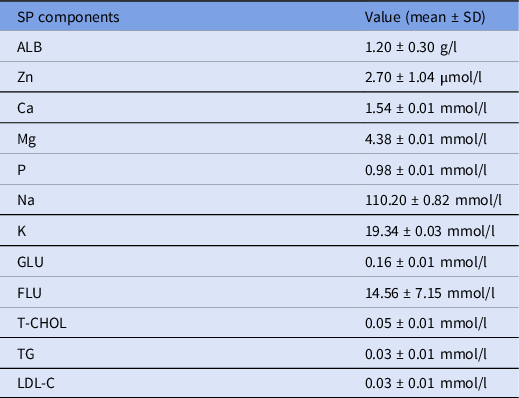
The values of selected SP components in boars are shown in Table 1. Among the selected sugars, fructose (FLU) was higher than glucose (GLU) (14.56 ± 7.15 mmol/l vs. 0.16 ± 0.01 mmol/l), among the selected minerals, sodium (Na) was the highest (110.20 ± 0.82 mmol/l), and among the selected lipids, the total cholesterol (T-CHOL) was the highest (0.05 ± 0.01 mmol/l).
Values of selected SP components in boars

Note: ALB: albumin; Ca: calcium; FLU: fructose; GLU: glucose; K: potassium; LDL-C: low-density-lipoprotein cholesterol; LDH: lactate dehydrogenase; Mg: magnesium; Na: sodium; P: phosphorus; T-CHOL: total cholesterol; TG: triglyceride; Zn: zinc.
The 25% SP effectively improves sperm quality during liquid storage
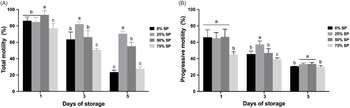
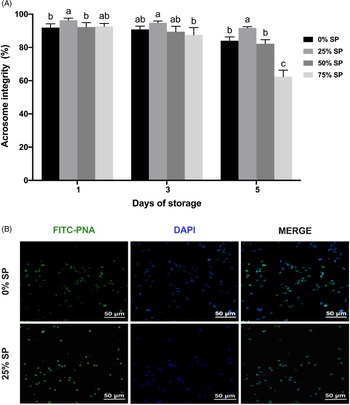
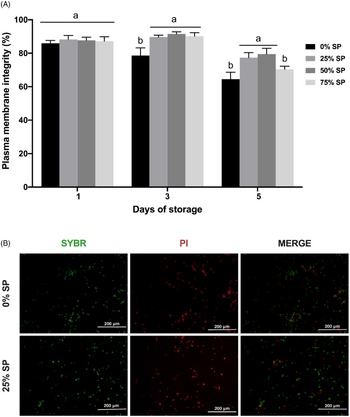
The effect of different levels of SP on sperm motility is shown in Figure 2. After 5 days of storage, 25% and 50% SP significantly enhanced total motility and progressive motility compared with the 0% and 75% SP (P < 0.05). Similarly, all tested sperm kinetic parameters (Table 2) including VSL, VCL, VAP, LIN, WOB, STR, BCF and ALH were also significantly improved at 25% SP compared with the other levels (P < 0.05). Consistent with this, after 5 days of storage, the percentage of sperm acrosome integrity (Figure 3) was significantly higher at 25% SP than at other levels (P < 0.05). Moreover, 25% and 50% SP significantly enhanced sperm plasma membrane integrity (Figure 4) compared with 0% and 75% SP (P < 0.05).
Effects of different levels of SP on sperm motility. (A) The variation in total sperm motility during liquid storage at 17°C. (B) The variation in progressive sperm motility during liquid storage at 17°C. Results are represented as mean ± SD (n = 3 per group). a–c Different letters indicate significant differences (P < 0.05).

Effects of different levels of SP on boar sperm dynamics

ALH: mean amplitude of lateral head displacement; BCF: beat cross frequency; LIN: linearity coefficient; STR: straightness coefficient; VAP: average path velocity; VCL: curvilinear velocity; VSL: linear velocity; WOB: Wobble coefficient.
Results are represented as mean ± SD (n = 3 per group).
a–cDifferent superscript lowercase letters in each column indicate significant differences (P < 0.05).
Effects of different levels of SP on sperm acrosome integrity. (A) The variation in sperm acrosome integrity during liquid storage at 17°C. (B) FITC-PNA and DAPI staining of sperm acrosome on the fifth day of storage at 17°C. Results are represented as mean ± SD (n = 3 per group). a–cDifferent letters indicate significant differences (P < 0.05).

Effects of different levels of SP on sperm plasma membrane integrity. (A) The variation in sperm plasma membrane integrity during liquid storage at 17°C. (B) SYBR and PI double staining of sperm plasma membranes on the fifth day of storage at 17°C. Results are represented as mean ± SD (n = 3 per group). a,bDifferent letters indicate significant differences (P < 0.05).

The 25% SP attenuates sperm oxidative stress during liquid storage
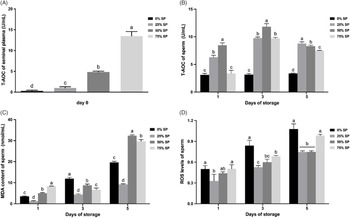
The effect of different levels of SP on sperm oxidative stress is shown in Figure 5. The T-AOC of raw SP (Figure 5A) was significantly elevated with SP levels (P < 0.05). By contrast, after 5 days of storage, T-AOC of sperm was significantly higher at 25% SP compared with other levels (P < 0.05), MDA content of sperm (Figure 5C) was significantly elevated at 50% and 75% SP but significantly decreased at 25% SP compared with 0% SP (P < 0.05), and ROS levels of sperm (Figure 5D) were significantly reduced at 25% and 50% SP compared with 0% SP (P < 0.05).
Effects of different levels of SP on sperm oxidative stress. (A) Changes in T-AOC of raw SP. (B) Changes in T-AOC of sperm during liquid storage at 17°C. (C) Changes in MDA content of sperm during liquid storage at 17°C. (D) Changes in ROS levels of sperm during liquid storage at 17°C. Results are represented as mean ± SD (n = 3 per group). a–dDifferent letters indicate significant differences (P < 0.05).

SP increases bacterial concentrations in a dose-dependent manner during liquid storage
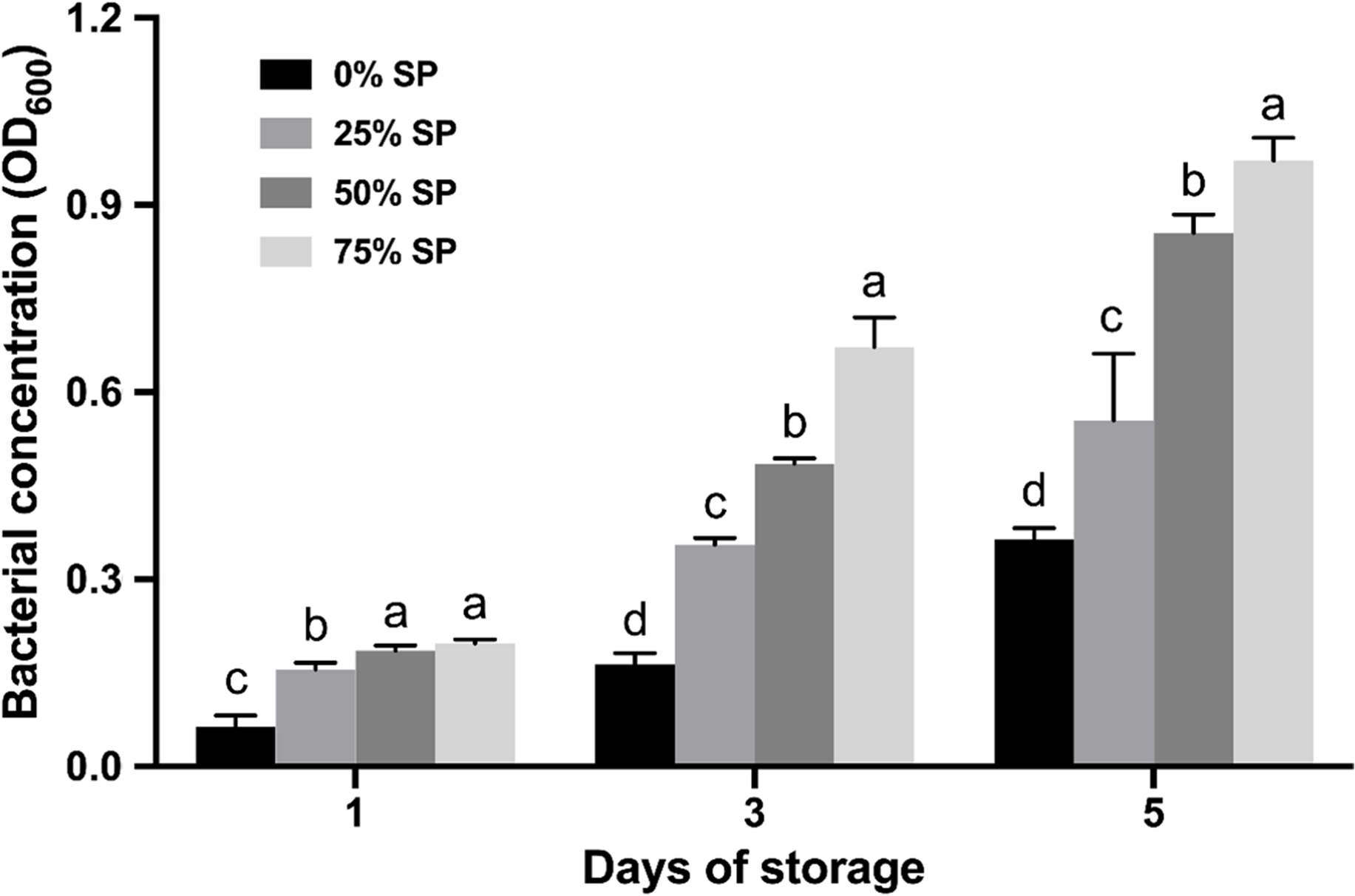
The effect of different levels of SP on the bacterial concentrations is shown in Figure 6. During liquid storage, the bacterial concentrations in extended semen were significantly higher in 25, 50 and 75% SP compared with 0% SP (P < 0.05). Furthermore, the bacterial concentrations in extended semen significantly increased in a SP dose-dependent manner (P < 0.05).
Effects of different levels of SP on the bacterial concentrations. Bacterial concentrations in extended semen were measured at 1, 3 and 5 days of storage. Results are represented as mean ± SD (n = 3 per group). a–dDifferent letters indicate significant differences (P < 0.05).

Discussion
In the present study, SP supplementation led to dose-dependent effects on sperm quality, but showed a dichotomy: low doses of SP promoted total sperm motility, progressive motility, sperm dynamics, acrosome and plasma membrane integrity, however high doses of SP led to lower levels of these parameters compared with the controls. The addition of 25% SP was most effective in improving sperm quality. In agreement with our study, Pan et al. (Reference Pan, Wu, Yang and Ye2018) reported that high concentrations of SP impaired canine sperm quality during liquid preservation, however the addition of a lower 25% SP proved to be effective in promoting sperm quality. Similar results were also reported by Maxwell et al. (Reference Maxwell, Welch and Johnson1996) that the addition of lower 10% SP was effective in promoting the viability and membrane integrity of boar spermatozoa.
Oxidative stress was implicated in low sperm quality (Ammar et al., Reference Ammar, Houas and Mehdi2019). In this study, high accumulation of ROS and MDA was observed when sperm were stored in extenders with high levels (75%) or absence (0%) of SP, which revealed that sperm suffered severe oxidative stress. Consistent with this, removal or high levels of SP resulted in a low sperm quality that had been observed in our study. However, low levels (25%) of SP in the extender improved the antioxidant capacity of sperm, therefore reducing oxidative damage to enhance sperm quality. In agreement with our results, previous studies have reported that sperm quality improvement can be achieved by enhancing its antioxidant capacity (Tian et al., Reference Tian, Li, He, Zhang, He, Du, Pang, Yang and Yu2019; He et al., Reference He, Li, Zhang, Tian, Pang, Du, Yang and Yu2020; Sun et al., Reference Sun, Fan, Zeng, Wang, Zhu, Li, Tian, Wang, Lin, Wu and Zeng2020). Both sperm and SP contain antioxidant enzymes such as superoxide dismutase (SOD), glutathione peroxidase (GPx), and catalase (CAT) (Juyena and Stelletta, Reference Juyena and Stelletta2012). In addition, many cations in SP can function as components of many antioxidant enzymes, such as Mg, Cu, and Zn and can form CuZn-SOD, Mn-SOD with SOD (Eghbali et al., Reference Eghbali, Alavi-Shoushtari and Rezaii2008), and Se can form Se-GPx with GPx (Jelezarsky et al., Reference Jelezarsky, Vaisberg, Chaushev and Sapundjiev2008). The previous study has shown that there is a continuous exchange of antioxidants between SP and sperm (Barranco et al., Reference Barranco, Tvarijonaviciute, Padilla, Rodriguez-Martinez, Roca and Lucas2021). Although spermatozoa themselves are mainly in the process of enzymatic antioxidant, however, they possess minimal antioxidant enzymes (Sabeti et al., Reference Sabeti, Pourmasumi, Rahiminia, Akyash and Talebi2016). Therefore, the antioxidants present in SP mainly compensate for the lack of cytoplasmic enzymes. T-AOC measurements take into account the cumulative effect of all antioxidants present in plasma and body fluids, therefore providing an integrated parameter rather than the simple sum of measurable antioxidants (Ghiselli et al., Reference Ghiselli, Serafini, Natella and Scaccini2000). In our study, T-AOC of the original SP increased in a dose-dependent manner, however, when sperm were stored with different levels of SP, we found a marked increase in sperm T-AOC at low levels of SP. These suggested that low levels of SP may promote the replenishment of antioxidants in the sperm cytoplasm and therefore promote antioxidant capacity.
In our study, no obvious association was found between sperm quality and bacterial content. Therefore, the harmful effects of bacteria on sperm quality may be related to their species. Previous reports have shown that persistent bacterial contamination, such as Enterobacter spp., can lead to decreased sperm quality in boars (Bussalleu et al., Reference Bussalleu, Yeste, Sepúlveda, Torner, Pinart and Bonet2011; Ubeda et al., Reference Ubeda, Ausejo, Dahmani, Falceto, Usan, Malo and Perez-Martinez2013; Pinart et al., Reference Pinart, Domènech, Bussalleu, Yeste and Bonet2017). However, the harmful effects of other bacterial genera on sperm have rarely been reported. Previous research has shown that some animals such as bull and boar have been proved to have antimicrobial defences in their semen against contaminating bacteria (Schulze et al., Reference Schulze, Jakop, Schröter, Herrmann, Leiding, Müller, Jung and Czirják2020). In addition, it has been reported that lysozyme in boar SP has killing activity against Gram-negative and Gram-positive bacteria represented by Escherichia coli and Staphylococcus aureus (Schulze et al., Reference Schulze, Czirják, Müller, Bortfeldt, Jung and Jakop2019, Reference Schulze, Jakop, Schröter, Herrmann, Leiding, Müller, Jung and Czirják2020). Furthermore, Strzeżek et al. (Reference Strzeżek, Hopfer and Zaborniak1987) reported the presence of zinc ion-dependent antimicrobial proteins in boar SP, which effectively inhibited the growth of Gram-positive bacteria. These anti-bacterial substances in the SP may help to attenuate the harmful effects of bacteria on sperm. However, in our study, bacterial concentrations increased with SP levels, suggesting that the antimicrobial activity of SP is weak and, instead, that SP can promote bacterial multiplication due to enriched nutrients. As reported in previous studies, the extenders are very rich media containing sufficient nutrients to support bacterial growth (Althouse and Lu, Reference Althouse and Lu2005; Hensel et al., Reference Hensel, Jakop, Scheinpflug, Mühldorfer, Schröter, Schäfer, Greber, Jung and Schulze2020). However, SP contains more nutritional components compared with extenders, which may act as a complement to extenders and therefore promote bacterial multiplication. Related studies are unreported and therefore need to be further explored.
In conclusion, maintaining high levels or absence of SP during liquid storage is more likely to expose sperm to oxidative stress, thereby reducing sperm quality, however low levels of SP can improve sperm quality by enhancing antioxidant capacity. In addition, SP can promote bacterial multiplication in a dose-dependent manner during liquid storage. As far as the current AI pig industry is concerned, these findings may provide new insights into pig semen storage. At this time, the dilution of liquid-stored boar semen is mainly based on sperm density and viability, which completely ignores the role of SP in the storage process. According to our study, maintaining 25% SP in extenders can effectively improve the sperm quality by enhancing its antioxidant capacity, which may play a complementary role to the current commercial extenders in antioxidant deficiency.
Acknowledgements
This study was supported by the National Key Research and Development Programme of China (2021YFF1000602) and China Agriculture Research System of the Ministry of Finance and the Ministry of Agriculture and Rural Affairs (CARS-35).
Author’s contributions
Zhongyun Kou designed and completed the experiments and wrote the manuscript; Bingyan Hu and Yuqing Li assisted in the experiments; Rui Cai, Lei Gao and Guiyan Chu assisted in the data analysis; Gongshe Yang and Weijun Pang supervised the project, revised and approved the final manuscript.
Disclosure statement
All authors affirm that there is no conflict of interests.
Ethical approval
All procedures involving boars were carried out in accordance with guidelines according to the Institutional Animal Care and Use Committee of Northwest A&F University.