Introduction
The protective influence of satisfied social needs on health and wellbeing
For every individual social needs are one of the most important human needs. They come right after physical needs and the need for safety as defined in the often-applied Maslow hierarchy of human needs (Maslow et al. Reference Maslow, Frager, Fadiman, McReynolds and Cox1970). Maslow et al. (Reference Maslow, Frager, Fadiman, McReynolds and Cox1970) define social needs as the basic human need for love, acceptance and belonging. When social needs are not satisfied, this can lead to loneliness and social isolation. Loneliness and social isolation are directly linked to sickness and mortality (Cacioppo, Hawkley and Berntson Reference Cacioppo, Hawkley and Berntson2003, Steptoe et al. Reference Steptoe, Shankar, Demakakos and Wardle2013). The body of literature that illustrates the protective role of satisfied social needs on physical and mental health is quite substantial (Al-Kandari and Crews Reference Al-Kandari and Crews2014; Avlund et al. Reference Avlund, Lund, Holstein and Due2004; Berkman and Syme Reference Berkman and Syme1979; Golden et al. Reference Golden, Conroy, Bruce, Denihan, Greene, Kirby and Lawlor2009; Iecovich, Jacobs and Stessman Reference Iecovich, Jacobs and Stessman2011; Portero and Oliva Reference Portero and Oliva2007; Seeman Reference Seeman1996). Fulfilled social needs protect against diseases and depression and were also found to have a positive influence on self-esteem and life fulfilment (Miura and Agari Reference Miura and Agari2006). Feelings of loneliness and social isolation are unwelcome and unhealthy for everyone and can be present regardless of age, sex and background. The fulfilment of social needs is therefore relevant for every individual. In this systematic literature review, we chose to focus specifically on community-dwelling older adults. In Western countries, the percentage of older people is growing rapidly (Gavrilov and Heuveline Reference Gavrilov and Heuveline2003). Moreover, in the last decade older people prefer to, and are expected to, remain community-dwelling as long as possible. Older people also tend to have fewer naturally social roles and consequently fewer social contacts caused, for example, by retirement and the absence of children living in their home. These demographic and societal developments underline the importance of studies focusing on the health and wellbeing of this specific group. For older people, the satisfaction of social needs is especially important for their general wellbeing (Antonucci Reference Antonucci, Birren and Schaie2001). Older adults with strong social relationships are able to maintain independence and live longer in community settings than are socially isolated older adults (Michael et al. Reference Michael, Berkman, Colditz and Kawachi2001). Older people see their social lives and their social relationships as the most important determinants of successful ageing. They even value wellbeing and social functioning to a higher extent than physical and psycho-cognitive functioning (Von Faber et al. Reference Von Faber, Bootsma-van der Wiel, van Exel, Gussekloo, Lagaay, van Dongen, Knook, van der Geest and Westendorp2001).
Theories about changes in social needs with advancing age
Social relations and social needs change with age. Theories explaining the changes in social relationships when people age are the social convoy model (SCM) of Antonucci (Reference Antonucci, Birren and Schaie2001) and the socio-emotional selectivity theory (SST) of Carstensen (Carstensen Reference Carstensen and Jacobs1993; Carstensen, Fung and Charles Reference Carstensen, Fung and Charles2003). The SCM states that individuals go through life embedded in personal networks of individuals whom they give and from whom they receive social support (i.e. the convoys). In this theory, the concept of circles is used to separate people in terms of the closeness of their relationships with individuals. When ageing, the number of convoy members declines, especially in outer circles (Antonucci Reference Antonucci, Birren and Schaie2001). The SST of Carstensen (Reference Carstensen and Jacobs1993) claims that the social networks of older people are formed through network movements that are characterised by a process of selectivity and motivated by the emotional goals of older individuals (Carstensen Reference Carstensen and Jacobs1993; Carstensen, Fung and Charles Reference Carstensen, Fung and Charles2003). These two theories are similar in the sense that they both indicate that social network size decreases with age – the number of more peripheral members especially reduces – but that older adults maintain or increase their interactions with family and intimate friends. The difference in the two theories lies in the motivation for change. For Antonucci (Reference Antonucci, Birren and Schaie2001), the primary factor lies in the changes of social roles. For example, the loss of work makes older adults focus more on close friends and relationships. For Carstensen (Reference Carstensen and Jacobs1993), the motivation is more developmental: with an increased sense of time limitations, people try to maintain emotionally meaningful relationships and discard the less important and potentially unpleasant ones. Besides the SST and the SCM, there is a third theory that explains social network changes when ageing: the Social Production Function Theory of Successful Aging (SPF-SA; Steverink, Lindenberg and Ormel Reference Steverink, Lindenberg and Ormel1998). This theory is a combination of a theory of needs, goals and resources and a theory of behaviour. The SPF-SA identifies three social needs: status, behavioural confirmation and affection. This theory explains the changes in social relations when ageing, by changes in goals and resources. Because the latter two diminish when one gets older, the needs of status and behavioural confirmation become more difficult to satisfy. With fewer resources, the need for affection is easiest to satisfy when one gets older (Steverink, Lindenberg and Ormel Reference Steverink, Lindenberg and Ormel1998). Factors associated with ageing, such as physical loss, lend more understanding to the changes in social network than age itself.
Steverink and Lindenberg (Reference Steverink and Lindenberg2006) also identify contradictions in current research about the social needs of older persons. On the one hand, the focus on emotionally and intimate relationships is being demonstrated by the SCM and the SST (Antonucci Reference Antonucci, Birren and Schaie2001; Carstensen, Fung and Charles Reference Carstensen, Fung and Charles2003). On the other hand, evidence shows the positive effects on health and wellbeing of older people who stay socially active in community service and voluntary and productive social activities (Harlow and Cantor Reference Harlow and Cantor1996). Also, there is a positive association between psychological and physical wellbeing and having diverse and multiple social roles (Adelmann Reference Adelmann1994). By focusing on the functions (affection, behavioural confirmation and status) rather than on the structure or density of the social relations, Steverink and Lindenberg (Reference Steverink and Lindenberg2006) give insights into the apparent contradiction of the changing relations of older adults and their association to wellbeing. They found that all three social needs remain important with increasing age (Steverink and Lindenberg Reference Steverink and Lindenberg2006).
Objective(s) and relevance
When social needs of older people are met, this is often associated with higher levels of wellbeing and higher quality of life. However, a better insight into the characteristics of the social needs of this diverse population is much needed. With these insights we will be able to create more successful interventions. Although many interventions have already been created and implemented to help older people meet their social needs or to prevent loneliness or social isolation, they are rarely being evaluated or proven successful (Cattan et al. Reference Cattan, White, Bond and Learmouth2005; Fokkema and van Tilburg Reference Fokkema and van Tilburg2003).
The objective of this systematic literature review is to provide an overview of the available body of knowledge about the social needs of older people. Based on our findings, implications will be formulated for interventions that help older adults meet their social needs and therefore contribute to their wellbeing. The current study focuses on community-dwelling older adults. The main research question of this review is the following:
• What are the social needs of older people and what are the implications for interventions aimed at satisfying these needs?
Method
Search strategy
A systematic search of papers published between 2005 and 2016 was conducted. Papers of interest were expected to be published mainly in psychological and sociological journals. For this reason, the databases of PsycInfo and Sociological Abstracts were searched. The search was conducted on 29 November 2016. Studies of adults aged over 65 were included because this is often the age researchers use in empirical studies and the age at which people retire from work and focus more on their social environment.
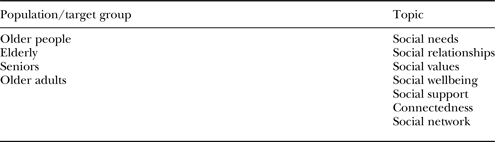
The key words and search terms are presented in Table 1.
Keywords and search terms

Inclusion and exclusion criteria
Articles published between 2005 and 2016 were included in this literature review. The inclusion and exclusion criteria that are consistent with the aim of this literature research are as follows:
1. Inclusion criteria:
(a) Empirical studies about social needs.
(b) Community-dwelling adults aged over 65.
2. Exclusion criteria:
(a) Study concerns special (medical) groups (e.g. patients, people with chronic illnesses, homeless people or earthquake survivors).
(b) Study aims to establish the relationship between social life/social support and health/depression/loneliness.
Study selection and data extraction
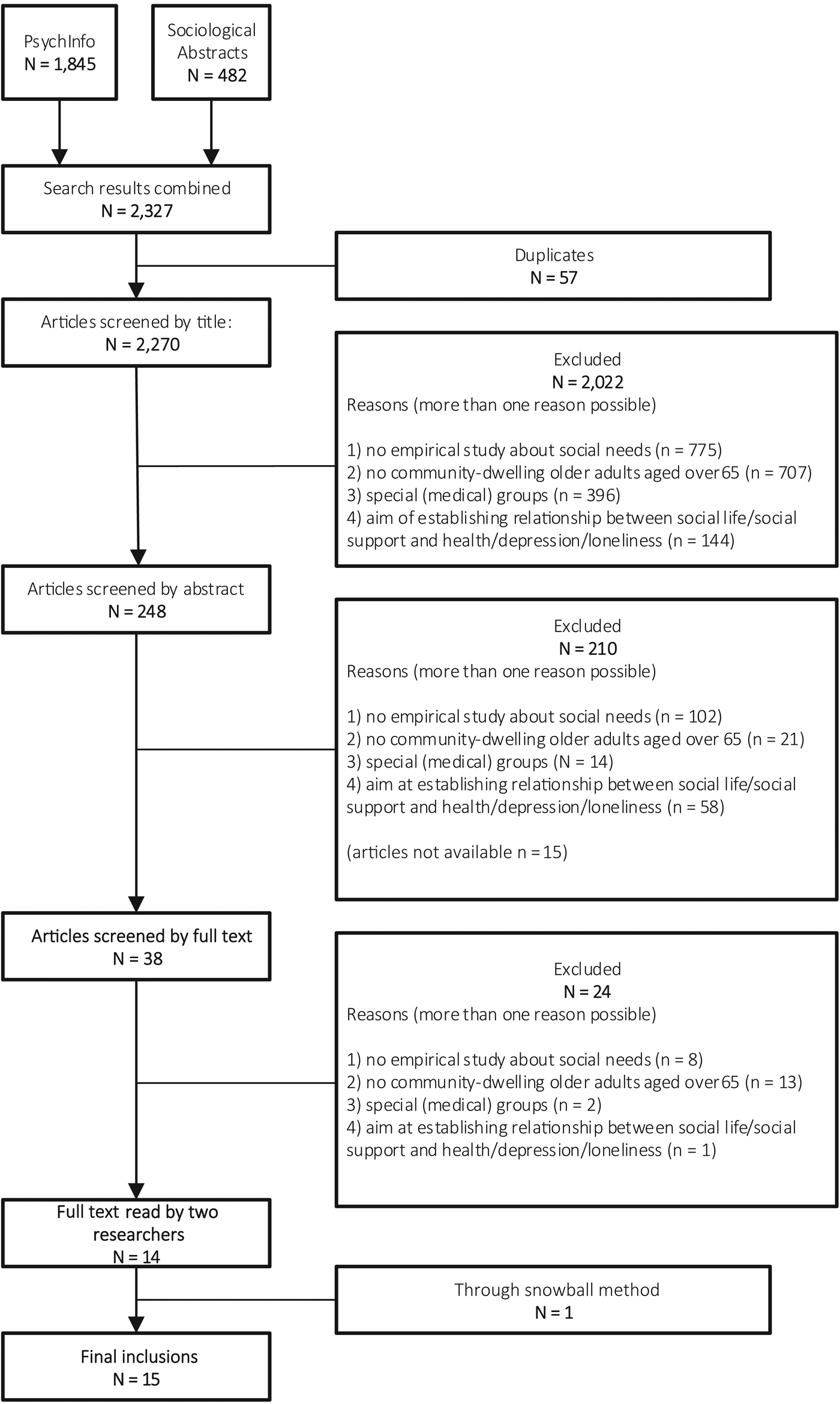
The number of articles drawn from the two databases was 2,327. The selection process is shown by the flowchart in Figure 1. In the first selection phase, the duplicates (N = 57) were removed and all the remaining 2,270 titles were screened by one reviewer (TB). In this phase, the articles that met the inclusion criteria and the uncertain ones were brought forward into the second phase. In the second phase, two reviewers (TB/JS and TB/KL) independently screened the remaining 248 articles in abstract form. The two reviewers discussed the abstracts until they reached consensus on the articles that would go into the third phase. The two reviewers (TB/KL and TB/JS) then independently screened the 38 articles that remained after the second phase in a full-text form. Fourteen articles remained after this phase. One reviewer (TB) assessed all the remaining articles (N = 14) to find more relevant studies (snowball method). This resulted in one relevant publication, which, again, was positively screened according to title, abstract and full-text version by the three reviewers. In total, 15 articles were included in the systematic literature review. The three researchers independently analysed the selected articles and reached consensus about the most important outcomes and themes.
Selection process flowchart.

Assessment of methodological quality
The Mixed Method Appraisal Tool (MMAT) checklist (Pace et al. Reference Pace, Pluye, Bartlett, Macaulay, Salsberg, Jagosh and Seller2012) is an instrument that can be used to assess the selected studies in terms of their quality. This instrument can assess both mixed-method studies and pure qualitative and quantitative studies. The checklist has 21 criteria, divided over six categories: (a) screening questions (for all types); (b) qualitative; (c) quantitative randomised controlled trials; (d) quantitative non-randomised; (e) quantitative descriptive; and (f) mixed methods. There are three levels for the MMAT criteria: fulfilled, unfulfilled and unmentioned. Two reviewers (TB/KL or TB/JS) assessed independently all the included articles using the MMAT. Disagreements between the assessors were resolved by discussion. Articles that met more than half of the criteria were considered to have sufficient quality for participation in the study. The first two screening questions of the MMAT should, however, always be answered positively.
Results
General findings and quality assessment
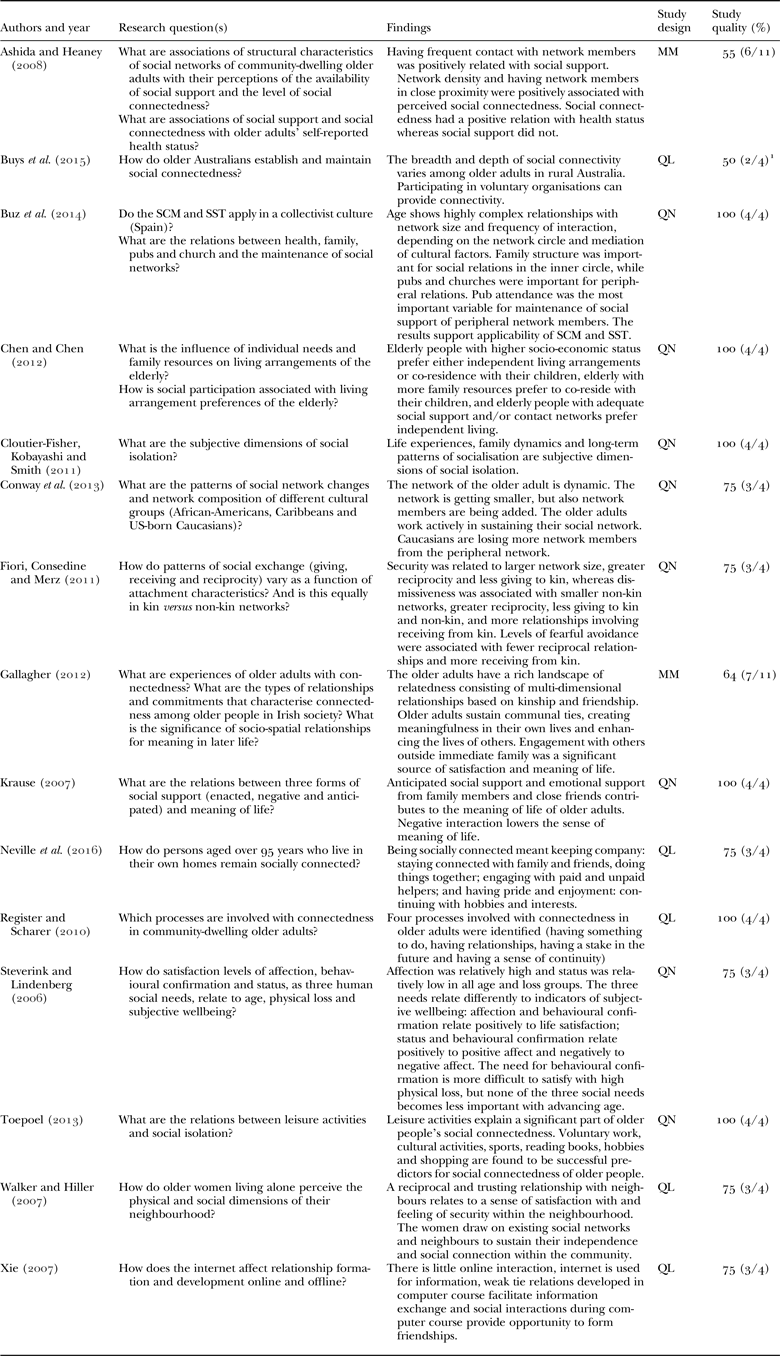
Following the selection process, 15 unique papers were included (Figure 1). The 15 selected articles used a quantitative descriptive approach (N = 8), a qualitative approach (N = 5) or a mixed method (N = 2). The outcome of the quality assessment and the focus and outcomes of the selected articles are presented in Table 2. Percentages of MMAT outcomes were calculated to compare the methodological quality of the included articles: these ranged from 50 to 100 per cent (Table 2). Almost half the selected articles – six in total – had an MMAT percentage of 100 per cent. The article of Buys et al. (Reference Buys, Burton, Cuthill, Hogan, Wilson and Baker2015) scored 50 per cent of the MMAT checklist and was therefore not included. This means that 14 articles are included in this systematic literature review.
Research questions, findings and Mixed Method Appraisal Tool (MMAT) quality

Notes: SCM: social convoy model. SST: socio-emotional selectivity theory. MM: mixed method. QL: qualitative. QN: quantitative research. 1. Study not included because MMAT quality is 50 per cent or less.
The MMAT criteria that were least frequently fulfilled by the included quantitative or mixed-method studies were the acceptable response rate (over 60%) and the influence (bias) of the researchers by the included qualitative and mixed-method articles. In three cases, the response rate was less than 60 per cent, and in two articles, the data were collected from a larger data-set, so the response rate was unknown. In five articles, the three researchers decided that insufficient consideration was given to the influence of the researcher. The data from the included articles were collected from respondents living in different parts of the world, six in the United States of America (USA), four in Europe (two in the Netherlands, one in Ireland, one in Spain) and one each, respectively, in Canada, Australia, New Zealand and Taiwan.
Themes
With the three theories (SST, SCM and SPF-SA) in mind, four themes emerged from the selected articles. The four themes that were most prominent were diversity, proximity, meaning of the relationship and reciprocity. The first theme was the most obvious one. In studying the social needs of older adults, researchers confirm the heterogeneity of the older population. Furthermore, it is interesting to look at cultural differences in the 14 studies from different parts of the world. The themes were also inspired by the three theories, SST, SCM and SPF-SA. Because SST and SCM focus on the difference in peripheral and intimate relations, proximity is an important theme to consider. Steverink and Lindenberg (Reference Steverink and Lindenberg2006) and Antonucci (Reference Antonucci, Birren and Schaie2001), in their theories, have also looked at the functional characteristics of social relationships. Social support and connectedness are often discussed as functional characteristics of social networks; they have also been identified by Ashida and Heaney (Reference Ashida and Heaney2008) and by this study's authors as relevant topics in this literature review. These are all about the meaning of the relationship for the older person. When analysing the second (proximity) and third (meaning of the relationship) theme, a related theme emerged, namely reciprocity. In a relationship, whether it is peripheral or intimate, reciprocity is a reoccurring concept. It also plays a role in the third theme, namely the functional characteristics of the social relationship.
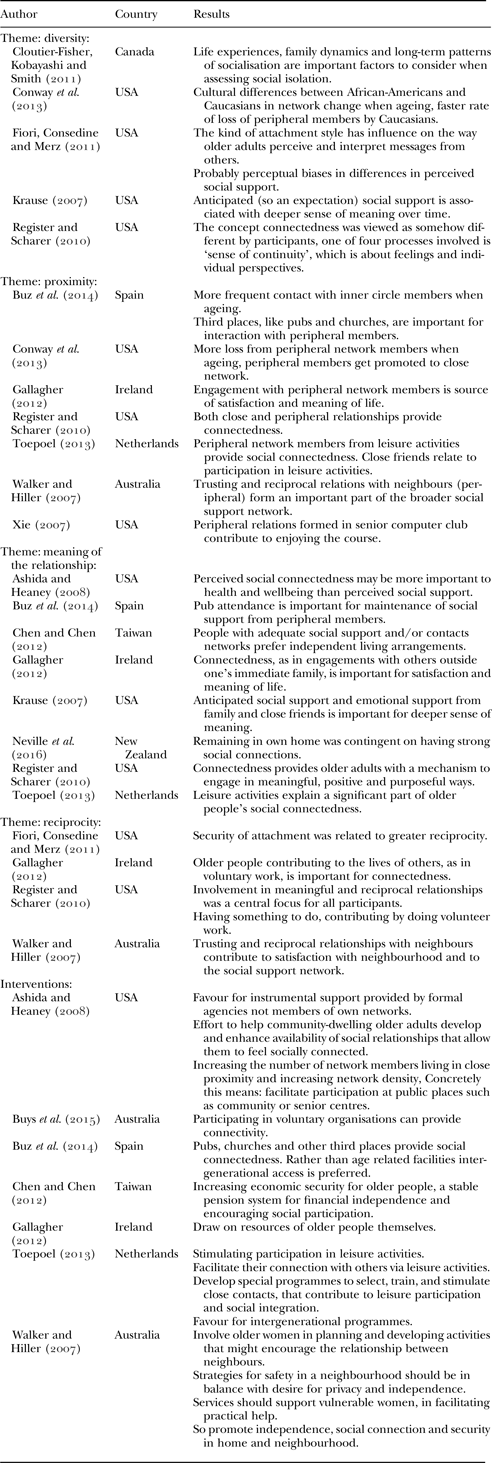
On the basis of the knowledge of social needs, this literature review intends to provide indications for successful interventions. Therefore, the paragraph ‘Interventions’ will present relevant findings about concrete interventions in relation to the four themes discussed in the 13 articles. Table 3 shows the four themes, including the information about interventions and the corresponding articles, and summarises the most important outcomes for each theme.
Themes, author, country and outcomes

Note: USA: United States of America.
Diversity
Diversity refers to the individual and cultural differences between older individuals in terms of their social needs. The population of older adults is very heterogeneous; therefore, individual differences or diversity occur. Not everyone needs a big and dense network; this depends on the individual's life experiences and personality. Cloutier-Fisher, Kobayashi and Smith (Reference Cloutier-Fisher, Kobayashi and Smith2011) have clearly demonstrated that some people are perfectly happy with a small and mostly peripheral network: so-called loners. This is also the case in studies by Gallagher (Reference Gallagher2012) and Walker and Hiller (Reference Walker and Hiller2007), where some of the participants state that they do not feel the need to be socially active or join a club and prefer to be on their own. The less-connected respondents were not automatically lonely or dissatisfied with their lives. Therefore, assessing a person's social needs is about the subjective perception and expectations he or she has. Objective assessment of the quality of someone's social network is difficult. For example, Krause (Reference Krause2007) demonstrates that the kind of social support most relevant to meaning of life is anticipated support. This means that expectations matter, perhaps even more than the objective and measurable aspects of social networks. Social connectedness, the presence of social ties, is also a difficult concept to measure objectively. For this reason, Ashida and Heaney (Reference Ashida and Heaney2008) discuss perceived connectedness as a partly subjective concept.
Besides individual differences, cultural differences play a role. Whereas in Asian countries adult children play an important role in providing social support and housing for their parents, in Western countries parents depend less on their adult children (Chen and Chen Reference Chen and Chen2012). Recently, in Asian countries, older adults with sufficient social resources other than their direct family also prefer more and more to live independently. The researchers’ interpretation is that older adults do not want to be a burden on their children and family and choose to stay independent as long as possible (Fiori, Consedine and Merz Reference Fiori, Consedine and Merz2011; Krause Reference Krause2007). Conway et al. (Reference Conway, Magai, Jones, Fiori and Gillespie2013) found ethnical differences in changes in social networks. Caucasians are losing more network members from their peripheral networks than African-Americans. The authors suggest that this might be due to the fact that African-American older adults sometimes have ‘extended kinship’, which means they include non-biologically related individuals in the family (Conway et al. Reference Conway, Magai, Jones, Fiori and Gillespie2013). Therefore, peripheral members of their network become close network members.
Proximity
When examining the structure of the relationships of (older) people, researchers must take into consideration the proximity of the relationships. Networks of people in general tend to shrink as people age due to loss of work, loss of social roles or loss of health, and sometimes, through the purposeful choice of older adults (Buz et al. Reference Buz, Sanchez, Levenson and Aldwin2014; Steverink and Lindenberg Reference Steverink and Lindenberg2006). In social networks of older adults, the loss of peripheral members is larger than the loss of intimate members (Buz et al. Reference Buz, Sanchez, Levenson and Aldwin2014; Conway et al. Reference Conway, Magai, Jones, Fiori and Gillespie2013; Steverink and Lindenberg Reference Steverink and Lindenberg2006). Conway et al. (Reference Conway, Magai, Jones, Fiori and Gillespie2013) suggest that older people may compensate for the loss of intimate network members by promoting members from a peripheral position to a closer network position. Therefore, when ageing, the size of the social network often diminishes, as does the number of frequent contacts with both peripheral and intimate network members (Conway et al. Reference Conway, Magai, Jones, Fiori and Gillespie2013; Toepoel Reference Toepoel2013). On the other hand, older adults are more satisfied with the contacts they have and feel more connected to other people (Toepoel Reference Toepoel2013).
Both intimate and peripheral relationships contribute to the wellbeing of older adults (Steverink and Lindenberg Reference Steverink and Lindenberg2006). Register and Scharer (Reference Register and Scharer2010) explain that both close and peripheral relationships provide a sense of connectedness. Therefore, it is not only relationships with kin and intimate friends that satisfy social needs but also relationships with neighbours and non-intimate friends from clubs, pubs and churches. For people with small social networks, both peripheral members and close members can help in terms of coping with loss and grief. For example, people find comfort in playing golf or going to church when dealing with the loss of a loved one (Cloutier-Fisher, Kobayashi and Smith Reference Cloutier-Fisher, Kobayashi and Smith2011). The peripheral relations with neighbours are important in more than one way. Besides contributing to a feeling of connectedness, they also provide safety and security. Safety is one of the most important concepts for older people (Walker and Hiller Reference Walker and Hiller2007). Ashida and Heaney (Reference Ashida and Heaney2008) found that, for older people, the geographical proximity of a social network is important to their feeling of social connectedness. Besides being connected to their neighbours, older adults can feel connected to the physical area or neighbourhood in which they live (Gallagher Reference Gallagher2012; Walker and Hiller Reference Walker and Hiller2007). Our results show that peripheral relationships are also of great importance to older people, and losing members of this peripheral network does not always seem to be a deliberate choice.
Meaning of the relationship
Meaning of the relationship refers to the functions or meaning the relationship has for older individuals. In this context, two important concepts are social support and social connectedness (Ashida and Heaney Reference Ashida and Heaney2008). Social connectedness is the presence of social ties. Social support is the support network members give to each other, which can be emotional, instrumental, informational or appraisal. Seven of the included articles discuss the concepts of social connectedness and/or social support. Both social support and social connectedness contribute to the meaning of life of older adults (Ashida and Heaney Reference Ashida and Heaney2008; Krause Reference Krause2007; Neville et al. Reference Neville, Russell, Adams and Jackson2016). Studies focusing on connectedness all indicate that it is important for older people in terms of giving them a sense of meaning in life (Gallagher Reference Gallagher2012; Neville et al. Reference Neville, Russell, Adams and Jackson2016; Register and Scharer Reference Register and Scharer2010; Toepoel Reference Toepoel2013). As Register and Scharer (Reference Register and Scharer2010) explain in their article (page 463), ‘connectedness provides older adults with a mechanism to engage life in meaningful, positive and purposeful ways’. According to Register and Scharer (Reference Register and Scharer2010), connectedness can be seen as the ultimate expression of human existence that determines how people engage with the world. Ashida and Heaney (Reference Ashida and Heaney2008) identify social support as a more functional construct whereas social connectedness has a more emotional dimension. While social connectedness and social support do overlap and are positively associated with each other, they differ in terms of their associations with social network characteristics and health status (Ashida and Heaney Reference Ashida and Heaney2008): social connectedness has a positive association with health status whereas social support does not. Gallagher (Reference Gallagher2012) also found that less-connected groups rate their own health as bad. As Gallagher (Reference Gallagher2012) shows, bad health can influence engagement with others (Gallagher Reference Gallagher2012), but being unconnected can also cause physical problems (Ashida and Heaney Reference Ashida and Heaney2008). It probably works both ways. Toepoel (Reference Toepoel2013) argues that people connect with each other by participating in leisure activities. There is a fun and light dimension to the construct of connectedness as identified by Gallagher (Reference Gallagher2012) and Buz et al. (Reference Buz, Sanchez, Levenson and Aldwin2014). Just visiting a pub contributes to a feeling of connectedness and wellbeing. Going to a pub also contributes to giving and receiving social support, as Buz et al. (Reference Buz, Sanchez, Levenson and Aldwin2014) found in their study. Informal conversations about sports, politics and gossip are important for older adults (Gallagher Reference Gallagher2012). An overlap can be found between connectedness and being socially active in more peripheral relations involving leisure activities, going to pubs and going to church (Buz et al. Reference Buz, Sanchez, Levenson and Aldwin2014; Gallagher Reference Gallagher2012; Toepoel Reference Toepoel2013). Therefore, both intimate and peripheral relations provide older adults with connectedness and social support, both of which contribute to wellbeing (Ashida and Heaney Reference Ashida and Heaney2008; Buz et al. Reference Buz, Sanchez, Levenson and Aldwin2014; Gallagher Reference Gallagher2012; Neville et al. Reference Neville, Russell, Adams and Jackson2016; Register and Scharer Reference Register and Scharer2010).
Social support seems to have an ambiguous relationship with independence. According to Gallagher (Reference Gallagher2012), older adults have a great longing for independence and do not want to be a burden, especially not on their children and family. On the one hand, receiving social support can contribute to independence (Chen and Chen Reference Chen and Chen2012). Receiving (social) support can enable older people to live longer independently and not go into a residential home. However, receiving instrumental social support can also diminish the sense of independence on older people (Krause Reference Krause2007). In this study, older adults who receive more tangible forms of social support have a lower sense of the meaning of life, which Krause explains as a perceived lack of independence.
Steverink and Lindenberg (Reference Steverink and Lindenberg2006) confirm the importance of both looking at the structure of the relationships and the functions (or meaning) of the relationships in the network. They identify three functions of social relationships that relate to social need fulfilment and wellbeing, which are affection, behavioural confirmation and status. Affection includes love, trust, acceptance, empathy and understanding, which are mostly found in intimate social networks. Behavioural confirmation and status are related to the peripheral social networks. Behavioural confirmation includes doing the right thing and being useful, which, for example, can be accomplished by doing volunteer work and building more peripheral networks. Studies by Gallagher (Reference Gallagher2012), Toepoel (Reference Toepoel2013) and Register and Scharer (Reference Register and Scharer2010) have confirmed this. Status consists of getting respect, being independent and autonomous, and having skills, which are also found in more peripheral networks. Krause (Reference Krause2007) and Chen and Chen (Reference Chen and Chen2012) have also identified independence as an important social aspect of older people. Assuming that needs such as behavioural confirmation and status remain as important to older adults as affection, these authors have shed light on the apparent contradiction that older adults, on the one hand, tend to focus on intimate friends and family and, on the other hand, need to stay active and participate in peripheral networks. When goals and resources diminish with age, it becomes more difficult to satisfy these needs. This results in a loss of more peripheral members of their networks.
Reciprocity
Reciprocity means not just receiving but also giving support and friendship, helping others and contributing to a community or society. The older person is not just a frail and vulnerable individual but is capable of giving back to others and to society (Gallagher Reference Gallagher2012; Toepoel Reference Toepoel2013). The older adult wants to give back to society, e.g. by doing volunteer work (Gallagher Reference Gallagher2012; Register and Scharer Reference Register and Scharer2010; Toepoel Reference Toepoel2013). Reciprocity in friendships contributes to the feeling of independence and being meaningful. For example, receiving instrumental support diminishes older people's sense of meaning and independence. When older people return a favour, for instance, by giving back support, they feel less dependent (Krause Reference Krause2007). Reciprocity relates to wellbeing (Krause Reference Krause2007). In Register and Scharer's (Reference Register and Scharer2010) study, all the participants experienced involvement in meaningful and reciprocal relationships as the central focus of their life. In Walker and Hiller's (Reference Walker and Hiller2007) study, women who lived alone found that trust and reciprocal contact with neighbours contributed to their social network and to the satisfaction they felt in the neighbourhood. Gallagher (Reference Gallagher2012) finds the same in his study in two communal settings in Ireland: when older people both give and receive practical help, it contributes to their satisfaction with life. To do volunteer work or help neighbours can also sometimes satisfy the need of older people to have something to do (Register and Scharer Reference Register and Scharer2010). Fiori, Consedine and Merz (Reference Fiori, Consedine and Merz2011) examine the relationship between attachment style and social support. People with a secure style of attachment (as opposed to a dismissive or fearfully avoidant style) reported a larger network size and greater reciprocity in their relations.
Altruism, i.e. doing someone a favour without expecting something in return, can be considered a higher level of reciprocity. Gallagher (Reference Gallagher2012) discusses altruism in his study of the connectedness of the lives of older adults in Ireland. The most connected participants showed altruism and practical social concern in the voluntary work they do. They had a strong feeling of awareness of the need of others, and derived a lot of satisfaction from the voluntary work they do. Register and Scharer (Reference Register and Scharer2010) also discuss this form of altruism, which contributes to the feeling of connectedness of older people. Participants found purpose and meaning by helping others in the community. The older people perfectly understood the importance of contributing to a neighbourhood for their own and others’ wellbeing (Gallagher Reference Gallagher2012; Register and Scharer Reference Register and Scharer2010).
Reciprocity overlaps with proximity (the second theme) and the meaning of relationships (the third theme). As discussed above, reciprocity is important in both close and peripheral relationships. It is also related to the meaning of relationships. The meaning of a relationship seems stronger when reciprocity occurs. It is similar to glue, binding together the social networks of older people and creating connections to the community and to society.
Interventions
This systematic literature review intends to identify implications for successful interventions based on the information about social needs captured in the four themes. The researchers found that the authors in the 14 articles often discussed valuable information about interventions. In this paragraph, this information is summarised. First and foremost, corresponding to the first theme of diversity, one should respect individual differences (Cloutier-Fisher, Kobayashi and Smith Reference Cloutier-Fisher, Kobayashi and Smith2011). One type of intervention will probably not be successful for all older people who are facing problems with loneliness or social isolation, which means that individual requirements should be considered (Cloutier-Fisher, Kobayashi and Smith Reference Cloutier-Fisher, Kobayashi and Smith2011). In creating and implementing interventions, diversity in life circumstances and health status must be taken into consideration.
In relation to proximity (the second theme), Ashida and Heaney (Reference Ashida and Heaney2008) and Gallagher (Reference Gallagher2012) discuss the importance of having social relationships and being involved with others, especially with people living in close proximity. Seniors should be stimulated by having pleasurable contact with neighbours and with peripheral members of their networks, such as social clubs and organisations (Buz et al. Reference Buz, Sanchez, Levenson and Aldwin2014; Gallagher Reference Gallagher2012; Neville et al. Reference Neville, Russell, Adams and Jackson2016; Toepoel Reference Toepoel2013; Xie Reference Xie2007). Gallagher (Reference Gallagher2012) states that such forms of social intercourse contribute to solidarity and belonging. Joining a senior computer club contributes to formatting valuable (offline) companionships (Xie Reference Xie2007). Ashida and Heaney (Reference Ashida and Heaney2008) advise policy makers to help people form relationships. Both Buz et al. (Reference Buz, Sanchez, Levenson and Aldwin2014) and Gallagher (Reference Gallagher2012) discuss the importance of pubs and churches where older people can become connected. In Spain and Ireland, the pub is the place where older people meet each other. Churches have a similar role in satisfying social needs. Buz et al. (Reference Buz, Sanchez, Levenson and Aldwin2014), Gallagher (Reference Gallagher2012) and Register and Scharer (Reference Register and Scharer2010) all identify the important role of churches as social meeting places. Besides this, a relationship with God contributes to the feeling of connectedness of older adults (Register and Scharer Reference Register and Scharer2010).
Besides focusing on the meaning of relationships (the third theme), almost half the discussed articles offer recommendations regarding the need of older people to be (socially) connected (Ashida and Heaney Reference Ashida and Heaney2008; Buz et al. Reference Buz, Sanchez, Levenson and Aldwin2014; Gallagher Reference Gallagher2012; Register and Scharer Reference Register and Scharer2010; Toepoel Reference Toepoel2013). For instance, Toepoel (Reference Toepoel2013) recommends promoting participation in leisure activities to help older adults connect with others. She advises policy makers to develop special programmes to select, train and stimulate close contacts, which contribute to leisure participation and social integration. Going to a pub is different from going to a senior centre because members of all generations come to socialise and have a good time in pubs, whereas senior centres focus only on seniors. Toepoel (Reference Toepoel2013), Gallagher (Reference Gallagher2012) and Buz et al. (Reference Buz, Sanchez, Levenson and Aldwin2014) discuss the need of older adults to connect with people outside their own age group. In their view, policy makers should focus on the need of older adults to access intergenerational places and contacts. Finally, Walker and Hiller (Reference Walker and Hiller2007) and Gallagher (Reference Gallagher2012) identify the importance of the neighbourhood in the lives of older people. Policy makers can improve neighbourhoods by making them safe and clean and by promoting social cohesion (Walker and Hiller Reference Walker and Hiller2007). Register and Scharer (Reference Register and Scharer2010) recommend that health-care professionals should be more aware of the beneficial effects of connectedness on the wellbeing of older people.
Corresponding to reciprocity (the fourth theme), Gallagher (Reference Gallagher2012) mentions the need of older people to engage in meaningful activities by drawing on their own resources. Older people want to use their talents and skills to find solutions to the problems they and others face. In doing volunteer work and helping others, older people find meaning and joy (Gallagher Reference Gallagher2012). Furthermore, Chen and Chen (Reference Chen and Chen2012) and Walker and Hiller (Reference Walker and Hiller2007) identify independence as important for older adults. They advise policy makers to promote older adults’ independence by means of practical solutions such as a good pension and the possibility for independent living (Chen and Chen Reference Chen and Chen2012) and by creating safe neighbourhoods (Walker and Hiller Reference Walker and Hiller2007).
Discussion
In this systematic literature review, 14 articles about the social needs of older community-dwelling adults have been analysed, resulting in four themes, namely diversity, proximity, meaning of relationships and reciprocity. The paragraph ‘Interventions’ emphasises relevant information for interventions aimed at improving the social wellbeing of older adults, for instance respect for individual differences, creating relationships and connectedness, and the need of older people to contribute to society. Together, this provides concrete information about social needs and the ability to satisfy these needs, which, in return, generates the elements of a successful intervention.
This systematic review offers insight into the social needs of older adults. Social needs include the need to give and receive friendship, companionship and love with intimate and peripheral contacts. This study reveals the social needs of older adults in a concrete sense (i.e. relationships, social networks social support) and a more abstract sense (i.e. feelings of connectedness and reciprocity). In terms of satisfying the social needs of older adults, subjectivity and cultural differences also play a role. Satisfaction is a feeling, and feelings are not objective but are different for every individual. Due to the long lifespan and, therefore, the many different experiences that older people have today, the population is more heterogeneous.
Both intimate and peripheral relationships satisfy older adults’ social needs and continue to be important as people age (Cloutier-Fisher, Kobayashi and Smith Reference Cloutier-Fisher, Kobayashi and Smith2011; Gallagher Reference Gallagher2012; Neville et al. Reference Neville, Russell, Adams and Jackson2016; Register and Herman Reference Register and Herman2010; Steverink and Lindenberg Reference Steverink and Lindenberg2006; Toepoel Reference Toepoel2013). More peripheral relationships, such as contacts at clubs, churches and pubs, will help adults participate in and contribute to society and will make them feel a part of life and of society; in other words, they will make them feel connected. Whereas more intimate relationships bring love and belonging into the lives of older people, peripheral relationships offer fun, friendship and equality. When it comes to satisfying social needs, loneliness can be prevented. De Jong Gierveld and Van Tilburg (Reference De Jong Gierveld and Van Tilburg2008) identify two types of loneliness: social and emotional loneliness. Social loneliness is the lack of an adequate social network, whereas emotional loneliness is the lack of a partner or close friend. Social loneliness can be considered the lack of a more peripheral network. Emotional loneliness, on the other hand, is the lack of a more intimate and close network. Both types of loneliness influence wellbeing. This is congruent with our finding that intimate and peripheral relationships must be considered when it comes to satisfying people's social needs. Proximity, the name of the corresponding theme, is important in both an emotional and a practical sense; sometimes, the proximity of a neighbour can satisfy a social need as well as a close relative can.
Older people's connection to others and to their neighbourhood or their society is of great value and an important concept when it comes to satisfying social needs (Gallagher Reference Gallagher2012; Register and Scharer Reference Register and Scharer2010; Walker and Hiller Reference Walker and Hiller2007). Connectedness can solve the basic social problem of alienation, isolation and loneliness, which older adults sometimes have (Rowe and Kahn Reference Rowe and Kahn1997). It appears that older adults want to be connected with other people (in both a close and a peripheral sense) and to their neighbourhood, community and society.
Reciprocity is highly valued by older adults. They want to receive and give friendship, companionship and love to intimate and peripheral relationships. They also want to participate in society by doing volunteer work (Gallagher Reference Gallagher2012; Toepoel Reference Toepoel2013; Walker and Hiller Reference Walker and Hiller2007). Furthermore, reciprocity contributes to a feeling of independence, which is highly valued by older individuals (Chen and Chen Reference Chen and Chen2012; Krause Reference Krause2007; Walker and Hiller Reference Walker and Hiller2007).
Older adults also want to be socially active and participate in their community and society. Older adults want to contribute to society in a valuable way, and this contributes to their health and life expectations. As Diamond (Reference Diamond2012) states, the way we treat older people in Western societies can be improved in comparison with other cultural settings. We can use the talents of older adults more effectively, as societies in the Blue Zones are doing. Blue Zones are areas in the world where people live significantly longer and healthier lives. Buettner (Reference Buettner2012) has identified five of these areas: Sardinia (Italy), Okinawa (Japan), Loma Linda (California), Nicoya Peninsula (Costa Rica) and Icaria (Greece). Besides a healthy diet and exercise, one of the reasons for older people's expanded lifespan is the perception and role of the older adult in the community. They are highly valued and respected and considered to be wise and erudite (Buettner Reference Buettner2012).
Three theories about the social networks of older people, the SST, the SCM and the SPF-SA, offer us abstract information about changes that occur during ageing. Although the population of older adults is rather diverse, these theories are modelled on the whole population of older adults. When examining the structures of (older) people's relationships, researchers have to take into account the proximity of the relationships. This is especially pronounced in the SST and SCM theories. A distinction is made between close or intimate relationships, such as family and close friends, and peripheral relations, such as acquaintances, neighbours or people at (sports) clubs. Studies by Buz et al. (Reference Buz, Sanchez, Levenson and Aldwin2014) and Conway et al. (Reference Conway, Magai, Jones, Fiori and Gillespie2013), which show a greater loss of peripheral members compared to intimate members in older people's social networks, have confirmed the claims of SCM and SST. Furthermore, these theories state that older people focus more on close relationships due to selectivity or their changing social roles. However, in this systematic literature review, it became evident that peripheral relationships cannot be ignored. The SPF-SA theory of Steverink and Lindenberg (Reference Steverink and Lindenberg2006) offers an explanation of this by stating that status and behavioural confirmation, which are mostly satisfied by having peripheral relationships, remain important. However, due to loss of resources and goals, they become difficult to satisfy. While reciprocity has been identified as an important concept in relation to the social needs of older people, this concept is not explicitly part of the three theories discussed here.
One can argue that when social needs are not satisfied, it can lead to social isolation and/or loneliness. Both social isolation and loneliness are relevant concepts when it comes to studying the social lives of older people, but they are not captured in this review. The reason behind this choice of focus is the assumption that identifying social needs and satisfying these needs can prevent loneliness and social isolation.
The selected articles in this review were published between 2005 and 2015. One could argue that the social needs of older people have not changed much over the years and that articles from before 2005 would contain relevant information about this topic. Although this literature review provides implications for interventions, this was not a search term or key term. This choice was made because the main focus is on social needs. By extracting concrete information about these needs, implications were identified about possible successful interventions.
Although this systematic review has a specific focus on the group of community-dwelling older people who have no special medical condition, it should be taken into consideration that even this specific group is still very heterogeneous in terms of life circumstances such as living situation and health status. Community-dwelling, for example, can mean living independently in rented accommodation, in a large villa or living in sheltered housing. Differences in health status may also affect the social needs of the older adults. Although these differences were not addressed explicitly in the articles that were included in this review, they may have influenced the findings. An important consideration for interventions is, therefore, that there is not one intervention that will work for everyone, but that individual solutions must be sought that meet individual needs.
This literature review shows that older adults play an active role in their own (social) lives. They do not passively respond to the ageing process. Older adults want to have an active role in their whole environment, including their own social network, their neighbourhood and their community. Service providers and policy makers must consider that a lack of meaning in life becomes one of the most pressing problems when people age. Based on the results of this literature review, the most important considerations for creating and implementing interventions that may help older people satisfy their social needs are:
• Promote active involvement
• Involve older people in creating and implementing interventions.
• Focus on leisure activities and volunteer work: older people want to stay active and contribute.
• Enable reciprocity: older people do not want to consume only.
• Show respect
• Respect individual differences by assessing individual social needs.
• Address the talents and skills of older people.
• Create intergenerational initiatives: older people prefer not to be treated as a separate group.
• Focus on independence: older people want to stay active and independent as long as possible.
• Stimulate social contacts
• Focus on creating both close and peripheral relationships.
• Stimulate neighbourhood initiatives: proximity and peripheral contacts with neighbours are highly appreciated and beneficial for wellbeing.
• Facilitate (intergenerational) social meeting places such as pubs and churches.
• Sharing knowledge
• Organisations providing care for older people and policy makers should be (made) aware of the importance of satisfying social needs.
• Organisations providing care for older people and policy makers should be (made) aware of important characteristics of interventions aimed at satisfying the social needs of older adults, as mentioned before.
The future work of the authors of this literature review will focus on these implications. We will create and implement an intervention that will aim to satisfy the social needs of older people and hopefully contribute to their quality of life.