Studying a language is a challenge not only in mastering a new grammar and vocabulary but also in the incorporation of nuance, inflexion, and a sense of normalcy. However, language learning is an extraordinary opportunity to transcend cultural differences and bring seemingly disparate members of societies into dialogue (Thomas and McDonagh Reference Thomas and McDonagh2013:49). Many people who study languages in North American schools merely fulfil a requirement for the larger purpose of graduation and have no expectation of ever actually using the language in real life. That level of language instruction runs the risk of sitting in the students’ bodies as a two-dimensional experiment that never moves beyond small talk and the conjugation of verbs. However, as any multilingual person knows, so much more is embedded in language instruction. Because the way people use languages reflects how they understand the world (Kuo and Lai Reference Kuo and Lai2006:1–10), the study of unfamiliar languages carries with it the possibility of new ways of thinking. In this article, the two authors discuss their use of Irish-language songs to introduce the language to non-native beginners in North America.
Language instruction in Ireland is connected to its history of English colonisation. As part of an English effort to create a new image of the invaders as bestowers of refined culture and laws, Irish people were inexorably forced into speaking English. Along with many other changes large and small, after 1695 the Penal Laws forbade the speaking or reading of the Irish language or playing of Irish music. The proportion of Irish speakers then declined sharply during the Great Hunger of 1845–50; not only did hunger, disease, and emigration kill many native speakers, but the Irish learned to associate a cultural cluster of language, songs, instrumental music, and dance with poverty and powerlessness (Ó Ceallaigh and Ní Dhonnabháin Reference Ó Ceallaigh and Ní Dhonnabháin2015:181). Associating the English language with modernity, power, and money was a further consequence of its use in the new national school system (founded by Edward Stanley) beginning in 1831.
By early in the 20th century, when Ireland had gained its independence and the language began to be taught again, education was placed in the hands of the Congregation of Christian Brothers, a Catholic educational organisation known at the time for its stern discipline and the teaching of the language through physical punishment and humiliation. A set of Irish-only schools, gaelscoileanna, was established in the 1970s as a modification from the Christian Brothers’ method. It now educates 50,000 students yearly in 178 different Irish-language-only elementary schools and 48 secondary schools. Some are within the Irish-speaking districts known as the Gaeltachtaí, but most are in English-speaking districts. Even with the position of Irish as the “first official language” at the establishment of the nation in the early 20th century, it was not then and has never been since the first language of most Irish citizens alive today.
The Irish-Gaelic language is notorious among learners in Ireland and abroad for its apparent complications of pronunciation, grammatical issues, and variations in local dialects. Most students of the language begin not with conversation, the way young people learn naturally, but with the thorny exactitude of grammar enforced by their teachers. After twelve years of compulsory education in the Irish language, many English-speaking Irish people claim that they cannot utter a single sentence and hope never to have to speak the language again. This preference reflects a generational divide, however; people below the age of 30 and above the age of 70 tend not to worry too much about grammatical errors, while those in between appear to bear deep concerns about “getting it wrong.” In this article, based on work with both native and non-native English and French speakers in North America, the authors propose a shift in pedagogical focus: from being more directly centred on grammar to using song as a language teaching tool. It is one step in responding to the bottomless pit of need among diasporic students to connect to their heritage identity and among those who long for a different way of knowing.
In many years of teaching beginning-level Irish language and songs to non-native speakers, the authors have experimented with methods that allow adult singers to smooth out their pronunciation while grasping customary, valuable phrases and grammatical clues from songs. With easy and effective pronunciation in place through the medium of song, students can better try communicating in conversation with native Irish speakers. Using examples from Irish songs, this article will demonstrate how the use of songs not only eases some of the complications of language study but also helps language learners absorb radically new concepts that can bridge barriers. Perhaps most importantly, singing together with others is a joy, even as it takes people outside their comfort zones; gaining skills in another language with like-minded people is best facilitated through the pleasure of connection. In short, even when most people between two nations share a language (English), moving into the Irish language represents an effort to increase understanding, engage in other epistemologies through language acquisition, and use songs to make that connection more effective.
Stepping away from one’s native language is also a way of refusing the social and cultural norms of one’s community and coming as a guest into another. Building the language into song reflects a more profound concept: building social cohesion across community boundaries. Such efforts are being implemented at several North American institutions; among them, New York University, the University of Montana, and Notre Dame University. Later in this article, the two case studies of how North Americans come to learn a different language through song represent an evidence-based array of experiences over decades on the part of the two authors and offer direct strategies through which confusion can reach clarity.
Irish, which is what most English-speaking Irish people call the Irish-Gaelic language (Gaeilge in Irish itself), is one of the oldest written languages in the world; it is Ireland’s first official language, with English as the secondary official language. Irish children are required to learn Irish from elementary through the end of secondary school; those children who self-identify as native speakers are below 5%. The rest speak English, but most adults are also quite good at speaking at least some Spanish, French, and German because of Ireland’s proximity to mainland Europe. Many more people speak it in their daily lives, and hundreds of thousands of Irish people know just a few words they pull out to give a toast, say a ritual blessing or impress foreigners. It is a heritage language for millions of North Americans, yet in Ireland itself, fewer than 2% of the adult population speaks Irish daily.
Several key features distinguish Irish from English; among those features are its membership among the Celtic—not Germanic, to which English belongs—languages; its word order of verb-subject-object (“goes-the woman-smart-to-the-store-book”); its gendered nouns; and the fact that most of its eleven irregular verbs are among the most commonly used verbs in conversation. It is also sometimes referred to as a “prepositional language” in that each preposition—at, with, of, from, etc.—has not just an infinitive form but eight additional forms, depending on gender and number. The fact that particular grammatical directives are embedded within complex sentences means memorisation, drills, and by-any-means-necessary teaching. Irish is not specifically more complex than any other language; however, it has unique challenges for English-speaking students.
Because spoken and sung languages are elemental to communication, they evoke emotional content and memory. They have form, internal structure, and emphasis on particular words and syllables. Many children learn to speak and sing simultaneously, facilitating comprehension and the production of correct words and phrases. Mathias Perner is quoted as saying, “Melody is often related to the intonation of speech, and rhythm is then related to the segmentation, pace, and pauses realised in an individual speech” (translated by Petra Besedova Reference Besedova2016:661). While the Irish-language songs used in this study may feature some older forms of speech, many of the phrases embedded in the songs are featured in regular, everyday conversations: from codail go foil (“sleep for now”) in a lullaby to éirigh ’do sheasamh (“stand up”) in a playful dialogue song. Moreover, the regionalism of the songs assists with emphasising the regionalism of the language in different parts of Ireland.
Promoting and Protecting the Irish Language
The Irish government has set up numerous schemes to promote and protect the Irish language, including developing Irish-language radio and television stations. Policies have ranged from the Education Act and Good Friday Agreement in 1998 to the Official Languages Act of 2003 and up to the 20-Year Strategy for the Irish Language, 2010–2030. This latest strategy is highly ambitious: it aims “to increase the number of daily speakers of Irish from 83,000 in 2010 to 250,000 by 2030” (Ó Ceallaigh and Ní Dhonnabháin Reference Ó Ceallaigh and Ní Dhonnabháin2015:185). Schools everywhere are central sites for reversing the decline, all over the world, of minority and endangered languages. The biggest challenge in Ireland, besides combating the sometimes-negative attitudes toward the language among English speakers, is finding and keeping qualified, fluent teachers.
The first Irish-language teacher training college in Ireland—the Colaiste na Mumhan or College of Munster (Province)—was established in 1904 in Béal Átha'n Ghaorthaidh in County Cork. It featured the Direct Method (Irish immersion), in which English was avoided altogether, and included the foregrounding of correct pronunciation, conversational speech, and songs. The Coláiste served as a central locus for the Gaelic Revival and as an intellectual home for some of the early leaders of Irish Independence. It is best known now as a place for Irish teens to visit during the summer months to improve their Irish language skills. According to Traolach Ó Riordán, professor of Irish at the University of Montana in Missoula, “The use of songs has been a part of every Irish language curriculum from the beginning” (Traolach Ó Riordáin, email, 11 November 2024). Tara MacLeod of Notre Dame University adds the following: “I only use songs occasionally in my classes, but it is a common teaching tool for language teachers including Irish teachers. Different lyrics can help practice different verb tenses, orders, structures, and vocabulary. It is also helpful for some people to speak (and develop good pronunciation) while singing because they are not solely focused on producing language and worried they aren’t doing it correctly” (Tara MacLeod, email, 7 November 2024).
This information about effective language instruction is key to our intention of enhancing the use of the language and its instruction through song in North America, at least in part because of its long history in Ireland. In “Irish Song Schools: A Memory and a Hope,” Elizabeth M.J. O’Boyle writes—in 1931—of how essential it is that teachers devote their Irish-language time to the inclusion of traditional songs in Irish because all that was heard of music at the time is “the latest jazz melodies” (O’Boyle Reference O’Boyle1931:223). Earlier in the piece, she makes an exhortation:
Wherever other circumstances permit, every teacher who has music in him should treat, first and foremost as a song, what is by nature a song. Let him prepare the way for the song by previously working into oral and written composition any new phrases or words which might shutter the ears of the listener. That working of Irish music into the time allotted for teaching Irish is one means of restoring our folk-songs which the school, acting on its own initiative, can make use of. (O’Boyle Reference O’Boyle1931:221)
Fortunately, the use of song in language instruction in Ireland or in its diaspora is not limited to the past. As an example, Oideas Gael, one of Ireland’s language and cultural institutes in County Donegal, advertises Irish-language song courses as a means by which one can improve one’s language skills. In a perusal of general online language instruction, the options run the gamut from supportive encouragement in the same thread as knock-down grammatical and pronunciation arguments on social media to add sentence options such as dhíoladh an scáth drugaí—“the shadow sold drugs”—on the AI-based language-learning site Duolingo. An overarching conclusion about the imminent death of the language, along with the accompanying assertion that its demise would be best for everyone hovers over many of the options. However, an interest in the language persists both at home and in the diaspora. Writing as two singers/scholars who feel keenly the potential loss of thousands of songs, along with the worldviews and stories embedded in those songs, teaching the language and songs together is the authors’ hill to die on. The students alone, whether in the classroom, choir, or in real life, measure how successful the authors’ efforts have been.
Putting Theory into Practice in Two Case Studies
This section features the pedagogical experiences of the authors: Sean Williams and Ellen MacIsaac. Williams lives in Olympia, the capital city of Washington State in the USA, and MacIsaac lives in Ottawa, the capital of Canada in Ontario. Williams teaches the language and songs in a college setting, and MacIsaac teaches the language and songs in a community choir setting. Both were language students in college (Williams in the 1970s and MacIsaac in the 1990s), and both have engaged in further study of the Irish language and songs in North America and Ireland. It was evident to both authors, as it is to others who use this method, that through the use of song, “sounds of a particular foreign language [can be] correctly perceived, processed, and produced” (Besedova Reference Besedova2016:650). Perceiving and processing are one thing; production is another, and highly dependent on the manner of teaching, the disposition of the students, the careful nurturing of the community of language learners, and the degree to which the songs can be deployed effectively so that students begin to produce the words and phrases on their own. Because the value of using song to enhance linguistic skills has been amply demonstrated (Busse et al. Reference Busse2018:1), this section explores how songs specifically address Irish-language acquisition. The following two sections feature case studies by the two authors; they use the first-person pronoun “I” to discuss the case studies in keeping with ethnomusicological practice.
Both Williams and MacIsaac have worked with solo singers and group singers in rehearsal and performance. While it is more challenging to work on individual pronunciation with a group of singers than with a soloist, the collective ease that comes from singing in a group allows greater experimentation and warming up to good pronunciation after a few rehearsals. Both authors have had the experience of native speakers noting the correct pronunciation of their singers as an aspect of performance.
Teaching Irish Language and Songs in American Higher Education (Sean Williams)
I offer a short example of my experience as an Irish language learner and teacher. I began to study Irish at the University of California at Berkeley in the mid-1970s with Breandán Ó hÉithir, raised in the Irish educational system of the mid-20th century. In our first class, he told us that “the language is dead” and that we would be studying only Irish-language publications from earlier in the century to translate them. When I visited Ireland in 1982, I noticed that people all over the far west of Connemara, Kerry, and Cork were speaking Irish, that teens were developing new slang words, and that my professor had been wrong. The language was thriving.
In graduate school at the University of Washington, I worked with the old-style (sean-nós) singer and native Irish speaker Joe Heaney several times each week. I learned to speak, to sing, and to develop effective pedagogies for language acquisition from Heaney himself. In our lessons, I would write down the song lyrics in Irish, and he corrected and helped me each time. I learned dozens of Irish-language songs, from those aimed at children to those sung at wakes and at oíche airneáil, evening gatherings of singers. The language and the songs gained three dimensions as I learned to internalise them, and grammatical and pronunciation issues leapt out of the songs at me, over and over. Through working with Joe Heaney, I learned the language by learning songs.
Every three years at The Evergreen State College in Washington State, I teach a year-long Irish Studies program that meets for sixteen hours each week. It is the only class I teach that year, and it is the only class that my students take that year. In the class, titled “Ireland in History and Memory,” the focus is on interdisciplinary approaches to cultural studies. The students spend six months on a combination of history, politics, spirituality, film, drama, poetry, music, dance, food, literature, and the Irish language. A typical 16-hour week includes daily half-hour language lessons, singing, a two-hour seminar with small group work, poems, several lectures, a readers’ theatre version of a play, and an instrumental music session. It is the interdisciplinary combination of these elements that most fully prepares students to spend the spring quarter on a study-abroad visit to County Donegal, Ireland, for at least two months. Once in Ireland, they go straight into an intermediate-level language intensive program of daily instruction, including songs, poetry, archaeology, politics, weaving, painting, and other lessons and training. The fact that we visit Donegal to improve our language skills is often received with shock by Irish speakers from other parts of Ireland for two reasons: its remoteness, and the unique features of Ulster Irish that are foreign to speakers of Connemara and Munster Irish.
Because of my work with the singer Joe Heaney, I have learned to teach the songs first, then follow up with grammatical points afterwards. To illustrate this, I use the song “An Crúiscín Lán” (The Little Full Jug; see Figure 1). “An Crúiscín Lán” is macaronic in that the verses are in English and the chorus is in Irish. It is a praise song to alcohol, steeped in references to the in-between: between day and night, greeting and parting, drinking and kissing. In the chorus are two crucial grammatical points that appear to be terribly dry when students first approach them: possessive pronouns and the matter of expressing likes and dislikes. Briefly, a singular possessive pronoun such as mo (my), do (your), a (his, but not her) lenites the initial consonant—adding the letter h to it—in the following word. The phrase mo chroí (my heart) takes the possessive pronoun mo and the noun croí, which in combination includes the lenition of croí as chroí. In the chorus of “An Crúiscín Lán” that possessive lenition occurs three times in the first line on the words croí (heart), crúiscín (little jug), and muirnín (darling).
Chorus of “An Crúiscín Lán” (The Little Full Jug).

Grá mo chroí, mo chrúiscín, sláinte geal mo mhuirnín Grá mo chroí, mo chrúiscín, lán, lán, lán
Grá mo chroí, mo chrúiscín, sláinte geal mo mhuirnín Is cuma liom do chúilín dubh nó bán.
Love of my heart, my little jug, bright health my darling
Love of my heart, my little jug, full, full, full
Love of my heart, my little jug, bright health my darling
It’s all the same to me whether your hair is dark or fair. (metaphor: ‘hair’ = beer, stout or lager)
In the use of possessive pronouns, students learn to sing phrases such as mo chroí, mo chrúiscín, and mo mhuirnín (my heart, my little jug, and my darling). From there we move to mo chara (my friend), mo mháthair (my mother), and mo mhadra (my dog). By singing the first possessive pronouns in the song, students absorb not just the particular pronoun in question; they also perceive the importance and sound of lenition, in which the first word softens the following word. Similarly, in the final line of the chorus, is cuma liom do chúilín, students use the second person possessive pronoun do—your—and lenite the word cúilín so that it is sung correctly as do chúilín—your little head of hair.
In teaching students about the expression of likes and dislikes, the phrases to use include is maith liom tae (“I like tea” or literally, “it’s good with me, tea”), ní maith liom tae (“it’s not good with me, tea”), and other choices. By using the key phrase from the song, is cuma liom do chúilín, dubh nó bán (“it’s all the same to me whether your hair is dark or fair”), students can instantly recall the melody line and all the phrases about likes and dislikes automatically fall into place. On numerous occasions, my students have recounted experiences in Ireland’s Gaeltachtaí in which they quickly recalled the last line of the chorus in order to converse about likes, dislikes, and general preferences (usually about politicians, music, or food).
“An Cailín Deas Donn” (The Pretty Brown-Haired Maid) teaches the students the past tense as well as two popular expressions: sláinte (health) and céad míle fáilte (a hundred thousand welcomes). It is easy to sing and, with its repetitive chorus, offers language learners the ability to absorb and use its phrases. It makes repetitive use of the singular possessive mo (my), in the phrase mo chailín deas donn (my pretty brown-haired maid) as part of the chorus, and a dúirt sí liom (she said with [to] me) at the end of each two-line verse (see Figure 2).
Chorus of “An Cailín Deas Donn” (The Pretty Brown-Haired Maid).

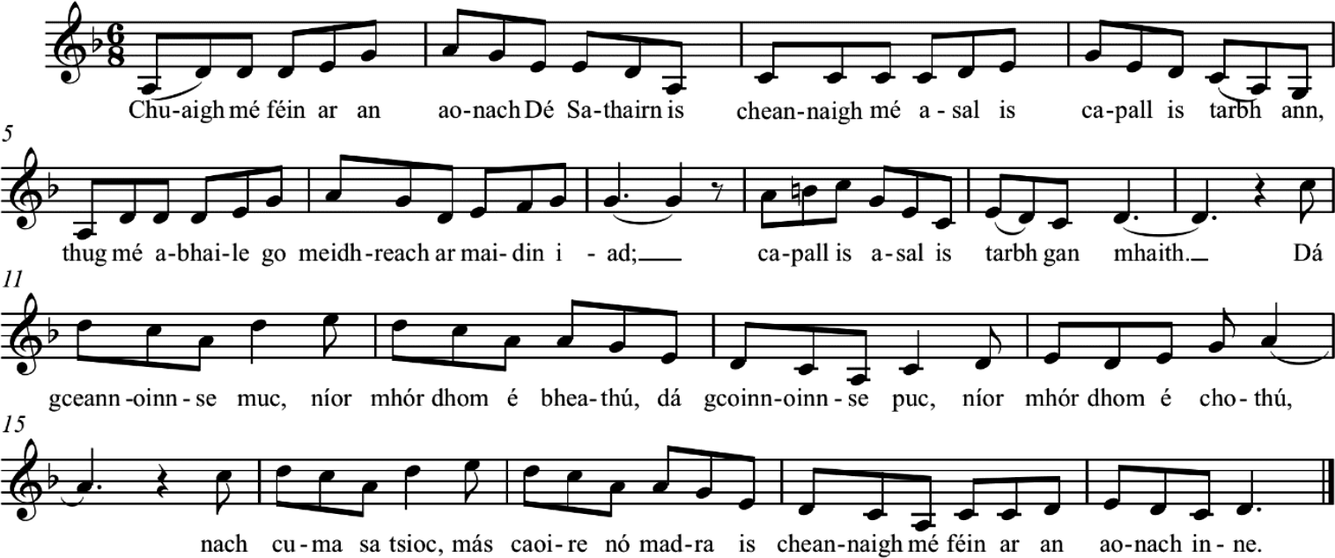
Newly-created Irish-language lyrics (“Chuaigh Mé Féin ar an Aonach” [I Went to the Fair] by Máire Breatnach) based on the jig “The Mist- Covered Mountain” are featured in the film The Secret of Roan Inish (1994). They are useful for the song’s use of the past tense, in which the imperative form of the verb has an h added to the first consonant, illustrating a different usage of lenition; lenition softens the consonant’s sound, indicating past tense. Because the song is very short and sung at high speed, it also enables students to experience the lightening of the language’s thorny-seeming consonant clusters when being produced at a normal conversational speed. In addition, the song offers three common past-tense verbs chuaigh mé, cheannaigh mé, and thug mé (I went, I bought, and I brought) as well as the names of important barnyard animals in rural Ireland: tarbh, asal, capall, muc, puc, caoire, and madra (bull, donkey, horse, pig, goat, sheep, and dog) (see Figure 3).
Entirety of “Chuaigh Mé Féin ar an Aonach” (I Went to the Fair).

To support language acquisition, I use a system drawn from my time of studying Bahasa Indonesia, where I spent two years doing research for my doctoral dissertation. I take a sentence in Irish, then swap out one word. For example, the phrase is buachaill deas óg mé (I am a fine young lad) is a line in the song “Bríd Óg Ní Mháille” [“Bridget O’Malley”]. A language learner can substitute single words in any number of ways that keep the phrase true to the grammar to deepen their understanding of the construction and syntax, as follows:
Is buachaill deas óg mé. — [it’s + a boy + fine + young + me] — I am a fine young man.
Is cailín deas óg mé. — [it’s + a girl + fine + young + me] — I am a fine young girl.
Ní buachaill deas óg mé. — [it’s not + a boy + fine + young + me] — I’m not a fine young man. Is buachaill deas óg é. — [it’s + a boy + fine + young + he] — He is a fine young man.
Similarly, a song line such as Chuir mé féin mo lámh i mo phóca (I myself put my hand into my pocket) can be used for various substitutions: lámh (hand) can appear as cos, ceann, airgead, or piscín (foot, head, money, or kitten) as substitutes, and póca (pocket) can be mála, carr, bróg, or teach (bag, car, shoe, or house). These substituted lines can be spoken or sung quickly and easily, just as one might quickly say “I don’t have any money (change, friends, time, etc.)” in English.
Irish has marked regional differences in vocabulary, dialects, and song choices. Until the advent of radio in 1926, some of the dialects were barely mutually intelligible. When the radio enabled Irish speakers to hear speakers from some of the other regions, they slowly became accustomed to the different sounds and vocabulary. Today, three major dialects (along with Standard Irish, taught in the schools) comprise the Irish language, with multiple variants in the cities and in diasporic locations such as Newfoundland and other places where a small Irish-speaking community is located. The three primary dialects are Munster Irish, in the southwest (Counties Kerry and Cork); Connemara Irish, in the west (Counties Galway and Mayo); and Ulster Irish, in the northwest (County Donegal). Of the three, Connemara features the majority of speakers who use Irish as their primary form of communication.
As an element of introducing students to the regional dialects, I select a song from each one. From Munster Irish, it could be “Mo Ghile Mear” [“My Gallant Darling”] from the County Cork townland of Cúil Aodha; it features a particular local set of pronunciations such as lwom rather than lyum (as they pronounce it further north) for the word liom, “with me.” Connemara options might include a song such as “Eileanóir a Rún” (“Eileen, [my] Secret”) to foreground such regional uses of taking the central g out of prepositions such as agam or agat (“at me” or “at you”), or the “w” sound for final bh rather than the southern pronunciation of bh as “v.” In Ulster Irish, it might be “Tá Mé i’ mo Shuí” (“I Am Awake”), which uses very strong Ulster pronunciation such as tá pronounced as “tah” rather than “taw,” and the use of the word cha (“will not,” an influence from Scots-Gaelic), among other area-specific choices. Each regional song offers a wealth of possibilities for exploring the language, pronunciation, and regionalisms.
Finally, pronunciation will always be an issue. Because few students or laypeople can use the International Phonetic Alphabet, many teachers create a type of “folk phonetic” system for speech and song. In my own transcriptions, I feature sheet music transcription of the notes with the original Irish language words underneath the notes; that is followed by the Irish (bold, italicised), by the folk phonetics in brackets, and then the translation into English, as follows:
Chuir mé féin mo lámh i mo phóca.
(khwer mey heyn muh law ih muh fōk)
I myself put my hand into my pocket.
Many people use a transcription with the folk phonetics underneath the lyrics as an aid to language learners. But we all use repetition of the songs and phrases until our students sound as if they’re singing in Irish rather than—as a friend put it on social media—a type of ‘fifty-word Klingon.’
Because of the small size and remoteness of the college where I work, I am only rarely able to take students beyond the beginning level of language. That is a disadvantage for them as well as for me because they have to move to a larger town to be able to continue their studies. I have no one to speak with in a small town with neither native speakers nor a cohort of Irish language learners. However, being not in the least bit shy about singing—I tell them that my voice is my teaching tool, whether I’m speaking or singing—allows them to also try to use their singing voices as a tool to approach the language. In learning to sing in Irish, they learn to speak in Irish. And in learning to sing a new language in a group, they learn that their voices—all their voices—matter.
Leading a Canadian Irish-Language Community Chorus (Ellen MacIsaac)
I started learning Irish in 1994, as a student studying for a Bachelor of Arts with honours in Music at the University of Ottawa. I began my studies once I made the decision to do graduate work in Ireland on Irish song, though the offerings at the university were limited and mostly confined to book learning. My professor, Pawl Birt, was a native Welsh speaker, the Chair of Celtic Studies and the only professor teaching the Celtic languages at my institution. Once in Ireland, I continued studying the language through a social and cultural organisation called Conradh na Gaeilge [the Gaelic League], courses offered at the University College Dublin, and through Oideas Gael (the same language and culture institute attended by Sean Williams’ students). However, I was not able to live for any length of time among native speakers in Ireland, and my spoken Irish has suffered more for it.
While in Dublin, I learned sean-nós singing with Seán Ó Casaide, a retired school inspector and father of the Donegal musical family known as Na Casaidigh, as well as immersing myself in traditional singing sessions such as An Góilín—a singers’ gathering in Dublin—and festivals such as the Oireachtas na Gaeilge (Irish Language Gathering, the premier annual festival of traditional Irish-language song). Once I graduated and returned to Canada, I wanted to create an opportunity for people to sing Irish traditional songs, in Irish and English, in Ottawa. We don’t have a tradition of singing sessions in Ottawa, but we do have a tradition of choirs. So, I created the Ottawa Celtic Choir and set a mandate for the choir to sing songs from the seven Celtic nations, in the six Celtic languages as well as English, French and Galician (Galego). My challenge was multifold: many people who joined the choir had never had exposure to any of the Celtic languages, had never heard many Irish traditional songs, and many had no experience singing in languages other than English or French.
Among my first challenges was repertoire. At the time I founded the choir in 2006, my choices for pre-published choral arrangements of Irish or other Celtic traditional songs were limited by the fact that the choir had little money to pay for commercial arrangements. I also needed arrangements simple enough for an un-auditioned community chorus. I also wanted to find arrangements of Breton, Manx, Cornish, and Galician songs, rather than just the Irish, Scottish, and Welsh songs that dominated the published choir music I could obtain. As a result, I began making simple choral arrangements for my group, as well as drawing on the mouth music and lilting traditions of Scotland and Ireland, respectively. This gave me the flexibility to choose songs with simple or repetitive lyrics or songs with familiar melodies to arrange. It is important to mention that most people do not join the choir because of a love of the language but for the music. The language nevertheless becomes necessary to address if members are to learn and perform all the songs the choir programs. Many choir members find the language daunting because of its unfamiliarity with spelling and pronunciation, so I need to take steps to make learning the language via the lyrics as painless as possible.
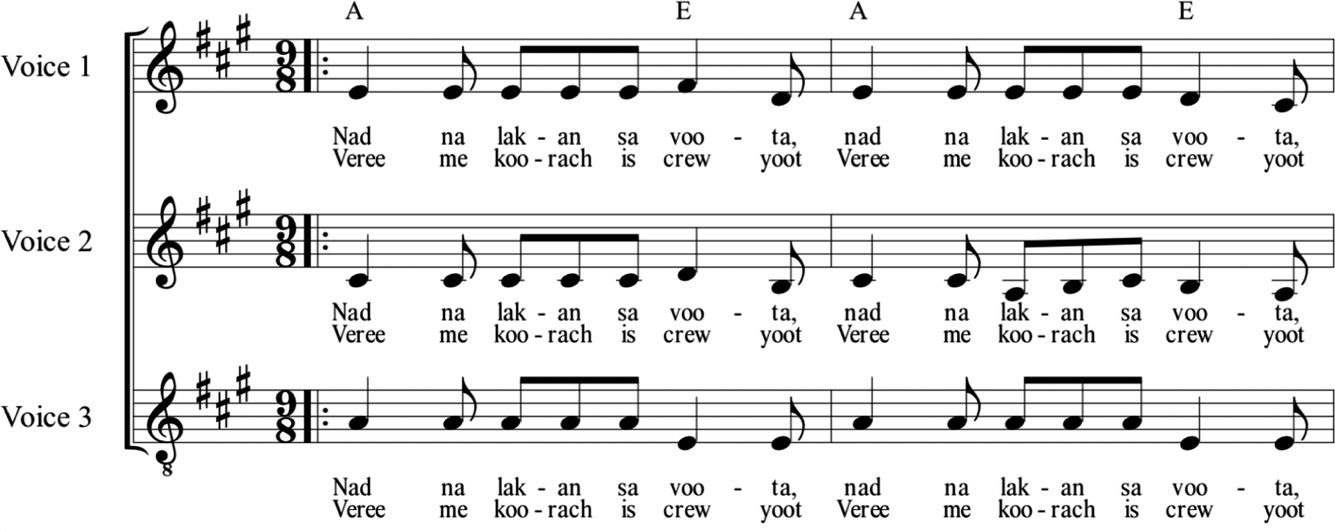
When introducing a song in a Celtic language to the choir, we usually learn the melody first (to “la” or “na”), then learn the words by rote with the aid of a pronunciation guide that I produce for each song. These have three columns, with the original language on the left, the phonetic pronunciation in the middle, and the English translation on the right. Although I try to be consistent in rendering the vowel and consonant sounds of the language on paper, there is no good substitute for pronouncing the words aloud. I speak each line of the lyrics slowly and clearly and have the singers repeat it back to me. I then say the line again in the rhythm of the song, and the singers repeat it in rhythm. Finally, we add the melody. For complicated lyrics, we start with a slow tempo and gradually increase the speed as the singers become more accustomed to making the sounds of the language. As time has gone on, I have moved from a separate sheet to putting the phonetics directly into my arrangements. This alleviates the choir members having to flip back and forth between two separate items during rehearsals (see Figure 4).
Note the use of folk phonetics for the choral rendition of the song “Nead na Lachan” (Nest of the Duck), arranged by Ellen MacIsaac.

Once the choir members have a grasp of the sound of the language, we talk about the meaning of the words, and how to interpret them in performance. This means understanding the story behind the song, as well as understanding the basics of how a sentence is laid out, so that they understand where the subject, the object, and the verb are in the lyrics, as well as any key words of emphasis. I also take the opportunity to point out words they may have seen in other songs, such as grá (love), Dia (God), brón (sorrow), and even more mundane words like fuinneog (window). Sometimes even phrasing recurs, such as mo chuid (my part of). This can even occur across the Celtic languages; although the spelling might be different, saying the words out loud makes the relationship between the languages clearer.
As a choir, we are keen to ensure we are pronouncing the words as correctly as possible; this is borne out of experiences in concert. We once did a concert at a branch of the Royal Canadian Legion at which we performed the “Sans Day” Carol (Saint Day Carol) in Cornish. I told the choir before the performance that Cornish is virtually a dead language and that the chances of having a Cornish speaker in the audience was virtually zero. After the performance was over, we were approached by an elderly gentleman who was effusive in his praise for our song choice, telling us he was from Cornwall and hadn’t heard the language spoken in years, much less from a choir in Canada! Ever since, we have taken great pains to ensure our performances are as close to an authentic singing style, dialect, or pronunciation of the language as we can possibly come.
One of the common ways in which choir music handles the issue of pronunciation is to publish a pronunciation guide, and when developing a piece for the choir, I am no different. The interesting twist for us is that a number of choir members are French-speaking by first language, as opposed to English. Virtually none of the choir can read the International Phonetic Alphabet. Because of this, I need to take special care when representing Irish sounds in a pronunciation guide, choosing combinations that are intelligible to both French and English speakers. For example, a chéile (each other) could be rendered in many ways, but “a hyay-la” is a way that both the French and English speakers in the choir can parse quickly and easily.
Representing nuances in pronunciation is more difficult in a written pronunciation guide, so, I work with the choir on diction, vowel placement and voiced consonants (which I call resonant consonants when describing their use in Irish traditional singing). This means a different performing style than is common for a choir used to performing western art music. For example, lilting requires the mouth to be partially shut to achieve the speeds required for the tunes. Plosive consonants such as d and t tend to be softened in Irish, and the shape of the mouth is a little wider and more horizontal for vowels than you would expect in classical choral singing. Irish traditional singing also tends to dwell on voiced consonants such as m, n, and l, to achieve a drone effect. For choir members accustomed to being told to enunciate, make each vowel with an open mouth in a long vertical shape, and use crisp consonants rather than dwelling on them, these instructions can seem odd. But the overall effect is sufficiently traditional sounding that we have been told by Irish speakers and teachers that we sound the way they are accustomed to hearing those songs sung at home.
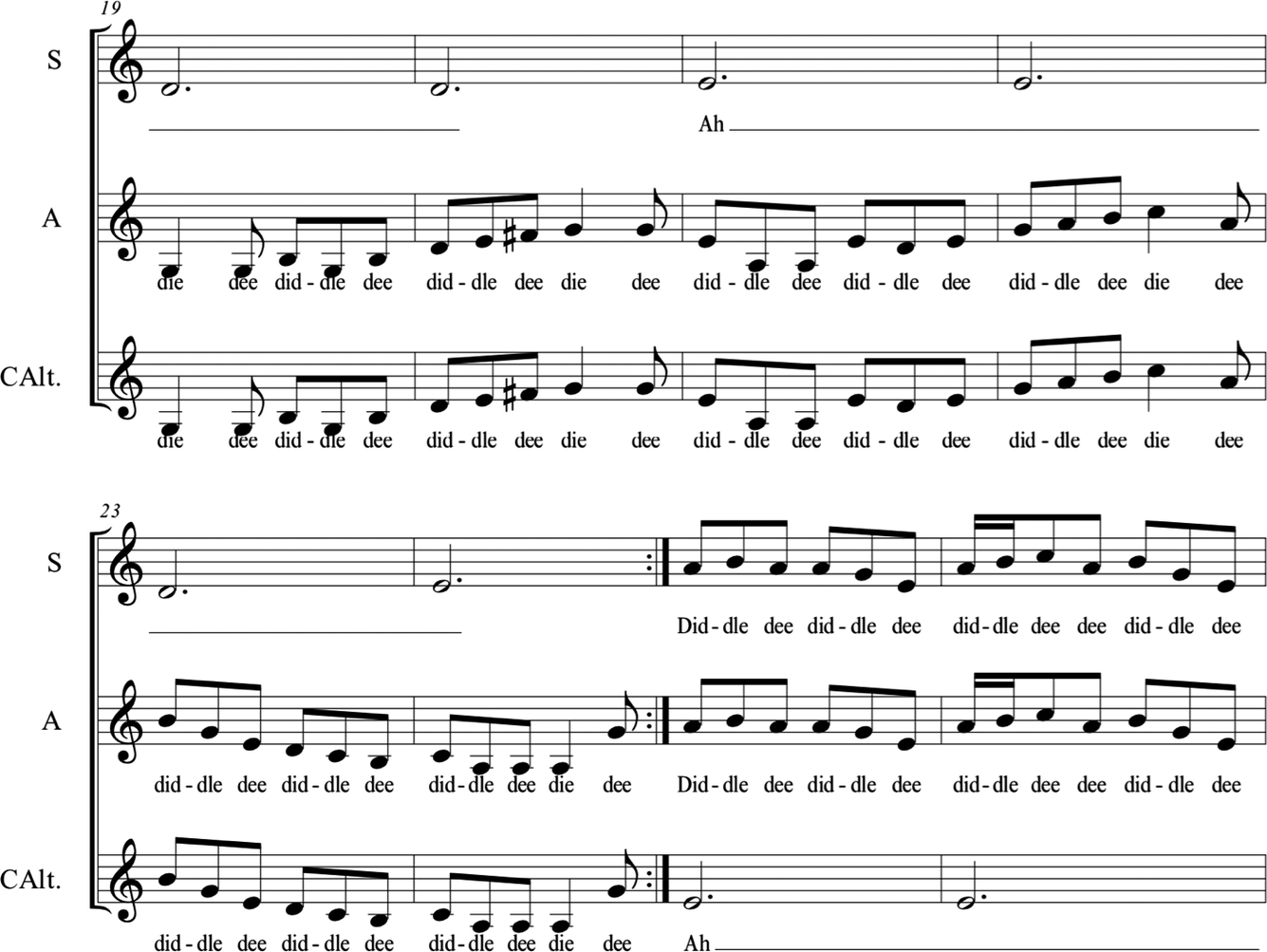
Lilting or mouth music presents its own set of challenges and opportunities when it comes to a choir. Traditionally, lilting is limited to one or two people who sing together but trade-off to smooth out the bumps in performance created by the singers needing to stop to take a breath. With a choir, a large number of singers can ensure the tune is performed smoothly with no breaks or unintended tempo changes. However, ensuring that everyone is on time, in tune, and saying the lilting syllables together can be a significant challenge. I have tended to solve these problems with the choir in a number of ways. First, in creating the arrangement, I spread the melody around among the parts to give everyone a chance to sing but also not have people singing outside of their natural range. I often incorporate bits of other tunes, either as an interlude or as a tune set (see Figure 5).
In this section of “Don Oíche Úd i mBethil/Apples in Winter” (Poem on the Night in Bethlehem), the lilting section of the jig, “Apples in Winter,” is written out.

Second, I work closely with the choir on diction, breath control, and limiting physical motion in performance. For diction, I encourage the choir to keep the mouth partially shut and to soften the voiced consonants to help with performing the piece at the tempo required. When the tune has words instead of vocables, we practice saying the lyrics quickly so that the choir gets used to the feel of the pronunciation and limits stumbling over the words. Thirdly, we blend breaths so that there is no audible break in the melody, and work on being in tune and in time with each other. Fourthly, I encourage the choir to stand as still as they can while lilting, as any physical motion will draw energy and breath away from the performance. And finally, once the choir has the tune, the words, or vocables, and feels comfortable performing the piece at speed, we work on sounding spontaneous; explaining what lilting or mouth music is used for in the tradition helps in this regard. Making jokes about the sometimes-humorous lyrics can also help loosen up the singers. If all goes well, however, the final result can be magical; the Ottawa Celtic Choir was invited to perform with the Chieftains—Ireland’s best-known “folk band”—at the National Arts Centre in Ottawa in October 2019, at which we performed my arrangement of “Nead na Lachan” during the ceili segment of the finale. The song and the performance fit perfectly with the informal “kitchen party” feel, but were still clear and intelligible to the audience (see Figure 6).
The lilting section of “Nead na Lachan.”

I will note that my approach to the performance of Irish songs is different from that advocated by Michael McGlynn, the founder and director of the group Anúna. I had the opportunity to meet him in St. John’s, Newfoundland for a conference several years ago, and we compared notes as to how we approached the songs. He prefers a more western art music approach for Anúna, but it is worth bearing in mind that they are a professional choir, whereas the Ottawa Celtic Choir is an un-auditioned community choir with an emphasis on teaching and celebrating Celtic languages. We don’t strive for perfection so much as we strive to convey the rich variety of Celtic languages and songs and have as much fun as possible while doing it.
The Role of Technology in Language Learning for Both Authors
Without a doubt, the COVID-19 pandemic has seen chaotic results in teaching and learning around the world. In the case of learning the Irish language, the authors have had to alter their methodologies. In the case of students from the Evergreen State College, the pandemic was declared four days prior to their planned departure for Ireland, where they would have been putting theory into practice by learning the language from native speakers of Irish and gaining precious information about how the Irish see and understand the world. Instead, Oideas Gael quickly set up videoconferences (Zoom) so that the students were able not only to study the language with native speakers but also to learn new songs. The fact that they still were able to put theory into practice and to function as language learners and singers across thousands of miles was possible only because of videoconferencing technology; it mitigated their disappointment and definitively connected them across a significant ocean.
In the case of continuing the Gaelic choir mid-pandemic in Ottawa, a hybrid approach worked best. Some singers were on videoconferencing, muted, and some were masked with specially made singers’ masks, in an in-person but socially distanced location. With a phone on a small tripod and having all of the online singers muted, the online participants had the benefit of hearing all of the harmonies at the same time. It was a near-seamless approach. Having the sheet music and recordings available to singers on a protected Google Drive worked best and replicated the ability of the director to physically hand out the music in person. What did not work for either the choir director or the study-abroad-from-home professor was the ability to have students sing simultaneously, un-muted. In an international emergency, the singers prevailed!
Conclusion
One of the most ill-advised things educators can do, whether it is in working with language or music, is to demand perfection from the beginning. Humans are perfectly imperfect, as are all languages of human communication. The students begin with receptive listening, whether learning a word or a musical phrase; with a song, the educators do not stop until the students sing the song. Similarly, as native speakers from the first year of life, humans do not stop talking until they can converse as adults. Yet as adult language learners, people often stop at the point of production because of our fear of sounding imperfect. The song is precisely the catalyst for shifting from the point of listening comprehension to out-loud creative production in conversation or in the song itself. Lifelong native English speakers make mistakes and, in so doing, bring regional variety, richness, and joy to their spoken praxis. Songs include grammatical mistakes as well; why else would several generations of English speakers insist on using the word “lay” rather than “lie” after hearing Bob Dylan’s “Lay, Lady, Lay” and Eric Clapton’s “Lay Down Sally”? Grammarians who rely on perfect execution rather than expression and communication may find their auditors overwhelmed and ready to abandon language study. The authors would argue that it is precisely by normal human beings singing the living, breathing versions of the language—flaws and all—that those languages live or die. Even better, singing across and through conceptual differences enables people to communicate in additional ways that are, perhaps, older than words.
Acknowledgements
From Sean Williams: I would like to thank the many native Irish speakers—both singers and regular speakers—who have worked with me and my students in Ireland. Part of their contributions to the success of my own teaching is that they, too, teach at least partly through song. The sean-nós singer and native Irish speaker Joe Heaney—Seosamh Ó hÉanaí—started the process of teaching the Irish language through song that led me to this point. The Evergreen State College has enthusiastically supported my efforts to teach the language through song for decades, and my gratitude is boundless.
From Ellen MacIsaac: I am extraordinarily fortunate not just to have been able to work with Seán Ó Casaide and other wonderful singers in Ireland, but also to live in a part of the world that has been experiencing a surge in interest in the Irish language in recent years. So my thanks go to all my traditional singer friends in Ireland, to all the wonderful people who have sung in my choir in the past two decades, and to the enthusiastic gaeilgeoirí, speakers of other Celtic languages and Celtic music lovers in Canada who have supported us.