Building community resilience (CR) has become a national policy issue and goal with the growth and development of public health emergency preparedness since 2001.Reference Chandra, Acosta and Stern 1 - 6 While there are many definitions of resilience, this article focuses on the ongoing ability of a community to withstand and recover successfully from adverse events.Reference Chandra, Acosta and Stern 1 CR in the context of public health preparedness is “the ongoing and developing capacity of the community to account for its vulnerabilities and develop capabilities that aid in: preventing, withstanding, and mitigating the stress of an incident; recovering in a way that restores the community to self-sufficiency and at least the same level of health and social functioning as before the incident; and using knowledge from the response to strengthen the community’s ability to withstand the next incident.”Reference Chandra, Acosta and Stern 1 CR moves away from professional-only emergency management, response-focused training, and accumulation of supplies, and focuses on empowering whole communities, promoting meaningful collaboration, and building on existing strengths in nondisaster periods.Reference Plough, Fielding and Chandra 7 CR-building activities promote general community health and safety through identifying and addressing everyday health hazards, networking, problem-solving, planning, and addressing social determinants of health.Reference Keim 8 By broadening disaster planning to include community-level involvement in all disaster phases, the CR framework aligns preparedness with general public health.
CR-building activities are a requirement for local health departments (LHDs) receiving public health emergency preparedness funding from the Centers for Disease Control and Prevention (CDC). 4 , 9 The CDC’s standards require collaboration with diverse partners for short-term response and long-term recovery, reflecting specific CR elements. 4 As public health emergency preparedness cooperative agreements provide considerable funding to all major metropolitan health departments, the CDC’s definitions and standards significantly shape how LHDs understand and apply CR. While LHDs wrestle with how to operationalize CR concepts, they are also implementing CR interventions for the first time. Studies have proposed metrics and made recommendations both to document and apply CR in action, but there remain more questions than answers owing to the newness of the topic. 10 The Federal Emergency Management Agency (FEMA) has highlighted existing projects that contain aspects of a whole community approach to preparedness, but to date, we know of no studies detailing US communities’ understanding of CR or their operationalizing of CR into practice.Reference Eisenman, Chandra and Fogleman 11 It is crucial to document and share the experiences and lessons learned by LHDs as they develop and field programs to build CR.Reference Chandra, Acosta and Stern 1 , Reference Schoch-Spana, Sell and Morhard 12
The Los Angeles County Community Disaster Resilience Project
The Emergency Preparedness and Response Program of the Los Angeles County Department of Public Health (LACDPH) launched the Los Angeles County Community Disaster Resilience (LACCDR) Project in 2013. As a major metropolitan LHD receiving public health emergency preparedness funding, the LACDPH has been taking steps to understand CR and meet the CDC’s requirements. The goal of the LACCDR Project is to translate the theory of CR into practice and improve CR to disasters in Los Angeles. Developed in collaboration with community, academic, government, and business partners, the Project focused on increasing individual’s and communities’ readiness to prepare for, respond to, and recover from natural or manmade disasters through a community-based approach, designed around 4 of 8 CR levers proposed by Chandra et al, which are further described below.Reference Keim 8 , Reference Chandra, Williams and Plough 13 , Reference Wells, Tang and Lizaola 14
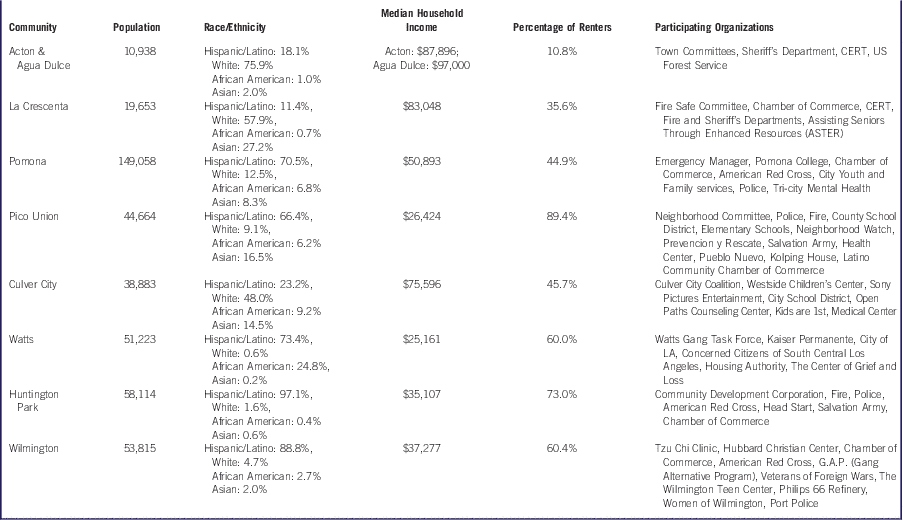
Previous articles related to the LACCDR Project have presented the theoretical framework of CR and described the Project’s coalition identification and intervention development process.Reference Keim 8 , Reference Chandra, Williams and Plough 13 , Reference Wells, Tang and Lizaola 14 The Project’s Steering Committee identified eligible coalitions from LA County’s 8 service planning areas on the basis of the community’s population size, level of community organizational infrastructure to lead capability development and implement the LACCDR Project, and diversity.Reference Eisenman, Chandra and Fogleman 11 Sixteen candidate communities (2 per service planning area) were matched for demographic and hazard risk characteristics; 8 were randomized to the CR intervention group (Table 1) and 8 to the preparedness control group. Emergency preparedness public health nurses (EPPHNs) trained the coalitions with either a CR Toolkit designed to provide knowledge, tools, and resources to strengthen resilienceReference Eisenman, Chandra and Fogleman 11 or a best-practice disaster preparedness resource focused on stockpiling personal or household supplies and emergency communication plans.Reference Eisenman, Chandra and Fogleman 11 , 15 All coalitions developed work plans and received $15,000 to implement resulting activities. CR coalitions could also request technical assistance from Project leadership.
Description of the Eight Resilience Communities and CoalitionsFootnote a

a Abbreviation: CERT, Community Emergency Response Training.
The purpose of this article was to expand the limited knowledge base around the application of CR concepts to public health emergency preparedness by describing the responses and challenges experienced by the 8 CR coalitions during the first planning year. Prior articles have described the project development, design, methods, and preliminary evaluation results; this article is the first to discuss community coalition-level experiences.Reference Plough, Fielding and Chandra 7 , Reference Eisenman, Chandra and Fogleman 11 , Reference Chandra, Williams and Plough 13 , Reference Wells, Tang and Lizaola 14 Our goal was to provide a glimpse into the pathways, struggles, and solutions communities and LHDs may encounter as they learn and apply resilience principles. Understanding the issues that arise when dealing with CR is critical for LHDs, especially in the early phases of fielding interventions with their local communities.
METHODS
Theoretical Framework
Chandra et alReference Chandra, Williams and Plough 13 proposed 8 levers of CR, 4 of which were used to design the LACCDR intervention and evaluation tools: education, engagement, partnership, and community self-sufficiency. Education refers to the uptake and application of resilience concepts in the community.Reference Chandra, Williams and Plough 13 Rather than focusing on individual preparedness knowledge, education in CR emphasizes understanding local hazards and resources, vulnerable populations, planning toward long-term recovery, and communication strategies for community education. Engagement entails active participation of communities in response and recovery and builds on social networks and participatory decision-making among diverse stakeholders, including marginalized or vulnerable groups.Reference Chandra, Acosta and Stern 1 , Reference Chandra, Williams and Plough 13 Examples of activities that promote engagement include actively inviting and involving residents in response planning or identifying geographic concentrations of vulnerable groups. Partnership refers to meaningful collaboration between stakeholders, particularly governmental and nongovernmental partners. It entails identifying strategies and resources to integrate disaster planning for whole CR and clearly delineated stakeholder roles and responsibilities.Reference Chandra, Williams and Plough 13 , Reference Alsei 16 , Reference Gajewski, Bell, Lein and Angel 17 Community self-sufficiency is a community’s ability to collectively plan for various phases of the disaster cycle and continually update and improve plans. Individuals and neighbors are ideally able to take care of themselves, while mutually providing and receiving help from within the community.Reference Chandra, Williams and Plough 13
Intervention Implementation
After the official LACCDR Project kickoff in January 2013, the 8 CR coalitions met monthly for 1 to 2 hours to receive the CR Toolkit trainings, plan activities, and budget how to spend their stipend of $15,000. The CR Toolkit was based on priorities identified during an earlier LACCDR development phase incorporating county-wide stakeholders’ interests and experiences.Reference Wells, Tang and Lizaola 14 Toolkit sections included Psychological First Aid, Community Mapping, Community Engagement Principles for CR, How to Identify and Develop Community Leaders, and Training Community Field Workers.Reference Eisenman, Chandra and Fogleman 11 It included activities, tools, and resources intended to bring communities together to strengthen their resilience and facilitate community-specific discussions, with the purpose of seeing if these resources could make a difference in their behaviors, knowledge, and attitudes about CR within LA County. The Toolkit presented interwoven themes of education, engagement, partnership, and self-sufficiency and provided CR coalitions opportunities to ask and answer community-specific questions. EPPHNs familiar with the respective service planning areas received trainings on 6 CR Toolkit modules before conducting coalition trainings.
Through the planning year, coalitions were also actively encouraged to invite new members to their meetings. The Project emphasized engaging and partnering with organizations representing CDC’s 11 community sectors: business, emergency management, housing and sheltering, community leadership, cultural and faith-based groups and organizations, health care, social services, media, mental/behavioral health, state office of aging (or its equivalent), and education and childcare settings (Table 2), 6 as well as with people with disabilities. EPPHNs, nursing supervisors, and investigators provided ongoing support and supervision for coalitions in monthly meetings as issues arose over the year.
Centers for Disease Control and Prevention 11 Community Sectors

Data Collection
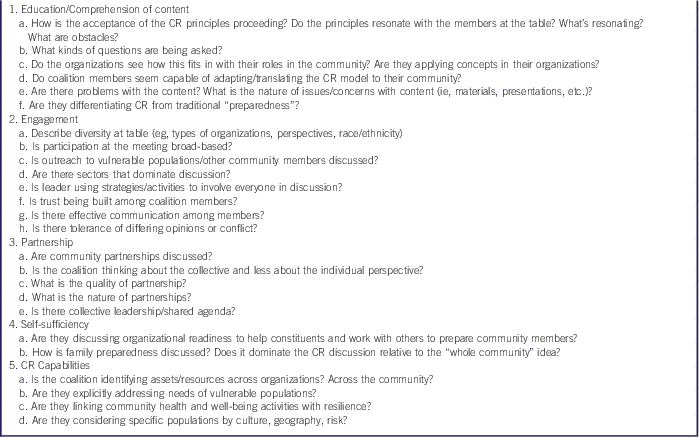
Resilience coalitions received CR Toolkit trainings from February to July 2013. Data were collected during training sessions by observers using a structured observation guide with specific questions around the 4 CR levers (Table 3). Observers received 2 hours of scribe training and attended assigned coalition meetings to audio record; take notes on attendance, composition, and participation; document interpretation, adoption, and application of resilience principles; and write up a synthesis report. Verbal consent for recording and note-taking was requested at every meeting. The study was reviewed and approved by the LACDPH Institutional Review Board.

Data Analysis
Structured observation reports were analyzed from August to November 2013. Qualitative content analysisReference Cho and Lee 18 was used to code actions and quotations as documented in structured observations as a way of evaluating the coalitions’ understanding and demonstration of the CR framework. Qualitative content analysis, a method of systematically classifying materials into identified categories with similar meaning, was determined as the analysis approach because it allows for coding into preconceived themes, in this case, the 4 CR levers previously described. First, 4 researchers (BC, RL, JB, DE) independently read through and analyzed a subset of structured observations. This first analysis looked at actions and quotations documented in structured observation reports for general themes related to the 4 CR levers and discussed if there were additional subthemes to add within the levers. The team then compared, refined, and expanded distinct codes from the CR framework and compiled agreed upon codes into a codebook. Codes were applied across the remaining structured observation reports. Analysis focused on CR coalitions’ understanding and application of CR concepts during the pilot year, including how they discussed resilience, who they invited to meetings, types of planned activities, and other CR-building actions.
RESULTS
Forty-one structured observation reports were analyzed, representing 85% of the 48 coalition meetings from February to July 2013. We report the most relevant and prominent themes and subthemes that emerged, following the structured observation outline. Quotations are presented to give insight into coalition understanding, uptake, and application of CR during this pilot year.
Education
Observers recorded 177 distinct descriptions or quotes that were coded as education. This theme encompassed the coalitions’ understanding of CR broadly, as well as specific plans and efforts to communicate concepts to their communities.
Understanding Community Resilience
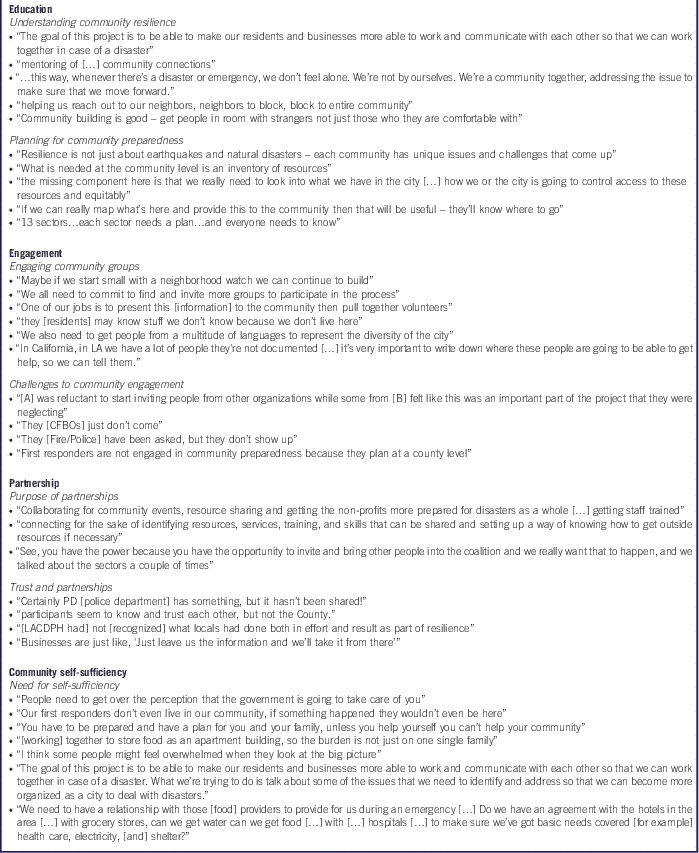
The term and concept of “community resilience” was unfamiliar to all coalitions when the EPPHNs initially provided CR Toolkit trainings. Discussions tended to align with traditional preparedness approaches and emergency supplies and coalitions lacked knowledge and resources for even personal preparedness (Table 4). Some coalitions focused on top-down approaches to the community, such as “informing the community of [the coalition’s] resiliency plan,” rather than involving the community in planning. Plans often focused on supplies, Community Emergency Response Training (CERT), government-led responses, and disaster response, rather than on the promotion of community health and readiness for any adverse event.
Coalition Understanding of Resilience Concepts

Over time, coalition discussions showed understanding of CR (Table 4). The concept began to resonate with coalitions’ sense of purpose; one coalition stated their goal was “to be able to make our residents and businesses more able to work and communicate with each other so that we can work together in case of a disaster.” Coalitions expressed wanting to build community capacity by reaching out to neighbors, convening people, leveraging relationships, and facilitating new and existing connections. They also talked about their roles and the importance of local organizations being on the same page.
Planning for Community Preparedness
Coalitions’ understanding of resilience was also reflected in how they discussed community preparedness planning. Suggestions included convening committees before disasters and reaching out to vulnerable groups (such as access and functional needs groups, older age groups, ethnic minorities, or low-income groups), planning for community-specific issues, customizing information for residents, and learning about local assets and resources. For example, one coalition wanted to involve each of their town’s sectors in planning, while another identified a local radio station as a nontraditional community-wide resource.
Engagement
Observers recorded 72 descriptions and quotes coded as engagement, describing the quality of interactions between coalition members and how coalitions felt about bringing new representatives into their coalitions or reaching vulnerable groups.
Engaging Community Groups
Coalitions were often already involved in engagement-related activities in their communities (Table 4). They saw the need for connections in their neighborhoods and reached out through creative efforts, such as developing disaster preparedness media in American Sign Language. Other engagement-enhancing strategies included using existing channels of communication by word of mouth, newspaper ads, e-mails, and billboards and through trusted people and organizations.
Most coalitions expressed a desire for greater participation from communities, including representation for those who spoke different languages, the homeless, undocumented individuals, access and functional needs groups, and those with age-related vulnerabilities, such as unattended children, disengaged youth, and older adults living alone. Coalitions also mentioned temporary workers, day workers, tourists and visitors, and groups that are isolated because of lack of access to official lines of communication or communication technologies. One coalition with heavy representation from civic leadership and emergency management wanted more residential involvement. Another coalition mentioned contracts and existing relationships that would benefit their ability to engage the community and promote planning and outreach activities.
Challenges to Community Engagement
Challenges emerged as coalitions sought to engage existing and new members. Part of the difficulty stemmed from members’ varied ideas of when and how to invite new members. Some expressed wanting to have a community plan completed before extending invitations, whereas others preferred not to wait. In addition, while groups verbally assented to invite new members, they often looked to their EPPHNs to reach out to agencies or representatives. Coalitions also struggled to identify organizations that could effectively represent local subgroups. For example, for 1 coalition, only 1 of 3 distinct cultural communities was represented at meetings because it did not have contact with the other 2 groups. Some coalitions felt limited in their resources to conduct outreach to at-risk groups (ie, through booths and fliers).
Coalitions also received mixed responses when they sought to expand. Members expressed frustration when invitations went ignored or meetings unattended. Groups primarily composed of cultural and faith-based organizations were disappointed that fire and police departments did not participate, whereas coalitions with civic and first-responder representation expressed similar frustration about cultural and faith-based organizations. At times, sectors were perceived as difficult to engage because of other priorities, such as “gangs, refinery problems, monitoring the harbor.”
Partnerships
Thirty-three quotes and observations were coded as relevant to the topic of partnership. Discussions of partnerships were limited through the coalitions’ first planning year, as they were not expected to implement CR-building activities in the formative stage. Coalitions ranged from 3 to 20 members and varied in membership composition, representation from the CDC’s 11 sectors, priorities, and interaction with potential new partners. Some meetings were initially attended by mostly city officials and emergency managers; faith-based organizations, schools, childcare, or senior services had the least representation.
Purpose of Partnerships
Coalitions mentioned various reasons for the need to build partnership: to build infrastructure for the community to connect, share information, and plan and prepare together; to promote collaboration, resource-sharing, and trainings for individuals and nonprofit organizations; and to provide community-led post-disaster services such as debris clearing (Table 4). They expressed desire to increase participation of volunteers, parents, and agencies already involved in non-disaster-related community wellness, such as humanitarian clubs and neighborhood improvement programs. Several coalitions specifically identified faith-based organizations as having the potential to play larger roles; they were perceived as being willing and wanting to be community resources. At other times, participants seemed more focused on individual organizational responses rather than on interagency networking.
Coalitions with members who had worked together extensively before the Project formed shared agendas more quickly than did younger coalitions. These groups discussed the importance of having clear and common coalition goals and objectives and shared their history and goals with new members. They also discussed formal memorandums of understandings or agreements between member agencies, although it is unclear how many were actualized. All coalitions wanted to better understand their role in the larger web of local partnerships organized outside of the Project; their sense of purpose was tied to understanding that role. For example, cultural and faith-based organization-heavy coalitions felt more confident in meeting specific needs when fire and police agency representatives articulated their agencies’ respective roles.
Trust and Partnerships
Coalitions emphasized the importance of trust in fostering and maintaining partnerships (Table 4). Some participants felt their work prior to the Project had not been recognized by the county, and past experiences of feeling excluded were identified as limiting coalitions’ willingness to actively pursue partnerships with governmental sectors. Coalitions also expressed frustration and a sense of disconnect from partners when they received what they perceived as inadequate communication or representation. Different approaches influenced coalitions’ tendency to build meaningful partnerships. For example, those with strong emergency management representation often influenced the group to take more traditional “preparedness” approaches, focusing on and using language relevant to response plans and supplies. Coalitions accustomed to working alongside residents spoke more about relationships and demonstrated the CR approach to partnerships with greater ease.
Community Self-Sufficiency
There were 52 observations and quotes related to self-sufficiency. While this lever was difficult to observe in action, coalitions expressed their perceptions of the concept and their desires to be self-sufficient.
Nearly all coalitions understood and identified self-sufficiency as a priority (Table 4). Coalitions felt that families would likely be focused on themselves after a disaster, but needed to be informed of the necessity for neighborhood-level reliance, instead of waiting for first responders and external aid. Coalitions cited food, water, connection, and communication as key for community self-sufficiency. If they could work together and collectively plan before a disaster, they could make sure that available resources would go to people in greatest need, specifically vulnerable groups. At the same time, coalitions understood that community self-sufficiency can seem daunting, especially for low-income residents. Coalitions discussed the benefit of planning with sectors to improve self-sufficiency, valuing programs like CERT. Others identified the importance of involving local businesses so that communities could be less reliant on external help. Some offered the importance of convincing people to prepare to minimize potential post-disaster looting and rioting, as portrayed in popular media.
DISCUSSION
Our analyses add to the few documented examples of operationalizing community disaster resilience.Reference Keating, Campbell and Mechler 19 , Reference Sudmeier, Jaboyedoff and Jaquet 20 We identified key themes from coalition meetings through the LACCDR Project’s first planning year as groups received CR-focused Toolkit trainings. Most observations aligned with CR themes of education and engagement, as communities wrestled with CR concepts and reached out to sectors and vulnerable groups during the initial planning year. Partnership was the least observed theme. Findings showed coalitions’ understanding and application of CR concepts during the first year. Groups varied in size and composition, particularly with regard to the CDC’s 11 sectors. Many groups struggled to engage new groups; some engaged new members through the year while others waited until their internal planning had progressed. Coalitions expressed the importance of trust and specifically recommended engaging faith-based organizations as community partners. Coalitions resonated with the idea of communities taking care of themselves, although the emphasis was often placed on household-level self-sufficiency and only sometimes stretched to the community level.
It may not be surprising that understanding and applying CR was challenging for coalitions in the first planning year. CR is a complex construct focusing on agency, community, and personal relationship-building and differs from the more traditional emphasis of public health emergency preparedness on professional responders. The process of learning about CR through the training modules was foundational to the coalitions’ application of resilience through community engagement and planning. Within the CR model, all community sectors have a role and are necessary partners in the larger work of community building, promoting community wellness, and increasing public health preparedness, all of which can promote resilience. Challenges lie with both defining and operationalizing resilience itself,Reference Brose 21 but understanding this concept proved to be a key part of the growth in orientation that occurred during the planning year. Public health programs that wish to engage communities in building resilience should anticipate this adjustment phase during which coalitions are calibrated on the meaning of resilience.
In addition, community engagement emerged as a leading challenge. Community engagement in the resilience framework encourages representation from various sectors and subgroups within a community, shared decision-making, and the identification and leveraging of nontraditional community resources. While this definition and approach to engagement was shared with all coalitions through the training modules, some engaged new partners more willingly and successfully than others. Coalitions with this new expanded network of stakeholders of representatives wrestled with the challenges of melding their prior identities and experiences in the process of understanding and applying CR. This was especially evident when observing coalitions with strong emergency management representation.
However, we highlight that this bringing together of different viewpoints through coalitions is in fact a microcosm of CR, which bridges the emergency management framework that has almost exclusively shaped public health emergency preparedness, with the public health promotion activities characterized by community participatory methods. As such, CR represents the intersection of 2 worlds. It merges the emergency preparedness lexicon of incident command structures with the language and tools of community engagement and education historically used in other public health and community empowerment initiatives.
Recommendations
In view of these difficulties, we recommend that LHDs play a more active role in helping initiate engagement of diverse community groups. For instance, coalitions largely composed of cultural and faith-based organizations may need assistance in recruiting the participation of public agencies and first responders. Likewise, coalitions composed largely of emergency management groups often needed help in identifying community organizations. Vulnerable communities were also a natural rallying point for most coalitions, but guidance was needed for how to approach these groups.
Specifically, LHDs may play a role in fostering increased trust both directly with and among community partners. One way of doing this may be by pursuing partnerships with faith-based organizations more explicitly, as they were often mentioned by coalitions as major community stakeholders who should be part of planning for preparedness, response, and recovery.Reference Stajura, Glik and Eisenman 22 - Reference Joshi 24 A vital asset that faith-based organizations can provide is trust within the communities with whom they are connected.Reference De Vita and Kramer 25
It is important to recognize that these themes emerged even while coalitions had substantial support from EPPHNs and LACDPH staff. Aside from training facilitation, EPPHNs provided support and mediation through group conflict and budget allocations as issues emerged throughout the year. In turn, the EPPHNs required ongoing support and supervision for communicating and operationalizing the CR concept to their coalitions. Overall, a high level of LHD support for putting CR in action was required in the first year of planning beyond the series of structured trainings. Developing a plan for enhancing CR is a complex endeavor, and much of the struggles experienced by coalitions might be expected. It is important for LHDs to anticipate these needs, especially early in the process.
Thus, the experience of the LACCDR Project’s planning year can be used as a guide to navigate challenges and issues that emerge and to help identify what resources and strategies are necessary to support a coalition through challenges. CR activities highly overlap with day-to-day public health practice, and being strategic about limited resources in challenging circumstances is key to success. Knowing what to expect can help both LHDs and community partners to view the challenges as a key part of growth and orientation that can occur in the planning phase.
Limitations
While structured observations helped capture nuances during coalition meetings, participants often referred to phone calls, e-mails, and side conversations that occurred outside of official meetings. Thus, there were communications, decision-making, and dynamics we were unable to observe. Observer bias and complex coalition and room dynamics are also potential limitations. In addition, analysis of structured observations was done in aggregate and not by coalition, and we cannot explain why variation in uptake of resilience concepts occurred between coalitions. This analysis did not attempt to evaluate differences between the resilience and preparedness coalitions.
CONCLUSIONS
The study’s description of coalitions’ first exposure to CR concepts reveals both the complexity and potential of CR programs. Although provided with the same set of trainings and tools, the coalitions’ processes of comprehending and applying CR was far from uniform. They did, however, share the experience of struggling with their roles, how to meaningfully engage with their communities, and how to think about resilience beyond initial disaster response. Findings from the LACCDR Project can suggest ways to clarify the CR model going forward and provide LHDs a better picture of how to operationalize resilience-building policy directives into concrete activities. Next phases of evaluation may focus on what coalitions actually implemented after planning and how those activities differed for CR and preparedness coalitions.
Funding
This work was supported by grants from the Centers for Disease Control and Prevention (grant 2U90TP917012-11), the National Institutes of Health (research grant P30MH082760 funded by the National Institute of Mental Health), and the Robert Wood Johnson Foundation (Grant #70503).