Introduction
In response to the global financial crisis of 2008, the UK Government pursued an austerity agenda involving significant cuts to public services and reforms to the social security system. Austerity measures and welfare reforms have been implemented against a backdrop of stagnant incomes, rising unemployment, and increased costs of living. Recent analysis of the European Quality of Life Survey published in this journal found that food insecurity had risen across many European Countries since the crisis and that the UK and Ireland had experienced the sharpest post-2008 rise (Davis and Baumberg Geiger, Reference Davis and Baumberg Geiger2017). In this context emergency food aid has greatly expanded as a reaction by church and charitable groups to the growing numbers of people struggling to afford enough food.
The rapid growth of food banks in the UK over recent years has received considerable public attention and prompted much debate as to its causes (Lambie-Mumford, Reference Lambie-Mumford2017). While the matter remains politically contested, there is a growing evidence base which links austerity measures and changes to the social security system – which include cuts to Housing Benefit, reassessments of disability benefit claims, reductions in tax credits for working families, and an overall benefit cap (Church Urban Fund, 2013) – to the rise in food bank use (Perry et al., Reference Perry, Sefton, Williams and Haddad2014; Dowler and Lambie-Mumford, Reference Dowler and Lambie-Mumford2015; Loopstra et al., Reference Loopstra, Reeves, Taylor-Robinson, Barr and Stuckler2015; Garratt et al., Reference Garratt, Spencer and Ogden2016). Part of the challenge in seeking to engage policy makers on this issue is the lack of consistent, reliable data on the prevalence of food bank use in the UK, both in aggregate terms and among different social and client groups. This article addresses this gap by estimating the prevalence of food bank use by households living in deprived areas and comparing this to a measure of food insecurity.
Food insecurity and food bank use
The rapid expansion of charitable food aid in the UK has stimulated particular interest in the issue of household food insecurity in the UK. Food insecurity is recognised as the inability to access adequate quality or sufficient quantity of food in socially acceptable ways, or the uncertainty that one will be able to do so (Radimer, Reference Radimer2002; also Dowler et al., 2001). The value of this definition is that it frames the issue as a social one and provides a multi-dimensional conceptual framework for understanding it. Food insecurity is identified not only in relation to the quantity and quality of food one has access to, but also its psychological and social implications. One can be considered food insecure if one is not able to access food in ways that are common and acceptable in a society, such as ‘resorting, e.g. to emergency food supplies, scavenging, stealing and other coping strategies’ (Anderson, Reference Anderson1990). The concept of ‘insecurity’ is also helpful in that it recognises the temporal nature and duration of the issue: while someone may have sufficient food to feed themselves and their family today, they can be considered food insecure if they are anxious or uncertain about their future ability to do so. The implication is that food bank use, whilst a result of acute food need, may not be a good indicator of the extent of food insecurity.
Food insecurity is important because it is recognised as a potent indicator of material deprivation (Loopstra and Lalor, Reference Loopstra and Lalor2017). It captures the experience of having insufficient and insecure financial resources to meet one's basic needs. Research evidence highlights the financial drivers of food insecurity. The ‘Food and You’ Survey in 2016 identified that adults in England, Wales and Northern Ireland with incomes in the bottom quartile and those who were unemployed or economically inactive were significantly more likely to be food insecure (Bates, Reference Bates, Roberts, Lepps and Porter2017). Analysis of survey data from countries where it is routinely monitored also shows low-income as a predictor of food insecurity (Che and Chen, Reference Che and Chen2001).
Food bank use and food insecurity measurements
Existing quantitative evidence on the scale and drivers of food bank use in the UK is largely reliant on data published by the Trussell Trust (TT), the biggest UK provider of food banks. They are a Christian organisation and operate a franchise model of food banks that currently number over 1235 centres (Trussell Trust, 2017a). Their food banks provide parcels of non-perishable food that are accessed via a voucher referral system, issued by service providers including social workers and health care professionals. The most recent figures from the Trussell Trust report that it provided over 1.1 million food parcels in 2016–17 across the UK. Of those 145,865 were in Scotland – a 9 per cent increase from the previous year (Trussell Trust, 2017b). However, these figures do not reflect the true scale of food aid use. Other food banks exist, and vary in their scale and mode of operating: some will allow self-referrals and others not; the size and number of parcels they will provide to an individual over a given period also varies. While it has been noted that the informal nature of much provision means it is difficult to comprehensively map services (Sosenko et al., Reference Sosenko, Livingstone and Fitzpatrick2013), on-going research by the Independent Food Aid Network has so far identified over 700 providers in the UK which are not members of the Trussell Trust.
It is also important to note that TT figures reflect the number of parcels provided and are therefore not a measure of how many individuals are using food banks. Indeed, Davis and Baumberg Geiger (Reference Davis and Baumberg Geiger2017) highlight common concerns over the validity of food bank statistics and the risk of errors such as double counting. While a good barometer of the growing issue of food bank use, reliance on TT data alone provides a limited picture of the prevalence of food bank use in the population. Furthermore, in the absence of a systematic measurement of household levels of food insecurity in the UK, available data on food bank use is often used uncritically as an indicator of the scale of the problem of food insecurity. Yet doing so is likely to underestimate the scale of food insecurity and mask problems of precariousness related to difficulties affording food (Lambie-Munford and Dowler, Reference Lambie-Mumford and Dowler2015).
Analysis which draws on food insecurity data and food bank data in Canada has suggested that while food bank use tends to be indicative of food insecurity, non-use does not indicate an absence of food insecurity (Loopstra and Tarasuk, Reference Loopstra and Tarasuk2015: 240). Indeed, in Canada only 20–30 per cent of food insecure households use food banks (Loopstra and Tarasuk, Reference Loopstra and Tarasuk2015), and studies have shown that food banks are most commonly used by those facing the most extreme level of food insecurity (Loopstra and Tarasuk, Reference Loopstra and Tarasuk2012). Recent UK research has also reported food bank use to be a strategy of last resort for people facing acute financial difficulties and that many experiencing food insecurity will not present at a food bank (Lambie-Mumford et al., Reference Lambie-Mumford, Crossley, Jensen, Verbeke and Dowler2014; Douglas et al., Reference Douglas, Ejebu, Garcia, MacKenzie, Whybrow, McKenzie, Ludbrook and Dowler2015). It has therefore been widely acknowledged that food bank use is an inadequate indicator of food insecurity (Loopstra and Tarasuk, Reference Loopstra and Tarasuk2015; Douglas et al., Reference Douglas, Ejebu, Garcia, MacKenzie, Whybrow, McKenzie, Ludbrook and Dowler2015). As discussed previously in this journal (Lambie-Mumford and Dowler, Reference Lambie-Mumford and Dowler2015), there is a need to develop systematic measurement and monitoring of both food bank use and household food insecurity as separate but connected phenomena, in order to enable ‘individual analyses of the causes and consequences of these experiences’ (Loopstra et al., Reference Loopstra, Fledderjohann, Reeves and Stuckler2016: 9).
In addition, reasons for non-use of food banks by those who might otherwise experience varying degrees of food need are worthy of further investigation. A study of food insecure households in Canada identified that most who did not use a food bank had chosen not to do so for reasons including the unsuitability of the food available, and the stigma associated with accessing such services (Loopstra and Tarasuk, Reference Loopstra and Tarasuk2012). Physical access barriers were less common reasons given for non-use. Until now there has been limited research on non-use of food banks in the UK, and yet this requires better understanding if food insecurity is to be addressed effectively.
Drivers of food bank use
Several recent studies have sought to better understand the reasons for food bank use in the UK. Such evidence highlights that food banks are used by people with a wide range of backgrounds, yet also consistently points to issues of delays and errors in the administration of social security payments, as well as the imposition of benefit sanctions, as common triggers for food bank use (Sosenko et al., Reference Sosenko, Livingstone and Fitzpatrick2013; Cooper et al., Reference Cooper, Purcell and Jackson2014; Lambie-Mumford and Dowler, Reference Lambie-Mumford and Dowler2015; Sims, Reference Sims2016). Analysis of changes in food bank use across local authority areas in England between 2009 and 2013 found that the highest levels of food bank use had occurred where there have been the highest rates of benefits sanctioning, unemployment, and cuts in central welfare spending (Loopstra et al., Reference Loopstra, Reeves, Taylor-Robinson, Barr and Stuckler2015). Further research has identified a robust, dynamic relationship between the number of sanctions applied and the number of adults receiving emergency food parcels (Loopstra et al., Reference Loopstra, Fledderjohann, Reeves and Stuckler2016).
Research carried out with food bank users found immediate income crisis, leaving a household with no or dramatically diminished income, to be a common trigger of food bank use (Perry et al., Reference Perry, Sefton, Williams and Haddad2014). Identified causes of such crises included sudden life events such as bereavement or redundancy, yet the operation of the benefit system was found to have been the most common cause (Perry et al., Reference Perry, Sefton, Williams and Haddad2014). Existing research therefore suggests key drivers of food bank use in the UK to be unemployment, the impact of welfare reforms (sanctioning in particular), and the experience of major life events.
The relationship between food bank use and ill health has been identified as an important yet under-researched issue. Garthwaite et al. (Reference Garthwaite, Collins and Bambra2015) in their ethnographic study of food bank use in the North East of England found that people accessing a food bank often suffered from chronic health conditions and mental health problems. NHS Health Scotland research into food insecurity also raised concerns regarding the need to better understand the health implications of food bank use and the extent to which it might exacerbate existing chronic health conditions (Douglas et al., Reference Douglas, Ejebu, Garcia, MacKenzie, Whybrow, McKenzie, Ludbrook and Dowler2015). Both studies called for further research into the relationship between health and food bank use.
While several case studies have described food bank users, there has been little systematic data available in the UK that offers demographic details on those who access food banks. A recent survey of a representative sample of TT food bank users provides the first evidence to fill this gap, with the most common household type being single males, followed by lone mothers with children (Loopstra and Lalor, Reference Loopstra and Lalor2017). The study also found that people with disabilities were over-represented among food bank users compared to the general population, and that mental health problems were particularly common – affecting one in three of the survey respondents (Loopstra and Lalor, Reference Loopstra and Lalor2017). Importantly, the study also examined clients’ economic status and income sources. All households reported incomes well below the threshold of low income in the UK, and 78 per cent were found to be severely food insecure. Most food bank users in the study were in receipt of benefits (69.3 per cent), with Employment and Support Allowance (paid to people unable to work due to illness or disability) the most common source of income. The findings point to the financial vulnerability of benefit claimants, with 39 per cent of food bank users in the study waiting for a benefit decision or payment.
The current study
Our article builds on the previous examination of food bank users from within food banks by looking at food bank use as a self-reported measure within a wider study of deprived communities in a major UK city, Glasgow. It also goes beyond descriptive information to consider which health, financial and socio-demographic factors are associated with food bank use.
This is important as existing evidence relies upon data provided by the Trussell Trust, which offers an incomplete picture of the scale of food bank use, limited information on the characteristics of those accessing food banks, and no assessment of the relationships between food bank use and key health and financial factors. Most existing evidence is qualitative and therefore able to identify factors and processes present among food bank users interviewed, but not the scale of use or the relative importance of those factors beyond the individuals. This article therefore focuses on the scale of food bank use in deprived neighbourhoods and offers three other important considerations.
First, it compares the scale of food bank use with the incidence of food affordability difficulties among households. While the survey was not initially designed to measure household food insecurity as it is defined above, given that the problem is recognised to be determined by lack of financial resources, the survey's question on experiences of difficulty affording food was considered an adequate proxy indicator.
Importantly, the survey also considers who is not using food banks – for reasons other than not needing to – so as to investigate the wider perceived relevance of food banks and highlight the issue of non-access amongst those who may be in need. Lastly, the article examines the relationship between food bank use and a range of other factors, and assesses the relative importance of demographic, health and financial factors. In this way, the article contributes to the on-going debate as to the suitability of food banks as a response to food insecurity in the UK.
Methods
Research aims
The aim of this research was to examine who uses food banks and why, or why not, among residents of deprived neighbourhoods. The research questions being addressed are as follows:
1. How prevalent is food bank use in deprived communities?
2. How well does food bank use equate to those facing food insecurity?
3. Which socio-demographic, personal, health and financial factors are associated with food bank use?
Study context
Glasgow, as a UK city experiencing considerable deprivation, has been disproportionately affected by austerity compared with more prosperous parts of the country (Beatty and Fothergill, Reference Beatty and Fothergill2014). Glasgow is Scotland's largest city with a population of approximately 600,000. This post-industrial city contains the largest share of deprived areas of any town or city in Scotland. According to the 2012 Scottish Index of Multiple Deprivation (SIMD), over one third of Glasgow's residents live in areas which fall within the 10 per cent most deprived neighbourhoods in Scotland, and almost half live in the 20 per cent most deprived. 21.5 per cent of Glasgow's population were income deprived in 2012, compared with the Scottish average of 13.4 per cent (Scottish Government, 2012a). As with other places that have been identified for research on food bank use (see Garthwaite et al., Reference Garthwaite, Collins and Bambra2015), Glasgow is also noted for its significant health inequalities, with a fifteen-year gap in life expectancy between residents of the richest and poorest parts of the city (McCartney, Reference McCartney2011).
Study communities and data source
The quantitative analysis presented in this article is based on data from interviews with householders conducted in 2015 as part of the Glasgow Community Health and Wellbeing Study (GoWell). This was the fourth wave of a household survey conducted across fifteen communities in Glasgow, each of which lie within the 15 per cent most deprived in Scotland (Scottish Government, 2012b). The 2015 survey comprised a follow up survey at addresses randomly selected from the Postal Address File in previous survey waves and at which a prior interview had been conducted; newly constructed dwellings in the study areas were also included in the survey (Egan et al., Reference Egan, Kearns, Mason, Tannahill, Bond, Coyle, Beck, Crawford, Phil Hanlon, Lawson, McLean, Petticrew, Sautkina, Thomson and Walsh2010). The 2015 survey achieved a response rate of 47 per cent (n = 3,614), with the survey data weighted by age, gender and housing tenure so as to reflect the composition of the fifteen study communities and control for non-response bias. Non-participation in the survey, without weighting correction, is most likely among those with higher levels of education and in employment, although this group are relatively small in number in deprived areas. For the first time the survey included a question on frequency of food bank use in the past year, with a follow up question on reasons for not having used a food bank. This provides a unique opportunity to examine the scale of food bank use, as a self-reported measure.
Measure of food bank use
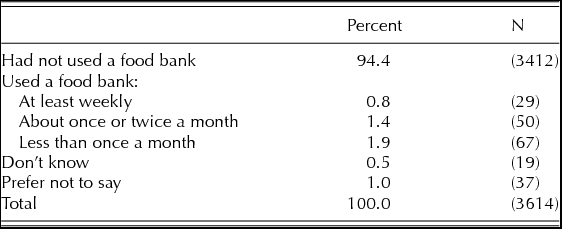
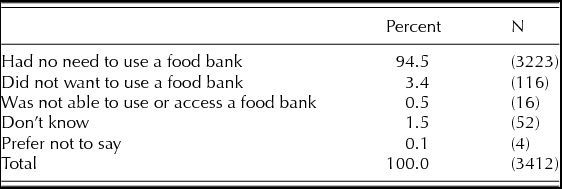
In the 2015 survey, respondents were asked: ‘How often have you used a food bank, or similar service, in the last year?’ Response categories were: I have not used a food bank; at least weekly; about once or twice a month; less than once a month; don't know; prefer not to say. To those who answered that they had not used a food bank, a follow-up question was asked about the reasons for not using one: ‘Was that because you have not. . . needed to use a food bank; wanted to use a food bank; been able to use or access a food bank; don't know; prefer not to say’.
Respondents were classified into one of three groups depending upon their answers to these two questions:
• Food bank users are those who said that they had used a food bank in the last year (weekly; once or twice a month; or less than once a month).
• Non-accessors are those who said that the reason they had not used a food bank was that they ‘had not wanted to use a food bank’ or ‘had not been able to use or access a food bank’.
• Non-users are those who reported that they had not used a food bank in the past year and that the reason for this was that they ‘had not needed to use a food bank’.
Independent variables
Predictor variables of interest examined in this study included key socio-demographic variables including: gender; age; household type; housing tenure; citizenship status (as migrants have different access to welfare support than British citizens); and employment status. The categories used for these variables are shown in Table 5 below. Other variables that have been shown in the literature to be important in relation to food bank use were also examined in terms of life events, health and financial factors. Survey respondents were asked whether they had experienced nine different life events in the past four years: a new job or promotion; unemployment, redundancy or reduced working hours; becoming a parent; serious health event; relationship break-up; bereavement; marriage or partnership; victim of a crime; moving home.
In relation to their health, respondents were asked whether they had a problem of stress, anxiety or depression lasting twelve months or more. Elsewhere in the survey they were asked if they had spoken to a GP in the past twelve months about being anxious or depressed or about a mental, nervous or emotional problem (including stress). A single variable for ‘mental health problems’ was constructed from these two questions where the presence of mental health problems was defined as an affirmative answer to either question. General health was measured according to whether respondents indicated that in general their health was: excellent, very good, good, fair or poor. Long-standing illness or disability is a binary variable based on responses to the yes/no question: ‘Do you have any longstanding illness, disability or infirmity?’
To assess their level of financial difficulty in relation to different items, respondents were asked ‘How often do you find it difficult to meet the costs of the following things?: rent or mortgage; repairs, maintenance or factor charges for your home; gas, electricity or other fuel bills; food; council tax; clothes and shoes; accessing the internet; credit card or store card bills; purchase arrangements for white goods.
In order to determine the extent to which a range of recent changes to the UK benefits and tax credit system have impacted respondents, they were asked: ‘Over the last four years, has your income been affected by any of these welfare reforms? Under-Occupation Deduction (‘Bedroom Tax’); Other Housing Benefit changes; Personal Independence Payment/Disability Living Allowance changes (PIP/DLA)Footnote 1; Working Tax Credit changes; Employment and Support Allowance (ESA) changes; Benefit sanctions.’ A summary variable was created denoting whether a respondent reported their income having been affected by none, one, or more than one of these reforms.
Analysis
Initially the prevalence of food bank use was determined from the two main variables (frequency of food bank use, and reason for not using food banks). Distinguishing ‘non accessors’ at this point and including this group in the next phase of the analysis enabled us to consider whether food bank users are a distinct group, and whether some of those who do not access food banks share characteristics with those who do.
The relationships between food bank use and the range of independent variables were investigated using chi-square statistics, and the results presented in three groupings: socio-demographic variables; health variables; and financial factors. Those variables found to have a statistically significant association with food bank use were then included in the regression analysis. In relation to affordability difficulties, food and fuel have been included in the analysis, given that meeting the costs of these is identified in the literature as being a particular challenge to food bank users and given that the ‘heat or eat’ dilemma is considered to be a key factor in causing people to turn to food banks (Lambie-Mumford and Snell, Reference Lambie-Mumford and Snell2015). To determine the relationship between food bank use and the independent variables of interest, a logistic regression model was developed in four stages.
Using food bank use [user vs. non-user (combining non-accessors and non-users)] as the outcome variable, first key demographic variables were included as predictor variables: gender; age; and household structure. Given the small numbers involved in several of the age groupings, this variable was collapsed into a binary variable comparing those under and those over forty, which represents two similar sized groupings. Similarly, for household structure ‘older single adult’ was merged with ‘single adult’ and ‘older couple/multiple person’ with ‘couple/multiple person’. Second, to evaluate the potential relationship between health and food bank use, the presence of long-standing illness or disability; mental health problems; and self-reported mental health were added to the model. Third, citizenship status; employment status; and experience of a number of different life events were added to the model. Finally, to determine the role of financial factors on food bank use, food affordability difficulties and fuel affordability difficulties [difficulty v no difficulty] were added, as well as a binary variable indicating whether or not a respondent's income had been impacted by welfare reforms. All analyses were carried out using SPSS 22.
Results
Rate of food bank use
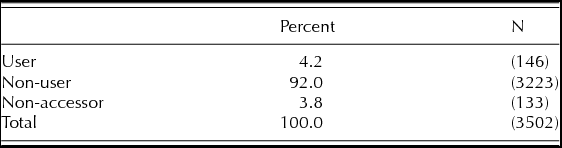
Table 1 indicates the frequency of food bank use in the previous year as reported by the survey respondents, while Table 2 shows the reasons for non-use given by those who said they had never used a food bank. Using these findings, respondents are grouped into ‘users’, ‘non-users’ and ‘non-accessors’ (as described above) in Table 3. The analysis shows that 4.2 per cent of the survey respondents reported having used a food bank in the past year.
Frequency of food bank use

Reasons for not using a food bank

Categorisation of food bank use

While most people do not use a food bank because they say they do not need to use one, 3.8 per cent of respondents reported not having used a food bank in the past year because they either did not want to, or were not able to do so. The majority of this ‘non-accessor’ group had elected not to do so – only 0.5 per cent reported that they had not used a food bank because they had not been able to use or access one (Table 2).
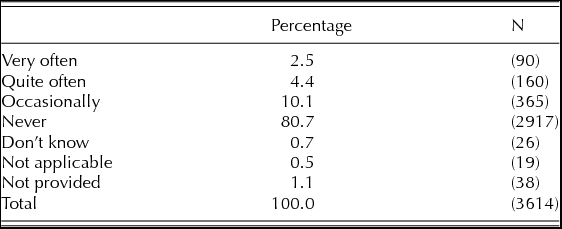
Comparing rates of food bank use from Table 3 with those of food affordability difficulties, presented in Table 4, 17.3 per cent of the survey respondents said that they occasionally, quite often or very often have difficulty meeting the cost of food. Thus, the group of food bank users and non-accessors is approximately half the size of the group who report food insecurity on financial grounds.
Frequency of food affordability difficulties

Socio-demographic characteristics of food bank users, non-accessors and non-users
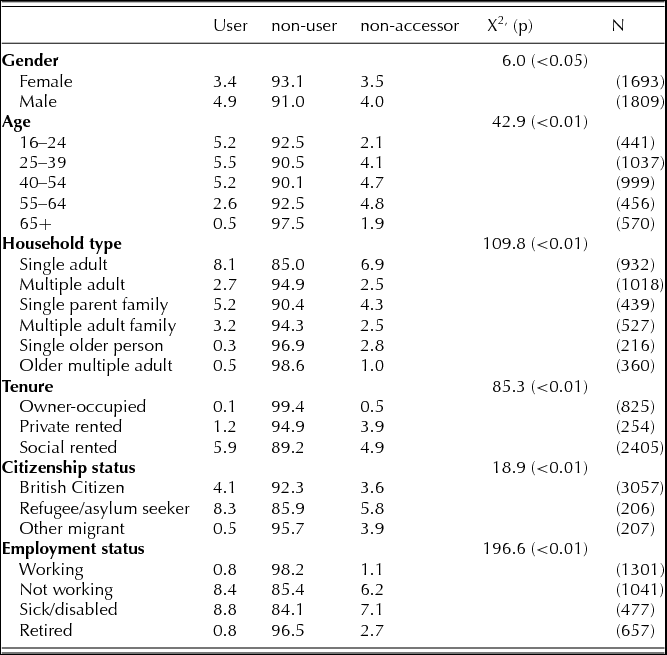
Table 5 shows the socio-demographic characteristics of respondents according to food bank use. Food bank use was found to be higher among men, younger age groups, single person households, social renters, refugee and asylum seekers, and those out of work.
Rate of food bank use according to different demographic variables (%)

Life events and food bank use
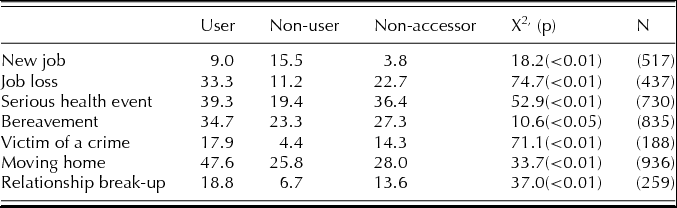
All of the life events, except for becoming a parent and a new marriage or partnership, showed associations with food bank use (based on chi-squared tests). Table 6 shows the proportion of each group of food bank users who had also experienced life events. Food bank users were four times more likely to have been a victim of a crime than non-users, and three times more likely to have experienced a reduction in employment, including unemployment, redundancy or reduced working hours. Approximately twice the proportion of food bank users (39.3 per cent) had experienced a serious health event, illness, or disability compared with non-users (19.4 per cent) and over twice as many food bank users as non-users had experienced relationship breakdown.
Proportion of respondents who experienced life events by food bank user group (Col. %)

Almost half of food bank users (47.6 per cent) had moved home in the previous year, many more than the number of non-users and non-accessors who had done so. This may be related to the fact that asylum seekers and refugees, who are concentrated in regeneration areas where house moves occur at a higher rate, are a group more likely to use food banks (see above), or simply due to the coincidence of poverty and home insecurity.
Health and food bank use
Table 7 indicates that 44.2 per cent of food bank users reported a longstanding illness or disability, compared with 28.4 per cent of non-users and 42.1 of non-accessors. Two-thirds (66.4 per cent) of those who had used a food bank reported a mental health problem, compared with 31.6 per cent of non-users and 57.3 of non-accessors.
Prevalence of self-reported health problems by food bank use (Col. %)

Financial factors and food bank use
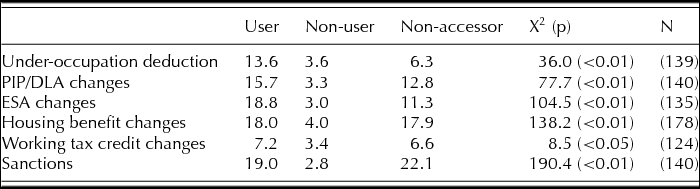
Each of the welfare reforms included in the survey affected between 3.8 and 5.4 per cent of respondents. Welfare reforms were far more common among food bank users than non-users (Table 8). Changes to Employment and Support Allowance, changes to housing benefit, and benefit sanctions are the most common welfare reforms experienced by those who report food bank use. A high proportion (22.1 per cent) of non-accessors, i.e. people who said they did not want to use a food bank or had not been able to, had also experienced a benefit sanction. The stigma of food banks may be a barrier to use in these cases (Purdam et al., Reference Purdam, Garratt and Esmail2015; Garthwaite, Reference Garthwaite2016).
Proportion of respondents impacted by welfare reforms by food bank user group (Col. %)

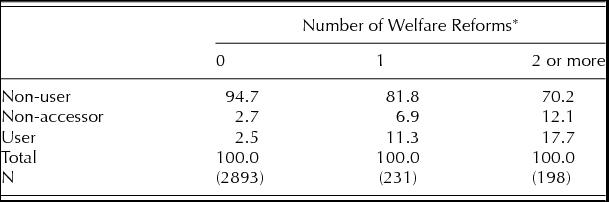
Table 9 shows the rate of food bank use according to the number of welfare reforms respondents reported having been affected by. Whilst only 5.3 per cent of those not affected by welfare reforms were either food bank users or non-accessors, 18.2 per cent of those affected by one welfare reform were either accessing or not able to access a food bank, rising to 29.9 per cent of those affected to two or more welfare reforms. Thus, where multiple welfare reforms affected a household, the likelihood of food bank use was higher.
Rate of food bank use by experience of welfare reforms (%)

* X2 (p) = 206.1 (<0.01)
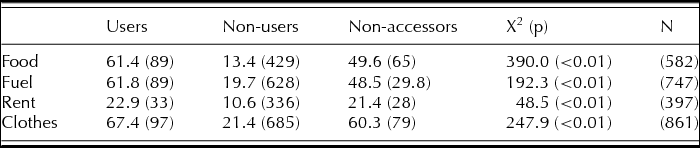
In terms of financial difficulties, difficulty affording each of the items included in the survey, with the exception of household repairs, had a significant relationship with food bank use (p<0.01) (Table 10). Among food bank users, affording clothes was the most common financial difficulty reported by two-thirds of users (67.4 per cent) followed by fuel (61.8 per cent) and food (61.4 per cent). Moreover, only 15.3 per cent of those reporting difficulty affording food had used a food bank. Among those who report frequent difficultyFootnote 2 affording food (7 per cent of respondents), 22.6 per cent had used a food bank and 13 per cent had not used one because they had not wanted to or had not been able to do so.
Proportion of respondents reporting difficulty affording different items by food bank user group

This descriptive analysis of the survey data has identified associations between food bank use and a number of socio-demographic, health, and financial variables. Particularly striking is the relationship with ill health, and the high prevalence of mental health problems among food bank users. In many instances, the characteristics of non-accessors lie somewhere between those of non-users and users, though more often closer to the latter than the former.
While these findings are helpful for understanding the common characteristics of food bank users, many of the factors described above may be interconnected. Further analysis used logistic regression to control for other factors when examining the impact of independent variables on food bank use. To address issues of multi-collinearity the logistic regression analyses were undertaken in blocks.
Regression results: predictors of food bank use
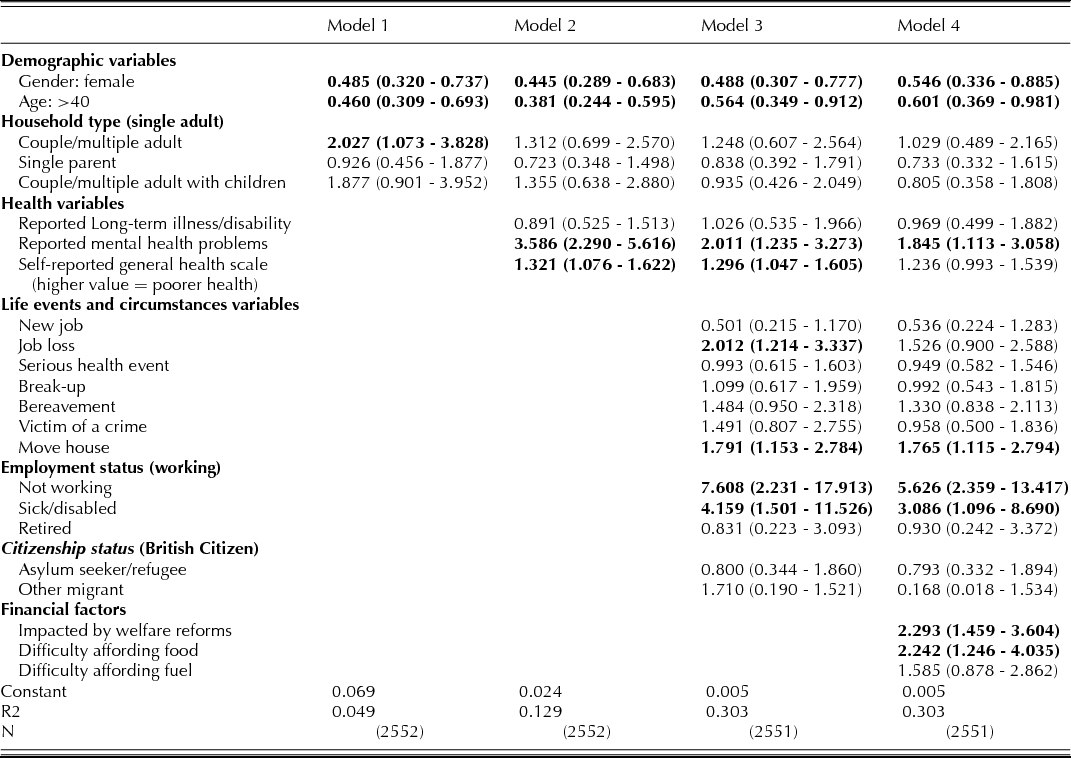
Table 11 shows the results of the logistic regression for food bank use. After controlling for all other variables women were less likely (OR 0.546, 0.336-0.885) than men to have used a food bank. Similarly, those over forty were less likely than those under forty to have used a food bank (OR 0.601, 0.369-0.981) after controlling for sociodemographic characteristics, as well as health and financial variables. The profile of food bank users is likely to be in part due to the protective impact of retirement on incomes – pensioners have not been adversely affected by welfare reforms (Mason, Reference Mason2016) and are not as vulnerable to disruptions to their income such as sanctioning as those claiming other forms of social security. Household structure and citizenship status did not have a significant relationship with food bank use, once other factors were controlled for.
Odds ratios (95% confidence intervals) of reporting use of food banks using logistic regression (bold values = p<0.05)

Self-reported general health was associated with food bank use, with those with worse health more likely to use a food bank (OR 1.321, 1.076-1.622), but this association became weaker upon inclusion of financial variables. Having a long-standing illness or disability did not have a significant relationship with food bank use. Those with a mental health problem were over three times more likely to have used a food bank than others, the odds falling to a little under twice as likely upon the inclusion of life events, status and financial variables in the model (OR 1.845, 1.113-3.058). Those of working age who were not working and those who classified themselves as long-term sick or disabled were several times more likely to have used a food bank than those in full-time work (OR 5.626, 2.359-13.417 and OR 3.086, 1.096-8.690, respectively). Similarly, those who had lost their job were twice as likely to have used a food bank as others (OR 2.012, 1.214-3.337), with this effect attenuated by the inclusion of financial factors in the model. The only other life event bearing a significant association with food bank use was moving home, (OR 1.765, 1.115-2.794). Having difficulty affording food, and having been affected by welfare reforms approximately doubled the odds of someone having used a food bank, all other factors considered (OR 2.242, 1.246-4.035 and 2.293, 1.459-3.604, respectively).
Discussion
Our findings from a survey of deprived neighbourhoods in Glasgow found that one-in-twenty-five participant households had used a food bank in the past year. A similar sized group identified as non-accessors, who reported not having used a food bank for reasons other than not needing to. The findings also highlight the very low prevalence of food bank use among those who struggle to afford food. A little over one-in-six of those who had experienced difficulty paying for food had used a food bank, including less than a quarter of those who frequently struggle to afford food. These results challenge perceptions that food banks are a ready and utilised resource by those unable to afford sufficient food.
These findings also build on existing evidence from the UK and elsewhere that suggests that food bank use is a strategy of last resort. The majority of the ‘non-accessors’ group in this study had chosen not to use a food bank, as opposed to being unable to do so, possibly due to perceptions of stigma and unsuitability of the food (Loopstra and Tarasuk, Reference Loopstra and Tarasuk2012). Comparison of the characteristics across the three groups (non-users, non-accessors, and non-users) suggests that there are similarities between food bank users and non-accessors but that the former group may face greater difficulties (for example, while a third of non-accessors had been affected by welfare reforms, this was the case for almost half of food bank users). This result appears to confirm suggestions elsewhere that food banks are avoided other than in cases of extreme need. Indeed, a quantitative study of food bank use among food insecure households in Toronto, Canada, found that while choosing not to use a food bank was the most common reason for non-use among those with lower levels of food insecurity, those with most severe food insecurity were far more likely than others to report barriers to accessing food banks as their reason for non-use (Loopstra and Tarasuk, Reference Loopstra and Tarasuk2012). The results of our study therefore develop the UK evidence of resistance to food bank use among residents of deprived communities, further challenging the argument that food bank use is supply-driven (Williams, 2013), and questioning the appropriateness of food banks as a policy response to food insecurity.
We found rates of food bank use to be highest among single people compared with other household types. This finding is consistent with evidence from Citizens Advice Scotland, where 60 per cent of clients given advice about food banks are single adults and 26 per cent are families with dependent children (Sims, Reference Sims2016). Similarly, a recent representative survey of TT food bank users found single male households to be the most common household type (Loopstra and Lalor, Reference Loopstra and Lalor2017). The large proportion of single adults among food bank users is potentially due to the lack of variety of income sources available to someone living alone, who is therefore more vulnerable to changes in income, resulting in acute income crises. A lack of family or social support could also be a reason for greater food bank use among those living alone.
Binary logistic regression modelling sought to identify the characteristics that are significantly associated with food bank use, after controlling for other variables. A striking finding is the role of mental health, whereby mental ill health was associated with food bank use after controlling for employment status, difficulty affording food and fuel, and impact of welfare reforms. Our analysis confirms a suggested relationship between poor health (poor mental health particularly) and food bank use (Garthwaite et al., Reference Garthwaite, Collins and Bambra2015). While mental ill health is a plausible contributory factor to food bank use, it is not possible through our data to determine the direction of the relationship between food bank use and mental ill health, the appropriateness of food banks as a response to food insecurity, particularly for those with mental health and other conditions, is called into question, given the stigma of food bank use reported elsewhere (Garthwaite, Reference Garthwaite2016; Purdam et al., Reference Purdam, Garratt and Esmail2015). The extent to which food bank use might exacerbate existing health conditions has been identified as a potential issue of concern particularly in relation to nutritional needs and physical health (Douglas et al., Reference Douglas, Ejebu, Garcia, MacKenzie, Whybrow, McKenzie, Ludbrook and Dowler2015), but our study also raises the possibility of negative effects of food bank use upon mental health and this requires further research. Given widely reported cuts to mental health services during the recent period of austerity (BMA, 2017), it also raises questions about the level and suitability of care being provided in general for those with mental health conditions.
We found that being male and being younger than forty increased the odds of food bank use, independent of other socio-demographic and financial factors. These results build on findings from a recent study by Citizens Advice Scotland which identified that clients seeking advice on food banks were more likely to be male (63 per cent) and younger than the average client (average age was forty-one for those seeking food bank advice) (Sims, Reference Sims2016). This demographic has also been identified as having been disproportionately affected by benefit sanctions in Scotland (Scottish Government, 2014). Whilst our basic analysis showed that crude rates of food bank use and non-access were similar between those in their thirties, forties and early fifties, the rate of use dropped among those aged mid-fifties or older. In addition, as noted earlier, pensioners have been largely protected from the kind of income crises caused by operations of the benefits system that often prompt food bank referrals.
The relationship between major life events and food bank use suggests the complex challenges which people face, and often traumatic experiences, such as bereavement, may compound existing issues and lead to crises (Perry et al., Reference Perry, Sefton, Williams and Haddad2014). In particular, our analysis found that having moved house in the past year almost double the odds of food bank use. This is likely to be because of the financial costs associated with moving and settling into a new home, and the impact of moving on other areas of household budgets for people on very low incomes.
The relationship between recent welfare reforms and food bank use identified in the study is particularly striking, with those impacted by the reforms being more than twice as likely to have used a food bank as other people in deprived areas. The vulnerability of those out of work due to long-term illness or disability to food bank use, a group historically better protected by the social security system, is perhaps also indicative of the extent to which the roll-back of the safety net function of the welfare state for this group is having detrimental impacts on food security. These findings echo those of Loopstra and Lalor's (Reference Loopstra and Lalor2017) study of TT food bank clients which found that most Employment and Support Allowance claimants among food bank users were in a group more likely to have experienced a benefit change following a work capability assessment, now subject to increased welfare conditionality.
Limitations
Our self-report measure of food banks use is a useful alternative to counts of food parcels, but it is also limited in that it relies on recall and may be open to under-reporting because of stigma or social desirability bias – people may not report food bank use. The survey is also limited because the financial variables are asked for at a point in time that may not coincide with the food bank use, so some of our comparisons may be affected. In addition, we cannot make claims about the prevalence of food bank use in the population as a whole as the survey is concentrated in deprived communities, likely to be experiencing higher levels of need.
Conclusion
The low rates of food bank use among those who report difficulty affording food and the extent of resistance to food bank use offer an important challenge to presumptions that food banks are an appropriate and utilised response to food insecurity. It is concerning that problems of food insecurity are much greater than the figures on increasing food bank usage would suggest. This finding warrants further investigation of the interface between food insecurity and food bank use. There is a need for systematic measurement and monitoring of both food insecurity and food bank use in the UK in order that this wider issue might be better understood.
The strength of the association between mental health problems and food bank use should be of particular concern to policy makers and practitioners, raising questions as to the adequacy of mental health services available to people facing destitution, thus expanding existing concerns about the ability of mental health services to cope with those in crisis (Care Quality Commission, 2015). The findings also suggest that the difficulties people face which lead to food bank use may extend beyond the financial to other aspects of wellbeing and associated support service requirements. The associations with life events add further weight to the argument that those using food banks are living in precarious conditions and that food banks may be a last resort, rather than a solution to rising issues of food insecurity.
These results highlight areas for policy attention with a view to the development of preventative and supportive policy and practice responses for public health gain (Eyler et al., Reference Eyler, Chriqui, Moreland-Russell and Brownson2016). Further research is required to better understand the role of food bank use within the experience of household-level food insecurity. Finally, given the relationship between welfare reforms and food bank use identified in this and other studies (Perry et al., Reference Perry, Sefton, Williams and Haddad2014; Loopstra et al., Reference Loopstra, Reeves, Taylor-Robinson, Barr and Stuckler2015), the ways in which charitable food aid might be challenging and changing the nature and purpose of the welfare state also requires further investigation.
Acknowledgements
This research was carried out for a PhD thesis and as part of the Glasgow Community Health and Wellbeing (GoWell) Research and Learning Programme (www.gowellonline.com). The PhD studentship was funded by the Economic and Social Research Council (ESRC) under grant number 20140828. GoWell is a collaborative partnership between the Glasgow Centre for Population Health, the University of Glasgow and the MRC/CSO Social and Public Health Sciences Unit. GoWell is sponsored by Glasgow Housing Association (Wheatley Group), the Scottish Government, NHS Health Scotland and NHS Greater Glasgow and Clyde.