Management Implications
Invasive tamarisk or saltcedar species (Tamarix spp.) are ecological and management concerns throughout riparian areas of the western United States. Tamarix management typically consists of herbicide (triclopyr or imazapyr) application or mechanical treatment via mowing or root grubbing. Both herbicide and mechanical grubbing treatments can effectively control Tamarix, but the disturbance caused may lead to secondary invasion, especially at drier sites with altered hydrology. Mowing is effective in the short term at reducing Tamarix canopy, but regrowth quickly occurs, necessitating repeated treatments. A biological control insect, the tamarisk leaf beetle (Diorhabda spp.), is now widely established in the southwestern United States, and its presence may increase efficacy of traditional management. We tested mowing and two rates of imazapyr (standard: 3.6 g ae L−1 [0.75% v/v]; and low: 1.2 g ae L−1 [0.25% v/v]) integrated with biological control herbivory compared with herbivory alone. When biocontrol herbivory was present, both mowing and standard herbicide rate reduced Tamarix green foliage, and after 2 yr the canopy was reduced compared with herbivory alone, and there was little regrowth. The low herbicide rate was not effective. Results indicate that the integration of herbicide or mowing with biological control can provide better control than herbivory alone. In particular, mowing, which has not been a long-term viable control option, in combination with herbivory from the Diorhabda spp. may provide long-term control.
Introduction
Tamarix spp. (tamarisk or saltcedar), a complex of nonnative shrubs that have hybridized in the United States (Gaskin and Kazmer Reference Gaskin and Kazmer2009), were introduced from Eurasia for stream stabilization and as ornamentals (Neill Reference Neill1985). Tamarix spp. currently occupy hundreds of thousands of hectares of riparian forests, with a majority located in the western United States (DiTomaso Reference DiTomaso1998; Zavaleta Reference Zavaleta2000). The high abundance of Tamarix along southwestern rivers can be largely attributed to hydrogeomorphic changes resulting from the creation of dams for river regulation (Stromberg et al. Reference Stromberg, Lite, Marler, Paradzick, Shafroth, Shorrock, White and White2007), but it is present on unregulated rivers as well. Once established, Tamarix can exhibit a range of negative effects within riparian habitat, including increased soil salinity (Bagstad et al. Reference Bagstad, Lite and Stromberg2006; Lehnhoff et al. Reference Lehnhoff, Rew, Zabinski and Menalled2012; Merritt and Shafroth Reference Merritt and Shafroth2012; Ohrtman et al. Reference Ohrtman, Sher and Lair2012), reduction of native soil biota (Beauchamp et al. Reference Beauchamp, Stromberg and Stutz2005; Ladenburger et al. Reference Ladenburger, Hild, Kazmer and Munn2006; Meinhardt and Gehring Reference Meinhardt, Gehring, Sher and Quigley2013; Sher and Quigley Reference Sher and Quigley2013), and alteration of native flora and fauna (DiTomaso Reference DiTomaso1998; Keller and Avery Reference Keller and Avery2014; van Riper et al. Reference van Riper, Paxton, O’Brien, Shafroth and McGrath2008).
Multiple management tools have been used to reduce Tamarix’s environmental and economic impacts (Douglass et al. Reference Douglass, Nissen, Hart, Sher and Quigley2013), with common conventional control methods including mechanical and chemical treatments (Duncan and McDaniel Reference Duncan and McDaniel1998; McDaniel and Taylor Reference McDaniel and Taylor2003b). Intensive mechanical treatments such as root grubbing can provide high shrub mortality rates compared with mowing, which is commonly used to reduce canopy volumes in monotypic stands but typically does not kill Tamarix (Duncan and McDaniel Reference Duncan and McDaniel1998; Taylor and McDaniel Reference Taylor and McDaniel2004). Chemical control of Tamarix ranges from the application of herbicide to individual plants to aerial spraying of large monotypic stands. Unlike mowing, herbicide applications can be highly effective, resulting in high plant mortality rates at a reduced cost (McDaniel and Taylor Reference McDaniel and Taylor2003a). Although both mechanical and chemical management may achieve reductions in Tamarix cover (McDaniel and Taylor Reference McDaniel and Taylor2003b), they are expensive (Taylor and McDaniel Reference Taylor and McDaniel2004), may disturb soil, and potentially lead to increased secondary invasion, particularly in drier sites (Bay and Sher Reference Bay and Sher2008; Shafroth et al. Reference Shafroth, Cleverly, Dudley, Taylor, Van Riper, Weeks and Stuart2005).
In 2001, tamarisk leaf beetles (Diorhabda spp.) were approved for open-field releases as a biological control agent by the Animal and Plant Health Inspection Service (DeLoach et al. Reference DeLoach, Lewis, Herr, Carruthers, Tracy and Johnson2003). The beetles, both larvae and adults, feed on the foliage of Tamarix during the spring and summer months (Lewis et al. Reference Lewis, DeLoach, Knutson, Tracy and Robbins2003). They can completely defoliate shrubs; however, regrowth develops several weeks after defoliation (Hultine et al. Reference Hultine, Belnap, van Riper, Ehleringer, Dennison, Lee, Nagler, Snyder, Uselman and West2010; Nagler et al. Reference Nagler, Pearlstein, Glenn, Brown, Bateman, Bean and Hultine2014). Adult beetles overwinter in the leaf litter and emerge in the spring when new Tamarix foliage becomes available. Since initial field releases in 2001, four Diorhabda species [Diorhabda carinulata (Desbrochers); Diorhabda elongata (Brullé); Diorhabda sublineata (Lucas); and Diorhabda carinata (Faldermann)] (Tracy and Robbins Reference Tracy and Robbins2009) have successfully established in 12 western states (Bloodworth et al. Reference Bloodworth, Shafroth, Sher, Manners, Bean, Johnson and Hinojosa-Huerta2016), with New Mexico being the first state to contain all four Diorhabda species (C Sutherland, personal observation). Of these species, the subtropical tamarisk leaf beetle, D. sublineata from Tunisia (Tracy and Robbins Reference Tracy and Robbins2009), may be the most important in New Mexico. Its quick dispersal rate combined with later seasonal diapause in a more southern latitude (Dalin et al. Reference Dalin, Bean, Dudley, Carney, Eberts, Gardner, Hebertson, Jones, Kazmer, Michels, O’Meara and Thompson2010; Milbrath et al. Reference Milbrath, Deloach and Tracy2007) and later annual Tamarix leaf senescence (Friedman et al. Reference Friedman, Roelle and Cade2011) has allowed the beetle to become an effective management tool to assist in Tamarix management in the Southwest.
Previous studies have addressed questions related to Diorhabda’s physiological effects on Tamarix, Tamarix mortality, and plant community response. Hultine et al. (Reference Hultine, Dudley, Koepke, Bean, Glenn and Lambert2014) demonstrated 54% canopy dieback and 10% mortality over 3 yr in the Virgin River watershed, Utah, USA, while Kennard et al. (Reference Kennard, Louden, Gemoets, Ortega, González, Bean, Cunningham, Johnson, Rosen and Stahlke2016) documented 15% to 56% Tamarix mortality after 6 yr in western Colorado. In a greenhouse study, Snyder et al. (Reference Snyder, Uselman, Jones and Duke2010) determined that while beetle and larval herbivory minimally affected photosynthesis, nighttime water loss was significantly higher, leading to desiccation of the foliage. Integration of fire with Diorhabda spp. was investigated by Drus et al. (Reference Drus, Dudley, D’Antonio, Even, Brooks and Matchett2014), who concluded that integrating herbivory and fire provided a synergistic effect by depleting greater carbohydrate storages, particularly starch, resulting in higher Tamarix mortality compared with unburned treatments. Sher et al. (Reference Sher, El Waer, González, Anderson, Henry, Biedron and Yue2018) investigated management via low-disturbance mechanical or chemical treatment integrated with Diorhabda spp. and documented that the change in relative cover of native understory plants was negatively correlated with change in Tamarix cover, and there was a greater positive change in native species cover at sites with integrated management.
Our study was conducted to determine whether D. sublineata, a recent migrant to the area, would enhance existing Tamarix management. We addressed the integration of foliar herbicide application or mowing with D. sublineata at a reservoir in southern New Mexico by asking: (1) Can integrating conventional management with the widely established biological control beetles improve Tamarix control compared with biological control alone? (2) Can integration of biological control and herbicide allow for a reduced herbicide rate? Furthermore, we asked (3) How will treatments impact plant communities?
Materials and Methods
Study Sites
Research was conducted in 2016 to 2017 at two field locations within the boundaries of Caballo Reservoir (Sierra County, NM). Sites with a high likelihood of adult D. sublineata (hereafter “beetles”) emergence in spring, based on the presence of the insects in the summer of 2015 and abundant supply of healthy Chinese tamarisk (Tamarix chinensis Lour.) (Allred Reference Allred2012) shrubs, were selected for the experiment in March 2016. The two sites included one dry and another seasonally flooded site. The dry site (33.0188°N, 107.2975°W), located 1.6-km west of the flooded site, was at the upper elevation of Caballo reservoir storage capacity, while the seasonally flooded site (33.0138°N, 107.2809°W) was located adjacent to the Rio Grande and within an area of the reservoir that filled seasonally. Tamarix at study sites were historically mowed each year with a John Deere HX15 flex-wing rotary cutter tractor attachment (John Deere, Moline, IL, USA) by the Bureau of Reclamation (BOR); however, stands of Tamarix quickly regrew and remained abundant (B Tanzy, Resource Specialist, U.S. Bureau of Reclamation Elephant Butte Field Division, NM, personal communication). Historical mowing resulted in stands of multistemmed Tamarix, with each stem approximately 4 cm in diameter and an average height of 2.5 m. While Tamarix density was high across the sites, there was generally a spacing of ∼2 m between individual Tamarix shrubs. Beetles were first observed at both study sites in late summer of 2015, and although extensive herbivory damage was observed in areas ∼6 km south, minimal herbivory damage was recorded at our sites in the fall of 2015.
Caballo Reservoir is located within the Chihuahuan Desert ecosystem. From 1980 to 2016, average annual precipitation was 278.4 mm and average annual maximum and minimum temperatures were 25.5 C and 5.3 C, respectively (data obtained from the New Mexico State University Cooperative Observer Program Station in Caballo, NM, ∼13 km southwest of the study site (Station ID no. 291286; 32.897°N, 107.309°W). During the study period at Caballo Reservoir, the 2016 and 2017 field season average annual precipitation was 260 mm and average maximum and minimum temperatures were 27 C and 10 C, respectively.
Vegetation characteristics between both sites differed. The dominant five dry-site plant species were silverleaf nightshade (Solanum elaeagnifolium Cav.) with large patches of bare ground during most of the year, followed by Russian-thistle (Salsola tragus L.), bitter rubberweed (Hymenoxys odorata DC.), broom snakeweed [Gutierrezia sarothrae (Pursh) Britton & Rusby], and jimsonweed (Datura stramonium L.). The seasonally flooded site had little bare ground present and was dominated by bermudagrass [Cynodon dactylon (L.) Pers.] followed by knotgrass (Paspalum distichum L.), alkali mallow [Malvella leprosa (Ortega) Krapov.], common cocklebur (Xanthium strumarium L.), and junglerice [Echinochloa colona (L.) Link].
Experimental Treatments
At each site, the study design was a randomized complete block, containing four treatments per block with five replicate blocks. Individual Tamarix shrubs were the experimental units (single multistemmed tree per replicate). Each plot within a block at each site was randomly assigned one of four main treatments: control, mowing, standard herbicide rate, and low herbicide rate application. Plots were 4 m in diameter, centered on a single Tamarix shrub, and were separated from each other by at least 5 m. We attempted to create another full set of treatments that were beetle-free. Malathion (Spectracide® Malathion Insect Spray Concentrate, Spectrum, Middleton, WI, USA) was applied every 2 wk via backpack sprayer at a rate of 162 ml 3.78 L−1 per label recommendations; however, beetles were not kept off the Tamarix, and these plots were abandoned (i.e., data not included herein). Because beetle herbivory was ubiquitous and represents the norm in our setting, “control” plots with beetles but no other treatments are henceforth called “beetle” plots.
Imazapyr (Polaris® AC Complete, Nufarm Americas, Alsip, IL, USA) herbicide was applied at both sites via a battery-powered backpack sprayer at 275.8 kPa with a Chapin brass fan spray nozzle calibrated for 100 GPA. The tank contained a 0.25% v/v nonionic surfactant (Amigo®, Loveland Industries, Loveland, CO, USA) and blue dye indicator. Imazapyr was chosen over triclopyr because imazapyr is the BOR’s herbicide of choice at Caballo Reservoir. Standard and low-rate herbicide applications were applied in early June 2016 at the dry site and late July 2016 at the seasonally flooded site. While standard imazapyr rates are 4.8 g ae L−1 (1% v/v), our application rates as recommended by the BOR (B Tanzy, personal communication) were: standard herbicide application rate of 3.6 g ae L−1 (0.75% v/v) and low herbicide application rate of 1.2 g ae L−1 (0.25% v/v). Foliar herbicide applications including a blue indicator dye were applied with a minimum coverage of 75%, estimated ocularly by a professional pesticide applicator.
Mowing was conducted twice at each site: early March 2016 and late April 2017. A tractor-assisted John Deere HX-15 flex-wing rotary cutter with a cutting height of 30 cm was used. This height was selected based BOR standard practices and is used prevent mower damage by assuring that the blade is above the height of the dense stumps from previous mowing treatments.
Measurements
Data were collected in the spring of 2016 before any treatments, with the exception of green foliage on mowed plots, because mowing occurred before leaf out. Subsequently, field sites were visited biweekly until first beetle emergence, then weekly until beetle numbers were near zero in late October.
Visual Beetle Counts and Foliar Estimation
Weekly beetle counts were conducted following a modified version of the Colorado Department of Agriculture and the Tamarisk Coalition impact-monitoring protocols (Colorado Department of Agriculture 2013; Jamison and Bloodworth Reference Jamison and Bloodworth2014). Each Tamarix shrub was visually inspected for both beetle larvae and adults for a total of 4 min (2 min for adults and 2 min for larvae) by one trained observer. The observer carefully scanned all branches for the presence of adults or larvae and recorded observed counts.
Visual percentage estimates of green foliage, beetle-affected foliage, and canopy dieback were recorded at each visit. Canopy dieback was recorded to the nearest 5% of the total branches for each tree, using branch color (brown or red), flexibility, and continuous presence of foliage as indicators. Complete defoliation was indicated by 100% of leaves either brown or not present on the shrub.
Canopy Volume
Canopy volume measurements were taken pre- and posttreatment in spring and fall 2016 and 2017, with the seasonally flooded site having only one recorded year, 2016. For each shrub volume measurement, only living green foliage was included. Canopy height and two perpendicular width measurements were taken, although only the radius of the largest width was used in the final calculations. Due to the noncylindrical shape of a mature Tamarix canopy, the equation of an inverted cone was used to calculate canopy volume (Bonham Reference Bonham2013):  $ ({\pi\over3}) $(r2)(height).
Tamarix Mortality Assessment
A final assessment of treatment effects on Tamarix was conducted on April 18, 2019, approximately 3 yr after initiation of the study. Each Tamarix shrub in the study was assessed to determine whether it was living or dead, and the percent green foliage for live trees was recorded.
Vegetation Sampling
Vegetation sampling was conducted in mid-March 2016 (before treatments) and mid-May 2017. Sampling was conducted in temporarily marked locations using 0.5 by 1 m quadrats, with one placed directly underneath the north side of the canopy and the second quadrat placed on the north side of the plot 1 m out from the canopy edge to sample both understory and interspace vegetation. All plants present in quadrats were identified to species level, and percent cover was estimated for each species.
Statistical Analysis
Data were analyzed using linear mixed-effects models in R v. 3.4.3 (R Core Team 2017) using lme4 (Bates et al. Reference Bates, Mächler, Bolker and Walker2015) and lmerTest (Kuznetsova et al. Reference Kuznetsova, Bruun Brockhoff and Christensen2016) packages. Tamarix green foliage and beetle counts were log transformed to meet the assumptions of normality. Data were analyzed with treatment and date as a fixed effect plus a treatment by date interaction, with plot nested within block as a random effect to account for repeated measures. Because there was a second year of data at the dry site, the design was unbalanced, and sites were analyzed separately. A single dry-site Tamarix beetle plot was removed from analysis (N = 19) due to shrub mortality in 2017. The decision to remove this plot was made early in the study, because the Tamarix showed signs of stress, and then mortality, far sooner than even the plots treated with full rate herbicide, leading us to suspect that the shrub was dying before the study began.
To visualize differences in community composition between treatments, we used nonmetric multidimensional scaling (NMDS) ordinations in R v. 3.4.3 (R Core Team 2017) with the vegan package (Oksanen et al. Reference Oksanen, Blanchet, Friendly, Kindt, Legendre, McGlinn, Minchin, O’Hara, Simpson, Solymos, Stevens, Szoecs and Wagner2018). Foliar cover percentages were used for the analyses, with comparisons between treatments for both spring 2016 or 2017 under and outside Tamarix canopies. In the vegan package we used the Bray-Curtis distance metric (Bray and Curtis Reference Bray and Curtis1957). Due to the dominance of C. dactylon within the seasonally flooded site, and only a single year of data collection, only the dry-site vegetation was analyzed.
Results and Discussion
Tamarisk Beetle Counts and Estimates of Green Foliage
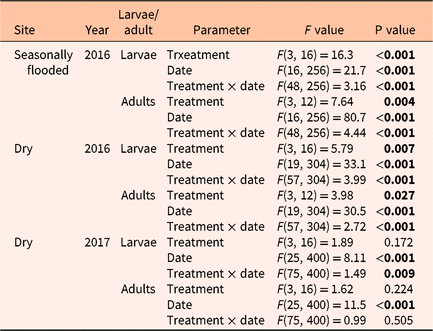
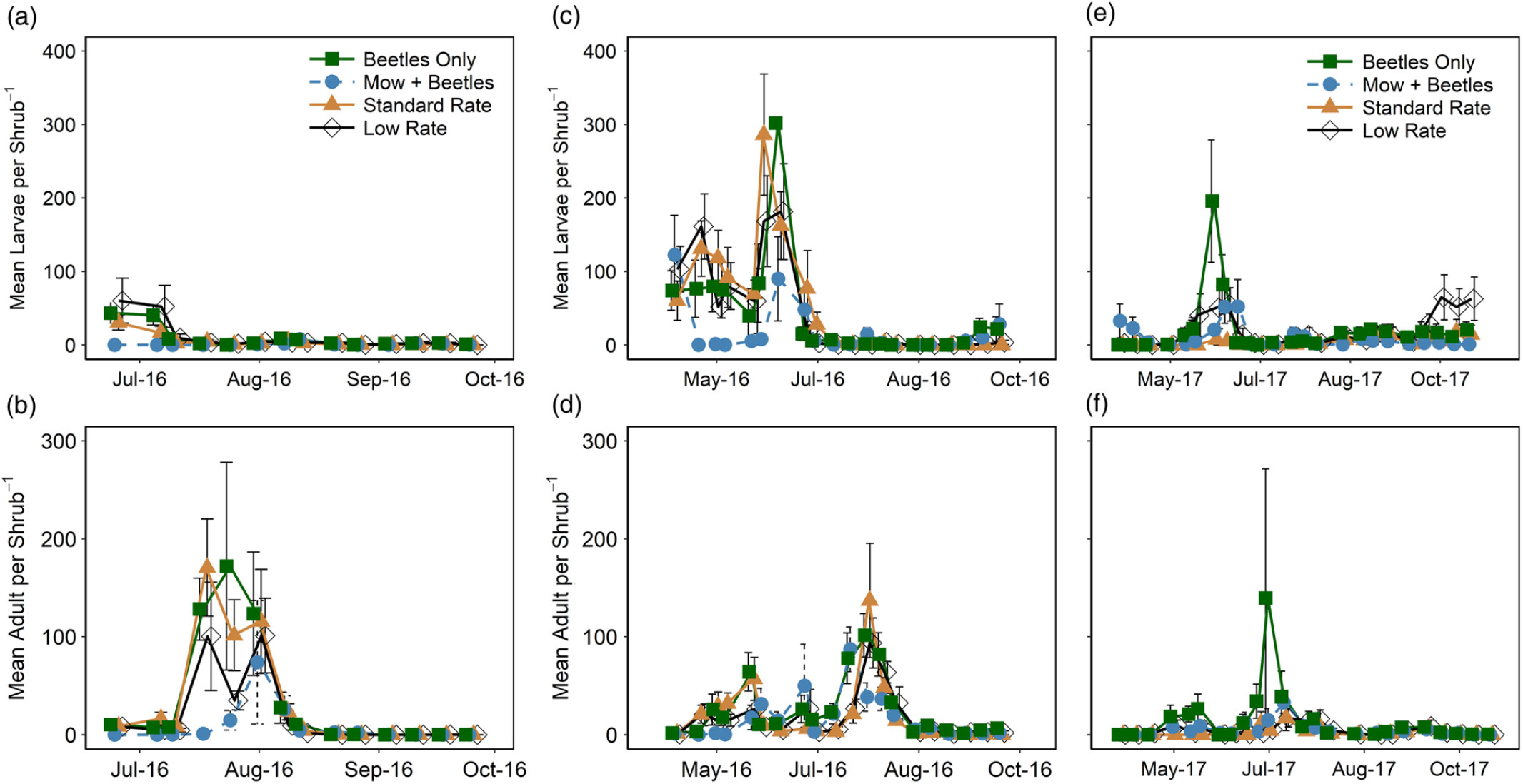
Beetle larval and adult counts differed by treatment and date, and there was a treatment by date interaction (Table 1; Figure 1A–F). In all cases in which there were treatment differences, they were driven primarily by there being fewer larvae and beetles on mowed and standard-rate herbicide plots than on other treatments. This was likely the result of there being less green foliage on these Tamarix than on other Tamarix plants, which reveals a conundrum: treatments that provide the greatest reduction in Tamarix foliage simultaneously reduce the food source for the biological control beetles. Reduced larval counts at the seasonally flooded site in 2016 (Figure 1A) compared with the dry site (Figure 1C) may be due to a high adult mortality resulting from an early-season inundation in the reservoir (April 20, 2016, to June 13, 2016).
Impacts of treatment (mowing, standard-rate herbicide, low-rate herbicide, and control), date, and treatment × date interaction on Diorhabda spp. larvae and adult counts at Caballo Reservoir, NM (N = 20 [2016] and 19 [2017]).

Bold P values are less than 0.05.
Mean 2-min visual tamarisk beetle (Diorhabda spp.) counts on Tamarix shrubs for 2016 at the seasonally flooded site (A and B) (N = 20) and for 2016 and 2017 at the dry site (C–F) (N = 19) at Caballo Reservoir, NM. Mean larval counts are given in the top row, and mean adult counts are given in the bottom row. The 2016 sampling start dates are different due to early-season inundation at the seasonally flooded site. Error bars ± SE.

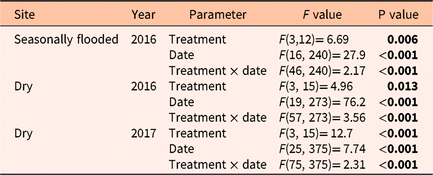
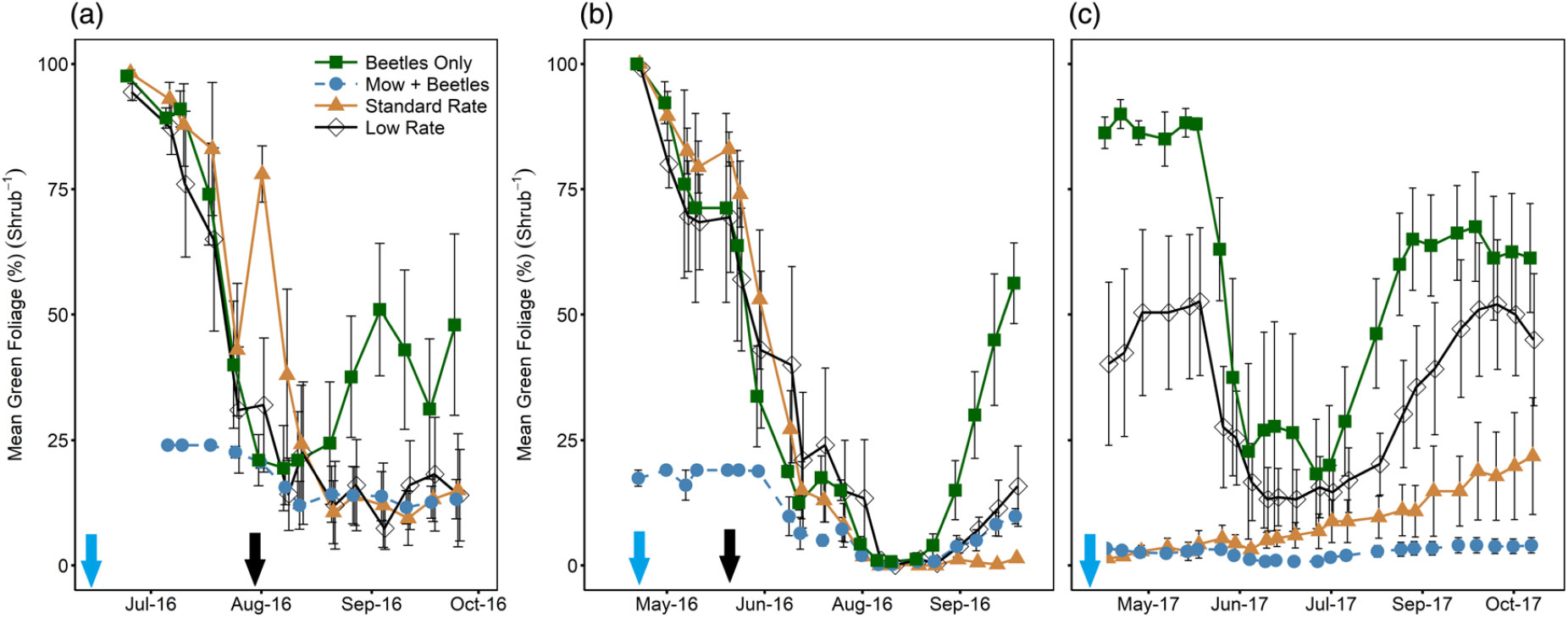
For both the dry and seasonally flooded sites, there was severe defoliation with treatment, date, and treatment by date interaction impacting the amount of green foliage (Table 2; Figure 2A–C). Peak defoliation in 2016 occurred mid-August at both sites and near late June in 2017 at the dry site. Regardless of year, both sites showed the beetle plots to have the highest average mean regrowth, although there was considerable regrowth variation between year and site. In fall 2017 at the dry site, there were no differences in green foliage between the beetle plots and low herbicide rate treatments (t(12) = 1.01, P = 0.75). Mowed treatments had significantly reduced green foliage compared with the beetle plots (t(12) = 4.38, P = 0.005), and were no different from the standard herbicide rate (t(11) = −1.52, P = 0.46).
Impacts of treatment (mowing, standard-rate herbicide, low-rate herbicide, and control), date, and treatment × date interaction on Tamarix green foliage at Caballo Reservoir, NM (N = 20 [2016] and 19 [2017]).

Bold P values are less than 0.05.
Mean green foliage present on Tamarix shrubs at (A) the seasonally flooded site (N = 20) and (B and C) dry site (N = 19) at Caballo Reservoir, NM. The 2016 sampling start dates are different due to early-season inundation at the seasonally flooded site. Due to season-long inundation at the seasonally flooded site in 2017, no data were collected. Arrows point toward dates treatments were implemented (blue, mowing; black, herbicide). In the mowing treatment, green foliage was not measured pre-mowing, because the Tamarix was mowed in the spring before leaf out; however, before mowing, canopy volume of these trees was similar to that of other treatments. Error bars ± SE.

Tamarix defoliation by the beetle was highly variable throughout the growing season, as documented by other researchers studying the northern tamarisk beetle (D. carinulata (Kennard et al. Reference Kennard, Louden, Gemoets, Ortega, González, Bean, Cunningham, Johnson, Rosen and Stahlke2016; Nagler et al. Reference Nagler, Nguyen, Bateman, Jarchow, Glenn, Waugh and van Riper2018). Defoliation levels were dependent on beetle populations and the availability of food sources. In 2017, the second defoliation year, the dry site had reduced larval and adult beetle numbers. Population declines seen in larvae at the dry site in mid-late June may be due to a combination of factors, including reduction in food source and substantial increase in ambient air temperatures.
The extent of mowing at Caballo may have negatively influenced larval populations through reduction in food availability. Although there were stands of Tamarix inaccessible to mowing, the integration of mowing led to an overall reduction in food source and a greater likelihood beetles would emigrate in search of a food source, as noted on the San Juan and Dolores River (Jamison et al. Reference Jamison, van Riper and Bean2016). Elevated temperatures in laboratory conditions (up to 40 C) increased egg, larval, and pupal mortality in D. elongata (Herrera et al. Reference Herrera, Dahlsten, Tomic-Carruthers and Carruthers2005) and larval mortality in D. carinulata (Acharya et al. Reference Acharya, Sueki, Conrad, Dudley, Bean and Osterberg2013). High summer temperatures were correlated with low humidity rates, and Lewis et al. (Reference Lewis, DeLoach, Knutson, Tracy and Robbins2003) noted high D. elongata pupal mortality in outdoor mesh bags, attributing it to low humidity levels. The reduction in overall stand canopy volume from annual mowing in the spring likely led to increased soil reflectance, and combined with temperatures in June approaching 43 C, may have been a cause of the recorded beetle mortality.
Beetle herbivory resulted in mortality of only one of the Tamarix experimental units during the 1st and 2nd years of defoliation (2016 and 2017), with consistently high rates of defoliation recorded in midsummer. This is not surprising, as Hultine et al. (Reference Hultine, Dudley, Koepke, Bean, Glenn and Lambert2014) recorded only 6% mortality after 2 yr and noted that canopy dieback was not correlated with number of defoliation events. Dudley and Deloach (Reference Dudley and Deloach2004) and Craine et al. (Reference Craine, Evankow, Wolfson, Dalton, Swedlund, Bowen and Heschel2016) observed a temporary beetle herbivory delay and highly reduced herbivory levels after the first herbivory event, as opposed to our results, which showed similar defoliation rates during both years. In contrast to previous research, green foliage recovered rapidly in 2017, even after severe defoliation, particularly at the dry site.
The resulting damage from beetle herbivory may have influenced the degree of injury and control seen with imazapyr applications at either low or standard herbicide rates. Though even extremely low concentrations of imazapyr can begin inhibiting amino acids within minutes, it may take several weeks to observe injury and up to 2 mo for plant death (Cobb and Reade Reference Cobb and Reade2010; Senseman Reference Senseman2007). With herbicide applications, it is vital to attain the highest levels of herbicide absorption and translocation throughout the plant by making application during optimum periods of active growth for successful control (Godar et al. Reference Godar, Varanasi, Nakka, Prasad, Thompson and Mithila2015). Diorhabda spp. herbivory can immediately cause stress and injury to plant foliage, and beetles can defoliate Tamarix shrubs in as little as a week. Therefore, rapid injury and defoliation via beetle herbivory may significantly reduce herbicide absorption and translocation and limit imazapyr injury. This possibility merits further research to better inform integration of herbicides with biological control.
Tamarix Mortality
Treatment and site affected Tamarix mortality. At both the dry and seasonally flooded sites three of five Tamarix treated with standard-rate herbicide died. None of the Tamarix treated with the lower rate at the dry site died, whereas four of five died at the flooded site. At the dry site, one mowed shrub died and two had only 1% green foliage, but at the seasonally flooded site, all five mowed shrubs died. In absence of any treatment other than beetle herbivory, one Tamarix at each site died. These results indicate that flooding greatly increased the mortality of Tamarix that had been mowed or treated with a low rate of herbicide. This increased mortality is not surprising, as it is known that 3 mo of inundation will kill Tamarix (Lesica and Miles Reference Lesica and Miles2004). In our case, the mowed shrubs were completely inundated; the herbicide-treated ones were not, but the added stress of being partially inundated likely led to increased mortality.
Canopy Volume
At the seasonally flooded site in 2016, the mowed canopy volume was reduced by 86% (2.63 to 0.37 m3, F(1, 8) = 17.56, P = 0.003) at the end of the season. Herbicide did not affect canopy volume (F(3, 12)= 1.88, P = 0.19). Treatments did affect canopy volume at the dry site by the end of 2017 (F(3, 15)= 8.91, P = 0.001). Tamarix canopy volume was reduced 90% by mowing (8.5 to 0.85 m3, F(1, 8) = 11.366, P < 0.001) and 73% by standard herbicide rate (6.45 to 1.75 m3, F(1,4) = 11.366, P = 0.03). Dry-site mowed and standard-rate treatments differed from the beetle plots (t(12) = 3.66, P = 0.02, and t(12) = 3.66, P = 0.02, respectively), although no differences were detected compared with low herbicide rate canopy volume (t(12) = 0.32, P = 0.99).
Surprisingly, we noticed severely stunted growth in mowing treatments. Previous studies indicated that mowing as a single treatment was not effective due to quick regrowth (up to 4 m in a year) (Duncan and McDaniel Reference Duncan and McDaniel1998; Taylor and McDaniel Reference Taylor and McDaniel1998). When mowing was integrated with the beetle herbivory, there were severe reductions in aboveground biomass at the end of one growing season.
Change in Vegetation Composition
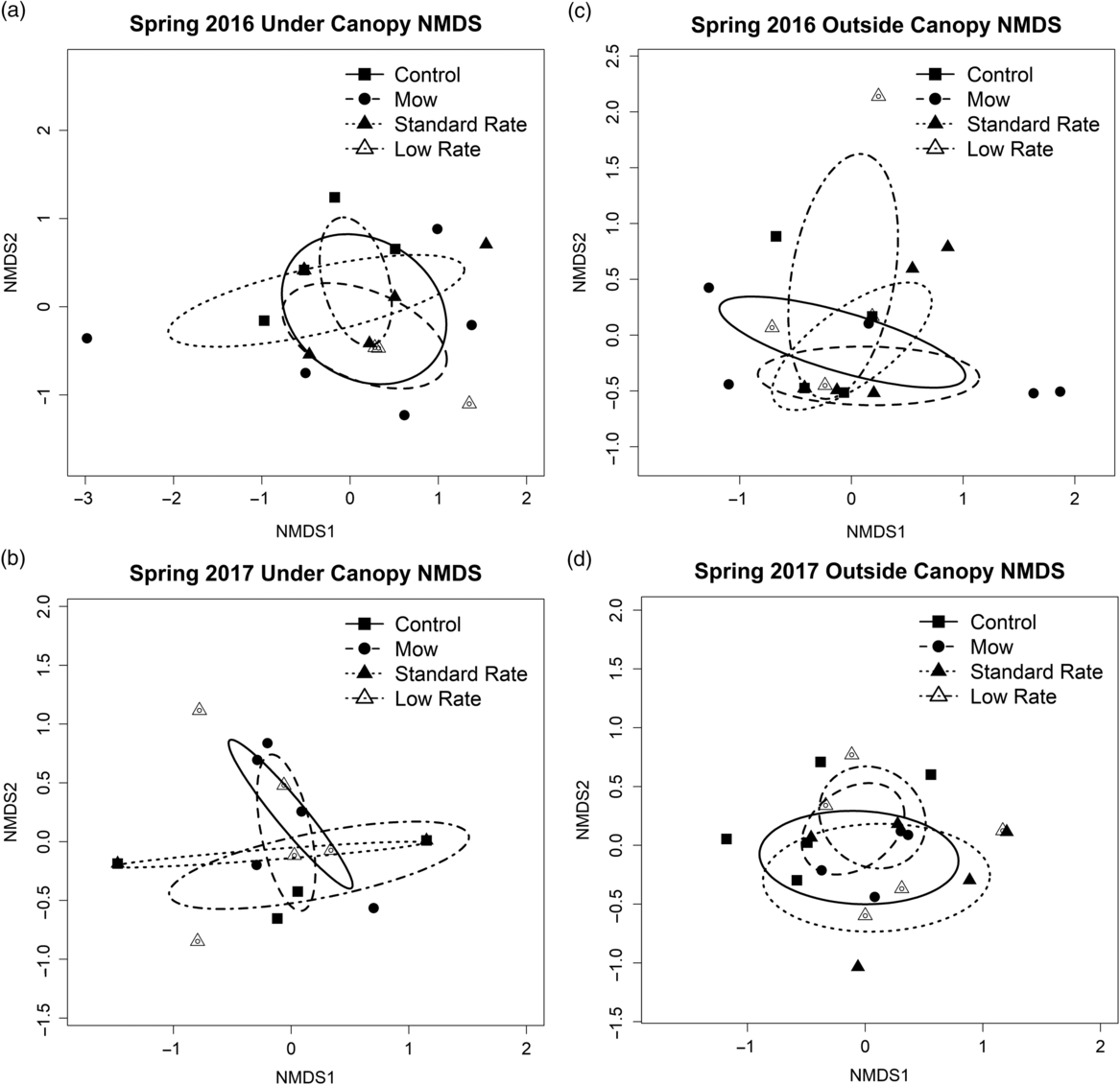
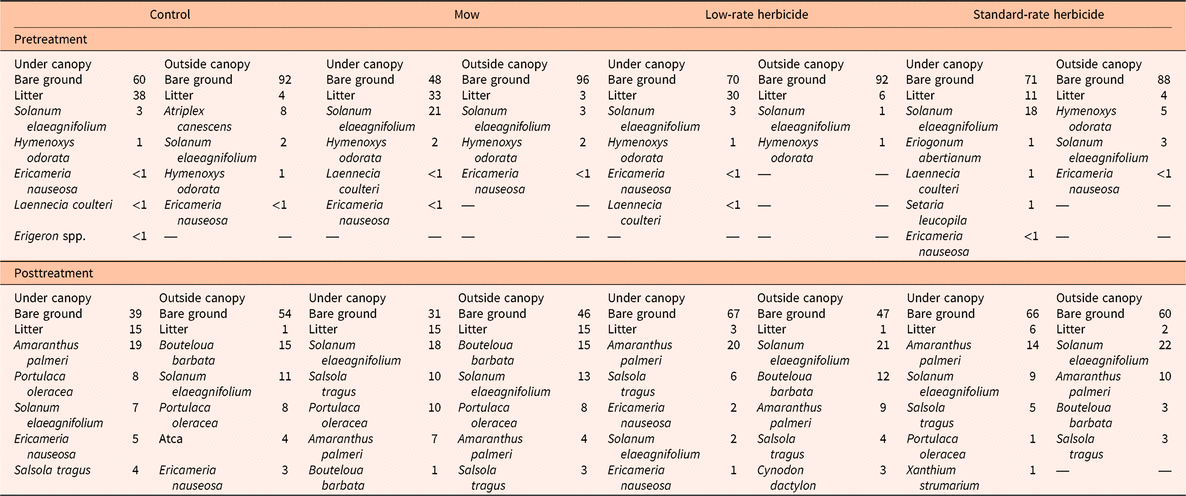
Vegetation community composition at the dry site between spring 2016 and spring 2017 did not differ according to NMDS. Both plant communities under Tamarix canopy (Figure 3A and B), and plant communities outside Tamarix canopy (Figure 3C and D) remained similar at 1 yr posttreatment. This contrasts with results from Ostoja et al. (Reference Ostoja, Brooks, Dudley and Lee2014), who showed increases in annual forbs after Tamarix treatment. The small plots (0.5 m2) and small sample size (1 set of paired plots under and outside canopy per replicate) may have contributed to the lack of differences. Furthermore, the lack of treatment difference is not surprising given the time required for plant communities to respond to vegetation treatments. For example, Sher et al. (Reference Sher, El Waer, González, Anderson, Henry, Biedron and Yue2018) demonstrated that after Tamarix removal, native plants increased by year 2 and exotic plant cover did not increase until year 4. There was a change in plant species presence and abundance from pretreatment in spring 2016 (dry season) to ∼15 mo posttreatment in August 2017 (monsoon season), but this was based on precipitation, not treatment. In beetle plots, plant cover increased dramatically both under and outside Tamarix canopy (Table 3). Similar increases were noted in all treatments. However, in all cases, with the exception of sixweeks grama (Bouteloua barbata Lag.), which was present between 3% and 15% as cover in plots outside the Tamarix canopy, plant species were undesirable weedy species such as Palmer amaranth (Amaranthus palmeri S. Watson), S. elaeagnifolium, and S. tragus.
Nonmetric multidimensional scaling (NMDS) ordination of vegetation community composition for spring 2016 under Tamarix canopy (A), spring 2017 under Tamarix canopy (B), spring 2016 outside Tamarix canopy (C), and spring 2017 outside Tamarix canopy (D) at Caballo Reservoir, NM. Close ellipses feature a similar species composition, increased distance between ellipses indicates greater dissimilarity. Vegetation community NMDS is only presented from the dry site due to season-long inundation in 2017 at the seasonally flooded site.

Pre- and posttreatment bare ground, litter and plant canopy cover (%) under and outside of Tamarix canopy at the dry site, Caballo Reservoir, NM.a

a Pre- and posttreatment data are from mid-March 2016 and mid-May 2017, respectively.
Compared with the increase in native plants noted by Sher et al. (Reference Sher, El Waer, González, Anderson, Henry, Biedron and Yue2018), the overall lack of positive response by understory plants at our site is likely because the dry site is not hydraulically connected to the Rio Grande or Caballo Reservoir (currently at a historical low level) and did not experience any inundation during the entire experiment. A comprehensive study by González et al. (Reference González, Sher, Anderson, Bay, Bean, Bissonnete, Bourgeois, Cooper, Dohrenwend, Eichhorst, El Waer, Kennard, Harms-Weissinger, Henry, Makarick, Ostoja, Reynolds, Robinson and Shafroth2017) indicated that native vegetation recovery is dependent on restoration of fluvial processes. Nonetheless, it is important to note that the management goal of Caballo Reservoir is water storage and not vegetation restoration, and thus the lack of vegetation response is not a management concern.
This study addressed (1) whether chemical and/or mechanical management practices integrated with Diorhabda spp. could improve Tamarix control compared with biological control alone (2) whether integrated management with the beetle could allow for a reduced herbicide rate, and (3) how treatments affected plant communities. We demonstrated that (1) both the standard herbicide rate and mowing treatments integrated with beetles led to reduced Tamarix green foliage compared with biological control alone; (2) low herbicide rate treatments were not effective and did not reduce Tamarix foliage compared with herbivory alone, except when Tamarix were inundated by floodwaters for an extended period; and (3) no treatments impacted the plant communities under Tamarix during the short duration of this study.
Tamarix management has historically been via chemical and mechanical treatment, with success varying depending on control method (Duncan Reference Duncan2003; Fick and Geyer Reference Fick and Geyer2010), application timing (Duncan and McDaniel Reference Duncan and McDaniel1998; McDaniel and Taylor Reference McDaniel and Taylor2003b), herbicide selection (Duncan and McDaniel Reference Duncan and McDaniel1998), and site soil characteristics (Douglass et al. Reference Douglass, Nissen and Kniss2016). Diorhabda spp. provides land managers with another tool in their integrated management toolbox by using a self-establishing, highly mobile (Ji et al. Reference Ji, Wang and Knutson2017) biocontrol population with high rates of selective herbivory. Given past successes with integrated management of herbicide with biological control in other systems, this study’s results are not surprising. For example Lym et al. (Reference Lym, Carlson, Messersmith and Mundal1996) demonstrated that picloram and 2,4-D combined with Apthona spp. flea beetles reduced leafy spurge (Euphorbia esula L.) populations dramatically compared with biological control alone. Similarly, in a greenhouse study, Collier et al. (Reference Collier, Enloe, Sciegienka and Menalled2007) showed that integration of herbicide (2,4-D, glyphosate, or clopyralid) and the stem mining weevil (Ceutorhynchus litura Fabricius) had greater impact on Canada thistle [Cirsium arvense (L.) Scop.] root biomass than treatments of herbicide or biological control alone.
Integration of chemical or mechanical treatments with tamarisk beetles provides land managers a wider array of control applications, particularly for large-scale Tamarix management operations. With the southern latitude beetle’s ability to provide longer periods of defoliation (Milbrath et al. Reference Milbrath, Deloach and Tracy2007) compared with more northern species, management integration of the southern latitude beetle (D. sublineata) could allow land managers to reduce the frequency of treatment applications, resulting in decreased labor and equipment costs. For example, at Caballo Reservoir, the success of integrated mowing and biological control may allow for biennial or triennial rather than annual mowing (B Tanzy, personal communication). This also may assure the long-term success of biological control by providing the opportunity to always have strips of unmowed Tamarix as a beetle refuge, thereby facilitating population survival.
Although foliar herbicide and mowing may be integrated with biological control, application timing should be carefully considered as to not negatively affect beetle populations, leading to reduced population numbers and less herbivory in future years. Additionally, the amount of time it takes for herbicide applications to cause injury to Tamarix in relation to beetle herbivory should be taken into consideration to limit ineffective practices. An alternative approach to be explored would be to not apply herbicide or mow in the spring/summer and allow beetles to defoliate Tamarix and deplete nutrients during the growing season, and then apply herbicide or mow in the fall as Tamarix are allocating nutrients for overwinter storage. While our research showed great promise for integrating herbicide or mowing with biological control for improved Tamarix management, additional research on treatment timing could help refine management programs to achieve even greater control.
Acknowledgments
This research was partially funded by the Western Integrated Pest Management Center (grant NM009) and the USDA National Institute of Food and Agriculture (Hatch project NM Lehnhoff-17H). We would like to thank the BOR and the Sierra County Soil Water Conservation District for their treatment application assistance and Anthony Colin and Adam Chaney for their field assistance. We are also grateful to the reviewers whose comments greatly improved this article. No conflicts of interest have been declared.