


INTRODUCTION
The past few decades have seen a remarkable transition in the political economies of the advanced industrial world. Whereas in the postwar era, the Keynesian duel of rapid price inflation and full employment held sway, since the 1980s inflation in the price of goods and services has been stable and declining. During the same time period, however, a new source of volatility, dormant since the Great Depression, has re-emerged—that of the price of assets, such as housing and equities. Between 1985 and 2006 real house price inflation was three times greater than between 1970 and 1985, with a standard deviation almost twice as large. The housing boom and bust that played out between 2002 and 2010 was unprecedented in modern times. Moreover, there has been ever greater “leakage” from the housing sector into the health of the overall economy. Cardarelli, Igan, and Rebucci (Reference Cardarelli, Igan and Rebucci2008) estimate that house price volatility and its feedback into consumption and investment now account for over 20% of the variation in economic output in many advanced industrial countries.
Surges and collapses in the price of assets affect the livelihood of citizens by underpinning, or undermining, their savings and personal wealth. Politicians have responded to the increased importance of assets in determining citizens’ welfare. In boom times there emerge declarations of an “ownership society.” In bad times, politicians fret about collapsing asset prices. These reactions suggest that asset prices have profound effects both on citizens’ welfare and on policymaking. However, to this point, social scientists know very little about how changes in the value of assets, such as house prices, affect support for the broader institutions of social policy. This neglect is surprising considering the importance of housing values to both individual well-being and macroeconomic health. The contemporary significance of housing markets provokes two questions in particular. First, how do citizens respond to house price growth and decline in terms of their demand for social insurance and redistribution? Second, how do governments of different partisan stripes respond to changing house prices in terms of social policy?
Political economists come to these questions armed with analytical weapons from an earlier war. The focus of political economy has been on the labor market—to the exclusion of the asset market—both in terms of the preferences of citizens over social spending and in terms of policymaking at the national level. Traditionally, scholars have emphasized the role of social class as defined by labor market income and occupation. Social class not only determines citizens’ demands for greater or lesser government spending (Goldthorpe et al., Reference Goldthorpe, Lockwood, Bechhofer and Platt1969) but also underpins the behavior of parties, with left-wing governments, supported by the working class, increasing social spending (Esping-Andersen, Reference Esping-Andersen1990; Huber and Stephens, Reference Huber and Stephens2001). More recently, a consensus has emerged on the importance of individual labor market risk—be it skill specificity (Iversen and Soskice, Reference Iversen and Soskice2001), occupational risk (Rehm, Reference Rehm2011; Rehm, Hacker, and Schlesinger, Reference Rehm, Hacker and Schlesinger2012), or income volatility (Hacker, Reference Hacker2006)—in determining social policy preferences and policy outcomes. At the microlevel, these scholars argue that the relative risk individuals face in the labor market shapes their preferences over government policies that insure them against income loss. At the macrolevel, aggregate labor market risk is considered to underpin support for national social policies, whether that risk is produced by specific skills (Estevez-Abe, Iversen, and Soskice, Reference Estevez-Abe, Iversen, Soskice, Hall and Soskice2001; Mares, Reference Mares2003), occupation-specific unemployment (Rehm, Reference Rehm2011), or exposure to volatile global trade and capital flows (Rodrik, Reference Rodrik1998).
While the rising importance of skills, income volatility, and global exposure has been incorporated into the political economy canon, the contemporary macroeconomic importance of asset markets, especially housing, has so far been largely neglected. Wealth, however, may be just as important as labor market income in shaping an individual's economic circumstances and, by implication, what they demand from government. Assets such as housing provide a stock of wealth independent from the dynamics of the labor market. Accordingly they both act as a store of permanent, as opposed to transitory, income and as a hedge against labor market risk—a form of “self-insurance” against hard times. Rising asset prices, perhaps driven by housing booms, increase both citizens’ expected lifetime income and their ability to hedge against labor-market risk, thereby reducing their demand for redistribution and social insurance. Collapsing asset prices, by contrast, may bolster citizens’ support for government programs. Thus, incorporating asset ownership complicates the existing labor market approach to the state-market nexus.
The implications of housing markets for social policy and individual preferences are not entirely uncovered terrain. In terms of the microanalysis of housing and individual preferences, Scheve and Slaughter (Reference Scheve and Slaughter2001) examine the role of home ownership in determining trade-policy preferences, arguing that homeowners in regions with uncompetitive industries will oppose free trade deals that might further weaken house prices. There is, however, no existing analysis of home ownership and preferences over social policies, particularly as mediated by house prices. At the cross-national level, Kemeny (Reference Kemeny1981), Castles (Reference Castles1998), Conley and Gifford (Reference Conley and Gifford2006), and Prasad (Reference Prasad2012) have noted the potential tradeoff between homeownership and the welfare state. However, these analyses focus on aggregate homeownership rates and largely neglect the relative price of housing, with homeownership assumed to have similar effects regardless of the value of housing. The value of housing as an asset, however, depends crucially on whether house prices are rising or falling. Recent work that does take into account fluctuations in the housing market, for example, Schwartz and Seabrooke (Reference Schwartz and Seabrooke2008) and Schwartz (Reference Schwartz2009), remedies this omission but it too does not delve into individual preferences or the behavior of parties, mostly focusing on national-level cross-sectional variation.
A final gap in work on housing and social policy is that, in contrast to the extensive labor-market literature, scholars have not connected the micro- and macrolevels of analysis. We do not yet know how the preferences of individual homeowners are aggregated into national social policies. This article fills this gap, analyzing how asset prices affect individual policy preferences, how these individual preferences are filtered by political partisanship, and how political parties respond to housing booms and busts through the making or unmaking of social policy.
I begin by outlining a theory that connects asset markets, focusing on housing, to both social policy preferences and outcomes. I develop an argument, drawing from literature on the “permanent income hypothesis,” that rising house prices alter the consumption profiles of homeowners by permitting them to smooth their spending over labor market fluctuations. Hence, studies focusing on labor market income or insecurity alone risk attributing too much importance to transitory labor market shocks faced by individuals. I then argue that asset ownership and asset prices systematically affect citizens’ support for social spending. Rising wealth both increases permanent income and provides a hedge against hard times, thereby reducing support for redistribution and substituting for social insurance. I further argue that political parties respond to these changes in voter preferences and that this effect is most pronounced for right-wing parties, who disproportionately represent homeowners and whose voters are particularly responsive to house price changes. Accordingly, I expect right-wing parties to cut redistributive and social spending particularly substantially during house price booms.
The following sections develop my empirical analysis of house prices and social policy. I begin at the microlevel, focusing on individual preferences over social policy using a series of panel surveys in the USA and the UK. I examine how the preferences of homeowners over social policy change over time according to the prevailing level of house prices, using both geographic data on house prices and individual self-estimates. Throughout these examples I find powerful effects of house price changes on social policy preferences, particularly among right-wing voters. I conclude by extending this analysis to citizens in 29 countries covered by the International Social Survey Program in 2009, where I show a similar negative relationship between housing equity and citizens’ preferences over redistribution.
I then turn to examining the effects of changes in aggregate house prices on national social spending policies. Here I examine the joint effect of political partisanship and house price changes on various forms of social policy, both in terms of aggregate spending and replacement rates. I find a conditional effect where right-wing government combined with house price appreciation reduces both spending and replacement rates dramatically, most pronouncedly in countries with high homeownership rates. This effect, hitherto unexamined in the literature on the determinants of public spending, demonstrates the significance of a deeper understanding of the role of ownership in political economy. I conclude with some implications of the approach developed in this article for rethinking a range of anomalies in political economy.
A THEORY OF OWNERSHIP, HOUSE PRICES, AND SOCIAL SPENDING
Ownership and Individual Preferences
What are the connections between homeownership, housing prices, and social policy preferences? The existing literature examining social policy preferences has two main strands, both built off an analysis of individuals’ labor market status. Class-based theorists argue that labor market income defines preferences over redistribution, with higher income individuals unsupportive of taxes and transfers that cut their net income (Esping-Andersen Reference Esping-Andersen1990; Huber and Stephens Reference Huber and Stephens2001, see also Meltzer and Richard Reference Meltzer and Richard1981). A more recent literature argues that labor market risk, rather than income, produces demand for social insurance, as citizens at risk of employment loss seek social spending to maintain consumption when out of the labor market (Iversen and Soskice, Reference Iversen and Soskice2001; Mares, Reference Mares2003; Rehm, Reference Rehm2011). Rehm, Hacker, and Schlesinger (Reference Rehm, Hacker and Schlesinger2012) argue that these two labor market literatures can be fruitfully combined by examining how the covariation of income and risk produces varied preferences over redistribution and social insurance. The role of asset ownership and wealth, particularly in the form of housing, has, however, been neglected in this focus on the labor market. As I argue below, this neglect is not unimportant: an individual's assets may rise in value even as their labor market income declines or they exit the labor market. If we are to understand individual support for redistribution and social insurance we need to take wealth seriously.
I conceive of wealth as the ownership of assets that can be converted into income either through sale (immediate or as an annuity) or by borrowing against them as collateral (for example, home equity) in order to smooth consumption. As such, it can be considered as a core part of an individual's “permanent income.” In the following, I presume the core asset owned by most citizens is housing, though many of the claims extend to other privately held assets (in the data analysis below I focus on housing but also examine investments where possible).
The “permanent income hypothesis,” dating back to Friedman (Reference Friedman1957) and Modigliani and Brumberg (Reference Modigliani and Brumberg1954), states that an individual's present consumption depends not on their present income, which may be affected by transitory fluctuations, but rather on their permanent income across their life, which includes their wealth. Accordingly, individual consumption should not fluctuate widely with transitory income but should be smoothed over the life cycle. Since housing adds to an individual's permanent income, a rise in the value of their house should enable individuals to raise their consumption. Moreover, this effect should be independent of an individual's transitory labor market income—indeed, citizens can sell their house or borrow against it as collateral in order to sustain consumption during periods of lower income, including retirement. Analyses that neglect the role of housing consequently miss a core element of an individual's permanent income and hence their expected living standards.
Housing serves not only as store of permanent income but also as a form of “self-insurance.” Carroll (Reference Carroll1997) adapts the permanent income hypothesis, noting that citizens may face liquidity constraints when out of the labor market and be unable to easily borrow against future income. This creates an incentive to engage in “precautionary saving” in order to maintain a “buffer-stock” of assets to ensure the ability to maintain consumption during periods of transitory income loss. Whereas assets in the traditional permanent income model exist to smooth consumption over the life cycle, the related buffer-stock argument presumes that housing also helps hedging against uncertainty in the labor market.
How housing affects an individual's permanent income depends not simply on the act of homeownership itself but also on the relative value of the house, which changes across time in real terms. Aggregate rises in house prices may boost an individual's permanent income even as their labor market income stagnates or declines. By contrast, housing busts reduce both expected permanent income and the effectiveness of housing as a buffer stock. Thus, solely examining the effects of being a homeowner without regard to housing prices is misleading. Changes in the value of an individual's housing may be unrelated not only to changes in their individual labor market income but also to broader labor market conditions. For example, Rajan (Reference Rajan2010) notes that median incomes in the USA were stagnant between 2000 and 2007, even as property prices surged. Symmetrically, fluctuations in labor market income or risk may be cushioned by stable housing prices.
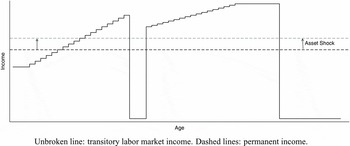
Figure 1 demonstrates how changes in asset prices—in this case housing—and labor market outcomes operate distinctly. The unbroken black line reflects labor market income across the lifetime—rising when in employment and dropping to zero when out of the labor market, both before (e.g., unemployment) and after retirement. The dashed black straight line reflects permanent income over the lifetime. This income comes from both the labor market and from the housing market. The value of assets such as housing not only reflects lifetime labor earnings (richer citizens can afford more costly housing) but may also come from bequests or from aggregate changes in the value of housing unrelated to the labor market. Hence housing values can be independent of both temporary and average labor market income. Figure 1 emphasizes that an individual's transitory and permanent incomes may diverge substantially at various points, particularly when out of the labor market through unemployment or retirement. The dashed grey line reflects the possibility that an individual's permanent income may also jump (or fall) dramatically as house prices change. If the individual expects house prices to remain high (low) then that produces increased (decreased) expected permanent income and hence consumption.
Permanent Income, Transitory Income, and Asset Price Changes over the Life Cycle

How does variation in housing prices affect preferences over redistribution and social insurance? In terms of redistribution, higher housing prices raise homeowners’ permanent income and thus reduce their expected demand for redistributive tax and transfer schemes. First, if property is taxable, homeowners may be subject to higher taxes, whether as capital gains, inheritance tax, or annual property taxation. Second, higher asset values may lead citizens to lose eligibility to receive means-tested redistributive transfers. Finally, presuming diminishing marginal returns to income, citizens with more valuable property and hence higher permanent income may have lower demand for redistributive transfers themselves. Collapsing house prices should produce greater support for redistribution among homeowners for the reverse reasons.
Housing also affects preferences over social insurance policies that provide income support during periods out of the labor market. The ability to use housing as a means to smooth consumption (through borrowing or sale) while out of the work force and to draw down on housing to fund retirement provides citizens with steady levels of consumption during periods of lower income and thus can substitute for socially provided transfers such as unemployment insurance and pensions. Homeownership thus acts as a form of self-supplied “private insurance” against the welfare losses associated with job loss, especially, per the buffer stock argument, when access to credit may be severely curtailed.Footnote 1 Higher house prices mean more valuable private insurance and hence should lead to lower demand from homeowners for social insurance as a hedge against such risks. These responses to rising house prices should be mirrored in the case of decreasing house prices, where homeowners should become relatively more supportive of social insurance as the value of their private insurance declines. In summary, house price appreciation reduces the demand for both redistribution and social insurance; house price depreciation increases this demand.
It is worth briefly discussing a number of potential qualifications. First, unless they sell their house, individuals do not see the realized value of their asset. For many individuals the value of their house is a subjective approximation based on information gleaned about the local or national housing market. However, many analyses of demand for social insurance also rely on individuals making judgments about uncertain quantities: specific skills approaches presume that individuals are making judgments about the likelihood of finding another job that rewards their skills like their current occupation (Iversen and Soskice, Reference Iversen and Soskice2001). Thus, even though citizens typically do not know the precise value of their house, local housing conditions will shape their estimate (for example, in UK survey data self-estimates and local housing prices are strongly correlated; see below).
Second, houses are not an especially fungible form of wealth. Selling a house can be a drawn-out process, the speed of which depends on local economic conditions. Given this “specificity” in the value of housing, it is likely that the effectiveness of housing as a cushion against income loss is conditioned by the time frame in which the property must be sold. Whereas retirements are planned over a long horizon, unemployment is a rapid and often unexpected event. Hence it is likely that asset ownership reduces demand for social insurance programs for old age more so than for programs targeted at unemployment.
Third, many homeowners hold mortgages and hence hold relatively little equity in their house. Such individuals may face greater risks in affording their house and have less accumulated wealth in the form of property. Accordingly, it is among individuals with greater equity in their house that we should see the least support for redistribution and social insurance since they face less risk of losing their house and they have already accumulated equity that can substitute for social insurance.
Finally, citizens’ short-term evaluations of the price of their home may be driven, at least partly, by “irrational exuberance” rather than the long-term “fundamentals” of the housing market (Shiller, Reference Shiller2007). Indeed, there is substantial evidence that homeowners in the 2004–2006 peak of the recent housing bubble believed their homes would continue to rise in value at a substantial rate over the coming decade (Case, Shiller, and Thompson, Reference Case, Shiller and Thompson2012). Thus even if homeowners had cashed out much of the appreciated value of their home through home equality loans (HELOCs), their expectation was that they would continue to have substantial equity remaining as a nest egg. That these homeowners’ expectations proved false was unfortunate but since policy preferences will be driven by subjective price expectations, we should expect rising house prices to produce less support for social spending even when equity has been drawn down through HELOCs.
From Voters to Parties
How do these arguments about the microfoundations of ownership aggregate upwards into actual policy outcomes? To make this micro- to macroconnection we first need to look at how changing house prices filter into the electorate as a whole and then secondly theorize how parties might respond to changing preferences among the public.
Above I argued that rising house prices shift the preferences of homeowners towards reduced redistribution and social insurance spending. In the aggregate, since homeowners are a majority in most countries this should reduce overall support for social spending. However, it is also worth considering which particular homeowners are most likely to be affected and how the role of partisan ideology might impact the connection between an individual's economic fortunes and their policy preferences. In particular, I argue that the effects of house price appreciation on individual policy preferences are likely to be strongest for right-wing voters.
Recent work has argued that the way citizens interpret economic data—both aggregate and individual—may be influenced by their ideological preferences, perhaps driven by elite behavior and party priming (Bartels, Reference Bartels2002; Carsey and Layman, Reference Carsey and Layman2006). For example, in a recent study of the credit crisis, Margalit (Reference Margalit2013) finds that the effects of experiencing job loss or insecurity on preferences over unemployment insurance are much stronger among right-wing voters than among left-wing voters. The implication of this work is that left-wing voters may be primed to resist cuts to social spending regardless of other individual characteristics, ideology thereby operating as a filter on economically derived preferences. Conversely, right-wing voters, lacking these ideological commitments, are likely to be more responsive to changes in asset prices. This “ideological filter” effect implies differential responsiveness to house price changes among partisans.
Putting these expectations together, for two reasons I expect that at the macrolevel right-wing parties’ policymaking should be especially responsive to changes in house prices. First, several studies show that right-wing parties disproportionately represent homeowners (Kingston, Thompson, and Eichar Reference Kingston, Thompson and Eichar1984; Verberg, Reference Verberg2000). Hence, during house price booms I expect right-wing parties to channel the preferences of these constituents for lower social insurance spending. Left-wing parties, with constituent bases that more heavily represent nonowners, should not respond in this fashion. Second, because of the “ideological filter” effect, right-wing voters are more likely than left-wing voters to alter their social policy preferences in response to changes in house prices. This implies that rising house prices create an opportunity for right-wing parties to cut social spending as their electoral base becomes more inclined towards that ideological end. In summary, right-wing parties should be more responsive to house prices than left-wing parties since they contain more homeowners in general and right-identifying homeowners are more responsive to changes in house prices in terms of their policy preferences.Footnote 2 Finally, where homeownership is higher, homeowners form a larger potential constituency of votes, including key swing voters. During house price booms this creates a greater electoral opportunity for right-wing parties to curtail social insurance programs. Hence in high homeownership countries the effect of house price booms on right-wing parties reducing support for social insurance should be amplified.
To summarize the theory developed in this section, I have argued that thinking about housing as a key element of individual's permanent income provides novel insights into both social policy preference formation and policy outcomes themselves. Citizens will become less supportive of both redistribution and social insurance the greater the value of their house. Political parties will respond to changes in support for social policy brought about by changes in house prices. In particular, right wing parties, with a support base disproportionately composed of homeowners, will be especially likely to cut back social programs during housing booms.
THE MICROFOUNDATIONS OF OWNERSHIP AND POLICY PREFERENCES
In this section, I test my conjectures about house price changes and support for redistribution and social insurance using panel survey data drawn from the USA and the United Kingdom and cross-national survey data from the International Social Survey Program (ISSP). Detailed information on these housing measures is available in a data appendix in the supplementary material.
Housing and Policy Preferences in the United States
I begin by examining preferences over the funding of the Social Security retirement program in the United States using the ANES 2000–2004 panel survey. The main dependent variable is a three-point scale asking whether individuals would like to see federal spending on Social Security decrease, remain the same, or increase. To examine change over time I convert this variable into a change measure, which is accordingly a five-point scale (ranging from someone who initially wanted to increase spending in 2000 but to decrease it in 2004 to the reverse scenario).
In terms of independent variables, I examine a variety of indicators of house price appreciation, with the expectation that homeowners who have experienced rising local house prices will become less supportive of Social Security over the 2000–2004 period. I draw on data at the Metropolitan Statistical Area (MSA) and U.S. state level provided by the Federal Housing Finance Agency (FHFA). These data come in two types: Purchase Only data which is calculated from same-dwelling sales and All Transactions data which includes both purchases and refinancing.Footnote 3 I adjust these data for consumer price inflation so that they measure real appreciation. As my core measure of house price appreciation, I create a variable that combines information on whether the respondent is a homeowner across the full 2000–2004 period multiplied by the regional increase in house prices. I examine (a) state-level appreciation (Δ St. House Price) and (b) state/MSA appreciation (Δ St./MSA House Price), where I employ the state-level variable for those respondents without MSA-level data. These variables equal zero for renters and the percent change in state (or state/MSA) house prices for homeowners. Thus this measure represents a respondent's expected gain in wealth due to regional house price appreciation across the panel.
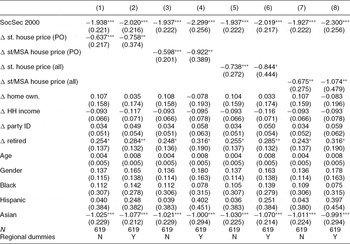
Table 1 examines how changes in regional house prices for American homeowners between 2000 and 2004 affected their support for Social Security. As control variables I include changes in income, homeownership status, party ID, and retirement status, and measures for the unchanging variables of gender, race, and age in 2000. Models 1 and 2 use the Purchase Only state-level data, models 3 and 4 use the Purchase Only state or MSA data, models 5 and 6 use the All Transactions state-level data, and models 7 and 8 use the All Transactions state or MSA data. Even-numbered models add dummies for state or MSAs and are thus fixed effects model netting out differences between regions driven by economic, political, or social conditions.
Panel Analysis of Change in Social Security Preferences: ANES 2000–4

Clustered standard errors in parentheses: *p < 0.1; **p < 0.05; ***p < 0.01.
Across all specifications I find a negative effect of estimated house price appreciation between 2000 and 2004 on changes in preferences over Social Security spending. To demonstrate the substantive magnitude of these effects, using model 4, I find that homeowners who experienced house price appreciation of 10% between 2000 and 2004 (the 10th percentile among homeowners) had an estimated probability of 14.2 percent of desiring less Social Security spending in 2004 than they did in 2000. By contrast, homeowners with house price appreciation of 50% (the 80th percentile) had a 22.5% probability of desiring less spending in 2004 than they did in 2000. Since stability of preferences is extremely common (around 85% of the sample) these predicted effects of house price appreciation are quite dramatic.
If the level of Social Security preferences in 2004 is used as the dependent variable (see supplementary material), the same difference in house price appreciation is associated with a decrease from 66% to 53% in the probability of supporting more spending in 2004. Thus examining both changes and levels of preferences, we find house price appreciation has a negative effect on support for social insurance. This negative effect of house price appreciation is limited to homeowners—in a sample restricted to homeowners, regional price changes have a negative impact on changes in social security preferences, whereas among renters the effect is positive, albeit not statistically significant at conventional levels (see supplementary material).Footnote 4
In the supplementary material, I also examine several other measures of asset ownership: stock ownership in 2000, the change in ownership between 2000 and 2004, and whether individuals owned a personal retirement account in 2004. These measures are binary and thus do not tap how much investment citizens have nor their likely gains or losses, and hence are considerably less satisfactory than the regional house price index as a measure of asset wealth (analysis of the British Household Panel Survey below rectifies this omission). Nonetheless I do find that individuals with stock market assets in 2000, or retirement accounts in 2004, appear to become less supportive of Social Security between 2000 and 2004, consistent with the argument developed in the theory section as applied to financial assets. House price appreciation remains negatively related to changes in social security preferences at a statistically significant level.Footnote 5 In all, the ANES data strongly support the conjecture that citizens become less supportive of social security as their wealth, especially in housing, rises.
Housing and Policy Preferences in the United Kingdom
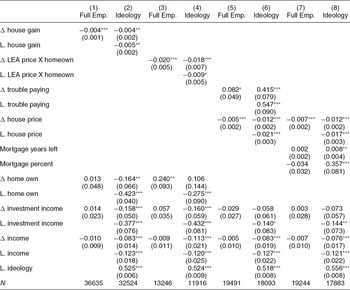
To check on the generalizability of these findings about policy preferences in the American context, I now turn to survey evidence from the United Kingdom, which not only provides data on individuals across time but also provides individuals’ estimates of the value of their house. The British Household Panel Survey (BHPS) includes over 50,000 citizens in a panel study for which I have data from 1991, 1993, 1995, 1997, 2000, 2004, and 2006, during which time the British housing market saw first a crash and then a long rise in house prices. During these particular surveys respondents were asked questions about their housing status (did they own or rent) and if they owned to evaluate the value of their house (referred to as House Price). Using this information I create an indicator of the change in the estimated value of their house (in £10,000 units), adjusted for consumer price inflation, from survey to survey.Footnote 6 I also include a second measure of assets: annual income from investments and dividends, also in £10,000 units, referred to as Investment Income. I control for homeownership, annual labor market income (in £10,000 units), gender, age, employment status, education, number of children (not shown), a time trend, and for voters of the main three political parties, partisanship.
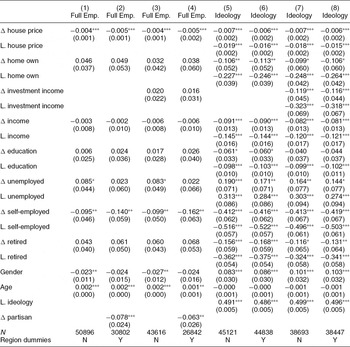
Models 1–4 in Table 2 examine the closest question on the BHPS to tapping social insurance preferences—asking people whether they agree that the government should see to it that everyone looking for work can find work—that is, whether the government should implement a de facto “full employment” policy. This is not an ideal measure of support for social insurance but it does address government support for people at risk of unemployment or low incomes. I use as the dependent variable change from period to period in support for the prompt, using changes in the independent variables (and levels of age and gender) as explanatory variables. Since the prompt has just five values, the possible level of change is limited and I use an ordered logit model, clustering standard errors by individual respondent. Models 1 and 2 examine the effects of changes in House Price alone, whereas models 3 and 4 add Investment Income, which reduces the sample by around 15%. Models 1 and 3 exclude change in partisanship and regional dummies whereas models 2 and 4 include these, at the loss of a further 40% of the observations.
British Household Panel Survey Analysis

Panel clustered standard errors in parentheses: *p < 0.1; **p < 0.05; ***p < 0.01.
Notes: Models 1–4 are ordered logit estimations. Models 5–8 are linear estimations with panel random effects.
Across all the models I find a statistically significant negative effect of self-evaluated house price appreciation on changes in support for employment policies.Footnote 7 In the supplementary material I show that these effects are consistent regardless of whether the sample is limited to increases in house prices or to decreases: house price increases lead to reduced support, house price decreases lead to increased support. The substantial effect of rather rapid house price appreciation—say 50% increase over three years—is to reduce support for full employment policies (either strongly or somewhat support) by around five percentage points. Changes in Investment Income and labor market income, by contrast, do not appear related to changes in support for employment policy.
In models 5–8 of Table 2, I extend the analysis to a broader dependent variable—a compound ideological index composed of the full employment question plus similar questions about whether there is one rule for the rich and one for the poor, whether industries should be nationalized, whether private enterprise solves economic problems, whether strong trade unions protect employees, and whether ordinary people are sharing in the nation's wealth. Combining these into a 30-point compound index—increasing in left-wing ideology—permits the use of linear models and the inclusion of individual-level random effects to account for variance across respondents. Models 5–8 use an error correction model with the respondent's score on the ideological index as the dependent variable and including a lagged dependent variable and changes and lagged levels of house prices and the other independent variables.
The results indicate that both changes in house prices and their level have strong negative effects on the compound ideological index and hence are associated with more right-wing ideological views. This implies both within-individual (changes) and between-individual (levels) variation in house prices matter for policy preferences.Footnote 8 The long-run effects of house price changes, taking into account the lagged dependent variable, are large: a doubling in house prices is associated with a long-run decrease of two-thirds of a within-person standard deviation in ideological preferences. Unlike the case of full employment preferences, Investment Income is also strongly and negatively related to ideological preferences. An increase of £10,000 in investment income is associated with a long-run decrease of almost half a within-person standard deviation in ideological preferences.
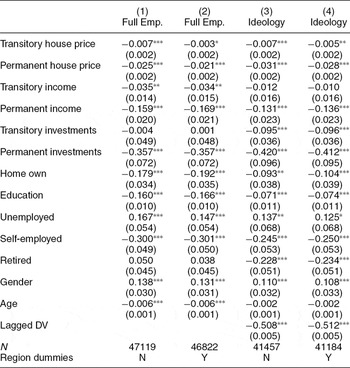
Table 3 alters the specification by introducing measures that are intended to directly pick up permanent versus transitory housing, investment, and labor market income. Here I follow Stegmueller (Reference Stegmueller2013) with an individual's average house price across the panel and their period deviation from this average as proxies for permanent and transitory housing wealth, along with controls for permanent and transitory investment and labor market income. I find that both permanent and transitory housing wealth have negative effects on both full employment preferences and ideology as in the error correction model. Similarly, across all specifications there is a strong negative effect of permanent investment income as well as a transitory effect for ideological preferences (though not full employment). Notably these are distinct from the effects of labor market income over the panel, implying that assets have a long-run effect independent from expected labor market income.
Permanent and Transitory Income and Assets in the BHPS

Panel clustered standard errors in parentheses: *p < 0.1; **p < 0.05; ***p < 0.01.
It is revealing to consider the relative magnitude of the effects of housing wealth, investment income, and labor market income. Each variable is measured such that a one-unit increase equals £10,000. In terms of raw coefficients, the estimated effect of permanent labor market income is six to eight times as large as that of house prices for full employment preferences and four times as large for ideological preferences. The estimated effects of investment income are higher: around 14 times as high as the effect of house prices across the models. However, these ratios need to be interpreted carefully since for homeowners in the sample, the average house price is £140,040, the average income is £14,773, and the average investment income is £1,263. Adjusted by these starting points, a £10,000 increase represents very different percentage increases. Indeed, adjusted in this way, the effect of housing is substantially larger than that of the other measures: 1.5 to 2.25 times larger than labor market income and eight times larger than investment income. Moreover, whereas 75 percent of the sample have £1,000 or less in annual investment income (25 percent have essentially zero investment income), over 75 percent own houses. This suggests that the aggregate political ramifications of shocks to housing are likely to be substantially larger than those to investment income, though both push in the same direction.
The BHPS provides a further range of variables that permit analysis of different measures of house equity and their effect on preferences.Footnote 9 Table 4 begins in models 1 and 2 by examining a measure House Gain produced by subtracting the initial purchase cost of the house from the respondent's current valuation (these models follow the specification of models 3 and 7 in Table 2). These models produce similar effects to the baseline House Price measure, albeit of somewhat smaller magnitude. Since these gains to house prices are potentially independent of the initial affordability of the house (and thus represent an asset “windfall”)—these results are strongly supportive of an effect of housing independent of labor market income.
Alternative Measures of Housing Equity in the BHPS

Note: Demographic variables not reported (see supplementary material).
Panel clustered standard errors in parentheses: *p < 0.1; **p < 0.05; ***p < 0.01.
Models 3 and 4 use data from the UK Land Registry on average house prices (adjusted for inflation and in £10,000 units) for 136 local education authority (LEA) districts in England dating back to 1996 (and thus excluding the first few waves of the survey). I interact the LEA mean price variable with homeownership to produce a measure similar to that used in the analysis of the ANES panel. This variable correlates at 0.52 with the respondent's estimates of individual house prices and picks up market characteristics for the local housing market as well as avoiding the potential problem of misestimation or biased estimation of house prices. It does, however, fail to pick up individual characteristics of the respondent's house not influenced by local average prices. In both models, the LEA homeowner appreciation variable has an estimated negative effect on policy preferences very similar in magnitude to that seen in models 3 and 7 of Table 2.Footnote 10
Models 5–8 examine issues related to repaying mortgages (hence I limit the analysis to homeowners). I argued above that changes in total equity should drive policy preferences, however, many homeowners still have substantial mortgages, reducing their share of equity in the house. Moreover, mortgage holders face the risk of losing the house should they miss payments. Models 5 and 6 examine a question in the BHPS asking homeowners whether they have faced difficulties paying for their house in the past two years. Respondents answering yes appear more likely to support employment policies and to have more left-wing ideological preferences but the negative effect of house price appreciation remains stable. A similar story can be seen in models 7 and 8 that add measures for the number of years left on the mortgage and the percentage of the initial purchase cost funded by borrowing. Though these measures do not appear to impact employment policy preferences, citizens with more years left to pay and who borrowed initially more tend to have more redistributive ideological preferences, even as rising house prices push them away from such attitudes. These results indicate that it is owning equity in a house, rather than the title to the house, that produces decreased support for redistribution.
Cross-National Survey Data
I now turn to cross-national survey data that allow me to address two important questions: to what extent do these survey results hold up outside of the USA and the UK; and what is the effect of a substantial decrease in property prices that leaves citizens with negative equity, as many citizens experienced during the recent housing downturn? I use the International Social Survey Program (ISSP) from 2009 to examine the effects of home equity on preferences over redistribution for over 15,000 citizens in 29 industrialized countries, many (but not all) of which had experienced significant house price declines following the peak of the housing boom. Unlike the previous surveys I do not have house price data matched to citizens nor is the ISSP a dynamic panel survey. It does, however, contain a question that taps into citizens’ equity in their house.
Specifically the ISSP asks “How much money would be left if the home you and your family live in was sold?” and presents a series of categories: just debts (negative equity); do not own; and a ten-point equity scale normalized by national currency (e.g., in the USA this runs from under $30,000 to over $900,000 in ten (differently sized) increments). Accordingly, this measure helps in examining whether the effects of housing wealth on policy preferences are symmetric in both directions: do homeowners with negative equity support redistribution more than renters; do homeowners with positive equity support redistribution less than renters (or homeowners with less/negative equity)?
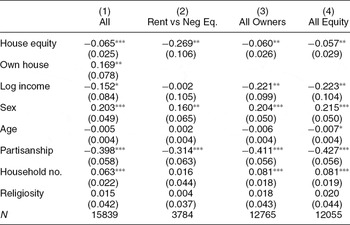
As a dependent variable I use the question that best taps redistributive preferences: “Do you think the government should reduce differences in income” (a question used by Rehm (Reference Rehm2011), among others). I control for homeownership, income (logged relative to the mean), sex, age, party identification (rising in right-wing support), work status (dummies not reported), education level (not reported), number of members of the family, and religiosity. I run a series of ordered logit models with survey weights and country-clustered standard errors.Footnote 11 The models then divide citizens into subsamples by house equity status (models 2–4).
Model 1 of Table 5 begins by examining all available respondents and includes both the house equity variable and a homeownership dummy. The equity variable has the expected negative sign and is statistically significant at the 1% level. The predicted substantive impact is large—whereas a homeowner with negative equity is expected to strongly support government redistribution with a probability of 34%, this probability declines to 30% for renters, 27% for homeowners with a moderate level of positive equity, and to just 21% for homeowners with a high level of positive equity. Model 2 restricts the sample to renters and citizens with negative equity, finding again that renters are substantially less supportive of government redistribution than are citizens with negative equity. Models 3 and 4 show that when we limit the sample to (a) only homeowners and (b) only those with positive equity, the negative effect on support for redistribution of rising home equity continues to hold. Accordingly, it appears that the effects of asset values operate in both directions—when assets are highly valued they discourage support of redistribution but when their value turns negative they produce greater support than the baseline of nonownership.
International Social Survey 2009: Should Government Reduce Income Gaps?

Country clustered standard errors in parentheses: *p < 0.1; **p < 0.05; ***p < 0.01.
Note: Dummies for education and employment status not reported.
Partisanship, Housing Prices, and Support for Social Insurance
I argued in the theory section that the effects of property prices on redistribution and social insurance preferences are likely to be stronger among right-wing voters than left-wing voters since, for ideological reasons, the latter group is likely to be less responsive to changes in personal economic conditions. I re-examine models from the ANES, BHPS, and ISSP, dividing voters by partisanship.
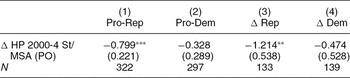
I begin in Table 6a with U.S. data from the ANES 2000-4 panel. I use two different techniques to split the sample, building off model 3 in Table 1. Models 1 and 2 split voters by whether they identified more with the Republican or Democratic Party in 2004. Only the former group shows the negative effect of house price appreciation on changes in social security preferences between 2000 and 2004. Models 3 and 4 split by changes in partisanship between 2000 and 2004. For voters who moved to the right we see a strong negative impact of house price appreciation on changes in Social Security support, whereas we do not see a similar impact among those who moved to the left.Footnote 12 In the supplementary material, following Margalit (Reference Margalit2013), I also examine restricting the panel sample to exclude individuals whose previous policy preference was in an “extreme” category. I find that that right-wing voters are always negatively affected by house appreciation, but among left voters only those who did not want more spending in 2000 are negatively affected. Left-wing voters who wanted more spending in 2000 are unaffected by house prices—evidence for the “ideological filter” effect: these voters are unwilling to countenance cuts regardless of individual economic conditions.
House Price Changes for Varying Partisans: USA

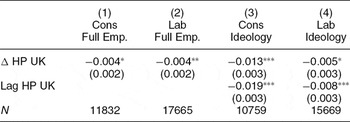
Table 6b undertakes a similar exercise for British voters, dividing them into those who identify with the Conservative Party and those who identify with the Labour Party. In the case of full employment preferences, there is little appreciable difference in the effects of house price appreciation between Conservative and Labour identifiers (building off model 1 of Table 2) but in terms of ideology (building off model 5 of Table 2) we again see right-wing (Conservative) identifiers having stronger effects of house price appreciation than left-wing (Labour) identifiers. In the supplementary material I again examine restricting the sample by previous support for the dependent variable. In the case of the ideology index, I find that right-wing voters are always affected by house prices regardless of their previous ideological preferences but more ideological left voters are unaffected by house prices. I also find that right-wing voters are consistently more strongly affected by house prices regardless of whether the Conservative or Labour party was in power.
House Price Changes for Varying Partisans: UK

Table 6c replicates the partisan distinction analysis for the ISSP sample. Again right-wing voters appear more strongly affected by changes in their housing wealth in terms of their support for redistribution. This difference holds up regardless of whether we examine the whole sample (models 1 and 2), renters versus citizens with negative equity (models 3 and 4), all owners (models 5 and 6) or all owners with positive equity (models 7 and 8). In the supplementary material I show that right-wing voters are more responsive to house equity changes regardless of the current partisanship of the government in power—accordingly, this is not driven by satisfaction with the current regime producing more optimistic views of equity positions. While party types vary greatly across the 29 countries in the ISSP, this pattern suggests that the results found in the UK and USA can be extended more broadly. Indeed, excluding the case of full employment policies in the BHPS, across the remaining seven comparisons in the ANES, BHPS, and ISSP the estimated coefficient on house prices/equity is consistently 1.5 to 3 times larger for right-wing voters.
House Price Changes for Varying Partisans: ISSP

Panel clustered standard errors in parentheses: *p < 0.1; **p < 0.05; ***p < 0.01.
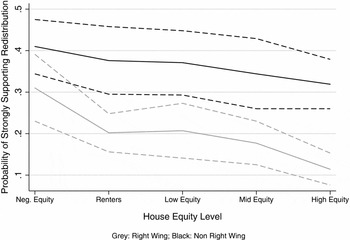
Figure 2 displays the differential effects of housing equity for left and right voters in the ISSP.Footnote 13 It shows that the overall effect of house equity is substantially stronger for right-wing voters who drop from a 32% probability of supporting redistribution when in negative equity to 12% when having high equity. By contrast, left-wing voters only decline from 42% to 33% probability of support. Being in negative equity is associated with right-wing voters having similar preferences to left-wing voters, supporting the finding in Margalit (Reference Margalit2013) that negative economic shocks push conservative voters towards greater support of redistribution. There is substantial separation of right and left voters with high equity and the effects of moving into this category are stronger for right-wing versus left-wing voters. This supports an ideological filter effect of partisanship: right-wing voters’ redistributive preferences are strongly affected by both negative and positive house price changes whereas left-wing voters do not become substantially less supportive of redistribution when they have high levels of equity.
Attitudes Towards Redistribution from the ISSP 2009

To summarize, the analyses in this section of the effects of homeownership and house prices on individual social policy preferences show a powerful negative relationship that previous studies of preferences have not uncovered. However, we are left with the question as to whether these preferences matter substantively—do political parties respond to the shifting views of voters?
HOUSING PRICES AND POLICY OUTCOMES AT THE MACRO LEVEL
In this section I move from examining how house prices affect policy preferences to analyzing whether house price fluctuations alter policy outcomes. In particular, I investigate whether the pattern of right-wing voters being most strongly affected by house prices manifests itself at the national level through the actions of right-wing parties. The findings in this section strongly support these conjectures. Even controlling for changes in standard macroeconomic factors including national income, price inflation, unemployment, and interest rates I find powerful effects of house prices on patterns of government spending. In short, when house prices are rising, right-wing governments appear to curtail social spending programs further. I explore this political effect of the housing cycle using cross-sectional time-series data for 18 countries from 1975 to 2001.
For the dependent variables in this section, I examine social spending policies from the OECD Social Spending dataset from 1980 to 2001, as well as OECD data on social transfers as compiled by Armingeon et al. (Reference Armingeon, Gerber, Leimgruber and Beyeler2008) and data on pensions and unemployment replacement rates compiled by Scruggs (Reference Scruggs2004). The variables taken from the OECD Social Spending dataset are total social spending as a percentage of GDP, spending on old-age pensions as a percentage of GDP, and spending on unemployment benefits as a percentage of GDP. The total social spending measure includes not only pensions and unemployment but also survivors’ benefits, incapacity benefits, health spending, family spending, active labor market programs, and public housing. The pensions replacement rate is for a retired couple and the unemployment replacement rate variable measures the net replacement rate during periods of unemployment for a solo breadwinner with dependent family (Scruggs, Reference Scruggs2004). These variables have the benefit of capturing changes in policy generosity that are not simply functions of the macroeconomic climate but are direct policy changes. Finally, the social transfers measure from Armingeon et al. (Reference Armingeon, Gerber, Leimgruber and Beyeler2008) is defined as social assistance grants and welfare benefits paid by general government and has the best availability, dating back to the 1970s.
For independent variables I focus on the interactive effect of house price appreciation and partisanship. For house price appreciation I use the five-year percentage change in real house prices (i.e., inflation adjusted), taken from the Bank of International Settlements’ house price data for 18 countries from 1970 to 2001. These housing data provide a country-specific level of house prices relative to 1970—note that this implies that house price levels cannot be usefully compared cross-sectionally, though changes can, hence my use of the five-year percentage change.Footnote 14 The mean of this variable is 12.8% (a compounded annual rate of around 2.5%), its standard deviation is 25.6%, and its minimum and maximum values are −45.8% and 118.3%.
For government partisanship I use Cusack and Engelhardt's cabinet “center of gravity” index, which produces a measure of cabinet ideology that is a weighted average of the ideology of parties in the governing coalition (Cusack and Engelhardt, Reference Cusack and Engelhardt2002). I use their “composite ideology” index, which is based on expert ratings and ranges (theoretically) between −100 and 100, with right-wing parties having higher scores, and has a mean of 3.65, and a standard deviation of 24.15.Footnote 15 Finally, the key independent variable in the analysis is the interaction of cabinet partisanship with the five-year percentage change in house prices—social insurance and redistributive spending should be reduced by the combination of right-wing government and house price increases.
I include as controls a set of macroeconomic variables that come from the Penn World Tables (PWT), the World Development Indicators (WDI), and the OECD. These include Gross Domestic Product (measured in $100 bn) and the annual growth rate of GDP from the PWT, the log of population, the real interest rate, and consumer price inflation from the WDI, and the unemployment rate from the OECD. I also add two further important determinants of social spending: trade openness (Rodrik, Reference Rodrik1998) and the proportion of citizens over 65 years of age (both from the WDI).
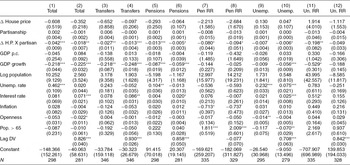
Table 7 tests the propositions developed above on a dataset of 18 states from 1975 to 2001, with between 280 and 346 observations across the various models. Models 1 and 2 examine total social spending, models 3 and 4 examine social transfers, models 5 and 6 look at old age pensions spending, models 7 and 8 examine pensions replacement rates, models 9 and 10 examine spending on unemployment benefits, and models 11 and 12 examine the net unemployment replacement rate. For each dependent variable I include country and year dummies both without and with the inclusion of a lagged dependent variable. Alternative specifications with autocorrelated error terms in place of the lagged dependent variable and without country fixed effects produce similar results in terms of substantive and statistical significance.Footnote 16
Social Policy and Housing Prices

Clustered standard errors in parentheses: *p < 0.1; **p < 0.05; ***p < 0.01. Note: All models contain country and year fixed effects.
The key finding of these analyses is that the interactive variable of cabinet partisanship and house prices is negative and significant across almost all of the models. Except for unemployment spending and replacement rates, where the results are more mixed, the effects of house prices conditional on right-wing partisanship are to decrease social spending, particularly pensions, and to lead to less generous replacement rates. Broadly, the implication is that the impact of house prices, controlling for other aspects of the business cycle and other determinants of government spending, is filtered through partisan control of government. When right-wing governments capture office and house prices have been appreciating we see a strong negative impact on social spending and transfers and in terms of old-age pensions (with mixed evidence on unemployment policies). Conversely, when left-wing parties are in power during periods of house price appreciation there is no distinguishable effect on social spending.
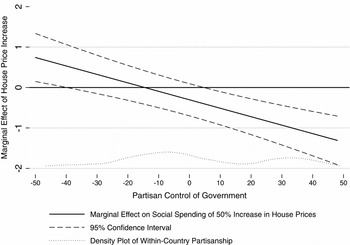
This pattern can be seen in Figure 3, which shows estimates drawn from model 1 of Table 7 of the marginal effect on social spending of real house prices increasing by 50% over five years. The figure can be interpreted as showing the estimated effect—with 95% confidence intervals—of this increase in house prices for a given level of partisanship, where negative numbers imply left-wing cabinet control and positive numbers imply right-wing control, relative to the country average.Footnote 17 The figure shows that when partisanship moves to the left there is little evidence of house price increases affecting social spending. However, when cabinet partisanship moves to the right there is a robust negative effect of house price increases on social spending. A 40-point swing to the right in partisanship (1.5 within-country standard deviations) combined with a 50% increase in house prices is associated with a reduction of spending of around one percentage point of GDP. These figures amount to half of a within-country standard deviation—a sizable effect with substantial political implications.
Estimated Effects of House Price Changes on Social Spending

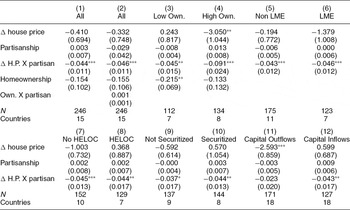
Table 8 examines how dependent the results from Table 7 are on the structure of different countries’ economies, particularly on the level of homeownership. I argued above that the interactive effect of house price appreciation and partisanship should be stronger in those countries with higher rates of homeownership, since such countries present a more fertile territory for opportunistic right-wing parties seeking to curtail social spending. Accordingly, I re-examine model 1 from Table 7, incorporating homeownership levels. I use data collected by Atterhög (Reference Atterhög2005) on homeownership rates from 1960 to 2003 across 15 of the countries in the dataset.Footnote 18
Homeownership, Economic Regimes and Social Spending

Clustered standard errors in parentheses: *p < 0.1; **p < 0.05; ***p < 0.01.
Note: All models contain country and year fixed effects and identical control variables to Table 7 (not reported).
In model 1 of Table 8 I add the homeownership variable to model 1 of Table 7. Although three countries are dropped, the estimated joint effect of house price appreciation and partisanship is extremely similar. Homeownership itself is negatively signed but is not significant at conventional levels. Model 2 adds the interaction of partisanship and homeownership rates, in order to clarify the conditional effect of house price appreciation vis-à-vis homeownership. The effect of partisanship does not appear to be conditional on homeownership but rather on house price appreciation. Thus, increases in asset prices rather than homeownership per se appear to drive partisan policymaking. However, it appears that homeownership may amplify house price changes. Models 3 and 4 split countries into two groups: those with average levels of homeownership across the time period lower than the overall median (61.75%) and those at or above the median.Footnote 19 Although the coefficient on the interactive variable remains statistically significant across both samples, it is substantially larger in magnitude for countries with higher homeownership rates than for those with lower rates.
Models 5–12 examine whether these results are dependent on the structure of financial markets across countries. As Schwartz and Seabrooke (Reference Schwartz and Seabrooke2008) argue, the Anglo-American countries had substantially more liberalized financial markets, particularly as related to mortgage financing, than did their Continental European, Nordic, and East Asian peers. Broadly, this pattern reflects the division between Liberal Market Economies (LMEs) and Coordinated Market Economies (CMEs) (Hall and Soskice, Reference Hall and Soskice2001), though a number of Scandinavian countries also had liberalized housing finance markets. Schwartz (Reference Schwartz2009) further notes that cross-national variations in the magnitude of the housing boom were closely connected to the level of capital inflows experienced by countries.
Models 5 and 6 split the sample into LMEs and non-LMEs. It is immediately apparent that there is very little difference between the two groups of countries—thus the interactive effects of partisanship and house price appreciation are not solely an “Anglo-American” phenomenon. Models 7 and 8 divide the sample by whether individuals were able to borrow against their houses through home equity loans (HELOCs). Again, we see little difference between these groups. Models 9 and 10 divide the sample by whether mortgages could be securitized—here securitization has a slightly stronger effect on the interactive impact of partisanship and house prices but it is not statistically distinct from the group of nonsecuritized countries. The only major difference occurs when we split the sample by whether countries had increasing or decreasing levels of capital account inflows over the previous five years—here we see the interactive effect of partisanship mattering substantially more in the capital inflow cases. These results indicate that it is rising asset prices themselves, not the ability to borrow against them, that matter most.
This country-level analysis marks an advance on previous analyses of homeownership and social spending (e.g., Conley and Gifford, Reference Conley and Gifford2006) in showing that it is not homeownership per se, nor economic regime type, that matters for public spending but rather the differential benefits homeowners obtain in terms of their wealth when house prices are rising. These effects appear more pronounced where homeownership is most widespread and hence more voters benefit from rising prices, and where capital inflows facilitating price increases are highest. In summary, OECD countries appear to have experienced important effects of housing on the behavior of governments. Right-wing parties respond to the opportunity provided by an ‘ownership society’ to cut back social spending policies quite dramatically.
CONCLUSION
The major economic story of the last decade has been the surge and collapse of house prices worldwide. Yet political economists have had very little to say about this critical phenomenon, trapped with an analytical language that speaks to the labor market but is deaf to the effects of wealth and ownership. This article has presented a novel theoretical contribution that addresses this analytical and empirical gap. Ownership matters for both the preferences of citizens over what they want from government and for the actual policymaking behavior of governments themselves. Building on a theory of assets as permanent income, I argued that homeowners who experience house price appreciation will become less supportive of both redistribution and social insurance spending. Furthermore, parties representing these citizens, typically right-wing parties, will respond by curtailing social spending during housing booms.
I tested these propositions in two empirical settings. First, I examined panel survey data from the USA, the UK, and a cross-national survey of 29 countries, finding strong evidence for the claim that homeowners with appreciating property are less supportive of both redistribution and social insurance and that this pattern is amplified among right-wing voters. Second, I found that right-wing parties do appear to have cut back social spending more vigorously during housing booms. Examining house price declines, I find a “reversal of preferences,” as homeowners, particularly those with negative equity, become relatively more supportive of social insurance and redistribution. The degree to which this will translate into higher spending at the aggregate level is a complicated question, given the other constraints on government spending that manifest during economic downturns. Nonetheless, this analysis suggests that social insurance policies are likely to increase in popularity among the public in the wake of the recent housing crisis, portending a clash between public opinion and austerity policies.
Put together, these findings suggest a powerful new approach to thinking about the interaction of the economy and the welfare state. As advanced economies have encountered both increasingly volatile asset markets and retrenchment in the welfare state, this theory helps us to understand how these forces are connected. Indeed, thinking about the role of ownership enables us to address a range of theoretical and empirical anomalies in political economy. For example, a core puzzle in comparative political economy is the so-called Robin Hood paradox (Lindert, Reference Lindert2004)—redistribution from the poor to the rich happens least when it is most needed, for example when inequality is high. Ownership provides one, among many, responses to this puzzle: labor market incomes alone do not fully specify individuals’ demands for social insurance and redistribution. Wealth, especially that stored in housing, may act as a countervailing force. As Rajan (Reference Rajan2010) has suggested, rising house prices may take the edge off increasing income inequality for the median voter, keeping redistributive demands at bay.
Ownership also has an intriguing international dimension. Rodrik (Reference Rodrik1998) has argued that globalization may increase the risk individuals face in the labor market and potentially cause them to support greater social insurance However, Busemeyer (Reference Busemeyer2009) shows that globalization and public spending have been negatively related since the 1990s, in contrast to the earlier positive relationship. This negative relationship may be related to the effects of globalization on private assets as opposed to private risk. Global credit markets underpinned a political economy of cheap credit and housing booms during the 1990s and 2000s and this potentially reduced support for social insurance, precisely the opposite of the story commonly told about globalization and social spending.
Supplementary materials
To view supplementary material for this article, please visit http://dx.doi.org/10.1017/S0003055414000045





Comments
No Comments have been published for this article.