Introduction
Over the past 20 years, the use of parent report questionnaires for assessing early language acquisition has been a method widely used for both clinical and research purposes. These questionnaires reflect child performance in a wide range of contexts and situations. Moreover, they allow the collection of data from very large samples at low cost in terms of human resources and time, while providing a representative picture of very young children's language skills.
One of the most popular and widely used set of instruments is the MacArthur-Bates Communicative Development Inventories (MB-CDI), originally developed both in American English and in Italian (Fenson et al., Reference Fenson, Dale, Reznick, Thal, Bates, Hartung, Pethick and Reilly1993; Caselli & Casadio, Reference Caselli and Casadio1995, respectively), and later developed in nearly 100 languages, including diverse sign languages (see <http://mb-cdi.stanford.edu/adaptations.html> for a complete list of languages). The instruments consist of two report forms: the Words and Gestures (WG MB-CDI) infant form, originally designed for children aged 8 to 16 months and now extended up to 18 months, assesses sentence comprehension, production of vocabulary, and gesture production; the Words and Sentences (WS MB-CDI) toddler form, designed for children aged 16 to 30 months, assesses productive vocabulary and morphosyntactic competence. In some languages, the CDI-III form was developed for children aged 30–37 months for evaluating productive vocabulary, syntactic maturity, and language use (e.g., Eriksson, Reference Eriksson2017; Fenson et al., Reference Fenson, Marchman, Thal, Dale, Reznick and Bates2007).
Using MB-CDI complete forms in studying early language development
Several studies have demonstrated the validity and reliability of the MB-CDIs (for a review, see Fenson et al., Reference Fenson, Marchman, Thal, Dale, Reznick and Bates2007; Law & Roy, Reference Law and Roy2008). Studies on concurrent validity have found moderate to strong associations between parental report and spontaneous use of expressive vocabulary (Fenson et al., Reference Fenson, Pethick, Renda, Cox, Dale and Reznick2000; Gatt, Grech, & Dodd, Reference Gatt, Grech and Dodd2014; O'Toole & Fletcher, Reference O'Toole and Fletcher2010; Ring & Fenson, Reference Ring and Fenson2000; Trudeau & Sutton, Reference Trudeau and Sutton2011) as well as for syntactic measures (Dale, Bates, Reznick, & Morisset, Reference Dale, Bates, Reznick and Morisset1989; Jackson-Maldonado, Marchman, Bates, & Gutierrez-Clellen, Reference Jackson-Maldonado, Marchman, Bates and Gutienez-Clennen1993; Thal, Jackson-Maldonado, & Acosta, Reference Thal, Jackson-Maldonado and Acosta2000). Furthermore, developmental trends highlighted by cross-sectional studies have been confirmed by longitudinal studies (Bavin et al., Reference Bavin, Prior, Reilly, Bretherton, Williams, Eadie, Barrett and Ukoumunne2008; Conboy & Thal, Reference Conboy and Thal2006; Stolt, Haataja, Lapinleimu, & Lehtonen, Reference Stolt, Haataja, Lapinleimu and Lehtonen2008).
The availability of normative data in different languages enables cross-linguistic comparisons using parallel measures and controlled procedures across studies. It allows universal processes and language-specific variations to be explored, considering lexical developmental trajectories, lexical composition, and the relationship between lexicon and grammar. MB-CDI-based comparisons reported similar patterns of lexical development in children speaking different languages, above all when the very early vocabulary (first 100–200 words) is considered (Bleses et al., Reference Bleses, Vach, Slott, Wehberg, Thomsen, Madsen and Basboll2008). Other MB-CDI studies, while recognizing large individual differences in typical language development, found that first words are produced by toddlers aged between 12 and 20 months and that the vocabulary acquisition rate increases after 18 months of age (Bates & Goodman, Reference Bates, Goodman, Tomasello and Bates2001; Fernald, Perfors, & Marchman, Reference Fernald, Perfors and Marchman2006). Two evident leaps in vocabulary development have been noted between 16 and 20 months of age, and between 24 and 30 months of age, even if not all individuals show these leaps at the same ages (Bates & Goodman, Reference Bates, Goodman, Tomasello and Bates2001; Reznick & Goldfield, Reference Reznick and Goldfield1994). With respect to lexical composition, in many languages an over-representation of nouns has been reported in the early stages of vocabulary acquisition, when children have around 200–250 words in their repertoire. This proportion of content words tends to decrease when children expand and diversify their vocabulary. The acquisition of a larger proportion of predicates (verbs and adjectives) and closed-class words is linked to grammatical development across different populations and languages, demonstrating strong relationships between lexical skills (in terms of vocabulary size and composition) and the development of multiword utterances and early grammar (e.g., Caselli, Casadio, & Bates, Reference Caselli, Casadio and Bates1999; Devescovi et al., Reference Devescovi, Caselli, Marchione, Pasqualetti, Reilly and Bates2005; Marjanovič-Umek, Fekonja-Peklaj, & Podlesek, Reference Marjanovic˘-Umek, Fekonja-Peklaj and Podlesek2013; Tardif, Fletcher, Liang, & Kaciroti, Reference Tardif, Fletcher, Liang and Kaciroti2009). These results provided evidence for lexicalist theories which suggest that grammars are built using the same set of domain-general learning mechanisms that guide the child's developing lexical knowledge (Bates & Goodman, Reference Bates, Goodman, Tomasello and Bates2001; Marchman & Thal, Reference Marchman, Thal, Tomasello and Slobin2005, for an extensive discussion on this topic). Recently, a website including individual data and lexical norms from MB-CDIs in several languages has been created in order to promote cross-linguistic research (<http://wordbank.stanford.edu>; Frank, Braginsky, Yurovsky, & Marchman, Reference Frank, Braginsky, Yurovsky and Marchman2017). Braginsky, Yurovsky, Marchman, and Frank (Reference Braginsky, Yurovsky, Marchman, Frank, Noelle, Dale, Warlaumont, Yoshimi, Matlock, Jennings and Maglio2015) analyzed the Wordbank database of WS MB-CDIs taking into account four languages (Danish, English, Norwegian, and Spanish) and confirmed the large contribution of vocabulary size to grammatical development across languages.
The MB-CDIs have been extensively used as research tools to describe the language profiles of bilingual children (see O'Toole et al., Reference O'Toole, Gatt, Hickey, Mieksz, Haman, Armon-Lotem, Rinker, Ohana, dos Santos and Kern2017, for a recent cross-linguistic comparison on bilingual children) and clinical populations, for example children with genetic syndromes, autism spectrum disorders, and cochlear implants, among others (Charman, Drew, Baird, & Baird, Reference Charman, Drew, Baird and Baird2003; Deckers, Van Zaalen, Mens, Van Balkom, & Verhoeven, Reference Deckers, Van Zaalen, Mens, Van Balkom and Verhoeven2016; Thal, DesJardin, & Eisenberg, Reference Thal, DesJardin and Eisenberg2007). These studies confirmed the usefulness of the MB-CDIs in describing lexical development trajectories and in highlighting a strong relationship between lexical and grammatical skills, also in bilingual children and in children with atypical development.
Finally, exploring inter-individual variability in language acquisition allows us to distinguish typical and atypical developmental trajectories and thus to define shared clinical criteria for the identification of children with language delay. Starting from 24 months, toddlers are considered to be late talkers if their expressive vocabulary is equivalent to or below the 10th percentile (Desmarais, Sylvestre, Meyer, Bairati, & Rouleau, Reference Desmarais, Sylvestre, Meyer, Bairati and Rouleau2008; Hawa & Spanoudis, Reference Hawa and Spanoudis2014; Rescorla & Dale, Reference Rescorla and Dale2013).
The development of the MB-CDI short forms for screening programs and clinical purposes
In the last twenty-five years, the multiple applications of the MB-CDI original complete forms has added new knowledge on language development in many different clinical and research topics. Despite the advantages and the demonstrated statistical strength, one limitation of the complete forms is the significant amount of time required to complete them. This may restrict their effectiveness when a rapid assessment of children's language is desirable, limiting the in-depth information obtained. Fenson and colleagues (Reference Fenson, Pethick, Renda, Cox, Dale and Reznick2000) proposed the first example of MB-CDI short forms as alternatives to the complete forms. Following this, several research groups developed short forms in other languages, either as alternatives to the original complete forms or with the specific aim of providing a screening tool. Because of these different purposes, the short forms available at present are not completely comparable with each other. For example, with regard to WS MB-CDI short forms, the Danish (Vach, Bleses, & Jørgensen, Reference Vach, Bleses and Jørgensen2010) and the Mandarin Chinese (Putonghua) (Tardif, Fletcher, Zhang, Liang, & Zuo, Reference Tardif, Fletcher, Zhang, Liang and Zuo2008) versions focus only on expressive vocabulary; the American English (Fenson et al., Reference Fenson, Pethick, Renda, Cox, Dale and Reznick2000) and the European Portuguese (Frota et al., Reference Frota, Butler, Correia, Severino, Vicente and Vigário2016) versions include a list of 100 words and one question on the frequency of use of multiword combinations; in both the American Spanish (Jackson-Maldonado, Marchman, & Fernald, Reference Jackson-Maldonado, Marchman and Fernald2013) and the Galician versions (Pérez-Pereira & Resches, Reference Pérez-Pereira and Resches2011), morphosyntactic skills are further explored by asking the parents for examples of the three longest sentences produced by their children. Few research groups have included a specific section with a list of alternative sentences increasing in length and complexity for exploring grammatical development in the short forms.
Differences also exist in the age of application of the short forms. Normative studies on short forms (Fenson et al., Reference Fenson, Pethick, Renda, Cox, Dale and Reznick2000; Frota et al., Reference Frota, Butler, Correia, Severino, Vicente and Vigário2016; Jackson-Maldonado et al., Reference Jackson-Maldonado, Marchman and Fernald2013; Pérez-Pereira & Resches, Reference Pérez-Pereira and Resches2011; Tardif et al., Reference Tardif, Fletcher, Zhang, Liang and Zuo2008) have collected data in the traditional age-ranges (8–18 months for the WG form and 18–30 for the WS form), while others developed the short form as a screening tool for a single age-group (Kern, Langue, Zesiger, & Bovet, Reference Kern, Langue, Zesiger and Bovet2010; Westerlund, Berglund, & Eriksson, Reference Westerlund, Berglund and Eriksson2006). For example, in order to screen Danish children with language delay, Vach et al. (Reference Vach, Bleses and Jørgensen2010) elaborated a short form for 36-month-old children, extending the traditional age range of the MB-CDI's use.
The early detection of children with language delay is the main aim of screening projects widely implemented in recent years (Bavin et al., Reference Bavin, Prior, Reilly, Bretherton, Williams, Eadie, Barrett and Ukoumunne2008; Collisson et al., Reference Collisson, Graham, Preston, Rose, McDonald and Tough2016; Kim et al., Reference Kim, Jeon, Park, Kim, Jung and Woo2014), and short forms have become particularly appropriate as screening tools, allowing data collection on large samples of children because they are cost-saving, time-saving, reliable, and valid. Although further studies will be necessary to explore the predictive validity of short forms when screening children with language delay, a systematic review of the US Preventive Service Task Force considered the short forms of the MB-CDIs to be among the most robust screening instruments, displaying internal consistency and acceptable levels of sensitivity and specificity (Wallace et al., Reference Wallace, Berkman, Watson, Coyne-Beasley, Wood, Cullen and Lohr2015).
Using the Italian MB-CDIs to study early language development
In Italy, the MB-CDIs have a twenty-year history: in 1995, Caselli and Casadio published the first manual with normative date for the original complete forms (Words and Gestures; Words and Sentences). Normative data for the complete forms have recently been updated and published in a new manual that also includes norms for the short forms (Caselli, Bello, Rinaldi, Stefanini, & Pasqualetti, Reference Caselli, Bello, Rinaldi, Stefanini and Pasqualetti2015). The Italian MB-CDIs are commonly used for clinical evaluation of language acquisition and for research purposes to describe language acquisition and development in typically developing Italian children (e.g., Caselli, Rinaldi, Stefanini, & Volterra, Reference Caselli, Rinaldi, Stefanini and Volterra2012; D'Odorico, Carubbi, Salerni, & Calvo, Reference D'Odorico, Carubbi, Salerni and Calvo2001; D'Odorico & Fasolo, Reference D'Odorico and Fasolo2007; Sansavini et al., Reference Sansavini, Bello, Guarini, Savini, Stefanini and Caselli2010; Usai, Garello, & Viterbori, Reference Usai, Garello and Viterbori2009), as well as for cross-linguistic comparisons (Caselli et al., Reference Caselli, Bates, Casadio, Fenson, Fenson, Sanderl and Weir1995; Caselli et al., Reference Caselli, Casadio and Bates1999; Devescovi et al., Reference Devescovi, Caselli, Marchione, Pasqualetti, Reilly and Bates2005; Stolt et al., Reference Stolt, Savini, Guarini, Caselli, Matomäki, Lapinleimu, Haataja, Lehtonen, Alessandroni, Faldella and Sansavini2017). The Italian MB-CDIs have also been used in numerous studies focusing on communicative, linguistic, and neuropsychological profiles in clinical populations, such as deaf children, children with Down syndrome, children with Williams syndrome, and preterm children (among others, Caselli et al., Reference Caselli, Vicari, Longobardi, Lami, Pizzoli and Stella1998; Cattani et al., Reference Cattani, Bonifacio, Fertz, Iverson, Zocconi and Caselli2010; Rinaldi, Baruffaldi, Burdo, & Caselli, Reference Rinaldi, Baruffaldi, Burdo and Caselli2013; Rinaldi & Caselli, Reference Rinaldi and Caselli2009, Reference Rinaldi and Caselli2014; Vicari, Caselli, Gagliardi, Tonucci, & Volterra, Reference Vicari, Caselli, Gagliardi, Tonucci and Volterra2002; Zampini & D'Odorico, Reference Zampini and D'Odorico2011). All of these studies, on both typical and atypical populations, confirmed and extended the results obtained using the MB-CDI forms with children acquiring languages other than Italian, demonstrating strong similarities across languages and across clinical populations in lexical developmental trajectories, and in changes occurring in lexical composition, as well as in the relationship between lexical and grammatical skills.
Some studies have also contributed towards demonstrating the concurrent validity of the Italian MB-CDIs in relation to cognitive skills and linguistic measures derived from other standardized tools (e.g., Bello, Giannantoni, Pettenati, Stefanini, & Caselli, Reference Bello, Giannantoni, Pettenati, Stefanini and Caselli2012; Bello, Onofrio, & Caselli, Reference Bello, Onofrio and Caselli2014; Cozzani, Usai, & Zanobini, Reference Cozzani, Usai and Zanobini2013; Vicari et al., Reference Vicari, Caselli, Gagliardi, Tonucci and Volterra2002). In particular, Bello and colleagues (Reference Bello, Giannantoni, Pettenati, Stefanini and Caselli2012) explored the concurrent validity of the Words and Sentences short form (WS-SF) in relation to a direct task assessing lexical comprehension and lexical production, the Picture Naming Game (PiNG). The authors found significant correlations between a composite score derived for PiNG and several measures derived from the WS-SF of the MB-CDI, namely: vocabulary size (r = 0.526), number of sentences (r = 0.324), and the grammatical complexity score (r = 0.533).
The predictive validity of the Italian WS-SF has also been demonstrated in a recent longitudinal study in which performance on the WS-SF at 29 months of age was predictive of the language skills assessed at 34 months using both the complete form (WS-CF) and a direct assessment tool, namely the PiNG task (Bello, Onofrio, Remi, & Caselli, Reference Bello, Onofrio, Remi and Caselli2018).
Extensive clinical experience with the Italian MB-CDIs revealed the need to extend the normative samples of the instruments to evaluate lexical production and grammar in children with linguistic and cognitive delay beyond 30 months. As a consequence, normative data for Italian monolingual children have been updated on larger samples aged between 18 to 36 months for both the complete and the short forms of the WS MB-CDI (Caselli et al., Reference Caselli, Bello, Rinaldi, Stefanini and Pasqualetti2015). Although the short forms are widely employed in Italy for clinical and research purposes, their concordance with the original forms has not yet been explored.
The current study
Some studies have shown that scores obtained through short forms are highly correlated with the overall scores based on complete forms, and hence can be expected to share the validity and reliability of the complete-form scores, whereas other researchers have validated the short forms through independent validity studies (e.g., Eriksson, Westerlund, & Berglund, Reference Eriksson, Westerlund and Berglund2002; Vach et al., Reference Vach, Bleses and Jørgensen2010).
Although the validity of the MB-CDI short forms has been amply demonstrated, few studies have explored the concordance between results from the original complete forms and those from the short forms, for example the American English (Fenson et al., Reference Fenson, Marchman, Thal, Dale, Reznick and Bates2007), American Spanish (Jackson-Maldonado et al., Reference Jackson-Maldonado, Marchman and Fernald2013), and Galician forms (Pérez-Pereira & Resches, Reference Pérez-Pereira and Resches2011). These studies showed that short forms reflect similar developmental trends as the original complete forms.
In Italy, the WS short form is already widely employed in screening programmes intended to identify late talking toddlers (Bello et al., Reference Bello, Onofrio, Remi and Caselli2018); however, its concordance with the complete form has not yet been explored.
The present paper aims:
1. to compare normative data of the WS MB-CDI complete and short forms, focusing on lexical development;
2. to compare normative data for grammatical measures (word combinations, sentence production, and complexity) derived from the WS MB-CDI complete and short forms and to study their relationship with lexical skills;
3. to analyze the concordance between measures obtained using the complete and the short forms in a subgroup of 65 children, whose parents filled in the two questionnaires within a week, while also measuring discrepancies between the two forms for each of the 100 words of the WS-SF, all of which are included in the WS-CF.
Method
The Italian MacArthur Bates Communicative Development Inventory, Words and Sentences is a questionnaire for parents that allows researchers and professionals to obtain data on lexical and grammatical abilities in toddlers between 18 and 36 months of age. The complete form (CF) and the short form (SF) are described in the following paragraphs and are available in the ‘Supplementary materials’ (available at <https://doi.org/10.1017/S0305000919000011>.
Instruments
Italian MB-CDI Words and Sentences – complete form
The first part of the Words and Sentences – complete form investigates word production and contains two sections (1A; 1B). Section 1A includes a checklist of 670 items, organized into 23 semantic categories, including nouns (53%), predicates (26%), function-words (11%) and social-words (10%). For each item, parents report whether the child produced the word. The total vocabulary score corresponds to the sum of items marked as produced. Section 1B consists of six target questions that investigate decontextualized comprehension and production. Three response options are given: “Not Yet”, “Sometimes”, or “Often”.
The second part is organized in three sections and investigates: (2A) how the child uses the morphology of nouns (singular and plural), (2B) adjectives (masculine and feminine form; singular and plural), and (2C) verbs (conjugated for person and number).
The third part is concerned with syntactic development and is organized in four sections (3A; 3B; 3C; 3D). Section 3A consists of a single question asking if the child has begun to produce sentences. Three response options are given: “Not Yet”, “Sometimes”, or “Often”. Section 3B asks parents to write out the three longest sentences that their child had said in the last few weeks.
Section 3C includes 37 pairs of sentences (type A or B), with different levels of complexity and morphosyntactic completeness. Parents are asked to indicate (even if their child has not said the particular sentence reported in the examples) which sentence in each pair “sounds more like the way the child is talking right now”. Within each pair, the second alternative (type B) always represents a more adult-like level of language production. The total number of sentences produced is based on a simple count of the number of items (type A or B) marked by parents, permitting a range from 0 to 37 points. The grammatical complexity score is computed for each child as the ratio of the number of complex sentences (type B) to the total number of sentences (A + B) reported by parents as produced. These measures represent estimations of the ability of children to produce sentences as well as complex sentences, based on parents’ report (as for the vocabulary checklist). Henceforth, we will use the term ‘production’, keeping in mind that it refers to indirect estimations. Finally, section 3D includes 12 pairs of sentences representing two alternatives for different levels of pronoun use.
Development of the short form
The first step in developing the short form was to reduce the number of words to 100 items, in accordance with the English version. This reduction allowed the vocabulary checklist to be limited to a single page. To extract a representative subset of words from the WS-CF MB-CDI, several linear regression analyses were performed (one for each semantic category), having age as a dependent variable and each item as an independent dummy variable. For each semantic category, a subset of items able to ‘predict’ the age of the child was identified, using stepwise forward selection with p < .05 as entry criterion and p > .10 as removal criterion. In order both to avoid possible floor and ceiling effects and to keep a similar proportion of items from each semantic category, some items were manually added, selecting them from among the most and least frequent words.
Correlations were then computed between these extracted scores and the children's original vocabulary scores on the WS-CF. Because it was essential that the WS-SF be valid at all ages and at high, medium, and low levels of language development, these correlations were calculated separately for nine subsamples of children (3 levels of age × 3 levels of vocabulary size). The correlation coefficients obtained were very good (consistently higher than 0.70).
Italian MB-CDI Words and Sentences – short form
The Words and Sentences-short form includes four sections. The first section consists of a list of 100 words, comprising both content words and function words in the same proportion as in the original complete version. For each of these words, the parents mark if the child produces the word. The second section investigates the production of sentences. A single question asks if the child has begun to combine words. Three response options are given: ‘Not Yet’, ‘Sometimes’, or ‘Often’. The third section includes 12 pairs of sentences selected from the 37 pairs of sentences of the complete form. As in the WS-CF, two alternative sentences representing different levels of complexity and morphosyntactic completeness are given.
Finally, in a fourth and new section, created specifically for this form, abilities related to language acquisition (e.g., verbal imitation, comprehension of decontextualized language, use of gestures, and presence of pretend play) are explored through seven specific questions. Data on this section are not reported in the present paper. The questionnaire ends by asking parents to write down the longest sentence their child has produced in the last few weeks.
Norming samples for the complete and short forms
The original norming sample of the WS-CF (386 18–30 month old children) (Caselli & Casadio, Reference Caselli and Casadio1995) has been extended to a total of 752 children (50.1% girls), while the norming sample of WS-SF consisted of 816 children (49.3% girls), including children up to 36 months of age. The CF and SF samples overlapped for 65 children for the analysis of concordance between the two tools. The ages of the children were truncated at the last completed month (e.g., a child was considered 30 months old until one day before turning 31 months old).
To take into account the socioeconomic status (SES) of the children's families, we considered the educational level of the family, defined as the highest level attained by at least one of the parents. Education is the most widely used indicator of SES, since it is objective, easy to measure, and fixed early in life. Thus, it is often used when a single indicator of SES has to be selected (Doblhammer, Hoffmann, Muth, Westphal, & Kruse, Reference Doblhammer, Hoffmann, Muth, Westphal and Kruse2009). The familial educational level was distributed as follows for the WS-CF: 8.4% of parents had a low educational level (< 8 years of schooling); 56.6% of parents had a medium level (8–13 years of schooling); 34.9% of parents had a high educational level (16 years of schooling or more; i.e., University/Master's degree). The familial educational level was distributed as follows for the WS-SF: 8.4% of parents had a low educational level; 53.9% of parents had a medium level; 37.7% of parents had a high level. Children were recruited from public nursery schools in the north and center of Italy. In accordance with recruitment criteria, all of the children were born full-term (at least 37 weeks gestational age), had an uneventful birth, were not twins, were not bilingual, and had not had recurrent otitis media in the first year of life. Children whose parents reported suspicions of cognitive, neurosensory, or psychiatric disorders were excluded.
In order to analyze the concordance between the WS-CF and the WS-SF, parents of a subgroup of 65 children were requested to fill in both forms within one week in counterbalanced order. During the last month of data collection, all parents who were recruited in the study completed both forms.
Statistical analysis
A scatterplot of the number of words produced with age showed that the relationship was not linear, that the dispersion was not homogeneous across age (heteroschedasticity), and that even the shape indices (skewness and kurtosis) changed with age. Therefore, we applied a statistical procedure that was able to model not only the location (mean or median) but also dispersion and shape indices. The procedure we chose was Generalized Additive Models for Location, Scale and Shape (GAMLSS) and refers to the software developed by Mikis Stasinopoulos and colleagues (http://www.gamlss.org/). The package has been implemented to work in R. It is worth pointing out that GAMLSS can be considered as an extension and enhancement of the software used to obtain growth curves (weight, height, and body mass) on which pediatric evaluations are based (Rigby & Stasinopoulos, Reference Rigby and Stasinopoulos2004).
For our data, we used a Beta distribution model for the WS-CF and a Beta-inflated distribution for the SF since, in the latter case, the percentage of children who saturated the questionnaire was higher. The two models allowed good adaptation of residuals to gaussianity and good control of the effect of abnormal values (outliers). Through the application of this procedure, fitted centiles of vocabulary size were obtained.
When the dependent variables had binomial or multinomial values, binary and multinomial logistic regression models were applied to estimate the effect of covariate (age) and to obtain fitted patterns of the relationship.
To deal with the sentence complexity score (computed as the ratio of complex sentences produced out of the total number of sentences marked as produced by parents) only children whose parents checked at least 5 utterances on the WS-CF and children whose parents checked at least 3 utterances on the WS-SF were included, in order to avoid the floor effect documented in previous studies on different languages (Bleses et al., Reference Bleses, Vach, Slott, Wehberg, Thomsen, Madsen and Basboll2008; Trudeau & Sutton, Reference Trudeau and Sutton2011). Since this analysis excludes a subset of the sample, findings about complexity score would be generalized only to those able to produce an adequate number of sentences. For this reason, the number of complex sentences (including all children, even those whose values = 0) was also analyzed with the aim of providing unbiased estimates about the whole population.
The correlations between vocabulary size and grammar scores (total number of sentences produced and grammatical complexity score) were calculated using Pearson's r and, to take into consideration the effect of age, partial correlations were also computed.
To assess the concordance between percentiles of the WS-CF and the WS-SF, Intra-Class-Correlation (ICC) was used. The Bland–Altman procedure allowed measurement of the possible bias of WS-SF vs. WS-CF. For categorical variables, total agreement was computed and Kappa's coefficient of agreement was used to assess its statistical significance. The eventual over- or under-estimation of SF vs. CF for each item was assessed by means of the McNemar test.
Results
Aim 1 – comparison of normative data of WS-CF and WS-SF: lexical development
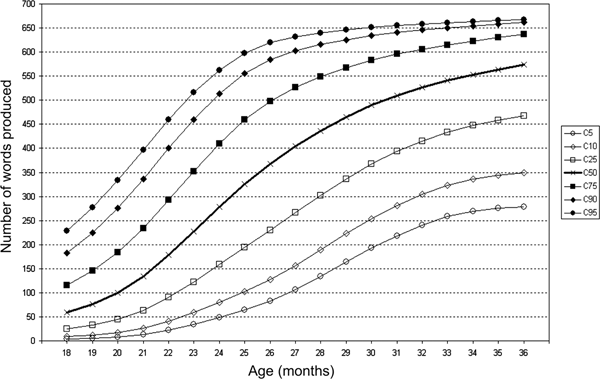
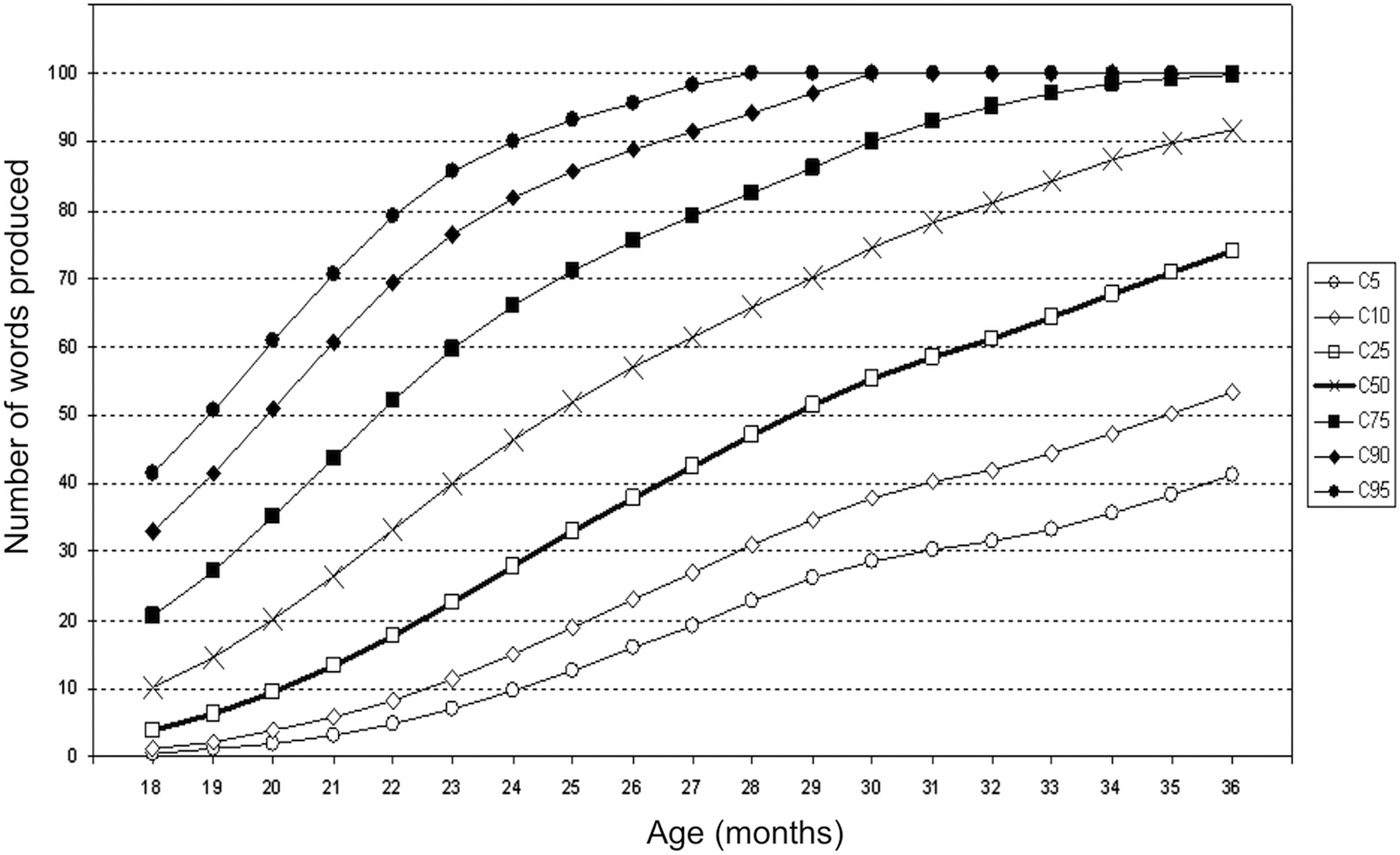
Developmental trends for word production on the Words and Sentences complete and short forms of the Italian MB-CDIs are presented in terms of fitted percentile values (5th, 10th, 25th, 50th (median), 75th, 90th, and 95th) in Figures 1 and 2.
Fitted percentile values (C) of production scores as a function of age (months) for the Italian WS MB-CDI complete form.

Fitted percentile values (C) of production scores as a function of age (months) for the Italian WS MB-CDI short form.

Looking at the developmental trends for the 50th percentile in both forms, there is evidence of a sigmoid pattern with a first positive flex at about 21 months of age and a second negative flex at about 30 months of age, indicating a slower lexical growth rate up to 21 months, followed by a steeper increase up to 30 months. Considering the 50th percentile values, the maximal monthly increase was observed at 23–24 months of age.
After 30 months of age, the developmental pattern showed a deceleration, probably due to the limited number of words on the inventories. Nonetheless, taking into account the 50th percentile values, a ceiling effect was not found in either form; below this percentile, great variability was still evident.
In particular, maximum inter-individual variability was observed at around 26 months for both forms (the range 5th–95th is 83–619 words on the CF and 16–96 words on the SF). Full tables of percentile values for each age group are available in the ‘Supplementary materials’ (available online) to provide all ranges of variability.
Aim 2 – comparison of normative data of WS-CF and WS-SF: grammatical development and its relationship with lexical skills
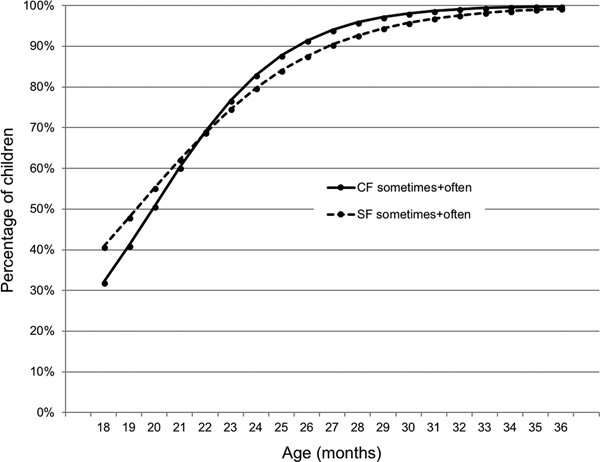
With regard to word combinations and the emergence of grammar skills, each form includes a question asking if the child combines words. Three response options are given: ‘Not Yet’, ‘Sometimes’, or ‘Often’. In Figure 3, monthly trends for affirmative responses (‘Sometimes’ + ‘Often’) are presented for CF and SF. More than 30% of children combined words by 18 months, and this competence became more consistent in the following months: by 24 months, more than 80% of children combined words at least sometimes. Both forms revealed that the age at which at least 50% of children combined words (sometimes or often) was around 20 months. At 30 months, more than 95% of children were able to combine words on both forms and the developmental patterns observed with the two forms were very close.
Percentages of children combining words sometimes or often as a function of age (months) for the Italian WS MB-CDI complete form (CF) and short form (SF).

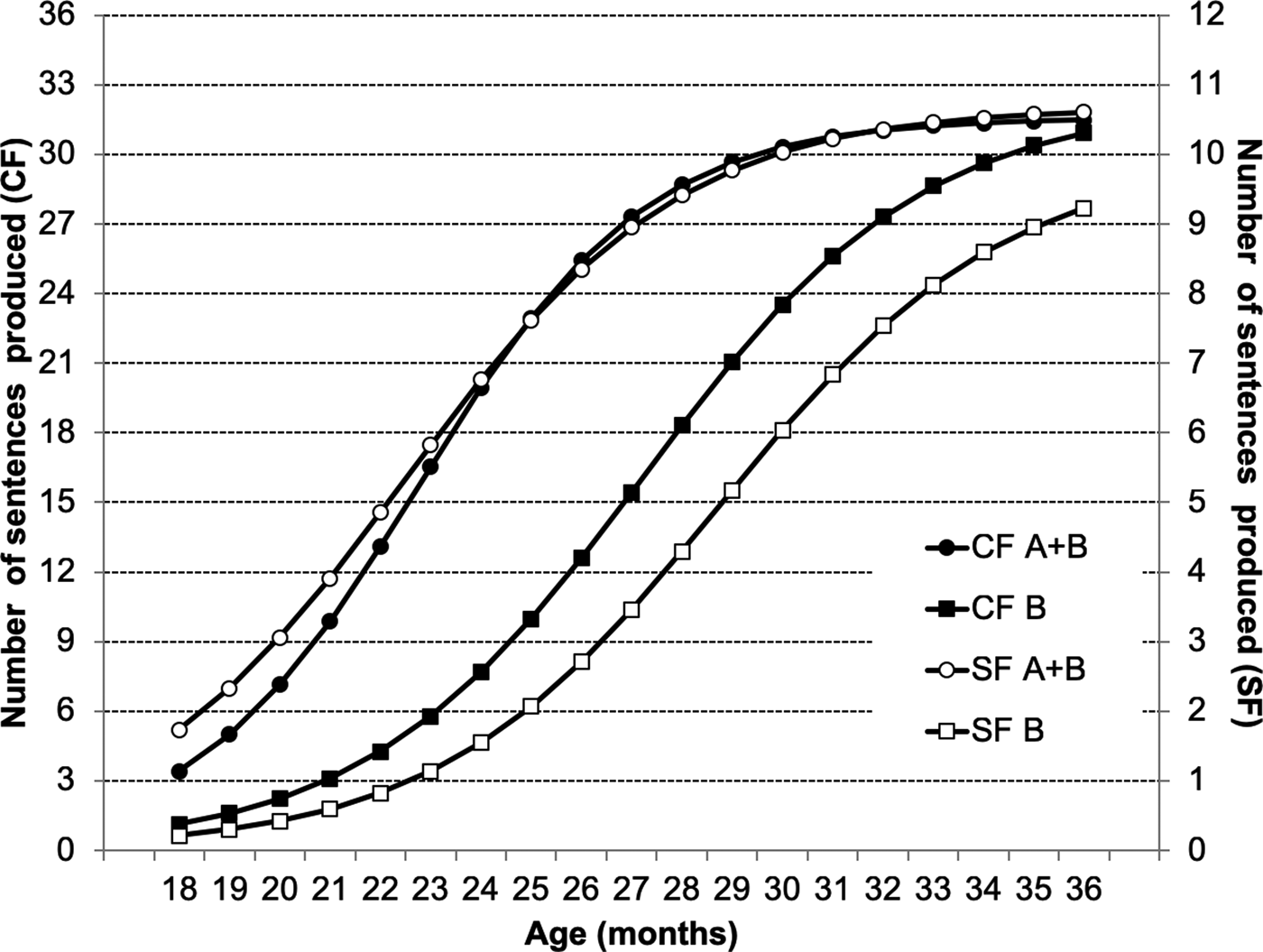
In Figure 4, the total number of sentences (type A + B) produced as well as the number of complex sentences (type B alone) on both forms are plotted by age. Developmental trends for both forms are very close for total number of sentences: at 18 months of age, the mean number of sentences produced by children is about 2 for the short form and about 3 for the complete form. Between 20 and 26 months of age, the ability of children to produce sentences rapidly increases and they are able to produce 66% of the sentences provided in the lists; after this age, the increase is slower. On the other hand, the SF slope for complex sentences produced (type B alone) was less steep, because some type A sentences are still produced by older children and this effect is more evident when the checklist is shorter, as in SF. The ceiling effect is not evident in any of the forms at the end of the observed age range.
Fitted age-related trends of the number of sentences produced by children on each form. The number of sentences included in the list of the complete (CF) and short forms (SF) is reported in the left and right axes, respectively.

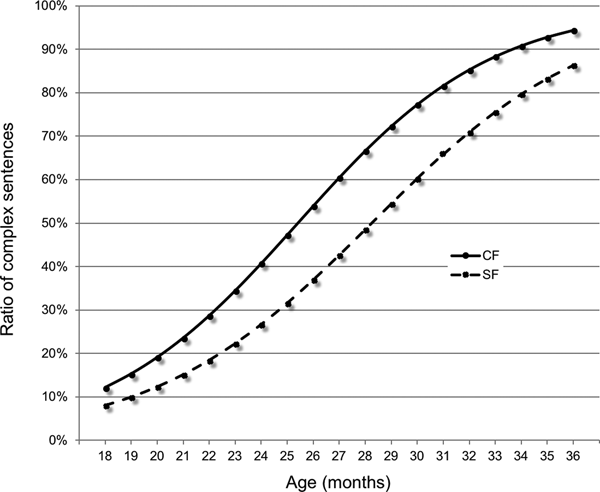
In Figure 5, the ratios of complex sentences [type B/(type A + B)] on both forms as a function of age are shown in order to examine the emergence of grammar complexity, including only children with enough data (number of produced sentences) to measure the extent of this complexity. For this measure, only children who produced at least five sentences on CF and three sentences on SF are included.
Ratio of complex sentences (type B) as a function of age (months) for the Italian MB-CDI complete form (CF) and short form (SF).
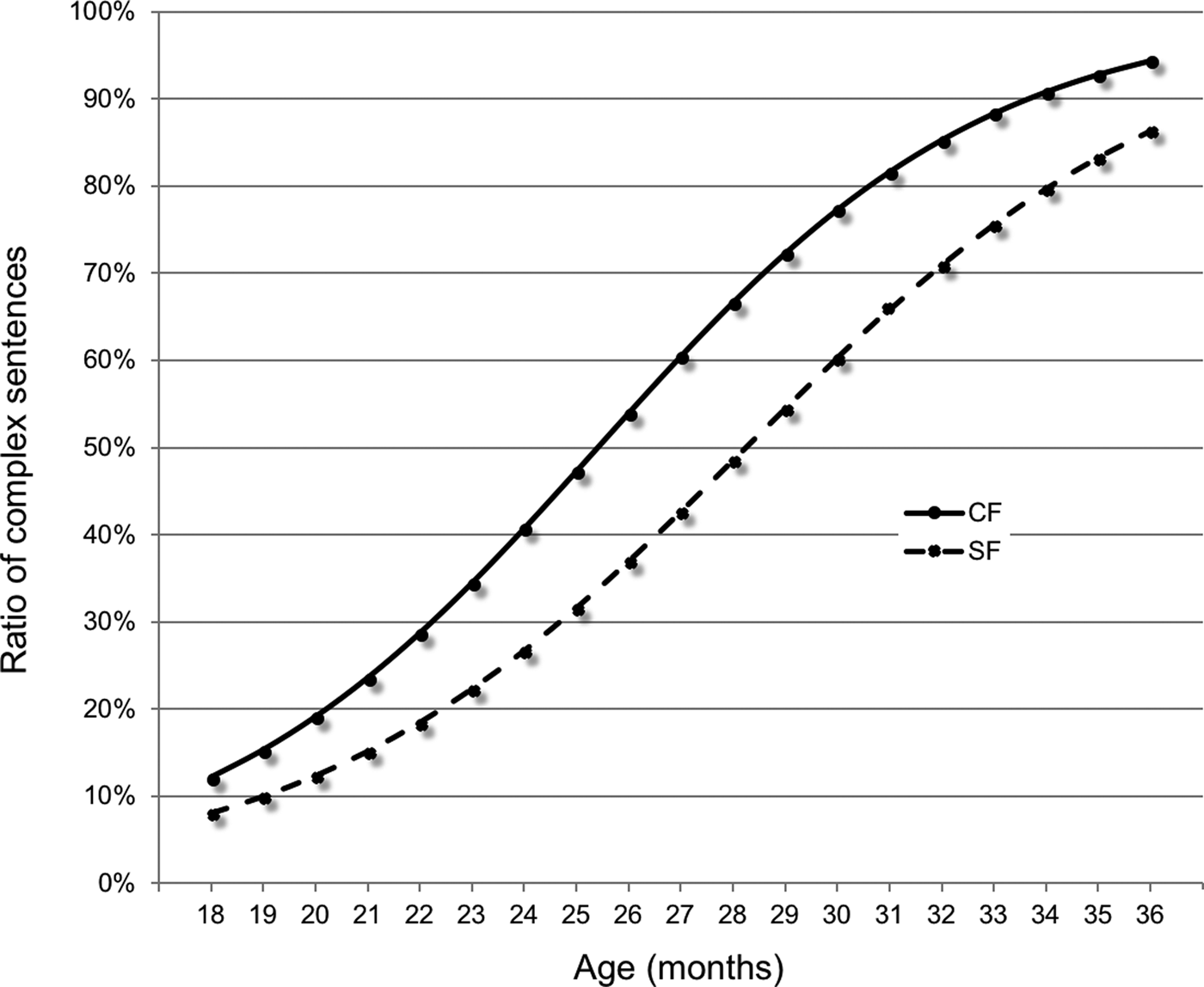
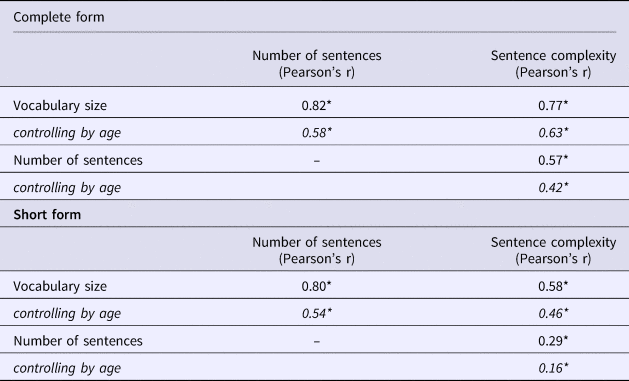
With regard to the ratio of complex sentences, the curves of the two forms are quite similar, ranging from approximately 10% to 90% at 18 and 36 months, respectively, with CF consistently higher than SF. The 50% complexity score was reached by children at about 25 months of age on the WS-CF and at about 28 months of age on the WS-SF. Moderate to high partial correlations were found among vocabulary size, total number of sentences produced, and grammatical complexity score (see Table 1), also controlling for the effect of age. Correlations for the WS-CF were generally stronger than those for the WS-SF.
Partial correlations between vocabulary size, number of sentences produced, and sentence complexity score, measured with the Italian WS MB-CDI complete form and short form

Note. * p < .001 for all values.
Aim 3 – concordance between the WS-CF and the WS-SF
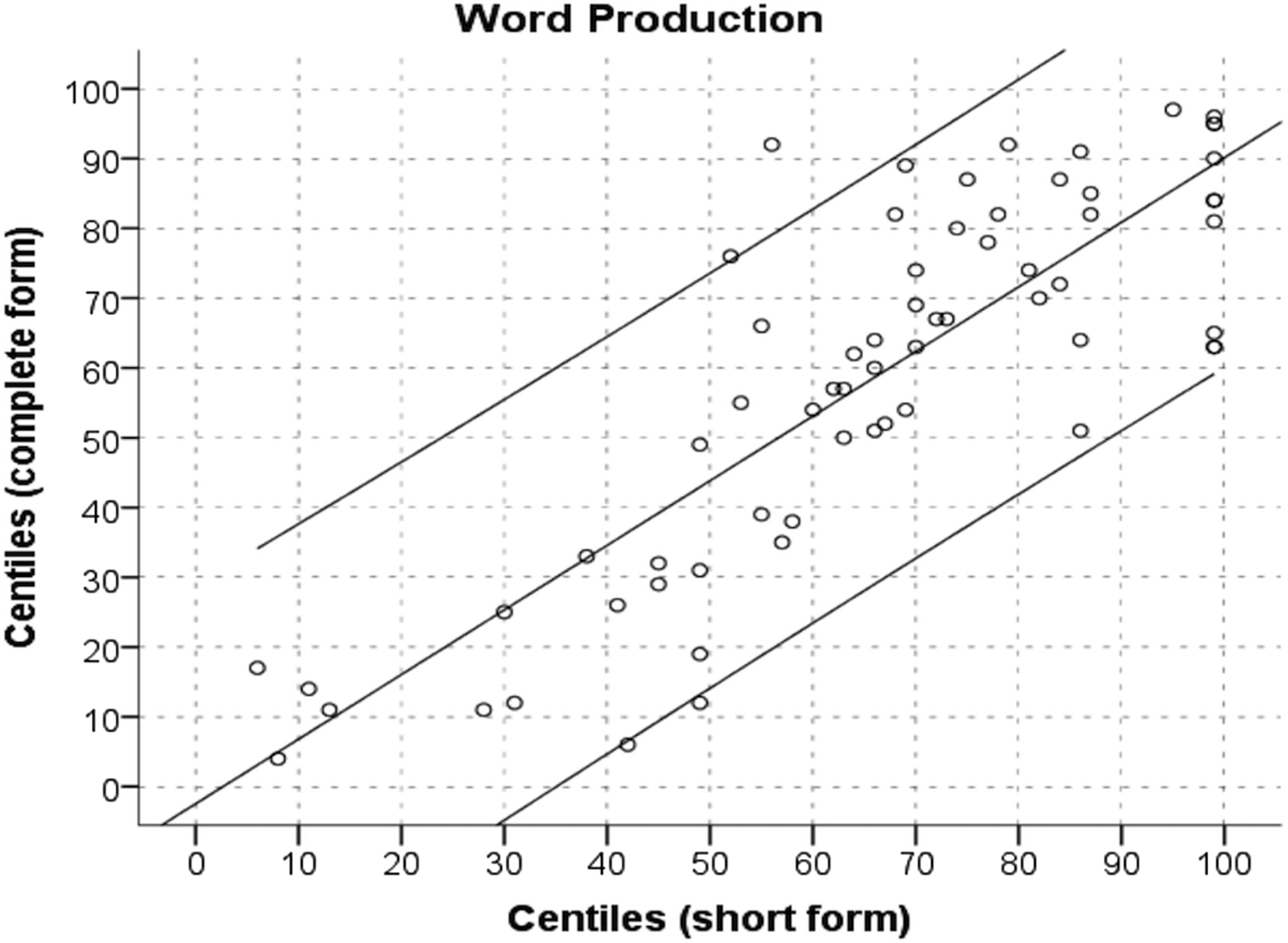
The correlation between vocabulary size estimated with the WS-CF and the WS-SF, examined in the subgroup of 65 children, was very high (Pearson's r = 0.92). This result was also obtained when partialling out age (r = 0.85). When centiles were considered, the stricter Intra-Class-Correlation coefficient was computed to measure the agreement between the two forms. ICC was equal to 0.80, indicating a good concordance (see Figure 6).
Agreement between percentile scores of word production on the complete form and short form of the WS MB-CDI.

The Bland–Altman procedure indicated that there was a significant over-estimation of the WS-SF in terms of vocabulary size, with an average of 7.3 centile points higher than the CF (95% CI: 3.7–11.0; p < .001). It should be noted that this finding was obtained in a subsample with a higher percentage of children older than 30 months with respect to the whole sample.
With respect to the cut-off of the 10th centile, the percentage agreement was 97%. However, since 95% of children were above the 10th centile, the agreement was recalculated by grouping centiles into quartiles. In this case, the total agreement was 63%. In 28% of children, the quartile obtained with WS-SF was one level higher than that obtained with CF, while in 9%, the opposite pattern was observed.
Looking at the production of each of the 100 words of the WS-SF (all included in the WS-CF), the concordance between the two forms was 90% (median) and only in 6 words was the agreement lower than 80% (but higher than 70%). In addition, we tested whether there were context effects due to list length and/or semantic category facilitation by measuring discrepancies between the two forms for each item. According to the McNemar test, no evidence of under- or over-estimation of the SF with respect to CF was found for any item but one: the pronoun lui ‘he’ was ticked significantly more frequently on the SF than the CF (+19%, McNemar p = .002). Furthermore, the discrepancies toward SF or CF, even if non-significant, were exactly balanced (median discrepancy = 0%), indicating that the number of items for which there was an over-estimation with SF was countered by the number of items for which there was an under-estimation with SF.
The concordance between the answer to the item ‘word combinations’ in the two forms (3 × 3 contingency table) was 81.9% (total agreement) and the Kappa agreement coefficient was 0.46 (p < .001). The occurring discrepancies were due to the three-level classification (‘not yet’, ‘sometimes’, ‘often’). Indeed, eight parents reported ‘often’ for SF and ‘sometimes’ for CF, while three parents reported ‘often’ for CF and ‘sometimes’ for SF. If the classification was considered as binary (‘not yet’, ‘sometimes + often’), no case of discrepancy emerged. The correlation between the total number of sentences produced in the two forms was very high (Pearson's r = 0.91), also when partialling out age (r = 0.88). This correlation was even higher when the grammatical complexity score was taken into account (r = 0.96; r = 0.94 when partialling out age).
Considering only the 12 common sentences, ICC was equal to 0.92 for the number of sentences produced and 0.97 for the grammatical complexity score.
Discussion
The first purpose of this study was to compare the normative data of the WS MB-CDI complete and short forms, focusing on the developmental trends of lexical acquisition in children from 18 to 36 months of age.
Statistical analysis revealed close similarity of developmental patterns derived from each form, showing a slower increase in lexical production before 21 months of age and after 30 months of age, and highlighting that the period of maximal monthly increase is around 23–24 months of age. These lexical trends are analogous to those described with other MB-CDI adaptations (among others, Jackson-Maldonado et al., Reference Jackson-Maldonado, Marchman and Fernald2013), and are in accordance with studies that reported two important leaps in toddlers’ vocabulary development: the first one between 16 and 20 months, the second one between 24 and 30 months. In our samples, the greatest inter-individual variability was observed at 26 months for both forms (the range 5th–95th is 83–619 words on CF and 16–96 words on SF). This result is partially different from those of other studies on MB-CDI short forms that found, for children in the higher percentiles, a ceiling effect already starting from 26–27 months of age (Fenson et al., Reference Fenson, Pethick, Renda, Cox, Dale and Reznick2000; Frota et al., Reference Frota, Butler, Correia, Severino, Vicente and Vigário2016; Jackson-Maldonado et al., Reference Jackson-Maldonado, Marchman and Fernald2013).
The wide inter-individual variability at this age supports the extension of our samples to 36 months, in contrast to the traditional normative data collected by the WS MB-CDIs including children up to 30 months of age. Statistical analysis showed that a ceiling effect was not found for either form at the 50th percentile, indicating that the CF and the SF are suitable for assessing lexical development in children up to 36 months, sustaining the utility of the use of the short form also with children identified as at-risk for language development (even if this is associated with intellectual disabilities) when they are older than 36 months if their scores fall in the lower half of the distribution (see Jackson-Maldonado et al., Reference Jackson-Maldonado, Marchman and Fernald2013). However, further investigation is recommended in order to verify this clinical application.
The second aim of the study was to compare the normative data of the WS MB-CDI complete and short forms focusing on the developmental trends of grammatical measures in children from 18 to 36 months and to study their relationship with the lexicon. Similar developmental patterns for early grammar, as assessed through the ability to combine words in sentences, were found in both forms, revealing that at least 50% of children combined words at around 20 months and that almost all children reached this capacity soon after 30 months of age. On both forms, the number of sentences produced showed a rapid increase between 20 and 26 months and a ceiling effect was not found.
Analyzing the grammatical complexity score, a small difference between the two forms emerged: the ability to produce complex sentences appeared to be already present at approximately 25 months of age with the SF, in contrast to 28 months of age with the CF. This discrepancy could be attributable to a ‘list length effect’: parents might have chosen to check complex sentences when the number of items was lower, as in the SF. In other words, it could happen that parents tended to report that their children produced at least a few sentences in the complex form even when the total number of sentences (simple and complex) was low, and this could happen more easily in the short form. Overall, our results confirm that developmental trends in lexical (vocabulary) and grammatical measures (word combinations and sentence production and complexity) resulting from the short forms are very close to those resulting from the original complete forms, as reported in previous studies (Fenson et al., Reference Fenson, Marchman, Thal, Dale, Reznick and Bates2007; Jackson-Maldonado et al., Reference Jackson-Maldonado, Marchman and Fernald2013; Pérez-Pereira & Resches, Reference Pérez-Pereira and Resches2011).
As to the relationship between lexicon and grammatical skills, our results showed a moderate–high correlation, confirming previous studies using the complete forms of the WS MB-CDIs. Those studies indicated a close interdependence between vocabulary and grammar, for both size and composition of vocabulary, while controlling for age (Dale & Goodman, Reference Dale, Goodman, Tomasello and Slobin2005; Devescovi et al., Reference Devescovi, Caselli, Marchione, Pasqualetti, Reilly and Bates2005; Marchman & Bates, Reference Marchman and Bates1994; Marjanovic˘-Umek et al., Reference Marjanovic˘-Umek, Fekonja-Peklaj and Podlesek2013; Stolt et al., Reference Stolt, Savini, Guarini, Caselli, Matomäki, Lapinleimu, Haataja, Lehtonen, Alessandroni, Faldella and Sansavini2017). Other studies demonstrated specific links between early lexical development and productive use of grammatical structures, in term of concurrent and predictive relationship (Bleses et al., Reference Bleses, Vach, Slott, Wehberg, Thomsen, Madsen and Basboll2008; Eriksson, Reference Eriksson2001; Feldman et al., Reference Feldman, Dale, Campbell, Colborn, Jurs-Lasky, Rockette and Paradise2005; Pérez-Pereira & Resches, Reference Pérez-Pereira and Resches2011; Reese & Read, Reference Reese and Read2000; Thal et al., Reference Thal, Jackson-Maldonado and Acosta2000). This strong relationship has been also found in previous studies using the short forms of the WS MB-CDI (Fenson et al., Reference Fenson, Marchman, Thal, Dale, Reznick and Bates2007; Jackson-Maldonado et al., Reference Jackson-Maldonado, Marchman and Fernald2013; Pérez-Pereira & Resches, Reference Pérez-Pereira and Resches2011). The close link between lexical and grammatical development is consistent with the view that “vocabulary development drives grammar (and vice-versa) because these two aspects of language are inextricably linked, represented together and accessed together” (Devescovi et al., Reference Devescovi, Caselli, Marchione, Pasqualetti, Reilly and Bates2005, p. 781). However, Braginsky and colleagues (Reference Braginsky, Yurovsky, Marchman, Frank, Noelle, Dale, Warlaumont, Yoshimi, Matlock, Jennings and Maglio2015) pointed out that aspects of grammar that are more closely related to syntax are modulated by age to a greater extent than those related to morphology. Moreover, their results showed that the trajectories of predicates and function words are modulated by age more than nouns. More studies are needed to confirm these findings on children speaking other languages, including Italian, in order to better understand the mechanisms driving children's early lexical development and the transition from single words to early grammar.
The third aim of the study was to analyze, in a subgroup of 65 children, the concordance between SF and CF, filled in by parents within one week. Statistical analyses showed a good concordance between CF and SF, both for total vocabulary sizes and for the 100 common words across the two forms. Results revealed a high percentage agreement (97%) between the percentiles of the two forms for the cut-off ‘below 10th percentile’, while this agreement was lower (63%) if percentiles were grouped in quartiles. The high agreement between the two forms in identifying children below the 10th percentile is a highly significant result since, at present, the MB-CDI is the most robust tool for identifying expressive vocabulary delays in children under three years of age.
Furthermore, in the comparison between the two forms it must be considered that, in the complete form, the words are arranged by semantic categories, whereas in the short form there is no grouping of words. Since semantic grouping might affect parents’ responses, we measured discrepancies between the two forms for each of the 100 common items. The discrepancy was significant only for one word: the pronoun lui ‘he’, that was ticked significantly more frequently on the SF than the CF. Probably this discrepancy could be explained by the different number of personal pronouns listed in the short form (only one) with respect to the complete form (seven pronouns). It could happen that in filling in the short form, parents whose child produced some pronouns but not the listed one, were more willing to tick it anyway, whilst when filling in the complete form they had the possibility to properly check the pronouns actually produced. In contrast with Vach et al. (Reference Vach, Bleses and Jørgensen2010), we did not find any other word marked more or less times on one form with respect to the other.
Also for the emergence of grammar skills, a perfect concordance between the answers to the item ‘word combinations’ in the two forms was found. Very strong correlations between CF and SF also emerged in the total number of sentences produced, in the scores obtained for the 12 common sentences and in the grammatical complexity score. It is important to note that this subgroup of children was not randomly selected from the entire sample and the concordance between the two forms might be affected by the higher percentage of older children with respect to the whole sample.
The good correlation between the two forms suggests that they could be considered as interchangeable for many purposes. However, some advantages and disadvantages in the use of the one form or the other should be considered. Pan, Rowe, Spier, and Tamis-LeMonda (Reference Pan, Rowe, Spier and Tamis-LeMonda2004), for example, showed that in clinical, research, and educational settings, short forms are more appropriate than the complete original ones with families from less educated backgrounds.
Moreover, as reported in the ‘Introduction’, most studies demonstrated that short forms of the MB-CDI questionnaires are among the most robust screening instruments. In fact, they are cost-saving, time-saving, reliable, and valid, displaying internal consistency and acceptable levels of sensitivity and specificity (Wallace et al., Reference Wallace, Berkman, Watson, Coyne-Beasley, Wood, Cullen and Lohr2015). In accordance with these studies, our experience in using the Italian MB-CDIs confirms that the SF is particularly appropriate for screening programs (Bello et al., Reference Bello, Onofrio, Remi and Caselli2018). A recent study also showed that the WS-SF of the Italian MB-CDI accurately identified Italian late-talking children within a screening program, and demonstrated that word production measured at 29 months was strongly predictive of word production at 34 months as measured using the WS-CF (Bello et al., Reference Bello, Onofrio, Remi and Caselli2018). The results of this study corroborate the employment of the Italian WS MB-CDIs after 30 months of age to serve lexical and grammatical evaluation in multiple clinical settings. The use of parent reports with children after three years of age is a question also explored by other research groups who worked on the development of CDI III (Eriksson, Reference Eriksson2017; Feldman et al., Reference Feldman, Dale, Campbell, Colborn, Jurs-Lasky, Rockette and Paradise2005; Fenson et al., Reference Fenson, Marchman, Thal, Dale, Reznick and Bates2007) for the evaluation of expressive vocabulary and early grammar at this age. In relation to the Danish version of WS MB-CDI SF, Vach and colleagues (Reference Vach, Bleses and Jørgensen2010) have already demonstrated its validity in identifying 36-month-old children with language delay.
At present, in Italy, the few experiences of screening programs for language delays have been realized for short periods, in different regions, and without a continuous and consistent arrangement between clinicians and researchers. Children who arrive for a first clinical evaluation are often three-year-olds or even older; many of them at this age are still shy or afraid of unfamiliar adults and therefore not well suited for a formal assessment of lexical and grammatical skills. In these cases, the short forms could represent an initial opportunity to collect information on their communicative and linguistic level. In other cases, when late-talkers are already evaluated at 24–30 months of age, the use of WS MB-CDI up to 36 months would be useful to monitor, with the same instrument, their spontaneous development or possible effects of a direct or indirect treatment. Finally, besides screening purposes, the short forms may have other clinical applications, integrating other linguistic and non-linguistic measures collected during quick controls, as in follow-up or day hospitals. In research projects, short forms may be useful for selecting or matching children's samples on the base of their language levels and are also suitable for longitudinal studies (e.g., Sansavini et al., Reference Sansavini, Bello, Guarini, Savini, Stefanini and Caselli2010, Reference Sansavini, Guarini, Savini, Broccoli, Justice, Alessandroni and Faldella2011).
Nevertheless, the short form has some limitations. The small set of words and sentences does not allow clinicians to deeply investigate specific aspects related to lexical and grammatical abilities. For this reason, we consider the CF more appropriate for research on language acquisition in typical and atypical populations. With respect to the short form, the complete form is also more appropriate in clinical settings because it is more informative from a quantitative and qualitative perspective. Using the complete form, clinicians may analyze vocabulary composition (i.e., the percentage of nominals, predicates, function words) and developmental change in lexical repertoires as a function of age, vocabulary size, and/or intervention. Moreover, the CF is more helpful in identifying specific targets for intervention in children with delayed language development. Finally, the use of the complete form in the clinical assessment of children with a reduced lexical repertoire may be encouraging for parents, who may recognize more words out of a list of 670 items relative to a list of 100 items. These suggestions derive from informal exchanges between researchers and clinicians; however, empirical studies are necessary to provide evidence on these issues.
Conclusion
This paper has presented new results on the validity of the Italian WS forms of the MacArthur-Bates CDIs. In light of these results, it is possible to conclude that the short form shows good concordance with the complete form, while providing adequate, representative assessment of lexical and grammatical abilities of children up to 36 months of age. In general, these results agree with those reported for English and other languages, and they offer new evidence for the relationship between early lexical abilities and emergent grammar. Furthermore, this study shows a high concordance between the two forms in assessing lexicon and early grammar. Future research needs to examine how the forms function in identifying clinical populations, as well as the long-term predictive validity of the CF and SF measures.
Supplementary Materials
For supplementary materials please visit <https://doi.org/10.1017/S0305000919000011>.
Author ORCIDs
Pasquale Rinaldi, 0000-0002-6544-7941
Acknowledgments
We are very grateful to Daniela Gatt and Luigi Girolametto for their precious, careful comments and valuable suggestions on the manuscript. We especially thank the children and parents who participated in the study. The research leading to these results has received funding from the Italian Ministry of Health, Cod. RF-2010-2314903 ‘Screening of children at-risk for language and communication disorders’.