INTRODUCTION
Extensive research has been conducted on disease and prognosis disclosure and on decision making for terminally ill patients (Holland et al., 1987). In Japan, a great deal of research has focused on cancer, but most of these studies were done on a small scale or in one institution. In Japan, only a few nationwide surveys have been aimed at the general population; these include the Ministry of Health and Welfare (MHW) Review meeting on attitudes of the nation toward terminal care in 1993 (Ministry of Health and Welfare, 1994), the 1992 and 1994 census of socioeconomics (Ministry of Health and Welfare, 1993, 1995), and the national random sampling survey conducted by Matsumura (Matsumura et al., 1997). However, as for medical practitioners, nationwide studies have been very few, although there have been some surveys in specific institutions (Ohara et al., 1982; Irie et al., 1995).
In 1997, a review meeting on attitudes toward terminal care was organized by the MHW, and a nationwide survey was conducted by randomly sampling the general population and medical practitioners. This was an expansion of the 1993 survey. A summary of this survey was already reported (Miyashita et al., 1999). This report is based on that survey.
Considering disclosure and decision making for terminal care, the meaning and significance of family differs according to country and culture (Holland et al., 1987; Benowitz, 1999). Previous investigations showed family to be a significant component of disclosure and decision making in terminal care in Japan (Long & Long, 1982; Mizushima et al., 1990; Hattori et al., 1991; Matsumura et al., 1997; Fetters, 1998; Long, 1999; Ruhnke et al., 2000). In Japan, not all patients desire disclosure in the terminal stage (Matsumura et al., 1997) and familial participation in the decision-making process is relatively common (Voltz et al., 1997; Konishi & Davis, 2001). In addition, some patients believe that physicians should abide by their family's request regarding the disclosure of their diagnosis (Asai et al., 1998). However, mostly small-scale and infrequent research has explored associated factors.
Herein, based on the above-mentioned national survey, we first investigated the Japanese general population's attitudes toward disease and prognosis disclosure and related factors. Second, we investigated Japanese medical practitioners' attitudes toward disease and prognosis disclosure for patients and decision making. This is the first study to simultaneously investigate attitudes and related factors among both the general population and medical practitioners nationwide in Japan.
METHODS
Participants
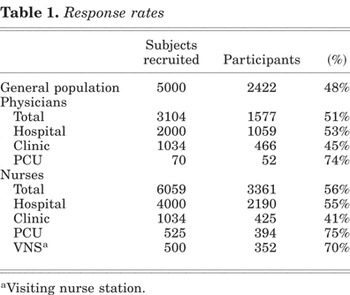
Table 1 shows the subjects recruited, participants, and response rates. Fifty thousand individuals over age 20, in the general population, were randomly sampled from the whole country by the two-stage stratified sampling method. Namely, in the first stage, 200 census districts were chosen in proportion to national regional block and scale of cities. In the second stage, we systematically selected 25 subjects from each census district by reading basic resident registers with permission from the mayors of these cities and so forth.
Response rates

As for medical practitioners, we surveyed 3104 physicians and 6059 nurses working in hospitals, clinics, palliative care units, or at visiting nurse stations. As for hospitals, 1,000 hospitals were chosen randomly from the whole country, and in each facility, two physicians and four nurses were selected. As for clinics, a total of 1034 clinics (22 in each of the 47 prefectures in Japan) were chosen, and one physician and one nurse were selected. Regarding palliative care units, two physicians and 15 nurses in 35 units (all units as of December 1997, in Japan) were selected, and as for visiting nurse stations, 500 stations were randomly chosen from the whole country and one nurse was selected by each station. We left subject selection to each facility.
Procedure
A self-administered postal questionnaire survey was conducted. Initially, the questionnaire was mailed to the subjects (each facility for the medical practitioners) with a posting deadline of 2 weeks after January 1998, and the reminder was sent to the total number 1 week after the deadline. To raise the response rate, by choosing 20% of nonresponder subjects, a reinvestigation was carried out by a similar method. This report is based on total responders from both.
Questionnaire
The following questions were asked of the general population: (1) How do you desire to be notified about disease and prognosis when you have an incurable disease and (2) what methods of notification about disease and prognosisdo you prefer? The questions for medical practitioners were as follows: (3) Who do you primarily notify of disease and prognosis when a patient in your case has an incurable disease, and (4) whose opinion do you primarily ask for in decision making regarding the treatment strategy? For physicians, questions were phrased, “do you?” and for nurses, “do you think you should?” Attention should be given to this point, particularly with regard to the use of the word “primarily” in questions 3 and 4. As to background factors for the general population, we also asked about sex, age, education, occupation, experience of the subject's and family's hospitalization, and experience of familial bereavement in the past 5 years. For physicians and nurses, we inquired about sex, age, experience of the subject's and family's hospitalization, medical experience caring for terminal patients with pain, and medical experience with patients in a vegetative state.
Statistical Analysis
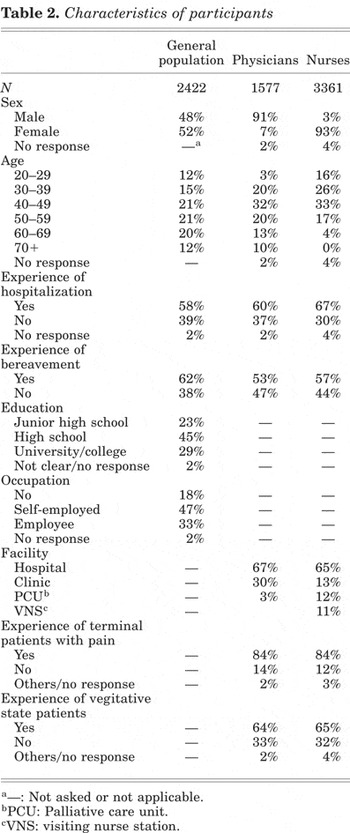
As to each question, first, descriptive tables are shown. Second, for each question, to explore related factors, multinomial or binomial logistic regression analysis was conducted with background factors as explanatory variables. We conducted analyses as follows: question 1 for the general population: “don't want to know” and “don't understand” were compared with “want to know”; question 2 for the general population: “want to receive” was compared with “through family”; question 3 for medical practitioners: “patient himself” and “family” were compared with “depends on patient's condition”; question 4 for medical practitioners: similarly, “patient himself” and “family” were compared with “depends on patient's condition” (reference category). Explanatory variables were the background factors shown in Table 2. The variables are categorized considering distribution and modeled by dummy variables. Age was categorized by 10-year periods (20 years for medical practitioners), and the reference category was the 20s. Experience of hospitalization answered “yes” meant family or patient himself had experienced hospitalization in the past 5 years, and experience of bereavement answered “yes” meant that a family member had died in the past 5 years. Two medical experiences of medical practitioners were included in the same model, respectively. The significance level was .05 for statistical tests. The odds ratio and confidence interval were calculated using statistical package SAS version 9.12.
Characteristics of participants

RESULTS
Response rates, summed for the first and second collection, were 48% (general population), 51% (physicians), and 56% (nurses) (see Table 1). The PCU physicians, PCU nurses, and visiting nurse stations had relatively high rates.
The characteristics of the participants are shown in Table 2. The proportion of men was 48% (general population), 91% (physicians), and 3% (nurses). The ages of the general population were 20–29 (12%), 30–39 (15%), 70 and above (12%), and for other generations about 20%. For physicians, 20–29 and over 60 were fewer than for the general population, whereas there were more 30–39- and 40–49-year-olds. For nurses, fewer were over 60 than in the general population, and more were 30–39 and 40–49 years old. The experience of caring for terminal patients with pain was reported by 84% (physicians) and 84% (nurses), and that of caring for those in a vegetative state by 65% (physicians) and 65% (nurses).
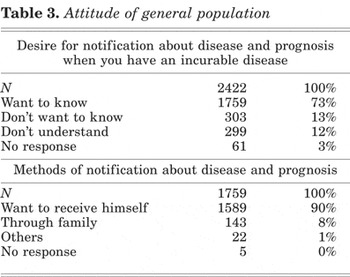
Desire for Notification about Disease and Prognosis When You Have an Incurable Disease (General Population, Tables 3 and 4)
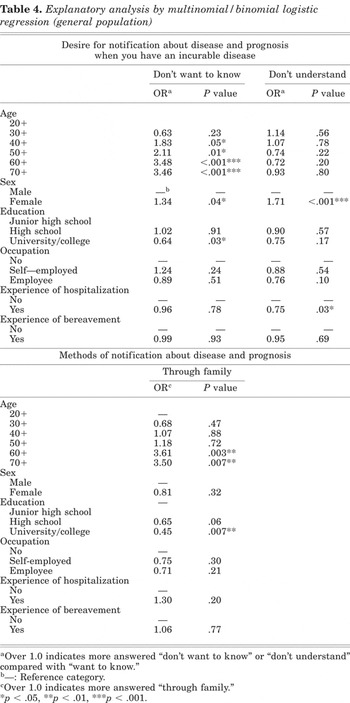
Seventy-three percent of the general population answered that they “want to know” and 13% answered that they “don't want to know.” Three-fourths of the Japanese general population definitely desired disclosure of disease and prognosis. The explanatory analysis shows that the respondents who answered “don't want to know” increased significantly with age (40s: OR = 1.83, p = .05; 50s: OR = 2.11, p = .01; 60s: OR = 3.48, p < .001; over 70: OR = 3.46; p < .001). As for sex, women answered “want to know” (OR = 1.34, p = .03), and as for education, university/college graduates often did not answer “don't want to know” (OR = 1.55, p = .03). In addition, females answered “don't understand” (OR = 1.71, p < .001) and people who experienced hospitalization did not answer “don't understand” (OR = 0.75, p = .03).
Attitude of general population

Explanatory analysis by multinomial/binomial logistic regression (general population)

Methods of Notification about Disease and Prognosis (General Population, Tables 3 and 4)
Among the respondents who answered “want to know” to the previous question, 90% desired direct disclosure “want to receive himself,” and 8% of them desired disclosure through their families. The explanatory analysis shows that “through the family” increased significantly with age (60s: OR = 3.61, p = .003; 70 and over: OR = 3.50, p = .007). Furthermore, as for education, university/college graduates significantly did not favor direct disclosure (OR = 0.45, p = .007).
Who Do You Primarily Notify about Disease and Prognosis When a Patient in Your Care Has an Incurable Disease? (Medical Practitioners, Tables 5 and 6)
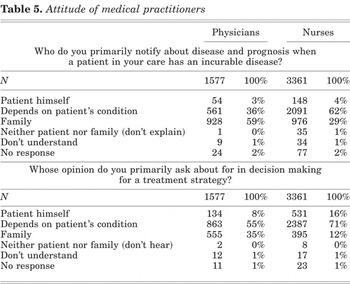
Few responded “patient himself” (physicians 3%, nurses 4%). On the other hand, for physicians, “family” was the most frequent response (36%), whereas for nurses, “depends on patient's condition” was the most common answer (62%).
Attitude of medical practitioners

Explanatory analysis by multinomial logistic regression (medical practitioners)

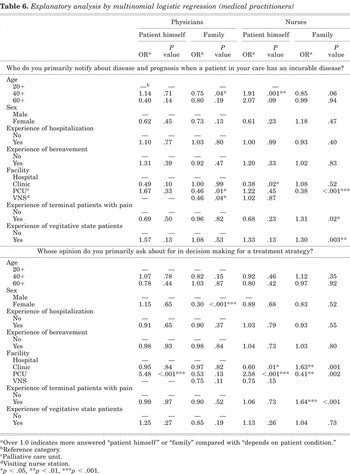
The explanatory analysis for physicians shows that for age, those 40–59 years most frequently did not answer “family” (OR = 0.75, p = .04). Among facilities, PCU physicians did not answer “family” (OR = 0.46, p = .01). As for nurses, those 40–59 years old answered “patient himself” (OR = 1.91, p = .001), among facilities, clinics and VNS did not answer “patient himself” (OR = 0.38, p = .02; OR = 0.46, p = .04, respectively), and PCU did not answer “family” (OR = 0.38, p < .001). In addition, “the experience of caring for a terminal patient with pain” and “the experience of vegetative patient” were answered “family” (OR = 1.31, p = .02; OR = 1.30, p = .003, respectively).
Whose Opinion Do You Primarily Ask for in Decision Making for a Treatment Strategy? (Medical Practitioners, Tables 5 and 6)
The answer “patient” was given by 9% of physicians and 16% of nurses, and was thus somewhat higher than for the previous question. The most frequent answer for both physicians and nurses was “depends on patient's condition” (55% and 71%, respectively).
The explanatory analysis for physicians shows that females did not answer “family” (OR = 0.30, p < .001), and among facilities, PCU physicians answered “patient himself” (OR = 5.48, p < .001). As for nurses, among facilities, clinics did not answer “patient himself” (OR = 0.60, p = .01) or “family” (OR = 1.63, p = .001). In contrast, PCU answered “patient himself” (OR = 2.58, p < .001) and did not answer “family” (OR = 0.41, p = .002). In addition, “the experience of caring for a terminal patient with pain” answered “family” (OR = 1.64, p = .001).
DISCUSSION
Survey Design and Participants
In this survey, because we adopted a random sampling procedure, our results seem to reflect public opinion well. We surveyed all PCU institutions because there were 35 such institutions (600 beds) in Japan at the time of the survey. In 1990, the MHW institutionalized palliative care by the approval of a PCU for cancer and AIDS patients in Japan. However, general hospitals mainly carry the burden of terminal care, and most patients die in hospitals.
As to the characteristics of participants, the sex and age distributions of the general population were almost identical to those of the census except that there were somewhat fewer 20–29-year-olds. As this study was a nationwide random sampling survey, this agreement with the census would show that nonresponder bias was relatively small due to demographics. Among physicians, compared to a survey of physicians, dentists, and pharmacists (Ministry of Health and Welfare, 1998), 20–39-year-olds comprised a relatively low proportion, whereas there were more 40–59-year-olds. Each institution was allowed to select participants, such that older physicians were surveyed.
In Japan, most studies on disease and prognosis disclosure have focused on cancer. Although our survey was not restricted to cancer, questions in our study were implicitly aimed at cancer (with pain) and the vegetative state (Benowitz, 1999), because the impression of cancer is to some extent that of an incurable disease for the general population, as compared to other major diseases. The following discussion is based on previous studies focusing on cancer.
Desire to Be Notified about Disease and Prognosis (General Population)
Most participants answered “want to know,” but some participants did not desire notification or were uncertain. This result is almost identical to that of previous studies (Long, 1999; Charlton et al., 1995; Matsumura et al., 1997). The answer “don't know” was more common in the elderly and was related to sex and education. This tendency is identical to that seen in Matsumura's study (Matsumura et al., 1997). They explored the relation between autonomy and hope for disclosure, referring to Ende et al. (1989) in the United States, and reported a desire for information as regards autonomy to be strongly associated. In Japan, there is a traditional characteristic of dependency referred to as “Omakase-model” (Voltz et al., 1997). Our results apparently reflect this characteristic. Because three variables, sex, age, and education, are supposed to be associated, we conducted a multivariate analysis, but this mathematical model does not necessarily assure complete adjustment, and the effects of confounding might exist.
Methods of Notification about Disease and Prognosis (General Population)
As to the methods of notification about disease and prognosis, 90% of participants answered “receive himself.” However, it is necessary to consider this question only in those who answered “want to know” to the previous question. That is to say, 63% of respondents wanted to know their disease and prognosis directly. Even considering the individuals who answered “don't understand,” it is clear that not everyone hopes for direct disclosure.
From the explanatory analysis, age and education are significant. The elderly or less self-confident person desires “from the family.” Tanida (1994) cited paternalism and not understanding disturbing factors regarding cancer disclosure in Japan as possible reasons that the general population experiences difficulty, as well as insufficient explanations from physicians.
Method of Notification about Disease and Prognosis (Medical Practitioners)
The answer “patient himself” was relatively uncommon. We must be cautious in asking this question of someone for the first time. The result does not show that physicians and nurses do not consider it necessary to explain things to the patient himself. Thirty-seven percent of physicians and 62% of nurses answered “depends on patient condition.” This would have revealed that many physicians have difficulty breaking bad news to patients and families. Considering the result of the previous question, which indicated that not all persons desire direct disclosure, the response from medical practitioners partly reflects the present state of our country. In addition, the patient's physical and psychological status, the family's strong request, and the patient's unrealistic hope due to insufficiency of physician's former explanation might be associated. However, recently, views toward disclosure have changed markedly. Several decades ago, not notifying patients was taken for granted (Long & Long, 1982). In a portion of cancer centers, disease disclosure would be carried out routinely, under various conditions with enhancements of the patient's conscious rights, influenced by the cultures of Western countries and so forth. Advocating disclosure for the patient primarily would still be difficult in the whole country. Our result suggests that the selection “depends on patient condition” would appear to be the most adequate method at the time. However, the desire for direct disclosure was not uncommon, and the answer “(always) family” was not a justification. Considering that physicians may underestimate patient desire for disclosure (Kai et al., 1993), consequently, Japanese physicians need to carefully communicate with patients individually to assess whether direct disclosure or primarily through the family is preferred (Matsumura et al., 1997). Nurses' answers may reflect that nurses are usually intermediaries between physicians and patients (Konishi & Davis, 1999).
From an explanatory analysis for the factor, for physicians in their 40s and 50s, PCU was significant. The younger physicians (20s and 30s) more often answered “family.” This result may reflect the physicians' immature communication techniques or the occupational hierarchy. For nurses, results might reflect actual medical condition.
Treatment Strategy Decision Making (Medical Practitioners)
In treatment strategy decision making, as compared to the previous question, the answer “patient himself” was more frequent and “depends on patient condition” was the most common response among physicians. For this question, we must also consider the “primarily” aspect of the previous question. In comparison to disclosure, these decisions are likely to be closer to patients. Although it may seem incongruous, this indicates that disclosure may strongly represent barriers in Japan.
From the explanatory analysis, female physicians did not answer “family.” The reason for this was not clear. In both physicians and nurses, the results might reflect the characteristics of facilities and their medical experience.
Limitations
There are several limitations in this study. First, questions are somewhat ambiguous. For all questions, intended disease and situation is not specified. Second, as to medical practitioners' answer, “depends on the patient's condition” is also vague. Third, because we left subject selection to each facility, the medical practitioners sample might not be a representative one. However, because in addition to the random sampling of hospitals, relatively experienced medical practitioners responded, so answers would almost reflect the Japanese usual medical situation.
Implications for Education and Future Research
Physicians should carefully assess the patient's and family's desire more consciously and should not make a stereotyped decision. In clinical settings, nurses and other health care professionals should play a role as advocates for patients and families in some cases.
This study revealed that most physicians have difficulty in breaking bad news to patients. The pre- and posteducational efforts that enhance communication between physicians and patients/families are needed. Appropriate methods of disclosure and decision making would depend on each situation. Research into specific diseases and more precise situations would support physicians' decision-making process.
ACKNOWLEDGMENTS
In conducting this survey, the review meeting on attitudes toward terminal care (chairman: Suemasu K, Saiseikai Central Hospital) and related working group contributed to planning and execution. We are grateful to members of this meeting and the working group. We also express our thanks to Professor Keiko Kazuma. This survey was supported by a grant from the Ministry of Health and Welfare, 1997, entitled “Research on attitudes toward terminal care.”