INTRODUCTION
In order to improve the efficiency of animal production at pasture, the dominant mode of feeding (Reynolds et al. Reference Reynolds, Batello, Baas, Mack and McGilloway2005; Kemp & Michalk Reference Kemp and Michalk2007) is a prime concern. It is important to consider the quantity and the quality of herbage actually consumed in situ in order to better manage and improve the suitability for production of the pasture on offer. The difficulty of estimating the diet in natural conditions is indeed an important limitation to efficient management of pasture and grazing of animals (Shepherd & Walsh Reference Shepherd and Walsh2007). Although much time has been devoted to developing methods to assess the diet at pasture, these often lack both precision and accuracy (Coleman Reference Coleman2006). Thus, general laws of animal feeding at pasture are often based on the extrapolation of assays carried out in stalls. It is accepted that a diet at pasture that is very digestible and rich in nitrogen allows good livestock production. However, due to the possible selective behaviour of the animals, the difference between the quality of herbage available and the actual diet quality of the grazing animals may be important. Thus, the nutritional value of grass consumed at pasture may vary from that in stalls (Van Soest Reference Van Soest1996; Zervas et al. Reference Zervas, Hadjigeorgiou, Zabeli, Koutsotolis and Tziala1999; Zemmelink & ′t. Mannetje Reference Zemmelink and ′t. Mannetje2002; Waghorn & Clark Reference Waghorn and Clark2004).
In the tropics, sheep are raised mainly at pasture for meat production. The development of an intensive fertilized and irrigated grazing system has led to an increase in animal production (Mahieu et al. Reference Mahieu, Archimède, Fleury, Mandonnet and Alexandre2008). However, such systems induce grass wastage, with many ungrazed patches (Corsi et al. Reference Corsi, Martha, Do Nascimento, Balsalobre, Gomide, Soares and da Silva2001; Hughes et al. Reference Hughes, Matthews, Matthew, Gomide, Soares and da Silva2001). In order to manage the ewes and pasture more efficiently and to increase livestock production, direct indicators of the nutrition of the animals are a prerequisite. Analysis of faeces by near-infrared reflectance spectroscopy (NIRS) is a good alternative for estimating the diet quality of grazing animals. For animals fed in stalls with fresh grass, the spectral properties of faecal samples have been used successfully to calibrate and cross-validate equations predicting digestibility or the chemical contents of the diet (Kitessa et al. Reference Kitessa, Flinn and Irish1999; Stuth et al. Reference Stuth, Jama and Tolleson2003; Landau et al. Reference Landau, Glasser and Dvash2006).
Thus, a study with five groups of 12 grazing Martinik ewes was carried out for five successive lactation cycles (LCs), to estimate their diet quality using faecal NIRS calibration (2007). Simultaneously, the characteristics of the pasture grazed by the ewes and their milk production (MP) were measured. The relationships between diet quality, pasture characteristics and MP were analysed to better understand the link between them, in order to manage grazing ewes more efficiently.
MATERIALS AND METHODS
The study was carried out at the experimental station of the National Agronomic Research Institute (INRA) in the French West Indies, Guadeloupe (16°16′N, 61°30′W). The experimental station is located in the driest area where annual rainfall averages 1280 mm, with a dry season lasting from January to May with less than 70 mm per month. Maximum air temperature varies from 27°C (January) to 32°C (August) with the minimum from 21 to 25°C, respectively. Relative humidity is usually above 70% and day length ranges from 11to 13 h.
Experimental design
During five successive LCs lasting 3 months each, five different groups of 12 lactating ewes were fed at pasture. The LCs occurred during two dry seasons (February–May 2000 and 2001), two intermediate seasons (June–September 2000 and 2001) and one wet season (October–January 2001). The pasture, based on Digitaria decumbens (majority grass that with other grasses represents more than 0·90 of the species present), was managed rotationally using a 28-day re-growth period (RP). Thus, each LC consisted of three RPs for a given group of 12 ewes.
The diet quality and MP of each ewe were measured at the end of each RP, i.e. three times per LC. Similarly, the herbage grazed was characterized every 28 days in terms of biomass, chemical composition and morphological composition. All measurements were carried out on the same paddock.
Pasture and animal management
The pasture based on Digitaria decumbens was divided into two plots, each grazed by six ewes. Each plot was further divided into five paddocks (measuring 550 m2). Each paddock was grazed for 7 days on 28 day periods (7 days grazing and 21 days resting), three times per LC. At the beginning of the experiment, the paddocks were fertilized with nitrogen at 150 kg/ha/year and were irrigated weekly, in accordance with the rainfall and evapotranspiration estimated from data collected by an adjacent automatic meteorological station (CIMEL).
The average live weight of ewes over the period of lactation was 47(±4·8) kg and they experienced three parturitions within 2 years in the mating system, not being subjected to a seasonal effect as in temperate areas. Thus, after 5 months of gestation followed by 3 months of lactation, ewes can be re-bred. The ewes were all multiparous with two lambs, weighing an average of 3(±0·2) kg at birth. The first lactation measurement occurred 8–15 days after lambing. Weaning was on average at 81·4 days (at 19±0·9 kg). Regular intramuscular injection of moxydectin (cydectine(R) 1% injectable solution) was carried out, in order to avoid any nematode infestation, twice per month for the lambs and monthly for the ewes. Control of external parasites consisted of spraying the lambs and ewes with flumethrine, an acaricide. Ewes were weighed weekly.
Pasture measurements
Biomass, dry matter (DM) content and chemical composition were determined on one of the five paddocks for each plot and at each RP before the re-introduction of the animals. Herbage mass was measured by cutting five 0·09 m2 quadrats per paddock to ground level with hand-held electric clippers. The samples were weighed fresh and then two sub-samples of 300 g were taken. The first sub-sample was used to determine DM content and chemical composition. The DM was determined by drying the samples at 60°C for 48 h, in a forced-draught oven. Dried samples were ground through a 0·75 mm sieve screen prior to chemical analysis. The organic matter (OM) content was measured after a 10 h pyrolysis at 550°C. The acid detergent fibre and lignin contents of the herbage (ADFh and ADLh) were estimated by the method of Van Soest et al. (Reference Van Soest, Robertson and Lewis1991) . The nitrogen concentration was determined by the Dumas method (AOAC 1990) and converted to crude protein content of the herbage (CPh) concentration by multiplying by 6·25. The second sub-sample was used to determine morphological composition, by separating stem, leaf, and dead and senescent material fractions manually, prior to drying and calculation of the proportions in the total herbage mass.
Faecal sample collection and NIR analysis to estimate diet quality
Faeces were collected twice daily from all ewes for 4 consecutive days using individual bags fitted to each ewe. Pasture herbage measurements were conducted at the same time. The faeces voided over the 4 consecutive days were weighed per ewe, mixed and homogenized. A sample of 100 g was dried (60°C, 48 h) and ground through a 0·75 mm sieve screen. A sub-sample was analysed using a Foss NIRSystem 6500 monochromator. Absorbance spectra (log 1/R) of samples were recorded. Samples were scanned at 2 nm intervals over the wavelength range 700–1100 and 1100–2500 nm. Spectra were subsequently reduced over the NIR region. Spectral data were processed using ISI software (Infrasoft International). Calibrations from a dataset having an origin that was similar to the actual samples to be predicted and involving Martinik rams fed with fresh Digitaria decumbens in stalls (n=174; Fanchone et al. Reference Fanchone, Archimède and Boval2009) were used to estimate the following parameters from faecal spectra: the organic matter digestibility (OMD), the organic matter intake (OMI), the CP content of the herbage ingested (CPi) and the ADF and ADL contents of the herbage ingested (ADFi and ADLi). The Mahalanobis distance from the ewes' individual spectra to the spectra of the rams in the calibration dataset averaged 3. For OMD, OMI, CPi, ADFi and ADLi, the s.e. of cross-validation (SECV) was 2·23, 7·46, 0·98, 0·79 and 0·44 and the R 2 of cross-validation (R 2cv) was 0·79, 0·97, 0·93 and 0·82 (Fanchone et al. Reference Fanchone, Boval, Lecomte and Archimède2007). The digestible OMI (DOMI) was calculated by multiplying OMD and OMI.
Milk production
The MP of the ewes was recorded using the oxytocin method described by Doney et al. (Reference Doney, Peart, Smith and Louda1979) along with measurements of diet quality and pasture. Oxytocin was administered at the rate of 5 IU by intravenous injection twice at 4 h intervals followed by hand milking. The first milking was carried out to remove the milk from the udder. Milking was repeated 4 h later and then the milk was weighed. Samples of 20 ml of milk were kept during LCs 1, 2 and 3 for the determination of fat and protein contents, using a Foss NIRSystem 6500 monochromator according to the same procedures as those described for faeces.
Calculations and statistical analysis
Data related to the pasture characteristics (n=150 for the two paddocks in the two plots, three times per LC, for the five LCs) were averaged to generate means for each plot, RP and LC. The fixed effects of plot, LC and RP within LC were tested using the GLM procedure of SAS (2000) . The effect of plot was never significant.
Data related to diet quality and MP (n=180 for the groups of six ewes, three times per LC and for the five LC) were averaged per LC and per ewe and the 60 averages calculated were analysed using the MIXED procedure of SAS (2000) . The effect of plot was not significant. The fixed effect of LC was tested and the random effect of ewe was included to account for repeated observations for ewes; the stage of lactation was added as a covariate. The LSMEANS option was used to calculate treatment means. All data are reported as least squares means. Significant effects were considered at P<0·05 and trends at P<0·10.
The relationships among the parameters related to diet quality (OMD, OMI, DOMI, CPi, NDFi, ADFi and ADLi, n=60) and those related to MP were examined by calculating correlation coefficients using the COR procedure of SAS (2000) . Regressions were also calculated by means of the REG procedure using the MAXR (maximum R 2 improvement) method. This method tests each independent parameter with all the others, until the best n-parameter model (n fixed by the user) is obtained, producing the highest R 2. Regressions for which at least one predictive parameter was not significant are not presented.
The data related to pasture characteristics and those related to diet and MP were averaged per RP and LC (n=15). Subsequently, the relationships among these sets of parameters were analysed as described previously for the relationships between the parameters related to diet quality and MP.
RESULTS
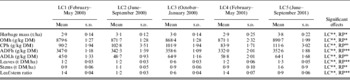
The herbage grazed by the ewes varied with the different LCs (P<0·01) and RP (P<0·05), with the highest value of herbage mass obtained during the fifth LC (Table 1). The CPh was on average 98 g/kg DM, with higher values during the second and the fifth LC, as for biomass. The ADFh and ADLh contents varied significantly between the LC (P<0·01, Table 1). The leaf and stem masses were greater during the fifth LC (P<0·05) and also during the first two LCs. The quantity of herbage available for 7 days per ewe was on average 30 kg DM.
The herbage mass, the organic matter (OMh), crude protein (CPh), acid detergent fibre (ADFh) and lignin (ADLh) contents of the herbage and the morphological composition (leaves and stem quantities) of Digitaria decumbens in the paddocks grazed by the nursing ewes during the different lactation cycles (LCs)

LC, lactation cycle; RP, re-growth period.
** P<0·01, *P<0·05, nsP⩽0·10.
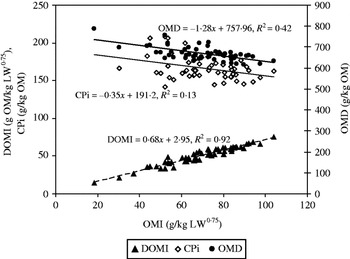
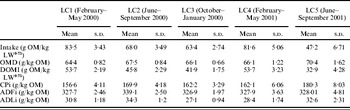
Intake varied significantly during the different LCs, from 47·2 to 83·5 g OM/LW0·75 (metabolic live weight), with higher values during the first and the fourth LC (P<0·0001, Table 2). OMD varied from 64·4 to 70·4 during the various LCs (P<0·0003), unlike intake, with higher values during the second and the fifth LC (Table 2). TheDOMI varied significantly like OMI (P<0·0001). The CPi was high on average and particularly during the fifth LC (Table 2). The CPi varied in the same way as OMD and inversely to OMI and DOMI (Fig. 1). The ADFi varied to a lesser extent than CPi, from 327 to 339 g/kg OM. The ADLi varied from 27 to 34 g/kg OM. The stage of lactation was not significant for any variable related to diet (P>0·10).
Changes in organic matter digestibility (OMD), digestible organic matter intake (DOMI) and crude protein content of the herbage ingested (CPi), as a function of the organic matter ingested (OMI).

Characteristics of the diet of grazing nursing ewes during the different grazing cycles (LC) estimated using faecal NIRS: organic matter intake (OMI), organic matter digestibility (OMD), digestible OMI (DOMI) and chemical composition of the herbage ingested, i.e. the crude protein (CPi), acid detergent fibre (ADFi) and lignin (ADLi) contents of the herbage ingested

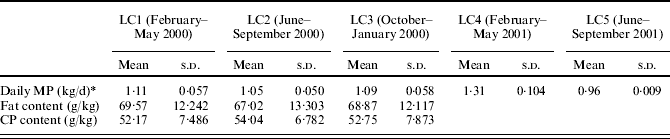
MP averaged 1·1 kg/day and was highest during the fourth LC (P<0·01, Table 3). The chemical composition of milk did not vary significantly between the different LCs (Table 3). The stage of lactation was not significant (P>0·97).
Adjusted means (n=60) of milk production (MP), fat and crude protein (CP) content for suckling ewes grazing Digitaria decumbens paddocks during different lactation cycles (LCs)
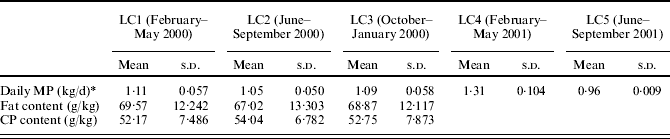
* MP measured concurrently with the measurement of intake.
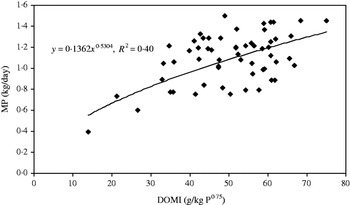
The average values of MP measured per ewe during the five different LCs was positively correlated with OMI (P<0·01) and DOMI (Fig. 2, R 2=0·40), and was negatively linked to OMD (r=−0·46, P<0·001). The OMD was positively related to CPi and CPh (r=0·69, P<0·0001 and r=0·25, P<0·03, respectively). CPi was positively correlated with CPh (r=0·50, P<0·001). ADFi was negatively correlated with CPh (r=−0·48, P<0·01) and ADLh (r=−0·43). ADLi was negatively correlated with the ADLh (r=−0·37, P<0·01) of the herbage in the pasture.
Daily milk production (MP; kg/day), according to organic matter intake (OMI; kg/day), measured per grazing nursing ewe over five lactation cycles.

DISCUSSION
The different attributes of the measured diet illustrate that it was of good quality and differed from the herbage offered. At pasture, herbage consumed may be different from that offered (Corbett & Freer Reference Corbett, Freer, Jarrige, Ruckebush, Demarquilly, Farce and Journet1995; Ungar Reference Ungar, Hodgson and Illius1996; Baumont et al. Reference Baumont, Prache, Meuret and Morand-Fehr2000; Chilibroste et al. Reference Chilibroste, Gibb, Tamminga, Dijkstra, Forbes and France2005), but few studies have illustrated this, particularly in tropical conditions.
The value for CP content in the diet was 1·6–2 times higher compared with the CP content of the herbage, although these two parameters were correlated. Conversely, the contents of ADF and ADL in the diet were lower than those in the herbage by an average of 0·95 and 0·54, respectively. The greater CP content and lower fibre content in the diet compared with the herbage offered suggest that ewes actively selected the higher quality herbage from the available species in the pasture. Given the results of the current study, there is the possibility of nitrogen deficiency, which is thought to limit the use of many tropical grasses (Minson Reference Minson1990; Coleman & Moore Reference Coleman and Moore2003). However, there was a distinction between the CP content of herbage offered and that ingested. Hence, the ewes enjoyed a pasture of good quality and adequate amounts, which represented approximately three times the herbage consumed. Such conditions support a good level of nutrition.
Values of intake and digestibility measured in the current study, and consistent with the MP measured independently, were higher than the averages generally reported for tropical grasses. Indeed, Cordova et al. (Reference Cordova, Wallace and Pieper1978) and Minson (Reference Minson1990) reported average values as 52 g DM/kg LW0·75 and 0·56, respectively. However, the current results compared favourably with reports by Fierro & Bryant (Reference Fierro and Bryant1990) and Lee et al. (Reference Lee, Atkins and Swan2002) for grazing ewes in tropical or desert pastures. Such variability in the measured values of intake and digestibility measured for tropical fodder, excluding methodological considerations, illustrates that tropical grass can provide good nutritive value under certain conditions.
Although the diet on the whole was of good quality, the different parameters relating to diet did not follow the same trend throughout the different periods of lactation (Fig. 1): OMD and CPi tended to decrease, whereas OMI and DOMI increased, as did MP, which was highly correlated with OMI and DOMI (Fig. 2).
Thus, during the second and fifth LCs, when OMD and CPi were highest, the herbage mass, leaf mass and the CP content of the herbage were at their highest. Unlike the CP content, the ADF and ADL contents of the herbage and the diet varied a little. Therefore the ewes had more leaves at their disposal, thereby improving the CP content of the ingested grass and the digestibility of the diet. Savadogo et al. (Reference Savadogo, Zemmelink and Nianogo2000) reported that selective consumption of leaves by grazing Djallonké rams induced an increase in the CP content of ingested OM and an increase in digestibility. There are very few other published data about this selective consumption of leaves at pasture, but this behaviour has been shown in stalls (Mero & Uden Reference Mero and Uden1998). However, despite the increase in CPi and OMD during the second and the fifth LC, neither had a positive effect on OMI and DOMI, nor on dairy production. Such a low impact of a high CP value on intake, combined with high herbage mass, was also reported by Avondo et al. (Reference Avondo, Bordonaro, Marletta, Guastella and D'Urso2000) for grazing Mediterranean ewes. It could be argued that such a good diet quality did not have an effect on OMI, because the quantities of leaves consumed represented smaller mouthfuls. Smaller mouthfuls and resulting DOMI have been measured for heifers grazing good quality sward at 14 days of re-growth, which had a high leaf and CP content, compared to a 28-day sward of poor quality (Boval et al. Reference Boval, Fanchone, Archimede and Gibb2007). Hence, the quality of the herbage grazed (which is different from the herbage offered) does not necessarily correlate with the amount of herbage grazed. Thus, for example, Varga et al. (Reference Varga, Tyrrell, Huntington, Waldo and Glenn1990) observed a negative relationship between digestibility and intake for steers grazing orchardgrass. Lippke (Reference Lippke2002) observed that the intake of Cynodon dactylon by steers was a better indicator of performance than digestibility. According to Noller (1997, cited by Burns & Sollenberger Reference Burns and Sollenberger2002) changes in daily animal response are frequently influenced far more by changes in daily DM intake than by changes in forage digestibility. However, in most studies carried out in stalls, digestibility is more often positively correlated with intake (Minson Reference Minson1990). In stalls, the mown and packed herbage does not allow much choice of the parts that will be consumed and swallowed, compared with the pasture; the animals take about the same amount of grass per mouthful in stalls, whether the quality of grass changes or not. However, at pasture the quality of the diet is not necessarily correlated with intake as in stalls, especially if qualitative sward characteristics such as leafiness vary like other characteristics such as density or height of the sward, which have been known to facilitate large mouthfuls (Prache & Peyraud Reference Prache and Peyraud1997; Baumont et al. Reference Baumont, Prache, Meuret and Morand-Fehr2000).
Therefore, to appraise the nutrition of grazing animals in order to manage the pasture better by reducing herbage wastage and to efficiently improve livestock production, it is essential to measure several parameters and to measure them in in situ conditions. Indeed, parameters measured in other conditions, such as indoors, may induce false estimation of the diet at pasture, by underestimating for example the diet quality compared to the herbage quality. By measuring only digestibility, it might have been concluded that the fifth period of lactation was the most favourable for the feeding of ewes, whereas it is during this period that intake and the production of milk were lowest. Thus when measuring digestibility it is necessary to evaluate the quality of the diet, intake and especially the DOMI, the latter being the most determining parameter for livestock production (Zemmelink & ′t. Mannetje Reference Zemmelink and ′t. Mannetje2002; Coleman & Moore Reference Coleman and Moore2003).
The DOMI values measured for the lactating ewes were indeed correlated with MP, which was higher during the first and the fourth LC like DOMI, whereas OMD varied in the opposite way. Digestible intake is known to be the main factor determining the production of milk (for reviews, see Landau et al. Reference Landau, Glasser, Muklada, Dvash, Perevolotsky, Ungar and Walker2005; Morand-Fehr et al. Reference Morand-Fehr, Fedele, Decandia and Frileux2007). Such relationships have already been found in controlled feeding situations (Cabiddu et al. Reference Cabiddu, Decandia, Addis, Piredda, Pirisi and Molle2005; Morand-Fehr et al. Reference Morand-Fehr, Fedele, Decandia and Frileux2007). The effect of diet quality on the chemical composition of milk is not as obvious as for MP. The composition of milk varied a little compared to the production of milk throughout the different LCs, in agreement with previous studies (reviews by Bocquier & Caja Reference Bocquier and Caja2001; Morand-Fehr et al. Reference Morand-Fehr, Fedele, Decandia and Frileux2007).
In the current study, the evaluation of several parameters to appraise nutrition at pasture was possible for each ewe, using the analysis of faeces by NIRS. The values of the diet attributes were consistent with the pasture characteristics and MP. The relationships between the three kinds of independent measurements suggest that faecal NIRS can provide appropriate evaluations of the nutrition of animals at pasture. Yet the statistical calibration that was used to estimate OMI was not as good as those obtained for OMD, CPi or ADFi (Fanchone et al. Reference Fanchone, Boval, Lecomte and Archimède2007). The SECV were acceptable and compared favourably with other reports for the last three parameters (Coates Reference Coates, Eldridge and Freudenberg1999; Krachounov et al. Reference Krachounov, Paul and Kirilov2000), although for OMI it was 10·8 g kg BW−0·75, with the error being 0·20 of the mean value. However, this error may be acceptable considering the difficulty of appraising intake at pasture and considering also the individual variability of intake from 0·10 to 0·30 (Coleman Reference Coleman2006). Intake is particularly more difficult to predict than digestibility, largely because the intrinsic properties of the feed explain only part of the variability in intake (Coleman & Moore Reference Coleman and Moore2003). With this level of precision, such calibrations can give worthy estimates for grazing animals. However, much work remains to be done, particularly the expansion of the faecal spectra database and generation of a network among researchers working at pasture, in order to enhance the potential for prediction in various grazing situations.
CONCLUSION
The current study highlights that the ewes at pasture consume herbage with a better chemical composition than the herbage offered and that their diet, considered as DOMI, is related to production of milk. However, by considering other attributes of the diet, such as OMD and CP content, these parameters do not correlate with MP. Therefore, to evaluate better the diet and improve the management of the pasture and grazing animals, variables such as digestible OMI, which is the most suitable for gauging the nutrition of livestock, should be assessed.
Measuring all indicative parameters of the diet of grazing animals at pasture is a significant challenge. The faecal NIRS methodology used in the current study provided an appropriate evaluation of the diet of the grazing ewes, which was consistent with the pasture characteristics and MP, when measured independently. This methodology is of great interest for appraising the diet attributes of grazing animals and the current databases of faecal spectra available must be widened to increase the potential for predicting nutritional variables at pasture. This is essential if the efficiency of livestock production is to be improved.