Introduction
Foraging strategies in gentoo penguins (Pygoscelis papua) have been well studied (e.g. Croxall et al. Reference Croxall, Davies and O'Connell1988, Robinson & Hindell Reference Robinson and Hindell1996, Lescroël et al. Reference Lescroël, Ridoux and Bost2004, Takahashi et al. Reference Takahashi, Kokubun, Mori and Shin2008, Xavier et al. Reference Xavier, Trathan, Ceia, Tarling, Adlard and Fox2017). The general consensus is this largest member of the three pygoscelid penguins displays both nearshore benthic and pelagic foraging tactics to consume combinations of crustaceans and fish. In a recent study, Carpenter-Kling et al. (Reference Carpenter-Kling, Handley, Green, Reisinger, Makhado, Crawford and Pistorius2017) reported that gentoos at sub-Antarctic Marion Island displayed a novel foraging strategy that consisted of alternating typical lengthy foraging trips with much shorter nearshore afternoon trips. They suggest the latter foraging behaviour may be a response to suboptimal feeding conditions caused by local environmental change. This novel discovery reinforces the fact that, despite considerable study, not all foraging tactics in penguins have been documented. In this paper, we describe what we believe to be, yet another undocumented foraging tactic employed by gentoos.
Observations
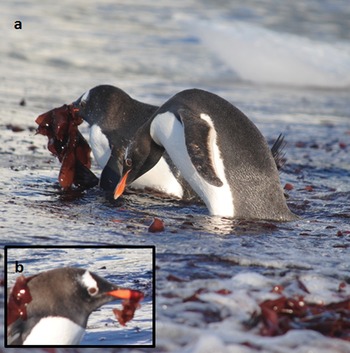
Observations of gentoo behaviours were made on 11 January 2019 in the intertidal zone of a small cove adjacent to the Caillet-Bois Argentine refuge hut on D'Hainaut Island (63°54'00''S, 60°47'00"W). This small island is located in Mikkelsen Harbor, Palmer Archipelago, western Antarctic Peninsula. The cove had a soft, sandy bottom, and along the shoreline there was a dense raft of drift algae comprised wholly of the red macroalga Palmaria decipiens (identified later from photographs taken of 20 individual thalli). The macroalgal raft extended from the beach to ~5 m offshore at shallow depth (< 1 m). Eight adult gentoos were observed over a period of 2 h moving repeatedly back and forth from the shore to the macroalgal raft. The presumptive foraging behaviour consisted of an individual wading out a few metres from shore to a depth of ~20–30 cm and then diving below the water from a standing position for a period of ~10–20 s. As each individual resurfaced and stood up, pieces of macroalgal drift were observed in the grasp of, or draped over, the beak (Fig. 1). This visual observation suggested penguins had been using their beaks to forage for prey among the drift. After ~5–10 dives, individuals returned to shore for several minutes, only to wade back into the macroalgal raft and repeat the diving behaviour.
a. Gentoo penguins foraging among a dense raft of drift of the red alga Palmaria decipiens along the shoreline of a small cove on D'Hainaut Island, Antarctic Peninsula. b. Gentoo penguin with P. decipiens draped over, not in, its beak.

Discussion
While it was not possible during these observations to determine the targeted prey (e.g. through stomach content analyses), the observed foraging bouts were highly focused, individualistic and repetitive, all factors that argue against a social behaviour or bathing. While mesograzer amphipods are known to associate in abundance with the red alga P. decipiens (Huang et al. Reference Huang, Amsler, McClintock, Amsler and Baker2007), the most probable prey item that gentoos were searching for among the macroalgal drift was dead individuals of the krill Euphausia superba. They have occasionally been observed washed up along rocky shores, presumably the result of strong storms (M.O. Amsler, personal observation 2016). Such storms would also simultaneously drive dislodged rafts of algae onto shore. Moreover, krill, rather than amphipods, are by far the major crustacean prey animals found in the stomach contents of gentoos in the region of these observations (Fraser, personal observation 2016).
The novel foraging strategy described by Carpenter-Kling et al. (Reference Carpenter-Kling, Handley, Green, Reisinger, Makhado, Crawford and Pistorius2017) in gentoos at sub-Antarctic Marion Island was suggested to be a response to recent regional oceanographical changes limiting prey availability that, in turn, may be reducing regional gentoo numbers. Therefore, augmentation of lengthy feeding trips with foraging bouts of short duration may have become a necessity. In contrast, the present observation of intertidal foraging by gentoos in a macroalgal raft is more probably incidental and opportunistic. This is supported by unpublished observations of similar patterns of repetitive intertidal diving behaviour by gentoos at a variety of locations along the western Antarctic Peninsula (Fraser, personal observation 2009–2018). Moreover, prey such as krill do not appear to be limiting for gentoos in the Palmer Archipelago (Steinberg et al. Reference Steinberg, Ruck, Gleiber, Garzio, Cope and Bernard2015, Fraser, personal observation 2009–2018), as evidenced by diet composition and ongoing regional range extension and population increase (Ducklow et al. Reference Ducklow, Baker, Martinson, Quetin, Ross and Smith2007, McClintock et al. Reference McClintock, Silva-Rodriguez and Fraser2010).
Acknowledgements
Our appreciation is extended to the reviewers of this manuscript. We dedicate this paper to the memory of Professor David Walton, an outstanding ambassador and scholar of Antarctic science.
Author contributions
JBM led the study and carried out the observations. MOA and CDA identified the red alga from images of thalli and contributed to the interpretation of the diving behaviour. WRF contributed to the evaluation of the intertidal diving behaviours, the potential nature of the prey and penguin ecology in general. All authors contributed to aspects of editing the final manuscript.
Financial support
This research was supported by the Climate Change Project sponsored on behalf of JBM and CDA by Abercrombie and Kent Philanthropy. CDA and JBM wish to acknowledge their support from NSF grant OPP-174450 and WRF from grant OPP-1745018. JBM also appreciates the support of an Endowed Professorship in Polar and Marine Biology from the University of Alabama at Birmingham.