1 Disciplines in product development
Product development always involves different disciplines (e.g. engineering and industrial design, economics, etc.) and depending on the company, product, etc. one of these disciplines dominates (e.g. Eckert & Clarkson, Reference Eckert and Clarkson2005; Graf & Hartmann-Menzel, 2010). In each case, product development is always also a design process, therefore usually any design discipline is involved.
Although the products of these processes may be quite different, ‘the processes of their creation are in many ways similar—however within each process the emphasis that is given to particular activities varies greatly between different domains’ (Eckert & Clarkson, Reference Eckert and Clarkson2005).
Designing is creating and developing new objects or processes. Beside many other things these objects can be products, machines or systems (see Dörner, Reference Dörner2002). Designing requires certain competences, skills and first of all the knowledge of the designer. A general definition of design which links to knowledge is given by Hatchuel and Weil (Reference Hatchuel and Weil2003): ‘Design is a process by which something unknown can intentionally emerge from what is known.’ This concerns especially original designs, where objects are designed from scratch. However, it must be stated that in practice ‘Most designs are created by evolution from existing designs’ (Eckert & Clarkson, Reference Eckert and Clarkson2005).
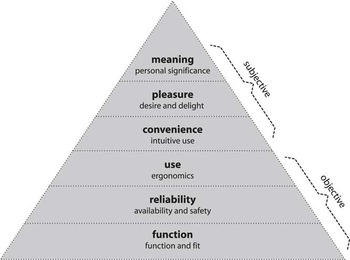
Industrial design takes an holistic approach on the creation of objects. It addresses user needs and the emotional relationship between human and product. (cf. Steinmeier, Reference Steinmeier1998), making the identity of an object apparent (see Eckert & Clarkson, Reference Eckert and Clarkson2005; Florida, Reference Florida2005). The success of a product does not only depend on its function and usability, but also from bringing ‘joy and excitement, pleasure and fun, and yes, beauty, to people's lives’ (Norman, Reference Norman2004). Originating from human–computer interaction disciplines, this relationship has been given more attention recently by use of the terms experience and experiencing in industrial design (e.g. Press & Cooper, Reference Press and Cooper2003; Schifferstein & Hekkert, Reference Schifferstein and Hekkert2008). Many models of user experience have been published in the recent time. A comprehensible example is the model of user experience in interaction design given by Anderson (Reference Anderson2006), who describes the relation between products and experiences by the use of a comprehensible pyramid model which relates to Maslow's Hierarchy of Needs (Reference Maslow1943). Applying this model to industrial design means that products must not only be functional, reliable and usable (lower levels), but also be convenient, pleasurable and meaningful (upper levels) to users (see Figure 1). Experiencing is a holistic process, involving all sensory organs. Usually, the most important element of experiencing is visual perception, thus visualization is essential to industrial design processes, as we will explain more in detail below.
A model of user experience in industrial design, correlating to the model of Anderson (Reference Anderson2006)

Creating products in engineering design involves basic, mathematical, engineering and natural science aiming at function and fit (Eckert & Clarkson, Reference Eckert and Clarkson2005). Engineering design pays attention to material, technological, economical, legal, environmental and human constraints (Pahl et al., Reference Pahl, Beitz, Blessing, Feldhusen, Grote and Wallace2007), whereas human constraints are named in the last place. In practice, these are often reduced to ergonomic aspects (Kranke, Reference Kranke2008). Methods concerning user experience are absent in traditional engineering design. Furthermore, engineering designers are kept away from specifying requirements related to user experience by marketing departments of many companies occupying user-related issues. According to Pahl et al. (Reference Pahl, Beitz, Blessing, Feldhusen, Grote and Wallace2007), design problems are abstracted and decomposed to sub-problems. This leads to a problem-oriented process in engineering design. Engineers do hardly consider solution-oriented processes to be efficient and appropriate (Brezing, Reference Brezing2006). On the contrary, industrial design ‘is not a matter of first fixing the problem and then searching for a satisfactory solution concept’ (Dorst & Cross, Reference Dorst and Cross2001) but it rather is characterized by parallel development of problem formulation and holistic representations of a solution. Thus, Dorst and Cross (Reference Dorst and Cross2001) name two design spaces—problem space and solution space, which are connected by information interchange and iterative co-evolution.
Although industrial design among other related disciplines belongs to the engineering designer's most important partners in product development (Jonas, Reference Jonas1995), there are still preventable difficulties that hinder an efficient collaboration across the design domains (Reese, Reference Reese2005; Kranke, Reference Kranke2008). From an engineer's perspective, industrial design aims are sometimes not plausible and complicate the engineering design process (Brezing, Reference Brezing2006). One constantly recurring example is the dissent on the importance of certain shapes or curves sometimes ignored by engineers on one side and extensive re-engineering provoked and sometimes underestimated by industrial designers on the other side. In addition to that, different cultures, tools, terms and work styles of the disciplines often hinder understanding, acceptance and effective collaboration or even prevent it (Reese, Reference Reese2005; Kranke, Reference Kranke2008). Despite the fact that industrial design issues are often considered being unimportant or bothersome in engineering design processes, aspects of human experiencing almost always influence the success of the products developed. The other way round, technical conceptualization is also essential especially in the early stages of industrial design processes. Thus, a strict separation between engineering and industrial design development is not possible and moreover inappropriate.
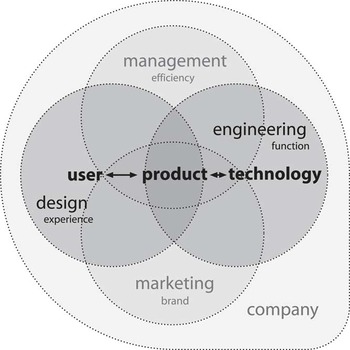
Figure 2 illustrates how aims and thus views on the object as well as decision making differ in industrial design and engineering design. It can be seen that the core and overlap of both disciplines is the product (i.e. the object to be designed), whereas user and technology are not linked directly. This is the reason why some industrial designers see themselves as advocates of the users. Ideally, engineering and industrial design integrate not only in product development processes but also in individual product developers. There is an ongoing trend in education which pays regard to this need in a variety of branches. However, in many cases engineers and designers have different educational and professional backgrounds. Their connection within the development process is the product. As this is usually not present especially during the early stages, descriptions and visualizations of problem and solution approaches are essential elements of the collaboration between the design disciplines.
The relationship between user, product and technology in collaboration with different disciplines in product development

2 Steps and loops in the design process
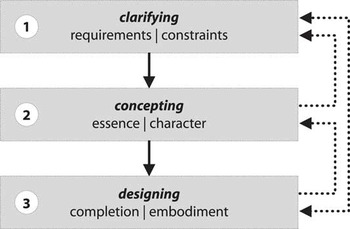
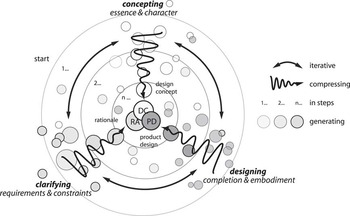
The important early stages of design processes are characterized by the interplay of the parallel and iterative development of three domains: knowledge, concept and design. The scheme presented in Figure 4 does not contradict established design process models. Most design process models are presented as linear process consisting of subsequent phases (e.g. Pahl et al., Reference Pahl, Beitz, Blessing, Feldhusen, Grote and Wallace2007). Many of these models imply iterative loops between the phases as shown in Figure 3. However, these loops usually receive only little attention. In contrast, the schema presented in Figure 4 focuses on iterative and parallel development of clarification, conceptualization and designing, all three domains being connected to each other.
A linear model of the early stages of the design process

The parallel and iterative loops of clarification, concepting and designing, translated from Drechsel (Reference Drechsel2008)

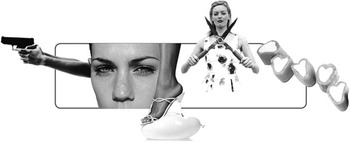
As we will describe in detail further below, visualization is essential to this iterative and parallel development in order to make complex issues transparent, to understand the underlying structure and to identify objectives. One particular example for visualization tools is the mood board, which is widely used and accepted in different design disciplines when it comes to defining objectives concerning human experiencing. A mood board usually is a collage of photographs, material probes and sometimes words or phrases (see Figure 5). It visualizes contexts of user life, the market or the product itself (Bürdek, Reference Bürdek2005). ‘Mood typically refers to a diffuse affective state that is of lower intensity than emotion, but considerably longer in duration […]. Whereas emotions are acute, moods evolve gradually over time’ (Desmet, Reference Desmet2008). Thus, mood boards are not only used at one early stage but also referred to and refined through the further design process.
A refined mood board entitled ‘Danger Doll’ for the development of a small race car by student Kimberly Clayton (Technische Universität Dresden, Germany)

3 Clarifying: knowledge evaluation and reasoning
3.1 Knowledge in product development
Not only the first stage but also the whole design process is characterized by the acquisition, evaluation, production and transfer of knowledge. Knowledge is an essential fundament of designing. It serves as a basis for understanding and reinterpreting the task, for clarifying constraints and contradictions, for developing concepts and for designing the object in engineering and industrial design. But there are certain kinds of knowledge that are relevant for the disciplines involved. Obviously, there are differences between knowledge required by industrial designers and by engineering designers at the start of a design process.
The term design knowledge has many interpretations from a number of disciplines. As a result there are many intersections and some contradictions in terminology and content. Therefore a definition of a cohesive model of design knowledge is quite difficult. We use the term design knowledge in the sense of prescriptive object knowledge according to van Aken's (Reference van Aken2005) categorization of design knowledge.
3.2 Design knowledge is not at hand
Design knowledge is not knowing (Jonas, Reference Jonas2004). At the start of a design process, designers have no concrete image of the goal they could aim at. They know just a few constraints and contradictions as well as little about the path leading to it. Notions about the process, the environment and implementation of the design object do exist, but these are neither precise nor verifiable (Lawson, Reference Lawson2006). This is the case for both industrial and engineering design, when the task is about designing objects which do not exist in any form yet (original designs, Pahl et al., Reference Pahl, Beitz, Blessing, Feldhusen, Grote and Wallace2007; new product development, Cagan & Vogel, Reference Cagan and Vogel2002; Ulrich & Eppinger, Reference Ulrich and Eppinger2003). In practice, engineering design is often concerned about adaptive design and detail design. In contrast, industrial design more often has to create objects from scratch, has shorter project duration and a larger number of different projects. Usually, the development of highly complex products involves more engineers than industrial designers; many engineers are engaged with detail problems framed by rather rigid requirements. Therefore the problem of not knowing tends to be more present in industrial design.
Not knowing is also linked to uncertainty and decision making. In engineering design, decisions are mainly concerned about function and fit, they are made objectively as far as possible or appropriate. There is a huge variety of methods for each stage of the engineering design process (Roozenburg & Eekels, Reference Roozenburg and Eekels1995; Cross, Reference Cross2001; Pahl et al., Reference Pahl, Beitz, Blessing, Feldhusen, Grote and Wallace2007). If applied, they support systematic considerations and thus enable rather objective decisions. In industrial design, decisions are usually made rather subjectively (Eckert & Clarkson, Reference Eckert and Clarkson2005). We have observed that inexperienced designers (i.e. students) feel inconvenient when there is no objective rule for making decisions, especially in the early stages of the design process (Woelfel, Reference Woelfel2008). This is also a facet of not knowing.
Design knowledge, for a large part, is knowledge that exists but cannot be expressed in words. According to Polanyi (Reference Polanyi1967) this tacit knowledge cannot be converted into explicit knowledge. Nonaka and Takeuchi (Reference Nonaka and Takeuchi1995) presented the SECI model (Socialization, Externalization, Combination, Internalization), which describes how explicit (design) knowledge can be internalized to implicit (design) knowledge and vice versa. There has been some discussion whether tacit knowledge can be directly converted into explicit knowledge. However, tacit (design) knowledge can serve as the basis for generating explicit (design) knowledge (Rust, Reference Rust2004). This is the case in both industrial and engineering design. The use of tacit knowledge in design processes leads to unconscious decisions, which can be observed as intuitive actions and are to some degree a reason for misunderstandings between the disciplines involved in product development. However, those decisions are not made without being connected to a certain fundament; they are based on (tacit) design knowledge. To some extent, tacit design knowledge is transferred into explicit knowledge during the design process. This will be described further below.
3.3 Design knowledge is episodic and prior knowledge from socio-cultural everyday life
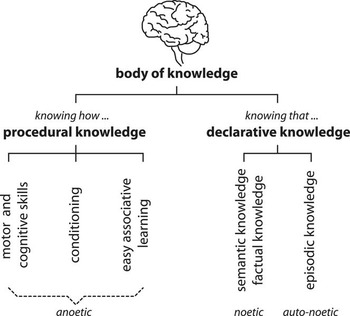
Knowledge used by designers can also be described by the use of neuro-scientific taxonomic models of human memory (summarized by Uhlmann & Schulze, Reference Uhlmann and Schulze2007, see Figure 6). According to these models, there are two main categories: procedural knowledge and declarative knowledge, subdivided into factual knowledge and episodic knowledge. During the design process, all of these knowledge categories are used, but in the early stages of the design process the focus lies on declarative knowledge, including factual and episodic knowledge. The occurrence of both episodic and factual knowledge can not only be observed in verbal data (e.g. Lawson, Reference Lawson2004) but also in drawings (Uhlmann & Schulze, Reference Uhlmann and Schulze2007). In industrial design, episodic knowledge plays a very important role. The same has been proven for engineering and other problem-solving disciplines (Visser, Reference Visser1995; von der Weth, Reference von der Weth2001), despite it is rarely or not taken into account in academic engineering design methodology.
Neuro-scientific models of human memory and knowledge as summarized and applied to industrial design by Uhlmann & Schulze (Reference Uhlmann and Schulze2007)

Phases of systematic and opportunistic behavior alternate while designing. During opportunistic phases, designers recall previous tasks or problems that they have solved in a certain manner and apply them to the problem at hand, even in cases in which a systematic approach might lead to another, possibly better solution (Hacker, Reference Hacker2005). The (unconscious) use of prior knowledge can be observed in many disciplines (Schön, Reference Schön1983), and studies show that it is inevitable (von der Weth, Reference von der Weth1994). In contrast to the field of engineering, design cultivates this behavior (Cross, Reference Cross2003; Lawson, Reference Lawson2004). Many studies suggest that design knowledge is to a large extent everyday knowledge (Lawson, Reference Lawson2004; Visser, Reference Visser2006; Uhlmann & Schulze, Reference Uhlmann and Schulze2007 and others), that is, it is not solely the knowledge gained from schooling or work, but knowledge from the entire day-to-day life of the designer. One reason for this may be the focus on the relationship between humans and objects in industrial design processes. User's experiencing and acceptance of designed objects to some degree depend on their socio-cultural background. Assuming this, one could state, the more socio-cultural knowledge designers have, the better they can meet the needs and expectations of users. This socio-cultural knowledge is gained through the whole life but only to a little extent from work or education.
Many tangible and intangible socio-cultural references contribute to the industrial design process. Studies have shown that the extensive use of everyday knowledge in the sense of socio-cultural references have a positive influence on industrial design processes (Strickfaden, Reference Strickfaden2006). There is a strong connection between episodic knowledge and everyday knowledge, so it can be concluded that everyday knowledge also has an impact on engineering design, though to a lesser extent.
3.4 Design knowledge is about experiencing
Finally, design knowledge is about experiencing. As described above, in contrast to engineering, industrial design focuses on the experiential relationship between the design object and the user. This experience is an individual one, and the evaluation of the object tends to be holistic. These judgements include objective as well as subjective and emotional criteria, even for the object's technical functions.
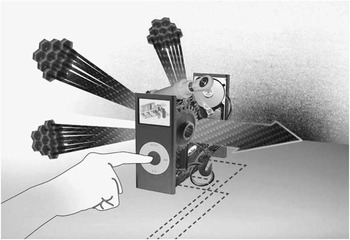
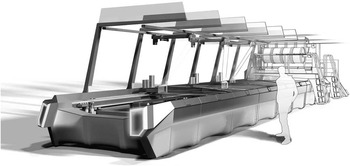
The example shown in Figure 8 is an original design (new product development) of a modular multi-axial textile machine. Within problem visualization, a very complex and heterogeneous non-modular predecessor has been illustrated and embedded into the ideal of a clearly arranged and easy to operate structure (Figure 7). This leads to a design concept in a very early stage, delivering a clear definition of the goal of the development process. Being present during the further design process, the concept found its correspondence in an innovative and clearly arranged textile-covered machine.
Problem visualization of a high-tech knitting machine by student Camillo König (Technische Universität Dresden, Germany)

Final design solution of a high-tech knitting machine with several weft insertion systems by student Camillo König (Technische Universität Dresden, Germany)

3.5 Design knowledge is a basis for design concepts
In sum, design knowledge can be described as knowing and not-knowing, as implicit and explicit, as factual and episodic, as prior knowledge from professional and socio-cultural everyday life, as objective, subjective as well as rational and emotional knowledge. These attributes are quite diverse. However, they are a suitable fundament for understanding knowledge as a key for visualization and reasoning in design processes. This knowledge serves as a basis for clarifying the task, constrains and contradictions as well as to substantiate the design concept and the final design itself.
4 Concepting: knowledge consolidation and visualization
4.1 Concepts in engineering and industrial design
According to Keinonen and Roope (Reference Keinonen and Roope2006), ‘Concepting is a relatively new idea within product development.’ Despite a large variety of publications about design concepts and related creative techniques, the process of concept creation in industrial design remains vague. Within the design process, all other phases appear to be investigated much more intensively. ‘Conceptual design is an important phase of the design process. However […], design theory and methodology has little to offer in support of this crucial activity’ (Roozenburg, Reference Roozenburg1993).
The creation of a design concept is not necessarily built up on rigidly ordered sequences. Explanations for that can be extracted from psychological work on problem solving (see, e.g. Dörner, Reference Dörner2002). Others (e.g. Roozenburg, Reference Roozenburg1993) name abductive reasoning as the key action during concept development. ‘Innovative abduction is the key mode of reasoning in design and therefore highly characteristic for this activity. But it is not unique to design. In both science and technology, and in daily life, abductive steps are taken in the search for new ideas’ (Roozenburg, Reference Roozenburg1993).
In order to be able to applicate industrial design concepts to engineering design, it is necessary to outline the differences between definitions of concepts in those disciplines. Thus, three different concept types are described below:
1. Most development-oriented concept models developed by economics are based on the complete product development process including marketing and sales activities. ‘A concept is a description of the form, function, and features of a product and is usually accompanied by a set of specifications, an analysis of competitive products, and an economic justification of the project’ (Ulrich & Eppinger, Reference Ulrich and Eppinger2003).
2. In engineering design, concepts are technically and functionally determined and emphasize on the constructional structure ‘A principal solution is an idealized representation (a scheme) of the structure of a system, that defines those characteristics of the system that are essential for it's functioning’ (Roozenburg, Reference Roozenburg1993). Conceptualization in engineering design has been deeply regarded by Pahl et al. (Reference Pahl, Beitz, Blessing, Feldhusen, Grote and Wallace2007). Requirements list and function analysis make up a product concept in engineering design. This correlates to technical function and fit being the main aims of engineering design processes as described in the first part of this paper.
3. In industrial design as well as in certain other design disciplines such as interaction or transportation design, design concepts focus on experiencing, determining the identity and character of the object. The industrial design concept defines the aim of the design process, serving as a nucleus which incorporates ‘all essence-determining characteristics of the coming product in it’ (Uhlmann, Reference Uhlmann2005). An industrial design concept also can be described as something which enables the product to be itself. A good concept leads to a design, which exposes the native character of the object and has nothing to do with an exercise in styling and trying to be different (Morrison, Reference Morrison2006).
Industrial design concepts are abstract goal definitions that require interpretation and embellishment, whereas engineering design concepts are usually processed straightforward. The specifics of industrial design concepts are described in detail below.
4.2 Existence, function and characteristics of design concepts
A design concept exists as key element of the design process in industrial design. In a recent study, such a concept has been traced in three out of four examined design projects (Krzywinski, 2008). In each case it exists at least in its basic rather than formal or functional approach. In most cases it is significantly broader and substantial. Accordingly, the relevance of a design concept can be confirmed, in particular for the early phases of the design process.
Design concepts are highly concentrated starting points of the design process. Thus, they can be called nucleus (of the design), while acting as guidelines to the artifacts. The design concept provides a clear aim for the object to be designed. The completeness of such concepts has been evaluated by qualitative content analysis. The system of categories applied has been developed from theoretical and empirical data. As an outcome of the study, it can be stated that the quantity and the density of informational content, as well as the more or less conscious utilization of the concept, strongly depend on the designer. In contrast, the creation and use of an industrial design concept is rather independent from the specific design problem.
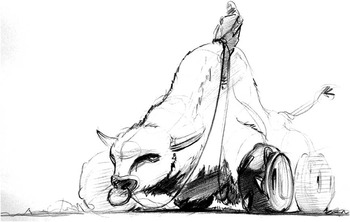
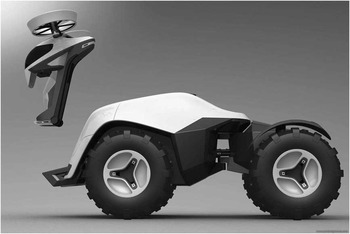
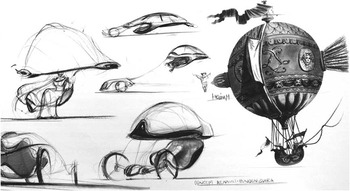
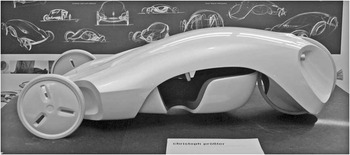
Industrial design concepts are subjective. The subjectivity of design concepts is documented in Figures 9, 10, 11 and 12. Design concepts are generally influenced by the designer's biography, by their knowledge and socio-cultural background (please refer to Section 3.3 above). The use of this knowledge and the biographic imprint are keys to a vivid and individual industrial design concept. Despite this subjectivity, a transfer of industrial design concepts to other designers and tasks is possible. This can be observed, for example, in larger companies where designers proceed with design processes that have been handled by other designers before. The result is a personal interpretation and thereby a certain adaptation of the original.
Concept sketch for tractor project by student Christoph Prössler (Pforzheim University, Germany)

Final design solution for tractor project by student Christoph Prössler (Pforzheim University, Germany)

Concept drawing (royal hot air balloon) and first sketches for upper range car by student Christoph Prössler (Pforzheim University, Germany)

Final design for the upper range car by student Christoph Prössler (Pforzheim University, Germany)

4.3 Design concepts as tools for different design disciplines
In addition to the general statements about industrial design concepts, it is interesting to know, whether such experience-focused concepts are existing or applicable in different design disciplines. It can be confirmed that functions of the design concepts—namely nucleus and guiding principle—are similar in different design disciplines. Due to different tasks, objects and knowledge bases, the quantity and quality of substantial contents of industrial design concepts can differ. This may affect formal considerations as well as ergonomics among others.
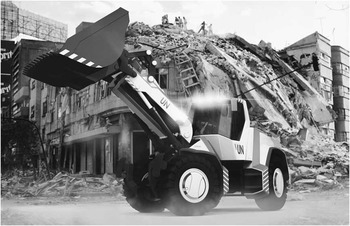
The example of the wheel loader shown in Figure 13 illustrates how industrial design concepts can be applied on engineering design tasks. The design process started with an extensive requirements list, which alone would have surely led to a sufficient technically solution. With the inclusion of an experience-focused industrial design concept (see Figure 14), the designer was able to make the product character more explicit.
Final design solution of a wheel loader by student Christian Mogel (Technische Universität Dresden, Germany)

Mood board, part of a design concept for a wheel loader by student Christian Mogel (Technische Universität Dresden, Germany)

Mood board, mood words, personas (describing prototypical users, see Cooper et al., Reference Cooper, Reimann and Cronin2007), user scenarios (describing the user's environment and time) and user stories (describing the user's relation to the objects to be designed) can support concept creation. The design concept stage is characterized by highly processed and compressed knowledge, represented by the high density of visual information.
5 Designing: knowledge application, visualization and evolvement
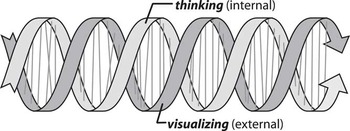
Considering design concepts being based on consolidated and compressed knowledge, the actual designing—also referred to as design actions—applies this knowledge to geometry. Besides applying, visualizing and evolving knowledge, designing is to a large extent based on the simultaneous occurrence of thought and visualization processes (Sachse, Reference Sachse2002). The result of each operation is recycled through the sensory organs and leads to further thinking. The use of sketches as means of reasoning has been observed in designer's but also in children's drawing processes (Goldschmidt, Reference Goldschmidt2003). In design there are different kinds of externalizations which can be used as means for knowledge externalization and evolvement. Most important are drawings, but also verbal representations, other visual representations such as mood boards, computer-aided design (CAD) and physical scale models as well as prototypes are used to transfer (tacit and other) design knowledge into external representations. These representational objects are then judged and serve as a basis for new (tacit and other) design knowledge in the designer's mind.
The importance of drawings (sketches, renderings, etc.) in industrial design is based on their tolerance against inevitable vagueness in early stages of the design process. As explained above, industrial design processes can be described as solution-oriented problem-solving processes, where a holistic approach is taken to develop details from general solutions. This means that the designer loosely defines the shape of an object without knowing about further (geometric) details. In drawings, those shapes can be visualized without bothering about the details. The shape can be evaluated for experiential aspects. Other people involved in product development, for example, managers, can also evaluate the shape but also accept its incompleteness. In contrast, CAD models require definite geometry of every part of the object which is hardly possible and definitely not useful in early stages of industrial design processes.
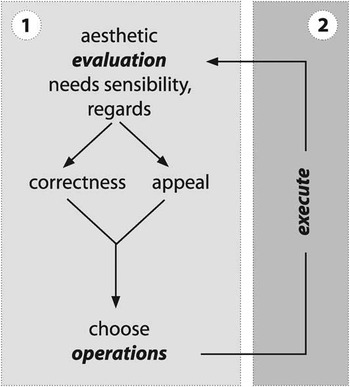
Aptitude and proficiency in representational design must be readily available in order to be used routinely and automatically. Visualization should require very little mental capacity during a representational design act. The two steps of the above mentioned model of externalization and internalization during designing can be further divided into five steps of evaluation, anticipation, decision, application and feedback (Uhlmann, Reference Uhlmann2005; Woelfel & Uhlmann, Reference Woelfel and Uhlmann2008):
1. Evaluation of an input status with regard to correctness and appeal. This input usually is the output of the previous design action.
2. Mental anticipation of a new status based on the previous evaluation and of operations that could invoke this new status.
3. Decision about the possible operations and anticipated result.
4. Execution of selected operations.
5. Review results—has the intended result regarding correctness and appeal been achieved?
The output of step 5 usually is input of step 1, until the designer is satisfied and moves his focus to (other) detail problems.
Looking at these five steps, skills and competences necessary for successful designing can be identified. These can be analyzed in novice designer's processes in order to select approaches for improving their skills, competences and thus their design processes and outcomes, for example, in education.
The model of Sachse referred to in Figure 15 has been developed as a model for design action in engineering design. However, it can be applied to industrial design as well. The five steps described above can also be applied to both engineering and industrial design. The main difference between both design disciplines is found in step 1, where evaluation depends on an holistic judgement consisting of two separate judgements of correctness and appeal (Uhlmann, Reference Uhlmann2005). Considering the different aims and knowledge bases described in this paper, we can assume that in engineering design the (rather objective) judgement of correctness is predominant, whereas in industrial design the (subjective) judgement of appeal is equally important, as the judgement of correctness (see Eckert & Clarkson, Reference Eckert and Clarkson2005). In any case, experienced designers make their holistic judgements rather intuitively. For educational use the five steps can be recombined into only two steps, resulting in the two-step method shown in Figure 16. We use this two-step method as a mean for teaching basic design methods.
Simultaneous occurrence of thought and visualization in designing according to Sachse (Reference Sachse2002)

Explanatory model: two-step-method (Woelfel & Uhlmann, Reference Woelfel and Uhlmann2008)

6 Perspective
Going a step further would mean using virtual products (animated or not) as visualizations for the design process. Designing in virtual reality means working in hybrid environments between geometric visualization and thoughts. This definitely helps the designer (engineering or industrial) to reduce the gap between internal knowledge and external representation, and may lead to faster design processes and decisions. Considering the fuzziness of sketching, one major problem becomes obvious: the necessary modeling makes every geometric data very strict and definite, somehow inflexible and clumsy even in early stages of the design process. Until now, appropriate tools for three-dimensional sketching and modeling are still missing. Unfortunately, there are only few promising attempts to overcome this problem (e.g. Bae et al., Reference Bae, Balakrishnan and Singh2008). More interdisciplinary research involving all stakeholders is necessary in this field.
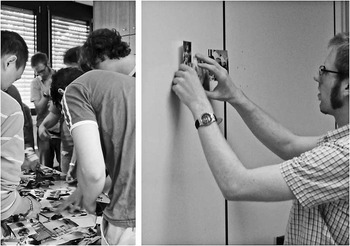
The example of three workshops accomplished at Aachen University, Germany, gives an idea, how teaching industrial design methods combined with visualization tools can change development processes. We offered the program to 12 students of mechanical engineering (Figure 17). The core element of the workshop is the industrial design concept as described in this paper. The concepts have been created by accomplishing three steps: scenario building, user story and description of the object's essence. These steps are prototypical methods of industrial design, combining reasoning and visualization. The development of the mood board itself was supported by 200 given pictures, from which up to five were selected and arranged as a mood board (Figure 18).
Engineering students (Aachen University, Germany) browsing through mood images (left) and arranging selected ones to a basic mood board (right)

Two basic mood boards for a hand-held wood router composed by engineering students (Aachen University, Germany) from given images

The student's positive feedback reveals their good experience of the workshop:
• ‘Particularly helpful: The tools for a systematic creation of industrial design concepts is an amazing approach, which can be applied to a multiplicity of practice cases.’
• ‘The workshop opened a completely different perspective to me. Compared to my educational background, I looked at technical problems from a very different perspective. I'm very grateful for experiencing this.’
• ‘I found the general approach to the information identification very helpful. [It was surprising,] that one can collect so much information about a product, which does not exist yet.’
From this paper we conclude two aspects: first, research and development processes of different disciplines will merge by means of different kinds of visualization, aiming at new knowledge and understanding by communication and re-interpretation of complex knowledge. Industrial design can play an important role in this development. Second, present practice of visualization can be complemented by modern and future tools of animation and virtual and augmented reality. Industrial design must be part of this process in order to be independent from established technology as it is, for example, in the field of CAD systems.
This paper outlines the strong connection of knowledge, reasoning and visualization in industrial design processes, steadily shifting between externalization and internalization. We think that this way of thinking and reasoning will be reserved for the human designer in the near future. But there is a huge potential for new and improved supporting tools. If future visualization tools are intended to support industrial design on a new level, designers must be involved in the development of such tools.