Introduction
In Europe, psychotic disorders are more common in people from ethnic minorities. In the UK, many immigrant groups, especially those of African-Caribbean origin, have higher incidence rates of psychotic disorders than the native population (King et al. Reference King, Coker, Leavey, Hoare and Johnson-Sabine1994; Bhugra et al. Reference Bhugra, Leff, Mallett, Der, Corridan and Rudge1997; Fearon et al. Reference Fearon, Kirkbride, Morgan, Dazzan, Morgan, Lloyd, Hutchinson, Tarrant, Fung, Holloway, Mallett, Harrison, Leff, Jones and Murray2006). Similarly, in The Netherlands, psychotic disorders are more common among non-Western immigrant groups, including Moroccans, Surinamese, Antilleans and immigrants from other non-Western countries (Selten et al. Reference Selten, Veen, Feller, Blom, Schols, Camoenie, Oolders, van der Velden, Hoek, Rivero, van der Graaf and Kahn2001). The incidence of psychotic disorders is also slightly increased among Turkish immigrants (Veling et al. Reference Veling, Selten, Veen, Laan, Blom and Hoek2006). These incidence studies are all based on contact rates with health services rather than on population-based data, because of the low prevalence of psychotic disorders and because most people with psychotic disorders eventually make use of the health services. However, contact rates primarily reflect how psychiatric symptoms are acted upon (e.g. the speed of help-seeking behaviour) rather than the actual prevalence of illness (Blane et al. Reference Blane, Power and Bartley1996). As non-Western immigrants in The Netherlands are under-represented in mental health care (Uniken-Venema & Wierdsma, Reference Uniken-Venema and Wierdsma1993; Dekker et al. Reference Dekker, Peen, Heijnen, Kwakman and Sanders1996; Dieperink et al. Reference Dieperink, van Dijk and Wierdsma2002), studies based on contact rates may underestimate ethnic disparities in psychotic disorders.
Another strategy for examining ethnic gradients in psychosis is one that is based on research suggesting that psychosis, although dichotomously defined for clinical purposes, in fact exists as a continuous phenotype (Johns & van Os, Reference Johns and van Os2001). The available research indicates that psychotic-like symptoms can occur in normal people. For example, it has been shown that hallucinations causing no distress or impairment are more prevalent in the general population than those associated with distress or impairment (Tien, Reference Tien1991). Nonetheless, longitudinal studies do suggest that individuals with psychotic-like symptoms are at increased risk of developing a psychotic disorder (Chapman et al. Reference Chapman, Chapman, Kwapil, Eckblad and Zinser1994; Poulton et al. Reference Poulton, Caspi, Moffitt, Cannon, Murray and Harrington2000).
If psychosis does exist as a continuous phenotype, it could be hypothesized that the associations between ethnicity and psychotic symptoms will match the associations between ethnicity and psychotic disorder. A UK study found a higher prevalence rate of psychotic symptoms among African-Caribbean people than among natives (King et al. Reference King, Nazroo, Weich, McKenzie, Bhui, Karlsen, Stansfeld, Tyrer, Blanchard, Lloyd, McManus, Sproston and Erens2005), but this twofold increase was much smaller than that commonly reported for psychotic disorder (Harrison et al. Reference Harrison, Owens, Holton, Neilson and Boot1988; Fearon et al. Reference Fearon, Kirkbride, Morgan, Dazzan, Morgan, Lloyd, Hutchinson, Tarrant, Fung, Holloway, Mallett, Harrison, Leff, Jones and Murray2006). As yet, few studies have examined ethnic disparities in psychotic symptoms (Johns et al. Reference Johns, Nazroo, Bebbington and Kuipers2002; King et al. Reference King, Nazroo, Weich, McKenzie, Bhui, Karlsen, Stansfeld, Tyrer, Blanchard, Lloyd, McManus, Sproston and Erens2005).
In this study, we examined ethnic disparities in self-reported auditory and visual hallucinations. The examination of ethnic disparities in self-reported hallucinations allows for a comparison with ethnic disparities in psychotic disorders, as reported in previous research (Selten et al. Reference Selten, Veen, Feller, Blom, Schols, Camoenie, Oolders, van der Velden, Hoek, Rivero, van der Graaf and Kahn2001; Veling et al. Reference Veling, Selten, Veen, Laan, Blom and Hoek2006). We also examined ethnic disparities in social adversity, which has been suggested as an explanation for the higher rate of psychotic disorder among migrants. Indeed, balanced reviews favour a primarily social rather than biological explanation on several grounds: (1) the rates of schizophrenia are increased in migrants from a wide range of countries of origin, (2) the rates are not increased in the countries of origin and (3) selective migration of individuals predisposed to psychosis is rendered unlikely (Fearon & Morgan, Reference Fearon and Morgan2006; Cantor-Graae, Reference Cantor-Graae2007; Selten et al. Reference Selten, Cantor-Graae and Kahn2007). Thus, it could be hypothesized that social adversity contributes to associations between ethnicity and hallucinations, and that these associations will diminish when adjusting for indicators of social adversity. King et al. (Reference King, Nazroo, Weich, McKenzie, Bhui, Karlsen, Stansfeld, Tyrer, Blanchard, Lloyd, McManus, Sproston and Erens2005) adjusted the ethnic disparities in psychotic symptoms for social factors (i.e. educational level and social class), but the disparities hardly diminished. In this study, we also made an adjustment for social adversity by taking into account indicators from different domains of social adversity (e.g. social difficulties and a significant drop in financial resources).
Method
Sample
This study involved a cross-sectional population-based survey conducted from September 2004 to October 2005. The Medical Ethics Committee of the Erasmus Medical Centre approved the design and conduct of the study. Thirty-five municipalities were selected randomly from the Dutch province of Zuid-Holland. Zuid-Holland comprises 92 municipalities in both rural and urban areas, where 21.2% of the Dutch population lives (CBS, 2004). From each municipality, 19–30-year-olds were selected randomly. The total sample comprised 3338 young adults.
A postal survey was sent to all 3338 young adults in September 2004. After 9 weeks the potential participants were reminded to fill in the questionnaire, either by telephone or by a home visit. A total of 165 persons were excluded from the sample because of intellectual or physical disability, a language barrier, moving away from the province, or death. Of 3173 eligible young adults, 2258 (71.2%) participated. Non-respondents were more likely to be male, non-Western migrants and younger than respondents. Non-response rates were 25.3% for Dutch natives, 31.6% for Western immigrants and 38.7% for non-Western immigrants (χ2=51.12, df=2, p<0.001). Most participants (n=2077) filled in the questionnaire by themselves; some (n=181) needed help in completing the questionnaire.
As there were 15 missing values on self-reported hallucinations, we analysed data from 2243 participants, including 1634 Dutch natives, 95 Turks, 67 Moroccans, 158 Surinamese/Antilleans, 60 Indonesians, 89 immigrants from other non-Western countries and 140 Western immigrants.
Measures
Hallucinations
The Adult Self-Report (ASR) was used to measure self-reported auditory and visual hallucinations in the past 6 months (Achenbach & Rescorla, Reference Achenbach and Rescorla2003); specifically, ASR item 40 (‘I hear sounds or voices that other people think aren't there’) and ASR item 70 (‘I see things that other people think aren't there’). The response format of these items is 0=not true, 1=somewhat or sometimes true, 2=very true or often true. A dichotomous variable was constructed indicating the presence of at least one hallucination (score 1 or 2) versus no hallucinations in the past 6 months (score 0).
In ASR items 40 and 70, a short description of the hallucinatory experience is requested. Comments frequently accompanying the endorsement of visual hallucinations included ‘I see shadows’, ‘I am spiritual’ and ‘I am paranormally gifted’, whereas comments frequently accompanying the endorsement of auditory hallucinations included ‘I hear deceased people’, ‘I am paranormally gifted’ and ‘I hear a voice calling my name’. In rare cases the comments indicated a misunderstanding of the meaning expressed in the ASR (e.g. ‘I see opportunities that other people do not see’); in such cases a 0 rating was given.
Internalizing and externalizing problems
More generally, the ASR assesses internalizing and externalizing problems in the past 6 months. The ASR comprises 123 statements that can be scored with 0=not true, 1=somewhat or sometimes true, 2=very true or often true. The 123 items constitute eight empirically-based syndromes (Achenbach & Rescorla, Reference Achenbach and Rescorla2003): Withdrawn, Somatic Complaints, Anxious/Depressed (together constituting the Internalizing group of syndromes), Rule-breaking behaviour, Aggressive Behaviour and Intrusive (together constituting the Externalizing group of syndromes), Thought Problems and Attention Problems (these two syndromes do not constitute a higher-order scale). A Total Problem score can be derived by adding the individual item scores. A dichotomized ASR Total Problem score was constructed to indicate the presence of serious internalizing/externalizing problems (yes or no). Scores above the 84th percentile represent the deviant range; these scores were found to be strongly associated with an external indicator of serious psychopathology, that is referral to mental health services (Achenbach & Rescorla, Reference Achenbach and Rescorla2003). Self-reported hallucinations were examined in relation to the dichotomous ASR Total Problem score, to determine their clinical significance (The two ASR hallucination items were removed from the ASR Total Problem score, to avoid overlap).
Ethnicity
Participants were considered to be migrants if they had been born abroad or when at least one parent had been born abroad (CBS, 2004). Six groups of immigrants were delineated: those from (1) Turkey, (2) Morocco, (3) Surinam/Antilles, (4) Indonesia, (5) other non-Western countries (mostly in Africa and Asia), and (6) Western countries (mostly in Western Europe).
Other variables
Four indicators of social adversity were distinguished: (1) low educational level, (2) low social support (past 12 months), (3) great social difficulties (past 12 months), and (4) a significant drop in financial resources (past 12 months). An index was constructed varying from 0 to 4 indicators of social adversity. These four indicators were rated dichotomously (present versus absent).
Participants were asked about their highest attained educational level. They could indicate one of the following: 1=no completed education, 2=primary education only, 3=lower vocational school, 4=lower secondary school, 5=intermediate vocational school, 6=intermediate or higher secondary school, 7=higher vocational school, or 8=university. These responses were dichotomized as lower (responses 1–5) and higher (responses 6–8). Participants who were following a course of education at the time of the survey were classified according to this level of education, even though they had not yet obtained any qualifications. Social support and social difficulties pertaining to relationships with friends and family were measured with the Multidimensional Health Profile–Psychosocial Functioning, for which good reliability and validity have been demonstrated (Ruehlman et al. Reference Ruehlman, Lanyon and Karoly1999). Social support is a composite score of items pertaining to the perceived satisfaction with emotional, practical and informational support received during the past year. With regard to social difficulties, the items assessed to what extent the participant had experienced things such as hostility, rejection or being gossiped about in the past year. The composite scales of social support and of social difficulties were both dichotomized using the 75th percentile as a cut-off score. Finally, we asked the participants whether they had experienced a significant drop in financial resources.
If some of the social adversity indicators were strongly inter-related, this could lead to inflated scores on the index of social adversity. However, correlations among the four indicators (i.e. low educational level, low social support, great social difficulties, and a drop in financial resources) were weak; the strongest association was 0.18 between high social difficulties and low social support.
We also examined whether cannabis use during the past 12 months (yes or no) contributed to ethnic disparities in self-reported hallucinations. Overlap between cannabis use and the index of social adversity was limited, with a correlation of 0.10.
Data analysis
First, rates of self-reported hallucinations were calculated for each ethnic group, by gender. Second, associations were examined between ethnicity and potential determinants of hallucinations with χ2 tests and ANOVA. Third, associations between ethnicity (the independent variable) and self-reported hallucinations (the dependent variable) were examined using logistic regression analysis. Three regression models were fit. In the first regression model adjustments were made for sex and age only, in the second and third models additional adjustments were made for cannabis use and the mean score on the social adversity index respectively. Fourth, using logistic regression analysis self-reported hallucinations were examined in relation to the dichotomous ASR Total Problem score, to determine their clinical significance. We tested for interaction between self-reported hallucinations and ethnicity in relation to the dichotomous ASR Total Problem score.
Results
Sample characteristics
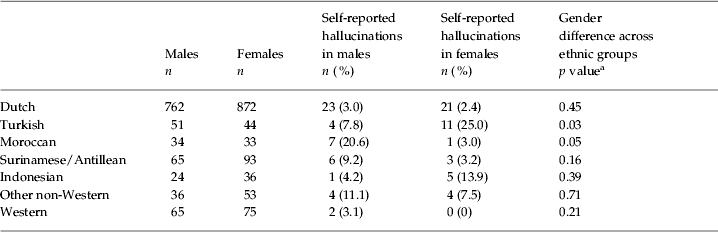
Ethnicity was associated with self-reported hallucinations (χ2=65.98, df=6, p<0.001), with the percentages of self-reported hallucinations being 2.7% for Dutch natives, 15.8% for Turks, 11.9% for Moroccans, 5.7% for Surinamese/Antilleans, 10.0% for Indonesians, 9.0% for other non-Western immigrants and 2.1% for Western immigrants. Table 1 shows that there is gender variation in self-reported hallucinations; Moroccan males were more likely to report hallucinations than Moroccan females, and Turkish females were more likely to report hallucinations than Turkish males.
Self-reported hallucinations across ethnic groups, stratified according to sex
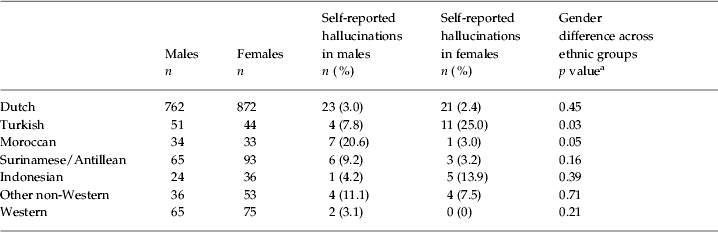
a χ2 test was conducted for Dutch natives and Turks; Fisher's exact test was conducted for all other ethnic groups because at least one expected cell count was less than 5.
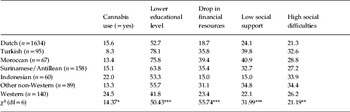
All non-Western immigrants groups, except Indonesians, had higher rates on most indicators of social adversity (Table 2). Further, ethnicity was significantly associated with the mean score on the social adversity index (F=16.51, df=6, 2247, p<0.001), independent of sex and age. Pairwise comparisons within ANOVA showed that the mean score on the social adversity index was significantly higher in Turks (mean=1.84, s.d.=1.02), Moroccans (mean=1.82, s.d.=1.07), Surinamese/Antilleans (mean=1.58, s.d.=1.10) and other non-Western immigrants (mean=1.54, s.d.=1.12) when compared to Dutch natives (mean=1.16, s.d.=0.96), whereas Indonesians (mean=1.17, s.d.=1.03) and Western immigrants (mean=1.13, s.d.=1.05) did not differ from Dutch natives. Cannabis use also differed across the ethnic groups: Western immigrants and Indonesians had higher rates, while Turks had lower rates in comparison to Dutch natives (Table 2).
Potential determinants of self-reported hallucinations across ethnic groups

df, Degrees of freedom.
Values are percentages.
χ2 test: * p<0.05, ** p<0.01,*** p<0.001.
Ethnic disparities in self-reported hallucinations
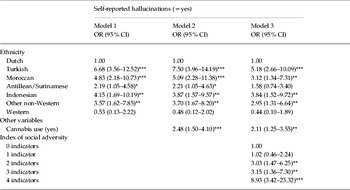
Logistic regression analyses indicated that ethnicity was associated with self-reported hallucinations, independent of sex and age, with highly increased odds ratios (ORs) for self-reported hallucinations in Turks, Moroccans, Indonesians and other non-Western immigrants and a moderately increased OR in Surinamese/Antilleans. Western immigrants, however, did not differ significantly from Dutch natives in the likelihood of self-reported hallucinations (Table 3, Model 1).
Associations between ethnicity (independent variable) and self-reported hallucinations (dependent variable), with and without adjustment for other variables

OR, Odds ratio; CI, confidence interval.
Model 1, OR adjusted for sex and age; model 2, OR adjusted for sex, age and cannabis use; model 3, OR adjusted for sex, age, cannabis use, and social adversity.
* p<0.05, ** p<0.01, *** p<0.001.
Adjustment for cannabis use (Table 3, Model 2) did not lead to reductions in the ORs for self-reported hallucinations among non-Western immigrants, while adjustment for social adversity (Table 3, Model 3) did. The reduction in OR was calculated from the equation: % reduction in OR=[(ORmodel2 – ORmodel 3)/(ORmodel 2 – 1)×100]. ORs were reduced in Turks (by 35.7%), Moroccans (48.2%), Surinamese/Antilleans (52.1%) and other non-Western immigrants (27.8%), but not in Indonesians.
Gender variation in self-reported hallucinations
We performed an additional logistic regression analysis stratified by gender, among Dutch natives and the groups with gender variation in self-reported hallucinations (i.e. Turks and Moroccans). Logistic regression analysis among Turkish, Moroccan and Dutch males showed that, after adjustment for age, Moroccan males were more likely to report hallucinations than Dutch males (OR 8.36, 95% CI 3.29–21.22), whereas Turkish males (OR 2.74, 95% CI 0.91–8.26) did not differ significantly from Dutch males. When additionally adjusting for cannabis use, the OR for Moroccan males (OR 8.56, 95% CI 3.34–21.94) hardly changed. However, after additional adjustment for the index of social adversity, the OR for Moroccan males (OR 4.76, 95% CI 1.67–13.54) showed a reduction of 50.3%.
Logistic regression analyses among Turkish, Moroccan and Dutch females revealed that, after adjustment for age, Turkish females were more likely to report hallucinations than Dutch females (OR 13.48, 95% CI 5.97–30.42), whereas Moroccan females (OR 1.15, 95% CI 0.15–8.85) did not differ significantly from Dutch females. When additionally adjusting for cannabis use, the OR for Turkish females (OR 13.90, 95% CI 6.12–31.59) hardly changed. After additional adjustment for the index of social adversity, however, the OR for Turkish females (OR 10.22, 95% CI 4.27–24.43) showed a reduction of 28.5%.
Associations between self-reported hallucinations and serious psychopathology
Among young adults who reported hallucinations (n=92), the majority (56.5%) had a deviant ASR Total Problem score, compared with only 14.7% of young adults who did not report hallucinations (n=2151). When stratifying by ethnicity, among young adults who reported hallucinations, the percentage with a deviant ASR Total Problem score was 50.0% in Dutch natives, 60.0% in Turks, 50% in Moroccans, 55.6% in Antilleans/Surinamese, 83.3% in Indonesians, 75.0% in other non-Western immigrants, and 50% in Western immigrants, compared with a much lower percentage with a deviant ASR Total Problem score in the groups who did not report hallucinations (13.0% in Dutch natives, 18.8% in Turks, 15.3% in Moroccans, 21.5% in Antilleans/Surinamese, 24.1% in Indonesians, 25.9% in other non-Western immigrants and 15.2% in Western immigrants). Logistic regression analysis revealed that the presence of self-reported hallucinations was strongly associated with having a deviant ASR Total Problem score (OR 6.70, 95% CI 4.31–10.44), independent of sex and age.
No interaction was found between self-reported hallucination and ethnicity in relation to having a deviant ASR Total Problem score (Wald=0.84, df=6, p=0.99).
Discussion
Main findings
In a general population sample of young adults, all non-Western immigrant groups reported hallucinations more often than Dutch natives did, whereas Western immigrants were similar to Dutch natives. When taking social adversity into account, the ORs for self-reported hallucinations in most non-Western immigrant groups showed considerable reductions, of 28–52%.
Interpretation of findings
In our study among young adults, 4.3% reported auditory or visual hallucinations in the past 6 months, which is comparable to findings for the UK, where 4% of the general population reported such experiences (Johns et al. Reference Johns, Nazroo, Bebbington and Kuipers2002).
Western immigrants were just as likely to report hallucinations as the native Dutch. Similarly, previous studies have indicated that the incidence of schizophrenia is not increased among Western immigrants (Selten et al. Reference Selten, Veen, Feller, Blom, Schols, Camoenie, Oolders, van der Velden, Hoek, Rivero, van der Graaf and Kahn2001; Veling et al. Reference Veling, Selten, Veen, Laan, Blom and Hoek2006). We also found that the likelihood of self-reported hallucinations was increased in all non-Western immigrant groups, that is in Turks, Moroccans, Indonesians, Antilleans/Surinamese, and other non-Western migrants. Similarly, Veling et al. (Reference Veling, Selten, Veen, Laan, Blom and Hoek2006) found higher incidence rates of schizophrenia in immigrants from Morocco, Surinam and other non-Western countries, but the incidence rate was only slightly increased for Turkish immigrants. Thus, the sevenfold increased likelihood of self-reported hallucinations for Turkish immigrants in our study is much higher than the increase reported for schizophrenia (Veling et al. Reference Veling, Selten, Veen, Laan, Blom and Hoek2006). It is possible that the incidence of schizophrenia in Turkish immigrants has been underestimated, as the incidence studies are based on contact rates with health services. Our population-based data provide support for this possibility; when controlling for sex, age and ASR Total Problem score, Turkish immigrants have a lower likelihood of mental health service use than Dutch natives (results not shown). However, self-reported hallucinations are not the same as a diagnosed psychotic disorder. Consequently, ethnic disparities in psychotic disorder may not be accompanied by identical ethnic disparities in self-reported hallucinations.
We found an increased likelihood of self-reported hallucinations among Moroccan males and Turkish females, but the likelihood was not increased among Moroccan females and Turkish males. In accordance with our findings, the incidence of schizophrenia is increased in Moroccan men but not in Moroccan women (Selten et al. Reference Selten, Veen, Feller, Blom, Schols, Camoenie, Oolders, van der Velden, Hoek, Rivero, van der Graaf and Kahn2001; Veling et al. Reference Veling, Selten, Veen, Laan, Blom and Hoek2006). Veling et al. (Reference Veling, Selten, Veen, Laan, Blom and Hoek2006) did not have sufficient power to examine gender differences, although in accordance with our findings the absolute values of the incidence rate ratios were higher in Turkish females than in Turkish males.
This study demonstrates that the ORs for self-reported hallucinations among non-Western immigrants were reduced by 28–52% when taking social adversity into account. The causal direction of the association between social adversity and self-reported hallucinations should be interpreted with caution. It is likely that social adversity explains at least in part the increased likelihood of self-reported hallucinations among non-Western immigrants. First, a growing body of evidence suggests that social adversity is causally implicated in the development of psychotic disorders among migrants. Factors related to social adversity, such as being born in deprived areas (Castle et al. Reference Castle, Scott, Wessely and Murray1993; Harrison et al. Reference Harrison, Gunnell, Glazebrook, Page and Kwiecinski2001), childhood trauma (Morgan & Fisher, Reference Morgan and Fisher2007), deafness (David et al. Reference David, Malmberg, Lewis, Brandt and Allebeck1995) and low IQ (David et al. Reference David, Malmberg, Brandt, Allebeck and Lewis1997), have been associated with an increased risk of developing a psychotic disorder, with possible mechanisms being increased exposure to life events and social exclusion (Selten & Cantor-Graae, Reference Selten and Cantor-Graae2005). In accordance with findings from our study, it has been shown that migrants generally experience greater social adversity than native people do (Fearon & Morgan, Reference Fearon and Morgan2006). Second, continuities have been found between self-reported hallucinations and psychotic disorders. For example, self-reported psychotic symptoms (including hallucinatory experiences) at age 11 years predicted a very high risk of a diagnosis of schizophreniform disorder at age 26 years (Poulton et al. Reference Poulton, Caspi, Moffitt, Cannon, Murray and Harrington2000). Given the continuity between psychotic-like symptoms and psychotic disorders and the evidence for social adversity as a cause of the increased psychosis rate among migrants, we consider it likely that social adversity contributes at least in part to ethnic disparities in self-reported hallucinations.
Although ethnic disparities in self-reported hallucinations may reflect actual differences between certain ethnic groups, they could also reflect cultural differences. For example, among Moroccans, the belief in witchcraft and evil spirits is not uncommon (Van Gemert, Reference Van Gemert1998). Given that hallucinatory experiences are more positively valued in some non-Western cultures, they may be more frequently noticed and reported (Al-Issa, Reference Al-Issa1995). However, it is unlikely that self-reported hallucinations among non-Western migrants reflect merely cultural expressions without any clinical significance. Our data indicate that self-reported hallucinations are of equal clinical significance among the different ethnic groups. Young adults who reported hallucinatory experiences were seven times as likely to have serious internalizing and externalizing problems than young adults who did not report such experiences; this association was equally strong for all ethnic groups in our study.
Our results should be considered within the context of the following limitations. First, hallucinations were assessed by self-report, which may not bear up to rigorous clinical assessment. Nevertheless, the phrasing of the ASR hallucination items does approximate to the DSM-IV definition of hallucinations as ‘sensory perceptions that have the compelling sense of reality of a true perception but that occur without external stimulation of the relevant sensory organ’ (APA, 1994). Second, non-Western immigrants had a higher non-response rate than did Dutch natives. If people with psychotic symptoms were less willing to participate, this may have resulted in an underestimation of the prevalence rates of hallucinations for non-Western immigrants. Third, although our measure of social adversity included several indicators of adversity, we did not measure all relevant social factors. It is likely that other factors related to social adversity also contribute to ethnic disparities in self-reported hallucinations found in this study. For example, perceived discrimination has been associated with increased incidence of schizophrenia (Veling et al. Reference Veling, Selten, Susser, Laan, Mackenbach and Hoek2007) as well as with psychotic symptoms such as delusional ideation (Janssen et al. Reference Janssen, Hanssen, Bak, Bijl, de Graaf, Vollebergh, McKenzie and van Os2003). Childhood experiences, such as being born in a deprived area, may also be important indicators of social adversity (Castle et al. Reference Castle, Scott, Wessely and Murray1993; Harrison et al. Reference Harrison, Gunnell, Glazebrook, Page and Kwiecinski2001).
In conclusion, the ethnic disparities in self-reported hallucinations demonstrated in the present study partly match the ethnic disparities in the incidence of schizophrenia and are explained for 28–52% by social adversity. These findings are supportive of a continuum of psychotic experiences. Improving social conditions for non-Western migrants may lower their risk of psychotic-like experiences and psychotic disorders.
Acknowledgements
This study was supported by funding from The Netherlands Organization for Health Research and Development, grant no. 2100.0089.
Declaration of Interest
None.