Introduction
There is increasing interest in characterizing the biodiversity and ecology of mesophotic ecosystems and particularly mesophotic coral reefs (MCRs) that span the 30–150 m depth range. The increasing availability of remotely operated vehicles (ROV) means these reefs are becoming increasingly accessible (e.g. Kahng et al., Reference Kahng, Copus and Wagner2014; Englebert et al., Reference Englebert, Bongaerts, Muir, Hay, Pichon and Hoegh-Guldberg2017). However, despite this, there are still some highly diverse geographic areas where mesophotic ecosystems have yet to be explored and characterized. Kahng et al. (Reference Kahng, Garcia-Sais, Spalding, Brokovich, Wagner, Weil, Hinderstein and Toonen2010) reviewed the distribution of MCR studies and at that time, no studies had been conducted in Indonesia, where biodiversity is considered to be among the highest anywhere in the world. To date, there have still been no published studies exploring Indonesian mesophotic ecosystems to see if they are dominated by coral as they are in other regions. The Wakatobi Marine National Park (WMNP) in SE Sulawesi (Indonesia) hosts rich and diverse shallow water benthic communities, but they have experienced large declines in coral cover in recent decades (McMellor & Smith, Reference McMellor, Smith, Clifton, Unsworth and Smith2010). Despite the strong focus on shallow water communities in the WMNP (e.g. Bell & Smith Reference Bell and Smith2004; Crabbe & Smith, Reference Crabbe and Smith2005; Powell et al., Reference Powell, Smith, Hepburn, Jones, Berman and Bell2014), very little is known of the ecosystems below 18 m. The aim of this study was to explore and characterize deeper water (to 80 m) benthic communities at two sites in the WMNP.
Materials and methods
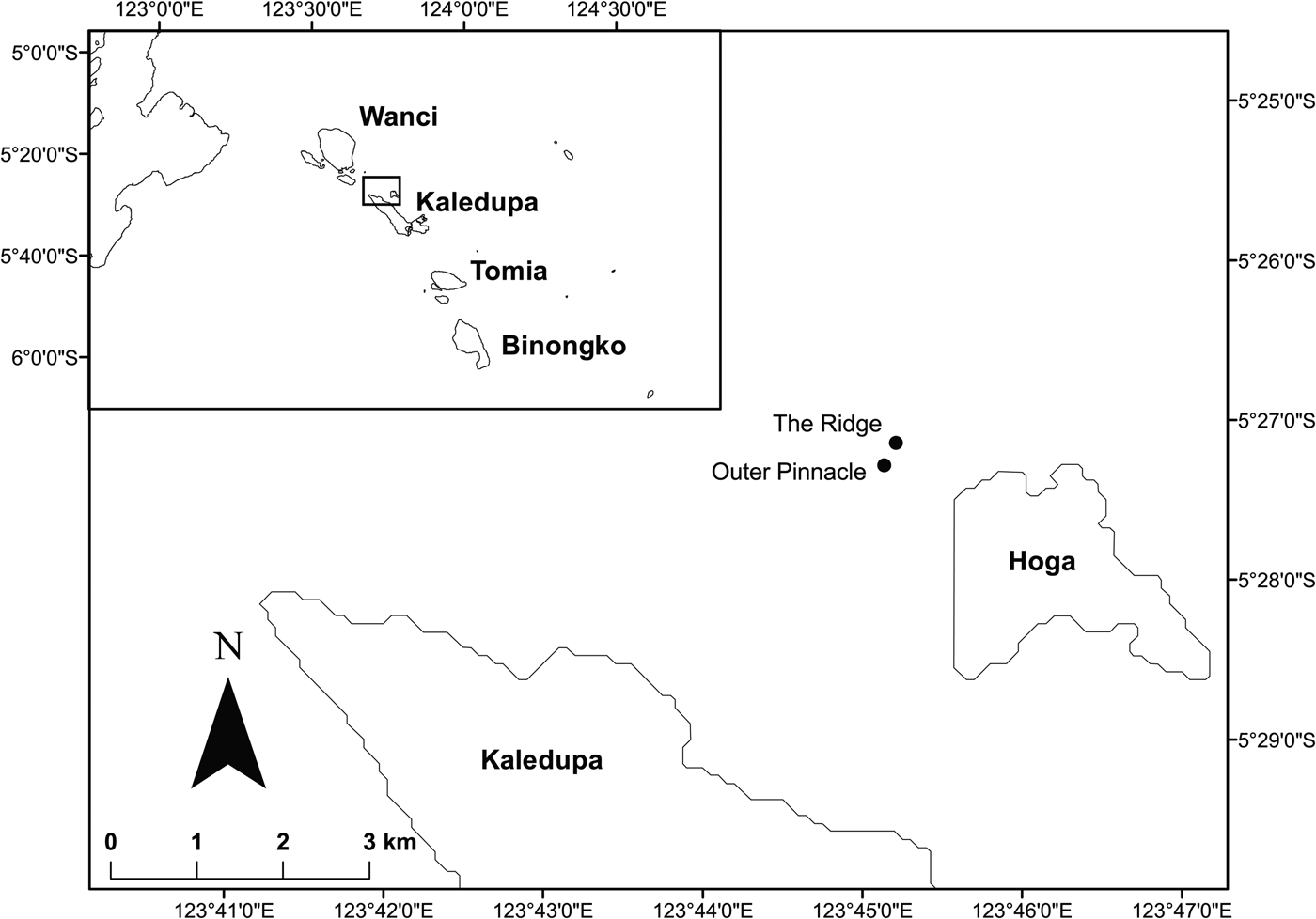
The WMNP (Figure 1) is Indonesia's third largest marine national park and was gazetted in 1996 (Clifton & Unsworth, Reference Clifton, Unsworth, Clifton, Unsworth and Smith2010). The park is located in the Coral Triangle Region and supports highly diverse marine communities, but is also inhabited by over 90,000 people who are heavily dependent on reef resources for food and income. Declines in hard coral cover in shallow waters have been documented in the park since 2002 (McMellor & Smith, Reference McMellor, Smith, Clifton, Unsworth and Smith2010). We conducted a number of preliminary ROV deployments at two sites, known locally as Ridge 1 and Outer Pinnacle, which are ~200 m apart (Figure 1), and are part of the same fringing reef system. For a full description of the environmental conditions and biological communities found in the shallow areas at Ridge 1 see Powell et al. (Reference Powell, Smith, Hepburn, Jones, Berman and Bell2014). Briefly, Ridge 1 has lower turbidity, sedimentation rates and higher chlorophyll concentrations at 10 m than other sites locally with relatively high coral cover (estimated at 35% at 10–15 m in 2010; Powell et al., Reference Powell, Smith, Hepburn, Jones, Berman and Bell2014). No environmental data have previously been collected at Outer Pinnacle.
Map of the Wakatobi Marine National Park, Indonesia, and location of two sites where the mesophotic reefs were sampled (adapted from Marlow et al., Reference Marlow, Schönberg, Davy, Haris, Jompa and Bell2018).

To sample the deepwater communities, we used the mini ROV, ‘SAL’, which is a Deep Trekker DTG2 (see http://www.deeptrekker.com). The ROV is rated to 150 m depth (although the maximum depth of continuous reef sampled in this study was 80 m). The unit is equipped with a low resolution internal camera for orientation, an externally mounted GoPro 4 capable of up to 4 K video resolution and a laser for sizing. Although continuous reef continued to ~100 m at these sites where the reef became more broken, we only sampled to a maximum depth of 80 m to avoid getting the ROV and its cable caught in the overhangs that were dominant between 80–100 m. For quantitative analyses, we deployed the ROV to 80 m, and kept the ROV at that depth while moving horizontally along the reef with the camera directly focused toward the reef. At each sampling point the ROV was held as stationary as possible at a distance of 30–40 cm from the substratum for ~15 s to try and collect a steady image for processing later. After 15 s the ROV was then moved 1–2 m along the reef at the same depth and the same process repeated. After filming for ~5 min the ROV was manoeuvred to a shallower depth and the sampling continued. Sampling was undertaken at 5, 10, 15, 30, 50 and 80 m depth. The video was played back in VLC media player, and still images (N = 5–7 from each depth) were extracted from the video by haphazardly stopping the recording where the frames were in focus and the laser positioning indicated the area being examined was ~0.5 m2 giving a total sampled area of ~2.5–3.5 m2 at each site, at each depth. These images were collected over a 5-day period in June 2017. Coral Point Count (CPCe) analysis (Kohler & Gill, Reference Kohler and Gill2006) was used to measure the percentage cover of different major groups of benthic organisms within the frame grabs obtained from the ROV footage. CPCe randomly allocates points over a given image and the user then manually identifies the substrate type or benthic taxa beneath each point. The software uses this input to estimate substrate composition across the entire frame grab (percentage cover of each substrate/benthic group). We overlaid 50 points on each frame grab (N = 5–7) from each depth (5, 10, 15, 30, 50 and 80 m) at each site (N = 2). The benthic categories used in this study were hard coral, soft coral, sponge, crustose calcareous algae, bare substrate and ‘other’, which included a range of tubeworms, molluscs, ascidians, bryozoans, gorgonians and other algae. Gorgonians are likely under-represented in our sampling as there were many large examples, but we specifically avoided these areas to avoid damage and entanglement.
Multivariate analyses were conducted within the PRIMER-E v6 software package with the Permutational Multivariate Analysis of Variance (PERMANOVA) add-on (Clarke & Gorley, Reference Clarke and Gorley2006) to compare the benthic community composition between depths and sites. The benthic community data analyses were based on resemblance matrices calculated from square-root transformed data using Bray–Curtis similarity coefficients. Data were transformed to reduce the influence of abundant and rare groups (Clarke & Warwick, Reference Clarke and Warwick2001). Differences in assemblage composition among depths and sites was assessed using PERMANOVA with depth and site as factors.
Results
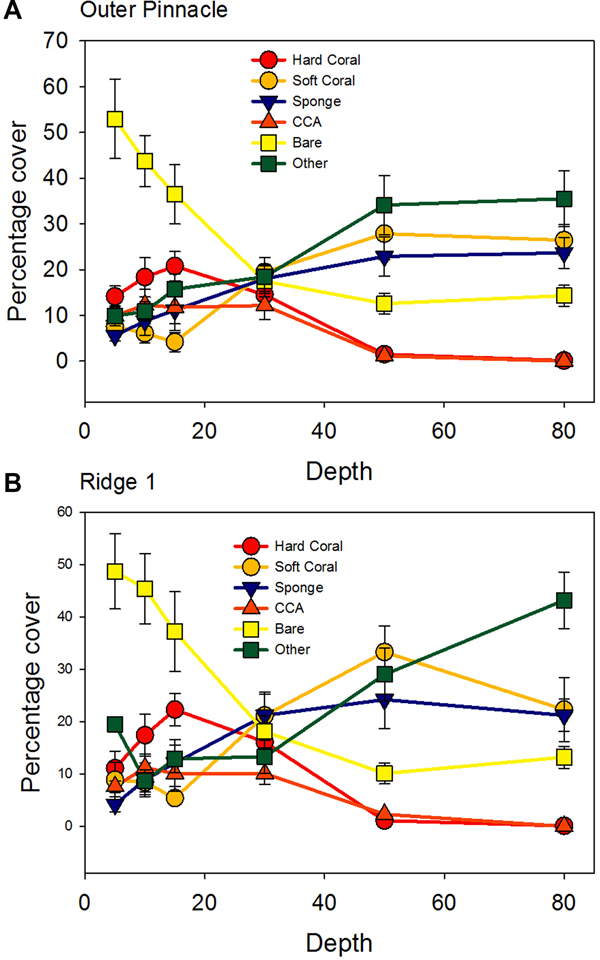
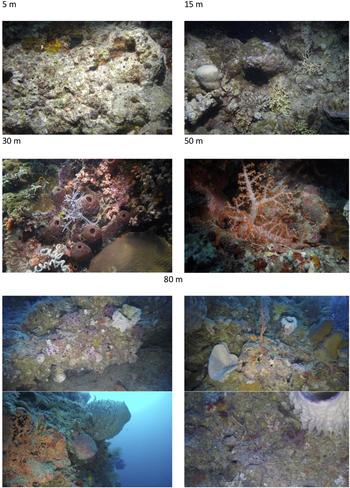
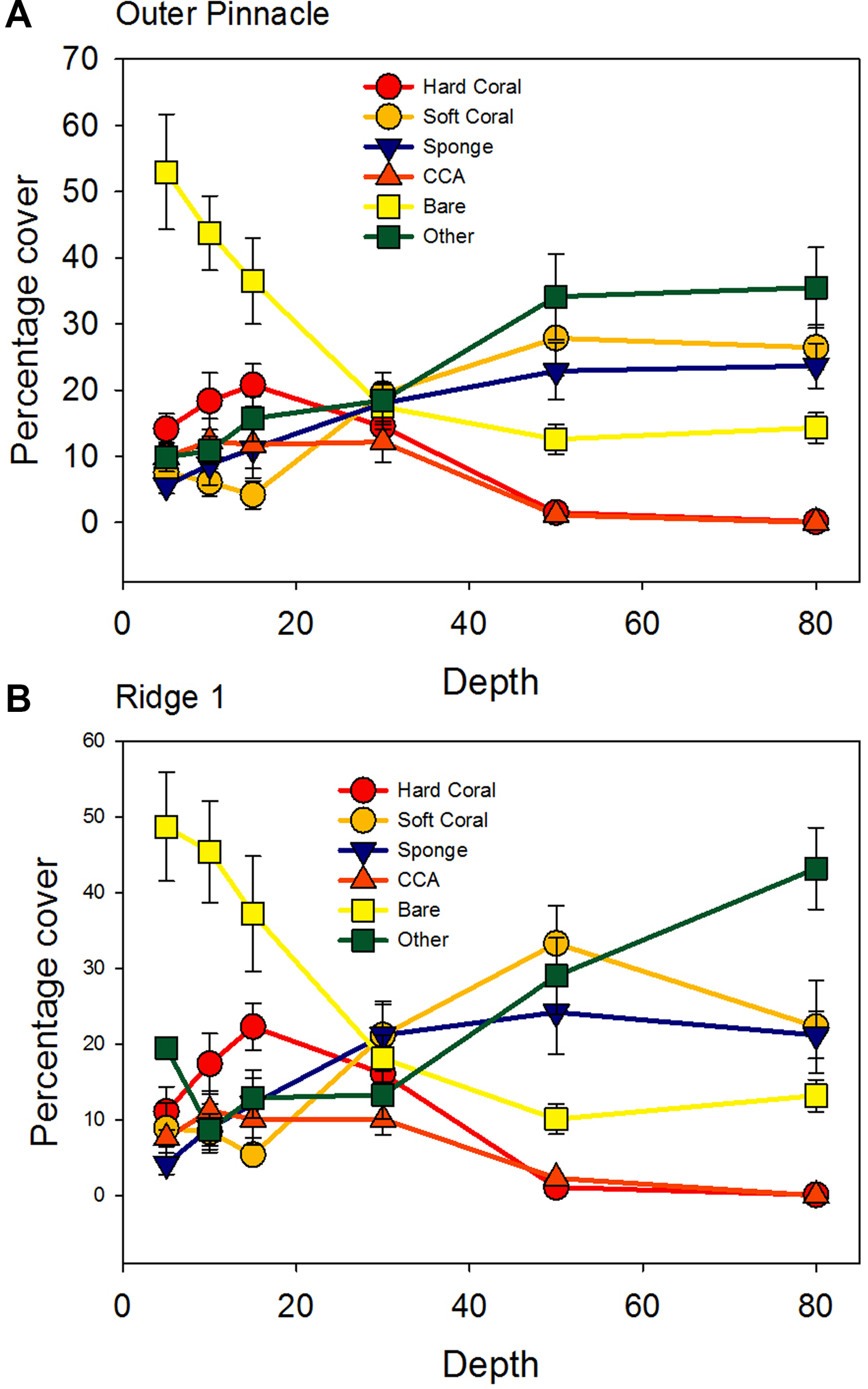
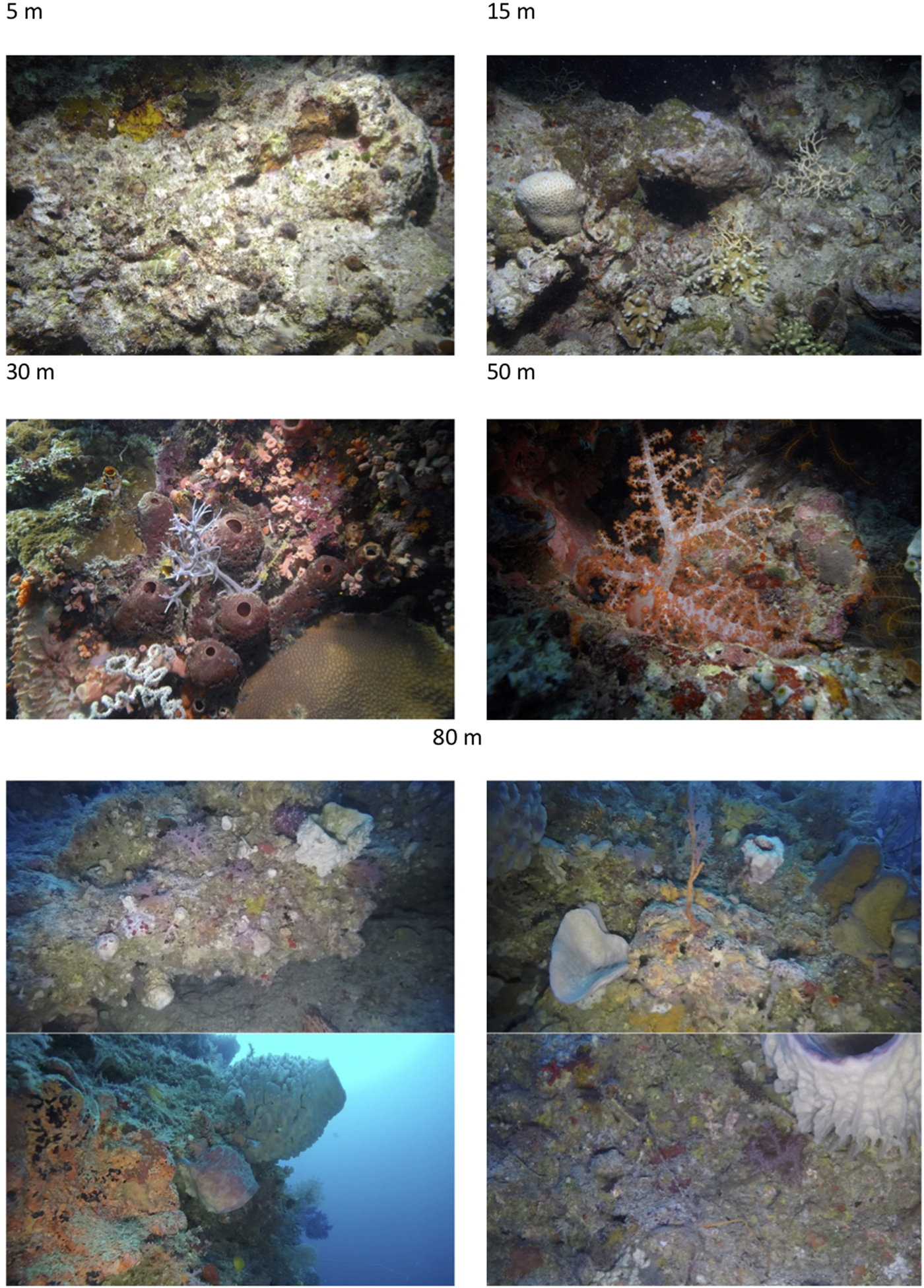
The two areas where the ROV was deployed showed very similar changes in benthic community composition with increasing depth (Figures 2 and 3). This was confirmed by the PERMANOVA, which showed a significant difference between depths (PERMANOVA, F (5,58) = 38.904, P = 0.001), but not between sites (PERMANOVA, F (1,58) = 1.04, P = 0.31). Both sites were dominated by bare space at 5, 10 and 15 m (~50–30%), bare space then decreased considerably with increasing depth, to be colonized by a range of benthic organisms. Coral cover increased with depth, reaching a maximum at 15 m, but then declined substantially by 30 m, to be replaced by sponges, soft corals and other benthic organisms. We found <1% coral cover at 50 m and below, and much less bare space at 30 m and deeper compared with shallower water. The complexity of the reef also decreased with depth, with mostly encrusting, two-dimensional forms dominating below 50 m. The exception was the presence of large (greater than 1.5 m in diameter in many cases) barrel sponges (Xestospongia spp.) and sea fans (see Figure 3).
Changes in the benthic organisms with depth (metres) at two sites (~200 m apart) in the Wakatobi Marine National Park, Indonesia.
Examples of the benthic communities at 5, 15, 30, 50 and 80 metres. Note that the pictures taken at 5 and 10 m were taken on scuba. 5 m – dominated by bare space; 15 m – dominated by coral and bare space; 30 m – dominated by mixed community of coral, sponges, CCA and soft coral (hard coral 15%); 50 m – dominated by mixed community of sponges, soft coral, and other benthic encrusting animals (hard coral <1%); dominated by mixed community of sponges, soft coral and other benthic encrusting animals.
Discussion
Here we present the first description of the organisms inhabiting mesophotic habitats in Indonesia. However, it is important to note that we have only quantitatively examined a very small area of the total reef area at the two sites and it is possible these areas are not representative of the wider Wakatobi. However, other ROV deployments across other areas at our sampling sites, along with shorter non-quantitative deployments at other sites in the Wakatobi by the authors also support the low coral abundance that we reported below 50 m. At 50 m and below we found a dominance of sponges, soft corals, gorgonians and other benthic, non-coral organisms.
Other studies from mesophotic depths in the Caribbean (e.g. Hoeksema et al., Reference Hoeksema, Bongaerts and Baldwin2017), Hawaiian Islands (Rooney et al., Reference Rooney, Donham, Montgomery, Spalding, Parrish, Boland, Fenner, Gove and Vetter2010) and the Great Barrier Reef (Englebert et al., Reference Englebert, Bongaerts, Muir, Hay, Pichon and Hoegh-Guldberg2017) have reported the presence of coral at much great depths (>120 m) than we reported here and there are a number of potential explanations for this difference including: (1) light penetration to support corals being much more limited in the Wakatobi compared with other sites; (2) increased sedimentation with depth, which smothers corals; (3) damage to the hard coral as a result of recent bleaching events in the Wakatobi in 2016 (authors’ unpublished data); and (4) regional-scale differences between the mesophotic environments in the Wakatobi and other geographic areas. Reduced light penetration seems the most plausible explanation since benthic communities at 50 m and below seem well developed, with large sponges and soft corals, and CCA abundance also showed a similar overall pattern of decline with depth. Initial observations of the videos also suggest that the assemblage composition for specific taxa is also different in deeper water compared with shallow water, particularly for sponges and soft corals, where many species at 50–80 m are not seen near the surface. It is also possible that sedimentation could influence the benthic community distribution, as we found some evidence of sediment accumulation on rock surfaces (<3%), although it did not appear to increase with depth.
In shallow water we found a high proportion of bare space that probably represents the long and continued history of exploitation of the shallow water areas on reefs generally in the Wakatobi (see McMellor & Smith, Reference McMellor, Smith, Clifton, Unsworth and Smith2010). Interestingly, our estimates of coral cover are markedly lower than those reported in 2013, suggesting on-going reef degradation in shallow water. As our study is the first to sample mesophotic ecosystems in the Wakatobi, it is unclear if these deeper water areas are being influenced by surface water anthropogenic activities, and future monitoring of these deeper water areas is required.
Sponges were an important component of the benthic community below 50 m and there were many large barrel sponges. Interestingly, unlike their shallow water counterparts, these sponges were all ‘bleached’ white, suggesting they have much reduced abundance of cyanobacteria in their outer tissue layer. Since there is no reason to believe this is not the natural state of these sponges, it does suggest Xestospongia spp. are not particularly dependent on their cyanobacteria for nutrition. However, Xestospongia muta from the Caribbean has been reported to undergo both cyclical bleaching and reduction in cyanobacterial abundance, but no stress is caused to the sponge (López-Legentil et al., Reference López-Legentil, Song, McMurray and Pawlik2008). While it is possible that cyclical bleaching is occurring in the Xestospongia spp. in the Wakatobi, it seems unlikely since no shallow water barrel sponges were ‘bleached’.
In conclusion, our results show that the deeper water communities in the Wakatobi are dominated by soft corals, sponges and other benthic organisms rather than hard corals like other mesophotic habitats. Further research is needed to determine how these reefs function, how they differ from shallow water reefs, and if they are able to support shallower water communities, for example through larval subsides. There is also a need to quantify the importance of environmental parameters that might explain the depth-related patterns we have observed, as currently data are only available for shallow water (10–15 m) environments (see Powell et al., Reference Powell, Smith, Hepburn, Jones, Berman and Bell2014; Marlow et al., Reference Marlow, Schönberg, Davy, Haris, Jompa and Bell2018). Importantly, there has been discussion in the literature about the potential for shallow water coral reefs to transition to reefs dominated by other groups of organisms including sponges and soft coral (Bell et al., Reference Bell, Davy, Jones, Taylor and Webster2013), and understanding the ecology of these deeper water reefs could provide insights into how altered shallow water reefs might function since they are already dominated by these groups.
Acknowledgements
We are grateful to Operation Wallacea for providing logistical support to the project. This work was conducted under permit from the Indonesian Ministry of Research and Technology (RISTEK) 141/SIP/FRP/E5/Dit.KI/VI/2017.
Financial support
We thank the George Mason Trust for funding to purchase the ROV, and Victoria University of Wellington for travel funding.