1. Introduction
In this paper, we compare semantic and syntactic features of periphrastic progressive constructions in Dutch and Afrikaans. In particular, we provide a corpus-based analysis of the Dutch aan het- lit. ‘on the’, bezig met/(om) te- lit. ‘busy with/to’, and cardinal posture verb constructions (with staan ‘stand’, zitten ‘sit’, liggen ‘lie’, or lopen ‘walk’ followed by te + verb infinitive). These data are contrasted with corpus data of the Afrikaans aan die/’t- lit. ‘on the’, besig om te- lit. ‘busy to’, and cardinal posture verb constructions (with staan ‘stand’, sit ‘sit’, lê ‘lie’, or loop ‘walk’ followed by en + verb; henceforth CPV-constructions). This is the first time such a comparison is undertaken on the basis of corpora that are equal in size (both about 57 million words) and of similar composition, containing roughly the same types of written text. The same methodological steps have been followed in the analysis of both corpora, so that the results are maximally comparable. This approach does not only allow us to compare frequencies of use along a number of relevant parameters, but also to investigate formal and functional similarities and differences between constructions that are relatively infrequent in one language or the other. Moreover, by investigating all three clusters of progressive constructions in Dutch and Afrikaans, the present study is wider in scope than previous investigations, which focus either on a single cluster in both languages (for example, Geleyn & Colleman Reference Geleyn and Colleman2014, Breed & Brisard Reference Breed and Brisard2015) or on several clusters in one language (for example, Breed & Van Huyssteen Reference Breed and Van Huyssteen2015, Lemmens Reference Lemmens2015).
The goal of this study is to determine to what extent each of the constructions has grammaticalized into a progressive marker. To that end, we asked the following questions:
-
(i) What is the overall frequency of the periphrastic progressive constructions? (section 4)
-
(ii) What are the frequency of aspectual versus nonaspectual uses for each construction? (section 5)
-
(iii) How freely does each construction combine with various verbs and verb types, and how strong are those collocations? (section 6)
-
(iv) Are those constructions compatible with transitive predicates, and can they be passivized? In this regard, we also considered the formal unit status of various collocations, specifically, impene-trability to complements (section 7).Footnote 1
Assuming that semantic bleaching is the core defining feature of the grammaticalization process, with respect to questions (ii) and (iii), we considered the generality of meaning/use of each construction.
We argue that overall, speakers of Afrikaans tend to pay more attention to the expression of progressive aspect than speakers of Dutch, as specifically attested by the high frequency of the besig-construction. In this respect, Afrikaans can be said to occupy a position between English (obligatory marking of progressive aspect with dynamic verbs) and Dutch. The following important observation supports this claim: In Dutch and other languages without a highly grammaticalized and systematically used progressive constructions (such as German or French), progressive marking is motivated by special emotional or other nontemporal considerations. In contrast, in Afrikaans the use of progressive constructions is not usually determined by this type of nontemporal meaning (see below). Moreover, the construction of choice used to express progressive aspect in Afrikaans, that is, the besig-construction, exhibits all the typical characteristics of a high degree of grammaticalization, including high frequency of use and generality of contexts. All other constructions, in both Dutch and Afrikaans, can be shown to have traits that point to a certain level of semantic persistence (that is, nongeneralization) when they are used to express progressive aspect.Footnote 2
While in this study we definitely want to suggest that, overall, speakers of Afrikaans tend to pay more attention to the expression of progressive aspect than speakers of Dutch, we are aware of the nontrivial difficulties and pitfalls that might be involved. Most importantly, comparing the formal unit status (degree of word order flexibility) of progressive constructions directly across these two languages runs into the following problem: Differences may arise due to more general properties of the languages involved, rather than to the constructions per se. For instance, Afrikaans generally allows the incorporation of objects with verbs much more freely than Dutch. For this reason, we refrain from comparing the two languages directly for this variable and include data on the relative positioning of verb and object exclusively to document and illustrate the different possibilities that exist in each language in this respect. Therefore, our main claim about the difference between Dutch and Afrikaans is primarily motivated by the following factors: different frequency relations (as shown below); the semantics of the constructions, as manifested through (non)aspectual uses and collocational tendencies; and to a certain extent their syntax—transitivity and passivizability, which reflect “raising” properties (Los et al. Reference Los, Blom, Booij, Elenbaas and van Kemenade2012:66) pointing to greater integration.
By way of corroborating evidence, we also refer to the often observed correlation between a lower degree of grammaticalization of progressive constructions and their (prime) use to express various nontemporal, (inter)subjective meanings, including feelings of irritation, surprise, and incongruity (sometimes referred to collectively as “interpretative” uses of the progressive; see Ljung Reference Ljung1980). This correlation has been demonstrated, for instance, for French (Franckel Reference Franckel1989, De Wit et al. Reference De Wit, Patard and Brisard2013) and German (Anthonissen et al. Reference Anthonissen, De Wit and Mortelmans2016): Rarely is a progressive used in these languages merely to express ongoingness or duration. Instead, the most prototypical uses seem to be associated with intense (negative) emotions and modal connotations.
We submit the same is true for the majority of uses of the Dutch constructions reported in this study, which reflects a lower degree of grammaticalization. We do realize that it is hard to quantify a feature that is so subjective (in the sense of expressing the speaker’s stance toward a proposition); yet we propose that most examples of Dutch progressive constructions given below express a feeling that there is something wrong or otherwise special about the event described. In Afrikaans, in contrast, this only holds for the CPV-constructions and much less so for aan die/’t- and besig-constructions.Footnote 3
Since we do not use the nontemporal meaning of Dutch and Afrikaans progressives as a systematic criterion for establishing degree of grammaticalization, these observations do not add substantially to our claim. However, they do further support our approach to studying aspectual categories in general. We believe that there is an important interface between aspect and modality, and a comprehensive description of any aspectual construction should take this interface into account (see, for example, Abraham Reference Abraham, Abraham and Leiss2008 and Leiss Reference Leiss2000, the latter specifically on “backgrounding” imperfectives and epistemic modality).
The structure of the paper is as follows. In section 2, we define the relevant concepts associated with progressive aspect and discuss the lexical sources of periphrastic progressive constructions in the Germanic languages. Sections 3–8 present the main corpus findings, starting with an introduction of the two corpora (section 3), and continuing with the analysis of the results for overall frequency of use of the periphrastic progressive constructions (section 4), frequency of their aspectual versus nonaspectual uses (section 5), collocations with various verbs and verb types (section 6), and transitivity (section 7). Finally, section 8 concludes the discussion.
2. Definitions and Origins of Aspectual Categories
2.1. Imperfective and Progressive
The present study deals with the expression of grammatical aspect, defined as a linguistic category that characterizes how a speaker views the temporal contour of a situation referred to. As such, it offers a certain viewpoint on said situation: “The aspectual viewpoint of a sentence functions as an independent lens on the situation talked about. Viewpoint makes visible all or part of a situation, without obscuring the conceptual properties of the situation type” (Smith Reference Smith1997:126). Traditionally (Comrie Reference Comrie1976), a general distinction is made between two basic perspectives: perfective versus imperfective. Whereas perfective aspect presents a situation as a single whole, without attending to the various distinct phases that make it up, imperfective aspect focuses on the internal structure of the situation. Since progressive aspect is regarded as a subtype of imperfective aspect, we are concerned with the latter category only, as exemplified in the following use of the English present progressive (or continuous) construction.
-
(1) I’m kicking the ball.
In 1, the event of kicking is viewed from within. It is construed as unbounded in time (despite the knowledge that the event of kicking a ball is bounded) and internally homogeneous. This means that component states are treated as identical (precluding distinctive initial and final states; compare Langacker Reference Langacker1990), so that the event in question acquires an overall (if momentary) state-like character.Footnote 4 This imperfectivizing construal of an ongoing situation (usually a dynamic event whose boundaries still feature in the conceptual background) overlapping with the time of speaking or another reference time is typical of many progressive constructions in the world’s languages. In addition, progres-sives may also be used to suggest the less than permanent or temporary character of a state of affairs: In other words, an actually ongoing situation is regarded by the speaker as contingent and phenomenal, rather than structural and consolidated (Goldsmith & Woisetschlaeger Reference Goldsmith and Woisetschlaeger1976, De Wit & Brisard Reference De Wit and Brisard2014).
We use the term progressive to refer to a type of imperfective aspect, next to nonprogressive imperfectives such as habitual/generic. Progres-sives designate a single or multiple process(es) that are actually ongoing (continuous), whereas with generics or habituals, the state or habit in question does not need to be literally going on at the time of speaking. The most prototypical type of progressive is what can be referred to as continuative or durative, a kind of phasal aspect simply referring to one ongoing state of affairs. Continuous, which has to be distinguished from continuative, is more general than progressive, strictly speaking, “because it can be used in progressive situations but in addition with stative predicates” (Bybee et al. Reference Bybee, Perkins and Pagliuca1994:127, following Comrie Reference Comrie1976). For instance, Afrikaans hou aan ‘keep on’ and bly ‘remain’ are best characterized as separate constructions dedicated to the expression of continuous meaning, as in 2 and 3, while a construction involving the word besig ‘busy’ is not just continuous but may be used to express the whole range of progressive meanings.
-
(2)

-
(3)

An instance of the continuative category was given in example 1. In the next section, we turn to the various lexical origins of grammatical constructions—usually periphrastic—expressing progressive aspect, a good number of which are represented in Dutch and Afrikaans.
2.2. Lexical Sources of Progressives
Based on Bybee et al. Reference Bybee, Perkins and Pagliuca1994 and Heine Reference Heine and Pagliuca1990, we identify the following four major lexical sources for the grammatical development of progressive constructions that are directly relevant for the Germanic languages:
-
(i) locative constructions
-
(ii) equation sentences
-
(iii) movement verbs
-
(iv) ‘keep on V-ing’ / ‘continue to V’
Bybee et al. (Reference Bybee, Perkins and Pagliuca1994:131) describe this first source, that is, locative-based progressives, as follows:
[They] always derive from a construction which originally included an element with locative meaning. Or, stated another way, aside from movement sources, reduplication, and constructions with verbs meaning ‘to keep on’, all progressives derive from locative constructions.
Though this is perhaps too strong a hypothesis typologically speaking, it certainly seems to fit the Germanic picture to a large extent.
Equation sentences, of the type X is (a) Y (for example, He is (an) eating (one)), are especially common with some kind of present participle, a strategy not or no longer favored in Germanic languages. In English, for example, the real participle construction has been replaced, as is well known, by the -ing-construction, which is said to derive from a construction with a locative preposition before the gerund (something like He is on hunting / He was a-coming home; see Jespersen Reference Jespersen1931).
Movement verbs, such as Spanish seguir ‘follow’, can also give rise to progressive constructions (Bybee et al. Reference Bybee, Perkins and Pagliuca1994:133). These, too, do not appear as frequently within the Germanic family, except perhaps with the verbs come and go in expressions such as to go around V-ing. Constructions of the type keep on V-ing illustrated in 2 were referred to as continuous in the previous section. They may, in certain cases, acquire other progressive meanings as well.
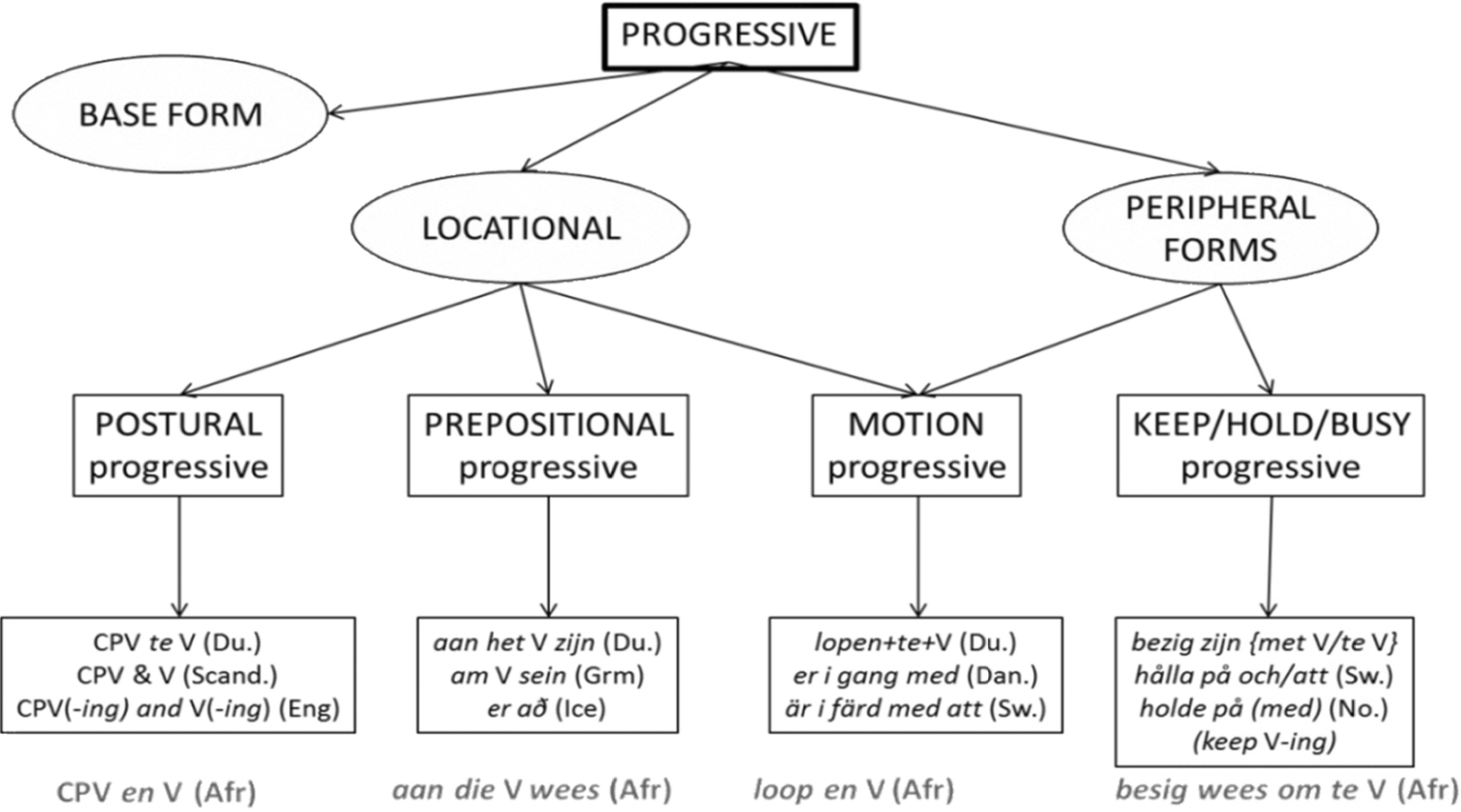
In figure 1, we offer the schema presented in Lemmens Reference Lemmens2008, showing different possible types of progressive constructions in Germanic languages, complemented with information on Afrikaans.Footnote 5
Progressive in the Germanic languages.

In this schema, we notice four distinct lexical sources for the grammatical expression of progressive aspect, which can in turn be grouped into two more general categories. In line with Bybee et al.’s (Reference Bybee, Perkins and Pagliuca1994:132) suggestion, most “nascent” progressive constructions in the Germanic languages instantiate some kind of locative construction, be it with the main verb as a verbal noun/gerund or in the form of a serial construction with posture verbs. According to Kuteva (Reference Kuteva1999:191), those languages that encode spatial position of an entity in terms of sitting, standing, or lying tend to elevate “the corresponding verb structures to the status of basic, most common verb expressions and thus [make] them appropriate source structures in auxiliation.” This is especially true for Dutch and Afrikaans.
As for the “peripheral” forms identified in figure 1, perhaps keep/hold-constructions should be separated from busy-constructions because the former seem to be the source for specialized constructions expressing continuous meaning (for example, Afrikaans Ek hou aan werk ‘I keep on working’), while busy-constructions can develop a broader range of progressive meanings/uses, as is the case with Afrikaans besig-constructions.
3. A Corpus-Based Comparison: Dutch Versus Afrikaans
Dutch and Afrikaans are closely related sister languages, both deriving from 17th-century Dutch (see, for example, Raidt Reference Raidt1972:177, Dekker Reference Dekker1973:6, Botha et al. Reference Botha, Ponelis, Combrink and Odendal1989:51, Carstens Reference Carstens1989:144, Mesthrie Reference Mesthrie1995:214, Sebba Reference Sebba1997:161). They are generally said to have a high degree of lexical overlap (up to 90–95% of the vocabulary), as well as many grammatical similarities. On this basis, and despite the obvious differences in evolution both languages have gone through over the ages, we expect more or less the same grammatical usage for cognate constructions, as well as similar patterns of grammaticalization for the constructions concerned.Footnote 6
3.1. Dutch and Afrikaans Progressives
In figure 1, the four cognate constructions used in Dutch and Afrikaans for expressing progressive aspect were presented. Because of the syntactic similarities between the CPV en V- ‘sit/stand/lay and V’ and the loop en V ‘walk and V’-constructions—both combine a posture or a motion verb with the collocation en V in Afrikaans, and with the collocation te V in Dutch—they are treated as one progressive cluster. Table 1 features three cognate progressive constructions in Dutch and Afrikaans: the prepositional construction (aan het/aan die), the busy-construction (bezig/besig), and the CPV-construction. Some of these constructions are subject to limited formal variation. Examples of each construction in Dutch and Afrikaans are given in 4 and 5, respectively.Footnote 7
Cognate progressive constructions in Dutch and Afrikaans.

-
(4) Dutch
Footnote 8Footnote 9 -
(5) AfrikaansFootnote 10
Footnote 11
The aan het/aan die-constructions involve a nominalized infinitive preceded by a definite article. The Dutch bezig-construction features a number of syntactic variants: with te infinitive, om plus te infinitive, and preposition met ‘with’ followed by a nominalized infinitive (without determiner).Footnote 12 In Afrikaans, the besig-construction almost always appears with om te plus infinitive.Footnote 13 Finally, postural verbs and lopen/loop combine with a to-infinitive (particle te plus infinitive) in Dutch, and with conjunction en ‘and’ followed by a bare verb form in Afrikaans. For all these constructions we assume a form of grammaticalization that involves, minimally, a syntactic reanalysis of the relation between the first predicate (including auxiliary zijn/wees) and the second, lexical verb. As a result, the original lexical predicate (aan + NP, besig/bezig + complement, and the postural verbs plus lopen/loop) is reinterpreted as an aspectual auxiliary, leading to one complex VP.
3.2. The Corpora
A preliminary study into the similarities and differences between Dutch and Afrikaans progressive constructions (reported in Breed Reference Breed2012, Breed & Brisard Reference Breed and Brisard2015, Breed & Van Huyssteen Reference Breed and Van Huyssteen2015) combined observations by various scholars of Dutch reported in the literature with results from a corpus investigation of Afrikaans.Footnote 14 The different (Dutch) corpora on which these studies were based, however, were not all comparable to the Afrikaans corpus, and the various authors used different parameters to categorize and investigate the constructions. Therefore, to ensure that constructions could be compared directly, two corpora of about the same size and composition were needed. This would not only allow us to compare frequencies of use along a number of relevant parameters, but also to investigate similarities and differences between constructions that are relatively infrequent in one language or the other, such as the bezig progressive in Dutch (whose status as a full-fledged grammaticalized marker of progressive aspect is sometimes even questioned, as shown in Mortier Reference Mortier2008:9).
The Taalkommissiekorpus (TK corpus) used in the present study was compiled in 2011 by the Taalkommissie (Language Commission) of the South African Academy for Science and Arts and features samples from many different strata of written Standard Afrikaans. The corpus consists of almost 60 million words and covers the following genres: literary prose (6 million words), academic writing (24 million words), and nonfiction (27 million words), including articles from newspapers and magazines, and nonfiction books.
The Dutch corpus should not only be equal in size to the Afrikaans corpus; it should also contain the same types of written text represented in the TK corpus. For this purpose, a selection of texts from the Dutch Lassy Groot-corpus was compiled (total size: 700 million words, compare van Noord et al. Reference Noord, Bouma, Van Eynde, de Kok, van der Linde, Schuurman, Tjong Kim Sang, Vandeghinste, Spyns and Odijk2013.Footnote 15 This subcorpus (henceforth LGSUB) consists of books (6 million words), formal texts (24 million), and newspaper articles (27 million). Table 2 summarizes the relevant properties of the two corpora used in this study.
Comparison between the Dutch and Afrikaans corpora.

Previous research into the various progressive constructions in Dutch has not investigated all of them at once (that is, the postural, the prepositional, and the bezig-progressive). Most publications (Van Pottelberghe Reference Van Pottelberghe2002; Lemmens Reference Lemmens and Newman2003, Reference Lemmens2005, Reference Lemmens2008, Reference Lemmens2015; Booij Reference Booij, De Caluwe, De Schutter, Devos and van Keymeulen2004, Reference Booij, Bergs and Diewald2008; Mortier Reference Mortier2008; Geleyn Reference Geleyn2010; Geleyn & Colleman Reference Geleyn and Colleman2014) focus on one or two constructions only (usually either the postural and/or the prepositional) and make use of corpora of limited size or composition. In order to assess the relative usage frequency of each construction in Dutch against that of their counterparts in Afrikaans, we conducted the quantitative analysis reported in the next section.
4. Overall Frequency of Periphrastic Progressives
Although the Dutch and Afrikaans corpora are very comparable in size and composition, we should first note that there are differences in content and in the manner of corpus research that may have influenced the absolute frequency counts of the progressive constructions, though not, we submit, in a way that would significantly alter our main findings. First, the formal genre part of the Dutch corpus also contains meeting reports with a rather fixed structure, whereas the formal genre part of the Afrikaans corpus mainly contains academic texts. Second, for the Dutch corpus search some digital tools (for example, a part-of-speech tagger) were used to preprocess the corpus, whereas the Afrikaans corpus search was performed only manually.Footnote 16
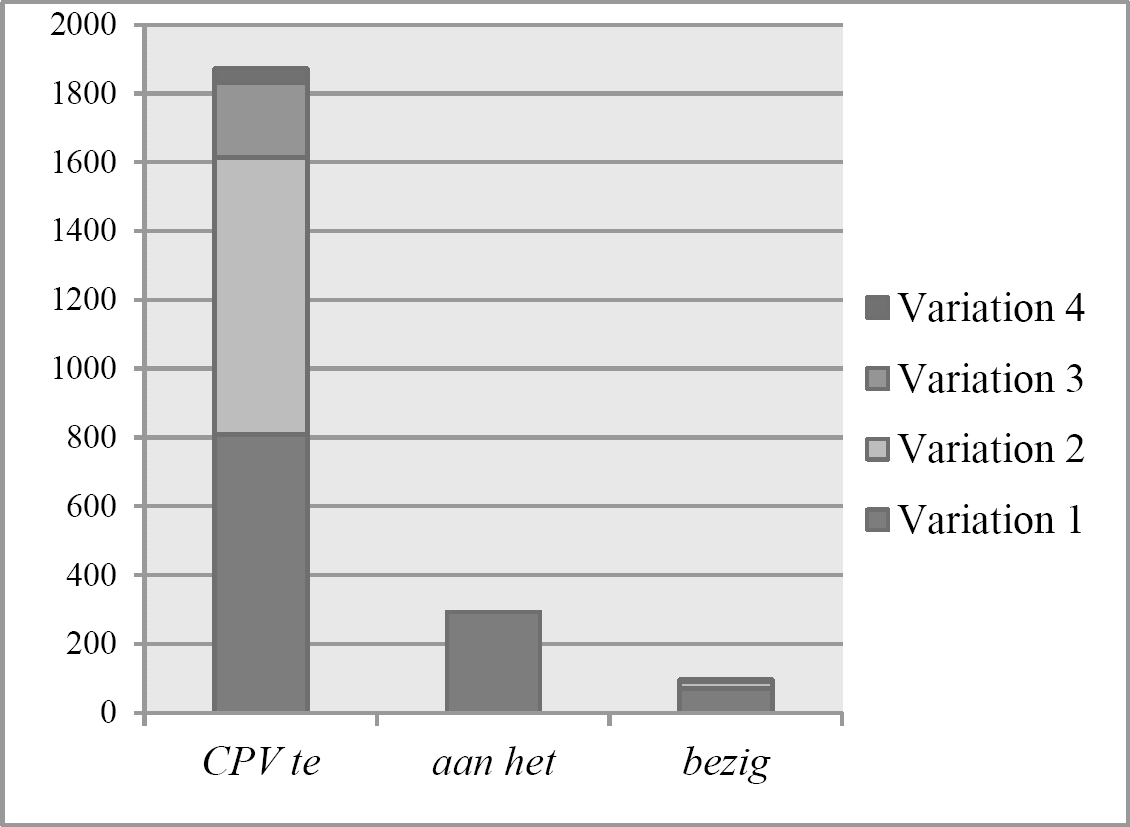
The results for the three Dutch progressive constructions and their respective frequencies in LGSUB are presented in table 3 and figure 2.
Internal frequencies: Dutch progressives.

Internal frequencies: Dutch progressives.

These results are similar to what has been reported in the literature on Dutch progressives (see Lemmens Reference Lemmens and Newman2003, Booij Reference Booij, De Caluwe, De Schutter, Devos and van Keymeulen2004:98, Geleyn & Colleman Reference Geleyn and Colleman2014:62). The Dutch CPV-progressive is clearly used more frequently than the other two types. As noted above, the bezig-construction is rather infrequent, making up only 4% of the Dutch periphrastic constructions used to express progressive aspect. The relative order of frequency is thus CPV te > aan het > bezig.
Breed (Reference Breed2012:114–116) presents the language-internal frequencies for the different periphrastic progressives in Afrikaans, on the basis of the TK corpus. The results figure in table 4 and figure 3. In Afrikaans, the relative order of frequency is besig > aan die/’ t > CPV en (with significant differences between all three constructions).Footnote 17
Internal frequencies: Afrikaans progressives.

Internal frequencies: Afrikaans progressives.

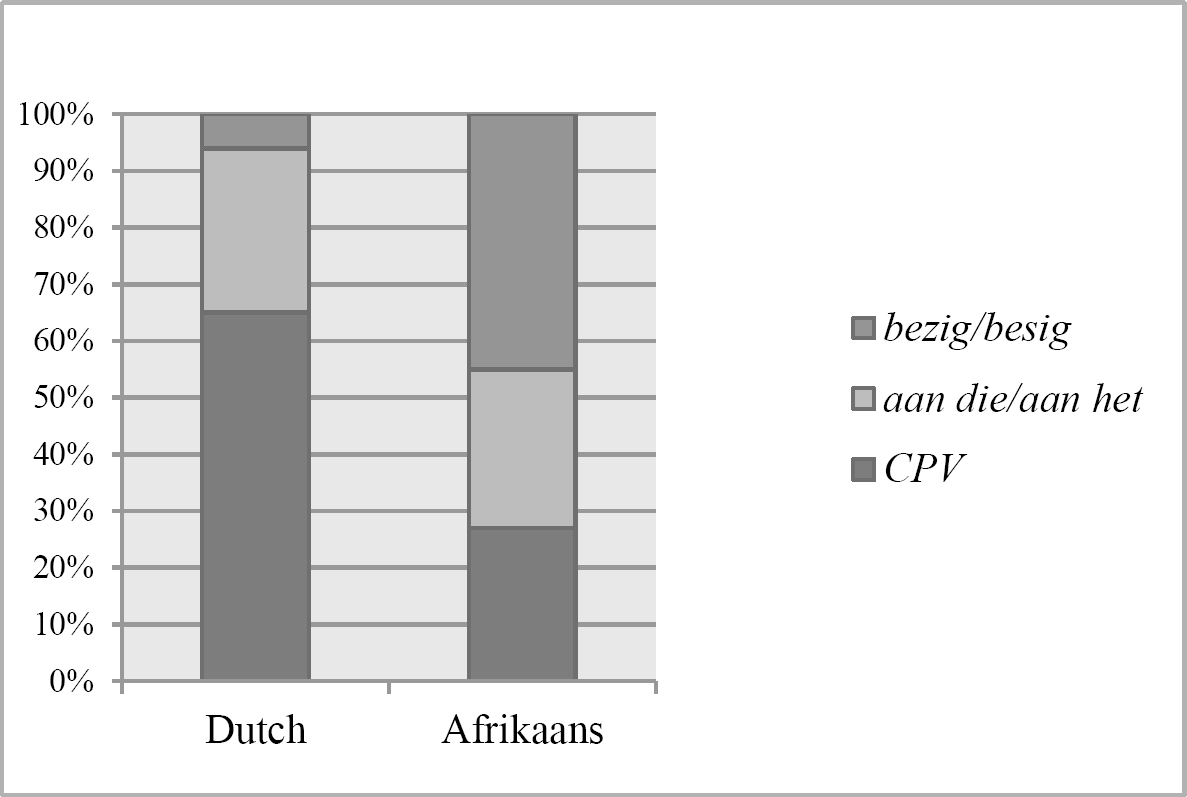
Clearly, then, Dutch and Afrikaans are different in a number of respects when it comes to frequency of individual progressive constructions. The most popular progressive construction in Dutch is CPV te, whereas in Afrikaans it is besig.Footnote 18 In addition, the frequency differences between CPV and aan are pronounced in Dutch, whereas they are more balanced in Afrikaans. We assume that higher frequencies are a symptom of an advanced stage of grammaticalization due to semantic bleaching; in contrast, relatively low frequencies suggest a higher degree of semantic persistence, and thus limited grammaticalization (for example, bezig in Dutch or CPV and aan in Afrikaans). The Afrikaans CPV-construction in particular does not have the same general popularity as its Dutch counterpart and is expected to be used in more specific contexts.Footnote 19 Finally, the usefulness of selecting corpora of similar (or larger) size is apparent from a comparison with the results for Dutch CPV te and aan het as presented in Lemmens Reference Lemmens2008: Our data from Dutch show a larger difference between these two constructions (65% versus 29%) than what was reported there (57% versus 43%). In figure 4, the language-internal frequencies of progressive constructions are given.
Frequency rankings of Dutch and Afrikaans progressives.

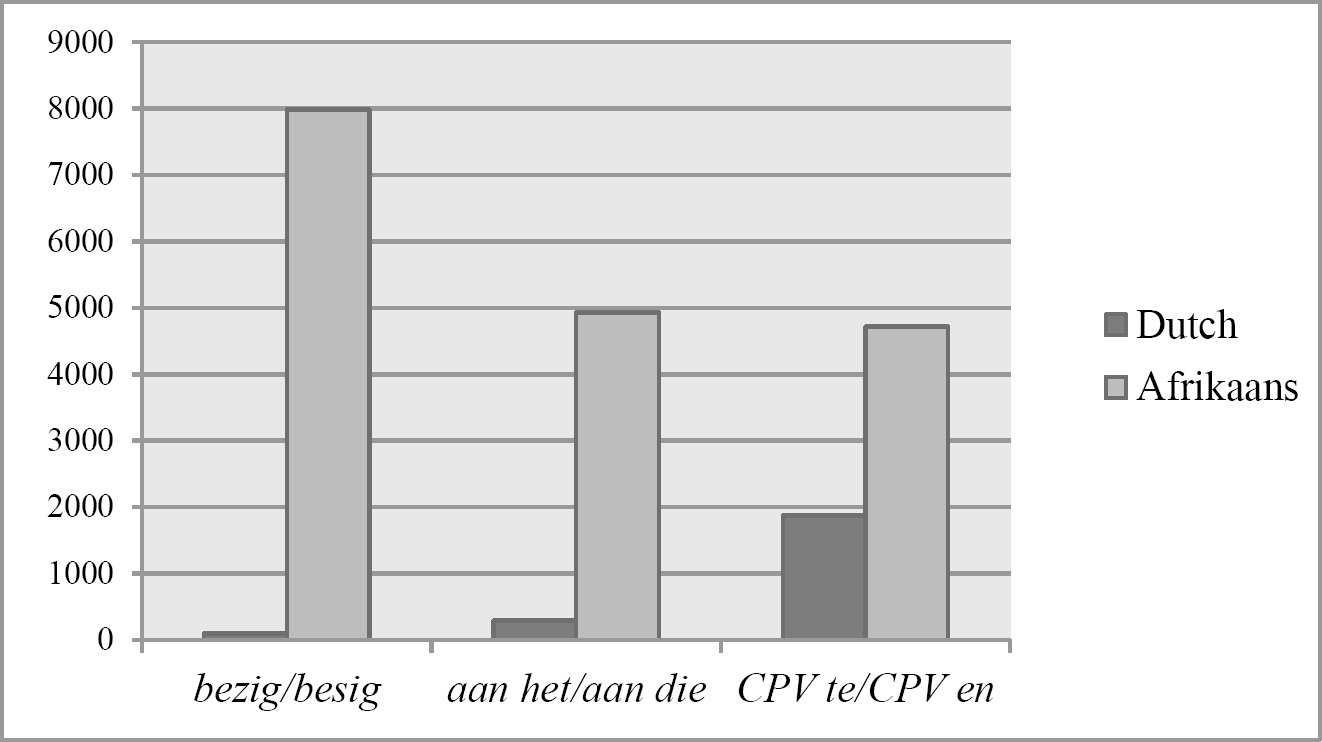
When total frequencies of the periphrastic progressive constructions in the two languages are compared (see figure 5), it appears that speakers of Afrikaans make significantly more extensive use of such constructions than speakers of Dutch.Footnote 20
Total frequencies: Dutch and Afrikaans progressives.

If the use of progressives is more widespread in Afrikaans than in Dutch, this must mean that there is an overall need for speakers of Afrikaans to mark progressive aspect more explicitly. This also implies that the Afrikaans constructions are becoming more grammaticalized (under-going a gradual process of “obligatorification”), and their use is less motivated by nontemporal, often emotional considerations than the use of their Dutch counterparts (see section 1). Afrikaans, in other words, is relatively closer to English than it is to Dutch, as it pays more than incidental attention to expressing progressive aspect (that is, ongoingness or duration). That said, however, progressive marking has not become a necessary and systematic grammatical feature of certain Afrikaans verbs: It is not ungrammatical in Afrikaans to use a nonprogressive form of dynamic verbs to refer to an ongoing event at the time of speaking, unlike in English.
5. Frequency of Aspectual Versus Nonaspectual Uses
A high degree of grammaticalization is usually signaled by a gradual bleaching of the lexical origins of a construction. It also manifests itself in the fact that speakers mobilize it to express grammatical rather than referential meaning (Bybee et al. Reference Bybee, Perkins and Pagliuca1994:20). It is therefore informative to compare the frequency of lexical uses of a given construction, where all components still retain (part of) their lexical meaning, with that of its purely grammatical uses. If the ratio of lexical uses to grammatical uses of a construction differs significantly between languages, then this might indicate a difference in degree of grammaticalization. Since it is not useful to compare the frequency of the aan het/die-progressives with the frequency of all prepositional constructions with aan followed by a definite noun phrase, only the bezig/besig- and CPV-progressives are discussed in this section.
5.1. Dutch Bezig Versus Afrikaans Besig
Earlier, it was noted that the frequency of use of besig as a progressive marker is significantly higher in Afrikaans than i) that of the other progressive constructions in Afrikaans, and ii) that of its counterpart in Dutch, which occurs relatively infrequently. This suggests that Afrikaans besig, unlike Dutch bezig, is subject to a process of grammaticalization. The use of Afrikaans besig for purposes other than progressive marking should therefore become more restricted. In contrast, Dutch bezig should mostly be used to express the lexical meaning ‘busy’, and not necessarily the progressive meaning of ‘ongoingness’.
Geleyn & Colleman (Reference Geleyn and Colleman2014) show that the frequencies of Dutch bezig in progressive and nonprogressive contexts differ significantly from those of Afrikaans besig.Footnote 21 The sentences 6 and 7 (from Geleyn Reference Geleyn2010:10) illustrate the use of bezig/besig in nonprogressive contexts. Progressive uses of bezig/besig were illustrated in 4b–d and 5c. The lexical meaning of bezig/besig focuses more on the subject involved in/occupied by an activity or state, while with aspectual uses, the ongoingness of the situation itself is more prominent. With event nouns such as huiszoeking ‘(house) search’, as in 6a, bezig does express (mere) ongoingness. However, it cannot be said to figure in a progressive construction, since it serves as a subject complement with the copula was and is not followed by an infinitival verb. Other adjectival uses (6b,c and 7b) can take nonverbal complements, in the form of a prepositional phrase.
-
(6) Dutch
-
a. Terwijl de huiszoeking bezig was, boden zich nog enkele andere gebruikers aan.
‘While the house was being searched, some other users volunteered/appeared.’
-
b. Leeuwerink was bezig aan zijn achtste seizoen bij de mannen-eredivisionist.
‘Leeuwerink was in his eighth season in the men’s honor league.’
-
c. De liefdadigheidsprojecten nemen niet weg dat Janssens zelf al lang bezig is met aparte projecten.
‘The charity projects don’t prevent Janssens from doing (being involved in) separate projects for a long time.’
-
-
(7) Afrikaans
-
a. Sy was in die kombuis besig toe twee jeugdiges skielik by die kombuisdeur inkom en haar en haar seun met ’n mes dreig.
‘She was busy in the kitchen when two young men came in through the kitchen door and threatened her and her son with a knife.’
-
b. Ek is lankal besig met my doktorsgraad in die Regte, en is op die oomblik besig met my doktorale tesis.
‘I’ve been busy with (working on) my PhD in Law for a long time now, and at this moment I am busy with (writing) my doctoral thesis.’
-
c. Die borduurwerk is vir haar iets wat jou ure lank besig hou.
‘Embroidery is something with which she can keep herself busy for hours.’
-
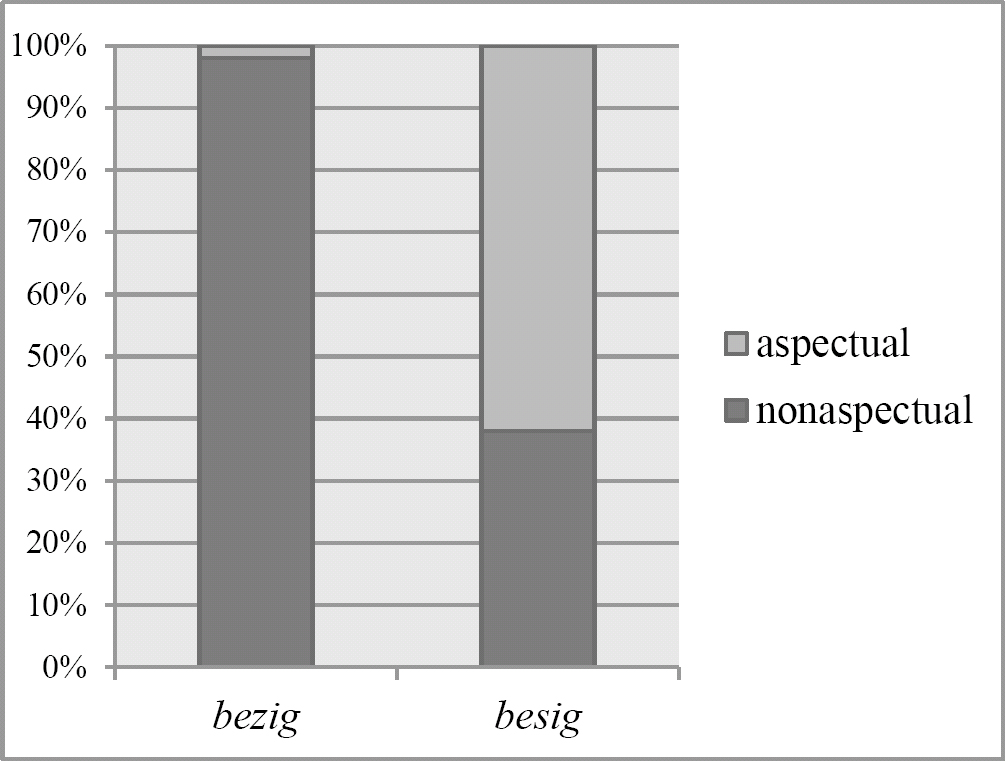
A search in the LGSUB and TK corpora yields similar results. Out of a total of 6,159 tokens of Dutch bezig, 6,063 (98%) are used nonaspectually, and only 96 (2%) occur in progressive contexts. In the TK corpus, 12,791 instances of Afrikaans besig have been found, of which 4,799 (38%) in nonaspectual contexts. This yields the opposite picture from Dutch, with a majority of uses (7,992, or 62%) expressing progressive meaning. Table 5 and figure 6 summarize these figures.
Aspectual versus nonaspectual bezig/besig.

Aspectual versus nonaspectual bezig/besig.

These results can be taken as a clear indication that, compared to its Dutch counterpart, the Afrikaans besig-construction is turning into a frequent (maybe even obligatory) general marker of progressive aspect.
5.2. Dutch CPV te Versus Afrikaans CPV en
Breed (Reference Breed2012:13) provides the following examples to illustrate the difference between the lexical use, as in 8, and the progressive use, as in 9, of the CPV-constructions in Dutch and Afrikaans.
-
(8)
-
a. Dutch
Hij zit op een stoel en werkt met het gereedschap dat hij al 50 jaar hanteert, een glimlach op zijn gezicht.
-
b. Afrikaans
Hy sit op ’n stoel en werk met die gereedskap wat hy al 50 jaar hanteer, ’n glimlag op sy gesig.
‘He is sitting on a chair and working with the tools that he has been using over the past 50 years, with a smile on his face.’
-
-
(9)
-
a. Dutch
Ton heeft de hele middag aan zijn bureau zitten (te) werken.
-
b. Afrikaans
Tonie het die hele middag by sy lessenaar gesit en werk.
‘Tony has been working (sitting) at his desk all afternoon.’
-
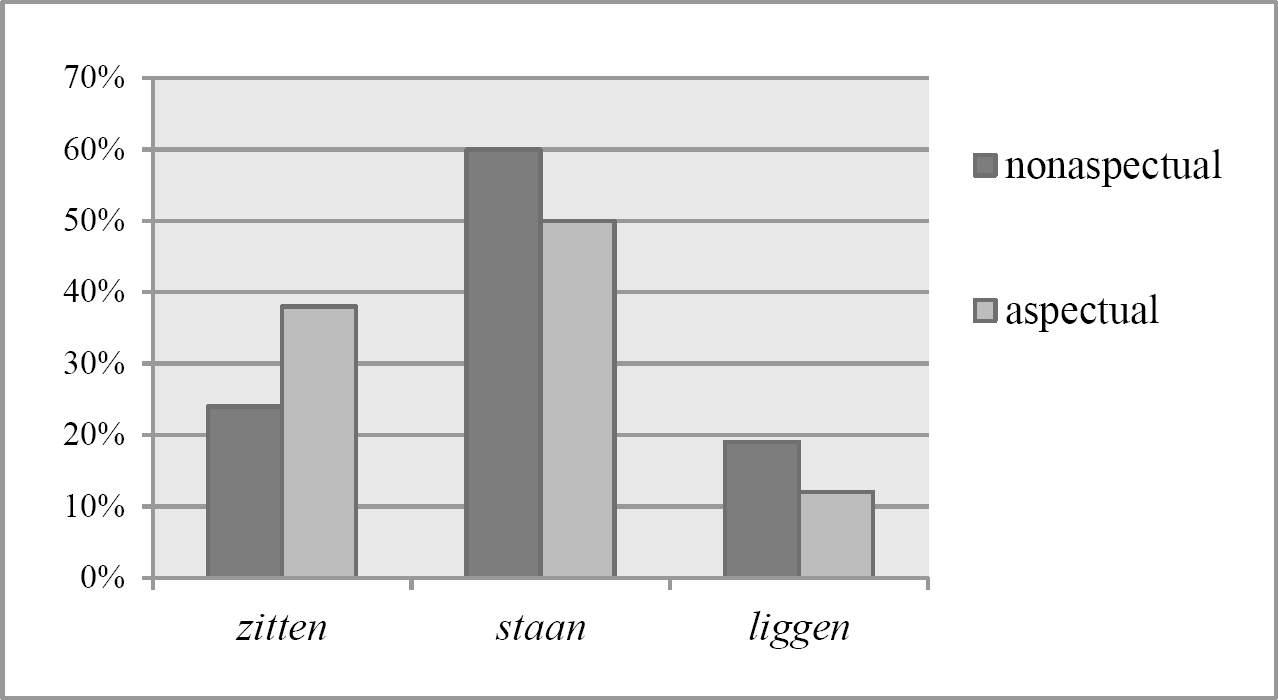
Lemmens (Reference Lemmens2005:188) has compared the frequencies of the most commonly used Dutch posture verbs (zitten/staan/liggen) with respect to their lexical versus progressive use (zitten te/staan te/liggen te). The results suggest that the overall ratio of the frequencies of aspectual to nonaspectual use is the same for all three verbs: Staan is the most frequently used verb with both aspectual and nonaspectual uses, followed by zitten and liggen (Lemmens Reference Lemmens2005:191). However, the internal ratios of the different constructions seem to differ: in the aspectual uses of the three verbs combined, only the proportion of zitten is relatively larger than its proportion in the non-aspectual uses.
In the LGSUB corpus, similar construction-internal ratios can be observed as in Lemmens Reference Lemmens2005 (compare table 6 and figure 7).
Aspectual versus nonaspectual Dutch CPV te in LGSUB.

Aspectual versus nonaspectual Dutch CPV te in LGSUB.

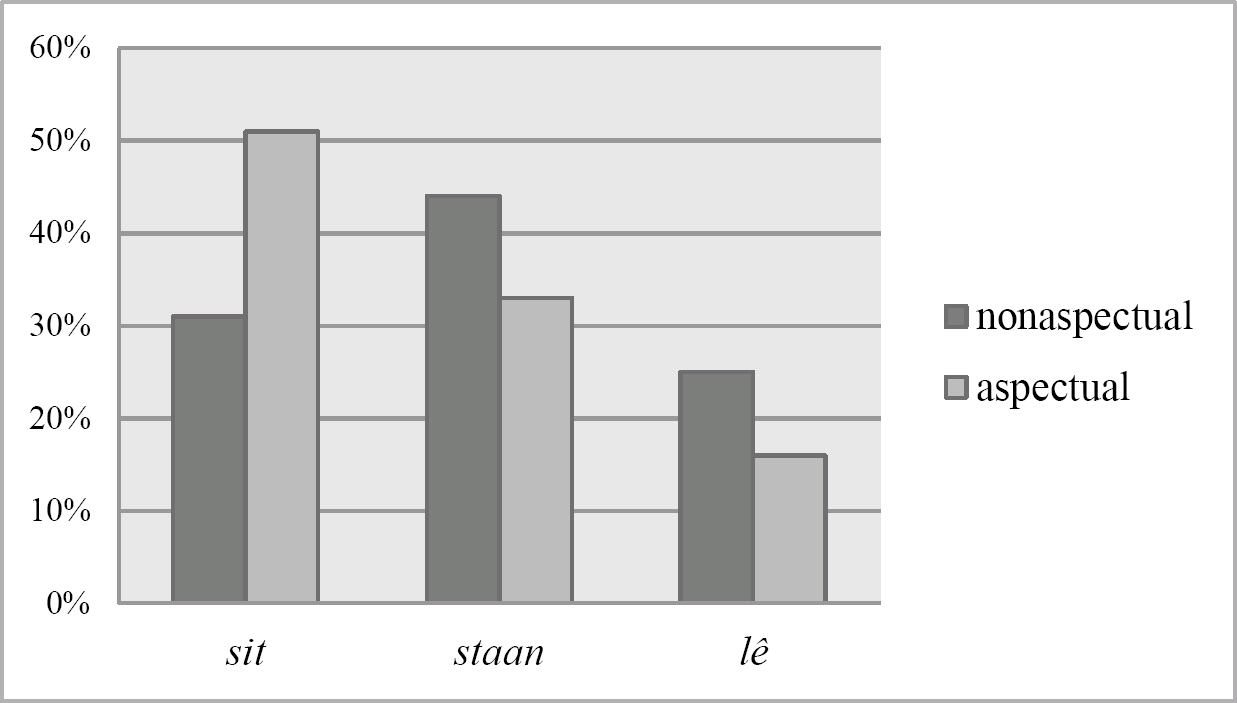
In the TK corpus, the following results were obtained for Afrikaans.
Aspectual versus nonaspectual Afrikaans CPV en in TK.

Aspectual versus nonaspectual Afrikaans CPV en in TK.

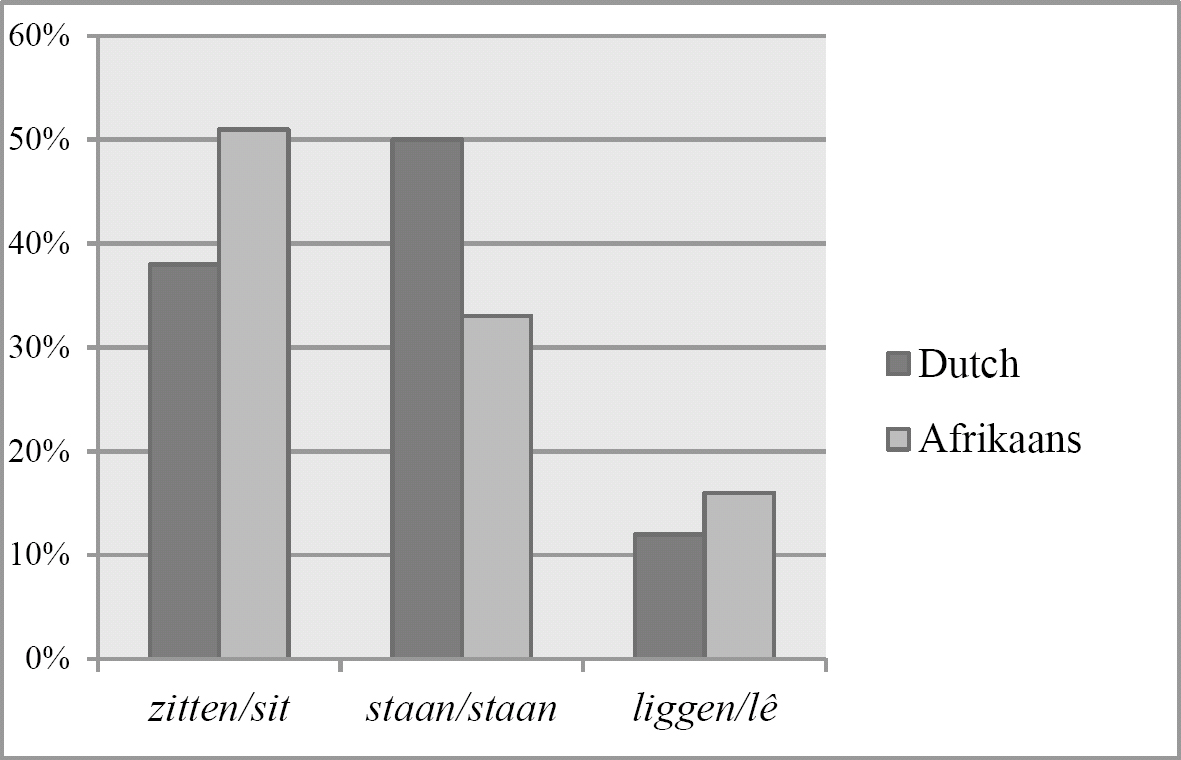
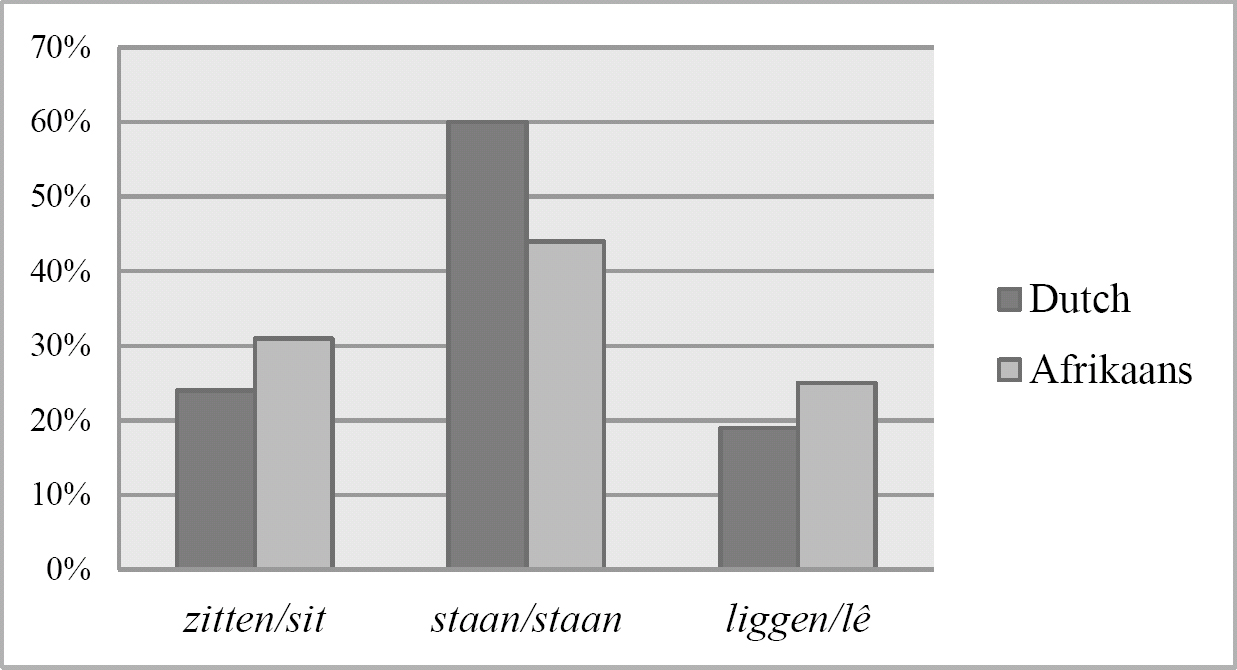
The combined results for all three verbs are the same as in Dutch (that is, nonaspectual uses are significantly more frequent than aspectual uses: 79,058 versus 4,499 occurences). However, the verb staan occurs most frequently only in nonaspectual contexts, whereas in aspectual contexts, sit is most frequent. Just as in Dutch, the proportion of sit is higher in aspectual contexts (51% of 4,499 occurences) than in nonaspectual contexts (31% of 79,058 occurences). Thus, Dutch and Afrikaans exhibit different patterns with respect to the frequency of aspectual use of zitten/sit: Dutch: staan > zitten > liggen; Afrikaans: sit > staan > lê.
Figures 9 and 10 summarize the verb-specific ratios of aspectual to nonaspectual uses of CPV-constructions in Dutch and Afrikaans.
Relative distributions of aspectual Dutch and Afrikaans CPV-progressives.

Relative distributions of nonaspectual Dutch and Afrikaans CPV uses.

In conclusion, although Dutch and Afrikaans both use CPV-constructions as progressive markers, language-specific patterns are different. In Afrikaans, CPV-constructions are not the most popular means of marking progressive aspect: The besig- and aan die/’t-constructions are used more often. In contrast, Dutch CPV-constructions are the most popular markers of progressive aspect. Yet, as progressive markers, Afrikaans CPV-constructions significantly outnumber their Dutch counterparts (see also figure 5 in section 4 above). This contrast suggests that the marking of progressive is overall much more common in Afrikaans.
6. Verb Collocations
6.1. Overview of Verb Collocations in Dutch and Afrikaans
The previous sections presented the usage frequencies of the different periphrastic progressive constructions—an important, if not uniquely decisive, factor in establishing a construction’s degree of grammaticali-zation. Grammaticalization usually implies a generalization of meaning, which can, in other words, be interpreted as a broadening of the contexts in which a construction can be used. In order to establish whether these progressive constructions can appear in a wide range of contexts, we looked at the types of verbs with which the various progressive constructions combine. We initially expected that the more frequently a construction is used, the more general its meaning becomes, and the less restricted the set of possible collocating verbs will turn out to be.
We compared verb collocations for the different constructions using Stefanowitsch & Gries’ (Reference Stefanowitsch and Gries2003) so-called collexeme analysis. This statistical method employs the Fisher exact test (Pederson 1996) to measure the association strength between a construction and the lexical items that occur in this construction (Gilquin Reference Gilquin2010:195). Four types of frequencies are involved in this statistical computation, namely, i) the frequency of the collexeme (L) in the construction (C); ii) the frequency of the collexeme (L) in all other constructions; iii) the frequency of the construction (C) with lexemes other than the collexeme (L); and iv) the frequency of all other constructions with lexemes other than the collexeme (L). Stefanowitsch & Gries (Reference Stefanowitsch and Gries2003:218) explain that the information that emerges from these four types of frequencies “computes the probability of this distribution and all more extreme distributions […] with the same marginal frequencies.” The computer program Coll.analysis 3.2a (developed by Gries Reference Gries2007) was also used in this study to conduct the collexeme analysis. When applying this test to our results, we treat the lexical verbs that appear in the three cognate progressive constructions as the collexeme (L), and the specific progressive construction that is examined in each instance as the construction (C). The test aims to show which individual verbs or verb types tend to collocate with which specific progressive constructions, and to what degree.
Since the TK corpus is not an annotated corpus, and since it is critically important for a collostructural analysis that all frequencies of lexical items be completely accurate (see Gries et al. Reference Gries, Hampe and Schönefeld2005:643–648), each result for the three Afrikaans progressive constructions had to be checked by hand.Footnote 22 To this end, a subcorpus exclusively consisting of newspaper texts was selected from the TK corpus. This subcorpus includes 16,458,450 words. Likewise, a newspaper subcorpus was also selected from the LGSUB.Footnote 23 This subcorpus consists of 29,010,694 words.Footnote 24 Table 8 shows the overall frequencies of the three Dutch and Afrikaans constructions in these newspaper subcorpora.
Internal frequencies in newspaper subcorpora: Dutch and Afrikaans progressives.

Table 9 shows the 30 verbs that collocate most strongly with the three Dutch progressive constructions, and table 10 presents the same information for the Afrikaans constructions.Footnote 25 These tables also indicate how frequently the verb appears in the news subcorpus, as well as how frequently the verb appears with a progressive construction. The last column shows the collocation strength of the verb with the specific periphrastic progressive construction. The higher this number is, the stronger the collocation.Footnote 26 Only collocations with collexeme strength > 1.301 have been included; for loop en and lê en, this means that the list contains less than 30 verbs. The higher the total of significantly attracted collexemes with a particular construction, the higher the degree of generalization.
Thirty strongest verb collocations for Dutch aan het.

Thirty strongest verb collocations for Dutch bezig.

Thirty strongest verb collocations for Dutch staan te.

Thirty strongest verb collocations for Dutch zitten te.

Thirty strongest verb collocations for Dutch liggen te.

Fifteen strongest verb collocations for Dutch lopen te.

Thirty strongest verb collocations for Afrikaans aan die.

Thirty strongest verb collocations for Afrikaans besig.

Thirty strongest verb collocations for Afrikaans staan en.

Thirty strongest verb collocations for Afrikaans sit en.

Twenty-one strongest verb collocations for Afrikaans lê en.

Twenty-seven strongest verb collocations for Afrikaans loop en.

As can be seen from the above tables, here, too, Afrikaans besig scores best, and Dutch CPV-constructions turn out less semantically restricted than their Afrikaans counterparts.
6.2. Dutch Verb Collocations
Lemmens (Reference Lemmens2015) conducted a distinctive collexeme analysis of the Dutch aan het- and CPV-progressive constructions.Footnote 27 He found that verbs of (slow) change (such as veranderen ‘change’ and groeien ‘grow’) and verbs of movement (such as stijgen ‘rise’ and dalen ‘descend’) combine more readily with the aan het- than with the CPV-progressives. In contrast, stative verbs (such as wachten ‘wait’ and slapen ‘sleep’), cognitive/perceptual verbs and emotion verbs (such as denken ‘think’, staren ‘stare’, and huilen ‘cry’) as well as idiomatic expressions (such as N1 zitten te wachten op N2 ‘N1 sit to wait for N2’) collocate with the CPV-progressive rather than with the aan het-progressive. The collexeme analysis in Lemmens Reference Lemmens2015 confirms the findings in our study, but our analysis also indicates a clear pattern of different verb types that strongly collocate with some of the three progressive constructions. In what follows, the semantic classes to which verbs can be assigned have been operationalized by looking at each example in context.Footnote 28
In addition to what Lemmens (Reference Lemmens2015) reveals, quite a few of the 30 strongest verb collocations on our collocation list for the aan het-progressive are change-of-state verbs (for example, bouwen ‘build’, groeien ‘grow’, veranderen ‘change’, maken ‘make’, and vernieuwen ‘renew’). What is more, there are a number of verbs that specifically express perceptual actions or acts of communication (for example, (be)kijken ‘look (at)’, praten ‘talk’, and luisteren ‘listen’). Most importantly, more than 20 of the 30 strongest collocations can be classified as transitive verbs involving some kind of action on a patient (see section 7 below).
From our data, it appears that the bezig-progressive collocates exclusively with transitive verbs, as in 10. It is therefore not surprising that all except two of the sentences with a bezig-progressive also feature an object.
-
(10)
-
a. Ik was net bezig een verbandje te leggen, toen de politie aanbelde.
‘I was just applying a bandage when the police came.’
-
b. Ik ben bezig uit te zoeken op welk moment ik mijn advertenties het beste kan plaatsen.
‘I’m finding out at what moment it would be best to place my ads.’
-
In our results we found only two examples of bezig that did not contain an object, and in both sentences the lexical verb was veranderen ‘change’. The bezig-progressive thus seems to have relatively restrictive use. Unlike the Afrikaans besig-progressive, it has probably never fully generalized, and the original meaning of bezig might still be present in many instances when the construction is also used to express progressive meaning.
As mentioned earlier in this section, our results confirm Lemmens’s (Reference Lemmens2015) finding that stative and cognitive verbs combine more frequently with the CPV-progressives than with the aan het-progressive. Furthermore, Lemmens (Reference Lemmens2005:208) identifies four verb types that frequently collocate with the Dutch CPV-progressives, namely, verbs of social interaction (for example, praten ‘talk’ in 11a or bidden ‘pray’), creative activity (for example, schrijven ‘write’ in 11b or maken ‘make’), visual or auditory perception (for example, kijken ‘look’ in 11c and luisteren ‘listen’), and cognitive activity (for example, dromen ‘dream’ in 11d and denken ‘think’). Breed (Reference Breed2012:137–138) and Breed & Brisard (Reference Breed and Brisard2015:19) add two types to this list, namely, verbs that express biological necessities (for example, slapen ‘sleep’ and eten ‘eat’ in 11e) and verbs that indicate that an object is static or inactive (for instance, wachten ‘wait’ in 11f).
The collexeme analysis of the Dutch CPV-constructions confirms that these six verb types collocate strongly with them, but it is also clear that each of the different postular verbs has its own preferences as well. For instance, some of the six verb types do not have a preference for any particular CPV-construction, while others collocate more strongly with a specific CPV-construction. Furthermore, as can be seen from the list below, a seventh verb type should be added, namely, verbs that express negative communication, as roepen ‘proclaim’ in 11g (see also Breed Reference Breed2012:140).
-
(11)
-
a. Ze wandelen wat, of zitten samen te praten.
‘They are walking around, or sitting together and talking.’
-
b. Velen zaten te wachten tot ze, net als haar schoonmoeder, een kookboek zou schrijven.
‘Many were waiting for her to write a cookbook, just like her mother-in-law.’
-
c. Terwijl hij in de zetel met de voeten omhoog tv ligt te kijken.
‘While he’s lying on the couch watching TV with his feet up.’
-
d. Koen ook niet: hij liep vroeger wel altijd hardop te dromen van vijf-zes, maar na Zita hoorde je hem af en toe toch al pruttelen dat “twee-drie misschien ook niet kwaad zou zijn”.
‘Neither did Koen: he used to (walk around and) dream aloud about five or six, but after Zita you could hear him mutter that “two or three would probably be fine too”.’
-
e. Op de Visserskaai speelde een man, die in een restaurant zat te eten, wel zijn portefeuille kwijt.
‘On the Fishermen’s Quay, a man who had been (sitting) eating in a restaurant lost his wallet.’
-
f. Zeven achteloos neergekwakte boomstammen liggen te wachten op vervoer.
‘Seven heedlessly felled tree trunks are (lying) waiting to be transported.’
-
g. Dit uitstel gebeurt met medewerking van kamervoorzitter Herman De Croo (VLD), die nochtans altijd loopt te roepen dat het parlement nooit met vakantie is.
‘This delay was approved by House Representative Herman De Croo (VLD), who usually (runs around and) proclaims that parliament is never on holiday.’
-
Verbs of social interaction strongly collocate with all four CPV-progressives, but verbs of creative activity do not collocate strongly with liggen ‘lie’. Verbs of perception collocate strongly with zitten ‘sit’, staan ‘stand’, and liggen ‘lie’, but not with lopen ‘walk’. A particularly interesting observation that emerges from the collexeme analysis is that the verbs of cognitive activity in our subcorpus do not collocate as strongly with CPV-progressives as one would think on the basis of Lemmens Reference Lemmens2005 and Breed Reference Breed2012. Only two such verbs are found with zitten (lezen ‘read’ and denken ‘think’), and only one verb is found with each of the other three CPV-progressives (lezen, bekommeren ‘worry’, and dromen ‘dream’). Verbs that express biological necessity strongly collocate with zitten, staan, and liggen, but none of these verbs are found with lopen (presumably because of the real-world incompatibility of the respective actions involved). Just like the cognitive activity verbs, verbs that express inactivity do not collocate strongly with CPV-progressives, except for liggen. Lastly, as mentioned above, a seventh class of verb types has been added to the CPV-collocation list, namely, verbs of negative communication.Footnote 29 Although none of these verbs could be found with zitten and staan, two of them (zeuren ‘whine’ and mopperen ‘grumble’) are found with liggen, and three with lopen (zeuren ‘whine’, roepen ‘shout/call’ and reageren ‘react’).
6.3. Afrikaans Verb Collocations
Breed & Van Huyssteen (Reference Breed and Van Huyssteen2015) conducted a distinctive collexeme analysis to determine and compare the strongest verb collocations of the Afrikaans aan die- and besig-progressives. Since they also worked with the same TK newspaper subcorpus used in this study, their findings are useful here as well. Their results and description of the two progressive constructions were subsequently included in this study and are presented below. An additional collexeme analysis of the Afrikaans CPV-constructions was conducted to enable a comparison between Dutch and Afrikaans verb collocations with all three constructions.
It is striking that quite a number of verbs that strongly collocate with aan die can also be used as nouns, namely, brand ‘burn’/’fire’, slaap ‘sleep’, stuur ‘drive’/‘wheel’, lewe ‘live’/‘life’, and werk ‘work’. In Afrikaans, both the verb and the noun have the same form, which is different from Dutch, where the verb would be marked as the infinitive, for example, branden ‘burn’. What is more, the use of these specific constructions is strongly conventionalized, and they function mainly as idiomatic expressions, as in examples 12a–c. They express concepts such as on fire, asleep, alive, including in metaphorical contexts, as in example 12d (aan die stuur ‘in charge’ lit. ‘on the wheel’).
-
(12)
-
a. Die slegtes steek die bome wat op die oewer staan aan die brand.
‘The troublemakers are setting the trees on the riverbank on fire.’
-
b. Terwyl sy in die badkamer is, raak hy aan die slaap.
‘While she is in the bathroom, he falls asleep.’
-
c. Dis soms dae lank wat hy nie sy mond aan kos sit nie, sodat sy wonder wat hou hom aan die lewe.
‘Sometimes he doesn’t eat anything for days on end, so that she wonders what is keeping him alive.’
-
d. Met hierdie leiers aan die stuur, is ek bevrees, gaan ons op dieselfde trant voortploeter.
‘With these leaders in charge, I’m afraid we are just going to keep on plodding like this.’
-
It is furthermore noteworthy that a number of verbs that occur with the aan die-progressive construction can be classified as change-of-state verbs, namely, toeneem ‘increase’, afneem ‘decrease’, taan ‘dwindle’, opbou ‘stop’, verander ‘change’, ontwikkel ‘develop’, groei ‘grow’, kwyn ‘wither’, and broei ‘brood’. From the verbs included in table 10 it appears that the aan die-progressive selects a less varied set of verbs than the besig-progressive. Twenty-five out of thirty verbs that combine with the aan die-progressive are activity verbs (in the classic Vendlerian sense; for instance, brand ‘burn’, praat ‘speak’, and gesels ‘converse’), while verbs compatible with the besig-progressive show more aspectual variety. Less than half of the verbs that combine with the besig-progressive can be classified as activity verbs (for instance, stort ‘shower’ and speel ‘play’), and there are more examples of verbs that can be classified as either accomplishments (for instance, daal ‘drop’) or achievements (sterf ‘die’ and oorgee ‘surrender’). In addition, the aan die-construction collocates more frequently with intransitive verbs. Only 10 verbs that combine with aan die can be classified as typical (syntactically) transitive verbs (that is, verbs usually accompanied by an object; for instance, broei ‘hatch’ and skryf ‘write’), while about half of the verbs that combine with besig can be classified as prototypically transitive (for example, kyk ‘watch’ and onderhandel ‘negotiate’).
6.4. Comparing the Dutch and Afrikaans CPV-Constructions
To compare the Dutch and Afrikaans CPV-constructions, we conducted distinctive collexeme analyses (Gries & Stefanowitsch Reference Gries and Stefanowitsch2004), indicating which lexeme/verb tends to cooccur with which CPV-construction.Footnote 30 In table 11, each CPV-construction features a list of verbs that it attracts as well as a list of verbs that it repulses. For example, Dutch/Afrikaans wachten/wag ‘wait’ does not seem to collocate well with the lopen te/loop en-construction (for obvious semantic reasons). Dutch zitten ‘sit’ and Afrikaans staan ‘stand’ exhibit stronger collocations with specific verb types than the other constructions, as manifested by the larger number of distinctive collexemes.
Distinctive collexemes analyses for Dutch CPV-constructions.

Distinctive collexeme analyses for Afrikaans CPV-constructions.

When the results for Afrikaans are compared to the results for Dutch, it turns out that the six verb types identified by Breed (Reference Breed2012) and Breed & Brisard (Reference Breed and Brisard2015) collocate more strongly with the Afrikaans CPV-constructions, especially staan and loop, than with the Dutch CPV-constructions (with the exception of zitten). Except for verbs that express inactivity, there are examples of all four CPV-constructions for all seven verb types distinguished above. Verbs of social interaction in particular collocate strongly with all four Afrikaans CPV-constructions.
To conclude this section, there are more similarities between the CPV-constructions of the two languages than between the aan het- and aan die-constructions or between the bezig- and besig-constructions. The Afrikaans CPV-constructions collocate more strongly with certain verbs or verb types than their Dutch counterparts. Furthermore, some CPV-constructions collocate more strongly with certain verb types than with others. Nevertheless, overall the Dutch and Afrikaans CPV-constructions both display a preference for the same verb types, including verbs of social interaction, creativity, perception, cognitive activity, biological necessity, inactivity, and negative communication.
There are significant differences between the verbs with which the Dutch aan het- and the Afrikaans aan die-constructions collocate. Although the constructions in both languages frequently collocate with change-of-state verbs, the Dutch construction prefers transitive and telic verbs (see also Lemmens Reference Lemmens2015), while the Afrikaans construction prefers intransitive and atelic verbs (specifically, activity verbs).Footnote 31
The Dutch bezig-construction is used in a more restricted way, collocating almost exclusively with transitive verbs. The Afrikaans besig-construction, in contrast, is a generalized construction that does not show a strong preference for any verb type. Both transitive and intransitive verbs, as well as a variety of aspectual verb types, are found with this construction.
Thus, the analysis of verb collocations for the three constructions in each language largely confirms our findings on the basis of frequency. The besig-construction is the most generalized progressive construction in Afrikaans; and it seems to have grammaticalized further than any one of the three progressive constructions in Dutch. The aan het-construction is the most generalized progressive in Dutch, but it also has certain preferences for specific types of collocation, just like the Afrikaans aan die-construction. The CPV-progressives in both Dutch and Afrikaans have pronounced collocational preferences, mainly with seven specific types of verbs.
7. Transitivity
Sections 4–6 have focused on the frequencies of use of the various progressive constructions in Dutch and Afrikaans, as well as on the kinds of verbs these constructions collocate with. To determine with greater precision to what degree the different constructions in each language have generalized as a marker of progressive aspect, it is useful to examine their valency properties, and in particular whether or not they allow transitively used verbs (with an expressed direct object), since a more grammaticalized construction would allow more transitive verbs. The constructions have been investigated with respect to the following properties: i) the relative frequencies of transitive versus intransitive verbs, ii) possible positions of the direct object with respect to the transitive VP, and iii) the possibility of passivizing the transitive construction. Those properties help shed light on the degree of grammaticalization: Highly grammaticalized constructions behave like a syntactic unit, and syntactic freedom of their internal elements (for example, direct objects) is restricted (see Bybee et al. Reference Bybee, Perkins and Pagliuca1994:40). Thus, a (more) fixed constituent order within a construction suggests that the latter has become a grammaticalized syntactic unit. In addition, we hypothesize that highly grammaticalized Afrikaans periphrastic progres-sive constructions might allow passivization in certain contexts (Bybee et al. Reference Bybee, Perkins and Pagliuca1994:40), a property that is not witnessed in the Dutch or German cognate constructions. For these purposes, a selection of 330 example sentences of each progressive has been compiled.Footnote 32
7.1. Transitive and Intransitive Verbs in Dutch and Afrikaans Progressives
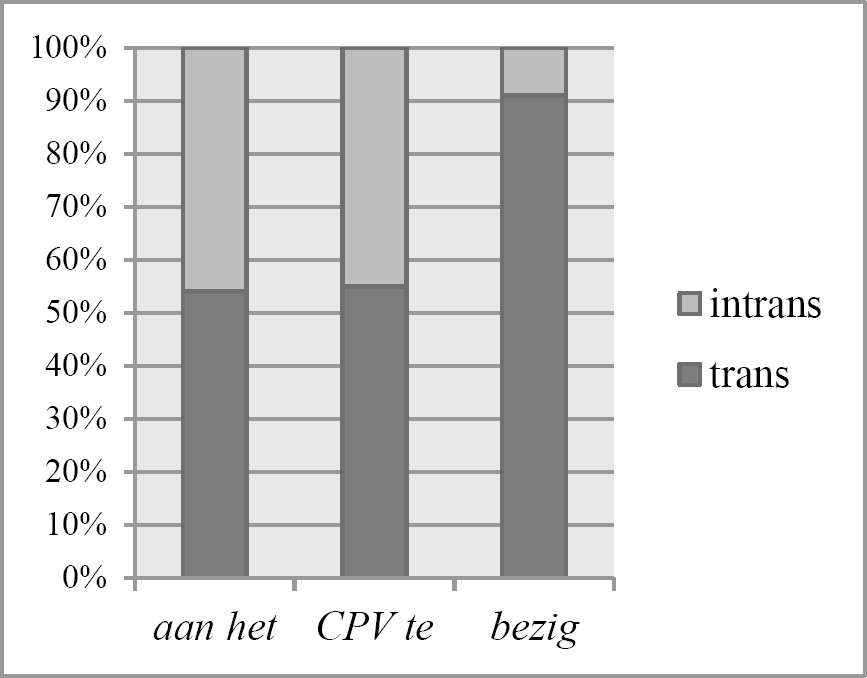
Tables 23 and 24, as well as figures 11 and 12, indicate the proportion of transitive versus intransitive verbs used with each construction.
Transitive versus intransitive verbs with the Dutch progressives.

Transitive versus intransitive verbs with the Afrikaans progressives.

Transitive versus intransitive verbs with the Dutch progressives.

Transitive versus intransitive verbs with the Afrikaans progressives.

As shown in table 25, there is a remarkable difference in the degree to which Dutch and Afrikaans progressive constructions are compatible with transitive verbs. In Dutch, all three progressives frequently occur with transitive verbs, although bezig-constructions prefer intransitive verbs. In contrast, the Afrikaans aan die- and CPV-constructions occur mostly with intransitive verbs; if Afrikaans speakers need to express a progressive meaning with a transitive verb, they typically use the besig-construction, as expected (see section 6.3).
Progressive constructions and transitivity.

Note that the Dutch aan het-construction is more generalized than the Afrikaans aan die-construction. We have already observed (see section 6) that the latter mainly features activity verbs.
The most surprising difference is that between the Dutch and the Afrikaans CPV-constructions. The data in section 6 suggested that both constructions are used with more or less the same verb types. However, this similarity with respect to verb types is not reflected in the relative frequencies of the transitive versus intransitive verbs with which the constructions combine. The Dutch CPV-constructions have no clear preference, but only 17% of the verbs appearing in the Afrikaans CPV-constructions turn out transitive. The most obvious explanation for this contrast is as follows: Afrikaans speakers are generally reluctant to use progressive constructions with transitive verbs. In rare cases, the besig-construction becomes their “designated” transitive progressive, to the detriment of the aan die- and CPV-constructions. This situation is very different in Dutch, which, in comparison with its sister languages Afrikaans and German (see Krause Reference Krause1997), is by far the most liberal in allowing transitive predicates with periphrastic progressives.
In the next section, we examine the positions of the direct object with transitive verbs in progressive constructions.Footnote 33 In general, we assume that the less syntactic variation is allowed, the more highly grammaticalized the relevant construction is. However, we do not compare unit status across languages (for the reasons given in section 1). The following discussion is therefore primarily meant to document and illustrate the different possibilities that exist in Dutch and Afrikaans.
7.2. Position of the Object in the Aan Het- and Aan Die-Construcitons
Out of 330 transitive progressives, 179 are Dutch aan het-constructions and only 50 are Afrikaans aan die-constructions (the proportion of transitive uses of the aan die-construction is the lowest of all three Afrikaans progressives). We demonstrate that the position of the direct object within the Dutch aan het-construction is more restricted than within its Afrikaans aan die counterpart.
Let us first consider Dutch. With the exception of NOBJ-VINF combinations that involve a direct object conventionally associated with the verb (discussed immediately below), the only possible syntactic structure of a transitive aan het-construction is shown in 13.
-
(13)
-
(14) Dutch
In addition, Dutch has the structures [NSUB zijn aan het NOBJ-VINF] and [NSUB aan het NOBJ-VINF zijn], with the object appearing as a separable part of a complex verb form. These structures can only be used when the action denoted by the verb is conventionally associated with the object, for example, koffiezetten ‘make coffee’. According to the rules of Dutch orthography, these NOBJ-VINF combinations have to be written as one word, even though the (bare) noun may appear separately in main clauses (see also Booij Reference Booij, De Caluwe, De Schutter, Devos and van Keymeulen2004:101–111, Reference Booij, Bergs and Diewald2008:92, Reference Booij2010:118–145).
In contrast, the Afrikaans aan die-construction allows three different word orders in the main clause, and two in subordinate clauses:Footnote 34
-
(15) Main clause structures:
-
(16) Subordinate clause structures:
-
(17) Afrikaans
-
(18) Afrikaans
In the Afrikaans corpus, the aan die-progressive appears most frequently in a subordinate clause, more specifically in the clause structure [NSUB NOBJ aan die VINF is]. The most frequent main clause structure is [NSUB is NOBJ aan die VINF].
Just like Dutch, Afrikaans has the NOBJ+VINF structure for conventionally associated objects (for example, boeklees ‘read a book’), but its use is much more widespread. This structure can be used in reference to activities where no conventional or stereotypical association is presumed between predicate and object (for example, houtry ‘transport/deliver wood’ in example 18b).
Finally, in Afrikaans, the object can either precede or follow aan die, as in 19. This is not possible in Dutch, as shown by the contrast in 20.
-
(19)
-
(20)
Thus, the data in this section show that the Dutch aan het-progressive is syntactically more restricted than its Afrikaans aan die counterpart. In the next section, we discuss the position of direct objects within the bezig-/besig-constructions.
7.3. Position of the Object in the Bezig- and Besig-Constructions
In our data, the Dutch transitive bezig-progressive allows four word order options in main clauses and four word order options in subordinate clauses. The position of the object always corresponds to that in Afrikaans (discussed immediately below), namely, preceding the lexical verb. This is shown in 21–22.
-
(21) Main clause structures:
-
(22) Subordinate clause structures:
-
(23) Dutch
Footnote 35 -
(24) Dutch
Footnote 36Footnote 37Footnote 38Footnote 39
‘It will take them a month to clean up the mess.’
Let us now turn to Afrikaans. In section 7.1, it was demonstrated that the Afrikaans besig-construction, as the most generalized expression of progressive aspect in that language, combines most readily with transitive verbs. One hundred and sixty-six of the 330 selected examples of the besig-progressives (see again note 33) feature direct objects. This construction only allows one type of main clause structure and one type of subordinate clause structure:
-
(25)
-
(26) Afrikaans
Unlike in Dutch, the preposition om is obligatory in Afrikaans. The object can only follow om. Incidentally, the besig-construction is the only periphrastic progressive in Afrikaans that does not allow verb-object merger (or object incorporation), as in appeleet: ?ek is besig om te appeleet ‘I am eating the apple’. Lit: *I am busy to apple.eat, or at least we could not find any instances of this in our corpus.
7.4. Position of the Object in the CPV te- and CPV en-Constructions
The Dutch CPV-constructions use the infinitival particle te, while the Afrikaans constructions make use of coordinator en followed by a bare verb form. The Dutch constructions only have one word order option for the main clause, and one for the subordinate clause:
-
(27)
The object follows the posture verb and precedes the particle in the main clause, and it follows the subject and precedes the posture verb in the subordinate clause.
-
(28) Dutch
Eighty-seven out of 330 instances of the Afrikaans CPV en-construction are transitive. The combination with transitive verbs is thus less frequent than with besig. The following structural patterns can be found:
-
(29) Main clause structures:
-
(30) Subordinate clause structures:
-
(31) Afrikaans
-
(32) Afrikaans
In Afrikaans, the (main and subordinate clause) structure that occurs most frequently is [NSUB VCP en NOBJ V]. Note that in Dutch, such a structure would be ungrammatical, except, perhaps, with objects conventionally linked to a verb (see section 7.2). In comparison to the corresponding CPV-construction in Dutch, the Afrikaans construction shows a more flexible word order: The object can appear in many more positions, in line with the general characteristics of Afrikaans with respect to the relative positioning of verb and object/complement.
7.5. Passivization
The possibility of passivizing a periphrastic construction is probably the most dramatic difference between Dutch and Afrikaans in the domain of progressive aspect marking. In Dutch, none of the progressive constructions can be passivized, as shown in 33a (bezig-construction), 33b (CPV te-construction), and 33c (aan het-construction).
-
(33) Dutch
In contrast, in Afrikaans, the besig- and the CPV en-constructions can occur in the passive voice, as shown in 34a and 34b, respectively. The aan die-construction, however, cannot be passivized, just like its Dutch counterpart (see 34c).
-
(34) Afrikaans
However, passivized besig- and CPV-constructions are not a very common phenomenon in Afrikaans. Only eight examples of the passive besig-construction could be found in the TK corpus, as shown in 35, and none for CPV en.
-
(35)
There are no attestations of passive CPV en-constructions (see 36a) on the Internet, though a number of impersonal passives were found (as shown in 36b and 36c). These passives can have the locative adverbs daar ‘there’ or hier ‘here’ as expletive subjects (see also Ponelis Reference Ponelis1979:408).
With CPV en, only the postular auxiliary verb takes the passive-participial form, while the main verb remains unchanged.
-
(37)
The possibility of passivizing Afrikaans periphrastic progressive constructions appears to indicate one of the last stages in their grammatical evolution, compared to cognate constructions in other Germanic languages, such as Dutch or German. Furthermore, as discussed above, Afrikaans speakers have a stronger “need” to mark progressive aspect than Dutch or German speakers. These observations place Afrikaans closer to English than to either Dutch or German, whose periphrastic progressive constructions are neither very frequent nor highly grammaticalized.
8. Conclusion
Based on frequency of use, periphrastic progressives are generally more widespread in Afrikaans than in Dutch. All three Afrikaans constructions occur more frequently than their Dutch cognate constructions. In Dutch, the CPV te-construction is more widely used than the others, with staan te being the most popular. In Afrikaans, the besig-construction appears to be the most generalized and neutral way to refer to actual ongoingness. Even if attending to progressive aspect looks relatively more common in Afrikaans, not all constructions can be considered grammaticalized to the same extent. In fact, both aan die- and CPV en-constructions exhibit a trait that points to a degree of semantic restriction, namely, typical collocations with specific verb types. They share this trait with the Dutch constructions, with the exception of aan het, which is more generalized in this regard than CPV te, despite its overall lower frequency. Finally, in Afrikaans, collocations with aan die- and CPV en-constructions are restricted to certain transitive predicates. In this respect, they resemble the German sein am-construction. The besig- and CPV en-constructions do allow passivization, which is remarkable for such periphrastic expressions.