Introduction
Soil amendments critically mediate plant-insect interactions through modifications to soil nutrient profiles, microbial communities, and plant secondary metabolism (Barragán-Fonseca et al., Reference Barragán-Fonseca, Greenberg, Gort, Dicke and Van Loon2023; Wantulla et al., Reference Wantulla, van Loon and Dicke2023). These alterations directly influence plant phenotypic traits – including seed germination efficiency (Solaiman et al., Reference Solaiman, Murphy and Abbott2012), vegetative growth (Roy et al., Reference Roy, Arunachalam, Dutta and Arunachalam2010), leaf expansion, and biomass accumulation (Agegnehu et al., Reference Agegnehu, Nelson and Bird2016; Holatko et al., Reference Holatko, Hammerschmiedt, Mustafa, Kintl, Radziemska, Baltazar, Jaskulska, Malicek, Latal and Brtnicky2022), while concurrently enhancing soil structure, water retention, and nutrient bioavailability (Zhou et al., Reference Zhou, Chen, Wang, Arthur, Zhang, Guo, Peng and Mooney2020; Xuan et al., Reference Xuan, Li, Yu, Jiang, Ji, Jia, Wang and Liu2022). Organic amendments further modulate plant defence mechanisms, inducing systemic resistance against herbivores through elevated secondary metabolites or nutrient reallocation (Gu et al., Reference Gu, Zalucki, Men, Li, Hou, Zhang, Ge and Ouyang2022; Javed et al., Reference Javed, Hasan, Sagheer, Abbasi, Hussain, Arshad, Hussain, Sarfaraz, Riaz and Rebouh2025). Crucially, bioactive compounds within amendments (e.g. chitin, neem derivatives) can directly suppress pest performance via antifeedant, repellent, or insecticidal activity (Alyokhin et al., Reference Alyokhin, Gross, Vincent and Giordanengo2013; Rowen, Reference Rowen2020), though efficacy is inherently dose-dependent and context-specific, as demonstrated by the phytotoxicity of high-concentration garlic stalk amendments in eggplant (Ghani et al., Reference Ghani, Ali, Atif, Ali, Amin, Anees and Cheng2019).
The functional diversity of soil amendments is evidenced across multiple systems: chitin-rich crustacean shells prime jasmonate-dependent defences against chewing herbivores (Sharp, Reference Sharp2013; van de Zande et al., Reference van de Zande, Wantulla, van Loon and Dicke2024), while insect exuviae amendments restructure rhizosphere microbiomes to enhance plant tolerance and yield in Brassica nigra L. (Barragán-Fonseca et al., Reference Barragán-Fonseca, Greenberg, Gort, Dicke and Van Loon2023; Wantulla et al., Reference Wantulla, van Loon and Dicke2023). Similarly, composted organics elevate defensive metabolites to reduce herbivory (Jiang et al., Reference Jiang, Bonkowski, Luo, Kardol, Zhang, Chen, Li, Xiao, Hu and Liu2020), and neem-based formulations disrupt aphid fecundity in brassicaceous crops (Lokanadhan et al., Reference Lokanadhan, Muthukrishnan and Jeyaraman2012; Gupta, Reference Gupta2022). Despite these advances, the potential of orange peel amendments, a globally abundant agricultural waste, remains underexplored in aboveground pest management, particularly for phloem-feeding insects.
Citrus sinensis L. peels are rich in bioactive compounds, including flavonoids, terpenes (notably limonene), and organic acids, which contribute to their well-documented antimicrobial and allelopathic properties (Saini et al., Reference Saini, Ranjit, Sharma, Prasad, Shang, Gowda and Keum2022; da Silva et al., Reference da Silva, Trindade, Vicente, de Souza, Maia, Ávila, da Silva, de Lima and Do Carmo2023; Maqbool et al., Reference Maqbool, Khalid, Atiq, Koraqi, Javaid, Alhag, Al-Shuraym, Bader, Almarzuq, Afifi and Al-Farga2023; Fernando et al., Reference Fernando, Jayasooriya, Samarakoon, Wijegunawardana and Alahakoon2024). Orange peel is a globally abundant agricultural by-product (Okino Delgado and Fleuri, Reference Okino Delgado and Fleuri2016; Mohsin et al., Reference Mohsin, Hussain, Zaman, Mohsin, Zhang, Liu, Tian, Salim-Ur-Rehman, Niazi and Zhuang2022). Previous studies have investigated its use in soil: for example, orange peel extract enhanced growth and antioxidant capacity in quinoa under water deficit (El-Bassiouny et al., Reference El-Bassiouny, Abdallah, Bakry and Ibrahim2016), and soil amendment with orange peel improved heat tolerance in Schefflera arboricola (Hayata) Merr. (El-Serafy et al., Reference El-Serafy, El-Sheshtawy and Dahab2023). When incorporated into soil, such organic amendments can modify rhizosphere conditions and plant physiology, which may indirectly influence aboveground insect herbivores (Gu et al., Reference Gu, Zalucki, Men, Li, Hou, Zhang, Ge and Ouyang2022; Barragán-Fonseca et al., Reference Barragán-Fonseca, Greenberg, Gort, Dicke and Van Loon2023). Importantly, limonene has also been shown to inhibit insect feeding and oviposition (Fernando et al., Reference Fernando, Jayasooriya, Samarakoon, Wijegunawardana and Alahakoon2024). Despite promising evidence for plant protection and plant resilience, the effects of orange peel amendments on aboveground herbivores, especially phloem-feeding insects like aphids, remain largely unexplored. This is a critical gap, as aphids are highly responsive to even subtle changes in host plant chemistry, which can profoundly affect their development, reproduction, and population dynamics.
Aphids such as Myzus persicae Sulzer (Hemiptera: Aphididae) pose serious threats to agriculture through direct feeding and virus transmission (Van Emden et al., Reference Van Emden, Eastop, Hughes and Way1969; Ali, Reference Ali2023; Ali et al., Reference Ali, Bayram, Mukarram, Zhou, Karim, Hafez, Mahamood, Yusuf, King, Adil and Ma2023). Their population dynamics are highly sensitive to host plant quality, particularly factors like nitrogen content, secondary metabolites (e.g. glucosinolates), and stress-induced changes in plant defence signalling (Ahuja et al., Reference Ahuja, Rohloff and Bones2011; Cao et al., Reference Cao2016; Ali et al., Reference Ali, Tonğa, Islam, Mir, Mukarram, Konôpková and Chen2024). Soil amendments that enhance plant defences or alter nutrient profiles have been shown to reduce aphid fecundity or delay development (Sharp, Reference Sharp2013; Gupta, Reference Gupta2022; Barragán-Fonseca et al., Reference Barragán-Fonseca, Greenberg, Gort, Dicke and Van Loon2023; Wantulla et al., Reference Wantulla, van Loon and Dicke2023). Nevertheless, imbalanced application rates can impose unintended stress on the plant, occasionally rendering it more vulnerable to pests, a paradox noted in allelopathic studies (Noble, Reference Noble2011; Abdel Ghani et al., Reference Abdel Ghani, Al‐Rehiayani, El Agamy and Lucini2018; Brtnicky et al., Reference Brtnicky, Datta, Holatko, Bielska, Gusiatin, Kucerik, Hammerschmiedt, Danish, Radziemska, Mravcova and Fahad2021; Adhikari et al., Reference Adhikari, Kwon, Khan, Shaffique, Kang and Lee2024). For instance, Ghani et al. (Reference Ghani, Ali, Atif, Ali, Amin, Anees and Cheng2019) showed that high doses of raw garlic stalk amendment suppressed eggplant biomass and photosynthetic efficiency, increased oxidative stress markers, hydrogen peroxide (H₂O₂), and malondialdehyde (MDA), and reduced chlorophyll content, despite lower doses enhancing antioxidative defences and promoting growth. This trade-off between pest suppression and plant vigour underscores the importance of optimizing amendment dosage. However, how such effects manifest in response to orange peel amendments, particularly in aphid-infested systems, remains unclear.
Despite the dual potential of C. sinensis peels as soil enhancers and sources of bioactive limonene, their impact on Brassica-aphid-parasitoid systems remains unknown. We applied orange peel powder as a soil amendment (rather than as a foliar spray) to test for plant-mediated, systemic effects on the aphid-parasitoid system. This method simulates a practical agronomic practice for integrating waste into soil and allows for the potential modulation of root-shoot signalling and phloem chemistry. We hypothesize that orange peel soil amendments alter Brassica rapa L. (Brassicales: Brassicaceae) physiology and defence profiles, thereby indirectly delaying aphid development via changes in host plant quality, without directly deterring the parasitoid. This study bridges this gap by investigating: (1) Dose-response effects of orange peel powder amendments on B. rapa growth traits; (2) Consequences for M. persicae developmental dynamics and population growth; and (3) Implications for the foraging efficiency of its parasitoid Aphidius gifuensis Ashmead (Hymenoptera: Braconidae). We hypothesize that peel amendments will induce plant defence responses, delaying aphid development without compromising parasitoid behaviour. Our findings will elucidate the viability of orange waste as a sustainable tool for integrated pest management.
Materials and methods
Insect culture
Myzus persicae founders were purchased from Qu Shou Natural (Nanyang, China) then reared on field mustard (B. rapa) plants in rearing cages (60 × 60 × 60 cm) under controlled environmental conditions (20 ± 2°C, 45 ± 5% RH, photoperiod 16L: 8D). Adult apterous aphids from this colony were used in all experiments. The initial colony of parasitoid A. gifuensis was sourced from aphid mummies provided by Better Life Co. Ltd., Yunnan, China. A. gifuensis were reared on B. rapa plants infested with M. persicae under controlled conditions (20 ± 2°C, 45 ± 5% RH, photoperiod 16L: 8D). After emergence, parasitoid adults were provided with a honey-water solution (1:1) in a small plastic tub (3 × 4 cm) placed in the corner of the rearing cage, which was replaced with fresh solution twice a week. Naïve female parasitoids (3–5 days old) were used in all the experiments.
Plant culture
B. rapa plants were grown from seed (Hebei Dayu Seeds, Cangzhou, China) at 20 ± 3°C, 50 ± 10% RH, 16L: 8D h photoperiod in 7 cm diameter pots filled with soil (Jiangsu Siweibo Biotechnology Co., Ltd., China). Experiments were conducted using four-week-old plants (Biologische Bundesanstalt, Bundessortenamt und Chemische Industrie [(BBCH]) growth stage 14 (Meier, Reference Meier2001), which corresponds to plants with four fully expanded true leaves.
Soil amendment
Soil amendment was carried out using dried and pulverized peels of C. sinensis (Gannan navel orange), a variety produced in Ganzhou City, Jiangxi Province. Fresh fruits were purchased from the Guoshu Fruit Chain Supermarket in Changchun, China. The peels were rinsed with distilled water and air-dried. The dried peels were first ground using a grinder and then sieved through a mesh with an approximate pore size of 1.2 mm × 0.8 mm to obtain a uniform powder. Soil was purchased from Jiangsu Siweibo Biotechnology Co., Ltd., China, and autoclaved before use. Three amendment treatments were prepared at peel-to-soil ratios of 1:10, 1:15, and 1:20 (w/w). The powdered orange peels were thoroughly mixed into the dry soil by hand to ensure uniform distribution. Control soil underwent the same procedure, but without the addition of orange peel powder.
Seed germination
To evaluate the effect of orange peel soil amendment on seed germination, an experiment was conducted using plastic seedling trays, each containing 50 cells (5 × 4.5 cm per cell). Two seeds were sown in each cell, resulting in 100 seeds per tray. Five trays were used per treatment, totalling 500 seeds per treatment group. Trays were filled with soil corresponding to the respective amendment treatments (1:10, 1:15, and 1:20 peel-to-soil ratios), along with a control treatment without orange peel powder. Seeds were sown directly into the amended soil in each cell. The total number of germinated seeds was recorded on the 15th day after sowing. A seed was considered germinated when the radicle visibly emerged above the soil surface. All trays were maintained under controlled environmental conditions (20 ± 3°C, 45 ± 10% RH, 16L:8D photoperiod).
Effect of orange peel amendment on plant traits
Plant growth parameters were evaluated in B. rapa plants grown for 4–5 weeks in amended or unamended soils under controlled environmental conditions. Measurements were performed across four treatments: control (unamended soil), T1 (1:10 w/w peel: soil), T2 (1:15 w/w peel: soil), and T3 (1:20 w/w peel: soil), with ten replicates per treatment. Plant height was quantified by measuring the vertical distance (cm) from the soil surface to the top of the longest leaf using a calibrated ruler (fig. 1, 1A). Leaf dimensions were assessed by recording leaf length as the linear distance from the petiole base to the leaf tip and leaf width as the maximum lateral span perpendicular to the midrib (fig. 1, 1B), with length and width analysed separately. Root length was measured after gently washing root systems under running water to remove soil particles; roots were blotted dry and measured linearly (cm) from the root–shoot junction to the tip of the longest intact root (fig. 1, 1C). Fresh biomass was determined by harvesting entire plants (shoots and roots) and immediately weighing them on a precision balance, with washed roots patted dry to minimize errors from residual moisture.
Overview of the experimental design used to assess the effects of orange peel soil amendment on plant growth, pest performance, and biocontrol agent behaviour. Control plants were grown in unamended soil, while treatment plants received soil amended with powdered Citrus sinensis peels. Assessments included: (1) plant growth parameters such as height (A), leaf dimensions (B), and root length (C); (2) aphid development time (A) and weight gain (B); and (3) parasitoid foraging behaviour. All experiments were conducted under controlled environmental conditions.

Aphid development and weight
To assess the effect of soil amendment on the development time and weight gain of M. persicae, a single wingless adult aphid was placed on a Brassica plant leaf in a Petri dish lined with moist filter paper. After 24 h, the adult aphid and all other nymphs were removed, leaving only one neonate nymph. This remaining nymph was then transferred to a fresh plant leaf and enclosed in a clip cage (25 mm diameter) using a camel hair brush. The nymphs were allowed to develop on the plant until they reached adulthood. Development time was recorded as the number of days from birth to reproductive maturity, which was defined by the appearance of the first offspring. For weight measurements, groups of five neonate nymphs were weighed in 1.5 mL Eppendorf tubes using an electronic microbalance (Sartorius Technology Instruments Company, Ltd., Beijing, China) on the first day and again upon reaching adulthood. Average weight gain was calculated by subtracting the initial weight from the final weight measured after 7 days. Twenty replicates were conducted for the development assay, and ten replicates were used for the weight gain bioassay.
Aphid population
In this experiment, we assessed the population growth of M. persicae. Three newly emerged wingless adult aphids were transferred onto each plant, which was then enclosed in a vented bag (30 cm × 40 cm). The plants were left undisturbed for 7 days. After this period, the total number of aphids, including adults and nymphs, was recorded for each plant. Ten replicates were conducted for each treatment.
Parasitoid foraging bioassay
This experiment was designed to evaluate the effect of soil amendment on the foraging behaviour of the parasitoid A. gifuensis. The total time female parasitoids spent on plants grown under different soil amendment treatments was compared with that on control plants. For each trial, a single female parasitoid was released from a vial onto a plant leaf placed inside an open-fronted cage. The total time the parasitoid remained on the plant was recorded using a timer. Observation ended when the parasitoid flew away from the plant, which was considered as leaving the foraging ‘patch’. If the parasitoid remained on the plant for longer than 25 minutes, the observation was terminated at that point. Sixteen replicates were conducted for each treatment, alternating between treated and control plants. All experiments were performed between 10:00 AM and 2:00 PM.
Statistical analysis
Count, binomial, and continuous data were modelled with generalized linear models with Poisson, Binomial, and Gaussian distributions. However, when over- or under-dispersion was observed, the models were converted to quasi versions to avoid dispersion-associated issues (Faraway, Reference Faraway2016; Dunn and Smyth, Reference Dunn and Smyth2018). Anova() function from car package helped generate likelihood ratio test results. Multiple comparison tests were performed based on Tukey’s approach, using emmeans package. All figures except fig. 1 were generated with ggplot2 package (Wickham et al., Reference Wickham, Chang, Henry, Pedersen, Takahashi and Wilke2023). Data underwent statistical procedures in R statistical software (R Development Core Team, 2024).
Results
Effect of orange peel amendment on plant traits
Orange peel amendment treatments significantly affected seed germination success (χ2df=3 = 48.00, P < 0.001), plant total height (χ2df=3 = 30.71, P < 0.001), plant root length (χ2df=3 = 12.58, P = 0.006) and plant fresh weight (χ2df=3 = 47.94, P < 0.001), and leaf dimensions (leaf length (χ2df=3 = 37.74, P < 0.001); leaf width (χ2df=3 = 66.96, P < 0.001). Seed germination success was significantly lower in soils with the 1:15 and 1:10 (w/w) orange peel amendments (fig. 2A). Plant height was significantly reduced in soil with the 1:10 amendment (fig. 2B). Although a significant overall effect on root length was detected (χ2df=3 = 12.58, P = 0.006), none of the amended treatments differed significantly from the control; differences occurred only among the amendment treatments themselves (fig. 2C). Plant fresh weight was significantly lower in soils amended at the 1:10 and 1:20 (w/w) ratios compared with the control (fig. 2D). Leaf traits were also affected, with the 1:10 (w/w) amendment significantly reducing both leaf length and leaf width (fig. 3A, B).
Proportion of germinated seeds (A), total height (B), root length (C), and fresh weight (D) of Brassica rapa plants under different orange peel amendment treatments with a respective ratio to soil (1:20, 1:15, 1:10 compared with control) as in the axis x for each subplot. Different lower cases depict the differences between treatments.

Leaf length (A) and width (B) of Brassica rapa plants under different orange peel amendment treatments with a respective ratio to soil (1:20, 1:15, 1:10 compared with control) as in the axis x for each subplot. Different lower cases depict the differences between treatments.

Aphid performance (development, weight, and population increase)
Aphid performance parameters such as nymphal duration (χ2df=3 = 172.43, P < 0.001) and adult weight gain (χ2df=3 = 25.86, P < 0.001) were significantly affected by orange peel amendments in the soil. The 1:15 and 1:10 (w/w) orange peel amendments delayed nymphal developmental duration (fig. 4A) while the 1:15 amendment reduced adult weight gain (fig. 4B). Aphid population increase was not significantly affected by the treatments (χ2df=3 = 2.42, P = 0.490, fig. 4C).
Nymphal developmental duration (A), weight (B), and population increase of Myzus persicae reared on Brassica rapa plants under different orange peel amendment treatments with a respective ratio to soil (1:20, 1:15, 1:10 compared with control) as in the axis x for each subplot. Different lower cases depict the differences between treatments, while the annotation ‘NS’ refers to a non-significant treatment effect.

Parasitoid foraging behaviour
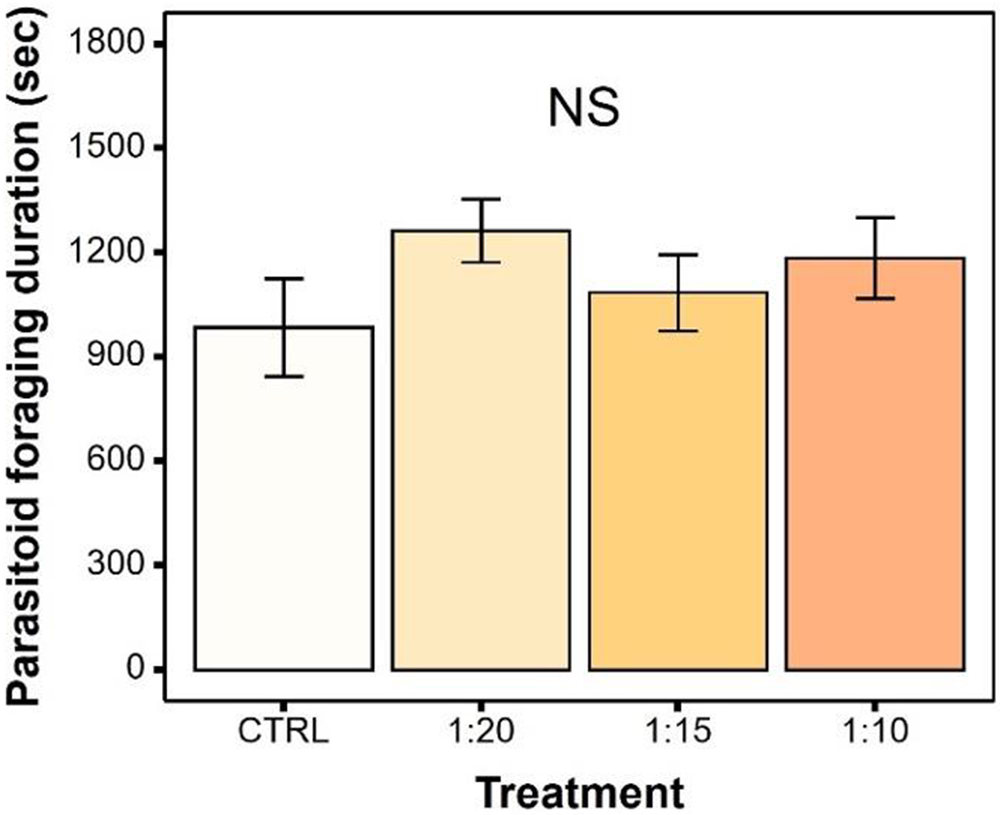
The foraging behaviour of A. gifuensis was not significantly affected by the soil amendments containing C. sinensis peel powder (χ2df=3 = 3.20, P = 0.362, fig. 5). Parasitoids showed similar host-searching durations across all treatments and the control.
Foraging duration (sec, mean ± sem) of Aphidius gifuensis under different orange peel amendment treatments with a respective ratio to soil (1:20, 1:15, 1:10 compared with control) as in the axis x. The annotation ‘NS’ refers to a non-significant treatment effect.

Discussion
The valorization of agricultural by-products as soil amendments represents a promising strategy for sustainable pest management. Orange peel, a globally abundant citrus waste rich in bioactive compounds, offers potential to modulate plant-soil-insect interactions. This study demonstrates that soil amendment with orange peel powder at specific ratios can influence B. rapa growth and M. persicae development, without disrupting the foraging behaviour of its parasitoid A. gifuensis. These findings highlight both the promise and the practical challenges of utilizing citrus waste in integrated pest management.
We observed clear concentration-dependent effects on plant performance. The 1:10 amendment significantly reduced seed germination, plant height, leaf dimensions, and fresh biomass, while the 1:20 amendment also decreased fresh weight. These phytotoxic effects are consistent with prior research on citrus-based amendments. Ribeiro and Lima (Reference Ribeiro and Lima2012) reported that volatile compounds in orange peel oil suppressed seedling growth and caused morphological changes in weeds. Similarly, Nath et al. (Reference Nath, Yumnam and Deb2016) found that lemon peel extracts reduced germination and growth in lettuce and cabbage, effects attributed mainly to limonene, a dominant compound in orange peels (Shafique et al., Reference Shafique, Shafique and Aqeel2013; Mahmoud, Reference Mahmoud2017). Ugolini et al. (Reference Ugolini, Crisci, Baronti, Cencetti, Dal Prà, Albanese, Michelozzi, Zabini and Meneguzzo2024) further showed that orange pastazzo extracts rich in limonene inhibited germination in Chenopodium album L. and delayed Lactuca sativa L. germination. Supporting this, Sahoo et al. (Reference Sahoo, Jeeceelee, Lallinrawna and Muthukumaran2015) demonstrated that Citrus reticulata leaf extracts inhibited germination and shoot/root growth in various crops in a dose-dependent manner. Allelopathic activity varies among citrus species and tissues. Fujihara and Shimizu (Reference Fujihara and Shimizu2003) found strong inhibitory effects from Citrus junos peel but minimal effects from navel orange and lemon, emphasizing the importance of species-specific phytochemical profiles. Furthermore, Tsai (Reference Tsai2008) showed that stored pulpified orange peels enhanced nematostatic and egg hatch inhibition effects, likely due to the release of essential oils during storage. This suggests that the method of orange residue preparation could significantly influence biological activity, an aspect worth exploring in future work.
Reduced plant height and fresh weight may also be linked to nutrient immobilization during microbial decomposition of high-carbon organic matter (Bonanomi et al., Reference Bonanomi, Sicurezza, Caporaso, Esposito and Mazzoleni2006, Reference Bonanomi, Incerti, Barile, Capodilupo, Antignani, Mingo, Lanzotti, Scala and Mazzoleni2011). Interestingly, even the low-concentration amendment (1:20) reduced plant weight, indicating that minor doses can influence soil nutrient availability or plant physiology. This contrasts with positive results reported from orange pulp amendments (Mahmoud et al., Reference Mahmoud, Hernández Bautista, Sandhu and Hussein2019), underscoring the different impacts of various citrus tissues. The pattern is consistent with dose-dependent effects seen in other amendments, such as garlic stalk, where moderate doses enhance growth but higher concentrations induce stress (Ghani et al., Reference Ghani, Ali, Atif, Ali, Amin, Anees and Cheng2019). Leaf size reduction in the 1:10 treatment aligns with reports of phytotoxic effects on leaf development. For instance, terpenes such as limonene have been suggested to interfere with hormonal signalling in other plant systems (Rodriguez et al., Reference Rodriguez, San Andrés, Cervera, Redondo, Alquézar, Shimada, Gadea, Rodrigo, Zacarías, Palou and López2011; Qasim et al., Reference Qasim, Islam, Rizwan, Hussain, Noman, Khan, Ghramh and Han2024), which could theoretically contribute to reduced leaf expansion. This indicates a trade-off between pest suppression and plant vigour, which could be attributed to phytotoxic effects of peel compounds and/or to nutrient immobilization during decomposition of the high-carbon amendment. These effects highlight the need for optimized application rates.
Also reported dose-dependent effects of garlic stalk amendments: moderate doses enhanced plant growth, while higher concentrations induced stress, a pattern consistent with our findings. Although we did not observe changes in root length, previous studies reported root suppression with orange peel extracts (Nath et al., Reference Nath, Yumnam and Deb2016), again pointing to species-specific sensitivity. Leaf size reduction in Treatment 1 is consistent with reports of phytotoxic effects on leaf development. For instance, terpenes such as limonene have been suggested to interfere with hormonal signalling in other plant systems (Rodriguez et al., Reference Rodriguez, San Andrés, Cervera, Redondo, Alquézar, Shimada, Gadea, Rodrigo, Zacarías, Palou and López2011; Qasim et al., Reference Qasim, Islam, Rizwan, Hussain, Noman, Khan, Ghramh and Han2024), which could theoretically contribute to reduced leaf expansion. Nevertheless, this did not translate into population-level effects on M. persicae, possibly due to the aphid’s ability to adjust feeding behaviour and reproduction under stress (Goggin and Fischer, Reference Goggin and Fischer2022; Ali et al., Reference Ali, Alam, Abdel Hafez, Abbas, Alam, Ji, Ghramh, Khan, Saddam, Tonğa and Chen2025a, Reference Ali, Munawar, Abbas, Khan, Ghramh, Li, Chen and Bayram2025b)
The impact on aphid performance was similarly dose-dependent. The 1:10 and 1:15 amendments significantly delayed nymphal development, and the 1:15 amendment reduced adult weight gain. This aligns with studies linking plant secondary metabolites to extended insect development. Hollingsworth (Reference Hollingsworth2005) demonstrated that 1% aqueous limonene solutions effectively controlled various sap-feeding insects, suggesting that limonene, a major component of orange peel oils, has potential as a natural insecticide. The reduction in adult weight at moderate amendment levels (1:15) suggests a possible induction of plant defence responses. In Brassica species, similar abiotic or biotic stresses can lead to increased glucosinolate production (Mewis et al., Reference Mewis, Khan, Glawischnig, Schreiner and Ulrichs2012), which is known to influence aphid performance. However, aphid population growth remained unchanged, contrasting with findings that compounds like sinigrin reduce fecundity (Gabrys and Tjallingii, Reference Gabrys and Tjallingii2002). This suggests M. persicae may possess metabolic adaptations to cope with moderate chemical defences (Farhan et al., Reference Farhan, Pan, Hussain, Zhao, Yang, Ahmad and Zhang2024). The absence of population-level effects may also reflect spatial limitations of the experiment. Gfeller et al. (Reference Gfeller, Waelchli, Pfister, Deslandes-Hérold, Mascher, Glauser, Aeby, Mestrot, Robert, Schlaeppi and Erb2023) demonstrated that root-exuded benzoxazinoids suppressed herbivore abundance only under field conditions. Similarly, Gu et al. (Reference Gu, Zalucki, Men, Li, Hou, Zhang, Ge and Ouyang2022) reported that aphid suppression by organic amendments depended on widespread application. Our pot-scale setup may not have provided sufficient spatial heterogeneity to amplify sublethal stress into population-level control (Gu et al., Reference Gu, Zalucki, Men, Li, Hou, Zhang, Ge and Ouyang2022; Gfeller et al., Reference Gfeller, Waelchli, Pfister, Deslandes-Hérold, Mascher, Glauser, Aeby, Mestrot, Robert, Schlaeppi and Erb2023, Reference Gfeller, Thoenen and Erb2024).
Importantly, orange peel amendments did not affect A. gifuensis foraging behaviour, suggesting that changes in plant traits or volatiles did not interfere with parasitoid host-searching. This aligns with Gu et al. (Reference Gu, Zalucki, Men, Li, Hou, Zhang, Ge and Ouyang2022), who found that maize straw amendments increased parasitism rates without altering parasitoid foraging, likely due to altered amino acid profiles rather than volatiles. Thus, orange peel amendments appear compatible with this aspect of biological control, though further research on other parasitoid life-history traits is needed for a comprehensive assessment. Beyond direct pest management, orange peel residues offer wider ecological benefits, such as their potential use in creating bioactive, sustainable materials (Selvaraj et al., Reference Selvaraj, Kanagaraj, Karuppiah, Ravindran, Raj, Senthamaraikannan and Suyambulingam2025).
In conclusion, this study demonstrates that soil amendment with orange peel powder can influence plant-insect interactions by modifying plant physiology and impairing aphid development. The amendments delayed M. persicae nymphal development and reduced adult weight gain, suggesting potential for pest suppression. However, these effects were accompanied by reductions in plant performance at higher amendment levels. The lack of effect on parasitoid foraging is encouraging for integrated strategies. These findings highlight the promise of orange peel residues as a sustainable tool while emphasizing the need to calibrate application rates. Future studies incorporating soil property analyses (e.g. pH, EC, and organic matter) would help elucidate whether plant responses are driven primarily by phytochemical activity or by shifts in nutrient availability. Research across different cultivars and field conditions, with quantification of active compounds, would support broader agricultural application of this approach to waste valorization.
Acknowledgements
The authors acknowledge BioRender.com for providing the platform used to create fig. 1.
Author contributions
Zhao Jianye: methodology, experimentation, data curation. Huan Xia: methodology, experiments. Jamin Ali: conceptualisation, methodology, experimentation, writing – original draft; writing – reviewing and editing, data analysis, visualization. Wang Jingyu: methodology, experimentation, data collection. Li Yang: experimentation. Yuhan Zhang: experimentation. Xiyao Xue: methodology, experimentation. Jiyun Liang: experimentation, resources. Han Xiao: writing – reviewing and editing. Mohammad Mahamood: writing – original draft; writing – reviewing and editing. Habib Ali: writing – original draft; writing – reviewing and editing, critical reading, and visualization. Adil Tonga: conceptualisation, original draft; writing – reviewing and editing; data analysis, visualization. Qiyun Li: conceptualisation, supervision, funding acquisition, project administration, resources, writing – review and editing. Rizhao Chen: conceptualisation, supervision, funding acquisition, project administration, resources, writing – review and editing.
Financial support
This work was supported by the People’s Government of Jilin (Grant No. 20220203198SF) and the Ministry of Science and Technology of China (Grant No. 2022YFD1500701).
Competing interests
The authors declare no competing interests.
Consent for publication
All authors agree to and provide their approval for the publication of this article.
Ethics approval and consent to participate
Not applicable.
Data availability statement
The data that support the findings of this study are available from the corresponding author upon reasonable request.