Introduction
The family Sternaspidae Carus, 1863 present as one of their characteristics a peanut-like body shape (Yoshino et al., Reference Yoshino, Nagayoshi, Sato, Katano, Ito, Fujii, Hamada and Hayami2016) and a characteristic stiff ventral shield which presents different shapes and pigmentation patterns in different species (Hutchings, Reference Hutchings, Beesley, Roos and Glasby2000; Salazar-Vallejo, Reference Salazar-Vallejo2017). This family is formed by four genera and 48 species, and is widely distributed in all oceans, from shallow to deep sea waters (Méndez & Yáñez-Rivera, Reference Méndez and Yáñez-Rivera2015; Díaz-Díaz & Rozbaczylo, Reference Díaz-Díaz and Rozbaczylo2017; Fiege & Barnich, Reference Fiege and Barnich2020; Chuar & Salazar-Vallejo, Reference Chuar and Salazar-Vallejo2021; Plathong et al., Reference Plathong, Plathong and Salazar-Vallejo2021); members of the family are motile, subsurface deposit feeders (Jumars et al., Reference Jumars, Dorgan and Lindsey2015; Hutchings, Reference Hutchings, Beesley, Roos and Glasby2000), occurring in substrates varying from coarse sand to mud (Sendall & Salazar-Vallejo, Reference Sendall and Salazar-Vallejo2013; Díaz-Díaz & Rozbaczylo, Reference Díaz-Díaz and Rozbaczylo2017). The species identification in Sternaspidae is currently based on the morphology of a limited set of characters, e.g. segments of the anterior region of the abdomen, type of introvert hooks and the ventro-posterior shield, the latter is the only characteristic used to define this family (Sendall & Salazar-Vallejo, Reference Sendall and Salazar-Vallejo2013; Drennan et al., Reference Drennan, Wiklund, Rouse, Georgieva, Wu, Kobayashi, Yoshino and Glover2019). In the recent revision of sternaspids performed by Sendall & Salazar-Vallejo (Reference Sendall and Salazar-Vallejo2013), the described species were grouped into three genera: Sternaspis Otto, Reference Otto1821, Caulleryaspis Sendall & Salazar-Vallejo, Reference Sendall and Salazar-Vallejo2013 and Petersenaspis Sendall & Salazar-Vallejo, Reference Sendall and Salazar-Vallejo2013, based on characteristics of the caudal shields, introvert hooks and number of anterior abdominal segments (Sendall & Salazar-Vallejo, Reference Sendall and Salazar-Vallejo2013; Wu & Xu, Reference Wu and Xu2017). Recently, Fiege & Barnich (Reference Fiege and Barnich2020) proposed a new genus with a new species, Mauretanaspis longichaeta Fiege & Barnich, Reference Fiege and Barnich2020 from deep sea off Mauritania and Angola.
In Brazil only two species of Sternaspidae have been reported, Petersenaspis capillata (Nonato, Reference Nonato1966) [ = Sternaspis capillata Nonato, Reference Nonato1966] (Amaral et al., Reference Amaral, Nallin, Steiner, Forroni and Gomes2012; Sendall & Salazar-Vallejo, Reference Sendall and Salazar-Vallejo2013), and Sternaspis aff. nana Zhadan, Tzetlin & Salazar-Vallejo, Reference Zhadan, Tzetlin and Salazar-Vallejo2017 (Craveiro & Rosa Filho, Reference Craveiro and Rosa Filho2021), which is herein regarded as a new species belonging in Caulleryaspis. Petersenaspis capillata was described from samples collected in muddy bottom (depth 52–126 m) of the São Paulo state, south-eastern Brazil. Sternaspis aff. nana were observed from samples collected in muddy bottom (15 m depth) of the external area of the Suape Harbour in Pernambuco state, north-eastern Brazil. Based on that, herein we report the new record of the species of Sternaspidae from Brazil and describe a new species of Caulleryaspis from shallow water in north-eastern Brazil.
Materials and methods
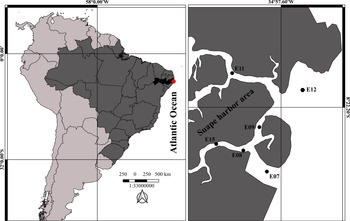
The specimens were collected in the Suape harbour area (Suape estuary complex), Pernambuco – Brazil (Figure 1) in January and June 2019. Samples were taken with a van Veen grab in muddy bottom in 7–16 m depth. After sampling, the individuals were fixed in 4% formalin solution in seawater and transferred to 70% ethanol for preservation. Thereafter, the specimens were identified to species level according to Sendall & Salazar-Vallejo (Reference Sendall and Salazar-Vallejo2013) and Salazar-Vallejo (Reference Salazar-Vallejo2017). In addition, some specimens were examined using scanning electron microscopy (SEM) investigations. Specimens were dehydrated by a graded ethanol series, critical-point dried using CO2, mounted on aluminium stubs, coated with gold, and examined and photographed at the Technology Platforms Center/FIOCRUZ. Specimens were deposited in the ‘Museu de Oceanografia Prof. Petrônio Alves Coelho (MOUFPE)’ at Federal University of Pernambuco, Recife, Brazil.
Geographic location of the study area, showing type locality collection stations (indicated by the black circles) of Caulleryaspis chicosciencei sp. nov. Suape Harbour area (Suape estuary complex), Pernambuco – Brazil.

Results
Systematics
Order Terebellida Rouse & Fauchald, 1997
Family Sternaspidae Carus, 1863
Genus Caulleryaspis Sendall & Salazar-Vallejo, Reference Sendall and Salazar-Vallejo2013
Caulleryaspis chicosciencei sp. nov.
(Figures 2–4)
Type Material
Holotype: MOUPFE 004, complete specimen (3.8 mm long, 1.35 mm wide; left shield plate 0.4 mm long, 0.4 mm wide), Suape, Pernambuco-Brazil, St E12 (8°21′52.02″S 34°57′11.14″W), mud, 15 m depth, Ipojuca, 22 Jan. 2019. Paratypes: MOUPFE 005, same field data as the holotype, 5 specimens. Three specimens with anterior ends retracted, 0.98–1.45 mm long, 0.63–0.94 mm wide; left shield plate 0.23–0.30 mm long, 0.15–0.30 mm wide. Two specimens’ anterior ends protruded 2.8–3.9 mm long, 1.2–1.55 mm wide; left shield plate 0.48–0.50 mm long, 0.30–0.43 mm wide.
Additional material: Suape, Pernambuco-Brazil. 22 Jan. 2019, Sta E08 (8°23′1.71″S 34°58′19.59″W), muddy substrate, 12 m depth: 5 specimens; 22 Jan. 2019, Sta E15 (8°22′54.30″S 34°58′50.83″W), muddy substrate, 9 m depth: 3 specimens. Suape harbour area, Pernambuco – Brazil. 26 Jun. 2019, Sta E15 (8°22′54.30″S 34°58′50.83″W), mud substrate, 9 m depth: 1 specimen; 26 Jun. 2019, Sta E12 (8°21′52.02″S 34°57′11.14″W), muddy substrate, 15 m depth: 1 specimen; 26 Jun. 2019, Sta E11 (8°21′32.51″S 34°58′32.44″W), muddy substrate, 11 m depth: 1 specimen; 26 Jun. 2019, Sta E09 (8°22′34.79″S 34°58′1.06″W), mud substrate, 7 m depth: 4 specimens; 26 Jun. 2019, Sta E07 (8°23′26.16″S 34°57′52.39″W), muddy substrate, 16 m depth: 1 specimen.
Diagnosis
Sternaspid with introvert hooks falcate. Seven segments between genital papillae (gonopodial lobes) and shield. Body with abundant minute cirriform papillae evenly distributed, both dorsally and ventrally. Ventro-caudal shield surface visible, covered by long cirriform papillae, papillae longer along its margins, shallow suture extended throughout shield; ribs indistinct; lateral margins medially expanded. Peg-chaetae not seen.
Description
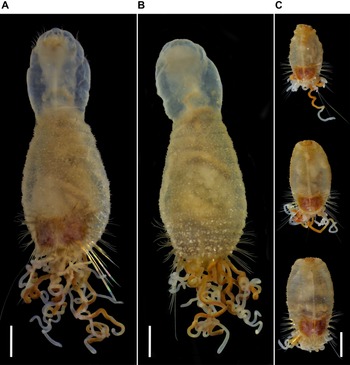
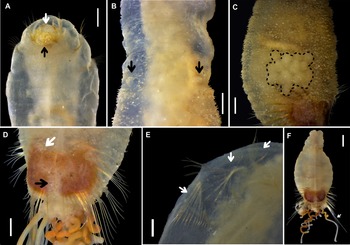
Holotype complete 3.8 mm long; 1.35 mm wide; left shield plate 0.4 mm long, 0.4 mm wide; about 26 segments. Body pale to yellowish with barely evident segments, hourglass-shaped, body wall semi-transparent; introvert colourless, fully exposed, narrower than abdomen. Abdomen cream-whitish with abundant long cirriform papillae evenly distributed ventrally, in posterior segments in rather regular transverse rows dorsally (Figures 2A–B & 3B–C). Intestine, ventral nerve (Figure 2A, B) and oocytes (Figures 2B & 3C) visible through body wall. Prostomium hemispherical, projected, small, semi-translucent, with two reddish-brown eyespots (Figure 3A). Mouth small, round, covered by abundant minute papillae (Figures 3A & 4B).
Caulleryaspis chicosciencei sp. nov., holotype (MOUPFE 004). (A) General ventral view; (B) General dorsal view; (C) Paratype: Series of juvenile specimens with introvert fully inverted. Scale bars: 0.5 mm.

Caulleryaspis chicosciencei sp. nov., holotype (MOUPFE 004). Prostomium, peristomium and introvert, ventral view. (A) Anterior part. White arrows showing prostomium; black arrows showing mouth. (B) Posterior part. Black arrows showing genital papillae (gonopodial lobes). Paratypes. (C) Pre-shield, abdominal region and ventro-caudal shield, ventro-lateral view showing body papillae. Black dotted area showing oocytes; (D) Pre-shield and ventro-caudal shield, ventral view. White arrows showing long cirriform papillae in the ventro-caudal shield. Black arrows showing sediment particles attached to ventro-caudal shield; (E) First three chaetigers. White arrows showing falcate hooks; (F) Ventral view. White arrows showing delicate, long capillary chaetae. Scale bars. A–D: 0.2 mm, E: 0.1 mm, F: 0.5 mm.

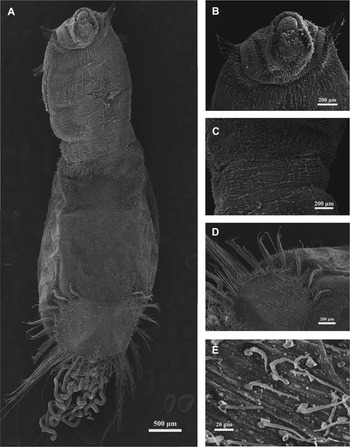
Caulleryaspis chicosciencei sp. nov. Paratypes, by SEM. (A) Ventral view; (B) Detail of the prostomium, peristomium, mouth and introvert hooks falcate; (C) Detail of the genital papillae (gonopodial lobes); (D) Detail of the ventro-caudal shield: marginal chaetal fascicles include eight lateral shield chaetae in an oval arrangement, and six posterior shield chaetae in slightly curved pattern; (E) Detail of the long cirriform papillae in ventro-caudal shield and sediment particles adhered.

First three chaetigers with 18–21 falcate hooks transparent tapering to sharp points, not subdistally expanded (Figures 3A, E & 4B). Constriction between segments seven and eight. Genital papillae (gonopodial lobes) small, protruding ventrally from seventh chaetiger (Figures 3B & 4C). Pre-shield region with eight segments, covered with abundant long cirriform papillae, with sediment particles adhered, without fine capillary chaetae.
Ventro-caudal shield reddish-brown, soft, without ribs and underdeveloped concentric lines, covered by long cirriform papillae (integument papillae), papillae larger towards margins; with small quantity of sediment particles firmly adhered (Figures 3D & 4E). Shallow suture extended throughout shield (Figures 2A, C & 3D). Shield plates with anterior margins slightly rounded; anterior depression very shallow; anterior keels not exposed. Lateral margins rounded, not expanding posteriorly, and posterior margins slightly rounded. Fan slightly projected beyond posterior corners, margin smooth, with median notch (Figures 2A, C & 3D).
Marginal chaetal fascicles (each containing many chaetae) include eight lateral shield chaetae in an oval arrangement, and six posterior shield chaetae in slightly curved pattern (Figure 4D). Peg-chaetae not seen. Two delicate long capillary chaetae, 2–3 times longer than posterior chaetae, in the first bundle of posterior shield chaetae (Figures 2A–C & 3F). Branchial filaments long numerous, slender, curled or spiralled (Figures 2, 3B & 4A).
Variation
Paratypes smaller, very similar to holotype. The number of chaetae of the introvert increases with body size. Body colour varies from pale to yellowish with little evident segments, less evident in juveniles (Figures 1A–C & 3C–F). Body shape almost oval in those specimens with introvert fully inverted (Figure 2C). Ventro-caudal shield translucent in small juveniles and reddish-brown to orange in larger juveniles and adults (Figures 2A, C & 3D, F).
Habitat
Muddy sediments with organic matter and seagrass detritus and lesser amounts of sand, depth varying between 7 and 16 m.
Geographic Distribution
Known only from the type locality in Suape estuary complex, State of Pernambuco, north-eastern Brazil.
Etymology
Caulleryaspis chicosciencei is named after Francisco de Assis França (stage name Chico Science), a remarkable Brazilian singer and songwriter (13 March 1966–02 February 1997), and one of the main collaborators and influencers in the manguebeat musical movement, along with the band ‘Nação Zumbi’. The specific epithet is a noun in the genitive case (ICZN 1999, Art. 31.1.2).
Remarks
The ventro-caudal shield flexible, introvert hooks tapered and anterior abdomen with seven segments are the main distinctive characteristics of the genus Caulleryaspis (Sendall & Salazar-Vallejo, Reference Sendall and Salazar-Vallejo2013), and the presence of these characters in Caulleryaspis chicosciencei sp. nov. leads it to being placed in this genus.
Caulleryaspis chicosciencei sp. nov. differs from other known species in Caulleryaspis by a combination of features related to the ventro-caudal shield (presence of sediment particles, colour, and presence of ribs), and number of the lateral shield chaetae. The shield is masked by sediment in Caulleryaspis laevis [Caullery, 1944], Caulleryaspis fauchaldi Salazar-Vallejo & Buzhinskaja, 2013 and Caulleryaspis gudmundssoni Sendall & Salazar-Vallejo, Reference Sendall and Salazar-Vallejo2013, but clearly visible in Caulleryaspis chicosciencei sp. nov., as in Caulleryaspis nuda Salazar-Vallejo & Buzhinskaja, 2013, Caulleryaspis nana Zhadan, Tzetlin & Salazar-Vallejo, Reference Zhadan, Tzetlin and Salazar-Vallejo2017, Caulleryaspis villamari Salazar-Vallejo, Reference Salazar-Vallejo2017 and Caulleryaspis sundaensis Chuar & Salazar-Vallejo, Reference Chuar and Salazar-Vallejo2021. Regarding colour of the shield, in Caulleryaspis chicosciencei sp. nov. it is reddish brown, whereas in C. nuda it is pale brown, in C. villamari it is greyish, and it is dark reddish-brown in C. sundaensis. Ribs are absent in Caulleryaspis chicosciencei sp. nov., whereas they are present in C. nuda, C. villamari and C. sundaensis. Finally, Caulleryaspis chicosciencei sp. nov. has eight lateral shield chaetae, and there are 10 lateral shield chaetae in C. nuda, C. villamari and C. sundaensis.
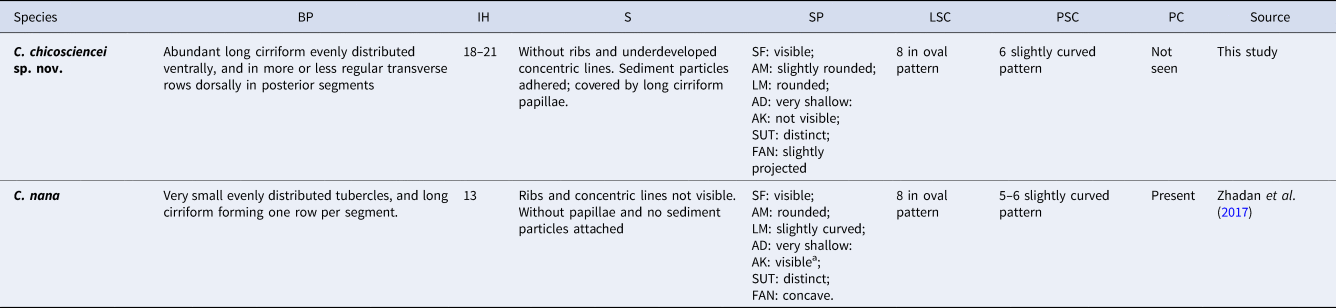
Caulleryaspis chicosciencei sp. nov. is very similar to Caulleryaspis nana from Vietnam because both have shield soft, reddish-brown; shield surface visible, without ribs, eight lateral shield chaetae in oval pattern; papillae present around ventral shield margins, and have small and abundant body abdominal papillae. However, these two species differ, mainly in the characteristics of the shield, where the Brazilian species, Caulleryaspis chicosciencei sp. nov., is covered by long cirriform papillae in shield surface and in C. nana the surface is smooth. Other features that differentiate these species are that Caulleryaspis chicosciencei sp. nov. has chaetigers of introvert with 18–21 falcate hooks per bundle, whereas C. nana has 13. Caulleryaspis chicosciencei sp. nov. has body papillae abundant long cirriform evenly distributed ventrally, and in rather regular transverse rows dorsally in posterior segments, whereas C. nana has body abdominal papillae of two kinds: abundant, very small tubercles, not arranged in series; other papillae long cirriform, forming rows on each abdominal segment. In Caulleryaspis chicosciencei sp. nov. no capillary chaetae were seen laterally in the segments, whereas C. nana has 1–2 fine capillary chaetae laterally in some segments. Caulleryaspis chicosciencei sp. nov. has posterior shield chaetae with six fascicles each containing many chaetae in slightly curved pattern, whereas in C. nana has five to six posterior fascicles each containing only one thick chaeta in slightly curved pattern. The morphological features are summarized in Table 1.
Main morphological features of Caulleryaspis chicosciencei sp. nov. and Caulleryaspis nana

BP, Body papillae; IH, Introvert Hooks; S, Shield; SP, Shild parts; SF, Surface features; AM, Anterior margins; LM, Lateral margins; AD, Anterior depression; AK, Anterior keel; SUT, Suture; LSC, Laterial shield chaetae; PSC, Posterior shield chaetae; PC, Peg Chaetae.
a In some specimens.
Acknowledgements
We would like to thank the Diretoria de Meio Ambiente e Sustentabilidade de SUAPE (Complexo Industrial Portuário Governador Eraldo Gueiros) and DBF Planejamento e Consultoria for supplying the material used and providing the necessary logistic support for this study. The authors thank the Associate Editor and the reviewers who provided valuable comments and suggestions. We also thank Claudeilton Santana and Karina Saraiva for helping us by making the photographs.
Author contributions
NC: research conceptualization, data collection, picture editing, data analysis and interpretation, roles/writing – original draft; writing – review and editing. JSRF: research conceptualization, data analysis and interpretation, roles/writing – original draft; writing – review and editing.
Financial support
The authors received no specific funding for this work.
Conflict of interest
None.
Ethical standards
All research pertaining to this article did not require any research permits.