Introduction
Until recently, populations of house mice Mus musculus L. introduced to oceanic islands were considered to have little impact on breeding bird populations. However, recent observations at Gough Island have shown significant impacts on both seabirds and endemic landbirds (Cuthbert & Hilton Reference Cuthbert and Hilton2004, Wanless et al. Reference Wanless, Angel, Cuthbert, Hilton and Ryan2007, Reference Wanless, Ryan, Altwegg, Angel, Cooper, Cuthbert and Hilton2009, Ryan & Cuthbert Reference Ryan and Cuthbert2008). Wanless et al. (Reference Wanless, Angel, Cuthbert, Hilton and Ryan2007) argued that mice are likely to be most problematic at islands where they are the only introduced mammal. In the absence of competition and predation by other, larger introduced mammals, mice attain high population densities that may trigger predatory behaviour. Sub-Antarctic Marion Island is one such island. Mice were introduced to Marion presumably by sealers sometime before 1818, and cats Felis catus L. were brought to the island in 1949 to control mice at the weather station, resulting in a feral population (Cooper Reference Cooper2008) that decreased breeding success of burrowing petrels and caused local extinction of some species (De Villiers & Cooper Reference De Villiers and Cooper2008). Cats were eventually eradicated from the island by 1992/93 (Bester et al. Reference Bester, Bloomer, van Aarde, Erasmus, van Rensburg, Skinner, Howell and Naude2002), leaving mice as the only introduced mammal.
Marion Island supports significant breeding populations of several threatened or near-threatened albatrosses: 22% of the world’s wandering albatrosses Diomedea exulans L. (Vulnerable), 9% of dark-mantled sooty albatrosses Phoebetria fusca (Hilsenberg) (Endangered), 7% of grey-headed albatrosses Thalassarche chrysostoma (Forster) (Vulnerable) and 3% of light-mantled sooty albatrosses P. palpebrata (Forster) (Near-Threatened; Ryan et al. in press). These species are listed as threatened largely due to accidental mortality on fishing gear, especially longlines (BirdLife International 2008 - www.birdlife.org). Both species of giant petrels Macronectes spp. (Near-Threatened) are also common surface-nesters at the island, and at least nine other species of petrels breed in burrows on the island, including white-chinned petrels Procellaria aequinoctialis L. (Vulnerable; Ryan & Bester Reference Ryan and Bester2008). In this paper we report evidence of mouse attacks on seabird chicks on Marion Island following the eradication of cats from the island.
Study area and methods
Marion Island (46°54′S, 37°45′E, 290 km2) has a vegetated coastal plain that rises to volcanic scoria peaks (highest point 1243 m). The island is home to large breeding populations of seabirds and pinnepeds, and ornithological research has been conducted on the island since 1965 (Cooper & Brown Reference Cooper and Brown1990, Ryan & Bester Reference Ryan and Bester2008), with regular monitoring of breeding success of three wandering albatross (c. 195–270 nests per annum) and three northern giant petrel (c. 70–135 nests per annum) colonies since the 1980s (Cooper et al. Reference Cooper, Brooke, Burger, Crawford, Hunter and Williams2001, Nel et al. Reference Nel, Taylor, Ryan and Cooper2003), and one grey-headed albatross (c. 90–140 nests per annum) colony since 1996 (Ryan et al. Reference Ryan, Phillips, Nel and Wood2007). In these study colonies, breeding attempts were monitored from egg laying to fledging. Once the chicks were no longer brooded, they were checked every 2–4 weeks, and any wounded chicks recorded. Ad hoc observations have also been made of albatross chicks outside study colonies, including chicks of light-mantled and dark-mantled sooty albatrosses, as well as small numbers of white-chinned and great-winged petrel Pterodroma macroptera (Smith) chicks observed in monitored burrows of low intensity studies. Wounded chicks were photographed, and where feasible, their fate was checked by repeated visits. Since the mid-1980s, annual counts of the entire breeding population of wandering albatrosses on Marion Island have been conducted during early incubation (January), and counts of large chicks have been made prior to fledging (October), allowing crude estimates of breeding success around the island.
Results
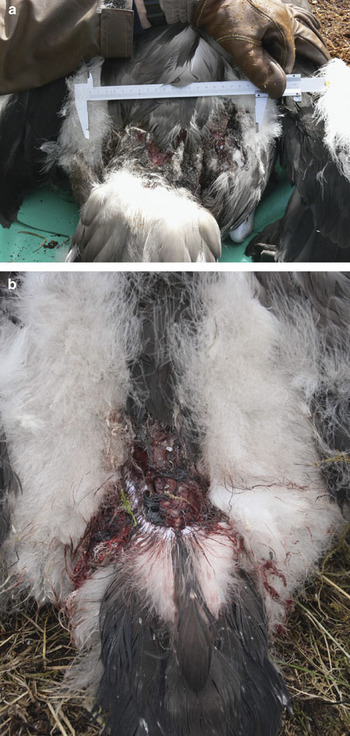
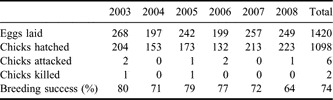
Since 2003, 12 wandering albatross chicks have been found on Marion Island with wounds on their backs, rumps and flanks that were identical to those exhibited by Tristan albatross Diomedea dabbenena Matthews chicks following attacks by mice (Fig. 1). Six were recorded among study colony chicks, with 0–2 records per year (0–2% of chicks that hatch; Table I). The other six were observed incidentally, mostly close to the research station, where observer effort is greatest, but one attack occurred on the island’s west coast, indicating that attacks occur around the island. The fates of 11 wounded chicks were followed, of which six (55%) died. Counts of incubating adults and large fledglings showed no consistent regional differences in breeding success around the island.
a. A well-feathered wandering albatross chick on Marion Island exhibits wound on its lower back (photo: M.G.W. Jones) very similar to b. those inflicted by mice on a Tristan albatross chick on Gough Island (photo: P.G. Ryan).

Numbers of wandering albatross chicks attacked and killed by mice in relation to breeding effort and success in study colonies at Marion Island since the first record of a mouse attack in 2003.

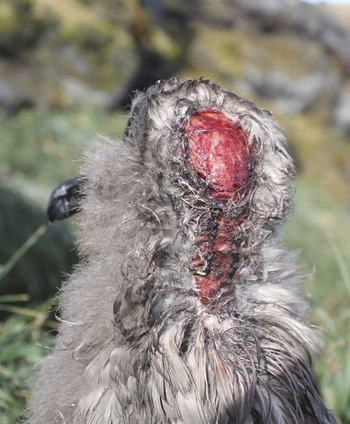
There has been no evidence of mouse attacks on grey-headed albatross or northern giant petrel chicks, either in the study colonies or from incidental observations. However, in April 2009 localized attacks were recorded on dark-mantled sooty albatross chicks at Marion Island. Seven of 19 large chicks on two ledges of an inland cliff in the south-west of the island (Old Sea Cliffs, Toffee Lava) bore open wounds on the backs of their heads and/or necks (Fig. 2) similar to wounds observed on some Tristan albatross chicks on Gough Island (K. Cita, unpublished photographs). Another dark-mantled sooty albatross chick bearing similar wounds was observed on sea cliffs near Bullard Beach on the eastern coast of the island during the same period (Bo Bonnevie, personal communication 2009). There have been no incidental observations of attacks on other seabirds. Mouse activity has been seen in many petrel burrows, including mice running over and around chicks, but no definite attacks have been recorded.
The head and neck wounds exhibited by one of nine dark-mantled sooty albatross chicks near the south-western point of Marion Island in April 2009 (photo: P.G. Ryan).

Mouse holes are frequently found in nests of wandering albatrosses and, to a lesser extent, in grey-headed albatross nests. Many such mouse holes lead into the base of the nest cup where the mice may obtain a thermal advantage, especially in winter (Sinclair & Chown Reference Sinclair and Chown2006). In April 2009 two small wandering albatross chicks died under brooding adults after they apparently were unable to extricate themselves from large hollows (c. 10 cm in diameter) in the nest cup. After death, their carcases required considerable force to be pulled from these hollows. It is probable that mouse nests had caved in under the chicks, indirectly killing them.
Discussion
Although mice have not been observed attacking albatross chicks on Marion Island, the nature of the chicks’ wounds strongly suggests that mice were responsible. Based on our observations, currently < 1% of wandering albatross chicks at Marion Island are attacked by mice. At Gough Island, mouse attacks on Tristan albatrosses were overlooked previously because of spatial differences in the frequency of attacks (Cuthbert & Hilton Reference Cuthbert and Hilton2004), but this does not appear to be the case at Marion Island. It is also probable that the attacks at Marion only commenced in the last few years, because monitoring of wandering albatross chicks has been conducted at the same intensity since the study colonies were established in the early 1980s without any records of wounded birds.
Wanless et al. (Reference Wanless, Angel, Cuthbert, Hilton and Ryan2007) hypothesized that mice have a greater effect on native vertebrates when they are the sole introduced mammal on an island. This is because their populations increase when the combined effects of dominance, competition and predation are removed. Our observations lend further support to this hypothesis because the first mouse attacks were recorded a decade after the eradication of feral cats, the only other introduced mammal on the island. The worrying conclusion is that mouse attacks might be expected to increase at Marion Island, especially if mouse populations benefit from global warming (de Villiers & Cooper Reference De Villiers and Cooper2008). This would be cause for serious concern given the large proportion of the global population of wandering albatrosses that breeds on Marion Island (Ryan et al. in press). Given the serious impacts of mice on insular populations when they are the sole alien mammal, precautions should be taken if competing aliens are eradicated. Every attempt should be made to eradicate mice as well as other predatory mammals.
The apparent attacks on dark-mantled sooty albatrosses are also cause for alarm. One sooty albatross chick has been recorded killed by mice on Gough Island (Cuthbert et al. unpublished), but this is the first occurrence of multiple attacks on chicks in a single colony. Sooty albatrosses are listed as Endangered (BirdLife International 2008), and are the only albatross species whose population is decreasing at Marion Island (Ryan et al. in press). It is also likely that burrowing petrels are victims of mouse predation at Marion Island, but that it goes undetected because they are less easily observed and are not currently studied at this island. In the 1980s, blue petrel Halobaena caerulea (Gmelin) chicks were apparently attacked by mice on Marion Island (Fugler et al. Reference Fugler, Hunter, Newton and Steele1987). South Africa is a party to the Agreement on the Conservation of Albatrosses and Petrels (ACAP) and as such has international obligations to ensure the conservation of these birds. Continued monitoring of seabird chicks on Marion Island for signs of mouse predation is required. Our study provides further support for the need to attempt to eradicate mice from Marion Island.
Acknowledgements
We thank Bo Bonnevie, Linda Clokie, Nico de Bruyn, Quentin Hagens, Henk Louw, Edith Mertz, Cornelia Niewenhuys, Samantha Petersen, Cheryl Tosh and Paul Visser, for their observations. Research on Marion Island is supported by the South African National Antarctic Programme through the National Research Foundation, with logistical support from the Directorate: Antarctica and Islands of the former Department of Environmental Affairs and Tourism.