The connections between adolescent marijuana use and both marijuana use and other negative outcomes in young adulthood have received much research attention; thus, our understanding of the developmental consequences of such use has increased in recent years. In particular, the use of marijuana in adolescence seems to contribute to mental illness (Ellickson, Martino, & Collins, Reference Ellickson, Martino and Collins2004; Moore et al., Reference Moore, Zammit, Lingford-Hughes, Barnes, Jones and Burke2007) and difficulties with employment in young adulthood (Brook, Richter, Whiteman, & Cohen, Reference Brook, Richter, Whiteman and Cohen1999; Griffin, Bang, & Botvin, Reference Griffin, Bang and Botvin2010). These outcomes suggest that the use of marijuana in adolescence changes developmental trajectories toward maladaptation. Although the connection between adolescent marijuana use and later use has been observed frequently (Lessem et al., Reference Lessem, Hopfer, Haberstick, Timberlake, Ehringer and Smolen2006), the complexity of individual and intraindividual differences in adolescent use and associated risk factors are less frequently examined. In studies where such differences in adolescence are modeled, the complexity of marijuana use in the 20s is seldom addressed. If this complexity of marijuana use in the 20s is considered, adolescent psychopathology is often overly simplified. In addition, few studies have looked at the consequences of marijuana use past the 20s. This has resulted in a body of studies detailing the risk factors associated with adolescent marijuana use and a growing second body of studies modeling the heterogeneity of use in the 20s, but the nature of the connection between these two complex processes is not well understood and their consequences for development into the 30s is even less understood.
As marijuana use among adolescents continues to rise (Johnston, O'Malley, Bachman, & Schulenberg, Reference Johnston, O'Malley, Bachman and Schulenberg2011) and as public opinion becomes more favorable of legalization (Carroll, Reference Carroll2005), the need to understand the developmental connections among adolescent marijuana use, individual and family characteristics, and marijuana use in the 20s, as well as the developmental consequences of these behaviors in the mid-30s, grows urgent. Using the Oregon Youth Study (OYS), a sample of boys from the Eugene–Springfield area who in childhood were at risk for conduct problems because of the neighborhoods in which they lived, we propose to examine the change across adolescence in both individual characteristics and in parenting and parental marijuana use with patterns of marijuana use in the men's 20s, and the consequences of these patterns in the mid-30s, using a dynamic developmental systems framework (Capaldi, Shortt, & Kim, Reference Capaldi, Shortt, Kim, Pinsof and Lebow2005). A two-part growth mixture modeling approach was used to model marijuana use in the 20s, to model both use versus nonuse and level of use given use.
The dynamic developmental systems framework focuses on how the many aspects of a person's life influence that person's behaviors (Smith & Thelen, Reference Smith and Thelen2003), with a particular emphasis on key influential social systems (e.g., parents and peers) and the developmental history that the individual brings to these social interactions. A second major aspect of the framework is to examine risk factors for substance use from two important developmental domains: first, factors that are associated with the general developmental pathway of problem behavior development (e.g., parental monitoring) and, second, outcome-specific risk factors (e.g., parent marijuana use; Capaldi, Feingold, Kim, Yoerger, & Washburn, Reference Capaldi, Feingold, Kim, Yoerger and Washburn2013). In addition, understanding the developmental processes leading to marijuana use in the 20s should be advanced by using a dynamic model, involving examining the change across adolescence for these theoretical predictors of marijuana use rather than using static time-point estimates in a regression. The most influential prior individual predictors of marijuana use patterns in the 20s is probably the developmental pattern or growth of marijuana use in adolescence.
On the basis of the developmental approach, three key adolescent risk factors associated with the general developmental pathway of problem behaviors, including substance use, namely, antisocial behavior, association with antisocial or deviant peers, and depressive symptoms, were examined in the present study. The first two of these in particular are associated with the use of marijuana and other substances in adolescence (Tarter, Kirisci, Ridenour, & Vanyukov, Reference Tarter, Kirisci, Ridenour and Vanyukov2008). Regarding family factors similarly associated with development of problem behaviors, parental monitoring was included. Examining both youth and family risk factors follows the dynamic systems approach of examining multiple levels of influence. Regarding outcome-specific risk factors, the men's own use of marijuana during their adolescent years, as well as their parents' use during their adolescence, was examined.
Few studies examining differential substance use in early adulthood have examined longer term outcomes. In the present study, indicators of adjustment in the mid-30s were examined for differential trajectories of marijuana use across the decade of the 20s. These adjustment indicators included reexamination of the men's antisocial behavior, association with deviant peers, and depressive symptoms, as well as diagnoses of marijuana use disorders. In addition, employment and marital status in the mid-30s were examined as important markers of transitions into adulthood. All together, the study covers 26 years in the lives of the OYS men.
Adolescent General Pathways
Youth antisocial behavior and association with deviant peers are strongly predictive of a cluster of problem behaviors in adolescence, including marijuana use (Dishion, Capaldi, & Yoerger, Reference Dishion, Capaldi and Yoerger1999; Tarter et al., Reference Tarter, Kirisci, Ridenour and Vanyukov2008). Specifically, Flory, Lynam, Milich, Leukefeld, and Clayton (Reference Flory, Lynam, Milich, Leukefeld and Clayton2004) showed that adolescents with symptoms of conduct disorder were more likely to be in either of the marijuana-use classes they identified as opposed to the nonuser class. Windle and Wiesner (Reference Windle and Wiesner2004) also found that initial levels of delinquent behaviors were significantly lower for nonusers than for all classes of users they identified based on growth patterns. Several studies also document that associations with deviant peers increase risk for later substance use (Dishion, Capaldi, Spracklen, & Li, Reference Dishion, Capaldi, Spracklen and Li1995; Kirisci, Mezzich, Reynolds, Tarter, & Aytaclar, Reference Kirisci, Mezzich, Reynolds, Tarter and Aytaclar2009), and marijuana use specifically (Mauricio et al., Reference Mauricio, Little, Chassin, Knight, Piquero and Losoya2009).
There is mixed and often contradictory evidence for an association between depressive symptoms and marijuana use for adolescents (Degenhardt, Hall, & Lynskey, Reference Degenhardt, Hall and Lynskey2003). Effects of depressive symptoms on later marijuana use would be expected based on the self-medication hypothesis, which posits that substances may be used to alleviate negative affect or to receive some positive stimulation in the context of anhedonia (Khantzian, Reference Khantzian1997). Although Degenhardt et al. did not find support for the self-medication hypothesis, others have. Windle and Wiesner (Reference Windle and Wiesner2004) found significant relations between depressive symptoms and marijuana use growth patterns in adolescence. Fleming, Mason, Mazza, Abbott, and Catalano (Reference Fleming, Mason, Mazza, Abbott and Catalano2008) found similar evidence for a main effect of depressive symptoms on using marijuana. It is thus important to examine this association in a further study, while controlling for associated risk factors (e.g., antisocial behavior).
The importance of family influence, particularly the parental influence, on adolescents in the area of substance use is well documented (Coombs, Paulson, & Richardson, Reference Coombs, Paulson and Richardson1991; Duncan, Tildesley, Duncan, & Hops, Reference Duncan, Tildesley, Duncan and Hops1995; Gutman, Eccles, Peck, & Malanchuk, Reference Gutman, Eccles, Peck and Malanchuk2011). Parental monitoring is a key general contextual protective factor for problem behaviors in adolescence (Snyder, Reference Snyder, Reid, Patterson and Snyder2002). Parental monitoring seems to be particularly important as a protective factor against substance use in adolescence (Capaldi, Stoolmiller, Kim, & Yoerger, Reference Capaldi, Stoolmiller, Kim and Yoerger2009), and a link between low parental monitoring and marijuana use has been identified (Lac & Crano, Reference Lac and Crano2009; Martins, Storr, Alexandre, & Chilcoat, Reference Martins, Storr, Alexandre and Chilcoat2008).
Adolescent Outcome-Specific Risk Factors
The influence of parental substance use on their children's substance use is well documented (Bailey, Hill, Oesterle, & Hawkins, Reference Bailey, Hill, Oesterle and Hawkins2006; Li, Pentz, & Chou, Reference Li, Pentz and Chou2002; Reinherz, Giaconia, Hauf, Wasserman, & Paradis, Reference Reinherz, Giaconia, Hauf, Wasserman and Paradis2000) and likely involves multiple mechanisms, including shared genetic risk, modeling of behavior, and increased access to substances. We are concerned here with the specific influence of parent marijuana use, which also has been reported to directly influence adolescent marijuana use (Kandel, Griesler, Lee, Davies, & Schaffran, Reference Kandel, Griesler, Lee, Davies and Schaffran2001).
In examining marijuana use in the 20s, it is of great importance to control for adolescent marijuana use. Several studies using growth mixture modeling have shown the continuity of marijuana use into the 20s (Ellickson et al., Reference Ellickson, Martino and Collins2004; Flory et al., Reference Flory, Lynam, Milich, Leukefeld and Clayton2004; Schulenberg et al., Reference Schulenberg, Merline, Johnston, O'Malley, Bachman and Laetz2005). These studies show that different trajectories in adolescence led to different initial levels of marijuana use in the 20s. For this reason, and given the relationship of our other adolescent predictors with adolescent marijuana use, we will control for prior growth in adolescent marijuana use. In this study, we estimate intercepts and linear slopes for all adolescent factors for use in the analysis to more dynamically predict associations.
Marijuana Use in the 20s
There is an overall decline in marijuana use across the 20s (Chen & Kandel, Reference Chen and Kandel1995) in the US population. However, recent work suggests that this decline masks considerable individual differences in marijuana use across this period. Although several research teams have examined patterns of marijuana use into the 20s and found a range of classes (three classes, Flory et al., Reference Flory, Lynam, Milich, Leukefeld and Clayton2004; four classes, Ellickson et al., Reference Ellickson, Martino and Collins2004; and five classes, Schulenberg et al., Reference Schulenberg, Merline, Johnston, O'Malley, Bachman and Laetz2005; Windle & Wiesner, Reference Windle and Wiesner2004), to our knowledge, Brook, Zhang, and Brook (Reference Brook, Zhang and Brook2011a, Reference Brook, Zhang and Brook2011b) is the only group that has examined marijuana use across the entire 20s. Brook et al. found evidence for multiple classes across the 20s (ages 14 to 32 years, with five time points) using two different models on the same sample. Five classes were found in both studies: a chronic users group, an increasing users group, a quitters/decreasers group, an occasional users group, and a never users group. Of particular importance was the evidence for a subclass of people who used marijuana chronically throughout the 20s, in contrast to the general downward trend found in population-averaged studies. Although from these studies it appears clear that heterogeneity in trajectories exists across the 20s, it is important to note that in all of these studies, at most, four time points were measured during the 20s (Schulenberg et al., Reference Schulenberg, Merline, Johnston, O'Malley, Bachman and Laetz2005), and the Schulenberg study only went to age 24 years. There is still much to be learned about marijuana use from studies that include multiple time points in the 20s, such as the present study, which includes 9 out of 10 years in the 20s. In particular, as marijuana use may increase then decrease in the 20s, quadratic models may best describe some use trajectories, and these require multiple time points.
Consequences in the 30s
There is little work on the effects of marijuana use on adults past the age of 30 years. However, there is some research that suggests possible differences by patterns of marijuana use. Brook et al. (Reference Brook, Zhang and Brook2011a) showed that patterns of greater marijuana use in the 20s were associated with more antisocial behavior in the mid-30s. Ellickson et al. (Reference Ellickson, Martino and Collins2004) found mental health, employment, and other substance use variation by patterns of marijuana use, although they examined these outcomes in the late 20s, not in the 30s. Staff et al. (Reference Staff, Schulenberg, Maslowsky, Bachman, O'Malley and Maggs2010) found effects of both employment and marital status on marijuana use during the 20s, and we posit that these associations will carry over into the 30s. Finally, diagnoses of marijuana abuse or dependence in the last 12 months at age 36 years is examined to check for prediction to later problems from the marijuana use patterns into the 30s.
Hypotheses
On the basis of findings of prior studies, at least three distinct patterns of marijuana use across the 20s were hypothesized: a class that did not use or used very little, a class that consistently used at substantial levels (i.e., above experimental quantities), and potentially a decreasing class.
Regarding adolescent risk factors associated with the development of problem behaviors, in general, it was expected that adolescents' antisocial behavior and deviant peer association would be associated with lower odds of being in a class that did not use when compared to all other classes, particularly a class that uses at consistently high levels. Similarly, adolescent's depressive symptoms were expected to be associated with lower odds of being in a class that did not use marijuana in the 20s when compared to all other classes. Parental monitoring, a protective factor, was expected to be associated with higher odds of the adolescent's being in a class that did not use marijuana when compared to all other young-adult classes, particularly a class that uses at consistently high levels.
Regarding risk factors specific to the outcome of marijuana use, both adolescent marijuana use and parents' use of marijuana during the young men's adolescent years were expected to be associated with lower odds of being in a class that did not use marijuana in the 20s when compared to all other classes, particularly a class that uses at consistently high levels. In a more general sense, we expected to see stronger associations for the outcome-specific variables compared to the general pathway risk variables.
At age 36 years, it was expected that men in a class that did not use marijuana in their 20s would have a higher chance of being employed and married. It was also expected that they would have a lower chance of reporting abuse or dependence of marijuana use in the last 12 months, lower depressive symptoms, lower antisocial behavior, and lower deviant peer association at that age than all other classes. In contrast, we expected a class that uses at consistently high levels to be the least likely to be married or divorced and have the highest levels of antisocial behavior, deviant peer association, and depressive symptoms. We also expected them to have the highest levels of abuse or dependence in the last 12 months at age 36 years.
Method
Sample
Schools in neighborhoods with higher incidences of juvenile delinquency were identified in a medium-sized metropolitan area (Eugene–Springfield, OR). Boys in Grade 4 (ages 9–10 years) of those schools were invited to participate in the study with their families. The recruitment rate was 74.4% (N = 206). In one case, parent data were not available, and this case was dropped from the analyses. Retention was at least 97% at each wave through the senior year of high school (Capaldi, Chamberlain, Fetrow, & Wilson, Reference Capaldi, Chamberlain, Fetrow and Wilson1997), with a minimum of 190 (92%) participants across the 20s and a minimum of 178 (86%) at age 36 years. The sample was predominantly White (90%), and 75% were of lower socioeconomic status. Parents living with the youth were invited to participate at each wave through their children's ages of 17–18 years, and information obtained at Waves 5, 7, and 9 was used in the study. A range of 182 (88%) to 188 (92%) mothers participated across the three waves, and a range of 120 (59%) to 132 (64%) fathers participated. The range of participation for both parents was 104 (51%) to 120 (59%) across the three waves.
Procedure
The OYS involved annual data collection with alternating major (odd) and minor (even) waves in the adolescent years, whereas waves during the 20s involved relatively similar assessment levels. The major assessments in adolescence included multimethod and multiagent reporting of the predictor and outcome measures. Minor waves were more limited in scope and focused mainly on the dependent variables, including measures of marijuana use. Waves 5–9, Waves 11–21, and Wave 27 of the OYS were used for the current analysis, with the marijuana outcome variable in the 20s taken from Wave 11 to Wave 21 (ages 20–30 years). Waves 5–9 (ages 14–18 years) was used to model adolescent predictors of marijuana use in the 20s. Wave 10 was not used because then the individual characteristic variables and the family characteristics variables would have covered different periods. Wave 27 (age 36 years) was used for the mid-30s consequences. Parents (and OYS men as adults) provided informed consent, and all procedures were approved by the institutional review board of the Oregon Social Learning Center. Participants were compensated for their time at each assessment wave. Family members were reimbursed at a rate of approximately $10 per hour for their participation in each of the assessment protocols, with rates for the men increasing at later waves.
Interviews and questionnaires
The parent (or parents) and adolescent boys were interviewed separately. The interviews lasted 45 min to 1 hr each. The boys were asked questions concerning problem behavior and substance use, and the interviewers completed a ratings checklist after each interview. The DSM-IV diagnostic interview was administered at ages 26 and 36 years.
Schools
Teachers completed questionnaires rating the study boys on academic, emotional, and behavioral adaptations to school using the Teacher Report Form (TRF; Achenbach Reference Achenbach1991).
Measures
Marijuana use in the 20s
The quantity of marijuana usage was calculated using a formula based on the reported number of times participants smoked marijuana in the past year. Two questions were asked of each OYS man: “How many times have you used marijuana in the last year?” and “When using marijuana, how much do you usually use?” This second question involved changing results not given as grams into grams. The assumption is that the average joint of marijuana is equal to 1 g (World Health Organization, 1997) and that a hit or toke is equal to 0.1 g. The multiplication of these variables gave an estimate in grams of marijuana of the amount of marijuana used in the last year. Given that the two-part analysis (Part I use vs. nonuse and Part II quantity of given use) assumes a normal distribution in the second part (i.e., quantity of marijuana use), to minimize skewness, the variable was log transformed after adding a constant. The variable was then separated into two variables: a binary variable for use at a given age, and a log-transformed variable of marijuana quantity set to missing for those who did not use.
DSM-IV measures
Two diagnostic variables regarding abuse of or dependence on marijuana were taken from the Composite International Diagnostic Interview. The first, assessed at age 26 years, was a lifetime diagnosis of abuse or dependence on marijuana. There were 196 out of 203 men who were interviewed, with 30.1% of the men reporting either abuse or dependence on marijuana. The second variable was assessed at age 36 years and regarded abuse or dependence on marijuana in the past 12 months. There were 178 out 203 men who participated in the diagnostic interview at this age, with 5.6% of the men meeting criteria for a diagnosis of abuse of or dependence on marijuana for the past year. The age-36-years measure was then residualized using the adolescent factors before being used as a distal outcome of marijuana use in the 20s (see Analytic Plan Section for further description).
Adolescent risk factors
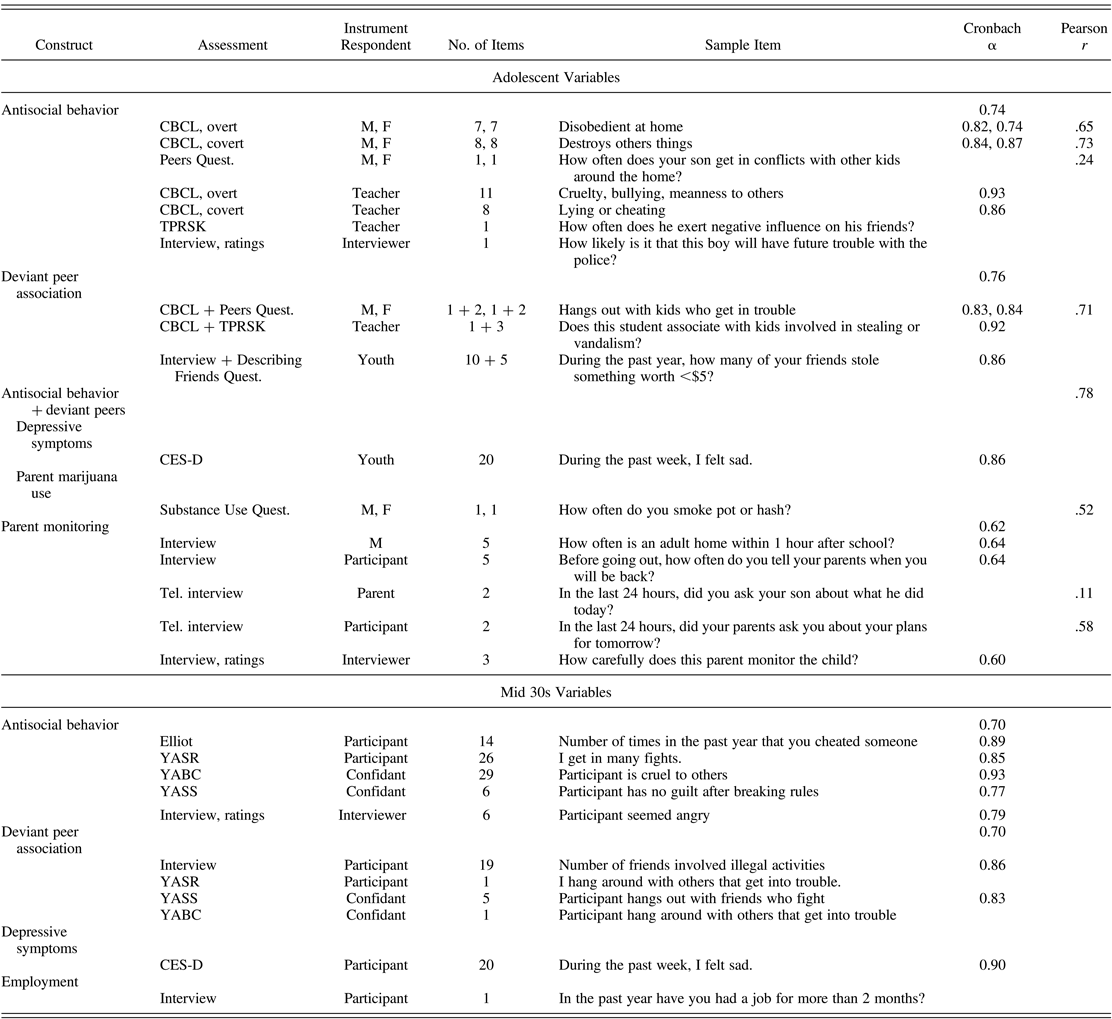
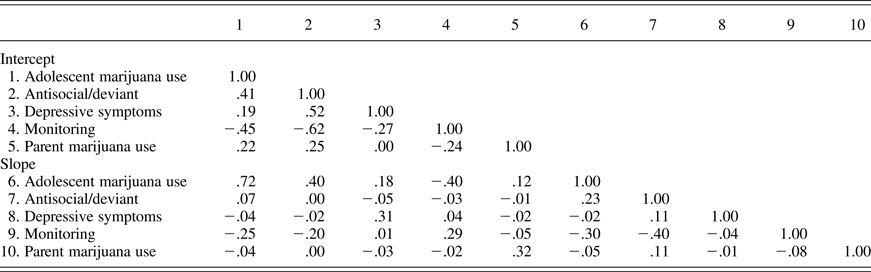
For most of the adolescent risk factors and outcome constructs (see Table 1), the construct development strategy used for the predictor variables has been described elsewhere (e.g., Dishion et al., Reference Dishion, Capaldi and Yoerger1999), and the reliability and validity of the assessments was established. To form each scale or indicator, the mean of the items was taken. To form a measure of a construct, indicators that met established convergence criteria were standardized before being combined to ensure equal weight was given to each indicator contributing to composite scores. For the parental behavior measures, the mean of the mother and father scores was taken when data were available from both parents. After formation at each wave, the risk factors were then estimated with a linear random effects model across the period of ages 13–14 through 17–18 years, centered at ages 13–14 years. The risk factors were standardized within each wave; in the case of parent marijuana use and adolescent marijuana use, they were then also log transformed. This results in an estimate of deviation from the average across time, giving a clearer picture of psychopathology. A random intercept and slope were estimated, allowing for individual intercepts and slopes for each risk factor to be estimated for each of the 203 men in the study. Marijuana use, antisocial behavior, deviant peer association, and depressive symptoms were assessed across five waves. Parental monitoring and parental marijuana use were assessed across three waves, because these were only collected at major waves (Waves 5, 7, and 9). Correlations of intercept and slopes of the risk factors are shown in Table 2.
Representative measures of predictors and outcomes

Note: CBCL, Child Behavior Checklist; M, mother; F, father; TPRSK, Teacher Peers Social Skills Questionnaire; TRF, Teacher Report Form; CES-D, Center for Epidemiologic Studies Depression Scale; YASR, Young Adult Self-Report; YABC, Young Adult Behavior Checklist.
Correlation matrix for predictors of latent marijuana classes
Parental monitoring
The parental monitoring measure was created from the parent interview, parent interviewer ratings, youth interview, and youth interviewer ratings. Mothers were asked 12 questions and fathers 15 questions that were separately validated and then combined. These were combined with interviewer rating items regarding monitoring by the mother and father. In a similar fashion, the boy answered 9 questions about parental monitoring in the interview, and the interviewer answered 1 question about the boy. The intercept (at ages 13–14 years) had a mean of 0.00 and a standard deviation of 0.61. The slope had a mean of –0.00 and a standard deviation of 0.07.
Frequency of parent marijuana use
Parental reports from the Substance Use Questionnaire were used. Following Capaldi et al. (Reference Capaldi, Stoolmiller, Kim and Yoerger2009), when both the mother and father reported on their marijuana use, a standardized average across the two parents was used; otherwise, the mother/father's score was used alone. The intercept had a mean of –0.62 and a standard deviation of 0.62. The slope had a mean of 0.01 and a standard deviation of 0.01.
Youth antisocial behavior and deviant association
Scales for youth antisocial behavior were created from three sources: parents, teachers, and the interviewer. None of the items pertained to substance use or illegal behavior directly related to substance use (e.g., selling drugs). Parent questions came from two questionnaires, the Child Behavior Check List (CBCL; Achenbach & Edelbrock, Reference Achenbach and Edelbrock1983) and the Peers Questionnaire (Oregon Social Learning Center, 1982–2012), with 15 questions from the externalizing scale of the CBCL and 1 question from the Peers Questionnaire. The scores from the mother and father were checked separately for construct validity and then combined. Teachers also filled out two questionnaires, the TRF (Achenbach, Reference Achenbach1991) and the Teacher Peers Social Skills Questionnaire (TPRSK; Dishion & Capaldi, Reference Dishion and Capaldi1985; Walker & McConnell, Reference Walker and McConnell1988), with 19 items from the TRF and 1 item from the TPRSK. A final item was the interviewer ratings of the boy's behavior from the youth interview.
Deviant peer association was assessed by two parent questionnaires (CBCL and Peers Questionnaire), with 1 item from the CBCL and 2 items from the Peers Questionnaire. Similar to the measure of antisocial behavior, the construct was validated for each parent and then combined. Teacher reports from two questionnaires were also included (TRF and TPRSK), with 1 item from the TRF and 3 items from the TPRSK. The final indicator of the construct came from youth report in an interview and questionnaire (Describing Friends Questionnaire), with 10 items from the interview and five questions from the questionnaire. The antisocial behavior and deviant peer association constructs were highly associated (r = .78) and were standardized and combined to avoid problems of multicollinearity in the final analysis. The intercept had a mean of 0.00 and a standard deviation of 0.79. The slope had a mean of 0.00 and a standard deviation of 0.08.
Youth depressive symptoms
A single indicator involving the sum of the youth's self-report of 20 items regarding depressive symptoms (Center for Epidemiologic Studies Depression Scale; Radloff, Reference Radloff1977) was used. The intercept had a mean of 0.00 and a standard deviation of 0.56. The slope had a mean of –0.00 and a standard deviation of 0.08.
Adolescent marijuana use
Adolescent marijuana use was calculated in the same manner as adult marijuana use (previously described) but was not separated into two variables. The intercept had a mean of –1.06 and a standard deviation of 0.11. The slope had a mean of –0.04 and a standard deviation of 0.08.
Outcomes in the mid-30s
In addition to the DSM-IV variables at age 36 years, four other variables were used as adult-adjustment outcomes: depressive symptoms, antisocial behavior, deviant peer association, and employment (see Table 1). Antisocial behavior and deviant peer association were not combined at this age because the correlations were lower than in adolescence (p= .54). All of the variables were residualized in the same manner as the DSM-IV outcome at age 36 years (see Analytic Plan Section).
Antisocial behavior
Scales for antisocial behavior were from reports by the participant, a confidant of the participant (e.g., a friend), and the interviewer. The participant answered 14 questions from the Elliot Behavior Checklist (Elliott, Ageton, Huizinga, Knowles, & Canter, Reference Elliott, Ageton, Huizinga, Knowles and Canter1983) and 26 questions from the Young Adult Self-Report (Achenbach, Reference Achenbach1993b). An Interviewer Impressions Questionnaire involved 6 questions about the participant, and the confidant answered 6 questions from the Young Adult Adjustment Scale (Capaldi, King, & Wilson, Reference Capaldi, King and Wilson1992) and 29 questions from the Young Adult Behavior Checklist (Achenbach, Reference Achenbach1993a). Cronbach α was 0.70.
Deviant association
Scales for the deviant peer association construct came from responses by the participant and a confidant. The participant answered 19 questions in an interview and 1 from the Young Adult Self-Report (Achenbach, Reference Achenbach1993b). The confidant answered 5 questions from the Young Adult Adjustment Scale (Capaldi et al., Reference Capaldi, King and Wilson1992) and 1 question from the Young Adult Behavior Checklist (Achenbach, Reference Achenbach1993a). Cronbach α was 0.70.
Depressive symptoms
A single indicator involving the sum of the men's self-report of 20 items regarding depressive symptoms (Center for Epidemiologic Studies Depression Scale; Radloff, Reference Radloff1977) was used. Cronbach α for the scale was 0.90.
Employment
The total number of months employed since we had last seen the participant (average 4 years) divided by the total number of months since we last saw the participant (i.e., proportion of the time employed) was used to measure employment.
Marital status
The marital status of the men was determined at age 36 years; two dummy variables were created to compare never married versus married, and divorced versus married. There were 99 men who were married at age 36 years, with 52 never married and 31 divorced. One man was widowed and he was set to missing.
Analysis plan
A series of two-part semicontinuous growth mixture models (Olsen & Schafer, Reference Olsen and Schafer2001) of marijuana use in the men's 20s, with predictors of latent classes, were run in Mplus 7.1. The two-part model was used to correct for the fact that marijuana use was both skewed and naturally could not be negative (a component of a normal distribution); thus, the binary part modeled use versus nonuse of marijuana and the continuous part modeled quantity of use for only those that had used. A series of growth mixture models was run to ascertain if adding a quadratic term for either the binary or the continuous parts of the model significantly improved fit over purely linear models. Using the Akaike information criterion (AIC), Baynesian information criterion (BIC), and sample-size adjusted BIC (SSBIC), the best fitting model was then selected. After the nature of growth across the 20s was determined, the number of classes judged as the best fit was then selected using the same information criteria and also the bootstrapped likelihood ratio (BLR) test (McLachlan & Peel, Reference McLachlan and Peel2000) and the Lo–Mendell–Rubin likelihood ratio (LMR) test (Lo, Mendell, & Rubin, Reference Lo, Mendell and Rubin2001). It has been found that the BIC and BLR are best for selecting the number of classes (Nylund, Asparouhov, & Muthén, Reference Nylund, Asparouhov and Muthén2007).
In predicting the age-36 outcomes from patterns of marijuana use in the 20s, adolescent risk factors were controlled to ensure that associations were not accounted for by prior risk. To accomplish this, each outcome was regressed on all adolescent growth factors (i.e. intercept and slope), including adolescent marijuana use (using logistic regression when necessary). The predicted outcome was subtracted from the observed outcome and then standardized. This standardized variable was tested for mean differences between classes. Correlations between the original variable and the residualized variable ranged from 0.80 to 0.99, with an average correlation of 0.90. The rank order of binary outcomes was maintained in the process. Finally, a simple test of means of outcomes at age 36 years was used after the model was selected using a pseudo class-based multiple imputation method in Mplus (Asparouhouv & Muthén, Reference Asparouhouv and Muthén2007; Wang, Brown, & Bandeen-Roche, Reference Wang, Brown and Bandeen-Roche2005). Given that only a single case was missing (a man without family characteristics) and the rest of the data was only missing at most 14% of the data, we used full information maximum likelihood assuming missing at random to control for missing data.
Results
Two-part growth mixture model and associations to age 26 years abuse/dependence diagnosis
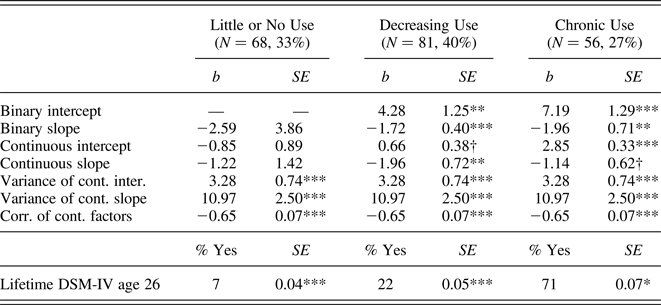
The results of the two-part semicontinuous growth mixture model are presented in Table 3. A three-class linear model was found to be the best fitting model. According to the AIC, BIC, and SSBIC, a linear model for both the binary and the continuous parts of the model improved model fit. The two-class model showed significant improvement over the one-class model when looking at the LMR (p < .001) and BLR (p < .001) tests. However, the two-class model had information criteria (AIC = 5982, BIC = 6065, SSBIC = 5986) that were all higher than the three-class model (AIC = 5807, BIC = 5943, SSBIC = 5814). The three-class model also showed improvement over the two-class model in both the LMR (p < .001) and the BLR (p < .001) tests. Entropy was basically the same between the two-class model (0.918) and the three-class model (0.917). The comparison between the three-class model and the four-class model was not as clear-cut. The four-class model had three indicators showing a better fit to the data than the three-class model: AIC (5770), SSBIC (5779), and a significant BLR (p < .001). In addition, entropy slightly improved in the four-class solution (0.940). However, the BIC (5959) and the LMR (p = .11) suggested that the three-class model fit the data better. A final factor to consider was that the four-class solution contained a class consisting of less than 5% of the sample, making potential replication difficult, as well as lowering power for that class. Based largely on the small class sample in the four-class solution, we decided that the three-class solution made the most sense to interpret.
Growth factors for both binary and continuous marijuana use
†p < .1. *p < .05. **p < .01. ***p < .001.
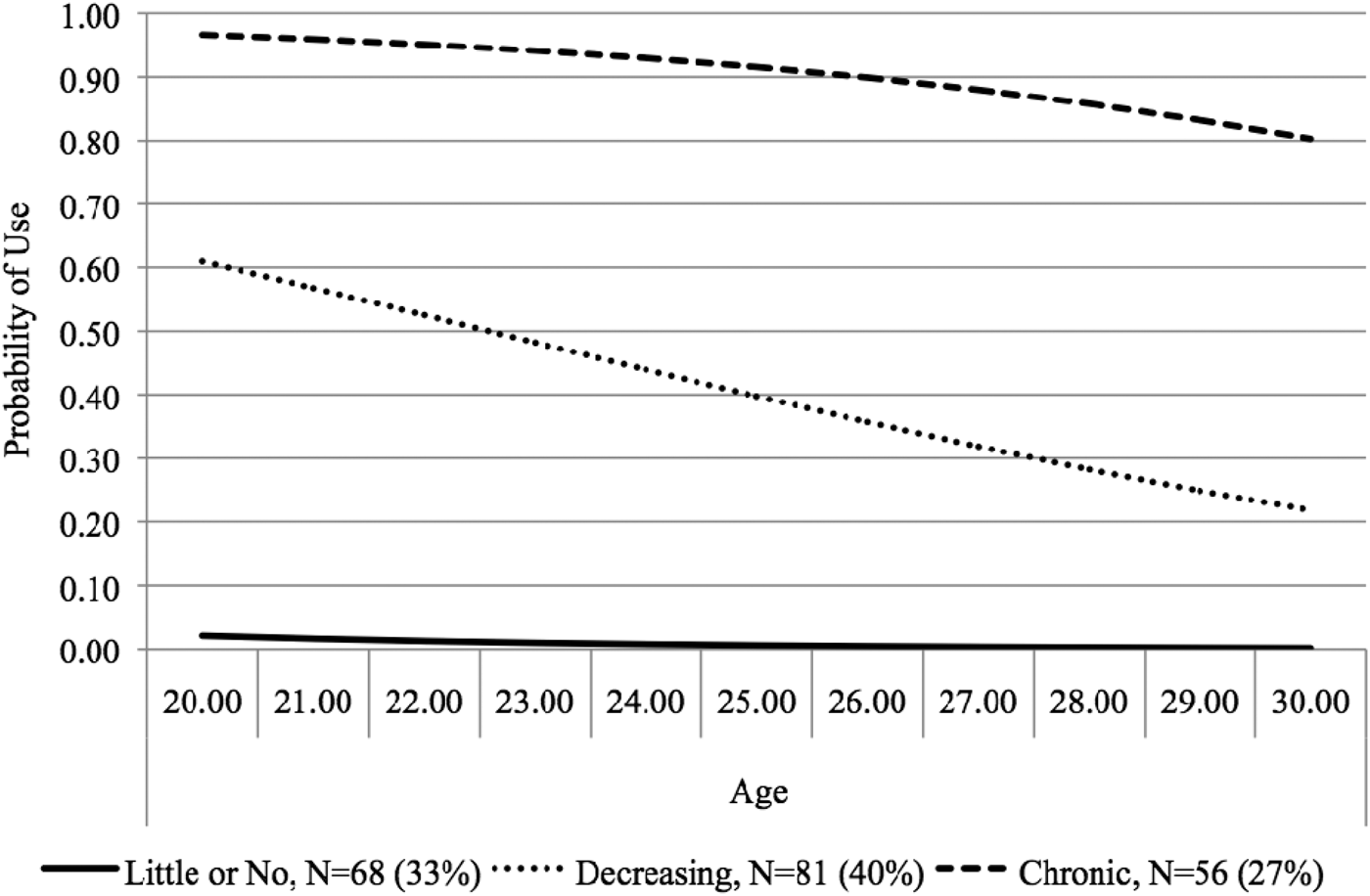
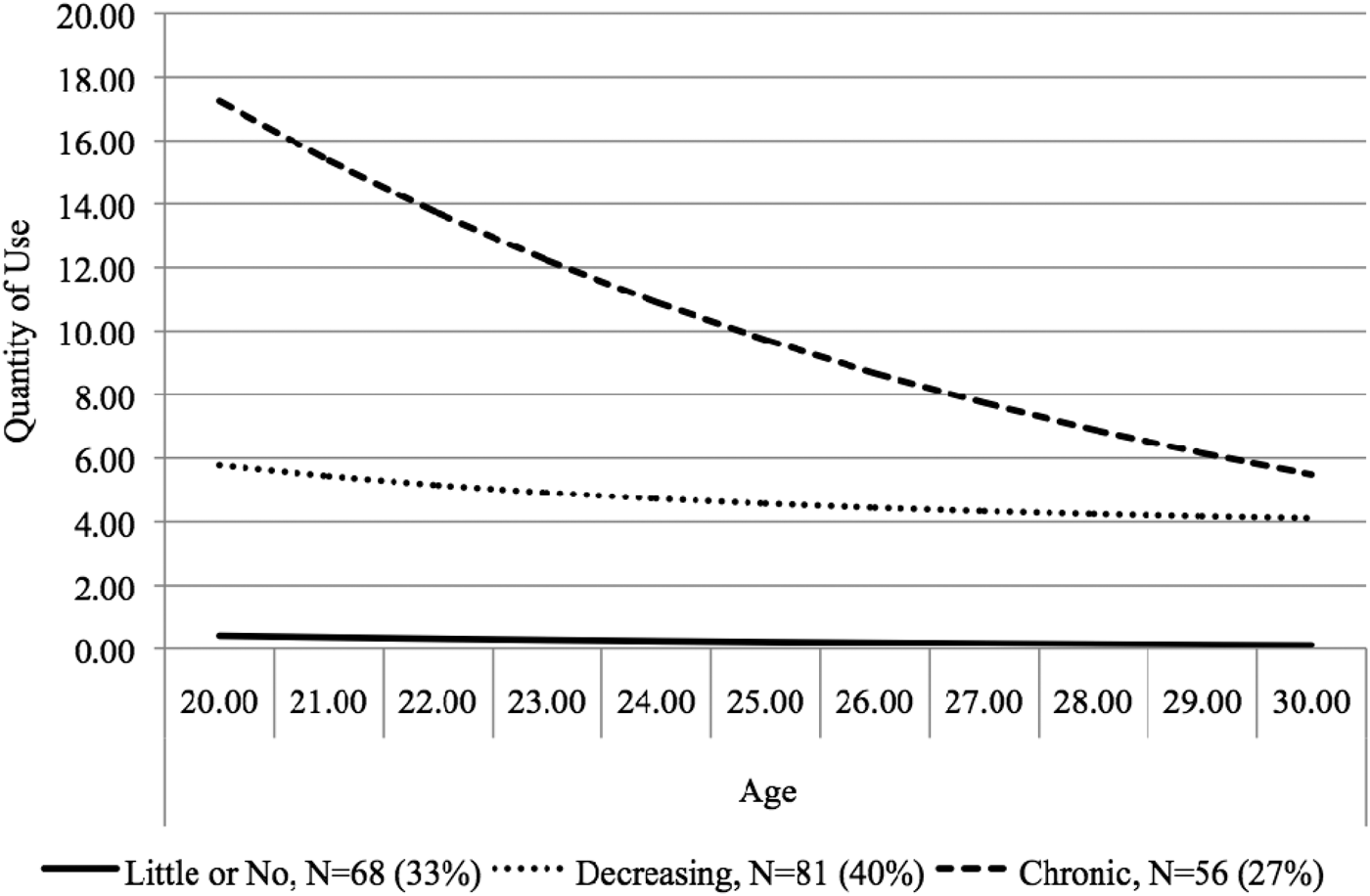
The three classes labeled according to their intercepts and slopes in Part I of the model (use vs. no use) were little or no use, decreasing use, and chronic use, respectively (Table 3); the classes are illustrated in Figure 1 (probability of use vs. nonuse) and Figure 2 (quantity of use). The first class (little or no use, n = 68, 33%) started with a very low probability of use (.02) at age 20 years and did not show a significant change across the 20s in probability of use. The little or no use class did not have a significant intercept in quantity of use and did not show a significant change across the 20s in quantity of use (Figure 2). The little or no use class also had the lowest level of lifetime abuse of or dependence on marijuana at age 26 years at 7% (Table 3, bottom row).
Predicted growth in probability of use of marijuana.
Predicted growth in quantity of use of marijuana.
The second class (decreasing use, n = 81, 40%) had a higher initial probability of use (.61) than did the little or no use class. The decreasing use class showed a significant decrease in the probability of use over the 20s. The decreasing use class had a slightly higher quantity of use intercept compared to the little or no use class and did show a significant decrease across the 20s. At 22%, the decreasing use class showed a larger percentage of men who reported lifetime abuse or dependence on marijuana at age 26 years compared to the little or no use class.
The final class (chronic use in Table 3, n = 56, 27%) had a predicted probability of use of .97 at age 20 years (higher than the other classes) and did show a significant but relatively small decrease in probability of use across the 20s (Part I, Figure 1). The chronic use class also had a large and significant intercept of quantity of use and only a marginally significantly decreasing slope over time (Part II, Figure 2). The chronic use class was highly likely to show problems associated with use, with 71% of the men in this latent class reporting abuse of or dependence on marijuana at age 26 years. Overall, the probability of a marijuana use disorder associated with membership in each latent class strongly supported the validity of the findings of the two-part growth mixture model.
Prediction to class membership from adolescent variables
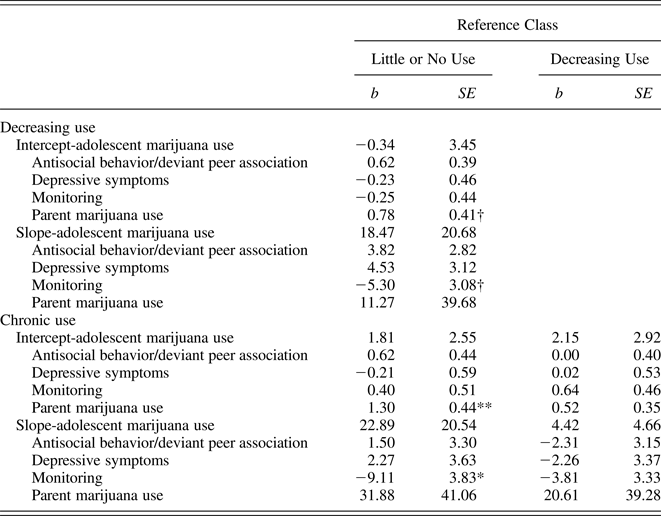
Table 4 provides the multinomial logistic regression results of the prediction of early adult marijuana class membership for all comparisons of classes. None of the adolescent psychopathology and marijuana use variables (whether outcome specific or general risk) predicted any differences between classes. Both the outcome-specific and the general-risk parent variables predicted differences between classes.
Adolescent predictors of marijuana classes
†p < .1. *p < .05. **p < .01.
Parental monitoring in adolescence differentiated between the little or no use and the chronic use classes, from the slope but not the intercept. A higher slope of parental monitoring was associated with more likelihood of being in the little or no use class when compared to the chronic use class.
Parent marijuana use also showed differentiation between the little or no use and the chronic use classes, in this case for the intercept of use, rather than the slope. A higher intercept for parental marijuana use in the men's adolescence predicted greater likelihood of being in the chronic use class when compared to the little or no use class.
Prediction from marijuana class membership to marijuana use disorder and adjustment at age 36 years
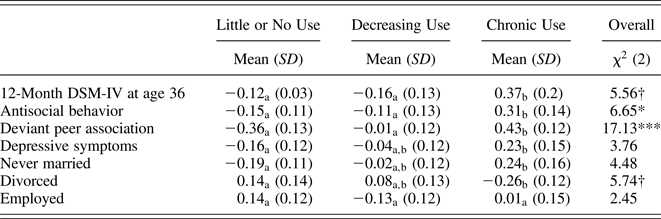
Predictions to indicators of adjustment at age 36 years (scores residualized from adolescent predictor measures) are shown in Table 5. Two significant differences in the likelihood of a DSM-IV diagnosis of a marijuana use disorder in the past 12 months at age 36 years were found, but the overall χ2 was only marginally significant. The chronic use class showed the highest value and was significantly different from the decreasing use class, which had the lowest level. The little or no use class was between the other two classes and was significantly different from the chronic class but not from the decreasing use class.
Association of marijuana classes and adjustment at age 36 years
Note: Columns with different subscripts are significantly different at .05.
†p < .1. *p < .05. ***p < .001.
Regarding adjustment at age 36 years, antisocial behavior and deviant peer association had significant overall χ2 tests, whereas depressive symptoms did not (Table 5). All three variables had the same ordering across the classes, with the chronic use class having the highest value or most problematic outcome. The decreasing class was next in rank order, with the little or no use class having the lowest problems for these three outcomes. Antisocial behavior showed two mean differences: the chronic use class had a significantly higher mean than either of the other two classes. Deviant peer association showed the same pattern of significant differences. Even with a nonsignificant overall value, there was a significant mean difference for depressive symptoms. The little or no use class was significantly lower than the chronic use class.
Regarding the variables assessing transitions to adulthood, being divorced was the only variable to have even a marginally significant χ2 value. The single mean difference for being divorced was between the chronic use class and the little or no use class, such that the latter were more likely to have been divorced. The chronic use class also was more likely to have never married at all than were the little or no use class. The final outcome of employment did not show any differences among classes.
Discussion
This study sought to take a broad view of development and examine both the adolescent antecedents and mid-30s consequences of differential trajectories of marijuana use in the 20s for a sample of men who in childhood lived in higher crime neighborhoods (from a medium-sized town). The heterogeneity of marijuana use across the 20s was examined in two ways. The models involved two parts, namely, the probability of use and the quantity of use across the 20s for those who did use. Within the two-part model, heterogeneity was examined through the use of growth mixture modeling. This allowed for both multiple classes, each with its own average intercept and trajectory, and random intercepts and slopes for each class. The three latent class model was selected as the best fit overall.
It was rather surprising that there was relatively little significant association found between the adolescent predictors and the latent classes in the multivariate prediction model. It is possible that this was partly attributable to associations among the predictors, particularly adolescent marijuana use, antisocial/deviant associations, and parental monitoring. It also indicates that early adult marijuana use in men may be more strongly predicted by more developmentally proximal factors than by adolescent factors, as appears to be the case for alcohol use. The lack of an association of adolescent depressive symptoms with early adult marijuana use indicated that evidence was not found for a self-medication hypothesis. Again, the next step would be to examine more proximal predictors. Despite these factors, associations were found for the outcome-specific predictor of parental marijuana use during the boys' adolescence and chronic versus little or no use of marijuana by the men during their 20s, controlling for other risk factors. This indicates the long-term importance of intergenerational transmission of marijuana use and of addressing this risk factor in prevention programs. A further parental factor, parental monitoring, which has been found to be protective against a number of adolescent risk behaviors, including marijuana use, was found to play a protective role in early adult marijuana use, indicating that parental monitoring can have beneficial long-term effects. This is further evidence for the importance of this parenting skill as a focus of prevention efforts.
These growth mixture modeling findings also shed light on the effects of the timing of growth or trajectory shape of marijuana use in the 20s. A relatively large proportion of men (25% of the sample) showed relatively chronic use of marijuana throughout their 20s (even though they did show a decline from their highest usage by the end of the 20s), and these men were very likely to meet criteria for a marijuana use disorder in their mid-20s, the age of their peak quantity of use. These men also showed problematic outcomes at age 36 years related to their history of high marijuana use and controlling for adolescent risk factors. In particular, they showed relatively high levels of associations with antisocial or deviant peers and also higher levels of antisocial behavior, indicating that relative to the other men, they were continuing engagement in multiple problem behaviors into their 30s. Given that problem behaviors overall show a downward trend in the 20s and 30s (e.g., crime), this may mean that these men do not show the expected developmental decreases across these years in their problem behaviors. Use of an illegal substance, namely, marijuana, is associated with this failure to make developmental improvements. Regarding depressive symptoms in the 30s, the men in the chronic use class showed higher levels than did men in the little or no use class. Given the controls for adolescent levels of depressive symptoms, this indicates that marijuana use may be predictive of increases in men's depressive symptoms relative to those of their peers. Thus, rather than evidence for marijuana being used as self-medication for depressive symptoms (as would have been indicated by prediction from adolescent depressive symptoms), there was evidence that prolonged use may relate to relatively increased symptoms. This might be due to the use itself, or to problems in the men's lives associated with use. Finally, the men in the chronic use class were more likely never to have married, indicating likely lower stability of personal relationships. Whereas they did not show a lower likelihood of being employed, this could be an indication that over the course of the 20s, they have discovered employers who tolerate their marijuana use.
The large decreasing use class (about 40% of the sample) showed a relatively similar probability of any marijuana use to the chronic use class at age 20 years. However, they showed a much lower quantity of use at that age and a substantially decreasing trajectory of probability of any use across the 20s, being close in probability of use to the little or no use class by age 30 years. Thus, this class appeared to comprise young adult users who essentially desisted from use by age 30 years. It was surprising that there were no significant differences in adolescent risk factors, including antisocial behavior/deviant peer associations, between the chronic and decreasing use classes. However, at age 36 years, the men in the decreasing use class were significantly lower in both antisocial behavior and deviant peer association than were the chronic use class men, indicating that the decreasing use men likely showed overall the developmentally normative reductions in problem behaviors, including in marijuana use, across their early adulthood.
The three latent classes of marijuana use modeled in the current study show consistency with the findings from prior studies. The many studies that have examined patterns in adolescence (Ellickson et al., Reference Ellickson, Martino and Collins2004; Flory et al., Reference Flory, Lynam, Milich, Leukefeld and Clayton2004; Schulenberg et al., Reference Schulenberg, Merline, Johnston, O'Malley, Bachman and Laetz2005; Windle & Wiesner, Reference Windle and Wiesner2004) and the early 20s typically end with groups either high or low, reflecting the starting point of the three classes modeled in the present study. The Brooks et al. (Reference Brook, Zhang and Brook2011a, Reference Brook, Zhang and Brook2011b) studies also show consistency with the present findings, although they modeled an additional two classes that showed continued use across the period. These additional classes could be a result of the earlier starting point (age 14 years) for their growth mixture model.
The large amount of data available across an unusually long time frame allowed for examination of the development of marijuana use and association with psychosocial risk factors and outcomes from ages 9–36 years for men from at-risk backgrounds. However, the study has several limitations. Although the quantity of marijuana used was estimated from both the frequency and amount of use, this does not take into account the potency of the marijuana used, which varies considerably and has increased over time. The sample was at risk for psychopathology based on neighborhoods where they lived in childhood, and even though the sample has shown similarity in findings with national samples in the past in key areas of behavior (Capaldi et al., Reference Capaldi, Feingold, Kim, Yoerger and Washburn2013), it does potentially affect generalizability. The sample was of men only, who were predominantly White; thus, replications for women and other ethnic groups are needed. The size of the sample is of concern though the effect of sample size on mixture models has been mixed in simulation studies. In growth mixture modeling with repeated measures over time, Nylund et al. (Reference Nylund, Asparouhov and Muthén2007) found that a sample size of 200 did result in some loss of power but not enough to warrant not using the approach. In more general mixture models, Henson, Reise, and Kim (Reference Henson, Reise and Kim2007) showed that it may be possible to not have power to find classes representing a small proportion of the population. Although the three groups found are likely to be replicable, it is also likely that, with a larger sample, classes that were too small to identify in the present study might emerge. Despite these issues, the findings showed considerable congruence with other studies of marijuana use (Brook et al., Reference Brook, Zhang and Brook2011a, Reference Brook, Zhang and Brook2011b).
Overall, the findings make a substantial contribution to understanding marijuana use in early- to mid-adulthood in showing that considerable heterogeneity in use is evident, despite the overall developmental trend of decrease. A particularly problematic class of chronic users was identified, who were likely to meet criteria for marijuana abuse or dependence in their mid-20s, and show higher engagement in problem behaviors in their mid-30s relative to their peers. Findings indicate that lowering marijuana use for parents, along with increased parental monitoring during their sons' adolescence, may have long-term beneficial effects on early adult marijuana use in men.