Introduction
The importance of cytological data for the study of evolution and diversification of plant species has long been recognised (Stebbins, Reference Stebbins1971; Stace, Reference Stace2000). Furthermore, polyploidy is considered to be one of the major forces behind speciation in higher plants (Stebbins, Reference Stebbins1971; Soltis & Soltis, Reference Soltis and Soltis1995), and it has been estimated that 50–70% of angiosperm species are polyploids or have a polyploid origin (Stebbins, Reference Stebbins1971; Grant, Reference Grant1981; Masterson, Reference Masterson1994). It has previously been suggested that polyploidy is one way by which plants can adapt to harsh climates at high altitudes (Janaki Ammal, Reference Janaki Ammal1950; Yoshida, Reference Yoshida2006) and therefore they are expected to be more frequent at high altitudes than low altitudes. The Nepal Himalaya exhibits extreme elevation ranges within very short distances so the occurrence of polyploids might be expected at higher altitudes. Indeed, polyploidy has been shown to play an important role in the speciation and diversification of some Himalayan taxa, for example Sedum L., Rhododendron L. and Anaphalis L. (Janaki Ammal, Reference Janaki Ammal1950; Wakabayashi & Ohba, Reference Wakabayashi and Ohba1999; Meng et al., Reference Meng, Sun, Yang and Nie2010).
The Berberidaceae include about 12 herbaceous and two woody genera (Berberis s.l. which now includes Mahonia Nutt., and Nandina Thunb.) (Mabberley, Reference Mabberley2008). Using character compatibility analysis, Meacham (Reference Meacham1980) recognised four major groups within the family and these were supported by chromosome numbers and fruit characters. An ndhF, rbcL and chloroplast DNA restriction site analysis recognised four chromosomal clades in Berberidaceae (x = 6, 7, 8 and 10) (Kim & Jansen, Reference Kim and Jansen1996, Reference Kim and Jansen1998; Kim et al., Reference Kim, Kim, Kim and Jansen2004). Berberis s.l. and Ranzania T.Ito form a clade with x = 7 (Kim & Jansen, Reference Kim and Jansen1998; Kim et al., Reference Kim, Kim, Kim and Jansen2004). Ranzania only has 2n = 14, while all chromosome counts for Berberis are 2n = 28 and 56 (Bottini et al., Reference Bottini, Greizerstein and Poggio1997, Reference Bottini, Greizerstein and Poggio1999, Reference Bottini, Greizerstein, Aulicino and Poggio2000; Rounsaville & Ranney, Reference Rounsaville and Ranney2010). From the distribution of somatic chromosome numbers in Berberidaceae (Kim & Jansen, Reference Kim and Jansen1998), the ancestral number appears to be 2n = 14 for the Berberis & Ranzania clade. Since meiotic counts in Berberis indicate the absence of multivalents, the genus could be regarded as a genus of tetraploid origin, that has undergone diploidisation and can be described as a diploid with a base number of x = 14.
The Argentinean species of simple-leaved Berberis have been relatively well studied cytologically (Bottini et al., Reference Bottini, Greizerstein and Poggio1997, Reference Bottini, Greizerstein and Poggio1999, Reference Bottini, Greizerstein, Aulicino and Poggio2000), and most are diploid with 2n = 28 chromosomes. Higher ploidy levels were reported only for Berberis buxifolia Lam. and B. heterophylla Juss., both of which had 2n = 56 (Bottini et al., Reference Bottini, Greizerstein and Poggio1997).
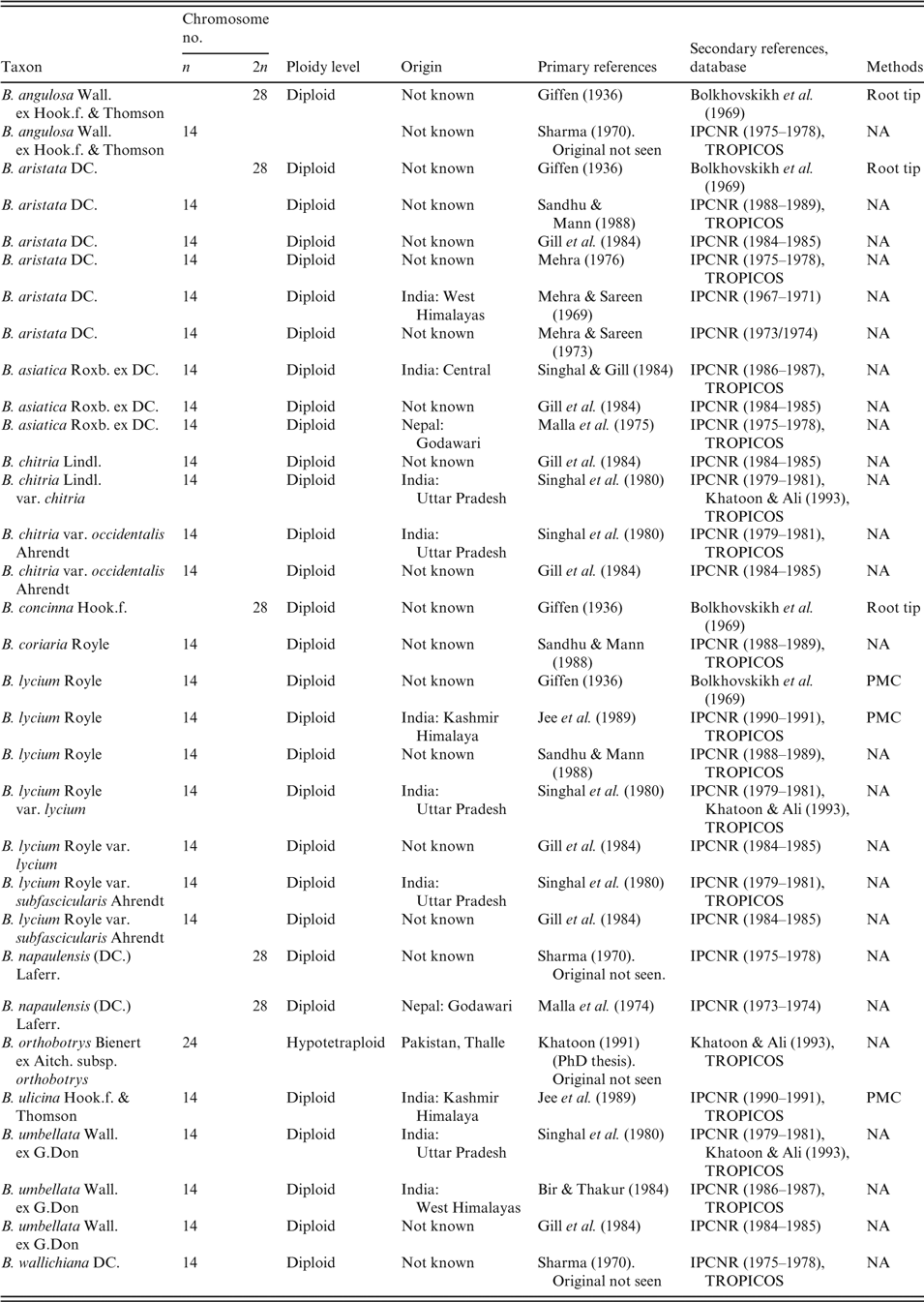
The chromosome numbers of Nepalese species of simple-leaved Berberis species are almost completely unknown. Of the 21 simple-leaved species recognised in Nepal (Adhikari et al., Reference Adhikari, Pendry, Pennington and Milne2012), chromosome counts have previously been published for only one species (Berberis asiatica Roxb. ex DC.) from a plant of Nepalese origin (Malla et al., Reference Malla, Bhattarai, Gorkhali and Singh1975). The published chromosome counts of other Nepalese species, Berberis aristata DC., B. angulosa Wall. ex Hook.f. & Thomson, B. concinna Hook.f. and B. wallichiana DC., were based either on plants of Indian origin, or on cultivated specimens of unknown origin. Of the Nepalese compound-leaved species, one species, Berberis napaulensis (DC.) Laferr., has been counted so far (2n = 28; Sharma, Reference Sharma1970). The published chromosome numbers for Nepalese species of Berberis and some closely related species from the Himalayan region are shown in Table 1.
List of published chromosome numbers for Nepalese Berberis and closely related species from the Himalaya with information on origin and references

IPCNR: Index to Plant Chromosome Number Report. NA: Not available. PMC: Pollen mother cell. TROPICOS: www.tropicos.org.
The objective of this paper was to determine the chromosome numbers of Nepalese species of Berberis to find out whether polyploidy was involved in the evolution and diversification of simple-leaved species of Berberis in Nepal.
Material and Methods
Chromosomes were counted in roots harvested from plants growing in the living collections at the Royal Botanic Garden Edinburgh. Prior to the roots being harvested, plants were re-potted with new compost and transferred to an environmentally controlled glasshouse (average day temperature 18°C and night temperature 16°C) to stimulate root growth.
Two pre-treatments were tested to prevent the formation of mitotic spindles (Jong, Reference Jong1997): α-bromo-naphthalene for 3 hours at room temperature and 0.002M 8-hydroxyquinoline for 5 hours at 4°C. 8-hydroxyquinoline gave better results than α-bromo-naphthalene. Root tips were then fixed with freshly prepared Farmer’s Fluid (3 : 1, absolute ethanol : glacial acetic acid) and kept at 4°C overnight.
They were stained with Feulgen reagent freshly prepared according to Fox (1969; see Jong, Reference Jong1997). Before squashing, the root tips were softened in a 1 : 1 enzyme mixture of 4% cellulase and 4% pectinase for 30 minutes at 35°C. Each root tip meristem was excised onto a slide with a few drops of 0.04% acetocarmine as counter stain, and permanent slides were prepared using the vapour exchange method (Jong, Reference Jong1997). Chromosomes were observed with a Zeiss Axioskop brightfield microscope and images were taken at different magnifications using a digital AxioCam MRc5 camera and AxioVision Rel. 4.7 (Zeiss, Welwyn Garden City, UK). Chromosomes were counted in at least five cells to confirm the number.
Results and Discussion
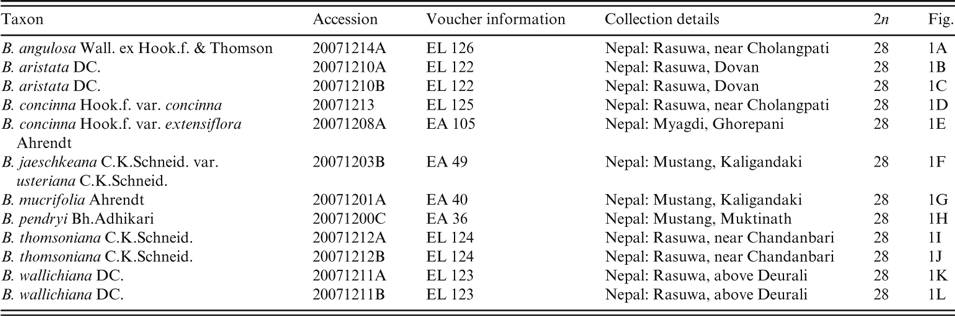
Chromosome counts from the present study are listed in Table 2. All chromosome numbers found in this study were 2n = 28. This is the first report of the chromosome numbers of nine taxa of Berberis from the Nepal Himalaya and, of these, five (B. concinna var. extensiflora, B. jaeschkeana var. usteriana, B. mucrifolia, B. pendryi and B. thomsoniana) were counted for the first time.
1. Berberis angulosa Wall. ex Hook.f. & Thomson
Chromosomes counts of Berberis taxa obtained in this study
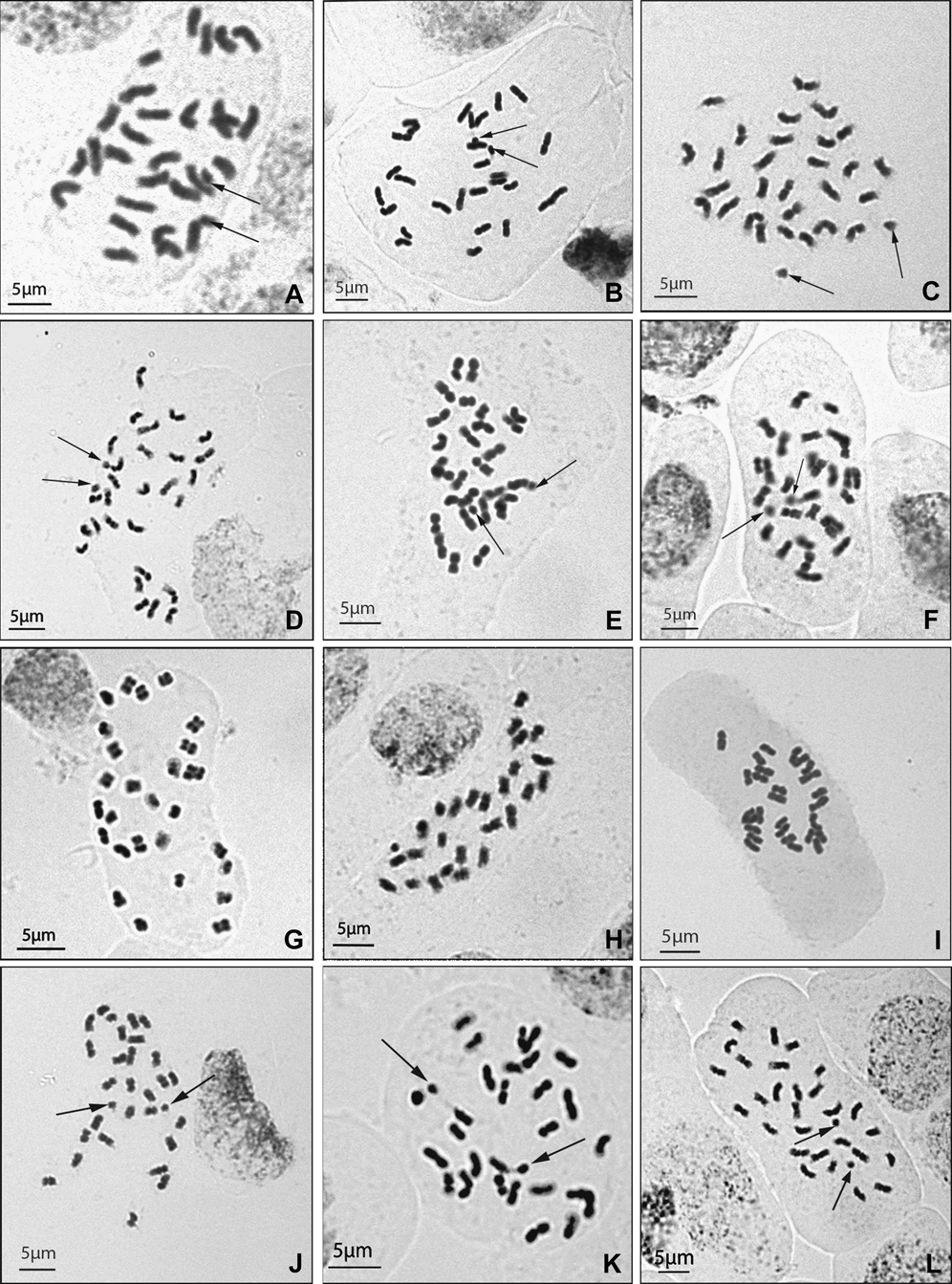
Berberis angulosa has the somatic chromosome number of 2n = 28 (Fig. 1A). Large satellites were prominent in metaphasic stages of mitotic divisions (arrows). This report of a chromosome number of 2n = 28 for Berberis angulosa from Nepal is consistent with previous reports by Giffen (Reference Giffen1936), though the present work is the first report of chromosome numbers for this species from a plant from Nepal.
2. Berberis aristata DC.
Mitotic chromosomes of Berberis. A. B. angulosa (20071214A), metaphase, 2n = 28; B. B. aristata (20071210A), metaphase, 2n = 28; C. B. aristata (20071210B), prometaphase, 2n = 28; D. B. concinna var. concinna (20071213), late prometaphase, 2n = 28; E. B. concinna var. extensiflora (20071208A), metaphase, 2n = 28; F. B. jaeschkeana var. usteriana (20071203B), prometaphase, 2n = 28; G. B. mucrifolia (20071201A), metaphase, 2n = 28; H. B. pendryi (20071200C), prometaphase, 2n = 28; I. B. thomsoniana (20071212A), metaphase, 2n = 28; J. B. thomsoniana (20071212B), prometaphase, 2n = 28; K. B. wallichiana (20071211A), metaphase, 2n = 28; L. B. wallichiana (20071211B), prometaphase, 2n = 28. Arrows indicate satellites.
Root tips from two individuals of the same accession were examined and both had chromosome numbers of 2n = 28 (Fig. 1B, C). Two satellite chromosomes were prominent in all spreads (arrows). In Fig. 1C, the chromosomes are in prometaphase and the satellites have been detached during slide preparation (arrows). Most chromosomes appear metacentric. The present count of 2n = 28 agrees with previous reports by Giffen (Reference Giffen1936), Mehra & Sareen (Reference Mehra and Sareen1969, Reference Mehra and Sareen1973), Mehra (Reference Mehra1976), Gill et al. (Reference Gill, Bir and Singhal1984) and Sandhu & Mann (Reference Sandhu and Mann1988). This is the first report of the chromosome number of this species from a locality in Nepal.
3. Berberis concinna var. concinna Hook.f.
The present count (Fig. 1D) confirms the previous count of 2n = 28 by Giffen (Reference Giffen1936). Large satellites were found in the late prometaphase (arrows) that shows mostly metacentric chromosomes. This is the first chromosome count of this species from a locality in Nepal.
4. Berberis concinna var. extensiflora Ahrendt
A somatic chromosome number of 2n = 28 was counted for this species (Fig. 1E). Large satellites are prominent in Fig. 1E (arrows). This is the first report of the chromosome number of Berberis concinna var. extensiflora.
5. Berberis jaeschkeana var. usteriana C.K.Schneid.
Root tips from two individuals of the same accession were examined and both had a somatic chromosome number of 2n = 28. Satellites were prominent in prometaphase spreads (Fig. 1F, arrows). Most chromosomes appear metacentric. This is the first report of the chromosome number of Berberis jaeschkeana.
6. Berberis mucrifolia Ahrendt
A somatic chromosome number of 2n = 28 was counted (Fig. 1G). The chromosomes showed mostly median centromeres. This is the first report of the chromosome number of this species.
7. Berberis pendryi Bh.Adhikari
The somatic chromosome number counted was 2n = 28 (Fig. 1H), and this is the first report of the chromosome number of this species.
8. Berberis thomsoniana C.K.Schneid.
Root tips of two individuals from the same accession were examined and both had the diploid chromosome number of 2n = 28 (Fig. 1I, J). Satellites were prominent in prometaphase chromosomes (Fig. 1J, arrows) but not in metaphase chromosomes (Fig. 1I). The chromosomes were mostly metacentric. This is the first report of the chromosome number of Berberis thomsoniana.
9. Berberis wallichiana DC.
Root tips of two individuals from the same accession were examined and both had a somatic chromosome number of 2n = 28. Satellites were prominent in both prometaphasic and metaphasic chromosomes (Fig. 1K, L, arrows). Satellite stalks were clearly visible in the metaphasic chromosomes (Fig. 1K, arrows). This count agrees with a previous count by Sharma (Reference Sharma1970), and is the first count of this species from Nepal.
The species of Berberis examined during this study grow between 2500 and 4500 m altitude in a variety of environmental conditions and all were found to possess 2n = 28 chromosomes. Rounsaville & Ranney (Reference Rounsaville and Ranney2010) also found that polyploidy was not common among wild and cultivated taxa of Berberis s.l., and found only one naturally occurring polyploid, the compound-leaved North American taxon B. nervosa Pursh, among 124 samples in 70 taxa. Khatoon & Ali (Reference Khatoon and Ali1993) reported a hypotetraploid, Berberis orthobotrys Bienert ex Aitch., from the Himalayan foothills in Pakistan but their original work could not be consulted so it is difficult to speculate on the origin or the consistency across B. orthobotrys of the aneuploid number of n = 24 reported there. Although polyploids seem to play an important role in speciation and diversification in some high altitude taxa (Janaki Ammal, Reference Janaki Ammal1950; Wakabayashi & Ohba, Reference Wakabayashi and Ohba1999; Meng et al., Reference Meng, Sun, Yang and Nie2010), Berberis does not seem to follow this trend. This would agree with the findings of Wakabayashi & Ohba (Reference Wakabayashi, Ohba, Ohba and Malla1988) in Saxifraga, which has similarly low numbers of polyploids, suggesting that polyploidy may not be an important factor in species diversification in the alpine flora of the Nepal Himalaya (Ohba, Reference Ohba, Ohba and Malla1988; Wakabayashi & Ohba, Reference Wakabayashi, Ohba, Ohba and Malla1988).
Examining only nine taxa out of 24 cannot rule out the presence of polyploids among Nepalese Berberis, however, and further studies in other taxa are needed to clarify the role of polyploidy in the speciation and diversification of Himalayan plants.
Acknowledgements
We should like to thank Kwiton Jong for his help and advice. Thanks are also due to David Knott for his help with the living collection at the Royal Botanic Garden Edinburgh, and Clare Morter who looked after the Berberis living collection in the glasshouse. This study formed part of the first author’s PhD project and was funded by the University of Edinburgh, the Royal Horticultural Society and the Royal Botanic Garden Edinburgh. The Royal Botanic Garden Edinburgh is supported by the Rural and Environment Science and Analytical Services division (RESAS) in the Scottish Government.