Pulmonary stenosis is one of the most frequent complications in patients with transposition of the great arteries after the arterial switch operation. It is also reported to be the most frequent reason for post-operative transcatheter interventions and reoperations. Reference Kirzner, Pirmohamed and Ginns1–Reference Oda, Nakano and Sugiura3 Pulmonary reconstruction during the arterial switch operation creates a new, complex anatomy with a crown-like shaped suture line, ranging from the apex of neopulmonary leaflets to the sinotubular junction. In addition, after the LeCompte manoeuvre, the pulmonary trunk and its bifurcation are located in front of the aorta. Both these factors make the pulmonary artery susceptible to multi-level stenosis, starting from the lower part of the valve, deep in the commissures, and ending at the proximal pulmonary branches, which are usually stretched and narrowed by the ascending aorta just above the level of the aortic sinotubular junction.
The aim of this study was to evaluate the frequency of pulmonary stenosis after the ASO, its development during post-operative follow-up, and potential risk factors. We assessed the need for post-operative transcatheter interventions and reoperations related to pulmonary stenosis and the impact of significant pulmonary stenosis on survival.
Material and methods
Study group
All patients with transposition of the great arteries who underwent an arterial switch operation in the Cardiac Surgery Department of the Polish Mother’s Memorial Hospital between 1991 and 2020 were included in this study. We included both simple and complex cases where transposition of the great arteries was associated with additional heart defects – most frequently ventricular septal defect, aortic arch anomalies (AAA), coronary anomalies, and the Taussig–Bing anomaly.
All patients’ data were retrospectively reviewed: operation details (including a detailed graphic presentation of aortic and pulmonary valve relations and the coronary anatomy), post-operative course, and information from both ambulatory and clinical post-operative follow-up control visits. All catheter interventions and surgical procedures conducted for patients with transposition of the great arteries after the arterial switch operation were checked to determine whether they were related to pulmonary stenosis.
Echocardiographic protocols were checked, and the maximal continuous wave flow in the pulmonary artery was assessed. Usually, the best acoustic window for evaluating pulmonary flow parallel to the ultrasound beam is the subcostal view or modified apical view. A pulmonary artery with a maximum flow speed below 2 m/s was considered normal and without stenosis. Pulmonary stenosis was assessed as follows:
-
mild - flow speed between 2 and 3 m/s (pressure gradient between 16 and 36 mmHg)
-
moderate - flow speed between 3 and 4 m/s (pressure gradient over 36 and below 64 mmHg)
-
Ssevere - flow speed over 4 m/s (pressure gradient over 64 mmHg)
Surgical technique
All arterial switch operations were performed by the team led by JJM, with his own modifications. Initially, the punch technique was used for the coronary transfer, but since 1996, the trap door technique has been introduced and adapted for all coronary transplantations in all possible anatomic setups. Direct pulmonary anastomosis without any patch is a procedure of choice in our centre. To make it possible, some modifications were introduced—the aorta is cut-off high above the valve, and the pulmonary trunk is cut-off just above the commissures. This allows for a tensionless anastomosis and provides enough tissue to cover the holes created by the harvesting of coronary arteries. In addition, deep mobilisation of the pulmonary arteries is necessary for the tensionless anastomosis between the neopulmonary valve and pulmonary trunk Reference Michalak, Sobczak-Budlewska and Moll4,Reference Moll, Michalak and Sobczak-Budlewska5
Data analysis
Presence of pulmonary stenosis was assessed in relation to its potential risk factors: Quantitative variables:
-
– age at operation [days]
-
– weight at the time of operation [g]
-
– aortic cross clamp time [min] – this variable is related to the duration of the main part of operation; it is usually longer when additional defects need to be repaired or unexpected problems need to be solved.
-
– year of operation [year] – this continuous variable was obtained as a measure of centre experience –values between 1 and 30 were respectively assigned to patients operated on between 1991 and 2020.
Qualitative variables:
-
associated CHDs:
-
ventricular septal defects – this group of patients consisted of all cases of ventricular septal defect closed during the arterial switch operation (small muscular ventricular septal defects that did not require operation were not included).
-
aortic arch anomalies – all cases of arch hypoplasia, coarctation of the aorta and interruption of the aortic arch repaired during the arterial switch operation were included in this group.
-
coronary anomalies – the presence of coronary anomalies was assessed directly during surgery.
-
Taussig–Bing anomaly – this group consisted of patients with a double-outlet right ventricle (DORV) anatomy associated with subpulmonary ventricular septal defect and, frequently, a smaller aortic valve and ascending aorta.
-
-
nonfacing commissures – this variable was assessed during pre-operative echocardiography and confirmed by the surgeon. The presence of significant commissural mismatch often requires modification of the landing zone for the transferred coronary arteries.
-
arterial valve discrepancy – this group includes patients with a difference above 20% in the size of the pulmonary and aortic valves. The size of the arterial valves was checked in a pre-operative echocardiographic study, and the disproportion was always confirmed intraoperatively.
-
pulmonary artery reconstruction with a patch – at our institute, most of the arterial operations are performed with direct pulmonary anastomosis. In selected cases where there was a risk of coronary compression or it was impossible to adequately mobilise the pulmonary branches, fresh autologous pericardium was used for pulmonary reconstruction.
-
pulmonary artery banding – in some rare cases of late-diagnosed transposition of the great arteries, especially in the early era of arterial switch operations or in the presence of multiple/apical ventricular septal defects, pulmonary banding was used as a bridge to the final surgery.
All these factors were checked to see if they impacted pulmonary stenosis as a continuous variable (maximum flow speed in the pulmonary trunk). Because from the clinical point of view, significant stenosis is an important complication, we also created a binary dependent variable separating patients with moderate and severe pulmonary stenosis, and again, we checked its potential relation with all analysed risk factors. The frequency of reoperation and catheter interventions related to pulmonary stenosis in patients with transposition of the great arteries after the arterial switch operation was presented in a time-related analysis. All variables presented above were checked to determine if they were significantly related to these events.
Statistical analysis
All quantitative variables are presented as the mean and standard deviation or median and interquartile range depending on the normality of their distribution. All qualitative variables are presented as percentages.
Assessment of the potential risk factors for pulmonary stenosis was performed in two ways: first, the speed flow in the pulmonary trunk was taken as a continuous dependent variable, and the impact of the tested variables was checked using linear regression – univariable as a first step to select significant factors and create an optimal multivariable linear model. The second approach was to test the presence of clinically significant pulmonary stenosis in univariable and multivariable logistic regression.
Time-related analyses of risk factors for interventional treatment and reoperations were performed using a Cox regression model.
To assess the impact of clinically significant pulmonary stenosis on survival, Kaplan–Meier curves and the log-rank test were used.
Results
Between 1991 and 2020, 848 arterial switch operations were performed in patients with all simple and complex transpositions of the great arteries. All these procedures were performed by one cardiac surgery team led by JJM. Reference Michalak, Sobczak-Budlewska and Moll4,Reference Moll, Michalak and Sobczak-Budlewska5 The overall early mortality was 6.96% (59 patients out of 848), and the late mortality was 2.53% (20 patients out of 789 survivors). The majority of late deaths occurred in the first year after the operation (65%, 13/20 patients).
The mean follow-up for all patients was 10.62 years (SD 7.65; range 0–26.22). For the follow-up time, we included only control visits, including echocardiographic studies, both ambulatory and during hospitalisation. Among the study group, 29 patients (3.5%) were lost to follow-up. Because of the pandemic situation, some patients did not show up for the planned ambulatory or clinical check-ups, but we contacted them or their parents to exclude the reoperation or reintervention in other centres and to invite them for a routine check-up.
Among all study groups, 243 (28.66%) patients developed mild pulmonary stenosis with a maximum pressure gradient between 16 and 36 mmHg, 43 patients (5.07%) had moderate stenosis with a pressure gradient over 36 to 64 mmHg, and 45 patients (5.31%) had severe pulmonary stenosis with a flow speed over 4 m/s and a maximum pressure gradient over 64 mmHg. Among the analysed risk factors in multivariable linear regression, aortic arch anomalies associated with transposition of the great arteries, patch reconstruction of the pulmonary artery, and coronary anomalies were significantly associated with a higher pressure gradient through the pulmonary trunk post-operatively. In the multivariable logistic regression for significant pulmonary stenosis, the same predictors were shown to be independent risk factors (Supplementary Table S1).
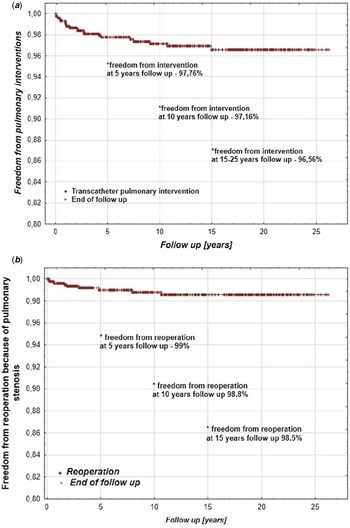
During the follow-up, 38 patients with transposition of the great arteries after an arterial switch operation required transcatheter interventions, most of whom – 21 – underwent procedures related to pulmonary stenosis. At the end of follow-up, freedom from transcatheter intervention related to pulmonary stenosis was 96.56% (Fig 1A). In the Cox regression model, pulmonary reconstruction with patches, aortic arch anomalies, and ventricular septal defects associated with transposition of the great arteries were significant risk factors for percutaneous interventions related to pulmonary stenosis (Supplementary Table S2).
Kaplan–Meier survival curves representing freedom from transcatheter interventions (a) and reoperations (b) during post-operative follow-up.

In our group, we did not perform any early reoperations (<30 days after surgery or before discharge home) because of pulmonary stenosis. For one patient, early reoperation included reanastomosis of the major pulmonary artery with pericardial patch implantation, but this was related to right coronary artery compression after the initial direct anastomosis.
During post-operative follow-up, nine patients required reoperation because of pulmonary artery stenosis, and one patient required more than one reoperation and ultimately required a homograft implantation. At the end of follow-up, freedom from reoperation because of pulmonary stenosis was 98.5% (Fig 1B). Similar to the pulmonary interventions, almost all of the reoperations performed due to pulmonary stenosis were conducted in the first 10 years after the arterial switch operation. Among the analysed risk factors, patch reconstruction of the pulmonary artery, aortic arch anomalies, and aortic cross-clamping time were shown to be significant risk factors for pulmonary reoperation in the multivariable Cox regression model (Supplementary Table S3).
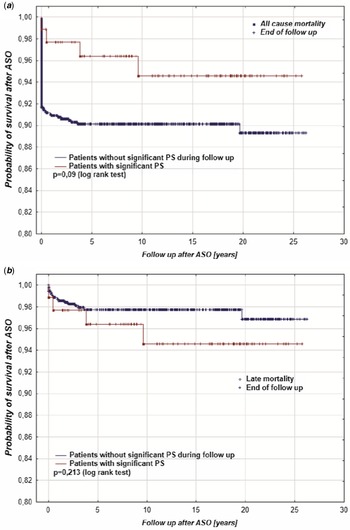
Significant pulmonary stenosis did not impact post-operative survival (Fig 2A). When we considered all cases of mortality, the probability of survival was higher in the group of patients with pulmonary stenosis than in the group without it, but the difference was not statistically significant. The early mortality among all patients was related to other reasons, and the majority of patients had no diagnosed pulmonary stenosis. When we included only late mortality in the analysis (Fig 2B), the Kaplan–Meier curves showed a higher probability of survival in patients without stenosis, but the difference was still not significantly different (p = 0.213).
Kaplan–Meier survival curves representing post-operative survival: all-cause mortality (a) and only late mortality (b) in patients with and without pulmonary stenosis.

Discussion
Pulmonary artery stenosis is the most frequent complication after the arterial switch operation. Reference Kirzner, Pirmohamed and Ginns1–Reference Oda, Nakano and Sugiura3 The native aortic valve arising from the right ventricle loses a significant part of its sinuses after the harvesting of coronary arteries, and the pulmonary trunk moves from the posterior to the anterior position during the LeCompte manoeuvre. Both of these factors make the pulmonary trunk more susceptible to stretching and narrowing after arterial switching. Additionally, the transferred coronary arteries are directly behind the posterior wall of the pulmonary trunk, and to achieve a successful operation, it is critical to avoid tension and potential pressure on proximal coronary arteries in this region. Reference Michalak, Sobczak-Budlewska and Moll4,Reference Moll, Michalak and Sobczak-Budlewska5 Patch reconstruction makes it easier to keep the proximal coronaries safe, but in our cohort, it increased the risk of pulmonary stenosis, percutaneous pulmonary interventions, and reoperations. The complex suture line established during pulmonary trunk reconstruction is responsible for the potential development of post-operative stenosis at the lower valvular level – deep in the sinuses, close to the apex of the leaflets – and very high, just before the bifurcation. Implantation of the patch makes the suture line even more complex and may lead to stenosis because of degeneration of the implanted tissue during follow-up. In our centre, direct reconstruction is the method of choice during an arterial switch operation, and patch reconstruction is an option when local adaptation of tissue is insufficient for establishing a tensionless anastomosis. Good results from patch reconstruction have been reported from other cardiac surgery centres, where it is the preferable surgical choice, suggesting that the best method is probably that most familiar to the surgeon. Reference Walter, Miera and Nasseri6–Reference Ullmann, Gorenflo and Bolenz9
In addition to patch reconstruction, aortic arch anomalies were significantly correlated with pulmonary stenosis and related interventions and reoperations after the arterial switch operation. Coarctation of the aorta and a hypoplastic or interrupted aortic arch are associated with a hypoplastic aortic valve and ascending aorta. In transposition physiology, they create a narrowed RV outflow tract, which may be a reason for the post-operative pulmonary stenosis. A smaller valve and additional suturing of the supravalvular part to the pulmonary trunk may result in worse, inadequate growth potential for proper, unrestricted pulmonary flow. Reference Losay, Touchot and Serraf10
The presence of coronary anomalies was associated with pulmonary stenosis. The most crucial part of the arterial switch operation is coronary transfer – it is important to keep the proximal pattern of the coronaries as close to the original as possible. The presence of coronary anomalies requires modification of the coronary button shape, size, and destination. This may lead to modification of the pulmonary anastomosis to avoid pressure on the proximal coronaries. Sometimes the coronary pattern determines the need for patch reconstruction.
In our group, significant pulmonary stenosis did not significantly impact post-operative survival. The overall, early, and late mortality is comparable to that reported in the literature, including the all-centre experience. Reference Morfaw, Leenus and Mbuagbaw2,Reference Van der Palen, Blom and Kuipers11,Reference Villafane, Lantin-Hermoso and Bhatt12 When accounting for all-cause mortality, the probability of survival was even higher in patients with pulmonary stenosis. This is mainly related to the fact that the early mortality was in all cases related to factors other than pulmonary stenosis, mostly to coronary transfer. When we excluded early mortality from the analysis, the probability of survival was higher in patients without pulmonary stenosis, but the difference was not statistically significant. Detailed analysis of all late deaths (20 patients) confirmed that none was related to pulmonary stenosis.
In our study, almost all significant cases of pulmonary stenosis occurred in the first 2 years after surgery. If stenosis occurs, it may develop and increase over time, but spontaneous improvement is also possible. In patients initially lacking signs of pulmonary stenosis, the later development of significant stenosis is rare; in our group, we only had nine such patients.
Most of the percutaneous interventions and reoperations were performed in the first 5–10 years after surgery; similar data may be found in the literature. Reference Walter, Miera and Nasseri6,Reference Van der Palen, Blom and Kuipers11,Reference Shim, Jun and Yang13–Reference Cleuziou, Vitanova and Pabst von Ohain16 In our centre, less invasive transcatheter treatment is always a procedure of choice. Balloon plasty may have a limited durability, and restenosis may occur, but even in such cases, reoperation is delayed, which is especially important in small babies. Stent implantation is also an option for patients with stenosis of the pulmonary branches and ensures a good long-lasting effect, but further redilatation is usually necessary. In patients with severe pulmonary stenosis and a poor echocardiographic window, we usually perform CT with 3D reconstruction of the pulmonary artery to choose the best method of treatment and plan the reintervention.
Conclusions
Pulmonary stenosis in patients with transposition of the great arteries after an arterial switch operation is a common complication. If significant, it occurs most frequently in the first 2 years after surgery, and it is the most frequent reason for post-operative interventions and reoperations. Patch reconstruction and aortic arch anomalies increase the risk of significant pulmonary stenosis and related interventions and reoperations.
Supplementary material
To view supplementary material for this article, please visit https://doi.org/10.1017/S1047951122002670
Acknowledgements
None.
Financial support
This research received no specific grant from any funding agency in commercial or not-for-profit sectors.
Conflict of interest
None.
Ethical standards
This study was approved by the local ethics board committee which waived the need of informed consent.