Implications
Achieving the appropriate body condition score (BCS) at parturition and minimizing BCS loss are the overarching goals of nutritional management in pasture-based system. A large number of systems studies have demonstrated that simply adding more concentrate will not result in improved fertility. Future research needs to identify specific micro- and macro-nutrients that can stimulate components of the reproductive axis.
Introduction
The effects of inadequate nutrition in cattle include delayed puberty (Kinder et al., Reference Kinder, Day and Kittok1987; Archbold et al., Reference Archbold, Shalloo, Kennedy, Pierce and Buckley2012), prolonged postpartum anovulation (Rhodes et al., Reference Rhodes, McDougall, Burke, Verkerk and Macmillan2003), reduced body condition score (BCS) (Roche et al., Reference Roche, Friggens, Kay, Fisher, Stafford and Berry2009), and poor submission and conception rates (Buckley et al., Reference Buckley, O’Sullivan, Mee, Evans and Dillon2003). Dairy production systems based on grazed pasture are primarily located in countries where environmental conditions support long growing seasons. The nutritional management of dairy cows in pasture-based systems is most heavily influenced by the stocking rate on the farm (McCarthy et al., Reference McCarthy, Delaby, Pierce, Journot and Horan2011). As stocking rate increases, an individual cow is less likely to be able to reach her dry matter intake (DMI) potential, simply as a consequence of more cows trying to graze a finite amount of available grass. The cow responds by reducing milk yield, but the total milk produced on the farm increases because more cows are being milked. If the stocking rate is excessively high, cows are perpetually underfed and productivity is reduced. If the stocking rate is excessively low, pasture is wasted and sward quality deteriorates. The challenge is to identify the optimum stocking rate such that output of milk solids per hectare of land is maximized while individual cow fertility, health and welfare is not compromised.
The evaluation of productivity in pasture-based systems is generally on the basis of milk solids (per cow and per hectare) rather than milk volume. Milk pricing schemes have evolved in Ireland and New Zealand to place a negative weighting on volume, as water ultimately represents a processing cost. This has implications for genetic selection and nutritional management goals. A cow that can produce 500 kg of fat and protein in a total volume of 5000 kg will generate more income than a cow that produces the same amount of fat and protein in 7500 kg over a full lactation. Of note, the former is also energetically more favourable for the cow, as she foregoes the requirement to synthesize an additional 120 kg of lactose (2500 kg milk×48 g/kg lactose).
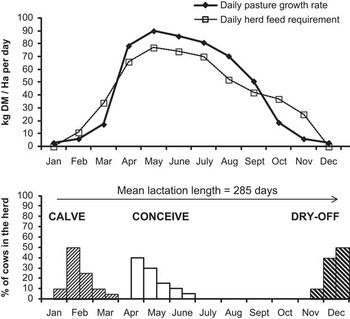
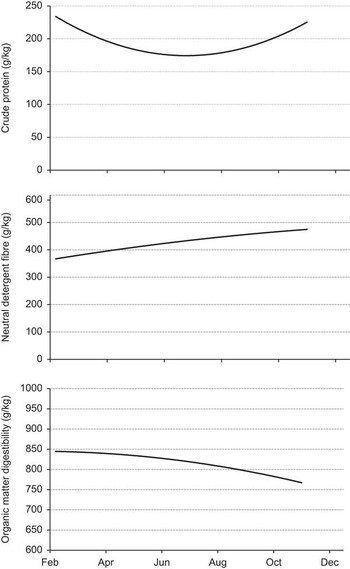
The availability and nutritive value of grazed grass varies over the grazing season (Figures 1 and 2). Crude protein (CP) is high at the start and end of the grazing season; although reduced during mid-season, CP concentrations are adequate to meet cow requirements. NDF rises as the season progresses, and correspondingly, organic matter digestibility decreases. During early lactation in spring, swards are composed of vegetative leafy growth and pasture digestibility is high, but pasture availability is generally lacking. As the plants enter the reproductive stage in late spring/early summer, pasture growth rates are high, but swards become increasingly stemmy and digestibility declines. In the autumn, growth rates and digestibility both decline (Holmes et al., Reference Holmes, Wilson, Mackenzie, Flux, Brookes and Davey2002).
Schematic representation of pasture-based seasonal-calving systems of milk production. Top panel: temporal patterns of pasture growth and herd feed demand. Bottom panel: Seasonal pattern of calving, breeding and drying off. Figure courtesy of B. Horan, Teagasc Moorepark and adapted from Holmes et al. (Reference Holmes, Wilson, Mackenzie, Flux, Brookes and Davey2002).

Seasonal variation in CP, NDF and organic matter digestibility in rye grass swards in Ireland (source: Moorepark database).

The purpose of this review is to summarize the state of the art in prepartum and postpartum nutritional management in pasture-based systems to facilitate optimal reproductive performance. As much of the literature on nutritional management relies on indicators of bioenergetic status as a proxy for likely effects on fertility, some general symptoms associated with unfavourable fertility will first be outlined. Where data are not specifically available from studies on pasture-based systems, insights from studies in confinement total mixed ration (TMR) systems are incorporated.
Reproductive targets for seasonal calving systems
The objective of seasonal-calving systems is to match herd feed requirements with the pasture growth profile (Dillon et al., Reference Dillon, Crosse, Stakelum and Flynn1995). To achieve this, a concentrated calving period – 90% of the herd calved within 6 weeks – in late winter/early spring is required. A concentrated calving period necessitates excellent fertility in the preceding breeding season (Figure 1). Fertility performance targets for the lactating herd in seasonal calving systems have been established (The InCalf Project, O’Farrell, Reference O’Farrell1994; McDougall, Reference McDougall2006). These targets are summarized as follows: (i) all cows calved by mating start date (MSD); (ii) ⩾70% cows resumed oestrous cyclicity by MSD; (iii) ⩾90% of lactating cows submitted for artificial insemination (AI) in the first 21 days of the breeding season; (iv) 6-week pregnancy rate of ⩾70% and 12-week pregnancy rate of >90%; (v) breeding season duration ⩽12 weeks. Clearly, it is important that cows have a prompt resumption of cyclicty after calving, exhibit overt behavioural oestrus, and have a strong likelihood of establishing and maintaining pregnancy after insemination. Inseminations are generally carried out after spontaneous oestrus (observed or detected with heat detection aids), but targeted or whole-herd synchronization (±timed AI) can be incorporated into the reproductive management to help achieve these targets (McDougall, Reference McDougall2010; Herlihy et al., Reference Herlihy, Berry, Crowe, Diskin and Butler2011).
General symptoms of inadequate nutrition
Energy balance and BCS
It is generally accepted that energy balance (energy consumed minus energy required for maintenance and milk) is a key regulator of reproductive status (Butler and Smith, Reference Butler and Smith1989; Chilliard et al., Reference Chilliard, Ferlay, Faulconnier, Bonnet, Rouel and Bocquier2000). During early lactation, the energetic cost of milk production can exceed energy consumed, resulting in a prolonged period of negative energy balance (NEB) and consequent mobilization of body tissue reserves. Thus, early lactation is analogous to severe undernutrition; it is typical for lactating cows to lose 30% to 40% of the initial lipid reserves at parturition, the figure rising to as high as 80% with inadequate nutrition (Chilliard et al., Reference Chilliard, Ferlay, Faulconnier, Bonnet, Rouel and Bocquier2000). A recent review noted that cows on pasture-based systems are generally thinner than cows on TMR systems (Mee, Reference Mee2012), highlighting that the extent of body fat reserve depletion is likely to be greater. In support of this, a study on two pasture-based herds in Florida reported that the incidence of elevated non-esterified fatty acid (NEFA) concentrations (⩾0.70 mM) and subclinical ketosis (⩾0.96 mM) in blood samples collected from 771 cows during the early postpartum period was 20% and 35.4%, respectively (Ribeiro et al., Reference Ribeiro, Lima, Greco, Bisinotto, Monteiro, Favoreto, Ayres, Marsola, Martinez, Thatcher and Santos2013). In a large survey of cow factors that affect fertility in spring-calving dairy cows in Ireland, both likelihood of submission for AI and likelihood of conception were positively related to nadir BCS, BCS during the breeding season, BW gain during the breeding season and 305-day milk protein concentration (Buckley et al., Reference Buckley, O’Sullivan, Mee, Evans and Dillon2003). In addition, it was also noted that 6-week in-calf rate was reduced when cows calved with a BCS >3.0 and subsequently lost >0.5 BCS units (Buckley et al., Reference Buckley, O’Sullivan, Mee, Evans and Dillon2003). Similarly, the likelihood of pregnancy establishment at first service, following 42 days of breeding or following 84 days of breeding was positively associated with nadir BCS and negatively associated with post-calving BCS loss and BW loss after the start of the breeding period (Roche et al., Reference Roche, Macdonald, Burke, Lee and Berry2007b). Calving at the appropriate BCS (3.00 to 3.25) and minimizing postpartum BCS loss (⩽0.5 BCS units) are associated with improved reproductive performance (Buckley et al., Reference Buckley, O’Sullivan, Mee, Evans and Dillon2003; Roche et al., Reference Roche, Macdonald, Burke, Lee and Berry2007b; Ribeiro et al., Reference Ribeiro, Lima, Greco, Bisinotto, Monteiro, Favoreto, Ayres, Marsola, Martinez, Thatcher and Santos2013).
The effect of metabolic status on reproduction
Several putative hormones, growth factors and metabolites have been identified that are stimulatory or inhibitory to the reproductive axis. In general, these factors tend to increase and decrease in tandem during unfavourable nutritional conditions (Butler et al., Reference Butler, Pelton and Butler2006). Reduced circulating concentrations of insulin, IGF-I, leptin and glucose, and elevated concentrations of BHBA, NEFA and glucocorticoids are all associated with impaired reproductive performance. Some recent reports indicate that superior phenotypic fertility performance in strains of cattle that have been genetically selected for improved fertility is not associated with improved postpartum calculated energy balance, yet differences in metabolic hormones and metabolites were detected (Patton et al., Reference Patton, Murphy, O'Mara and Butler2008; Moore et al., Reference Moore, Fair, Lonergan and Butler2014). This suggests that the internal metabolic signalling within the cow is more important than differences in calculated energy balance. In dairy cattle, a precipitous decline in circulating IGF-1 begins 2 weeks before parturition, and is paralleled by a decline in plasma insulin, with reciprocal changes in plasma growth hormone (GH) over the same period (Bell et al., Reference Bell, Burhans and Overton2000). GH is classified as a homeorhetic agent (Bauman and Currie, Reference Bauman and Currie1980), and in periparturient cows GH orchestrates numerous changes in various tissues in support of lactation. These changes include a reduction in insulin sensitivity, an increase in hepatic gluconeogenesis, and reduced whole body glucose utilization (Bell and Bauman, Reference Bell and Bauman1997). Hence, the early lactation period is characterized by reduced plasma insulin and IGF-1 and elevated GH and NEFA.
The role of glucose
Blood glucose concentrations are reduced in high-yielding compared with low-yielding cows on a pasture diet (Snijders et al., Reference Snijders, Dillon, O'Farrell, Diskin, Wylie, O'Callaghan, Rath and Boland2001). It has been clearly established that the brain is sensitive to hypoglycemia and that glucose is necessary for hypothalamic gonadotropin-releasing hormone (GnRH) release. Results of glycolysis inhibition studies using 2-deoxy-d-glucose (2-DG) have demonstrated that glucoprivation (inhibition of glucose metabolism) results in reduced LH pulse frequency, and that the effect is mediated at the level of the hypothalamus, as administration of GnRH or N-methyl-d-aspartate (a GnRH secretogogue) restored LH pulsatility (Bucholtz et al., Reference Bucholtz, Vidwans, Herbosa, Schillo and Foster1996). It is thought that the inhibitory effects of glucose deprivation on GnRH release are mediated by sensors in the lower brain stem (Murahashi et al., Reference Murahashi, Bucholtz, Nagatani, Tsukahara, Tsukamura, Foster and Maeda1996; Cates and O’Byrne, Reference Cates and O’Byrne2000). In cattle, insulin-induced hypoglycemia or administration of 2-DG interrupts oestrus and ovulation (McClure, Reference McClure1968; McClure et al., Reference McClure, Nancarrow and Radford1978). Hypoglycemia results in impaired tonic and surge release of LH in ewes, and can be restored by administering exogenous glucose (Medina et al., Reference Medina, Nagatani, Darling, Bucholtz, Tsukamura, Maeda and Foster1998). The effect of glucose deprivation on LH pulsatility in rats is potentiated in the presence of oestradiol (Nagatani et al., Reference Nagatani, Bucholtz, Murahashi, Estacio, Tsukamura, Foster and Maeda1996). This indicates that the negative feedback effects of oestradiol are enhanced during hypoglycemia. This is in agreement with the observation that LH pulse frequency is suppressed in oestradiol-supplemented heifers fed a low-energy diet, whereas no effect of oestradiol was observed in heifers fed a high-energy diet (Imakawa et al., Reference Imakawa, Day, Zalesky, Clutter, Kittok and Kinder1987). LH pulse frequency was shown to be increased by chronic glucose infusion in postpartum anestrous beef cows (Garmendia, Reference Garmendia1986). In addition to the well documented effects of hypoglycemia and glucoprivation on LH pulse frequency, glucose is also the principal metabolic fuel of the ovary (Rabiee et al., Reference Rabiee, Lean, Gooden, Miller and Scaramuzzi1997). During early lactation, cows with good (Fert+) genetic merit for fertility traits have greater circulating glucose concentrations compared with cows with poor (Fert−) genetic merit for fertility traits (Moore et al., Reference Moore, Fair, Lonergan and Butler2014), and this may play a role in the superior phenotypic fertility achieved by Fert+ cows under pasture-based systems (Cummins et al., Reference Cummins, Lonergan, Evans, Berry, Evans and Butler2012b). In support of this, Garverick et al. (Reference Garverick, Harris, Vogel-Bluel, Sampson, Bader, Lamberson, Spain, Lucy and Youngquist2013) reported that plasma glucose concentrations were greater during the 1st week postpartum in cows that subsequently became pregnant at first insemination compared with those that failed to become pregnant. Nutritional status during the immediate postpartum period has lingering consequence for subsequent fertility.
The role of insulin
Insulin is secreted from the pancreatic β-cells, and exerts a significant effect on the metabolism of the body. In general terms, it promotes anabolic processes and inhibits catabolic processes. Circulating insulin is reduced in cattle during lactation-induced NEB in pasture (Cummins et al., Reference Cummins, Lonergan, Evans, Berry, Evans and Butler2012b) and TMR systems (Beam and Butler, Reference Beam and Butler1998), and is also reduced during periods of increased milking frequency (Patton et al., Reference Patton, Kenny, Mee, O'Mara, Wathes, Cook and Murphy2006) and undernutrition (McGuire et al., Reference McGuire, Bauman, Dwyer and Cohick1995). Selection for milk yield is associated with decreased plasma insulin and increased circulating GH concentrations (Bonczek et al., Reference Bonczek, Young, Wheaton and Miller1988). Differences in plasma concentrations of insulin and GH in cows with different milk yields are reflective of energy status (Bauman et al., Reference Bauman, McCutcheon, Steinhour, Eppard and Sechen1985). Accordingly, Bonczek et al. (Reference Bonczek, Young, Wheaton and Miller1988) observed that insulin increased and GH decreased as lactation progressed.
Insulin also plays a role in ovarian steroidogenesis. Insulin receptors are widely distributed throughout all ovarian compartments, including granulosa, thecal and stromal tissues (Poretsky and Kalin, Reference Poretsky and Kalin1987). In vitro studies have shown that insulin directly stimulates both mitosis and steroid production of cultured bovine granulosa cells (Gutierrez et al., Reference Gutierrez, Campbell and Webb1997) and luteal cells (Mamluk et al., Reference Mamluk, Greber and Meidan1999). In addition, insulin increases steroidogenesis in response to gonadotropins in vitro (Stewart et al., Reference Stewart, Spicer, Hamilton and Keefer1995; Silva and Price, Reference Silva and Price2002). This is supported by in vivo findings, where a hyperinsulinemic-euglycemic clamp during the first postpartum follicular wave increased circulating oestradiol concentrations without any change in LH pulse frequency in TMR-fed cows (Butler et al., Reference Butler, Pelton and Butler2004). Early postpartum dairy cows fed TMR diets designed to increase circulating insulin concentrations had an earlier return to cyclicity and had a more favourable conception rate to first service (Gong et al., Reference Gong, Lee, Garnsworthy and Webb2002). A follow-up study reported by Garnsworthy et al. (Reference Garnsworthy, Fouladi-Nashta, Mann, Sinclair and Webb2009) indicated that the likelihood of successful pregnancy establishment was increased by feeding a diet designed to stimulate high circulating insulin concentrations until cows resumed cyclicity (average ~30 days postpartum), and then switching to a diet designed to stimulate low circulating insulin concentrations until pregnancy establishment. Those authors hypothesized that after resuming cyclicity, low circulating insulin concentrations would improve follicular development, oocyte competence and embryo development (Garnsworthy et al., Reference Garnsworthy, Fouladi-Nashta, Mann, Sinclair and Webb2009). Although the cows assigned to a high-insulin diet until resumption of cyclicity followed by a low-insulin diet thereafter did have a statistically significant improvement in reproductive performance, fertility of animals on the other treatments was poor, and the study had a small number of animals per treatment (n=15). Hence, there is a need to replicate this feeding strategy with greater animal numbers to verify an improvement in fertility performance.
Elevating circulating insulin using the hyperinsulinemic-euglycemic clamp technique has been demonstrated to increase circulating IGF-1 during early lactation (Butler et al., Reference Butler, Marr, Pelton, Radcliff, Lucy and Butler2003), highlighting the important inter-relationship between these two metabolic signals. During early lactation, Fert+ cows had greater circulating insulin concentrations compared with Fert- cows (Cummins et al., Reference Cummins, Lonergan, Evans, Berry, Evans and Butler2012b).
The role of IGF-1
IGF-1 is structurally homologous to proinsulin, it is a potent anabolic peptide, and its concentration in blood is primarily of liver origin and a reflection of nutritional status (Jones and Clemmons, Reference Jones and Clemmons1995). In many species including cattle, IGF-1 stimulates proliferation of ovarian granulosa cells (Gong et al., Reference Gong, McBride, Bramley and Webb1993; Hamilton et al., Reference Hamilton, Vizcarra, Wettemann, Keefer and Spicer1999) and acts synergistically with FSH to increase aromatase activity (Adashi et al., Reference Adashi, Resnick, Brodie, Svoboda and Van Wyk1985). Indeed, IGF-1 is considered critical for follicular maturation due to its intrafollicular role in amplifying gonadotropin stimulus (Fortune et al., Reference Fortune, Rivera, Evans and Turzillo2001). Plasma IGF-1 concentrations were found to be 40% to 50% greater in cows with an ovulatory follicle compared with cows with a non-ovulatory follicle, and circulating oestradiol and IGF-1 concentrations were highly correlated (Beam and Butler, Reference Beam and Butler1997 and Reference Beam and Butler1998). In feed-restricted heifers, a linear decrease in plasma IGF-1 was observed from the start of feed restriction until the onset of anoestrous, with an opposite relationship observed from the commencement of realimentation to the resumption of ovulatory cyclicity (Bossis et al., Reference Bossis, Wettemann, Welty, Vizcarra and Spicer2000). Pushpakumara et al. (Reference Pushpakumara, Gardner, Reynolds, Beever and Wathes2003) demonstrated that circulating IGF-1 is greater in cows that conceive early (<86 days) compared with cows that conceive late (86 to 230 days) or cows that do not become pregnant at all. Cows with circulating IGF-1 concentrations >25 ng/ml in the 1st week after calving and cows with >50 ng/ml at first service were 11 times and five times more likely to conceive to first service than those with lower concentrations, respectively (Taylor et al., Reference Taylor, Cheng, Pushpakumara, Beever and Wathes2004). In pasture-based systems, circulating IGF-1 concentrations were associated with earlier resumption of cyclicity and increased likelihood of conception (Patton et al., Reference Patton, Kenny, McNamara, Mee, O'Mara, Diskin and Murphy2007). The availability of both IGF-1 and insulin during follicular growth are postulated to be critical for ovarian gonadotropin responsiveness. As both hormones are depressed during NEB, they have received much attention as potential metabolic signals that result in anovulation (Beam and Butler, Reference Beam and Butler1999; Diskin et al., Reference Diskin, Mackey, Roche and Sreenan2003).
On pasture-based systems, Fert+ cows have greater circulating IGF-1 concentrations throughout lactation compared with (Fert−) cows (Cummins et al., Reference Cummins, Waters, Evans, Lonergan and Butler2012a and Reference Cummins, Lonergan, Evans, Berry, Evans and Butler2012b). Similarly, Holstein–Friesian cows with New Zealand genetics have greater circulating IGF-1 concentrations compared with cows with North American genetics on a pasture-based diet (McCarthy et al., Reference McCarthy, Berry, Dillon, Rath and Horan2007a and Reference McCarthy, Butler, Patton, Daly, Morris, Kenny and Waters2009; Patton et al., Reference Patton, Murphy, O'Mara and Butler2008; Lucy et al., Reference Lucy, Verkerk, Whyte, Macdonald, Burton, Cursons, Roche and Holmes2009). Though not reported in all studies, BCS was greater in animals with increased circulating IGF-1 concentrations (Patton et al., Reference Patton, Murphy, O'Mara and Butler2008; Lucy et al., Reference Lucy, Verkerk, Whyte, Macdonald, Burton, Cursons, Roche and Holmes2009; Cummins et al., Reference Cummins, Lonergan, Evans, Berry, Evans and Butler2012b). It is likely that the role that IGF-1 plays in nutrient partitioning and as a signal of bioenergetics status represents a key mechanism linking nutritional status with the reproductive axis.
The role of leptin
The ‘lipostat’ theory, first proposed by Kennedy and Mitra (Reference Kennedy and Mitra1963), asserted that reproductive performance was positively related to body-fat mass. Leptin, the 167 amino acid protein product of the ob gene, was first isolated and characterized in 1994 (Zhang et al., Reference Taylor, Cheng, Pushpakumara, Beever and Wathes1994). It is produced primarily by adipocytes, and plays a major role as a signal of nutritional status and adequacy of fuel reserves (Schwartz et al., Reference Schwartz, Woods, Porte, Seeley and Baskin2000). The ob/ob mouse – which has a mutation in the ob gene – lacks functional leptin and displays a phenotype that includes infertility. Chronic treatment of ob/ob mice with leptin increases serum concentrations of gonadotropins and weight of reproductive tissues (Barash et al., Reference Barash, Cheung, Weigle, Ren, Kabigting, Kuijper, Clifton and Steiner1996) and can result in ovulation, pregnancy and parturition (Chehab et al., Reference Chehab, Lim and Lu1996).
Circulating leptin and subcutaneous adipose tissue expression of leptin mRNA are reduced following parturition in dairy cattle (Block et al., Reference Block, Butler, Ehrhardt, Bell, Van Amburgh and Boisclair2001). Plasma leptin concentrations remain low beyond the timing of return to energy balance equivalence, and this is thought to reflect the depletion of adipose stores in support of milk synthesis during the early lactation period of NEB (Block et al., Reference Block, Butler, Ehrhardt, Bell, Van Amburgh and Boisclair2001). During the first 80 days of lactation, cows with higher DMI and a mean positive energy balance have greater circulating leptin than cows with lower DMI and a mean NEB, but no relationship between plasma leptin and onset of ovulatory activity was observed (Liefers et al., Reference Liefers, Veerkamp, te Pas, Delavaud, Chilliard and van der Lende2003). Plasma leptin concentrations increased steadily throughout an extended lactation (>600 days) in cows managed in a pasture-based system, especially during the extended portion (days 300 to 600) when milk yield was declining and BCS increasing (Marett et al., Reference Marett, Auldist, Grainger, Wales, Blache, Macmillan and Leury2011). The specific role of leptin in the regulation of the reproductive axis in lactating dairy cows remains to be determined.
The role of NEFA, BHBA and liver triglyceride (TG)
The increase in body tissue mobilization at the onset of lactation is reflected by a marked elevation in circulating NEFA. Circulating NEFA are taken up by the liver in proportion to its concentration in plasma where they are (1) oxidized to create energy, (2) partially oxidized and converted to ketones or (3) esterified to form TG. The rate of TG transport out of the liver is very slow in ruminants, resulting in TG accumulation when circulating NEFA exceeds hepatic oxidation capacity (Drackley et al., Reference Drackley, Overton and Douglas2001). Elevated circulating concentrations of NEFA and BHBA and liver accumulation of TGs are all associated with impaired fertility.
Concentrations of NEFA in plasma and follicular fluid are closely related, and a negative relationship between follicular concentrations of NEFA and oestradiol has been demonstrated (Comin et al., Reference Comin, Gerin, Cappa, Marchi, Renaville, Motta, Fazzini and Prandi2002; Jorritsma et al., Reference Jorritsma, Groot, Vos, Kruip, Wensing and Noordhuizen2003). In addition, NEFA does not appear to be used by the ovary as a metabolic fuel in normal circumstances (Rabiee et al., Reference Rabiee, Lean, Gooden, Miller and Scaramuzzi1997). Elevated circulating NEFA does not appear to have a detrimental effect on LH pulse frequency (Estienne et al., Reference Estienne, Schillo, Green and Boling1989). In many tissues, high circulating NEFA reduces the responsiveness to insulin and, as discussed above, insulin plays an important role as a signal to the reproductive system.
Elevated circulating concentrations of ketone bodies are also detrimental to reproductive performance. Koller et al. (Reference Koller, Reist, Blum and Kupfer2003) found that cows with greater circulating ketone bodies (BHBA, acetone and acetoacetone) during the first 6 weeks postpartum took longer to become pregnant than herd-mates with lower levels of ketone bodies. The probability of pregnancy was 30% lower for cows with elevated liver TG (>50 mg/g tissue) during the early postpartum period (Jorritsma et al., Reference Jorritsma, Jorritsma, Schukken and Wentink2000). The efficiency of storing lipid during time of nutrient surfeit and mobilizing it during times of deficit is dependent on NEFA being successfully partitioned for productive uses. Clearly, re-esterifying NEFA mobilized from adipose tissue back into TG in the liver is not an energy-yielding process. Indeed, excessive hepatic TG storage may lead to compromised liver function (Strang et al., Reference Strang, Bertics, Grummer and Armentano1998; Drackley et al., Reference Drackley, Overton and Douglas2001). There appears to be a lack of published reports on temporal patterns of hepatic TG accumulation in grazing dairy cows. It is likely to be important, however, given the extent of BCS loss that can occur.
The prepartum period
The prepartum period encompasses the entire duration from late lactation through to parturition. In seasonal-calving systems, it is normal for the entire herd to be dried off in the winter (Holmes et al., Reference Holmes, Wilson, Mackenzie, Flux, Brookes and Davey2002). Depending on geographic region, severity of the local winter and grass availability, cows may spend the entire dry period in winter accommodation fed conserved feeds (e.g. Ireland) or they may be kept outdoors on grazed pasture supplemented with conserved feeds (e.g. New Zealand). Where grazed pasture is the main dietary component during lactation, a variable proportion of the herd will be below target BCS in late lactation depending on stocking rate, concentrate supplementation practices, BCS at parturition and genetic merit for milk production. Pasture digestibility deteriorates as the grazing season progresses, and hence a grass-only diet in mid to late lactation can be inadequate to support body condition accretion. McCarthy et al. (Reference McCarthy, Berry, Dillon, Rath and Horan2007b) reported that cows managed on high stocking rate (2.74 cows/ha; 325 kg concentrate) or moderate stocking rate systems (2.47 cows/ha; 325 kg concentrate) with low concentrate supplementation fail to regain BCS during lactation, but cows on a high concentrate feeding regime (2.47 cows/ha; 1445 kg concentrate) at pasture do regain BCS during lactation. Similarly, Roche et al. (Reference Roche, Berry, Lee, Macdonald and Boston2007a) reported that cows fed a diet of grazed grass fail to regain BCS during lactation, whereas cows fed a TMR return to calving BCS by the end of lactation. Supplemental concentrate feeding in late lactation and/or allocating a longer dry period may be necessary for thin cows to achieve BCS targets at dry-off and calving.
Recently, there has been considerable interest in feeding high-fibre diets (>30% chopped straw in a TMR) to control energy intake during the dry period. In confinement systems with high-yielding cows, feeding high-fibre diets reduces BCS gain during the dry period, improves postpartum appetite, reduces the incidence of metabolic disorders and improves fertility performance (Cardoso et al., Reference Cardoso, LeBlanc, Murphy and Drackley2013). In pasture-based systems, feeding a high-fibre diet can be unfeasible as specialized feeding equipment to chop the straw and mix it with the other dietary ingredients is required. This equipment is generally not used on pasture-based systems given the short duration that cows spend indoors. The typical diet of a dry cow in Ireland is grass silage (GS), which can be fed restricted, ad libitum or supplemented with concentrate depending on silage quality and the requirement to maintain or improve BCS. Butler et al. (Reference Butler, Patton, Murphy and Mulligan2011) fed dry cows either a high-fibre TMR (HF-TMR) or GS from dry-off until parturition, and cows were turned out to pasture full time on the day after parturition. The cows fed GS had greater BCS at calving (+0.4 units) and lost more BCS during the first 8 weeks after calving (+0.2 units) compared with HF-TMR cows. This BCS loss was associated with greater daily energy-corrected milk production for GS cows during the first 8 weeks after calving (+2.2 kg/day), but cumulative milk production over the full lactation was similar. Circulating concentrations of BHBA were greater in GS cows during the first 4 weeks postpartum, but there was no treatment effect on the incidence of ketosis or any other metabolic disorder. Though the number of animals per treatment was small, some fertility variables tended to be improved in the GS cows. It should be pointed out that the GS fed was of average quality (72% dry matter digestibility), with ADF and NDF concentrations of 331 and 537 g/kg, respectively. This compared with ADF and NDF concentrations of 368 and 614 g/kg, respectively, for the HF-TMR diet. The results of this study indicate that where cows are not at risk of over-conditioning, there is no advantage of feeding a HF-TMR over feeding GS alone. One of the reasons that HF-TMR systems are successful in confinement systems with high-yielding cows is the improved appetite and DMI postpartum. For pasture-based cows, there appears to be little advantage offering HF-TMR diets during the dry period as cows fail to meet DMI potential in early lactation anyway (Stockdale, Reference Stockdale2004).
The postpartum period
Stocking rate and quantity of concentrate
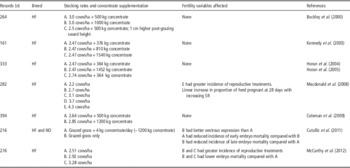
Much work has been carried out to examine the effect of stocking rates and supplemental feeding practices in the period after parturition. The results of long-term systems trials that examined the effect of different stocking rate and concentrate feeding treatments on fertility measurements in lactating cows are summarized in Table 1. Though not reported for all studies, the concentrates used in these studies generally contained mixtures of standard ingredients including barley (~0.25), maize gluten feed (~0.25), beet pulp (~0.25), with the remainder composed of soya bean meal, rapeseed meal, tallow and minerals and vitamins. It is apparent that simply adding more concentrate or reducing stocking rate is not a useful strategy to improve fertility. This finding would appear to be somewhat paradoxical given the preceding discussion about the importance of energy balance, metabolic hormones and energy metabolites as indicators to the reproductive axis. A number of these studies indicated that cows on the treatments with high levels of concentrate feeding partitioned most of the additional energy to produce more milk. For example, Kennedy et al. (Reference Kennedy, Dillon, O’Sullivan, Buckley and Rath2002) reported that the mean milk yield response to additional concentrate in cows with high merit for milk production was 0·89 kg milk per kg concentrate DM going from treatment A to B and 1.01 kg milk per kg concentrate DM going from treatment A to C (treatments described in Table 1). Corresponding values for cows with medium merit for milk production were 0·66 and 0·74 kg milk per kg concentrate DM, respectively. Similarly, Horan et al. (Reference Horan, Dillon, Faverdin, Delaby, Buckley and Rath2005) evaluated the milk production response going from treatment A to B (treatments described in Table 1). The mean milk production response to increased concentrate supplementation in cows of North American ancestry was 1.08 kg of milk/kg of concentrate versus 0.43 kg or milk/kg concentrate for cows of New Zealand ancestry. Clearly, cows with high merit for milk production are genetically disposed towards increasing milk output in response to additional ingested nutrients. This was also noted by Cutullic et al. (Reference Cutullic, Delaby, Gallard and Disenhaus2011); additional milk production in response to supplemental concentrate was greater in Holstein cows compared with Normande cows, despite Holstein cows having lower BCS.
Summary of long-term systems trials that evaluated the effect of stocking rate and concentrate supplementation on fertility performance of lactating cows

HF=Holstein–Friesian; NO=Normande.
Very high stocking rates did increase the incidence of anoestrous cows and the requirement for reproductive treatments at the start of the breeding season (Macdonald et al., Reference Macdonald, Penno, Lancaster and Roche2008; McCarthy et al., Reference McCarthy, Pierce, Delaby, Brennan and Horan2012). Apart from greater incidence of embryo loss between 30 and 60 days post-AI in the lowest stocking rate treatment (McCarthy et al., Reference McCarthy, Pierce, Delaby, Brennan and Horan2012), no other fertility measurements were affected, presumably indicating an acceptable response to reproductive treatments imposed. Just as increasing concentrate feeding did not improve fertility, neither did reducing stocking rate (Macdonald et al., Reference Macdonald, Penno, Lancaster and Roche2008) or relaxing grazing pressure (Buckley et al., Reference Buckley, Dillon, Crosse, Flynn and Rath2000). As a result, efforts have recently concentrated on trying to identify specific supplements or ingredients that could stimulate improved reproduction performance in pasture-based systems.
Specific supplements
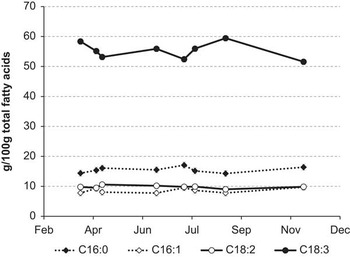
Santos et al. (Reference Santos, Bilby, Thatcher, Staples and Silvestre2008) reviewed the effect of feeding supplemental fat on fertility. The majority of the studies included in the review involved dairy cows on TMR feeding systems. The authors concluded that supplemental fat generally resulted in improved indices of reproductive function, and noted that unsaturated n-3 and n-6 fatty acids were more beneficial than saturated fats. In pasture-based systems, the predominant fatty acid in the diet of dairy cows is n-3 α-linolenic acid (Figure 3), and this fatty acid is also high in conserved GS (Mohammed et al., Reference Mohammed, Stanton, Kennelly, Kramer, Mee, Glimm, O’Donovan and Murphy2009). This is in contrast to TMR-based production systems, where plant oils high in n-6 linoleic acid are widely used and are the primary fat source in dairy cow diets. Hutchinson et al. (Reference Hutchinson, Hennessy, Waters, Dewhurst, Evans, Lonergan and Butler2012c) examined the effect of feeding isolipid diets containing saturated fat, conjugated linoleic acids (CLA), flaxseed (n-3) or fish oil (n-3). Cows fed the saturated fat and CLA supplements had greater corpus luteum volume and circulating progesterone concentrations during the luteal phase compared with cows fed either of the n-3 supplements. On day 7 of the oestrous cycle, endometrial gene expression of prostaglandin G/H synthase (PTGS2) was greater in cows fed the flax supplement compared with control and expression of prostaglandin F2 synthase (PGFS2) tended to be greater. Previous studies that reported reductions in prostaglandin F metabolite (PGFM) in n-3 PUFA supplemented cows used basal diets containing a high proportion of n-6 fatty acids, and the PGFM measurements were conducted at a later stage of the oestrous cycle (~day 15; see review by Mattos et al., Reference Mattos, Staples and Thatcher2000).
Temporal pattern of pasture fatty acid composition during the grazing season.

It is likely that the effects of fatty acid supplementation on prostaglandin synthesis are influenced more by the ratio of n3:n6 fatty acids provided, rather than absolute levels of either family of PUFA. Based on the results of Mohammed et al. (Reference Mohammed, Stanton, Kennelly, Kramer, Mee, Glimm, O’Donovan and Murphy2009), the ratio of n-3 PUFA to n-6 PUFA on a diet of grazed grass is ~5.5 to 1, and this ratio is reduced to ~3.2 to 1 on a diet of conserved GS. Supplementing dairy cow diets with n-3 PUFA, therefore, may only have beneficial effects on prostaglandin synthetic capacity with diets that are generally low in these fatty acids, rather than the relatively high n-3 PUFA pasture-based diet.
CLA are geometric and positional isomers of linoleic acid, and are normally produced in the rumen as intermediates in the biohydrogenation of linoleic acid to stearic acid (Bauman and Griinari, Reference Bauman and Griinari2003). Trans-10,cis-12 CLA is an isomer of CLA that inhibits milk fat synthesis (Baumgard et al., Reference Baumgard, Corl, Dwyer, Saebo and Bauman2000) and has been shown to reduce mammary milk fat synthesis in a dose-dependent manner (de Veth et al., Reference de Veth, Griinari, Pfeiffer and Bauman2004). This phenomenon has been observed in cows consuming both pasture (Kay et al., Reference Kay, Roche, Moore and Baumgard2006; Hutchinson et al., Reference Hutchinson, Hennessy, Dewhurst, Evans, Lonergan and Butler2012b) and TMR diets (Bernal-Santos et al., Reference Bernal-Santos, Perfield, Barbano, Bauman and Overton2003; Odens et al., Reference Odens, Burgos, Innocenti, VanBaale and Baumgard2007; Hutchinson et al., Reference Hutchinson, de Veth, Stanton, Dewhurst, Lonergan, Evans and Butler2011) at various stages of lactation. However, the dose of trans-10,cis-12 CLA necessary to evoke milk fat depression immediately postpartum (36.9 g/day; Moore et al. Reference Moore, Hafliger, Mendivil, Sanders, Bauman and Baumgard2004) was found to be greater than the dose necessary in established lactation (8.8 g/day; Perfield et al. Reference Perfield, Bernal-Santos, Overton and Bauman2002). Fat is energetically the most expensive component of milk; daily milk fat secretion in early lactation cows represents up to 35% of net energy intake (Bauman and Currie, Reference Bauman and Currie1980). The milk fat depressing effects of trans-10,cis-12 CLA could therefore be used as a management tool to temporarily reduce milk energy output. A meta-analysis of studies conducted in TMR systems indicated that CLA supplementation reduced the postpartum interval to first ovulation and the interval to conception (de Veth et al., Reference de Veth, Bauman, Koch, Mann, Pfeiffer and Butler2009). Hutchinson et al. (Reference Hutchinson, Hennessy, Dewhurst, Evans, Lonergan and Butler2012b) conducted a field trial to examine the effect of CLA supplementation in a pasture-based herd. All cows in the study (n=409) had similar nutritional management, except 203 cows were individually fed 51 g of CLA per day (containing 5 g of trans-10,cis-12 CLA) from parturition until 60 days in milk. There was no effect of CLA supplementation on the interval to first ovulation, oestrous cycle characteristics or submission and conception-related variables. Based on these results, supplementing pasture-based herds with CLA does not improve herd fertility, but additional larger studies are required.
As outlined earlier, Gong et al. (Reference Gong, Lee, Garnsworthy and Webb2002) suggested that feeding a TMR diet that stimulated greater circulating glucose and insulin concentrations favourably impacted the reproductive system. This was tested in a pasture-based system by Burke et al. (Reference Burke, Kay, Phyn, Meier, Lee and Roche2010a) in a 2×2 factorial study examining the effect of supplementing cows with a high-starch concentrate during the dry period and early lactation. Cows were assigned to be supplemented or not with 3 kg of dry matter/per day of a corn- and barley-based concentrate for 36 days prepartum. Within each pre-calving group, cows were assigned to be supplemented or not after calving with 5 kg of dry matter/per day of a corn- and barley-based concentrate for at least 35 days postpartum. Prepartum diet did not affect reproduction. The postpartum anovulatory interval (PPAI) was 8 days shorter and the 6-week pregnancy rate was 17% greater in cows supplemented with concentrate postpartum compared with the cows that received no concentrate postpartum. Interestingly, feeding 5 kg of the corn- and barley-based concentrate stimulated an increase in circulating glucose and IGF-1, but not circulating insulin concentrations. More work is necessary to determine if this simple feeding strategy can reliably improve fertility performance.
Short-term restriction
Adverse weather conditions (cold, drought, excessive rain) can reduce pasture growth, resulting in a short-term feed deficit. What are the implications of a short period of inadequate pasture availability for herd fertility? Burke and Roche (Reference Burke and Roche2007) conducted a 2×2 factorial study to examine the effect of prepartum pasture intake (11.9 or 4.8 kg/day for final 29 days of gestation) and post-partum intake (13.5 or 8.6 kg/day for first 35 days of lactation) on the PPAI. The PPAI tended to be shorter in cows on the high intake treatment pre-calving compared with cows on the low intake treatment pre-calving (32.0 v. 38.7 days; P=0.07). Pre-calving intake had little effect on postpartum milk production, whereas post-calving intake had a large effect on milk production, but did not affect PPAI. Cows on the high intake treatment post-calving had greater circulating glucose concentrations, but neither insulin nor IGF-1 were affected. Compared with the favourable effects of supplemental starch based concentrates on PPAI discussed previously (Burke et al., Reference Burke, Kay, Phyn, Meier, Lee and Roche2010a), there appears to be a specific requirement for the dietary treatment to stimulate a robust increase in circulating IGF-1 (±insulin).
Burke et al. (Reference Burke, Williams, Hofmann, Kay, Phyn and Meier2010b) imposed a high or low pasture allowance for the first 14 days of the breeding season, which resulted in estimated mean daily intakes of 14.3 and 8.0 kg DM per day. The timing of the restriction would have coincided with peak milk production. Though conception rate to first and second services did not differ, cows on the high pasture allowance had greater 21 day submission rate (+4.2%; P=0.06), 3-week pregnancy rate (+7.1; P=0.05) and 6-week pregnancy rate (+6.6%; P=0.04). The cows on the low pasture allowance also had reduced milk yield and milk protein concentration, implying that the cows were in NEB, which the authors suggested as a possible underlying cause for the reduced 3- and 6-week pregnancy rates.
Fat supplementation has been shown to increase plasma progesterone concentrations (Ryan et al., Reference Ryan, Spoon and Williams1992; Hawkins et al., Reference Hawkins, Niswender, Oss, Moeller, Odde, Sawyer and Niswender1995; Lammoglia et al., Reference Lammoglia, Willard, Hallford and Randel1997). Hawkins et al. (Reference Hawkins, Niswender, Oss, Moeller, Odde, Sawyer and Niswender1995) reported that fat supplementation resulted in greater progesterone half-life in circulation compared with control cows receiving no fat supplement, indicating that reduced metabolic clearance rate is a major contributing factor to the increased plasma progesterone concentrations in cows fed a high-lipid diet. Hutchinson et al. (Reference Hutchinson, Dewhurst, Evans, Lonergan and Butler2012a) conducted a 2×2 factorial study to examine the effect of pasture allowance (ad libitum or restricted) and fat supplementation (750 g/day of fat or no fat). Progesterone clearance rate was not affected by pasture allowance or fat supplementation, but a tendency for an interaction was detected whereby cows on the restricted-fat diet tended to have a longer progesterone half-life than cows on the ad libitum-fat diet. This may have practical implications in pasture-based systems where pasture deficits can arise before and during the breeding season. Supplementing fat to cows on a restricted pasture diet could increase circulating progesterone concentrations during the luteal phase. A field trial is required to determine if this would have beneficial effects on embryo survival and fertility.
Conclusions
Successful pasture-based systems of milk production are reliant on achieving excellent fertility performance, thereby allowing a compact calving period that coincides with the onset of spring pasture growth. Nutritional management has a key role to play in achieving fertility targets. It is now firmly established that achieving the correct BCS at calving (3.00 to 3.25) and minimizing postpartum BCS loss (⩽0.5 BCS units) are key drivers of herd fertility performance. Nutritional management must revolve around achieving these goals. Development of nutritional strategies to favourably impact metabolic indicators that regulate the reproductive axis should be prioritized.
Acknowledgements
Funding from the Dairy Levy Trust and the National Development Plan are gratefully acknowledged.