Rumen microflora play a paramount role in ruminant lipid metabolism. Characterising the fatty acids (FA) arising from rumen microbial metabolism is key to know the nutritional attributes of milk fat. Odd and branched chain FA, trans-11 18 : 1 (vaccenic acid, VA) as well as cis-9 trans-11 18 : 2 (rumenic acid, RA) are known for their potential healthy properties (Shingfield et al. Reference Shingfield, Chilliard, Toivonen, Kairenius and Givens2008).
Probiotics have become an appealing alternative to chemical and hormonal growth promoters in recent years, in order to improve digestive and production efficiency in livestock industry. The ability of probiotic bacterial strains to metabolise unsaturated FA in vitro is well known (Ogawa et al. Reference Ogawa, Kishino, Ando, Sugimoto, Mihara and Shimizu2005), however, literature reporting the effects of probiotics in ruminant diet on milk FA profile is very scarce. Recent research has shown that probiotic consumption by lactating goats can affect the concentrations of major FA, but detailed information about minor FA of rumen origin were not provided (Maragkoudakis et al. Reference Maragkoudakis, Mountzouris, Rosu, Zoumpopoulou, Papadimitriou, Dalaka, Hadjipetrou, Theofanous, Strozzi, Carlini, Zervas and Tsakalidou2010; Apás et al. Reference Apás, Arena, Colombo and González2015). Furthermore, to the best of our knowledge there are no published studies with lactating ewes. Sheep milk is a valuable nutritional food that has traditionally enriched the human diet in numerous countries. If the incorporation of probiotics to sheep diet affected the rumen ecosystem, lipid metabolism could alter and milk FA profile might change from a nutritional point of view. Therefore, the aim of the present work was to investigate the effects of probiotic supplementation on milk fat FA profile of ewes kept under the same feeding regime and management conditions.
Materials and methods
This study was carried out in the Animal Research Station of Razi University Agriculture College (Kermanshah-Iran). The research protocol was approved by the Animal Care and Use Committee of Razi University.
Experimental design
Sixteen Sanjabi ewes, each suckling one lamb and kept in individual straw-bedded pens provided with individual water and feeding troughs, were randomly allocated to a control diet without probiotics (CON) or the same diet supplemented with Primalac probiotics (PRO). Diet was based on alfalfa hay (60% DM) and a concentrate mix (40% DM). The ration was fed in two equal amounts at approximately 07 : 30 and 17 : 30 h. Once a day, before morning feeding, the ewes in the PRO treatment were fed 0·75 g of Primalac probiotics (manufacturer's recommended dosage), which were thoroughly mixed with about 10 g of concentrate. Primalac® 454 Feed grade (Star-Labs, Clarksdale, MO, USA) is a multi-strain commercial preparation in powder form (1 × 10⁸ CFU/g) that consists of Lactobacillus acidophilus (2·5 × 107 CFU/g), Lactobacillus casei (2·5 × 107 CFU/g), Bifidobacterium thermophilum (2·5 × 107 CFU/g), and Enterococcus faecium (2·5 × 107 CFU/g). Water was provided ad libitum throughout the experimental period. Milk yield and composition was determined throughout 24-h periods at biweekly intervals up to 10 weeks of lactation, starting 2 weeks after parturition. Lambs were separated from their dams at 1630 h on the day before each test day and bottle-fed. On the test day, ewes were milked twice by hand at 0630 and 1630 h, and milk from each ewe was sampled at each milking. The morning and evening samples from each ewe were mixed and two subsamples were taken for laboratory analysis. Milk fat and protein contents were determined in refrigerated milk samples using a Milko-Scan (Foss Electric, Hillerød, Denmark). Milk samples intended for the FA profile determination were kept frozen at −20 °C until analysis. Milk fat was extracted by double centrifugation and FA were determined as methyl esters by gas–liquid chromatograph (Agilent 6890 N Network System) by injection onto a CP-Sil 88 fused silica capillary as described by Bodas et al. (Reference Bodas, Manso, Mantecón, Juárez, De la Fuente and Gómez-Cortés2010).
Statistical analysis
SAS 9.1.3 (SAS Institute Inc., Cary, NC) was used to perform all the statistical analyses. The MIXED procedure was used in a repeated measurements analysis. The statistical model included the fixed effects of treatment, week of lactation and their interaction, and the random effects of sheep nested within treatment. Statistical significance was declared at P < 0·05. The CANDISC procedure was used to perform a canonical discriminant analysis. The FA that would be included as predictors were selected with the STEPDISC procedure (P to enter, 0·10; P to stay, 0·15). Only FA of known exclusive rumen origin (Fievez et al. Reference Fievez, Colman, Castro-Montoya, Stefanov and Vlaeminck2012; Martínez Marín et al. Reference Martínez Marín, Gómez-Cortés, Núñez, ánchez, Juárez, Garzón Sigler, Peña Blanco and De la Fuente2015) and found in relevant amounts in milk fat (more than ≈0·05%) were included in the study.
Results and discussion
There were no significant differences between the CON and PRO treatments in ewe's body weight at the end of the experimental period (53·4 ± 7·9 kg), average milk yield (452 ± 148·6 g/d) and milk fat and protein contents (5·2 ± 1·74% and 6·8 ± 0·47%, respectively). More than one hundred individual FA, including geometric and positional isomers, were identified and quantified in milk fat. The complete FA profiles are provided in online Supplementary Table S1.
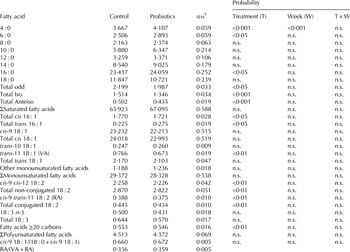
The lack of differences in the contents of 8 : 0 to 16 : 0 between treatments (Table 1) indicated that de novo FA synthesis in the mammary gland remained almost unaltered by probiotic supplementation, which would indicate that substrate availability remained unaltered. However, the significantly higher average contents of butyric (4 : 0) and caproic (C6 : 0) acids in the PRO treatment suggested that changes in the rumen fermentation pattern might occur due to probiotics. Butyric acid is produced in the rumen with other volatile FA, such as acetic acid, from fermentation of feed components. Caproic acid is exclusively produced in the mammary gland, mainly via acetyl-CoA carboxylase but also from butyryl-CoA (Palmquist, Reference Palmquist, Fox and McSweeney2006), and its increase could be related to a higher availability of acetate and β-hydroxybutirate in the udder.
Effects of probiotic supplementation on the contents (g/100 g of fatty acid methyl esters) of selected fatty acids and sums of fatty acids in ewes

† sem, standard error of the mean; n.s., not significant.
Despite the changes observed in butyric and caproic acid levels due to probiotic supplementation, a stable rumen function during lactation can be proposed from the lack of significant changes of the contents of odd and branched chain FA (Table 1). These FA are distinct components of milk, largely derived from bacteria leaving the rumen, and serve as biomarkers of rumen function, i.e. ruminal fermentation pattern (Fievez et al. Reference Fievez, Colman, Castro-Montoya, Stefanov and Vlaeminck2012). The few changes in cis and trans 18 : 1 FA levels (Table 1) are further evidence supporting the view that rumen function was not substantially modified by probiotic supplementation. These FA come from rumen microbial metabolism of dietary unsaturated FA with 18 atoms of carbon and the milk fat contents of most of them have been ascribed to either oleic, linoleic or α-linolenic acid consumed by ruminants (Martínez Marín et al. Reference Martínez Marín, Gómez-Cortés, Gómez Castro, Juárez, Pérez Alba, Pérez Hernández and De la Fuente2012). It is noteworthy that trans-10 18 : 1, which is normally associated to shifts in the pathways of biohydrogenation of the dietary unsaturated FA was not affected by probiotic supplementation (Table 1). Except for Maragkoudakis et al. (Reference Maragkoudakis, Mountzouris, Rosu, Zoumpopoulou, Papadimitriou, Dalaka, Hadjipetrou, Theofanous, Strozzi, Carlini, Zervas and Tsakalidou2010), who reported an increase of VA in the milk of goats fed a Lactobacillus plantarum strain, to our knowledge no published papers have reported a detailed profile of milk trans 18 : 1 FA after probiotic supplementation.
The stability in both the 18 : 0 Δ−9 desaturation index and the oleic acid content (Table 1) in milk fat would suggest no negative effects on the mammary stearoyl-CoA desaturase. Contrary to our results, Apás et al. (Reference Apás, Arena, Colombo and González2015) found significantly higher contents of stearic and oleic acids at 25 and 55 d of trial in goats that were managed under a semi-extensive system and fed a mixture of probiotics that included selected strains of Lactobacilllus reuteri, Lactobacillus alimentarius, Enterococcus faecium and Bifidobacterium bifidum. The absence of changes in the VA Δ−9 desaturation index and the RA content (Table 1) would further support that probiotic supplementation had no negative effects on the mammary Δ−9 desaturase activity and did not favour alterations in the rumen biohydrogenation pathways of the unsaturated FA.
The lack of deep differences in the milk FA profile between treatments persuaded us to perform a canonical discriminant analysis in order to identify which, if any, of FA from rumen origin might be indicative of probiotic supplementation. Eight FA out of 25 were selected as predictors in the canonical discriminant analysis (online Supplementary Table S2). The canonical correlation indicated that the discrimination ability was very good. Taken into account the canonical structure and the class means for each group's canonical observation scores, the content of 4 : 0 was positively associated with probiotic supplementation in agreement with the previous univariate analysis, whereas 17 : 0 iso and VA were positively related to the control diet. In this regard, Vlaeminck et al. (Reference Vlaeminck, Fievez, Cabrita, Fonseca and Dewhurst2006) found a positive correlation between 17 : 0 iso and VA in a comprehensive milk FA dataset. According to those authors, rumen conditions that promote synthesis of bacterial 17 : 0 iso are detrimental to the bacteria responsible for biohydrogenation of the trans 18 : 1 to 18 : 0. Thus, the results of the canonical discriminant analysis suggested that, in the present work, probiotics might subtly affect the rumen conditions, but this point would need to be explored more closely.
Conclusion
The present work gives detailed data on the milk fat FA contents of ewes fed probiotics during lactation. The probiotics tested had no negative effects on milk fat FA that are relevant from the human's health point of view. The few changes in FA originated from rumen microbial metabolism would be evidence supporting the view that, under the conditions assayed, the rumen conversion pathways of FA were not substantially altered by probiotics.
Supplementary material
The supplementary material for this article can be found at https://doi.org/10.1017/S0022029917000115.
The Razi University Agriculture College and the Agriculture Organization of Kermanshah (Iran) province, Mr Alejandro Salvá, and the Animal Production Department of the University of Córdoba (Spain) are gratefully acknowledged for their valuable help.