


Introduction
Homelessness is a worldwide phenomenon associated with mental health disorders, particularly anxiety and depression, and health risk behaviours (Hodgson et al., Reference Hodgson, Shelton and van den Bree2015; Marcal, Reference Marcal2017), having long-term deleterious effects on adult well-being. It is also linked to various social problems such as poverty, marginalization, social exclusion, prostitution, substance use and abuse, delinquency and violence. Thus it leads to increased socioeconomic, educational, employment, and cultural deficits (e.g. inequality, discrimination, social exclusion, violation of rights, injustice, health disparities, etc.). It also results in direct (e.g. financial outlays for housing, health, education, crime prevention, correctional services, etc.) and indirect costs (e.g. under-achievement in education, school drop-out, discrimination, lower status job, unemployment, family instability, etc.) to society (Xie et al., Reference Xie, Sen and Foster2014). Among homeless people, homeless girls are a highly vulnerable group growing at a fast rate (Committee Opinion, 2013), and are present in every country around the world (Jabeen and Azra, Reference Jabeen and Azra2013).
Homeless girls suffer sexual and labour exploitation, abuse, and discrimination at a higher rate than the rest of the population (Misganaw and Worku, Reference Misganaw and Worku2013). They usually experience domestic violence and live in families undergoing poverty, unemployment and lack of housing with poor quality of life opportunities and outcomes (Towe et al., Reference Towe, Hasan, Zafar and Sherman2009; Canadian Homelessness Research Network, 2012). They are less likely to receive the healthcare they are entitled to (Saewyc and Edinburgh, Reference Saewyc and Edinburgh2010). They present anxiety, depression and suicidal behaviour (Sarajlija et al., Reference Sarajlija, Jugovic, Zivaljevic, Merdovic and Sarajlija2014) at a higher rate than homeless boys (Tevendale et al., Reference Tevendale, Lightfoot and Slocum2009). They usually exhibit aggressive behaviours, and lack assertive skills (Ganesh et al., Reference Ganesh, Campbell, Hurley and Patten2013), self-control, and emotion regulation strategies needed to adapt and cope with environmental stressors (Elegbeleye, Reference Elegbeleye2013). These factors diminish their quality of life (Oppong et al., Reference Oppong, Meyer-Weitz and Petersen2015), thus having a negative impact on adult well-being (UNICEF, 2009).
Mexico has the second largest number of homeless children in Latin America to date, with 1.3 million cases (The Critical Point, 2013). It is believed that there are at least 95,000 homeless children in Mexico City alone (Carlos Slim Foundation, 2013). Despite its prevalence and that childhood homelessness is a precursor for adult homelessness (Finley, Reference Finley and Salkind2008), homeless children are still one of the most underserved populations in Mexico. In particular, the situation of homeless girls is partially and superficially known, not even having information on how many girls are homeless. The latest research on Mexican homeless girls has showed that this group experiences abuse, poverty, neglect and abandonment. They are mainly characterized by a low self-concept and self-esteem, by diminished self-efficacy, a decreased perceived subjective well-being, and by the presence of anxiety, depression and aggression. Also, they have difficulties in behaving assertively, and they use dsyfunctional emotion regulation strategies (e.g. self-multilating behaviours, substance use and abuse, avoidance, and running away) to control their emotions (Castaños and Sánchez, Reference Castaños and Sánchez2015, Reference Castaños and Sánchez2016; Castaños et al., Reference Castaños, Turnbull and Aguilar2017).
To summarize, some of the main characteristics of homeless girls are the presence of anxiety and depression, a low subjective well-being, and the lack of functional emotion regulation strategies and assertive skills.
Subjective well-being incorporates aspects of mental functioning, feelings and behaviours, and has been described as feeling good and functioning well (Diener and Ryan, Reference Diener and Ryan2009). Positive subjective well-being has been associated with better physical and mental health and with reduced mortality (Diener and Chan, Reference Diener and Chan2011), while negative well-being has been related to emotion dysregulation, unassertiveness and to the presence of anxiety and depression (Derdikman-Eiron et al., Reference Derdikman-Eiron, Indredavik, Bratberg, Taraldsen, Bakken and Colton2011). Anxiety and depression are disorders that occur twice as often in women than in men (Rafful et al., Reference Rafful, Medina-Mora, Borges, Benjet and Orozco2012). They are the primary cause of disability in the female population (Noble, Reference Noble2005), and they have a high frequency of comorbidity, especially in girls (Frank et al., Reference Frank, Matza, Revicki and Chung2005). These disorders are correlated with emotion dysregulation and unassertiveness (Mohapatra et al., Reference Mohapatra, Agarwal, Sitholey and Arya2014), which, in turn, increase the risk of conditions including anxiety, depression (Pe et al., Reference Pe, Raes and Kuppens2013), and social incompetence, along with overall psychopathology and functional impairment.
Anxiety, depression, emotion dysregulation and unassertiveness are factors that foster cumulative impairments in mental health (Crawford and Manassis, Reference Crawford and Manassis2011) such as: (a) disruptive and anti-social behaviour, (b) health risk behaviours, (c) school drop-out and poor school performance, (d) emotional problems, (e) psychiatric disorders, (f) uneffective coping and problem solving skills, (g) unproductive labour, and (h) social exclusion and marginalization. All of these constitute a burden to the individual and to society, because of the costs generated (Slesnick et al., Reference Slesnick, Guo, Brakenhoff and Feng2013).
Although evidence has revealed that these factors are essential in shaping mental health, few studies have addressed these variables in homeless populations. Yet, less is known for homeless girls, a common circumstance in societies with a predominantly male orientation that discriminates and excludes women (Venumadhava, Reference Venumadhava2013). Moreover, particularly in Mexico, policy actions that can successfully address homelessness have not been planned or developed. These circumstances exact a huge toll on individuals, families and society, and undermine the health and well-being of homeless girls.
One way that seems to be efficient when addressing the needs of vulnerable groups, is to deliver a cognitive behavioural therapy either in an individual or group format. The cognitive behavioural therapeutic (CBT) approach is based on scientific principles which research has repeatedly shown to be efficacious and effective for a wide variety of psychological problems. It is time limited in comparison with traditional psychoanalytic therapy, is often conducive to manualization, and can thus be scaled. A collaborative effort between therapist and client is an essential ingredient for change; it is both highly structured and flexible, it addresses problems in a direct and targeted way, and it focuses on the acquisition and utilization of skills aimed at enabling the client to tackle their problems by harnessing their own resources (Sheldon, Reference Sheldon2011; Wright, Reference Wright2004). Also, the approach can be used with individuals, families and groups to help anyone irrespective of age, ability, culture, race, gender or sexual preference (Roth and Fonagy, Reference Roth and Fonagy2005). It is largely presented focused, culturally sensitive and tailored developmentally when working with children and adolescents (Szigethy et al., Reference Szigethy, Weisz and Findling2012). CBT helps children and adolescents reframe or challenge their own beliefs, automatic thoughts and schemas (Kendall, Reference Kendall2012). Children at least 7 years of age are able to engage in CBT (Stallard, Reference Stallard2007). However, Durlak et al. (Reference Durlak, Fuhrman and Lampman1991) found that children in the formal operations stage (ages 11 and older) have twice the positive effects utilizing CBT as children aged 2–10. Yet, in other studies CBT has proven to be effective in 3- to 7-year-old anxious children (Minde et al., Reference Minde, Roy, Bezonsky and Hashemi2010; Normann et al., Reference Normann, Lonfeldt, Reinholdt-Dunne and Esbjorn2016).
Regarding CBT with vulnerable groups, worldwide relatively few studies have focused on CBT for homeless people (Barker et al., Reference Barker, Humphries, McArthur and Thomson2012), particularly homeless girls, who have received very limited attention in the intervention research literature. Nonetheless, the researcher considered a CBT approach appropriate for addressing the social-emotional needs of Mexican homeless girls due to existing evidence of its effectiveness with similar groups, for example homeless men with alcohol and/or substance misuse problems (Maguire, Reference Maguire2006), people with criminal records (Perry et al., Reference Perry, Neilson, Martyn-St James, Glanville, Woodhouse, Godfrey and Hewitt2015), low-income women with major depressive disorder (O'Mahen et al., Reference O'Mahen, Himle, Fedock, Henshaw and Flynn2013), women with a history of substance abuse (Clarke et al., Reference Clarke, Mun, Kelly, White and Lynch2013), women with anxiety, depression and stress (Asghari et al., Reference Asghari, Faramarzi and Mohammmadi2016; Pahlavanzadeh et al., Reference Pahlavanzadeh, Abbasi and Alimohammadi2017), teenage girl victims of assault violence (Cisler et al., Reference Cisler, Sigel, Kramer, Smitherman, Vanderzee, Pemberton and Kilts2016), children with trauma (Diehle et al., Reference Diehle, Opmeer, Boer, Mannarino and Lindauer2015), and orphaned children with maladaptive grief and post-traumatic stress symptoms (O'Donnell et al., Reference O'Donnell, Dorsey, Gong, Ostermann, Whetten, Cohen, Itemba, Manongi and Whetten2014). In fact, CBT seems to be the leading approach with the most evidence for improving symptoms when the child is exposed to a traumatic event (Dorsey et al., Reference Dorsey, McLaughlin, Kerns, Harrison, Lambert, Briggs, Cox and Amaya-Jackson2017). Homeless girls are constantly exposed to traumatic events. Moreover, cognitive behavioural group interventions have proven to be effective in reducing depressive and anxiety symptoms in women affected by intimate partner violence (Latif and Khanam, Reference Latif and Khanam2017), and with depressed adolescents in south west Nigeria (Bella-Awusah et al., Reference Bella-Awusah, Ani, Ajuwon and Omigbodun2016). In addition, there have been potentially promising outcomes with cognitive behavioral approaches used with homeless young people (Altena et al., Reference Altena, Brilleslijper-Kater and Wolf2010), especially when interventions are brief (Carney and Myers, Reference Carney and Myers2012). Likewise, research has found that CBT improved psychological, behavioural and cognitive outcomes among homeless women (Speirs et al., Reference Speirs, Johnson and Jirojwong2013). Finally, Thompson et al. (Reference Thompson, McManus and Voss2006) suggested that when working with homeless youths, low-threshold CBT interventions would be best suited for them, making it accessible and engaging to maximize involvement.
The aims of this study were to (a) assess the preliminary effect of a brief cognitive behavioural group intervention in the well-being of a group of Mexican homeless girls, (b) examine the preliminary efficacy of the intervention for homeless girls with symptoms of anxiety and depression, and (c) determine the clinical significance of the treatment effect. The intervention derives from a pilot trial carried out in previous research after achieving promising results (Castaños, Reference Castaños2014). The researcher sought to improve the well-being of a group of homeless girls by diminishing symptoms of anxiety and depression and by increasing assertive behaviours and functional emotion regulation strategies. The research hypothesis was that after the brief cognitive behavioural group intervention, symptoms of anxiety and depression would diminish, and homeless girls would learn and acquire basic social and functional emotion regulation skills. Therefore, it was expected that their level of well-being would improve.
Method
Participants
Participants recruited were 84 homeless girls between the ages of 9 and 17 years old. Forty-two girls received the cognitive behavioural intervention (CBT) (mean [SD] = 11.62 [2.036]) and 42 received the treatment as usual (TAU) (mean [SD] = 11.9 [1.95]). Using a purposive sampling method, participants were recruited from four non-governmental organizations of Mexico City that serve homeless children and youth as their primary function. Participants were required to (1) reside within the selected shelter during the intervention period, (2) present symptoms of anxiety and/or depression, unassertiveness, and emotion dysregulation, and (3) consent to participate in the study. Participants with insufficient capacity to provide informed consent, insufficient proficiency in Spanish (spoken or written) to engage in CBT, and a primary diagnosis of intellectual disability, head injury or substance misuse were excluded. Participants in the CBT group did not receive the treatment as usual.
Measurement
In Mexico, measures for homeless girls do not exist. Worldwide there are significant logistical and measurement issues when assessing homeless children that challenge accurate and thorough assessment of need (Marcal, Reference Marcal2017). All scales were developed during this study using the culturally relevant psychometric validation process proposed by Geisinger (Reference Geisinger1994) and, specifically for Mexican culture, by Reyes and García (Reference Reyes and García2008). The researcher selected items from various Mexican scales for children and youth that assess anxiety, depression, assertiveness, emotion regulation, and subjective well-being. Items were chosen based upon their relevance for the group under study as they evaluate cognitive (e.g. self-criticism, helplessness, self-devaluation, catastrophic thoughts, self-focused attention, etc.), behavioural (e.g. under-estimation of the ability to cope and of help available, dependence, withdrawal, failure to resist their peer's influence, aggression reactivity, compliance, etc.), emotional (e.g. nervousness, fear, sadness, irritability, anger, guilt, etc.), and social (e.g. social interactions, peer approval, peer influence, deviance, risk behaviours, etc.) characteristics present in Mexican homeless girls according to the results obtained in a previous study (Castaños and Sánchez, Reference Castaños and Sánchez2016). Items of each instrument were rated on a 6-point Likert scale from 1 (never, 0% of the time) to 6 (always, more than 80% of the time).
Psychometric validation of the scales
For the psychometric validation process, three pilot studies with differing samples of randomly selected participants were carried out, utilizing responses from 143 homeless girls (sheltered, emergency sheltered, and unsheltered) and 30 girls that were determined to be at risk of homelessness. Age means and standard deviations of each subsample did not differ significantly. Selected items measured cognitive, emotional and behavioural issues, and were evaluated by psychology experts in the field. The final version of the instrument assessed 240 homeless girls selected using a non-random method and measured self-reported anxiety symptoms, depressive symptoms, assertive skills, emotion regulation, and subjective well-being.
Symptoms of anxiety scale
Anxiety was measured using an 8-item scale grouped into two factors that explain 56% of variance (α = 0.59). An example of an anxiety scale item includes the question, ‘I am worried that something bad will happen to me’.
Symptoms of depression scale
Depression were measured using an 8-item scale grouped into two factors that explain 50% of variance (α = 0.75). An example of a depression scale item includes the question, ‘I feel that only bad things happen to me’.
Assertive skills scale
Assertive skills were measured using a 9-item scale grouped into two factors that explain 52% of variance (α = 0.64). An example of an assertiveness scale item includes the question, ‘I can tell someone to stop bothering me when other people are watching’.
Emotion regulation scale
Emotion regulation was measured using a 7-item scale grouped into two factors that explain 50% of variance (α = 0.60). An example of an emotion regulation scale item includes the question, ‘I get upset easily’. The emotion regulation scale included additional questions to explore strategies that individuals use to manage and control their emotions when experiencing anxiety and depression such as ‘If you feel worried, what would you do to calm down?’.
Subjective well-being scale
Subjective well-being was measured using 32 items grouped into five factors that explain 61% of variance (α = 0.85 to 0.90). An example of a subjective well-being scale item includes the question, ‘During the last month I have felt pleased with the support the institutional staff has given me’. The subjective well-being scale also evaluated the intensity and frequency of 10 emotions using a 10-point scale from ‘0 (never/none)’ to ‘10 (very often/a lot)’.
Procedure
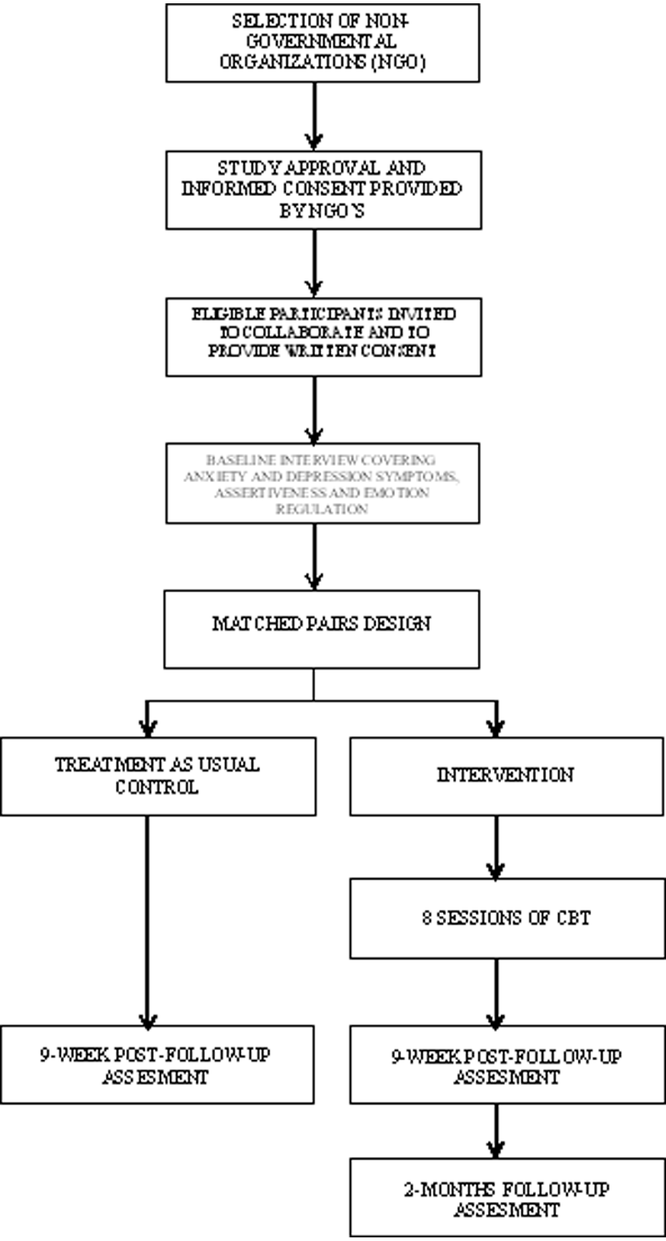
Because homeless girls experience unstable living conditions (Coker et al., Reference Coker, Elliot, Kanouse, Grunbaum, Gilliland, Tortolero, Cuccaro and Schuster2009), the researcher worked with non-governmental institutions that support homeless girls to acquire access to this population. Permission to conduct the study was provided by the institutions in lieu of parental consent, as legal authority rested with the institutions to provide consent on behalf of children. All girls that were eligible participants were invited to collaborate in the study on a voluntary basis and received information about the study's general objectives, use of data, and confidentiality agreement. Girls consenting to the study provided their fingerprint as written consent, and were empowered to discontinue study participation at any time (Fig. 1). The research took place in on-site classrooms at collaborating institutions. After the girls’ consent, they were individually interviewed and responses were recorded on questionnaires by the researcher. While interviews lasted approximately 15 to 30 minutes each, no time limit was established. Following this baseline assessment, participants were allocated to either the intervention group or control group using a matched pairs design. Participants were paired up in various demographic characteristics (e.g. abuse, substance use, birthplace, age, time spent in homeless shelters or facilities that serve homeless people as their primary function, health risk behaviours, etc.). Seven groups with a total of six participants per group were constituted for the intervention group and seven groups with a total of six participants per group were constituted for the control group. Intervention was delivered over a maximum of 8 weeks to avoid attrition. Outcome indices were measured for the treatment and control groups immediately post-intervention. Due to lack of resources and to the highly transitory nature of homeless girls, only the CBT group was assessed at a 2-month follow-up assessment to see if there was a lasting effect. The intervention period was from January to October 2013.
Intervention flowchart
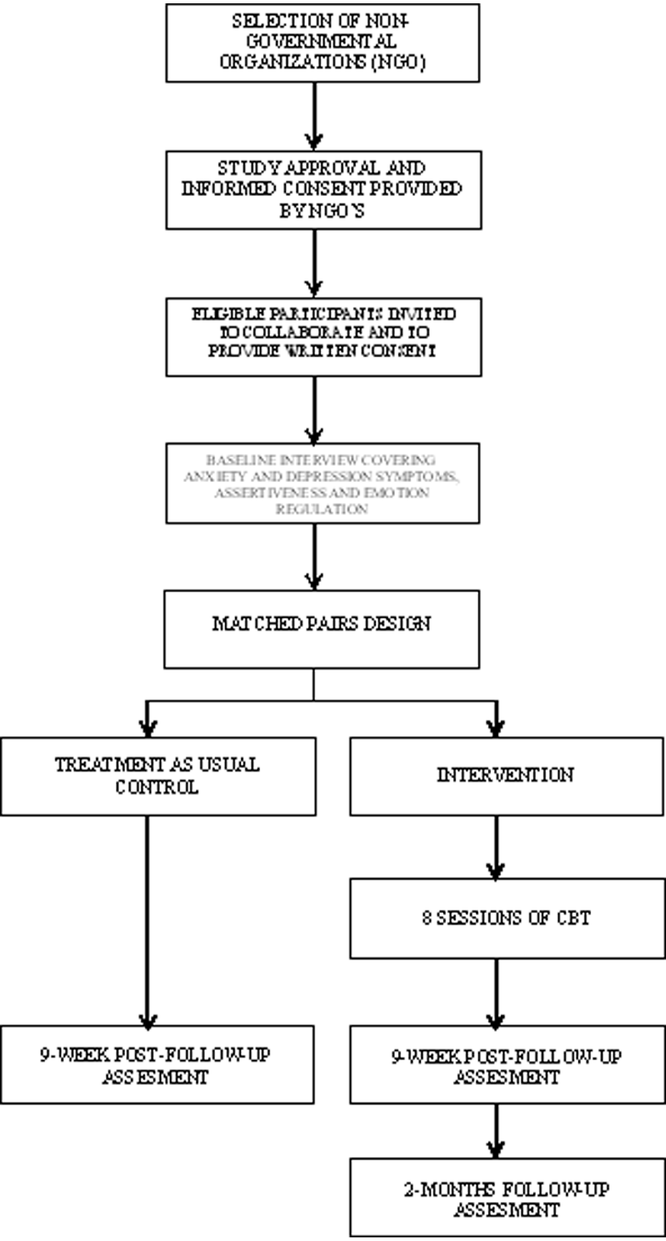
This study was reviewed and approved by the Academic Board of the Master's and PhD program in Psychology of the National Autonomous University of Mexico. This review serves as the Mexican equivalent to an American IRB Review.
Intervention
The intervention is based on various protocols developed for CBT for children and adolescents (Kendall, Reference Kendall2012; Reinecke et al., Reference Reinecke, Dattilio and Freeman2006; Stallard, Reference Stallard2007), specific problems and populations (White and Freeman, Reference White and Freeman2000), anxiety (Kendall and Hedtke, Reference Kendall and Hedtke2006), depression (Stark et al., Reference Stark, Schnoebelen, Hargrave, Molnar and Glen2007), social skills (Caballo, Reference Caballo1993), and brief (Bond and Dryden, Reference Bond and Dryden2002) group therapy (Christner et al., Reference Christner, Stewart and Freeman2007; Bieling et al., Reference Bieling, McCabe and Antony2009).
The intervention was culturally adapted to the particular needs and characteristics of Mexican homeless girls in a previous pilot trial that produced preliminary evidence of efficacy (Castaños, Reference Castaños2014). The adaptations were both structural and didactic. Structural adaptations included changes in the language used to describe some of the cognitive behavioural techniques, and simplification of some of these techniques. Didactic adaptations in the content of the material to be covered each week included adding several audiovisual materials (e.g. videos, drawings, images, games) to help explain the concepts and techniques, to promote adherence and engagement, and to make it more fun for the participants. Also, the intervention was tailored developmentally using a developmental approach (Graham and Reynolds, Reference Graham and Reynolds2013). Developmental considerations that were incorporated into treatment design included focusing on concrete concepts rather than abstract principles, using a more simplified language, vocabulary, and age-appropriate activities to convey therapeutic skills, such as child-friendly materials, drawings, games, audiovisuals, pictures and cartoons, and simplifying the cognitive restructuring process to replacing negative thoughts with more positive thoughts. The therapeutic techniques used included the key components of CBT for internalizing disorders in children like depression as stated in a meta-analysis of published studies on internalizing disorders (Coyne et al., Reference Coyne, Burke, Freeman, Hersen and Gross2008). The intervention aimed to increase the level of subjective well-being by reducing symptoms of anxiety and depression, and by enhancing social and emotion regulation skills. It was hypothesized that through diminishing symptoms of anxiety and depression and increasing assertive and emotion regulation skills, the well-being of homeless girls would improve. The intervention was delivered, in addition to treatment as usual (see below) over eight 3 h sessions, covering the areas outlined in Table 1, as appropriate and determined by the needs of the participants. Sessions were conducted in on-site classrooms at collaborating institutions. Finally, a follow-up was done at 2 months to see if there was a lasting effect.
Components of CBT intervention
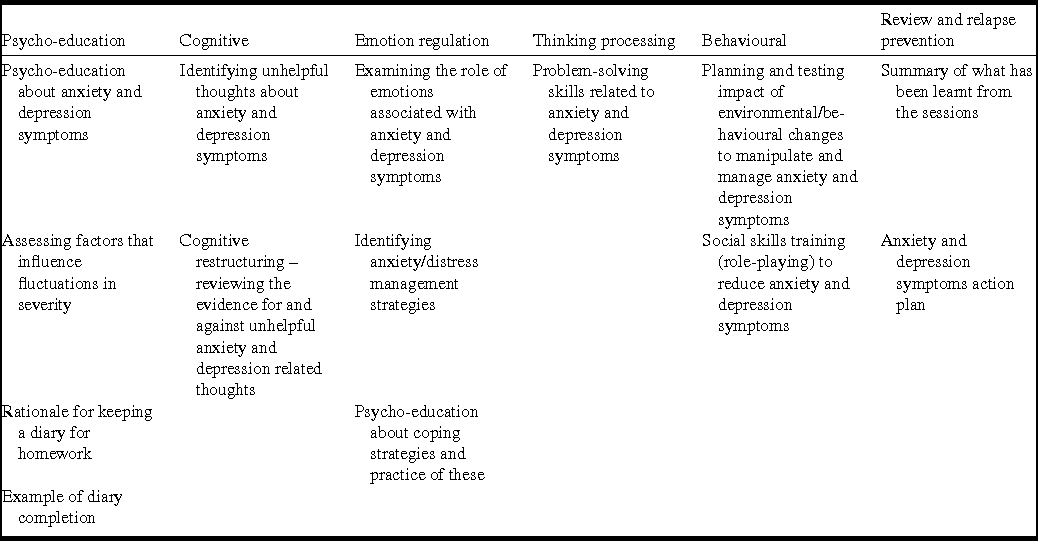
After each session, participants will be given a small ‘homework’ task to practise techniques introduced in the session and to monitor symptoms and behavioural changes using a diary.
Treatment as usual control condition
The typical treatment consisted of individual therapy given by the psychologists in each collaborating organization. However, the psychologists of the collaborating institutions only give therapy to homeless girls with severe emotional or behavioural problems (i.e. when the girls have a mental disorder such as attention deficit disorder, post-traumatic stress disorder, substance disorder, etc.). Also, to date, the collaborating organizations have not used specific intervention models and the interventions that have been implemented rarely have an empirical and theoretical foundation. Furthermore, not every institution has a psychologist. Homeless girls who are not treated individually do not receive treatment at all. They usually participate in workshops where they are taught several topics such as sexual health, risk behaviours, moral values, and self-esteem. Nonetheless, these workshops are mainly given by non-health professionals without a pre/post assessment.
Data analyses
Statistical analyses were conducted using SPSS version 21. The researcher analysed differences between both groups using Student's t-test for independent samples, between the pre/post test in the CBT group and the TAU group separately, using paired samples Student's t-test, and among the pre-test, post-test and 2-month follow-up only in the CBT group using analysis of variance for repeated measures. Multiple comparisons were performed employing a Bonferroni correction to identify means that were significantly different from each other in the analysis of variance for repeated measures carried out. The researcher evaluated the effect size of the Student's t-tests using Cohen's d and of the analysis of variance for repeated measures using eta coefficient. Finally, the researcher used the reliable change index of Jacobson and Truax (Reference Jacobson and Truax1991) to determine the clinical significance of the results obtained with Student's t-tests for only the CBT group.
Results
Before the CBT intervention (pre-test), various data analyses were carried out in order to verify the equivalence of the treatment groups (CBT and TAU) in different demographic characteristics and the study variables.
Regarding demographic characteristics, findings obtained with Student's t-test for independent samples, a Mann–Whitney U-test, and with a chi-squared test (Table 2), revealed no significant differences among treatment groups previous to CBT intervention.
Differences in various demographic characteristics between treatment groups (N = 84) (pre-test)
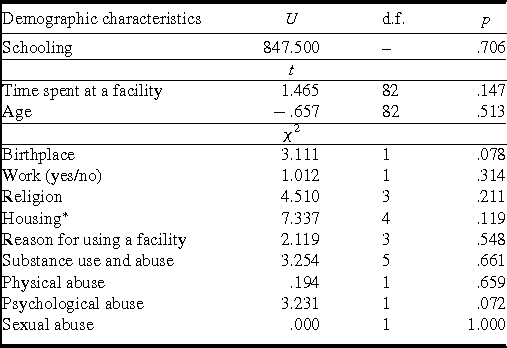
*The characteristic ‘Housing’ alludes to where the homeless girl lives when she does not stay in a facility that serves homeless people as its primary function.
Findings obtained with Student's t-test for independent samples (Table 3), revealed no significant differences in symptoms of anxiety and depression, assertiveness, emotion regulation strategies, and subjective well-being prior to the cognitive behavioural intervention (pre-test).
Differences in research variables between treatment groups in the pre-test (N = 84)
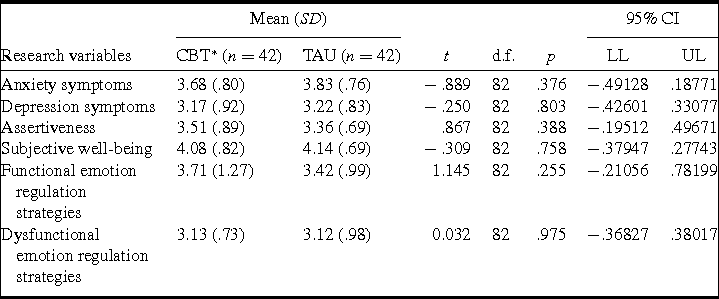
*Group with cognitive-behavioural treatment: CBT; group with usual treatment: TAU.
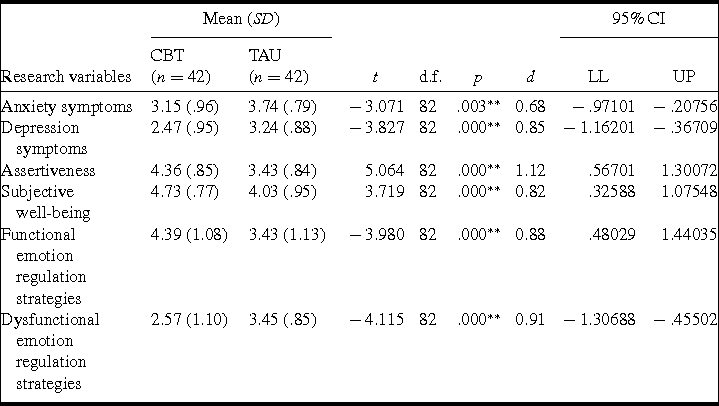
After the CBT intervention (post-test), Student's t-test showed significant differences in symptoms of anxiety and depression, assertiveness, subjective well-being, and emotion regulation strategies between the CBT group and TAU group. CBT treatment effects ranged from moderate to high according to Cohen's d for independent samples (Table 4).
Differences in research variables between treatment groups in the post-test (N = 84)
**p < .01.
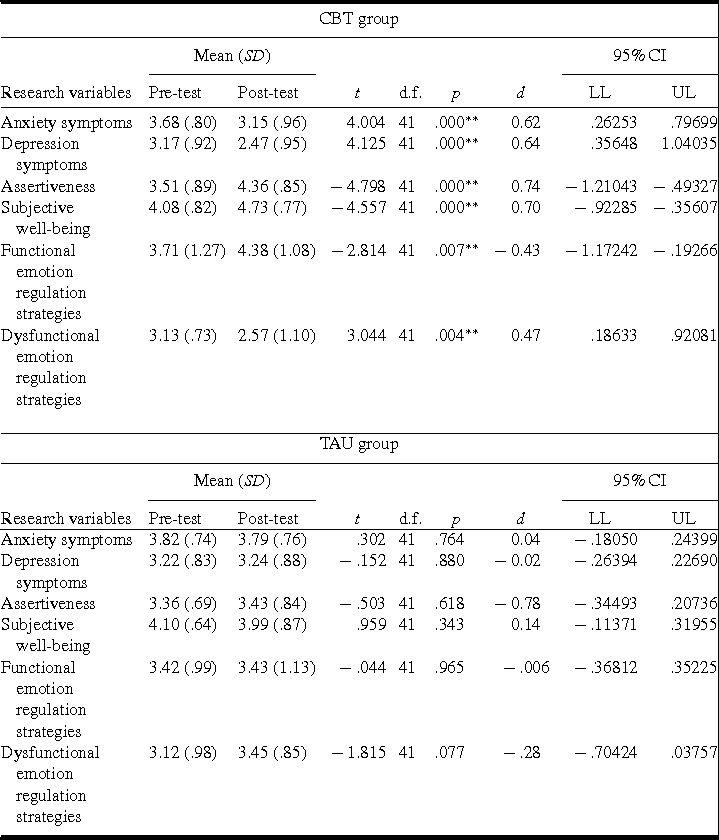
The difference between pre-test and post-test scores for each treatment group was analysed separately with a Student's t-test for paired samples. In the case of the CBT group, Student's t-test for paired samples revealed significant differences in symptoms of anxiety and depression, assertiveness, emotion regulation strategies and subjective well-being. Treatment effects ranged from moderate to high using Cohen's d. In the TAU group, Student's t-test for paired samples showed no significant differences in any variable. Treatment effects were low using Cohen's d (Table 5).
Differences in research variables in each treatment group between the pre-test and the post-test (n = 42)
*p < .05, **p < .01.
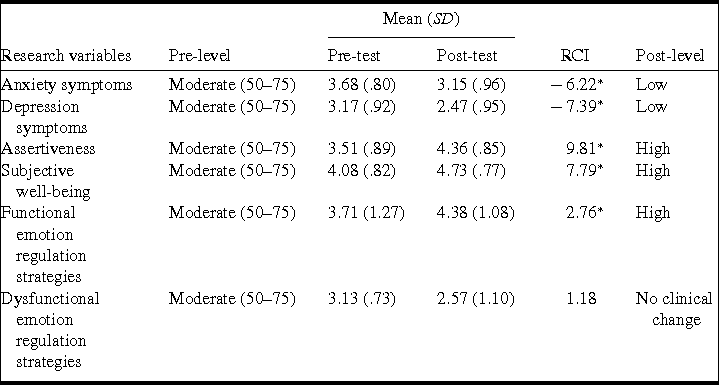
Based on the parameters set by González-Celis and Araujo (Reference González-Celis and Araujo2010), cut-off points corresponding to quartiles <25, 50 and >75 of the means of the study variables were established only in the CBT group to indicate low, moderate and high levels of symptoms of anxiety and depression, assertiveness, and emotion regulation strategies. For the purposes of this study, clinical significance of the CBT intervention was defined as the transition from one level (i.e. low, moderate or high) to another in the expected direction. The clinical significance of the treatment effect for the CBT group was determined using the reliable change index (RCI) of Jacobson and Truax (Reference Jacobson and Truax1991). According to the RCI, scores equal to or greater than ±1.96 at p < .05 are indexes of clinically relevant change as they involve the transition from one level to another. Thus, significant clinical changes were achieved in all study variables in the CBT group with the exception of dysfunctional emotion regulation strategies (Table 6).
Analysis of the clinical significance of each research variable for the CBT group (N = 42)
*The RCI values are significant at p < .05.
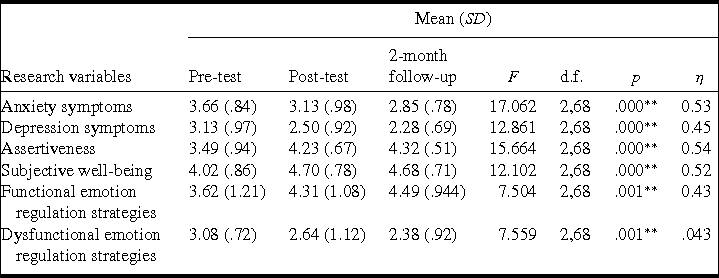
Finally, changes in the CBT group were assessed at a 2-month follow-up (Table 7). However, by that time some of the participants of the CBT group (n = 7) had already abandoned the shelter. Therefore, the data obtained were analysed with 35 homeless girls of the initial 42 which were allocated to receive CBT. Outcomes obtained with the analysis of variance of repeated measures showed significant differences for anxiety and depression symptoms, assertiveness, subjective well-being and emotion regulation strategies with moderate treatment effects according to eta coefficient. In addition, to determine among which assessments (pre-test, post-test or follow-up) there were significant differences, multiple comparisons were made using the Bonferroni adjustment. The results indicated significant differences between the pre-test and subsequent measures for symptoms of anxiety and depression, assertiveness, and subjective well-being. Regarding emotion regulation strategies, there were only significant differences between the pre-test and 2-month follow-up for both functional and dysfunctional strategies.
Differences in research variables in the CBT group at 2-month follow-up (N = 35)
*p < .05, **p < .01.
Therefore, this exploratory CBT intervention seems to help decrease symptoms of anxiety and depression, and increase levels of assertiveness, subjective well-being and functional emotion regulation strategies at 2-month follow up.
Discussion and conclusions
Homeless girls are a highly vulnerable group. To date, at least in Mexico, interventions for homeless girls have been limited, inefficient and unsustainable. As a result, health, social, economic, labour, educational, cultural and political deficits increase.
The main aim of this study was to examine the preliminary effect of a brief cognitive behavioural group intervention in the subjective well-being of Mexican homeless girls. Given the results achieved and having obtained moderate to high treatment effects, this exploratory intervention proves to be promising in promoting and increasing the well-being of homeless girls, thus leading to a healthier developmental social-emotional path (i.e. engage in positive self-care behaviours, have a better self-concept and self-esteem, improve connectedness to school and friends with positive social values, self-regulation, emotional control, and constructive resolution of conflicts, increase effective coping, and reduce self-harming behaviours, suicide attempts, and risk behaviors, etc.) (Volk, Reference Volk, Haskett, Perlmant and Cowan2014; Shulman, Reference Shulman2016).
Another objective was to assess the efficacy of the intervention for homeless girls with symptoms of anxiety and depression. Findings showed that this intervention proves to be useful for this particular group of homeless girls. The research hypothesis was confirmed as symptoms of anxiety and depression decreased, and basic social and functional emotion regulation skills increased, all of which impact well-being (Nishida et al., Reference Nishida, Richards and Stafford2016; Assana et al., Reference Assana, Laohasiriwong and Rangseekajee2017). Also, as participants kept showing improvement from pre-treatment on all measures, changes seem to be maintained at 2-month follow-up. Hence, this intervention appears to be promising when addressing the specific needs and problems of a group of Mexican homeless girls with symptoms of anxiety and depression. Therefore, this intervention has demonstrated preliminary evidence of efficacy. Future studies will have to carry out a large multi-site trial to improve the current intervention and develop a sustainable and effective programme for homeless girls, especially in the context of Latin American cities.
The final goal was to obtain the clinical significance of the intervention, i.e. if it produces any real difference in the daily functioning of individuals. Results indicated that significant clinical changes were achieved in all study variables with the exception of dysfunctional emotion regulation strategies. So, after the CBT intervention, homeless girls allocated to the CBT group exhibited lower levels of anxiety and depression and higher levels of assertiveness, subjective well-being and functional emotion regulation strategies. The fact that significant clinical changes were not accomplished for dysfunctional emotion regulation strategies may be because homeless girls are constantly exposed to chaotic environments where they need to adapt in order to survive and they learn such strategies from their peers, caregivers and surroundings. Changes in the process of emotion regulation would require more time and a CBT intervention specifically focused in this process (Gross, Reference Gross2007). Future studies may include specific emotion regulation strategies to improve the current proposed CBT intervention.
On the other hand, findings achieved may also partially be explained because therapeutic outcome in a CBT group is determined by both the formal CBT strategies and the small group process present in the group context (Bieling et al., Reference Bieling, McCabe and Antony2009). Concerning anxiety and depression, when positive change is handled efficiently, it can engender more hope and purpose in other group members, serving as a model of inspiration and success (Free, Reference Free2007). For example, if a homeless girl is able to stop a self-defeating behaviour, reduce reliance on a dysfunctional strategy or engage in an anxiety-reducing exposure, other homeless girls have access to a model that has succeeded. Likewise, emotion regulation strategies and assertive skills can be improved because the group provides an atmosphere that promotes learning and behavioural change (Söchting, Reference Söchting2014). That is, homeless girls are able to practise new behaviours with one another, exchange information, obtain feedback for social interactions, and reinforce each other. Moreover, they are able to gain new insight on their problems. Finally, the group provides a sense of belonging and reduced isolation (Christner et al., Reference Christner, Stewart and Freeman2007). By being part of a group, homeless girls are reminded that they are not alone in their struggle and they get support from other group members. Thus, well-being can be enhanced more effectively in a CBT group intervention when working with vulnerable groups. This suggests that a CBT group format may be a necessary component of interventions when addressing vulnerable groups such as homeless girls as it can booster the effects of CBT. CBT delivered in a group approach seems to be more appropriate when funding is limited and to treat more people within a given period of time. Lastly, the group itself can create a milieu that supports the overall goals of learning and using cognitive and behavioural strategies.
Homeless girls have received very limited attention in the intervention research literature. As such, no studies of CBT interventions applied specifically to homeless girls were found in the reviewed research literature. However, results obtained in this study concur with findings of interventions carried out with similar groups. For example, Pritchard and van Nieuwerburgh (Reference Pritchard and van Nieuwerburgh2016) found that at-risk adolescent girls who received a positive psychology group intervention had a better control of emotions/reactions and experienced more positive emotions after the intervention. Also, Smith-Adcock et al. (Reference Smith-Adcock, Webster, Leonard and Walker2008) found that girls at risk for delinquency had a better self-concept and resolved conflicts in a more constructive way after their participation in a holistic counseling group. These findings are similar to those achieved by the researcher and are comparable because of some of the intervention strategies used (i.e. problem-solving skills, emotion regulation strategies, coping skills, cognitive restructuring, etc.). Furthermore, Chamberlain et al. (Reference Chamberlain, Leve and Smith2006) proposed an intervention for girls in foster care that targeted skills promoted in this research: problem-solving skills and assertive behaviours, which gives more support in using a CBT approach with vulnerable groups. In conclusion, as Ruffolo et al. (Reference Ruffolo, Sarrij and Goodkind2004) stated, when working with vulnerable girls, interventions should be designed to develop girls’ internal resources and skills to foster resilience and coping, one of the goals of a CBT approach. Further longitudinal investigation should determine the potential value of preferentially targeting these areas in therapy to meet national requirements to prioritize well-being outcomes.
Some limitations should be considered when interpreting the study's findings. The results are exploratory rather than confirmatory. The sample size was not large enough and the relative ethnic homogeneity of the sample reduces the generalizability of the results to homeless girls of certain areas of Mexico City. Another limitation of the study was the low internal consistency of some of the psychosocial scales as determined using Cronbach's alpha and the absence of 2-month follow-up with the control group due to lack of sufficient resources and to the unstable living conditions of the participants. Thus, further research should replicate this intervention to confirm the results obtained. Nonetheless, this study is among the first to develop preliminary effective brief group interventions for homeless girls worldwide. Likewise, results achieved look promising when addressing symptoms of anxiety and depression in Mexican homeless girls and pave the way for future research involving the promotion of their mental well-being.
Further research should improve the current exploratory CBT intervention to examine its efficiency and sustainability and to promote generalization and improvement of mental health status among homeless girls.
Main points
(1) Symptoms of anxiety and depression decreased in the CBT group.
(2) Assertive skills, functional emotion regulation strategies and subjective well-being increased in the CBT group.
(3) Changes seem to be maintained at 2-month follow-up in the CBT group.
Acknowledgements
I would like to express my gratitude to PAIDI, NGO, for their assistance during the planning and development of this research. This study was conducted at the Universidad Nacional Autonoma de Mexico, Avenida Universidad no. 3000, National Autonomous University of México (UNAM, CU), Coyoacan, México City, 04510.
Biographical notes
Susana Castaños-Cervantes is an Associate Professor and Researcher in the Psychology Department at Universidad La Salle who has worked with homeless children and youth in Mexico City alongside several non-governmental organizations (NGOs) since 2011. She has given many workshops and cognitive behavioural therapy to vulnerable families and to the staff of NGOs, presented several papers at international conferences, and published some articles about homeless girls.
Conflicts of interest
The author, Susana Castaños-Cervantes, has no conflicts of interest with respect to this publication. No financial interest or benefit that has arisen from the direct applications of this research.
Ethical statements
I would like to assert that I have abided by the Ethical Principles of Psychologists and Code of Conduct as set out by the APA. Ethical approval was given by the Academic Board of the Master's and PhD program in Psychology of the National Autonomous University of Mexico. This review serves as the Mexican equivalent to an American IRB Review.
Financial support
This study is part of a non-funded research project.
Upon reading this paper, researchers should be able to:
(1) Describe the general psychosocial characteristics of Mexican homeless girls.
(2) Determine why a brief cognitive behavioural group intervention was used with this specific vulnerable group.
(3) Evaluate the preliminary effects of a brief cognitive behavioural group therapy for Mexican homeless girls.
(4) Compare the effects of CBT among homeless girls who received the proposed intervention and those who did not.




Comments
No Comments have been published for this article.