It makes no sense to divide cities into [happy and unhappy] species, but rather into another two: those that through the years and the changes continue to give their form to desires, and those in which desires either erase the city or are erased by it.
—Italo Calvino ([Reference Calvino1972] 1974:35)
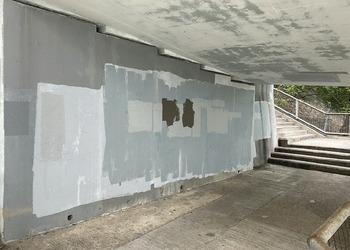
Hong Kong, in Calvino’s scheme, defines itself through erasure. The city, as Ackbar Abbas theorized two decades ago against the backdrop of its handover to China, has been characterized by a culture of disappearance (1997). With a landscape that mutates at breathtaking speed, transience and placelessness—the sense of “here today, gone tomorrow”—have benignly assumed permanence. Hitherto a port(al) at the crossroads between different times and spaces—“colonial history and Chinese actuality” (Wan Reference Wan, Goodrich and Rosenfeld2019:279)—building and rebuilding have defined Hong Kong’s topography, cultural works, and putative identity, all characterized by ephemerality. Since July 2020, with the outward transmogrification of public and scholarly discourse and the foreseeable emigration of “a third of youngsters” (The Standard 2021), this culture of disappearance has rapidly grown in complexity. Abbas notes, however, that disappearance is not non-appearance or absence but rather misrecognition—“recognizing a thing as something else” (1997:7). In a dissimilar context, Jacques Derrida in The Ethics of Deconstruction argues that the erasure of a word or phrase does not imply its disappearance. Instead, the old haunts the new, transforming it while conserving its original meaning (1994:200–03). Performance studies, now marked by a postmaterial turn where the categories of liveness and materiality have been vigorously reconsidered, has likewise come to view performance (previously deemed evanescent due to its associations with the live body) as a vehicle through which disappearance brokers materiality (Schneider Reference Schneider2011:105). As scholars such as Rebecca Schneider and Dorota Sosnowska have shown, unruly remains of past performances—worn things, tangible traces, leftovers, objects transfigured by time—provoke interminable tensions between the physical and the ephemeral, the desire to remain and to pass (Schneider Reference Schneider2011:105; Sosnowska Reference Schmidt2017:47). In keeping with these understandings of disappearance and erasure as transformation rather than consummate loss, a discourse partially illuminated by the 2019–2020 prodemocracy protests—on individual and communal precarity, advanced network capitalism’s commodification of life, and biopolitical subjectivities—remains. Though ostensibly erased, this vocabulary persists through not only postmaterial traces on the city’s surfaces—whitewashed walls, poorly scrubbed graffiti, and concrete filled pavements—but also the city’s equivocal, nonnormative, and hence undisciplined art (fig. 1).
Erased graffiti near the University of Hong Kong, 3 November 2020. (Photo by Rashna Darius Nicholson)

Focusing on modes of performance that function outside explicitly theatrical frames, art installations staged in Hong Kong between June and October 2020 progress a broader view of Hong Kong’s imperfect shift from a semidemocratic to a semiauthoritarian society. From the performance of the global city to the biopolitics of home to the spectacle of nationalism, these works explore the aporias that the city carries within the reflexive realm of interactive art that belies unequivocal propaganda or specious solidarity. Through silent methods of archiving, reading, and critically dismantling the city during what was one of its most historically definitive moments, these installations allow audiences to question what constitutes “home” with a degree of distance and sensitivity that traditional publishing outlets and social media no longer allow.
The three works under examination—Mark Chung’s Wheezing (Reference Chu2020), Nadim Abbas’s Homeless Forms for Formless Homes (2020), and Christopher K. Ho’s Always Stop Eating While You’re Still a Little Hungry (2020)—exceed a manifestly “live” encounter while demonstrating an active remediatization of performance and theatricality. For each of these works, the city above all retains its political salience as a symbolic field within which new self-governing forms of modern consciousness, the banalization of life, the concomitant anthropomorphization of the market, and the legitimation of the state are played out through corporeal interaction. To read the city of Hong Kong, they show, is to read the relation of urban space to the body and the exercise of state power on the latter through the former.
Possibly because they lie outside conventional academic analyses, a now smothered protest movement, and a polarized mediascape, these works provide nuanced insights on the hidden and dispersed sources of power that facilitate the continued functioning of seemingly ordinary life in the global, postapocalyptic city. How does Hong Kong art function as a reflexive realm, a site of “counter-memory” (Schneider Reference Schneider2011:105) where the rhetoric of the Hong Kong protests, including the earlier “Umbrella Movement […,] one of the most spectacular revolutionary moments of our time (Cheng Reference Cheng2016:383), lingers in partial focus? How do these works index powerful liminal subjectivities despite their equivocality and lack of transparency? How in sum do they function as an archaeology of memory, persistently looking at the remains of the erased city, that which “is kept out of sight, off stage, and out of view” (Mirzoeff Reference Mirzoeff2018)? To answer these questions, I begin with Chung’s installation, which probes the relationship between performances of the global city and the late-capitalist “cultural economy” exemplified by Hong Kong’s booming art world. By exploring infrastructure—the human and nonhuman substructures that keep global cities and their “creative hubs” running—Wheezing reflexively attunes audiences to art’s mediating power in ensuring the health of the market at the expense of the health of the individual body. This biopolitical theme is taken up and expanded upon by Abbas who, under the thought-provoking aphorism “banal profundity and profound banality,” probes how seemingly benign homely (heimlich) objects—dish sponges, rolls of toilet paper, and cans of spam—embody a prosthetic governmentality linked to quotidian politics, self-surveillance, and the ritualization of life (and death).Footnote 1 Architecture comprising not merely monumental skyscrapers and anonymous residential blocks but also intimate articles linked to consumption and the elimination of waste serve to convert the body into an area of political management, to redefine private and public spheres, and to transform the realm of the home into a domestic theatre. While Abbas suggests how architecture operates within us, Ho’s painstakingly-built miniature of Ford’s Theatre in Washington, DC, compels viewers to untangle the complex crosshatch between the monumental neoliberal city, the individual citizen, and the spectacle of nationalism.Footnote 2 These three illocutionary frames—the performing city (infrastructure), the theatre of domesticity (private), and the spectacle of statehood (public)—underscore the aesthetics of possibility in developing alternative, fugitive critiques of Hong Kong’s development, constituting an uncanny murmur that lies vaguely beyond newspaper articles, Twitter feeds, and China’s Greater Bay Area advertisements of the postdemocratic possibilities of oblique demurral.
The Performing City
All day long, we had been cutting trash into smaller pieces of trash, this is trash from an exhibition just finished […] With your hurting back in the narrow bus seats, you question everything you’d worked on for the exhibition you’d just trashed/thrown away trash away. We had to cut because the 3 of us cutting non-stop for a day is marginally cheaper than buying construction-waste trash skip services, and we can throw away the whole city and no one will bother to say a thing as long as we cut it into small enough pieces. (Chung Reference Chu2020:6)
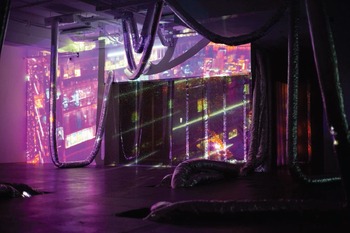
Wheezing consists of several related immersive installations based on the artist Mark Chung’s “empirical experience of Hong Kong” between July 2019 and August 2020 (de Sarthe 2020).Footnote 3 Visitors entering the de Sarthe Gallery first encounter a monochromatic environment—entitled Ptosis, a medical condition when the upper eyelid droops over the eye—due to tube lights with low CRI (color rendering index) that permit viewers to see only a limited spectrum of colors. As visitors proceed into the next installation in a glass-paneled room, they sense an uncanny fall in temperature but, as Christie Lee notes, “you’re too distracted by the mirage of light bouncing on the glass around you to whip out the cardigan in your bag” (2020) (fig. 2). Befuddled, a video of The Symphony of Lights—Hong Kong’s second-most-visited tourist attraction after Victoria Peak—engulfs visitors. Described by the Hong Kong tourism board as “a truly all-encompassing visual and sound scape of the soul of Hong Kong,” The Symphony of Lights, the world’s largest permanent lightshow, was established in 2003 through unprecedented cooperation between Hong Kong’s largest developers and its government in order to rehabilitate the city’s image after the SARS outbreak (Tourism Commission Reference Schmidt2017). During this flawlessly harmonized 14-minute laser light spectacular, 42 of Hong Kong’s most iconic skyscrapers around Victoria Harbour self-animate each day at 8:00 p.m. to a throbbing soundtrack recorded by the Hong Kong Philharmonic Orchestra (Petty 2015:2, 165–66). Margaret Maile Petty notes that during The Symphony of Lights, “Hong Kong’s most iconic buildings become actors in an indefinite spectacle, flashing and dancing in a frenzy of light and color” (2015:167). The city’s skyscrapers, she posits, constitute the ideal stage for a performance that mimics the language of capital flow and commodity exchange—dazzling but manifestly elusive and fleeting.
Exposed air-conditioning tubes and drone video of the Symphony of Lights. Mark Chung, Wheezing, de Sarthe Gallery, 2020. (Photo courtesy of de Sarthe and Mark Chung)

Global cities, as Joanna Mansbridge argues, perform (2020:197). Ostentatious light shows, LED luxury mall façades, and generic scrolling Mother’s Day greetings on twinkling neon high-rises compel mindless visual consumption, blur distinctions between materiality and simulacral hyperreality, and express power—foreign investment, speculation, and artificial real estate monopoly—as space. Similarly, glass architecture, as Achille Mbembe notes, articulates the fantasy of the disentanglement of fictitious, hyperreal, placeless, and modular forms of capital from the byzantine webs of ecology, politics, and cities’ underbellies, the underpaid underclass upon which they are so deeply dependent (2014:142). Glass functions as a metaphor of the global city’s desire to sever itself from its ugly precondition of precarity. Projected through a smashed glass partition evocative of the shattered storefronts of the 2019–2020 protests, Chung’s drone video of the reflection of The Symphony of Lights on the surface of the 108-story International Commerce Centre functions as screen, mirror, and filter. By simultaneously reflecting and splintering the performance of the Hong Kong skyline “sing[ing] as one” (LUXE City Guides n.d.), Wheezing not only disambiguates the global city’s performances of invulnerability and immortality but also elucidates how Hong Kong’s self-definition as world financial center, tourist attraction, economic corridor, and especially creative hub seems oddly estranged from its infrastructure, the “connective tissue and memory system of a city” (Mansbridge Reference Chu2020:201).
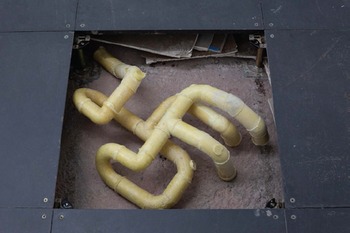
The uncanniness of Chung’s twisted visual rendering of The Symphony of Lights is amplified by a more holistic sensory imbalance triggered through the gallery’s skewed temperature. Visitors passing from the second section to the third experience a shift from Siberian air conditioning to the prickly heat and humidity characteristic of the Hong Kong outdoors but alien to its high-rise offices and art galleries. “Has somebody turned off the air-conditioning?” Lee wonders as she steps over “the forest of pipes that appear to spring forth from the air-conditioning units above” (2020). By redirecting hot and cold air and disrupting Hong Kong’s rigorously controlled indoor climate through exposed, lumbering tubes, Chung’s third large-scale installation, Growl, references the invisible systems, comprising obscure yet ubiquitous human and nonhuman labor (drainage systems, high-speed internet facilities, Filipino domestic workers, and “cardboard grannies”) that facilitate the city’s performances of efficiency.Footnote 4 Wheezing’s implicit thermic reference to Hong Kong’s dysfunctional and overstressed infrastructure is made explicit through his final installation, Volvulus, comprising polyurethane sculptures of the twisted, often clogged PVC pipes that are found on the surfaces of buildings that accommodate subdivided flats. Echoing the shattered glass, Wheezing’s mimicry of clogged plumbing systems and toggling of normative temperature controls highlights not only an urban infrastructure in atrophy and the breach of the city’s flows by the protests, but also the commercial substructures of Hong Kong’s art fair vernissage world that stand in synecdochic relation to the infrastructure of the global city (fig. 3). Over the past decade, Hong Kong’s government has invested considerable energy in mammoth cultural development projects such as the West Kowloon Cultural District and Art Basel Hong Kong in its drive to champion Hong Kong as a premier cultural hub. Driven by market competition, exogeneous unrepentant speculation, and a “creative turn” in global public policies of urban development that seek to diversify city economies through creative industries, Hong Kong’s cultural market mimics and extends the primal fantasies of the placeless city that combines technology, capital, and speculation. Art, as a writeup on Art Basel Hong Kong argues, “is the new money” (Kubler Reference Aggeklint2015). Drawing on his experiences as a technician for Art Basel, Chung avers in his artist statement, “your whole body slowly dissolves into the humid air in the room until the first crates of artworks arrive, when the climatization becomes necessary. While you slowly stop sweating […] you will hang images and place objects until you’re told to leave. […] You were then told to label the objects you wish to trash. So that they will not mistakenly trash an art piece” (2020:6–7). Here Chung juxtaposes misused human labor in the art world with the city’s hidden, collapsing nonhuman infrastructure, epitomized by the smell of clogged sewage, rotting instant noodles, hair, and excrement, in subdivided homes: “there is no escape, the corruption of the city is in the air, the air is in your home, you can close the door, crank up the ventilation and only make it less noticeable but not run away from it. Again, you gasp” (6). Chung thus uses the invisible hard labor of the gallery technician as a metaphor for the invisible hard labor underpinning the smooth-running global city.
Molds of pipes from Hong Kong’s subdivided flats. Mark Chung, Wheezing, de Sarthe Gallery, 2020. (Photo courtesy of de Sarthe and Mark Chung)

Performance is intrinsic to Chung’s elucidation of the ways in which infrastructure is intensely political, both performance by the city and its art world, and the human and nonhuman performances within them. He demonstrates how performances in commercial art fairs comprise not only aesthetic compositions by artists but also “Instagram moments” in private members-only lounges, where flexible, contractual, grossly underpaid laborers facilitate the transactions of high-prestige value goods and activities. While traditionally, as Theron Schmidt describes, the performance of deterritorialized labor by gallery workers in hidden back rooms is comprehended in contradistinction to mimesis or representation—and therefore distanced from aesthetic performance (2017:12)—Wheezing underscores not only the continuities between these performances of art/the spectacle of the global city and the labor of those who support the works of art/the city, but also their disruption by the spectacular events of 2019–2020.Footnote 5 “It’s only when the flow gets disrupted do we become hyperaware of the different elements that make up the quotidian—be it of a gallery space or a city,” says Chung (in Lee Reference Chu2020). Accordingly, Wheezing ascribes the artist’s work and its cooptation by the magical art fair world of luxury brand buy-ins and burlesque dancers in life-sized martini glasses (see Aggeklint Reference Aggeklint2015), pure market competitiveness, cosmetic “creative city” developmental projects, the neoliberal politics of public health, and the prodemocracy protests to a single line of meaning. Contemporary art fairs and galleries, akin to placeless displays like The Symphony of Lights, Chung shows, are intimately connected to the biopolitical control of life through ventilation ducts, drainage, and forms of hidden labor. Governmentality, he demonstrates, deploys aesthetics to cultivate the illusion of societal development and urban revitalization when in fact private property masquerades as public space, pleasure is regulated, labor is abused, and bare life as described by Giorgio Agamben is produced and re-produced ad nauseam (Agamben Reference Agamben2005). Yet, as Chung evocatively shows, while the wonders of the global city evoke an apocalyptic vision of the fate of humanness, inadvertently theatricalizing the spectacle of its own demise, the city also holds the potential for modes of performance that disturb, halt, and upturn its seemingly unstoppable development. Wheezing thus gestures towards the particular agential possibilities of a renewed home, an inner city of the imagination where one follows “not what is outside the eyes, but what is within, buried, erased” (Calvino [Reference Calvino1972] 1974:90–91).
The Theatre of Domesticity
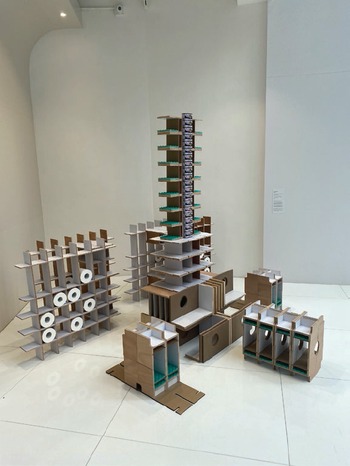
The global city’s literal and figurative “denial of shit” (Kundera 1985:248; in Abbas 1997:66), a core theme of Chung’s Wheezing, is echoed in Nadim Abbas’s Homeless Forms for Formless Homes (2020). Part of the exhibition Household Gods, Abbas’s work catches the eye with its prominent position in the front window of HART Hall, a gallery located on one of Hong Kong’s most trafficked retail promenades. Items typical of everyday activities—consumption (canned luncheon meat), maintenance (dish sponges), and defecation (toilet paper)—are arranged in multiple rows and columns within wooden and cardboard structures throughout the gallery, evoking the formless homes, that is, high-rise “monster buildings” typical of Hong Kong’s dramatic urban landscape.Footnote 6 Abbas’s installation thus simultaneously appears as domestic interior, spectacular cityscape, and altar, obfuscating any straightforward reading and eliciting more questions than answers (fig. 4).
View of sequentially placed toilet paper, spam, and dish sponges in Homeless Forms for Formless Homes. Nadim Abbas, Homeless Forms for Formless Homes, Hart Hall, Reference Chu2020. (Photo by Rashna Darius Nicholson)

A central preoccupation in Abbas’s work is the nature of the image: how an object becomes performative by presenting itself as an image, how this image disappears with daily use, how the artist can resurrect its truth, and how the image holds the power to re-engineer the everyday or change how we understand our surroundings. In several interviews, he elaborates on the dictum “profound banality and banal profundity” that formally frames this 2020 installation: “It is often said that the most disappointing thing about stage magic is when you discover how the trick is done simply because it’s so banal. With my work I would like to suggest otherwise; today it is the illusion that is banal since there is nothing more baffling than reality itself—a sphinx without a secret” (Para Site 2020). Here, Abbas implicitly references a significant influence on his body of work, Vilém Flusser’s conception of home and homelessness.Footnote 7 Drawing on the feelings of loss and alienation that he experienced as a Jewish Czech refugee living in post–World War II São Paulo, Flusser proposed a distinction between Heimat (homeland) and Wohnung (house), arguing that citizens were linked to their homeland through imperceptible, unconscious habits—for example, customs, speech, and use of objects. These “habits prevent bits of information from being perceived” (2002:105), render everyday space as secure, mundane, and pretty, and facilitate love for the homeland or the sacralization of the banal. The homeless individual who has traveled to another country, however, is not only aware of the habits that must be consciously acquired in a new place but also intuitively recognizes the necessity of rendering these conscious habits unconscious in order to successfully integrate in a new homeland. The immigrant’s demystification of a place’s secret codes, consciousness of home as “nothing more than a place to live surrounded by mysteries,” and exposure of “the beauty of home as nothing more than pretty kitsch” (95, 99) is essentially the banalization of the sacred, a process that risks revealing the true character of the home to its citizens. The homeless individual is therefore unsettling, uncanny, hateful, and ugly to natives, a view that either builds towards pogroms against these displaced outsiders or political and social amendments that potentially emancipate citizens from the instinctive, unconscious habits of their homeland that bind them. Flusser thus indicates how the existential condition of homelessness, of transforming the familiar into the unusual and the ordinary into the extraordinary, constitutes both an aesthetic as well as ethical act:
If I am sitting at my writing desk, then I do not recognize the books and papers lying around, because I am used to them. I only recognize the books and papers that have recently arrived. […] For habit is like a cotton blanket: It covers up and rounds off the edges of phenomena. It prevents me from recognizing the misery and injustice prevailing [in the city], and I can only vaguely feel them. They become part of the prettiness of home that I confuse with beauty. This is what is so catastrophic about habit. (2002:101)
Abbas’s reading of Flusser’s condition of homelessness manifests in his body of work through the remediatization of everyday objects, the deliberate invocation of the unfamiliar in the familiar, and the ensuing generation of uncanniness and monstrosity. By deconstructing and recontextualizing Hong Kong’s most paradigmatic domestic items within cardboard scaffolding—a cheap material suggestive of the global market’s obdurate drive towards commercial value creation and the state’s indifference towards the protection of its most vulnerable populations (cardboard scavengers)—Homeless Forms indicates how Hong Kong art remains “political without [becoming] a glorified form of social work” (Para Site Reference Chu2020). Spam, sponges, and toilet paper rolls—the generic, industrially manufactured building blocks of Abbas’s densely packed mall-cum-skyscraper installation—operate, as the artist shows, as sacred totems, the literal and metaphoric brick and mortar of humdrum Hong Kong daily life, a dispersed source of power facilitating the city’s smooth functioning despite its irreconcilable dynamics. The installation’s “symmetry, repetition and tessellation” (Chu 2020), an aesthetic allegory of Flusser’s paradigm of “catastrophic habit,” invokes the idea of exterior and interior architecture governing conduct and administering life across all scales—from the body to the home to the city.
Abbas’s irruptive installation momentarily distracts passersby from their well-entrenched diurnal routines. It thus cites the themes invoked by Chung’s animated pipes: the porosity between objects and bodies, the body as a site of disciplinary interaction with the physical spaces of the art gallery and the city, and an architecture of power that operates within these spaces through the biologized control of daily life. However, while Chung focuses on infrastructure’s role in the performance of the global city, Abbas takes as his point of departure a theatre of domesticity where the capacity for self-governance through seemingly private self-care functions as a portal of intrusion. As numerous scholars of biopolitics from Michel Foucault to Roberto Esposito and Agamben have noted, the home not only formally negotiates the individual’s relationship with the state and the market by diffusing economic risk among citizens but also informally constitutes the axiomatic arena for the operation of a microprosthetic governmentality through the integration of the body within an expanding network of domestic norms intimately connected with the strategic needs of the state (Foucault [Reference Foucault and Senellart2004] 2011; Esposito Reference Esposito2008; Agamben Reference Agamben2005). Soft forms of power embedded in “scriptive things” (luncheon meat, toilet paper) (Bernstein Reference Bernstein2009), serve to redefine public and private realms—to facilitate the “miniaturization, internalization, and reflexive introversion of surveillance” and politicize seemingly sovereign spheres of everyday life through fictive offerings of choice (Preciado Reference Preciado2013:79). As Ackbar Abbas presciently noted, “if you cannot choose your political leaders, you can at least choose your own clothes” (1997:5). The apartment thus becomes “a peepshow and a gallery, where inhabiting means broadcasting a fiction of interiority that is publicly constructed as intimate and private” even as the boundaries between private life and public existence, the biological and political, the unsayable and sayable, are disbanded in the name of stability and order (Preciado Reference Gruneau and Neubauer2012:129).
However, while demonstrating how homely biopolitical technologies have become indistinguishable from the bodies that they act upon, the unsettling sense of cross-spatial slippage in Homeless Forms also points to the fugitive possibilities of homelessness. This nonplace or impossible place exists in the syncopated, “special” time between immersion and image at the level of formalism, and between coloniality, transnationality, and nationality at the level of semiology and metaphor. The “vague, somewhat unwelcoming invitation to interactivity” characteristic of many of Abbas’s works including Homeless Forms, which uncongenially plays with thresholds by asking viewers to step on protruding cardboard surfaces that extend onto the floor (Shaffer Reference Schmidt2017),Footnote 8 illustrates a movement through, across, or within a border—a negotiation of artistic and ideological precarity fundamental, in Nadim Abbas’s words, to “work[ing] out contemporary problematics involving economics, social, religious, political and cultural issues” (in Brittney 2013). Michal Kobialka, echoing Abbas, notes that an aesthetic border (e.g., proscenium) that marks the threshold between life and the aesthetic representation of life erodes political binarisms—conventional modes of thinking about historical, social, and cultural differences—and therefore functions as “a locus of hope for a better land, a model for new consciousness, a place where an identity is formed” (1999:3). Akin to Homi Bhabha’s uncanny (unheimlich) moment—the disconcerting appearance of the familiar in an unfamiliar setting—Homeless Forms’ queer, palimpsestic convergence of the daily and the extra-daily (not unlike the erased protest signage on Hong Kong’s streets) disturbs the postulates of easy, oppositional political discourse by emphasizing the threshold between the object and the representation of that object, the real and the illusory; and metonymically, between event and discourse, fact and law. Abbas’s work thus serves to question not only Hong Kong residents’ “household gods” or the quotidian acts that make a “home” but also, more radically, engages the viewer in the redressive act of revisioning that home. If patriotism is fundamentally “the symptom of an aesthetic disease,” where biopower, exploiting an unquenchable thirst for consumerist kitsch, deploys the camouflage of health and happiness, sanitation and safety, to monitor, contain, and control, what radical, nomadological idea of home can an art installation that delivers “an analogy of the contemporary condition, where inanimate objects are coming alive and living things are reverting to a zombified or death-like state” (Department of Comparative Literature n.d.), compel the viewer to imagine? In the haptic mediation between faceless viewing subjects and viewed optical reality, what new communitarian realignments, material transformations, and affective relationships over and above polarizing sociocultural ownership, can be imagined? What home, what physical and invisible cities does Homeless Forms invite those passersby in Hong Kong’s placeless Central business district to erase, inhabit, or dream into being?
The Spectacle of Nationalism
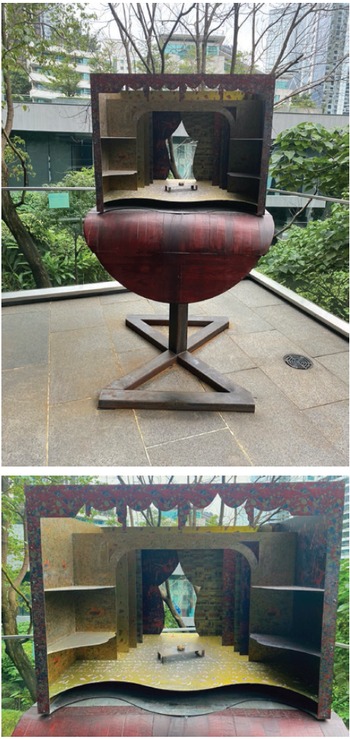
A similar line of questioning manifests in Christopher K. Ho’s multilayered Always Stop Eating While You’re Still a Little Hungry (2020), the most explicitly theatrical of the three works (figs. 5 and 6). A 67.5”l x 42.75”w x 85”h brass model of Ford’s Theatre—the site of Abraham Lincoln’s assassination—sits on a gymnastics vault on the lower deck of the Asia Society’s Yasumoto Bridge.Footnote 9 The first thing that catches the eye is a miniature glimmering turkey perched atop a table on the model proscenium stage, a visual reference to the installation’s title Always Stop Eating While You’re Still a Little Hungry. This oft-repeated dictum by John D. Rockefeller highlights, according to Ho, a paradox: a life of abstention by an oil tycoon whose life’s mission was the unmitigated, often merciless accumulation of wealth. Ho’s turkey thus alludes not only to the Rockefeller-funded Asia Society’s elaborate soft-power history in Asia but also to a complex historical continuum between the systematic oppression of America’s Indigenous populations through popular national celebrations such as Thanksgiving and the neocolonial masquerading of the violence of sovereign power through seemingly ethical, homely habits. Ho thus visibly cites Abbas’s theatre of domesticity (the politicization of private space) while linking this biopolitical theme to public pageantry (nationalist performance’s ability to palliate deep-seated humanitarian crime).
Installation of Ford’s Theatre. Christopher K. Ho, Always Stop Eating While You’re Still a Little Hungry, Asia Society Hong Kong Center, 2020. (Photo by the Rashna Darius Nicholson)

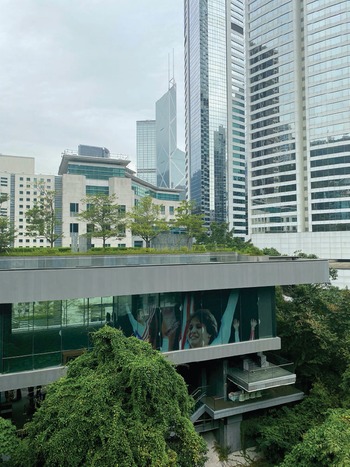
Yet this already labyrinthine line of inquiry is still too easy, too singular for Ho. Almost immediately after spotting the turkey, the viewer is distracted by another, much larger, more evocative visual of US nationalist spectacle. The gilded curtains of Ho’s model theatre, in styles such as “Empire” and “Victory,” open up to reveal a 432-foot banner of the American gymnast Mary Lou Retton from the 1984 Olympics, visible across the Asia Society’s ravine (see fig. 7). The 1984 Los Angeles Olympics that Ho witnessed on TV as a child was a watershed transnational moment marking several historical shifts. Under the vision of Peter Ueberroth, the Olympics transitioned in 1984 from an expensive, burdensome, government-supported project to a sophisticated profit-making, corporate entity. Ronald Reagan used Retton’s gold-medal win and the game’s new commercial successes to campaign for economic growth based on personal income tax cuts, market deregulation, and lower government spending. According to Rick Gruneau and Robert Neubauer, Reagan used the 1984 Olympics to dramatize political choice: American businesses with entrepreneurial drive and hard work would, like the US gymnasts, “go for the gold” instead of being hampered by bureaucracy, welfare programs, and inflation (Gruneau and Neubauer 2012:149). The games thus played an influential role in the critique of the Keynesian welfare state, Reagan’s landslide reelection, and the diffusion of neoliberalism in US popular culture. However, the United States was not the only nation impacted by this moment of historical transition in global sports. Susan Brownell describes how Chinese spectators watching these Olympics games, the first to be televised in China, witnessed both the rise of China’s first great Olympic star, Li Ning, who won six medals including three golds in men’s gymnastics, and a bewildering model of booming, corporate-sponsored yet nationalist mega-events. The 1984 Olympic Games, she argues, left a strong impression on Communist Party leaders, including Deng Xiaoping, who averred that the games “reflect a country’s economy and civilization” (in Brownell 2015:132). Consequently, just as Retton’s win furthered the diffusion of Reaganomics, the Olympic successes of Li Ning (who would subsequently become the founder and chair of a global sporting goods company that competes with Adidas and Nike), and the aggressive advertising and brilliant images of a free-market economy, played a significant role in Chinese economic reforms. In sum, even as the 1984 Olympic games facilitated US market reforms and Cold War diplomacy, it concurrently set in motion China’s ambition of transforming into a 21st-century economic and political powerhouse.
View of Christopher K. Ho’s 432-foot banner of Mary Lou Retton and the Asia Society ravine, which can be seen by peering through the curtains of the miniature Ford’s Theatre. Christopher K. Ho, Always Stop Eating While You’re Still a Little Hungry, Asia Society Hong Kong Center, 2020. (Photo by Rashna Darius Nicholson)

Crucially, however, the year 1984 marks not only Retton’s and Ning’s famous wins, a harbinger of impending US-Chinese rivalry in sports competitions, economic success, and military dominance, but also the Sino-British Joint Declaration, an agreement signed by the United Kingdom and China in 1984 that stipulated that Hong Kong would retain a degree of autonomy, “remain[ing] unchanged for 50 years.” Ho’s mammoth, relentlessly citational, anxiously scriptive portrait of this pivotal moment in global history—plastered on a foundation established to develop “mutual understanding” between the US and Asia during the Cold War (Rockefeller Reference Rockefeller1967)—challenges any neat antimony between US and Chinese hegemony, national geopolitics and global capital, and public spectacle and private choice, asking viewers to consider Hong Kong’s place in the operation of power across globe, nation, and home within a single interpretive frame.
This tripartite focus is highlighted by the installation’s tri-dimensionality: while the model Ford theatre with its homely turkey on the Yasumoto bridge palpably converses with the colossal image of Retton’s (and the US’s) historic Olympic triumph, the Asia Society’s dramatic urban surroundings comprising landmark skyscrapers such as the Bank of China Tower, the JW Marriott Hotel, and the Central Plaza, form the backdrop of this site-specific study of the underside of nationalist spectacle. The visual meaning of the city of Hong Kong and its residents’ place in nation formation is thus shown in Always Stop Eating through a bewildering series of optical movements between the city’s iconic skyline (the performance of the neoliberal, global city), the aesthetics of state power (the spectacle of nationalism), and the Thanksgiving dinner table (the theatre of domesticity). Ho’s installation thus squares the circle of themes depicted by Chung’s and Abbas’s works by means of a complex cross-spatial and cross-temporal ricocheting between globalist neoliberal empires, Cold War–era geopolitics, and the violence of home. Through the drawing of complex parallelisms between the US and China, the installation dialogically asks its Hong Kong audience (many of whom, during the 2019–2020 protests, waved US flags) to address the contradictions and tautological reasoning of the prodemocracy movement, and to consider, in the age of neoliberal nationalism, the meaning of good and evil, war and peace, injustice and redemption, public celebration and private ceremony (Reuters Reference Wan, Goodrich and Rosenfeld2019).
With an eye to the ideologically convoluted long durée of political transformation, Ho coyly appears to ask how 1984, a year marking the beginning of the transfer of sovereignty from one empire to the next, leaks into the present, impalpably and palpably shaping our subjectivities, regulating our social and private lives, and mediating our understandings of the now. What underlying woof does the warp of patriotic pomp and ceremony, cozy domestic interior, and glittering urban stage obscure? If, as a reviewer of this Asia Society exhibition argued, “there is no future for Hong Kong—only a multitude of pasts, some partially recollected, others still inhabited” (Masters Reference Masters2020), what does Ho’s neither dead nor completely alive representation of 1984 point to? Who within this queasy, multiply laminated visual narrative that threads together the benign dinner table with the sparkling spectacle of market nationalism is the actor on the stage—the turkey to be served up for dinner?
Some answers lie in the miniscule, delicate, disorienting patterns printed on the Ford’s Theatre’s gilded surfaces: of provincial Fourth of July pageants; processions at Colonial Williamsburg; balloons from Democratic and Republican National Conventions; animated audiences at the 1984 Olympics; and the performance of George Balanchine’s ballet Stars and Stripes for Nelson Rockefeller’s inauguration as Governor of New York State. Visually bewildering, these unassuming images of US memorabilia plastered on the theatre are in effect magic eyes or autostereograms—optical illusions that, when studied closely, reveal hidden imagery. The hidden images, unseen by most of the installation’s visitors, are decoy ducks, artificial objects resembling real ducks that were first employed by Indigenous Americans to hunt waterfowl and subsequently avidly purchased by “patriotic” collectors such as David Rockefeller. Ho thus draws red lines not only between Retton and Li Ning and the US as past and China as future superpower, but also between the Thanksgiving turkey (the de facto symbol of the US’s violent origin myth) and the Peking or mandarin duck. The installation thus invites viewers to regard the US’s subjugation of Indigenous peoples not as a historical fact nor as an anomaly belonging to the past but as a mirror. Through the ghost jump that Always Stop Eating evokes between 1984 and 2020, the naïvely perambulating Asia Society visitor is moved into drawing conceptual linkages: on the exercise of sovereign power across geographic boundaries; on what or whom may be sacrificed in the incessant shifts between liberal and authoritarian capitalism, “freedom” and “order”; and on the intimate symbiosis that is common to both the world’s superpowers between political repression and bare life. In so doing, Ho resists or complicates easy ideological side-taking, asking whether the pro-Trump Hong Kong nativist movement mimics the very ideology that it claims to resist. Yet while critiquing the polarized vocabulary of right-wing populist protest discourse, Always Stop Eating affirms the necessity of utopic ideals that, though destined for failure, are upheld by millions of faceless “subjects” (Chan Reference Chan2022). Not unintentionally, Ho’s larger-than-life banner—of Retton who has ostensibly seamlessly landed from the theatre’s vaulting table across the gorge—depicts two palms open, a gesture that can be read in two directions. On the one hand the upraised arms depict a decline suggesting submergence or drowning. On the other, the five fingers visibly outstretched raise a silent echo of the 2019–2020 Hong Kong protest movement’s ubiquitous rallying cry.
Reading Hong Kong
At the time of writing this conclusion, there have been mounting claims that Hong Kong’s public broadcasters and press are losing editorial independence, that its universities are ceding institutional autonomy, and that the city’s past, conserved through institutions such as the Hong Kong History Museum, is undergoing a “revamp.” Simultaneously, authorities are “on full alert” to ensure that art exhibitions are “not undermining national security” (RTHK 2021). Yet, as a semiotic resource expressing equivocal, nonnormative, obstinately wayward, often counterintuitive viewpoints, Hong Kong art, as these three installations evocatively affirm, are almost never pure expressions of propaganda that “incite hatred” (RTHK 2021). Shaped by the intertwined realities of cities’ performances of worldliness, the global logic of artistic commodities, bare life, and an evolving critical public, art expresses rather than domesticates societal volatility, thereby remaining a resilient arena for memorialization, social iteration, and debate. Through their transduction of contesting discourses within and beyond the local context in understated visual form, their ambivalent enactments of peripheral subject positions, and their silent gestation of liminal subjectivities, Hong Kong art holds the possibility of articulating perspectives that have retreated in the shadows in other spheres. These outwardly unassuming, yet resiliently unruly installations thus constitute crumbs and clues for lost inhabitants to pick: “how to live together in a place that is increasingly volatile” (in Moscow Biennale of Contemporary Art 2015); how to return to or find home; what is lost or gained in moving forward. Like the city itself that does not tell but rather contains (Calvino [Reference Calvino1972] 1974:11), art—lyrical and expressive rather than literal and persuasive—negotiates Hong Kong’s disappearance, nuancing discourses, retracing past and future journeys, and queering for aficionados, inquisitive onlookers, and even naïve passersby, ways of reading and knowing home.