Even as this issue of Politics & Gender appears in print, a committee of scholars (Kimberly Morgan, Vanita Seth, and Wendy Gunther-Canada in 2011) is serving the discipline by undertaking the fascinating and painful task of choosing a book (or books) upon which to bestow the American Political Science Association's Victoria Schuck Award for Best Book on Gender Politics. Twenty three committees have given the award to 32 books since the first awards were made in 1988. The Schuck Award is one of only four association-wide book awards (the others, of course, are the Ralph Bunche Award for ethnic and cultural pluralism; the Gladys Kammerer Award for best book in U.S. national policy; and the Woodrow Wilson Award for Best Book as chosen by the Woodrow Wilson Foundation on government, politics, or international relations).Footnote 1 How did the young field of gender politics reach such heights of scholarly recognition so soon?
A quarter century after the award's establishment in 1986, it seems appropriate to recall the beginnings of the Schuck Award, to pause to appreciate the accomplishments and spirit of its founder, Victoria Schuck, and to reflect on what the award has meant to the field of gender politics research. In this issue of Politics & Gender, we take the opportunity to depart momentarily from publishing the customary reviews of new books. Instead, we are celebrating the scholarly excellence signified by the Schuck Award winners, chosen by almost 70 scholars who have served on the award committees over the years, some of whom have themselves won the awardFootnote 2—while we also think of all the nominees who did not win but whose merit caused Schuck committees a good deal of anguish!
I well remember that particular anguish, when the Schuck Award committee I chaired in 1994 struggled to call one book “the best” among the gratifyingly but dauntingly large group of more than 30 books published in 1993 that had been nominated by their publishers. That year, my committee awarded the Schuck prize to Cynthia Daniels's At Women's Expense: State Power and the Politics of Fetal Rights. When we learned that Daniels was preparing her tenure and promotion dossier, we realized that we had an opportunity to use the award precisely as Vicky Schuck had intended it be used: to advance both the scholarship and the professional development of the scholars producing it. The committee wrote to Daniels's department to explain the award, the selection process by which we had chosen At Women's Expense, and the rigor of the competition from which it emerged. Today, Daniels says, “That award was critical to my promotion process, as it legitimated my work and gave me national visibility.”Footnote 3 Judith Stiehm and Jane Mansbridge have also told me how much the Schuck Award meant to them and to their careers; no doubt all the other winners would agree. Victoria Schuck worked relentlessly to advance both women's opportunities to be political actors and to craft scholarship on the politics of gender.
Victoria Schuck
Vicky was born in Oklahoma in 1909. She was one of the first 80 women to earn a Ph.D. in political science—from Stanford, in 1937—and one of the first 25 women members of the APSA. After earning her degree and teaching at Stanford, she joined the Mount Holyoke faculty in 1940 and, immediately, it seems, began building institutions. She founded the first Washington Internship program ever at Holyoke in 1949, and hers became a model for uncounted numbers of other programs.Footnote 4 She was a founder of the New England Political Science Association, and she was secretary of the APSA in 1960. She was in on the creation of the Women's Caucus for Political Science in 1969, and was a member of the first APSA Committee on the Status of Women in the Profession in 1971. She was a political actor as well as a scholar of political science, serving in the U.S. Office of Price Administration during World War II and on President John Kennedy's Commission on Registration and Voter Participation, among other assignments.
One of her advisees at Mount Holyoke, the Reverend Susan H. Mozena, has vivid memories of Schuck's pedagogical style in the late 1960s and early 1970s:
I came from northeastern Iowa, and my parents were very conservative politically, so I was, too … in those days. I was an anomaly in that classroom, for the most part… . What I greatly appreciated about her was that she orchestrated the classroom so that everyone felt comfortable speaking up. In the minority, I was not afraid to speak. It was clear that she was very liberal politically, but she had a way of creating space for any view that was well expressed, thoughtfully defended… . She was really quite passionate about that, and very skillful at pulling it off. No one was marginalized. She insisted on “civil discourse” before I had ever heard the term. … She was a consummate name-dropper. She was in her element in those days, a Kennedy Democrat who often dropped the name “Teddy” (Sorenson), and others, including “Jack.” We might inwardly groan, but then we learned that she actually knew them on a first-name basis! She arranged for “Teddy” (as in Edward the Senator) to speak on campus. And, we also had Stokely Carmichael. I'm not sure if she arranged for that one, but she might have had a big hand in it. If I remember correctly, there is a photo in one of my yearbooks of her with him on stage in our auditorium, while she was managing the Q and A session following his address.Footnote 5
Schuck was a prolific scholar while at Mount Holyoke, publishing some 80 articles and monographs, many of them on women and politics. Although sources differ somewhat in their dating of the events in her life, it would seem that she retired from Mount Holyoke in 1974 but apparently continued to teach there until 1976. She was inaugurated as the sixth president of Mount Vernon College (now the Mount Vernon campus of George Washington University) in 1977, occupying the office until 1980. She then spent time at the Woodrow Wilson Center for International Scholars and the Stanford Political Science Department, where she was a visiting scholar. She died in 1999, at the age of 89. I am sure I join many who remember her energetic ubiquity at Women's Caucus meetings in the 1980s. A PS article describes her portrait at Mount Vernon as “puckish,” and certainly, age seemed unable to dim any of her enthusiasm for the twin causes of advancing political women and women in politics scholarship.
Establishing the Award
Schuck, in anything but a quiet retirement, commenced conversations in 1986 with then-APSA Executive Director Thomas Mann and President Aaron Wildavsky to create an award recognizing women and politics scholarship. Schuck and the late Walter Beach, who had connections both to APSA and to Mount Vernon, were close friends, and Beach may also have advocated for Vicky's plan with Mann and Wildavsky. Early in the summer, she proposed endowing the award herself with an initial contribution of $3,000 (about $6,000 in today's dollars), which she later supplemented, in addition to giving another $500 to fund the first award outright, without touching the endowment. In August 1986, the APSA Executive Council voted to create the award and—certainly not part of her own request—to name the award for Schuck herself. Stiehm notes that Vicky was shrewd to make this an Association-wide award from the outset, rather than a Caucus or Organized Section Award.Footnote 6
Wildavsky, Mann, the Council, and even Schuck herself seemed to have expected that the award might be biennial, and feared that it would be triennial, given falling interest rates (in those inflationary days, “falling” meant a dip to 9% from 11% the year before) and the need for additional fund-raising.Footnote 7 In fact, the award was given annually from its debut, although the early years were fraught with worry about its financial health. By the end of 1993, the award was endowed at only a third of the newly established minimum requirement of $12,500 for annual prizes of $500 (and it is worth noting that early committees had often given two awards a year, further imperiling its fiscal health). Jennifer Hochschild, who was then the Women's Caucus president, Marian Palley, the chairperson of the APSA Committee on the Status of Women in the Profession, and Christine di Stefano, then president of the Organized Section for Women and Politics Research, jointly led an urgent fund-raising effort to which 65 APSA members responded with donations—contributing enough money apparently to secure the Schuck Award's future by the end of 1994.
Today, the future of the Schuck Award is not as secure as it should be. Its endowment teeters on the precipice of $25,000, the minimum amount required for an annual APSA award, and it needs new contributions if it is to remain healthy.Footnote 8 Perhaps the award's constituency has not been aware of its potentially precarious state. It seems to be time for a new fund-raising effort (and readers of this essay who wish to do so can donate to the Schuck Award now at http://www.apsanet.org).
The Winners
Susan Carroll (who chaired the committee once again in 1995), Jean Bethke Elshtain, and Norma Noonan formed the first award committee. They selected two books published in 1987 on which to bestow the inaugural award in 1988: Mansbridge's Why We Lost the ERA (which also won the APSA's Kammerer Award that year) and Rebecca Klatch's Women of the New Right. Both books quickly achieved the canonical status merited by their brilliant exegeses of the searing encounters of American feminist activists, not just with the masculinist status quo but with an equally passionate, organized, and tactically effective antifeminist movement, and they set both a standard and a tone: From the beginning, Schuck Award winners have made exemplary use of gender as a theoretical and analytical construct of illuminating power.
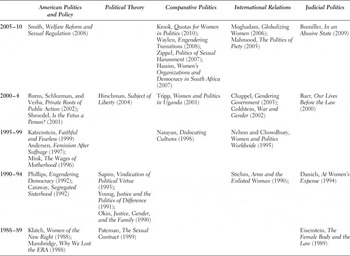
Schuck winners come from every field. The creativity and diversity of the scholarly projects the award has recognized are breathtaking. Depending on how one might characterize the books—and characterizing the books can be a challenge, as many winners make contributions to the literature of more than one subfield—they distribute themselves quite evenly across the entire discipline, as Table 1 shows. Over time, it would appear that the winners’ modal field may be shifting from American to comparative politics, while political theory, international relations, and judicial politics all continue to provide regular winners. Collectively, the award winners have limned powerful investigations of precisely the ways that sex, gender, and the codes of difference constructed from them have affected not just women's lives but every part of political life, right down to the constitution of the state. But if the settings of the research are ever more diverse, the enduring question of the state's uses and meanings of gender—from political participation to officeholding, from sexual violence to women and war, from women and the family to women and freedom—does not change. The Schuck Award gives powerful visibility not just to fine scholarship but to the enormously important insights into political life that the scholarship engenders.
Victoria Schuck winners by field and period, 1988–2010

Source: Books and years from APSA, https://www.apsanet.org/media/Victoria%20Schuck%20Award.pdf, organized by author.
The Schuck Award has outlived some who are associated with it. Susan Moller Okin, who both won the award (in 1990, for Justice, Gender, and the Family) and chaired an award committee (in 2000), died in 2004. Iris Marion Young (who won in 1991 for Justice and the Politics of Difference) died in 2006. Both Okin and Young died when they were only 57, leaving us bereft of all the new scholarship they no doubt would have produced. Roberta Sigel chaired the 1993 committee that gave the award to Virginia Sapiro's fascinating study of Mary Wollstonecraft's political theory, A Vindication of Political Virtue. Sigel, who occupied that pioneering place in which Shuck also stood, as one of the first women in political science, died in 2008 at age 92, only very recently having stopped attending APSA meetings.
Schuck Award winners seem unusually likely to exhibit substantial leadership not just in scholarship but in academic and public governance as well, something that surely would have made Vicky proud. Just sampling some of their accomplishments is dizzying: The winner in 1992 for her book Segregated Sisterhood, Nancie Caraway, is now the first lady of Hawaii and an international authority on human trafficking. Sapiro, the winner in 1993, is dean of arts and sciences at Boston University. Nancy Burns, who with her colleagues Kay Lehman Schlozman and Sidney Verba won in 2002 for their brilliantly imaginative and insightful study of participation, The Private Roots of Public Action, is now the director of the Center for Political Studies at the University of Michigan. Barbara Nelson, who was dean of the UCLA School of Public Affairs from 1996 to 2008, was a vice president at Radcliffe College when she won the award in 1995 with her coeditor Najma Chowdhury for the remarkable compilation Women and Politics Worldwide, the only time the Schuck Award has been given to an edited volume. Daniels, who was going up for tenure at Rutgers when she won the Schuck Award for At Women's Expense, now chairs the Rutgers department of Political Science, which is the home of the Center for the American Woman and Politics. Carole Pateman, who was a cowinner in 1989 for The Sexual Contract, is now the president of the APSA.
Many truly superb books, of course, have not been chosen to win the Schuck Award. The gender politics canon is far greater than even this extraordinary list of winners can represent. But even that—even the fact that committees struggle to choose from a wealth of good work—testifies to the vitality of the field. In this twenty-fifth year since Victoria Shuck was corresponding with Aaron Wildavsky and Tom Mann, working out the details of what she could give to establish the prize, we should pause, in gratitude, to honor this colleague and her last great gift to our shared enterprise. Thank you, Vicky.