Introduction
Conventional hearing aids are currently the main tools used in the rehabilitation of moderate-to-severe hearing loss worldwide.Reference Klein, Nardelli and Stafinski1 Despite the improvements in conventional hearing aid technology in the last few decades, there are still some limitations, such as insufficient gain, acoustic feedback, distortion of spectral shape and phase shifts, non-linear distortion, occlusion effects, cosmetic problems, poor transduction efficiency, recruitment and reduced dynamic range, and incorrect perception of pitch and sound localisation.Reference Bruschini, Forli, Santoro, Bruschini and Berrettini2
Middle-ear implant technology has been developed to overcome such problems.Reference Tringali, Pergola, Berger and Dubreuil3 Middle-ear implants bypass the external ear canal, and directly stimulate the ossicular chain or middle-ear windows. These devices may be either fully or semi-implantable, depending on the location of the microphone and power source. The critical components of implantable hearing aids are the signal transducer and the mechanism that connects this signal transducer to the ossicles or windows.Reference Shaw and Gatehouse4 The major limitations of middle-ear implants are: the need for surgery, device extrusion, increased charging times, device lifetime issues, magnetic resonance imaging incompatibility and cost.Reference Bruschini, Forli, Santoro, Bruschini and Berrettini2 Currently, two types of fully implantable middle-ear implant are available for use: the Esteem® and Carina® implants.Reference Klein, Nardelli and Stafinski1
The fully implantable active middle-ear Carina implant contains an electromagnetic transducer.Reference Ko, Zhu, Kane and Maniglia5 All components of the Carina device are implanted under the scalp skin, which helps to overcome many of the problems experienced during swimming, showering, sports activities and working in dusty environments. In addition, it has cosmetic advantages.
This study aimed to compare the clinical and audiological results of the Carina with those of conventional hearing aids in the treatment of moderate-to-severe mixed hearing loss.
Materials and methods
Nine patients who underwent middle-ear implantation with Carina fully implantable devices in the Otorhinolaryngology Department at Gazi University, between July 2010 and March 2012, were retrospectively included in the study. There were 6 males and 3 females, with ages ranging from 33 to 57 years (mean, 46 years). All of the patients had bilateral moderate-to-severe mixed hearing loss and previous experience with conventional hearing aids for at least three months. Implantation was performed on the right and left sides in four and five patients, respectively.
Pure tone and speech audiometry was performed pre- and post-operatively to evaluate the air and bone conduction thresholds and speech discrimination scores. Post-operative assessment was performed at least three months after the activation of the Carina implant.
A quality of life questionnaire, the Glasgow Benefit Inventory, was administered post-operatively. The inventory yields a total score and three subscale scores: general, social support and physical health. There are 18 questions and each is scored from 1 to 5. Scores between 1 and 100 show an improvement in quality of life, whereas scores between −100 and −1 indicate a regression.
Surgical techniques
In five patients, the transducer was placed on the incus body (Figure 1). Three of these patients had previously undergone canal wall up surgery to treat chronic otitis media, one had undergone stapedotomy with Teflon™ piston placement to treat otosclerosis, and one had congenital external ear canal atresia.
Implanted Carina device with the transducer placed on the incus body.

In two patients, the transducer was placed on the oval window. One of them had a canal wall down mastoidectomy and the other had a canal wall up mastoidectomy. The transducer was placed on the round window in one patient who underwent canal wall down mastoidectomy. In the last patient, as the oval and round windows were both ossified, the implant transducer was placed on the cochlear endosteum in the area corresponding to the round window region.
In the patients who had a canal wall down mastoidectomy, a blind sac closure of the ear was performed and the skin was simply closed over the cavity without any obliteration material. The microphone was placed beneath the mastoid tip in all patients.
Statistics
Statistical analysis was performed using the SPSS statistical software package, version 17.0 (SPSS, Chicago, Illinois, USA). The descriptive statistics were presented as means±standard deviations. The Wilcoxon signed-rank test was used to compare pre-operative and post-operative audiological results. In all of the tests, p < 0.05 was considered to be statistically significant.
Results
The mean pre-operative and post-operative pure tone audiometry results are shown in Figure 2. Pre-operatively, mean air and bone conduction thresholds were 79.10 ± 11.18 dB (range, 65.56–97.78 dB) and 34.86 ± 10.53 dB (range, 22.22–45.56 dB), respectively. Post-operatively, the mean air conduction threshold was 86.48 ± 14.13 dB (range, 70.56–108.33 dB), whereas the mean bone conduction threshold was 38.09 ± 12.23 dB (range, 21.88–53.00 dB). There were no significant differences between the pre-operative and post-operative air and bone conduction thresholds (p > 0.05).
Mean pre-operative and post-operative audiological results from the nine patients. Pre-op = pre-operative; AC = air conduction; BC = bone conduction; post-op = post-operative
Pre-operatively, the mean aided air conduction threshold was 45.97 ± 8.01 dB (range, 36.67–53.33 dB). The mean implanted air conduction threshold was 42.92 ± 9.02 dB (range, 33.13–58.13 dB). There was no significant difference between the thresholds achieved with hearing aids and the Carina implant (p > 0.05).
No significant difference was found between the pre-operative and post-operative speech discrimination scores (mean values were 72.8 ± 19 per cent and 69.9 ± 24 per cent, respectively; p > 0.05).
There was no significant difference in mean functional gain between incus attachments and middle-ear window attachments (p > 0.05).
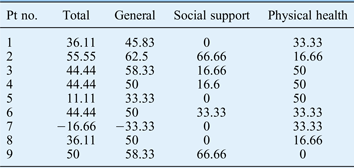
All of the patients, apart from one, showed clinical improvements according to the quality of life questionnaire (Glasgow Benefit Inventory) after implantation (Table I). The exception was patient number seven, who had a history of stapedectomy and Teflon piston application, and in whom the transducer was placed on the incus body. Despite an initial 38 dB functional gain, this patient suffered total sensorineural hearing loss (SNHL) three months after implantation.
Post-operative glasgow benefit inventory scores
Pt no. = patient number
The patients did not have any complaints about sound quality with the implanted microphones, and they did not suffer any sensitivity to body noise.
Discussion
Implantable hearing aids have been used in the treatment of moderate-to-severe hearing impairments. They can be used for sensorineural, conductive or mixed hearing loss. An active middle-ear implant can be coupled to the middle-ear ossicles, the windows or the endosteum of the inner ear.Reference Dumon, Zennaro, Aran and Bebear6–Reference Colletti, Soli, Carner and Colletti8
The fully implantable middle-ear Carina implant was primarily developed for the treatment of moderate-to-severe SNHL. Jenkins and colleagues reported their short-term and long-term results with the Carina device used for the amplification needs of adults with SNHL.Reference Jenkins, Niparko, Slattery, Neely and Fredrickson9–Reference Jenkins, Atkins, Horlbeck, Hoffer, Balough and Alexiades11 In their description, the tip of the transducer was attached to the incus via insertion into a laser-drilled hole. According to Jenkins et al., the Carina implant is a safe and clinically effective middle-ear prosthesis for the treatment of SNHL.
The Carina implant has subsequently been used for the treatment of conductive and mixed hearing loss. Previous studies have shown the usefulness of middle-ear ossicles and windows for stimulation; hence, the transducer of the Carina device may be placed on the round or oval windows, and on the incus.Reference Dumon, Zennaro, Aran and Bebear6–Reference Colletti, Soli, Carner and Colletti8 Lefebvre et al. applied the Carina implant to the round window in six patients suffering from mixed hearing loss without any adverse effects and with an average functional gain of 26.2 dB.Reference Lefebvre, Martin, Dubreuil, Decat, Yazbeck and Kasic12 Martin et al. reported an average functional gain of 29 dB and improved speech reception by placing the Carina transducer on the round window.Reference Martin, Deveze, Richard, Lefebvre, Decat and Ibanez13 In our study, the transducer was placed on the incus body in five patients, and on the middle-ear windows (round or oval window) in four patients. No statistically significant difference was found between incus and window applications (p > 0.05).
The Carina implant can also be used in cases of congenital aural atresia. Tringali et al. implanted the Carina device in a patient with Treacher Collins syndrome and this yielded a 29 dB functional gain.Reference Tringali, Pergola, Ferber-Viart, Truy, Berger and Dubreuil14 Siegert et al. implanted five congenital aural atresia patients and reported an average functional gain of 36 dB.Reference Siegert, Mattheis and Kasic15 These results are comparable to our results for the one patient with congenital aural atresia.
Active middle-ear implants can be inserted during or after stapedectomy. Venail et al. fitted semi-implantable hearing aids to four patients during or after stapes surgery.Reference Venail, Lavieille, Meller, Deveze, Tardivet and Magnan16 They reported improvements in hearing and quality of life with middle-ear implants in otosclerosis patients. In one of our patients who was implanted with a Carina device after stapedectomy, there was an initial 38 dB functional gain; however, this patient suffered total SNHL a few months after implantation.
In the present study, the Carina implant was used for the treatment of mixed hearing loss. There was no statistically significant difference between the conventional hearing aids and the Carina implant with regard to hearing amplification and speech discrimination; however, patient compliance and acceptance were better with the Carina implant compared to conventional hearing aids. This is supported by the findings of the Glasgow Benefit Inventory.
• Middle-ear implants were designed to overcome audiological and clinical gain issues of conventional hearing aids
• In this study, the clinical and audiological outcomes of the Carina middle-ear implant were similar to conventional hearing aids
• The Carina implant is better accepted compared with conventional hearing aids, especially regarding cosmetic concerns
In conclusion, acceptance of the Carina implant is better than with conventional hearing aids, although both yield similar hearing amplification. Cosmetic reasons appear to be critical for patient acceptance.