This book provides theoretical linguists and readers within the broader linguistic community with an analysis of the main aspects of contemporary Italian phonology.Footnote * It is divided into seven chapters, the first three of which provide the reader with a theoretical background and an overview of the history of the language. The subsequent chapters present a discussion of segmental processes such as velar palatalisation, the feature system of Italian, syllable phonotactics, stress placement and processes above the word level. The theoretical framework adopted in this book is Optimality Theory (Prince & Smolensky Reference Prince and Smolensky1993), for it is very well suited to the analysis of variation. The theory of segmental features used in the analysis of the segment inventory and segmental processes assumes a version of Morén's (Reference Morén2003) Parallel Structures Model of feature geometry.
The book forms part of the publisher's The Phonology of the World's Languages series, whose specific goal is to provide a systematic understanding of the phonology of a language. The wealth of topics discussed in the book goes along with the variety of approaches taken to gather linguistic evidence; these range from psycholinguistic experiments to the analysis of previously discussed data, Internet searches and fieldwork. The author's attempt to use experimental data to gather an insight of the speakers' linguistic competence is not common in other books of this series.
The author opens the book by addressing the issue of the extreme heterogeneity of what Italians refer to as italiano. By acknowledging the importance of regional variation, the author undertakes the brave and complicated task of covering a range of phenomena that are found in different varieties of the language (e.g. Veneto, Roman and Servigliano). He attempts to provide the reader with analyses which account for the different distribution of a given process across different dialects; this is for instance the case of his thorough analysis of metaphony.
Rather than providing a thorough review of the book – and not doing justice to many of the addressed topics – I shall entice the reader with just a few examples of what this book offers, and comment on those in particular. Throughout the review, I will appeal to the need to involve phonetic factors such as formant space, stress and durational details in order to better understand some of the phenomena discussed in the book.
1 Vowel neutralisation
Standard Italian shows a pattern of vowel neutralisation in unstressed syllables: lax mid vowels are realised as tense in this position. This process is shown in (1): (a) exhibits [ɔ]/[o] and [ε]/[e] contrasts in stressed syllables, (b) shows reduction of [ɔ] to [o] and [ε] to [e] in unstressed syllables.
(1)


In line with work by Crosswhite (Reference Crosswhite2001, Reference Crosswhite2004), Krämer (pp. 99–123) analyses this process as arising from a ban on high-sonority segments in non-prominent positions. A markedness hierarchy for unstressed positions, in (2), is used to derive the neutralisation pattern.
(2)
The absence of raising of the most sonorous vowel [a] in unstressed position derives from its feature specifications. The author develops a feature system of the Italian vowel inventory based on Clements' (Reference Clements1989, Reference Clements1991) vowel-height theory. In Krämer's system, vowels of different height are distinguished by their specifications of the incremental feature [close] in different registers. Moreover, vowels and consonants share the same set of place features. The low vowel has the feature [dorsal], and unlike all the other vowels in (2), it is not specified for the feature [close] on any register. Its raising is blocked by a co-occurrence constraint against segments carrying the feature [dorsal] with the feature [close]: *[dorsal, close].
Krämer's analysis expresses a tension, which is found throughout the book, between endorsing ‘functional grounding’ and ‘retreat[ing] to a more abstractionist position that holds that language is arbitrary and grammar is only constrained by its own systemic limits’ (p. 112). The author's scepticism around concepts such as sonority being at the core of neutralisation processes of this sort arises from the difficulty of formalising these notions in terms of segmental features. The author also asks how cross-linguistic tendencies can be expressed, if different languages appeal to different features to encode the same kind of surface structures. Although similar concerns are central in the debate on the relation between the phonetic realisation of sounds and their representations, the author does not discuss models of the interaction between phonetics and phonology, which have directly addressed these issues.
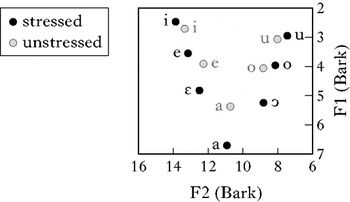
I shall try to explore some of the advantages of an alternative analysis of vowel reduction, which resolves this tension by endorsing phonetic grounding. Krämer's analysis makes a specific phonetic prediction: whereas lax mid vowels are raised in unstressed position, the acoustic realisation of [a] is independent from the position of stress. Albano Leoni et al. (Reference Albano Leoni, Rosaria Caputo, Cerrato, Cutugno, Maturi and Savy1995) measure average formant values for stressed and unstressed vowels of five male speaker of Lazio. This study provides experimental evidence that goes against this prediction (at least for the studied dialect). The data is plotted in Fig. 1, where we see raising of [ɔ] and [ε], but crucially also that the low unstressed vowel is significantly higher than its stressed counterpart. The feature-based account proposed by Krämer fails to capture the fact that this neutralisation pattern is not merely a phonological reduction caused by the raising of two lax mid vowels. It involves systematic changes of the vowel space, which also affect acoustic properties of vowels that do not undergo a categorical process, such as [a]. Even more so, Flemming (Reference Flemming2004) identifies in the raising of [a] the trigger of this process. In this analysis, the neutralisation of mid vowels is only the indirect result of the low vowel raising in unstressed position. I present his analysis of Italian vowel neutralisation, which builds on acoustic data of Italian vowels (Albano Leoni et al. Reference Albano Leoni, Rosaria Caputo, Cerrato, Cutugno, Maturi and Savy1995) and better captures the reorganisation of the vowel space in unstressed position. Unlike in Krämer's model, in which markedness is a property of individual sounds or feature co-occurrences, in Flemming's Dispersion Theory (Reference Flemming2002, Reference Flemming2004), markedness is a property of contrasts, and bans the realisation of sounds that are too similar.
Average formant values (Barks) for stressed and unstressed Italian vowels. Data (transformed from Hz to Barks) from Albano Leoni et al. (Reference Albano Leoni, Rosaria Caputo, Cerrato, Cutugno, Maturi and Savy1995) ; figure adapted from Flemming (Reference Flemming2005: Fig. 10).

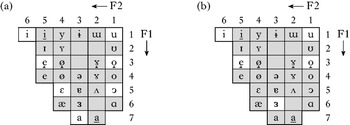
In Dispersion Theory, the selection of sounds in the inventory involves finding a balance between conflicting requirements on contrasts, formalised within the framework of Optimality Theory by three families of constraints: maximisation of the number of contrasts (MaximiseContrasts), maximisation of distinctness (MinDist), and minimisation of effort. Distinctness between the realisations of a pair of sounds is calculated from their distance along the dimensions of the similarity space, in the case of vowels, F1 and F2. Figure 2 represents a two-dimensional vowel space (adapted from Flemming Reference Flemming2004: 238); (a) shows F1 and F2 specifications for the Standard Italian stressed vowel inventory, (b) the F1 and F2 specifications for the reduced vowel inventory in unstressed position.
Representation of the Standard Italian vowel space (unshaded cells): (a) vowels in primary stressed syllables; (b) vowels in unstressed syllables. Sounds in the shaded cells are vowels that are not selected in the inventory. For a slightly different characterisation of the neutralised mid vowels in unstressed position see Bertinetto & Loporcaro (Reference Bertinetto and Loporcaro2005).

If we were to reconcile the specifications in Fig. 2 with Krämer's feature system, the cut-off level for vowels specified for [close] would coincide with vowels with an F1 value of up to 6. The following analysis will suggest that this cut-off level should probably be lowered to F1 values up to 5, to allow for the raising of [a] to [ɜ].
The selection of the Italian vowel inventory in stressed position, [i u e o ε ɔ a], emerges from the ranking of the positive constraint MaximiseContrasts below two constraints which prefer distinct contrasts (MinDist=F1:1 and MinDist=F1:2). In unstressed position, decreased vowels duration increases the articulatory effort involved in the production of the high F1 target for low vowels. A markedness constraint against high articulatory effort bans inventories containing vowels with high F1 (*Short low V): this causes the raising of [a] to the lower mid vowel [ɜ]. The direct effect of vowel shortening on low vowels has consequences on the entire system of vowel contrasts: it causes a crowding of the F1 space, and thus a reduction of the inventory to [i u e o ɜ].
The neutralisation pattern of Standard Italian described above is very similar to other vowel-neutralisation processes in unstressed syllables. Differences between Standard Italian and other languages arise from the different distinctiveness requirement on vowel contrasts. A phonetically based approach to vowel neutralisation provides a cue to answering Krämer's concerns about cross-linguistic tendencies. Since it is not directly dependent on the feature specifications of individual sounds, it allows for a more unified analysis of what triggers similar processes across different languages.
2 Velar palatalisation
A further case of segmental alternation analysed in the book is velar palatalisation (pp. 56–84). The author addresses the different distributions of palatalisation in verbal and nominal inflection, and derivation, which depend on the domain of application. Traces of Late Latin palatalisation in contemporary Italian are found morpheme-internally and in alternations. In nominal and adjectival inflection the process is only triggered by the masculine morpheme /-i/, but not uniformly. In derived nouns it is subject to suffix-specific constraints. In the verbal domain, palatalisation is subject to both paradigm- and suffix-specific constraints: in the 1st conjugation it is blocked; in the 2nd and 3rd conjugations it applies before /i/ and /e/ if the palato-alveolar affricate is present in the infinitive form of the verb.
The affrication process is accounted for in terms of the spreading of the [coronal] place node of front vowels and glides to the [dorsal] C-place node of the preceding consonant. The exceptional blocking of palatalisation in the different domains is analysed by Krämer in a uniform way: it arises from high-ranking Base–Output faithfulness constraints that are indexed with the relevant morphemes or lexical items (à laPater Reference Pater2000). A sketch of Krämer's analysis is given in (3).
(3)
Constraint indexation has been proposed in the literature as a possible account for cases of exceptional blocking, and it can easily account for the blocking of palatalisation in the first conjugation. I would like to suggest that, while constraint indexation might be needed in the case of verbs, the cases described in (c) and (d) are not lexical idiosyncrasies, and therefore need not be accounted for in these terms.
I have argued (Giavazzi Reference Giavazzi2009) that the application of palatalisation in the verbal domain should be regarded as fundamentally distinct from palatalisation in nominal and adjectival inflection. If we assume two distinct palatalisation processes in contemporary Italian, there is no need to appeal to an indexed constraint blocking the process in the plural of feminine words. The nature of the restrictions on the triggering vowels, such as the one in feminine nouns and adjectives, has been widely discussed in the literature on the perceptual bases of velar palatalisation (Guion Reference Guion1996, Wilson Reference Wilson2006). Their cause is likely to reside in phonetic and perceptual facts, and not in the lexical indexation of faithfulness constraints: velar stops and palato-alveolar affricates are more articulatorily, acoustically and perceptually similar before [i] than before [e]. Furthermore, a corpus study of Italian palatalisation in plural nouns and adjectives (Giavazzi Reference Giavazzi2009) reveals that, unlike what is claimed by Krämer (Reference Krämer2006, Reference Krämer, José Masullo, O'Rourke and Huang2009) and Celata & Bertinetto (Reference Celata and Bertinetto2005), the application of palatalisation in nominal and adjectival inflection is conditioned by the location of main stress: palatalisation is generally blocked in immediately post-tonic position. Only 2·4% of the words with penultimate stress, (σn).ˈσ.ki, have a palatalized plural, whereas 91·6% of the words with antepenultimate stress, (σn).ˈσ.σ.ki, do. Observations about a possible effect of stress on palatalisation are present both in Krämer's work and in work by Dressler (Reference Dressler1985), but they are not incorporated in previous analyses.
The question to ask next is whether velar palatalisation is productive in nominal and adjectival inflection. Krämer presents results from a small nonce word study with speakers from mostly Lombardy, Veneto and Lazio, aimed at addressing this issue. According to the author, results suggest that the answer is ‘it depends on the speaker’ (p. 84): one group of speakers always applied palatalisation, and a second group of speakers never did. The author analyses this bimodal distribution as arising from two different underlying grammars, in which indexed faithfulness and markedness constraints are differently ranked. The two grammars are shown in (4). In (4a) BO-IdentNx selects the non-palatalising candidate when a lexically indexed noun stem is in the input. In (4b) palatalisation is blocked in all nouns by the constraint BO-IdentN. Exceptional application is triggered by the markedness constraint Paly, which is carried in the lexical representation of palatalising nouns.
(4)
Since most nonce words were disyllabic or had a heavy penultimate syllable, Krämer's subjects mostly assigned penultimate stress. In Giavazzi (Reference Giavazzi2009) I present results from a larger nonce word study, in which the majority of testing words could be assigned penultimate or antepenultimate stress; this allowed for a better comparison between the generalisation found in the corpus study and the speakers' intuitions. Speakers were recruited from Lombardy, Veneto, Emilia Romagna and Lazio; the elicitation procedure was comparable to Krämer's. Results of the nonce word test show that speakers productively apply palatalisation according to the stress generalisation: the proportion of words palatalised in the plural is 89·7% among words that were assigned antepenultimate stress, but only 16% among words that were assigned penultimate stress.
When reporting results from a further study using the same set of nonce words, the author warns the reader to treat the results with caution, given the small number of testing items (p. 175). Although the author does not express the same concerns for the palatalisation study, our larger study with more controlled experimental material reaches different conclusions. The results from both the corpus study and the nonce word test provide strong evidence against an account of palatalisation as unpredictable within lexical nouns and adjectives, and against a two-grammar account of the speakers' intuitions. Rather, it points to a unified analysis of both lexical items and nonce words, which regards velar palatalisation in the inflection of nouns and adjectives as a fully productive, stress-conditioned process. An analysis of velar stops in different prosodic positions (Giavazzi Reference Giavazzi2009) reveals an acoustic basis for the link between palatalisation and stress. On the lines of Guion (Reference Guion1996) and Wilson (Reference Wilson2006), I propose that palatalisation is the neutralisation of contrast between velar stops and palato-alveolar affricates. It is blocked in penultimate stressed words because of the acoustic effect of stress on the following stop burst, which causes velars and affricates to be distinct enough.
3 Syllable structure
A large part of the book (Chapter 5) is devoted to a thorough discussion of syllable structure. The author refers to the debate around the status of the syllable as a grammatical domain. The status of the syllable as a phonological unit has been questioned in phonological theory, but Krämer agrees with Vogel (Reference Vogel1982) in stating that the concept of the syllable can nowadays be taken for granted. The author presents an analysis of syllable structure and syllable phonotactics that builds on previous work on the Italian syllable (Davis Reference Davis1990, Wiltshire & Maranzana Reference Wiltshire, Maranzana, Authier, Bullock and Reed1999).
A recurrent claim in support of a syllable-based analysis of Italian, both in previous literature and in the present book, is that a variety of phenomena in Italian phonology receive a unified analysis if constraints on syllable structure are posited. The following three processes are argued to arise from such constraints: lengthening of stressed vowels in open penultimate syllables (Chierchia Reference Chierchia1986, Nespor Reference Nespor1993, D'Imperio & Rosenthall Reference D'Imperio and Rosenthall1999), raddoppiamento sintattico (Chierchia Reference Chierchia1986, Repetti Reference Repetti1991, Vogel Reference Vogel1982) and definite article allomorphy (Davis Reference Davis1990, Marotta Reference Marotta1993). Vowel lengthening and raddoppiamento sintattico are claimed to be driven by a constraint on foot binarity. We will take a closer look at both these processes.
The examples in (6) show why a syllable-based account using the constraints in (5) is argued to inform an analysis of vowel lengthening.
(5)
Main stressed vowels are claimed to lengthen in open penultimate syllables; this provides evidence for the syllabic constituency of segments. Vowels are claimed to be long before singleton onset consonants and tautosyllabic clusters (a, b), and short before heterosyllabic clusters (c).
(6)
The author recognises that the picture is slightly more complicated than this (p. 134): Bertinetto (Reference Bertinetto2004) shows that syllabifications such as [(peː).sto] for (6c) are also an option for speakers of Italian. Krämer does not pursue possible problems that arise from consulting phonetic and psycholinguistic literature on cluster syllabification. Nonetheless, studies of the phonetic underpinnings of this phonological process reveal that a syllable-based account does not make the right predictions. I review some of these results below.
Farnetani & Kori (Reference Farnetani and Kori1986) found that although stressed vowels followed by a single intervocalic consonant are longer than vowels before claimed heterosyllabic clusters, transsyllabic factors can also affect vowel duration. Specifically, there is a negative correlation between the duration of the stressed vowel and the duration of the following consonant cluster. McCrary (Reference McCrary2004) presents results from a similar, but more articulated experiment with speakers of Pisan Italian. First, she shows that unlike what is predicted by a syllable-based account, durational differences before consonants that differ minimally in linear order and syllabifications are not significant (e.g. Vdur(ˈpal.ka)=156 ms, Vdur(ˈpa.kla)=152 ms; McCrary Reference McCrary2004: 211). Second, whereas the ranges of consonant durations in singletons, tautosyllabic and heterosyllabic clusters do not overlap, differences in vowel duration before the different cluster are gradient. They do not fall into two categories according to syllable type, as predicted by a syllable-based account. Third, there is an inverse relation between the duration of the consonant interludes and the duration of the vowel. These findings suggest that the domain relevant to predict vowel duration in Italian is not the syllable, but a domain at least as large as the vowel–vowel interval. This domain spans over the consonant interlude and is independent from syllable boundaries (McCrary Reference McCrary2004: 231).
Let us now move to Krämer's analysis of the second phonological process, which is argued to provide further evidence for constraints on syllable structure, raddoppiamento sintattico. Raddoppiamento is the lengthening of a word-initial consonant when preceded by a word ending in a stressed vowel, in certain phonological (and syntactic) environments. This process is claimed to arise from the interaction between a foot-binarity requirement and a ban on word-final long vowels (for a similar account see Borrelli Reference Borrelli2002). The examples in (7) show the interaction between the prosodic constraint and constraints against vowel lengthening at the end of the word (a) and across words (b).
(7)
If the word following final stress begins with a consonant cluster, the presence or absence of raddoppiamento is argued to provide evidence for the syllabic constituency of the segments in the cluster. Whereas the first consonant of a tautosyllabic cluster is geminated in order to satisfy foot binarity, the process is blocked in the case of a heterosyllabic cluster; in this case foot binarity is satisfied by leftwards resyllabification of the first consonant. This is illustrated in (8a) and (b) respectively.
(8)
A prediction of the syllable-based account is that tautosyllabic and heterosyllabic clusters will be differentiated by whether or not they undergo raddoppiamento sintattico. In her study, McCrary shows that for her speakers this was only partially true: they only applied the process in a subset of the predicted contexts, namely CV sequences (as in (7b)) and obstruent+liquid clusters (as in (8a)), but not in obstruent+nasal ones. Although McCrary takes this as counterevidence to a syllable-based analysis of this process, this argument is not very strong. First of all, as observed by Krämer, this process is subject to dialectal variation; McCrary's speakers of Pisan Italian might apply it to a lesser extent than speakers of other dialects discussed in previous literature. Second, obstruent+nasal clusters are extremely rare in the language and there might be independent reasons for their resistance to undergo raddoppiamento. Krämer's analysis seems to correctly capture distribution of raddoppiamento. Nevertheless, as shown with vowel lengthening, the connection between these phonological processes and syllable structure is not unproblematic when phonetic detail is taken into account; we should thus be careful when using them as evidence for a role of the syllable in Italian phonology.
4 Conclusion
I would like to end with two more general comments. The task of an author who attempts to provide an overarching analysis of the phonology of a language is incredibly complex. This task is possibly even greater in the present case, given the extremely diverse linguistic reality of Italian dialects. Krämer's is the first attempt to create an organic overview of the phonology of Italian. The book is a very rich source of data; it is also an intriguing research mine for the curious reader, since the author frequently points to interesting research questions that still need to be addressed.
A last comment should be made about what it means for a book on the phonology of a language to provide a ‘unified picture’ of the system (p. 4). Within the framework of Optimality Theory, an overarching analysis of a language results from a coherent, non-contradictory constraint ranking which can account for different phonological processes. The book presents formal accounts of different phenomena, but unfortunately, not a clear formulation of a unified system of rankings for the phonology of Italian. As already stressed before, this goal is very hard to achieve; nevertheless, the reader's understanding of this complex phonological system would have been facilitated if a more unified grammar of the language had been proposed.