Introduction
The co-morbidity of depression and inflammation-related physical illnesses, particularly cardiovascular disease, has raised the possibility of a shared, underlying inflammatory pathway involving central and systemic responses (Irwin & Miller, Reference Irwin and Miller2007). Proposed bi-directional mechanisms for how inflammatory processes may induce depressive mood, and vice versa, incorporate evidence that prolonged exposure to inflammatory mediators can impair the regulation of neuroendocrine stress, influence the availability of monoamine neurotransmitters, and decrease neurogenesis and neurotropic support (Maes et al. Reference Maes, Yirmyia, Noraberg, Brene, Hibbeln, Perini, Kubera, Bob, Lerer and Maj2009; Miller et al. Reference Miller, Maletic and Raison2009).
Much of the evidence supporting inflammatory theories of depression is cross-sectional with many studies demonstrating that compared to people without depressive symptoms, people with high depressive symptoms show elevated levels of inflammatory markers (including cytokines, chemokines and acute-phase proteins) in peripheral serum and cerebrospinal fluid (Zorrilla et al. Reference Zorrilla, Luborsky, McKay, Rosenthal, Houldin, Tax, McCorkle, Seligman and Schmidt2001; Lindqvist et al. Reference Lindqvist, Janelidze, Hagell, Erhardt, Samuelsson, Minthon, Hansson, Bjorkqvist, Traskman-Bendz and Brundin2009; Dowlati et al. Reference Dowlati, Herrmann, Swardfager, Liu, Sham, Reim and Lanctôt2010). These differences have been observed in both medically healthy people with depressive symptoms and those with co-occurring medical co-morbidities such as cardiovascular disease, renal disease and cancer (Howren et al. Reference Howren, Lamkin and Suls2009; Bossola et al. Reference Bossola, Ciciarelli, Di Stasio, Conte, Vulpio, Luciani and Tazza2010). Fewer studies examine the association between depression and inflammatory markers over time, although this can help develop the case for whether elevated levels of inflammatory markers may be a cause or simply a consequence of depression.
This meta-analysis is one of the first to estimate change in inflammatory markers before and after antidepressant treatment. Through narrative review and meta-analytical moderator analysis, we also explore sources of heterogeneity related to individual differences and co-morbidity. The cytokine interleukin (IL)-6 and an acute-phase protein, C-reactive protein (CRP), were selected as prototypical pro-inflammatory markers, robustly associated with systemic inflammatory response, and IL-10 was selected as an important anti-inflammatory marker. These are repeatedly shown to be elevated in people with depression, compared to people without depression (Howren et al. Reference Howren, Lamkin and Suls2009; Dowlati et al. Reference Dowlati, Herrmann, Swardfager, Liu, Sham, Reim and Lanctôt2010) and assuming there is an association, we would expect these to decrease as depressive symptoms decrease in association with antidepressant treatment.
Method
Systematic search
Studies were included in the meta-analyses if they met the following criteria: (i) participants were adults either diagnosed with major depression/dysthymia or endorsing high depressive symptoms on a standardized inventory; (ii) patients were not undergoing cytokine treatment (e.g. interferon or IL-2); (iii) the study explicitly reported antidepressant treatment in the methods; (iv) mean or median resting levels of IL-6, CRP or IL-10 in circulating plasma or serum were reported before and at least once after starting antidepressant treatment; (v) either a pre-test/post-test design or a randomized controlled trial (RCT) design was used; (vi) publication was in English in a peer-reviewed journal; and (vii) enough information to calculate an effect size was reported. Studies of people with depression and a co-morbid general medical condition were included providing the methods stated that the disease and medications were stable for the duration of the study.
A computerized search of EMBASE, Medline, PsycINFO and Cochrane Library databases was completed in March 2011 using two different search strategies: (i) the key terms mapped to subject headings for depression (depression, depressive disorder, major depressive disorder, dysthymic disorder) and either ‘interleukin-6’, ‘C-reactive protein’ or ‘interleukin-10’; and (ii) depression subject headings and ‘cytokine/interleukin’ or ‘acute phase protein’ and ‘antidepressants’. Both searches were limited to human and English-language literature. The abstract of each article identified in the search was screened for relevance. If the abstracts mentioned antidepressant use and measurement of inflammatory markers, or the abstracts lacked detail, full text articles were extracted and compared against selection criteria for eligibility. The reference lists of included studies and relevant review articles were screened for additional articles.
Eligible studies were coded and blindly checked by one author (S.H.) for the sample size and the outcome variable of mean (with standard deviation/standard error) circulating IL-6, CRP or IL-10 before and after treatment. Means and standard errors of inflammatory markers reported only graphically were converted to numerical values using Data Thief III, version 1.5 (Tummers et al. Reference Tummers, van der Laan and Huyser2008). Moderator and mediator variables were also coded, including: diagnosis, mean group depressive symptom rating at baseline and follow-up, mean age, proportion of males, treatment duration, inpatient or outpatient status, proportion of treatment responders and type of antidepressant. Where not reported, these variables were coded as missing values.
Statistical methods
Statistical analyses were completed using Comprehensive Meta-Analysis II (Biostat Inc., USA). For the antidepressant treatment arm in each study, individual study effect sizes for change in inflammatory markers and depressive symptoms were calculated as repeated-measures Cohen's d standardized mean difference using the pre- and post-test means, standard deviation of the difference calculated from the pre- and post-test standard deviations and an estimation of the pre- and post-test correlation (Borenstein et al. Reference Borenstein, Hedges, Higgins and Rothstein2009). If the mean was not reported, the median was used as an estimate because sample sizes were sufficiently large (Pudar Hozo et al. Reference Pudar Hozo, Djulbegovic and Hozo2005). We used a conservative correlation of 0.5 as an estimate for the correlation between pre- and post-treatment inflammatory markers but also re-tested the meta-analysis model using other correlations (r=0.4, 0.6, 0.7), with none producing a large difference as a result. For one study which failed to report standard deviations/errors but otherwise met selection criteria (Dawood et al. Reference Dawood, Lambert, Barton, Laude, Elghozi, Esler, Haikerwal, Kaye, Hotchkin and Lambert2007), the effect size was calculated using the difference in means, sample size and paired p value. For the few studies that included more than one follow-up measurement of IL-6, CRP or IL-10 (Kubera et al. Reference Kubera, Kenis, Bosmans, Zieba, Dudek, Nowak and Maes2000; Hernandez et al. Reference Hernandez, Mendieta, Martinez-Fong, Loria, Moreno, Estrada, Bojalil and Pavon2008; Mackay et al. Reference Mackay, Forrest, Christofides, Bridel, Mitchell, Cowlard, Stone and Darlington2009), we calculated a study effect size for the follow-up point closest to the mean duration of the remaining studies for that inflammatory marker, in order to reduce the variability that too large a range of treatment duration might cause. For studies reporting data for subgroups only, whole sample data points were imputed by collapsing subgroup means (Sluzewska et al. Reference Sluzewska, Rybakowski, Laciak, Mackiewicz, Sobieska and Wiktorowicz1995; Leo et al. Reference Leo, Di Lorenzo, Tesauro, Razzini, Forleo, Chiricolo, Cola, Zanasi, Troisi, Siracusano, Lauro and Romeo2006; Yoshimura et al. Reference Yoshimura, Hori, Ikenouchi-Sugita, Umene-Nakano, Ueda and Nakamura2009). A positive effect size indicates that there was an increase in the inflammatory marker over time.
Individual study effect sizes were synthesized to generate an overall effect size using a random-effects model, weighted by the inverse of variance. We also completed a sensitivity analysis to identify potential outliers by removing each study one by one to examine the influence of each individual study on the overall effect size. Egger's test of funnel plot asymmetry (Egger et al. Reference Egger, Davey Smith, Schneider and Minder1997) and failsafe N (Rosenthal, Reference Rosenthal1979) were calculated to assess publication bias. Heterogeneity in the meta-analysis was assessed using Cochrane's Q and I 2 which calculates a proportion of variation attributed to heterogeneity (Higgins et al. Reference Higgins, Thompson, Deeks and Altman2003). Moderator analysis was undertaken to explore sources of heterogeneity. Subgroup analysis was completed by comparing pooled inflammatory marker effect size in subgroups of categorical moderator/mediator variables, while method-of-moments meta-regression was completed to explore the relationship between effect size and continuous variables.
Results
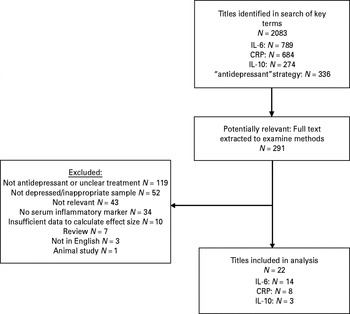
There were 22 studies relevant to these meta-analyses (n=14 for IL-6, n=8 for CRP, n=3 for IL-10; methods and relevant findings are summarized in online Supplementary Table S1, article extraction process is summarized in Fig. 1). Most study designs were of a single group of people with depression, measured before and after (or during) antidepressant treatment (n=15). Seven studies were RCTs comparing an antidepressant treatment condition and either a non-antidepressant treatment or antidepressant in conjunction with non-antidepressant pharmacological treatment. Many studies included a control condition of people without depression who were measured for inflammatory markers at a single time point (n=17) to infer whether levels of inflammatory markers in the depression group changed to a level comparable to a non-depressed control group. Every study reporting depressive symptoms showed a significant group reduction in depressive symptoms after antidepressant treatment.
Summary of article extraction process after two systematic search strategies either based on search for ‘depression’ and either the specific mediator interleukin (IL)-6, C-reactive protein (CRP) or IL-10, or ‘antidepressants’, ‘cytokine/interleukin’ and ‘acute phase protein’. Reasons for exclusion are listed.

Most of the included studies had similar exclusion criteria: excluding people with DSM-IV Axis I disorders besides major depressive episodes or dysthymic disorder (n=12; except Sluzewska et al. Reference Sluzewska, Sobieska and Rybakowski1997, who additionally included people with a lifetime diagnosis of bipolar disorder in a current depressive episode), people on psychotropic medication in the 2 weeks before blood collection (n=22), people with general medical illness (n=15), people with recent allergic reactions (n=7) and pregnant women (n=7). The study where patients had stable coronary heart disease were not acutely ill, and had been stable on medication (Pizzi et al. Reference Pizzi, Mancini, Angeloni, Fontana, Manzoli and Costa2009). Most studies collected blood in the morning.
IL-6 and CRP
Although in two studies administration of the selective serotonin reuptake inhibitor (SSRI) fluoxetine resulted in no significant change in IL-6 (Jazayeri et al. Reference Jazayeri, Keshavarz, Tehrani-Doost, Djalali, Hosseini, Amini, Chamari and Djazayery2010) or CRP over multiple time-points (Mackay et al. Reference Mackay, Forrest, Christofides, Bridel, Mitchell, Cowlard, Stone and Darlington2009), most of the remaining studies that administered SSRIs reported significant reductions in IL-6 or CRP, including other studies of fluoxetine (significant reduction only observed in people with elevated IL-6 at baseline; Sluzewska et al. Reference Sluzewska, Rybakowski, Laciak, Mackiewicz, Sobieska and Wiktorowicz1995), sertraline (Leo et al. Reference Leo, Di Lorenzo, Tesauro, Razzini, Forleo, Chiricolo, Cola, Zanasi, Troisi, Siracusano, Lauro and Romeo2006; Pizzi et al. Reference Pizzi, Mancini, Angeloni, Fontana, Manzoli and Costa2009) and citalopram (Leo et al. Reference Leo, Di Lorenzo, Tesauro, Razzini, Forleo, Chiricolo, Cola, Zanasi, Troisi, Siracusano, Lauro and Romeo2006).
Few studies examined non-SSRI antidepressants. No significant changes in IL-6 were observed in studies administering a serotonin-norepinephrine reuptake inhibitor (duloxetine; Fornaro et al. Reference Fornaro, Martino, Battaglia, Colicchio and Perugi2011) or a serotonin antagonist and reuptake inhibitor (trazodone) either alone or augmented with pindodol (Maes et al. Reference Maes, Bosmans, De Jongh, Kenis, Vandoolaeghe and Neels1997). Significant reductions in CRP were observed after administration of the tricyclic antidepressant, amitriptyline, in people with and without 50% reductions in depressive symptoms (treatment responders and non-responders, respectively; Lanquillon et al. Reference Lanquillon, Krieg, Bening-Abu-Shach and Vedder2000). People with higher levels of CRP after treatment also recorded significantly higher levels of trait anxiety than people with lower levels of CRP. Finally, Chen et al. (Reference Chen, Lin, Chen, Mao and Hung2010) reported a significant increase in IL-6, but no change in CRP, in young, normal-weight males who were maintained on a strict diet with restricted alcohol and coffee intake while in an inpatient facility. While participants were randomized to four different SSRI and non-SSRI antidepressant conditions, the authors only reported summary statistics for the entire study sample, as the increase in IL-6 was comparable across conditions. The authors reported an increase in weight in two of the four conditions which while not statistically significant, may still be clinically meaningful in contributing to elevated IL-6.
In the remaining studies, a clinician decided case-by-case which antidepressant was administered. In the two studies where clinicians were unrestricted in their choice of antidepressant, neither demonstrated a significant change in IL-6 (Kubera et al. Reference Kubera, Kenis, Bosmans, Zieba, Dudek, Nowak and Maes2000; Kagaya et al. Reference Kagaya, Kugaya, Takebayashi, Fukue-Saeki, Saeki, Yamawaki and Uchitomi2001). No significant change in IL-6 was observed in two studies where participants were administered either a tricyclic antidepressant or a particular SSRI (fluoxetine: Maes et al. Reference Maes, Meltzer, Bosmans, Bergmans, Vandoolaeghe, Ranjan and Desnyder1995; paroxetine: Mikova et al. Reference Mikova, Yakimova, Bosmans, Kenis and Maes2001). However, significant decreases were observed in IL-6 and CRP after administration of various other antidepressants from SSRI classes (Tuglu et al. Reference Tuglu, Kara, Caliyurt, Vardar and Abay2003; Basterzi et al. Reference Basterzi, Aydemir, Kisa, Aksaray, Tuzer, Yazici and Goka2005; O'Brien et al. Reference O'Brien, Scott and Dinan2006). In contrast, Dawood et al. (Reference Dawood, Lambert, Barton, Laude, Elghozi, Esler, Haikerwal, Kaye, Hotchkin and Lambert2007) demonstrated a significant increase in CRP, with only 5/24 patients recording a decrease in CRP after treatment. Two studies that selected from SSRI and serotonin-norepinephrine reuptake inhibitors also reported significant reductions in IL-6 (Yao et al. Reference Yao, Tao, Zhang, Sha, Hou and Zhang2004; Yoshimura et al. Reference Yoshimura, Hori, Ikenouchi-Sugita, Umene-Nakano, Ueda and Nakamura2009), but not for treatment non-responders (Yoshimura et al. Reference Yoshimura, Hori, Ikenouchi-Sugita, Umene-Nakano, Ueda and Nakamura2009). Sluzewska et al. (Reference Sluzewska, Sobieska and Rybakowski1997) also reported a significant reduction in CRP for both treatment responders and non-responders in participants with a refractory major depressive episode receiving various antidepressants and lithium carbonate. Neither change in depressive symptoms nor change in CRP differed significantly between people with lifetime bipolar disorder or major depressive disorder admitted to the study during a depressive episode.
IL-10
No significant changes in IL-10 were observed after administration of fluoxetine, although levels were initially lower than controls (Song et al. Reference Song, Halbreich, Han, Leonard and Luo2009). The remaining studies reported that initially elevated levels of IL-10 reduced over treatment to a level below the controls at baseline (Kubera et al. Reference Kubera, Kenis, Bosmans, Zieba, Dudek, Nowak and Maes2000; Hernandez et al. Reference Hernandez, Mendieta, Martinez-Fong, Loria, Moreno, Estrada, Bojalil and Pavon2008). Additionally, Hernandez et al. (Reference Hernandez, Mendieta, Martinez-Fong, Loria, Moreno, Estrada, Bojalil and Pavon2008) reported that while IL-10 measurements at 5, 20, 36 and 52 weeks showed a decreasing trend, participants reached clinical remission for depression by 20 weeks.
Antidepressants v. non-antidepressant treatment conditions
There were only two RCTs with placebo treatment arms. Pizzi et al. (Reference Pizzi, Mancini, Angeloni, Fontana, Manzoli and Costa2009) found no change in IL-6 or CRP after 20 weeks of placebo treatment. Furthermore, treatment with sertraline led to significant reductions in IL-6 and CRP compared to placebo at follow-up (between-subjects IL-6: d=−0.74, 95% CI −1.16 to −0.32; CRP: d=−1.00, 95% CI −1.43 to −0.56). Song et al. (Reference Song, Halbreich, Han, Leonard and Luo2009) also showed no significant decline in IL-10 after placebo treatment; however, there was no significant difference in IL-10 between placebo and active treatment groups at follow-up, as IL-10 did not significantly decline in the active treatment groups either (fluoxetine and sham electroacupuncture or antidepression sequence of electroacupuncture and placebo capsules). The null result may possibly be due to non-specific treatment effects of sham electroacupuncture. In both studies, there was no significant decline in depressive symptoms in the placebo treatments, but significant declines in the active treatments.
Two studies randomized participants to antidepressants and other antidepressive treatments. Neither study showed that IL-6 or CRP significantly declined within the active treatment groups over time nor significantly differed between the active treatment groups at follow-up (IL-6 after treatment with fluoxetine, eicosapentaenoic acid, and fluoxetine and eicosapentaenoic acid combined for Jazayeri et al. Reference Jazayeri, Keshavarz, Tehrani-Doost, Djalali, Hosseini, Amini, Chamari and Djazayery2010; and CRP after treatment with fluoxetine, fluoxetine with tri-iodothyronine and counselling groups for Mackay et al. Reference Mackay, Forrest, Christofides, Bridel, Mitchell, Cowlard, Stone and Darlington2009). One final study treated a depressed and non-depressed control group with duloxetine, and found that IL-6 did not change in either group, although depressive symptoms declined in the depressed but not the control group (Fornaro et al. Reference Fornaro, Martino, Battaglia, Colicchio and Perugi2011).
Meta-analysis
First, we examined whether depression significantly declined over the course of antidepressant treatment. Several studies were excluded from this analysis as they did not report sufficient information (Sluzewska et al. Reference Sluzewska, Rybakowski, Laciak, Mackiewicz, Sobieska and Wiktorowicz1995, Reference Sluzewska, Sobieska and Rybakowski1997; Mikova et al. Reference Mikova, Yakimova, Bosmans, Kenis and Maes2001; O'Brien et al. Reference O'Brien, Scott and Dinan2006; Yoshimura et al. Reference Yoshimura, Hori, Ikenouchi-Sugita, Umene-Nakano, Ueda and Nakamura2009; Jazayeri et al. Reference Jazayeri, Keshavarz, Tehrani-Doost, Djalali, Hosseini, Amini, Chamari and Djazayery2010). Meta-analysis of the depression severity scores (chiefly the Hamilton Rating Scale for Depression) revealed a significant decrease in the studies which investigated IL-6 (n=10, d=−1.82, 95% CI −2.36 to −1.28, I 2=85.4), CRP (n=7, d=−1.93, 95% CI −2.59 to −1.27, I 2=90.1%) and IL-10 (n=3, d=−4.77, 95% CI −8.13 to −1.41, I 2=92.0%).
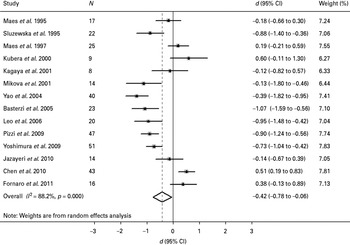
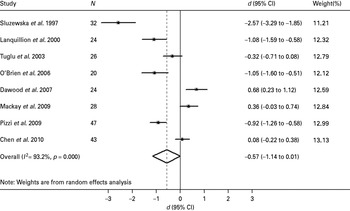
Second, we analysed changes in inflammatory markers after antidepressant treatment. Meta-analysis revealed a significant decrease in IL-6 (n=14, d=−0.42, 95% CI −0.78 to −0.06, Z=2.30, p=0.02; Fig. 2). There was a marginally significant decrease in CRP (n=8, d=−0.57, 95% CI −1.140 to 0.005, Z=1.94, p=0.052; Fig. 3). In both instances, there was high heterogeneity (IL-6: I 2=88.2%, Q 13=110.23, p<0.001; CRP: I 2=93.2%, Q 7=103.66, p<0.001). There was no evidence of publication bias via Egger's test (IL-6: t 13=0.42, p=0.68; CRP: t 7=1.53, p=0.24). The failsafe N was 148 for IL-6, which means 148 extra studies would be required for the p value to be >0.05. Failsafe N was 82 for CRP.
Forest plot for change in interleukin (IL)-6 after antidepressant treatment including study name identifier, total number of participants, the standardized paired difference in IL-6 (d, 95% CI) and the relative weight that each study contributes to the overall pooled estimate of effect. The diamond at the bottom of the effect size plot represents the overall pooled effect size for standardized change in IL-6 (d, 95% CI) and the I 2 measure of heterogeneity. Negative effect sizes represent a decrease in IL-6 following antidepressant treatment.

Forest plot for change in CRP after antidepressant treatment, details as for Fig. 2.

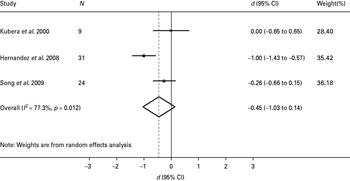
Based on the very few studies and a failsafe N calculation of 5, the meta-analysis for IL-10 should be considered exploratory and considered a description of currently available data, rather than a true representation of the effect. There was a non-significant decrease in IL-10 following antidepressant treatment (n=3, d=−0.45, 95% CI −1.03 to 0.14, Z=1.49, p=0.14; Fig. 4). Significantly high heterogeneity was also observed (I 2=77.3%, Q 2=8.81, p=0.01). There was no significant publication bias according to Egger's test although this test lacks power when there are few studies (t 2=0.76, p=0.59). Sensitivity analyses revealed no extreme influence of any single study in the IL-6, CRP or IL-10 analyses.
Forest plot for change in IL-10 after antidepressant treatment, details as for Fig. 2.

Moderator analysis
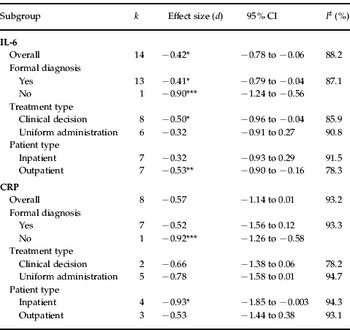
Moderator analysis was completed on the IL-6 and CRP studies (no analysis was undertaken for IL-10 because there were too few studies). Table 1 shows the results of random-effects analysis on smaller subgroups of the included studies (whether or not a formal diagnosis was completed, whether it was a uniform or tailored antidepressant administration, whether participants were inpatients or outpatients, and IL-6 assay brand). Only the subgroup of outpatients for IL-6 resulted in a strongly significant pooled effect size (p<0.01), recording a larger decrease in effect size than in the overall meta-analysis. There was no substantial reduction in I 2 in each subgroup, suggesting that none of these factors alone were responsible for the heterogeneity.
Cohen's d (95% CI) pooled effect sizes under a random-effects model for the change in CRP or IL-6 following antidepressant treatment for subgroups of studies within the overall meta-analysis, with k number of studies and I2 measure of heterogeneity

CRP, C-reactive protein; IL-6, interleukin-6.
* p<0.05, ** p<0.01, *** p<0.001 (based on a single study).
Meta-regression compared the standardized changes in IL-6 or CRP and continuous variables of standardized change in depression severity score, weeks in treatment, age, percentage males, and percentage of responders, for studies in which these variables were reported. Meta-regression revealed significant, positive associations between standardized change in IL-6 and percentage of males (n=17, β=−0.02, s.e.=0.006, b=−1.12, p=0.03). No other associations were significant (p>0.05). Finally, meta-regression of the standardized change in depressive symptoms against the baseline levels of IL-6 and CRP showed a negative, although non-significant, relationship (IL-6: n=10, β=−0.14, s.e.=0.15, b=−1.44, p=0.39; CRP: n=6, β=−0.26, s.e.=0.25, b=−1.58, p=0.35).
Discussion
This study is the first to provide pooled estimates of the change in resting, circulating IL-6, CRP and IL-10 in people with depression after antidepressant treatment. Meta-analysis indicated that after various antidepressant treatment durations there was a significant pooled reduction in IL-6, marginally significant reduction in CRP, and non-significant decrease in IL-10. There was good support for the reliability of the pooled reduction in IL-6 and CRP, with no evidence of publication bias and a high failsafe N, meaning it would take many unpublished, or yet to be published, studies to negate this pooled estimate. The few studies and low failsafe N for the IL-10 meta-analysis means that this observed pooled reduction should be interpreted with caution and considered preliminary. There was high heterogeneity in all the pooled estimates which could not be explained by meta-regression and subgroup analysis. Narrative review identified several issues which may help clarify unexplained sources of heterogeneity regarding co-morbidity and individual differences.
In cross-sectional studies, levels of IL-6, CRP and IL-10 are elevated in people with high compared to low depressive symptoms (Howren et al. Reference Howren, Lamkin and Suls2009; Dowlati et al. Reference Dowlati, Herrmann, Swardfager, Liu, Sham, Reim and Lanctôt2010). It is fitting that these inflammatory markers decrease as depressive symptoms decrease in association with antidepressant treatment. There may be a difference in the sensitivity of CRP and IL-6 for recording a change after treatment, with some studies demonstrating a change in IL-6 but not CRP (Chen et al. Reference Chen, Lin, Chen, Mao and Hung2010) and the pooled decrease only marginally significant for CRP. Nevertheless, the association between antidepressant treatment and reduction in inflammatory markers was demonstrated with different antidepressants, in a depressive episode irrespective of lifetime diagnoses of major depressive disorder or bipolar disorder (Sluzewska et al. Reference Sluzewska, Sobieska and Rybakowski1997), and to a limited extent, over time (Kubera et al. Reference Kubera, Kenis, Bosmans, Zieba, Dudek, Nowak and Maes2000; Hernandez et al. Reference Hernandez, Mendieta, Martinez-Fong, Loria, Moreno, Estrada, Bojalil and Pavon2008; Mackay et al. Reference Mackay, Forrest, Christofides, Bridel, Mitchell, Cowlard, Stone and Darlington2009).
IL-6, CRP and IL-10 play a regulatory role in the acute phase of inflammation, with IL-6 and CRP being primarily pro-inflammatory and IL-10 being inhibitory (Gabay & Kushner, Reference Gabay and Kushner1999; Moore et al. Reference Moore, de Waal Malefyt, Coffman and O'Garra2001), yet the role of each of these markers in depression is unclear. Indeed, there may be a problem in balancing pro- and anti-inflammatory agents, and the relative concentrations of the pro- and anti-inflammatory markers may be more important than the absolute levels. At a broad level, elevations in pro- and anti-inflammatory markers during depressive illness may represent a generalized over-activation of the inflammatory system during the acute emotional state, which normalizes following alleviation of depressive symptoms. This is supported in studies which showed no significant difference between levels of inflammatory markers in the depression group post-treatment and in the healthy control group (Yao et al. Reference Yao, Tao, Zhang, Sha, Hou and Zhang2004). However, the relationship between depression and inflammatory markers over time is not necessarily linear. For example, the longest study with multiple measurements demonstrated constant reductions in IL-10 at weeks 5, 20, 36 and 52, although depressive symptoms remained relatively consistent from week 20 (Hernandez et al. Reference Hernandez, Mendieta, Martinez-Fong, Loria, Moreno, Estrada, Bojalil and Pavon2008). These results require replication due to the methodological limitations of this study, including that only 35% of participants were retained by 52 weeks.
Although no outliers were detected and there was no evidence of publication bias for the IL-6 and CRP meta-analyses, there are limitations to the interpretation of these pooled effect sizes. First, it is likely that the magnitude of the decrease in these inflammatory markers is slightly inflated due to regression to the mean (Bland & Altman, Reference Bland and Altman1994). This problem is characteristic of single-group pre-test/post-test designs, highlighting the need for further placebo-controlled RCTs. The available placebo-capsule RCT demonstrated that sertraline use was superior to placebo at reducing inflammatory markers (Pizzi et al. Reference Pizzi, Mancini, Angeloni, Fontana, Manzoli and Costa2009). Furthermore, the high levels of heterogeneity observed in each meta-analysis make interpretation of the overall pooled estimates difficult. This level of heterogeneity was expected because liberal inclusion criteria were employed to maximally canvass the literature. The liberal inclusion criteria are both a weakness and strength of this meta-analysis. While studies of low methodological quality and studies with diverse samples were included, it has also identified potential sources of heterogeneity to be considered in future research.
The main drivers of the high heterogeneity in the IL-6 and CRP data were not identified using subgroup analysis or meta-regression. This implies that there is probably a cumulative effect of patient characteristics on the degree of change in pro-inflammatory markers and factors not reported in the primary studies may more precisely account for unexplained heterogeneity. For instance, many studies lacked potentially useful prognostic information, such as compliance information, to consider whether declines are associated with the biochemical effects of antidepressants compared to decline in depressive symptoms over time. In the subgroup analyses, the only highly significant effect size was for outpatients in IL-6, which only slightly decreased the level of heterogeneity and generated a slightly larger pooled decrease in IL-6. The only significant positive linear association in the meta-regression analyses was that having fewer males in a study was associated with a larger standardized decrease in IL-6. The reason for this is unclear but may be because females tend to have higher response rates to particular antidepressant treatments (particularly SSRIs) in clinical trials (Khan et al. Reference Khan, Brodhead, Schwartz, Kolts and Brown2005).
Narrative review identified several other potential sources of heterogeneity in co-morbidity and individual differences. Changes in weight variables were rarely reported despite the co-morbidity between depression and obesity, and the relationship between antidepressant use and weight gain (Evans et al. Reference Evans, Charney, Lewis, Golden, Gorman, Krishnan, Nemeroff, Bremner, Carney, Coyne, Delong, Frasure-Smith, Glassman, Gold, Grant, Gwyther, Ironson, Johnson, Kanner, Katon, Kaufmann, Keefe, Ketter, Laughren, Leserman, Lyketsos, McDonald, McEwen, Miller, Musselman, O'Connor, Petitto, Pollock, Robinson, Roose, Rowland, Sheline, Sheps, Simon, Spiegel, Stunkard, Sunderland, Tibbits and Valvo2005; Serretti & Mandelli, Reference Serretti and Mandelli2010). Studies which recorded an increase in IL-6 indicated that there were increases in fat distribution (Chen et al. Reference Chen, Lin, Chen, Mao and Hung2010), and adiposity is significantly associated with inflammatory changes, particularly increases in IL-6 (Park et al. Reference Park, Park and Yu2005). Furthermore, people with higher levels of CRP after treatment had significantly higher levels of trait anxiety than people with lower levels of CRP (Lanquillon et al. Reference Lanquillon, Krieg, Bening-Abu-Shach and Vedder2000). This finding may explain continued elevations in CRP or IL-6 in other studies which often fail to measure anxiety, despite its high co-morbidity with depression (Rush et al. Reference Rush, Zimmerman, Wisniewski, Fava, Hollon, Warden, Biggs, Shores-Wilson, Shelton, Luther, Thomas and Trivedi2005) and independent association with inflammatory markers (O'Donovan et al. Reference O'Donovan, Hughes, Slavich, Lynch, Cronin, O'Farrelly and Malone2010).
Major depressive disorder is a clinically heterogeneous disorder and these differences may extend to differences in inflammation. Sluzewska et al. (Reference Sluzewska, Rybakowski, Laciak, Mackiewicz, Sobieska and Wiktorowicz1995) highlighted that only certain people with depression may exhibit elevated levels of IL-6, and only these people decreased their levels of IL-6. Disregarding issues of regression to the mean, this study highlights that certain people with depression may be more susceptible to elevations in pro-inflammatory markers. For instance, some research suggests that people with depression with melancholic features may exhibit a different inflammatory profile to those without melancholic features (Rothermundt et al. Reference Rothermundt, Arolt, Fenker, Gutbrodt, Peters and Kirchner2001). Depression with melancholic features is associated with a decrease in CRP in serum following treatment (O'Brien et al. Reference O'Brien, Scott and Dinan2006) and there are indications that levels of stimulated cytokines decline in melancholic but not other depression (Rothermundt et al. Reference Rothermundt, Arolt, Fenker, Gutbrodt, Peters and Kirchner2001), implying that perhaps the inflammatory state is more closely associated with organic rather than cognitive symptoms of depression.
Furthermore, there is a possibility that baseline levels of inflammatory markers may identify those who may respond to treatment. Meta-regression in the current review showed no significant association between baseline IL-6 or CRP and change in depressive symptoms, although the pattern across studies was that higher baseline IL-6 and CRP were related to larger decreases in depressive symptoms. In individual studies, there is evidence in support of this, with higher baseline levels of CRP in treatment responders (Sluzewska et al. Reference Sluzewska, Sobieska and Rybakowski1997), and evidence to the contrary that lower stimulated levels of IL-6 at baseline (but not baseline serum CRP) in treatment responders compared to non-responders (Lanquillon et al. Reference Lanquillon, Krieg, Bening-Abu-Shach and Vedder2000). Additionally, meta-regression showed no significant relationship between percentage of individuals who responded to treatment and inflammatory marker change, perhaps because it was infrequently reported and thus the meta-regression was restricted in range. At the individual study level, there was evidence of decreases in IL-6 for treatment responders, but not treatment non-responders (Yoshimura et al. Reference Yoshimura, Hori, Ikenouchi-Sugita, Umene-Nakano, Ueda and Nakamura2009), although two studies demonstrated a significant decrease in inflammatory markers in both responders and non-responders (people with and without a 50% reduction in depression, respectively; Sluzewska et al. Reference Sluzewska, Sobieska and Rybakowski1997; Lanquillon et al. Reference Lanquillon, Krieg, Bening-Abu-Shach and Vedder2000). It is possible that even with small decreases in depressive symptoms, substantial changes to inflammatory markers may occur. Future studies should verify whether differences exist in inflammatory marker change and baseline inflammatory markers for treatment responders and non-responders, to support whether improvement in depressive symptoms is associated with a normalization of inflammatory markers and provide evidence for whether inflammatory markers can act as a biomarker of treatment response.
On the whole, the evidence presented in this meta-analysis is consistent with the inflammation theory of depression; with a reduction in depressive symptoms, there is a co-occurring reduction in inflammatory markers. At an illustrative level, these data support the idea that the causal chain is ‘depression driving inflammation’, because treatment for depression also has the capacity to change inflammatory markers. Yet at the same time, antidepressants may have a direct anti-inflammatory effect, thus potentially causing the reductions in depressive mood. In vitro studies demonstrate that administration of antidepressants, particularly SSRIs, produces anti-inflammatory effects in the blood of both people with depression and healthy volunteers, decreasing pro-inflammatory markers including IL-6, IL-8 and tumour necrosis factor-alpha and increasing anti-inflammatory markers including IL-10 (Kenis & Maes, Reference Kenis and Maes2002; Janssen et al. Reference Janssen, Caniato, Verster and Baune2010). The observed anti-inflammatory effects may occur through antidepressants increasing glucocorticoid receptor-mediated negative feedback of the hypothalamic-pituitary-adrenal axis or increasing intracellular cyclic adenosine monophosphate (for reviews see Maes, Reference Maes2001; Carvalho & Pariante, Reference Carvalho and Pariante2008; Carvalho et al. Reference Carvalho, Garner, Dew, Fazakerley and Pariante2010; Janssen et al. Reference Janssen, Caniato, Verster and Baune2010). Alternatively, studies into the effect of anti-inflammatory medications on depressive symptoms would provide evidence for the ‘inflammation driving depression’ causal chain, and if supporting the idea of an underlying common cause would be persuasive. To further explore the directionality, more longitudinal and prospective measurement of depression and inflammatory markers are necessary. It would also be of benefit to investigate changes in other immunomarkers after antidepressant treatment to provide the context of the changes in the few inflammatory markers reported in this study, as cross-sectional evidence suggests that depression is associated with many markers of cell-mediated immune activation (Zorrilla et al. Reference Zorrilla, Luborsky, McKay, Rosenthal, Houldin, Tax, McCorkle, Seligman and Schmidt2001).
Note
Supplementary material accompanies this paper on the Journal's website (http://journals.cambridge.org/psm).
Acknowledgements
Sarah Hiles is supported by an Australian Post-graduate Award and the Vice Chancellor's Award for Outstanding Candidates. Amanda Baker is supported by an Australian National Health and Medical Research Council Senior Research Fellowship.
Declaration of Interest
None.