


This article examines relations between American Indian tribal governments and nearby local governments, and it examines the constraints and opportunities that marginalized groups face in politics. Whereas some Native communities have transformed their fortunes in recent years with highly profitable casinos, most continue to struggle against stark disadvantages. Nonetheless, there are a number of instances where tribes in constrained circumstances have convinced states and localities to change regulatory standards, pursue joint initiatives, and deliver assistance to tribal communities. How is it that tribes, in some cases, overcome the odds and make their voices heard?
This analysis presents original quantitative and qualitative data on interactions between American Indian tribal governments and county governments in three regions of the country. The analysis demonstrates that many American Indian tribal governments have achieved successes in local politics by cultivating policy expertise and political knowledge, even in environments where tribal interests are often ignored or met with hostility. I show that it is both feasible and effective for marginalized groups to build knowledge about politics and policy that can influence outcomes. There are, however, some sobering limits. Where Indian–White conflict is very pronounced, the scale of conflict exhausts the strategic capacities of resource-constrained groups. Also, in a challenging environment marked by high levels of contestation in multiple venues, tribes deplete their capacity as well.
Expertise stands in contrast to the many political resources that are often more or less determined by forces beyond a group's control—such as group size, funds, cohesion, and the intensity of group preferences. Despite these challenges, groups can develop expertise: knowledge about the preferences of other actors, the approaches that are more likely to persuade, the problems that the group faces, and the possible solutions to those problems. Savvy politicians and technocrats can make a difference, even when there is little at hand for building and sustaining expertise. Yet expertise's undoing can come with exhaustion when vital, limited resources for cultivating expertise are spread too thinly across venues, and where skills and insights are not highly portable among them.
Fundamentally, this article seeks both to understand the unique features of American Indian politics and to expand our understanding of broader political forces through the study of the American Indian experience. There are aspects of tribal politics that are context-specific and worth explaining in their own right. Native struggles also generate portable concepts. Vine Deloria Jr. (Reference Deloria1970), whose scholarship is at the foundation of the contemporary study of American Indian politics, contended that although we should not overlook important distinctions, many minority communities—not just American Indians—face the challenge of establishing autonomy, exercising meaningful power through existing governments, changing legal structures that undermine real-world self-determination, and protecting what he explicitly terms their “sovereignty” (esp. 100–37).
Native nations come to local politics as governments, with particular opportunities and vulnerabilities that are associated with that status. They are long-standing, legally recognized sovereign powers, with authority articulated in treaties, statutes, and case law, and with land bases that they govern.Footnote 1 What is easily overlooked about American Indian politics—and what changes a variety of debates once it is noticed—is the dilemma of harnessing the potential of a vulnerable government. Government is a resource, but it is not clear how tribal political actors can use it to full advantage under marginal circumstances. Put differently, what does it mean for a tribe to be a government insider in one venue and an outsider in almost all other political contexts? We cannot understand the nearly 600 American Indian tribal governments without engaging that issue. Indeed, in a federalist system with 51 other sovereigns and upwards of 89,000 total governments (U.S. Census Bureau 2008), surely there are many nontribal governments that we cannot really understand without engaging with that question.
Perhaps the most extensive literature on marginalized governments comes from urban politics. Urban governments are often constrained by forces beyond their control: grinding poverty, meager tax bases, hostility from outside actors, and the decisions of other levels of government. (Browning, Marshall, and Tabb Reference Browning and Tabb1997; Orr Reference Orr1999; Stone Reference Stone1989). What responses to profound power imbalances are available to governmental advocates? Research on pressure groups sheds some light on this dilemma, although the literature focuses on actors outside of government. One possible path to provoking change is use of outside patronage (McCarthy and Zald Reference McCarthy and Zald1977). A second is to build on internal institutions (Morris Reference Morris1984). Other possibilities include creative leadership and organization, which might involve innovative tactics (Clemens Reference Clemens1997; Ganz Reference Ganz2000), thorough knowledge of the inside game (Katzenstein Reference Katzenstein1998), or long-term coalition building and careful issue selection (Warren Reference Warren2001). And yet there are still good reasons to be pessimistic about prospects (Piven and Cloward Reference Piven and Cloward1977). The upshot is that, absent other means, groups must outflank opponents with creativity, but without the luxury of much time or energy to devote to the task.
It is unclear how and when a marginalized government is able to borrow the techniques of pressure groups, and how and when it runs up against obstacles. I offer a two-pronged theory of the political constraints and opportunities that American Indian tribal governments encounter. First, tribal governments have two important routes with potential for cultivating expertise: government institutionalization and economic development.Footnote 2 Tribal governments with these opportunities—the specialization of tasks and differentiation of roles within government institutions, or the fungible resources that economic development provides—can more easily build knowledge, see their environments differently, and undertake different strategic approaches to politics and policy. Second, both racial conflict and outside demands can undermine—but not entirely erase—such accomplishments. Where Indian–White conflict is more pronounced, and when tribes face political challenges in multiple venues, their expertise degrades.
The analysis that follows further specifies the nature of tribes’ expertise and exhaustion. The article examines 12 American Indian tribal governments’ relations with surrounding or adjacent counties in the Southwest, Pacific Northwest, and Upper Plains from 1990 to 2000. I employ qualitative analyses of sources that have previously been unused in scholarship: I examine minutes from both tribal councils’ and county commissions’ proceedings, along with newspapers from both Indian and nearby White communities. In addition, I conduct quantitative analysis of an original dataset that tracks county government decisions affecting tribes. I find that government institutionalization and economic development in the tribe facilitate expert behavior, whereas racial conflict and engagement in multiple political venues hamper it. Under conditions where expertise can flourish, tribes are more successful in influencing county policies and in presenting sophisticated political arguments.
UNDERSTANDING TRIBAL GOVERNMENTS
American Indians’ history and contemporary circumstances heavily stack the odds against them in politics. Native communities are plagued by deep poverty, low levels of education, and a legacy of social and political marginalization. In the 2000 Census, per capita income for reservation Indians was $7,958, as compared to the U.S. average of $21,587. The poverty rate was 39%, versus 12% nationwide. Nearly a third of reservation households lacked telephones. Only 6% of American Indians on reservations were college graduates, in a country where one-fourth of the population has earned a college degree. Although much public attention in the past decade has focused on tribal casinos, casinos have in fact transformed the fates of only a small proportion of tribes. As of 2002, 198, or roughly a third, of the 559 federally recognized tribes had casinos. Ultimately, however, highly profitable gaming depends on a circumstance that most tribes lack: an advantageous location that provides easy access to a large customer base. Consequently, various studies estimate that the median casino tribe sees fairly modest earnings from gaming, with about one-seventh of tribal casinos generating about two-thirds of all tribal casino revenue (Henson et al. Reference Henson, Taylor, Bean, Bishop, Black, Grant, Jorgensen, King, Lee, Nelson and Roubideaux2002, 106–15; National Indian Gaming Commission 2006). With some notable exceptions, tribal officials often operate from dilapidated office buildings, on meager budgets, amid populations that struggle against the ravages of shockingly low incomes, inadequate housing, and poor health. These disadvantages are compounded by other institutional and demographic factors. American Indians often have minimal electoral power: They are 2% of the U.S. population, dispersed across more than 560 federally recognized reservations in 33 states, each with unique cultures and communities. Most reservations are in rural areas, which means they are invisible to most Americans. On multiple dimensions, American Indian politics is about isolation from centers of institutional power.
American Indian tribal governments are unique entities. First, they are governments, and these legal structures have both permanence and authority. Of course, tribal governments often carry with them a clouded past, with features historically imposed by outside forces that may fit poorly with their communities’ current needs and values (Alfred Reference Alfred1999; Biolsi Reference Biolsi1992; Cornell and Kalt Reference Cornell and Kalt1992). Although other groups may approach politics in order to gain access to government, Indian politics takes up the protection, management, and mending of governments and communities. Furthermore, American Indian politics builds upon a legacy of legal claims. (See Deloria and Wilkins Reference Deloria and Wilkins1999 for an overview.) This is a political battle that, in certain respects, is unlikely to change over time. In a federalist system, all governments continually face a certain temptation to encroach on each other's powers. Finally, Indian self-determination must persistently counter arguments that treat tribal claims as archaic. (See Turner Reference Turner2006, chap. 4, for a discussion of how that defense may proceed.)
Drawing on others’ work (see Boehmke and Witmer Reference Boehmke and Witmer2002; Wilkins Reference Wilkins2002), I treat tribes as both governments and pressure groups for the purpose of my analysis. All governments, tribal or otherwise, can be seen through this lens: Each has spheres where it decides and spheres where it wishes to influence others’ decisions. Behaving like pressure groups does not contradict legal status as governments. When states lobby the federal government for more aid or beneficial programs, for example, and when the U.S. government seeks to influence decisions of international organizations, all these governments act as pressure groups without renouncing their sovereignty.
We know that localities and tribes come into frequent contact. Tribal sovereignty and federal policy constrain the ability of state and local governments to intervene in tribal affairs. Tribes’ trust relationship with the federal government obligates the federal government to protect tribes’ interests and American Indian lands (although there is much room for debate on how well the federal government has lived up to its obligations). Treaties and the trust relationship restrict state involvement in tribal affairs and also give the federal government a hand in the control of American Indian land.
Yet tribes and nearby governments, although distinct authorities, still affect each other. Some policy issues do not neatly follow jurisdictional boundaries, meaning that decisions made by neighboring authorities will have impacts beyond their borders (Biolsi Reference Biolsi2001; Lopach, Brown, and Clow Reference Lopach and Clow1998). Some federal policies have delegated powers to state and local governments to interact with tribal governments and/or tribal members, casino regulation being perhaps the most high-profile of these policy arenas (Mason Reference Mason2000). Conflicts over law enforcement, business regulation, and fishing rights have been well documented (Ashley and Hubbard Reference Ashley and Hubbard2004, Biolsi Reference Biolsi2001; Bobo and Tuan Reference Bobo and Tuan2006). Finally, tribal governments often play key roles in defending the rights of American Indians to participate fully in state and local politics (McCool, Olson, and Robinson Reference McCool, Olson and Robinson2007).Footnote 3 There are indications that at least some tribal interactions with neighboring authorities have brought about positive outcomes for tribes. In recent years, tribes across the nation have hammered out agreements on gaming (Barfield Reference Barfield2001; Groark Reference Groark2001), fisheries policies and waterways management (Hansen Reference Hansen2002; McClure Reference McClure2001), and the joint provision of basic services like trash collection and the cross-deputization of area police (“Flexing Too Much Muscle?” 2000). (See Ashley and Hubbard Reference Ashley and Hubbard2004 for more examples.)
Tribal participation and successful influence in regional affairs are surprising. In light of harsh realities and stark disparities, how do some tribes manage to achieve influence in local decision-making?
DATA COLLECTION
This analysis examines tribe–county interactions for 12 tribes and counties from 1990 to 2000 in the Southwest, Pacific Northwest, and Upper Plains.Footnote 4 I conduct both quantitative and qualitative evaluations of the 12 tribes’ interactions with counties. I draw on the minutes of the proceedings of the 12 county commissions. County minutes capture both outcomes and processes, as they record the commentary and discussion along with motions and votes. County Commission meetings are open to the public. Their minutes capture remarks from board members, county bureaucrats, invited guests, businesses and organizations with particular interest in the day's agenda, and the general public.
I also turn to tribal council minutes, tribal newspapers, and newspapers from nearby White communities. Newspapers and tribal records are not available for all tribes for all years. Also, typically, newspapers and tribal records have been retained in ways that are poorly organized and make it impractical to conduct a comprehensive review of every source. I have, however, accessed a substantial selection of materials that span all three regions under consideration, all four types of government under consideration, and years across the 1990s. Here, I draw on these texts to illustrate dynamics within tribe–county interactions.
To compile the dataset, I read all the minutes of the 12 county boards of supervisors/county commissions/county courts from 1990 to 2000 and identified all interactions with tribal governments in a sample of policy areas. The methods I used to identify a tribe–county interaction were as follows. If anyone at the meeting identified a proposal as affecting or involving the tribe in the sample, I included it. Also, any project within an American Indian community on the reservation was included in the sample. I did not limit the sample to highly formal proposals: For example, if someone at the meeting remarked that “the county should include reservation communities in its Economic Development District,” without elaborating on any details, I included the case. In short, I cast a wide net for actions that could affect reservations.Footnote 5
This coding focused on the policy areas of public safety, natural resources, business regulation and development (which included gaming), and elections. Interactions were coded as favorable or unfavorable to the tribe according to the position that tribal representatives took on the matter. This coding task turned out to be quite straightforward—there were no instances where either council members or attendees debated what the tribal government's preference was, and no instances in which actors appeared to misrepresent the tribe's position.Footnote 6 When no commentary was available, I considered an interaction favorable if it increased the power or resources accorded to tribal governments.Footnote 7
I took a conservative approach to labeling an interaction as successful for a tribe. If a specific favorable proposal was mentioned in the minutes, but no follow-up action was ever reported, the interaction was treated as if the proposal failed. If a proposal included several steps to address tribal concerns, but the county only enacted some of those steps, I considered the interaction a failure.
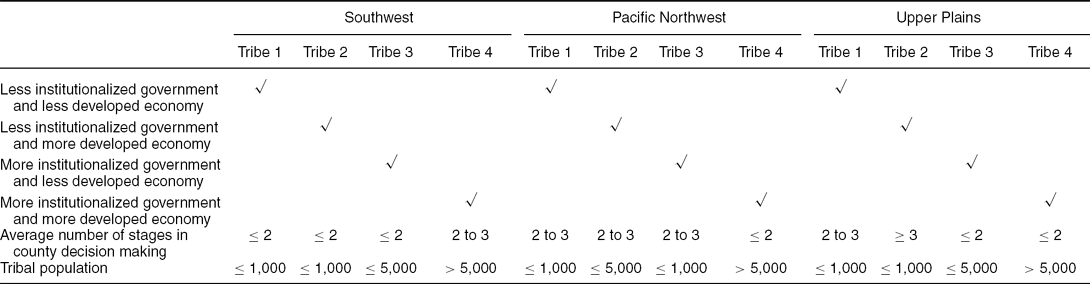
I selected for this analysis three less endowed tribes—tribes with both less economic development and less government institutionalization. I also selected three tribes that were well endowed—tribes with both developed economies and institutionalized governments. Finally, I selected “off-diagonal” tribes—three tribes with developed economies but less institutionalized governments, and three tribes with institutionalized governments but less developed economies. I focused on tribal capacities in or around 1990. I split the sample between the Southwest, the Pacific Northwest, and the Upper Plains.
Once I had identified tribes that met each criterion—high or low government institutionalization and high or low economic development—I selected among them as follows. To provide comparability among cases, I selected cases so that critical features of local government—liberal or conservative tendencies in local politics, affluence or poverty in the neighboring community, degree of urbanization in the area—were distributed evenly across the cases. Also, for each region, I selected cases so that they were not all within a single state, but at least one state per region contained two cases. I wanted to be sure that I was not just measuring the results of 12 distinct cultures, so I included more than one Pueblo tribe, more than one Sioux tribe, and more than one tribe that signed a treaty with clauses guaranteeing fishing, hunting, and gathering rights. I eliminated from consideration tribes without federal recognition, located in unusually remote areas, or not near at least one non-Indian community (no matter how small). Of course, I do not expect that my matching is so complete as to obviate further adjustments through multivariate analysis.
The cases that I selected are not a representative sample of tribal governments. Their economies and governments are either markedly constrained or advantaged. I chose these cases in order to provide clear tests of the consequences that economic development and government institutionalization can bring. There are over 560 federally recognized tribal governments with widely varying circumstances. Rather than trying to identify a set of “typical” tribal features, I instead sought to gain crisper insight into specific causal mechanisms.
A THEORY OF AMERICAN INDIAN TRIBAL GOVERNMENT POLITICAL ACTIVISM
I define expertise as specialized knowledge about environments, problems, and problem-solving routines. The more expertise a group possesses, the better that group can evaluate politics, policy, and programs, and thus the better the group is positioned to envision and implement new strategies. More expert actors are better at issue selection: They pick winning issues, winning frames, and winning coalitions. Furthermore, more expert actors are better at persuasion: They make better cases in their interactions with both allies and adversaries. Inexpert actors lack these qualities. Exhausted actors display these qualities erratically when they face intense outside pressures; their expert behavior rises and falls as those pressures fluctuate.
I examine two pathways along which government might build and sustain expertise. I test whether government institutionalization and economic development matter. I evaluate whether tribal governments that differ on these key dimensions behave in ways that are consistent with changing opportunities to accumulate expertise. Knowledge should alter how advocates see their context. Expert advocates will recalibrate strategy as necessary. Their detailed knowledge should be on display.
Features of Governments and Economies
First, I contend that more institutionalized tribal governments have better tools for building and deploying expertise. We find smart, hard-working leaders across all levels of institutionalization. I join others in arguing, however, that institutionalized governments best cultivate, utilize, and sustain individual talents and best retain and disseminate best practices. Generalists face serious performance constraints because they wear many hats and function in less routine ways.
Cornell and Kalt (Reference Cornell and Kalt1992) have stressed repeatedly that institutions matter for effective tribal governments. Specifically, they have directed attention to the importance of “rules and procedures that delegate and delimit authority.” They remark, “No society of significant size can count solely on the goodwill of its leaders and citizens” (21; see also Harvard Project on American Indian Economic Development 2008). We find these same themes in Polsby's (Reference Polsby1968) work on political institutionalization. Polsby specifies three key features of institutionalization: (1) structures that are well bounded and differentiated, (2) complexity and specialization, and (3) universalistic, automatic rules. He continues, “the total impact of a cadre of specialists operating over the entire spectrum of public policies is a formidable asset for a political institution.” (166) Along the same lines, Stinchcombe (Reference Stinchcombe1990) argued that, where there is differentiation of tasks, workers can more easily understand their environments and promote innovation.
We find routinization, differentiation, and specialization in the traditions of both indigenous and Western governments. For example, Biolsi (Reference Biolsi1992), drawing on Wissler (Reference Wissler1912, 7–11) and Walker (Reference Walker1982), documents the distinct roles for decision-making in mid–nineteenth century Oglala Lakota society. He describes how the naca ominicia, a body composed of most older men, selected seven wicaśa it'ancan (men chiefs) to serve lifelong, usually hereditary terms. Those seven then selected four others to oversee hunting and campsites. Another body that served one-year terms then appointed akicita it'ancan (soldier chiefs), who in turn appointed a police force (35–36). Even if certain institutions today are borrowed from Westerners, it does not mean those particular practices are incompatible with traditional values. As Alfred (Reference Alfred1999, 3) notes, “[m]ost acknowledge that all Native structures will have to incorporate modern administrative techniques and technologies.” Rather, Alfred argues, the distinction between indigenous and European-derived governments lies in features such as the role of government in society and the nature of the consent of the governed.
Second, I evaluate whether well-established economic development matters. Here, I argue that an infusion of funds makes it easier to build up expert capacity by allowing tribes to bring in additional staff or new programs. Tribal economic development almost always takes the form of tribally owned and operated enterprises. Simply put, independent funds generated by these enterprises make it easier for tribes to support governmental activities.Footnote 8
In short, for generally underresourced groups, we ought to expect to see some advantages flow from obtaining perhaps the most fungible resource of all—money. The question, however, is exactly how money can have an impact. Hall and Deardorff (Reference Hall and Deardorff2006) suggest that information improves when budget constraints are loosened, and their argument implies that a better-funded interest group can do more to redress its allies’ information limitations. It seems reasonable to expect this for tribal governments as well.
Economic development, in this respect, is notable precisely because it provides an independent resource. As one Pacific Northwest tribal council member described it in 1999, one of the chief advantages of tribal economic development was that it generated funds “not subject to interference from well-placed political Indian fighters.” Much of the social movement literature has documented the perils that can arise if resource-constrained actors become dependent on outsiders (McAdam Reference McAdam1982; Morris Reference Morris1984). More economically developed tribes can more easily avert such perils. In sum, I expect economic development to influence outcomes because it produces a potentially flexible and independent resource. Furthermore, if expertise matters in politics, economic development should nurture governments that better understand their environments and display more sophisticated strategic calculations.
Features of Governments and Economies Operationalized
I identified government institutionalization and economic development in the following ways.Footnote 9 To identify the six tribes with stronger economic bases, I looked for reservations with very profitable economic development enterprises. Most commonly, these enterprises were extensive natural resources extraction operations (four of the six tribes selected) and/or large casinos (three of the six). Four tribes had notable commercial development—such as resorts, shopping centers, other retail services, and manufacturing—but typically, commercial development was preceded (and presumably funded to a degree) by natural resources extraction or casinos.
The sources of information about tribal governments are far from uniform. I turned to documentation for a variety of indicators of institutionalization:Footnote 10 (1) All six tribes showed functional specialization within tribal government. (2) Five tribes were praised by outside observers for units within the tribal government with specialized, effective skills. (3) For four tribes, the number of tribal employees was much larger than for the other tribes in the sample. (4) For four tribes, staff had played leadership roles in intertribal organizations. (5) Departments within several of the tribes have received recognition such as Honoring Nations awards from the Harvard Project on American Indian Economic Development. (6) All six tribes received funding from the Bureau of Indian Affairs [BIA] (1992–1999) in ways that suggested more effective governments. If tribes are willing and able to operate their own government programs, they can opt into certain BIA grants. Four tribes received especially large grants from the BIA. Three tribes persuaded the BIA to allocate funding through block grant programs, including the Consolidated Tribal Government Program and the Self Government Compacts.
I identified less institutionalized governments by the following features.Footnote 11)1) All six tribes lacked the following traits in the early 1990s: functional specialization, large staffs, key roles in intertribal organizations, programs that won prominent awards, and Self Government Compacts from the BIA. (2) Two tribes received federal recognition fairly recently, which meant that their governments were less experienced at key tasks. (3) Four of the reservations had populations of less than 200 people. With such a small population, it is hard to justify staffing beyond a handful of people, which of course then makes specialization and differentiation impractical.Footnote 12 (4) The BIA has guidelines for minimal budgets for tribal governments to sustain basic operations (Bureau of Indian Affairs 1998, BIA–60). Two tribes were below that threshold and two were only slightly above it. (5) For two tribes, I found praise of the tribal government by outside observers, but that praise centered on particular personalities and not on organizations or structures.
Why would any tribe end up with a developed economy but a less institutionalized government, or alternatively, a highly institutionalized government but a less developed economy? The easiest cases to explain are institutionalized governments with constrained economies. All three tribes in these circumstances face disadvantages of geography. None sits atop highly profitable natural resources. None is very close to metropolitan areas or busy interstates, which means they lack a customer base for a highly profitable casino. All have fostered multiple economic development initiatives—such as small-scale natural resource extraction, agriculture, casinos, retail services, and programs to help tribal artists. These initiatives generated jobs for tribal members, but none generated large revenue surpluses for tribal government.
How does a tribe end up with a developed economy but a less institutionalized government? In at least one case, the tribal government had only recently been recognized by the federal government, which meant that tribal leaders began the 1990s still trying to hammer out basic operations. In two cases, very small tribal populations resulted in governments with very small staffs, making it more difficult to specialize and differentiate. In all three cases, flourishing economic activities were relatively more recent developments. As the 1990s unfolded, tribes with economic advantages but less institutionalized governments invested in their governments. By the final years of the sample, at least two tribes initiated programs that would go on to receive prominent awards as they matured and at least two of the tribes had staff with roles in intertribal organizations. At least two tribes won federal funding that was more and/or more flexible. Yet institutionalization can be a slow process, and these tribal governments changed gradually.
County Hostility toward Tribes
I argue that expertise's undoing lies with the related dynamics of racial conflict and organizational exhaustion. To consider the sources of expertise's undoing, I turn attention first to Indian–White conflict, its roots, and its consequences. Indian–White conflict is pervasive, and I identify some circumstances where it may be more intense and thus more draining. I expect that in settings with entangled Indian and non-Indian lands, conflict should be greatest and most taxing.
There is ample anecdotal evidence that tribal–local relations are plagued generally by hostility toward tribal governments and American Indians. Ashley and Hubbard (Reference Ashley and Hubbard2004) illustrate how some counties have resisted recognizing tribal governments as legitimate sovereigns. There are further examples from government documents and newspaper coverage of tribal–local relations in the 1990s for the regions that I analyze in this article. In one case from the Southwest, a newspaper ran the following coverage. In a first article, the county sheriff announced that he was cutting off law enforcement and emergency response to the reservation to “hold out for compensation for his department's services.” The editor's column the next day did not raise concerns about the potential public safety consequences of such political brinksmanship. Rather, the column attacked the tribe over water-use negotiations. The tribe was developing some new businesses and wanted to secure more access to water. As the newspaper's editor saw those negotiations, the tribe had decided to “hold hostage” the wider community: “In other words, the [tribal] negotiators are saying ‘You give us exactly what we are asking for in order for us to destroy your business community’ . . . [Tribal officials], true to form, are refusing to return phone calls. . . .” In a case from the Pacific Northwest, in a discussion of a tribe's new casino, a county commissioner remarked caustically,
I don't think it's right that a so called sovereign nation can open up a casino and do damn well what it wants to do and totally unregulated by the feds and the State. . .. It's not fair that a sovereign nation that you can't sue that you can't do anything about operates gambling and can dictate to you the payoffs and not pay a dime to the counties and not pay a dime to the state unless they are compact[ed] and we are looking into [what] the compact between the state and the [tribe] has provided for.
The commissioner's statement contains a long series of factual errors, beyond his reference to “so called” sovereign nations. Tribal casinos are subject to regulations and taxes—although clearly not the kind of regulations and taxes that this county commissioner would prefer.
In such examples of tribal interactions with counties, the non-Indian officials that the tribes faced did not simply have different preferences or priorities. Some officials and community leaders held pronounced hostility toward the very enterprise of tribal government. Beyond these dilemmas of general prejudice, however, there is good reason to give special attention to one classic source of Indian–White conflict: the extent to which land within reservation boundaries is “checkerboarded.” In some regions, federal policy in the late nineteenth century resulted in private ownership of land tracts within reservation boundaries by nontribal members. Since then, this entanglement of interests has fueled political, economic, and social conflict (Biolsi Reference Biolsi2001). Checkerboarding is rare in the Southwest and Pacific Northwest but relatively commonplace in the Upper Plains.
There is compelling evidence that entangled land leads to angry, bitter, and fearful clashes. Bobo and Tuan (Reference Biolsi2006) find such patterns in Indian–White conflict over fishing rights on the Great Lakes. In much the same way, the evidence suggests that politics in the Upper Plains, where checkerboarding is most pronounced, are poisoned by negative attitudes about American Indians as a people. There are few survey data on racial attitudes in the region, with the exception of one study in the mid-1980s (Peterson Reference Peterson1987). On key questions, typically one-fifth to one-fourth of respondents expressed negative attitudes about American Indians.Footnote 13
There is other evidence of racial hostility in the Upper Plains as well. In a newspaper based in one largely white community within a reservation's boundaries, a county official wrote a letter opposing candidates for state and local office with ties to tribal government and calling for “representatives who will protect the constitutional rights of all parties concerned, not those who will help strip those rights away from the citizens.” The implicit contrast suggested is that only those without ties to tribal government “will protect the constitutional rights,” whereas those with such ties “will help strip those rights” from (white) citizens. On another occasion, some white locals described disputes with tribal government as “explosive” and “about ready to blow.” Soon thereafter, the paper published a column calling on the community “to finally set aside our jealousies, gossip, envies, distrust, and assumptions so we can hash out our land disputes, our jurisdictional concerns and our sovereignty issues.” There are other contemporaneous, well-publicized examples from the Upper Plains. Perhaps most notably, a county official at a public meeting in the early 1990s described American Indian culture as “mongrelized,” “primitive,” and “a culture of hopelessness, godlessness, joblessness and lawlessness” (“Slam of Indians Challenged” 1990). In this same time period, a number of cases from the criminal justice system provoked well-publicized outrage and charges of differential treatment of Indians (South Dakota Advisory Committee to the United States Commission on Human Rights 2000).
I suggest that racial conflict fueled by checkerboarding creates unique difficulties for tribes’ effectiveness in intergovernmental relations in the Upper Plains. There are serious reasons, however, to think that American Indian tribal governments’ travails in the Upper Plains—and indeed, in other parts of the country as well—are not due to only the contemporary challenges that checkerboarding creates. A number of analysts have expressed concern that with the mismatch between pre-existing social institutions and the formal governing institutions on reservations that were designed by the U.S. government in the early twentieth century, tribal governments descended deeply into incompetence and corruption (see, for example, Biolsi Reference Biolsi1992 and Cornell and Kalt Reference Cornell and Kalt1992). Concerns about institutional mismatch and resulting governance problems are not specific to the Upper Plains (see also Alfred Reference Alfred1999; Deloria and Lytle Reference Deloria and Lytle1984; O'Brien Reference O'Brien1989), but some of the most striking examples are drawn from that region.
There is no doubt that history matters. I focus on contemporary obstacles, however, for multiple reasons. First, even a corrupt or venal official would have incentives to learn how to interact effectively with other governments, in order to capture power and finances. Also, contemporary circumstances—such as the present-day conflicts around checkerboarding—can exacerbate underlying historical vulnerabilities. To their credit, Upper Plains tribes have initiated a number of effective programs; for example, a number of units in tribal governments have been awarded the prestigious Honoring Nations Awards for their accomplishments (Harvard Project on American Indian Economic Development 2007). But if their modern environment were not so taxing, perhaps they could achieve much more. In short, where institutions have created entangled interests, I expect that present-day conflict and related ongoing dysfunctions will grow.
Conflict in Other Venues
I argue that exhaustion from outside demands can sap expertise. Tribes that specialize in one variety of interaction can build knowledge that is specific to that kind of interaction. In contrast, tribes that are drawn into multiple and distinct venues may overextend their limited capacity. Thus, tribes’ performance in interactions with local governments’ legislative bodies should decline if tribes face political contestations in other domains that are particularly pressing.
To evaluate this premise of exhaustion elsewhere, I consider variation over time in the energy that tribes expend in a venue that is distinct from county legislative interactions. To be sure that I am measuring significant investments in venues that are clearly separated from legislative interactions, I want to identify activities that (a) demand significant time and energy, (b) generate skills that are not highly portable to county legislative interactions, (c) vary in part because of exogenous forces, so that tribes have difficulty predicting the exact timing of demands, and (d) do not allow tribes to adjust their involvement quickly and easily.
Here, I turn to the extent to which the tribe is involved in legal disputes—appeals cases in particular—as an indicator of this kind of exhaustion. It is reasonable to ask whether a variable that tracks courtroom conflict really just reflects other dynamics. An alternate hypothesis is that it actually measures overall tensions, not fluctuation in demands on tribes’ capacities. I am not suggesting that baseline racial conflict and momentary spikes in legal disputes are wholly unrelated. The data analysis that follows will examine whether conflict and exhaustion have unique dynamics.
Nor am I suggesting that lawsuits are a less desirable means of conflict resolution. Lawsuits are a way of forcing accommodations from intransigent adversaries, and they set precedents that can preclude or minimize potential future disputes. Lawsuits consume enormous resources, however, as many tribal leaders would attest: Lawyers are expensive, and lawsuits can take a great deal of time to reach resolution. Furthermore, the skills generated in winning legal battles can be quite venue-specific. Indeed, although McCool, Olson, and Robinson (Reference McCool, Olson and Robinson2007) provide excellent documentation of the accomplishments that Voting Rights Act litigation has achieved for American Indian voters, they also note that “(l)itigation, however, is complex, time-consuming, and heavily dependent on access to sophisticated counsel” (89). Also, I look to lawsuits—appeals in particular—because their timing is not necessarily under the control of the parties involved. Additionally, either party may feel compelled to continue in an appeals process, even if the context changes over time, because of the precedent at stake. As a result, it can be difficult—or simply impractical—for a tribe to back out of a suit at moments when it is stretched particularly thin.
On a related front, it is natural to wonder whether tribes’ strategies are wholly path-dependent processes. My findings indicate, however, that tribes are not locked into a particular path. Fortunately, the data at hand capture much over-time variation. For example, for one tribe, lawsuits are particularly frequent in 1990, 1992, and 1999, but not in 1991, 1998, or 2000. This timing is not entirely under the tribe's control, of course, given that the analysis focuses on cases in the appeals process.
Records of both the tribal council and the county commission show that, in 1990, 1992, and 1999—when lawsuits are particularly high—this tribe is less effective in its county interactions. In 1990, 1992, and 1999, county commission minutes show that a variety of the tribe's initiatives fail: proposals to coordinate on animal control, policing, ambulance services, 911 services, and a rodeo. The tribe cannot even persuade the county to write a letter of support for its application for a federal declaration of a natural disaster emergency. In 1991, 1998, and 2000, the patterns differ. The tribe's efforts at coordination on 911, telephone services, and traffic safety move forward. The county provides a letter supporting the tribe's opposition to a declaration of an endangered species.
The minutes contain important insights into the tribe's problems with ambulance services in years with a large number of suits. The tribe often asks for county assistance with the ambulance program, but the tribe's requests are sometimes vague and can change over short windows of time. County officials express frustration with this lack of clarity. A tribal liaison notes the organizational problems behind these errors: There is no full-time paid staff member who runs the program. The liaison remarks, “[i]t is difficult to get anything done without someone in charge and some type of continuity.” The flip side of the close attention to lawsuits is that there is no manpower left to run other vital efforts.
Other sources offer insights into the mechanisms at hand. For example, the proceedings of one tribal council reveal that program staff must assist with a brief in one lawsuit and compile “statistics on land holdings, land losses, and land acquisition” for attorneys. The staff is redirecting time away from other endeavors. If these statistics were portable to county interactions, we might expect them to show up in the many analyses and proposals about land issues that the tribe makes before the county council. This does not happen.
On another occasion, a tribal chair instructs fish and wildlife program staff on tactics that will help with a lawsuit. For the sake of the lawsuit, the tribal chair wants game wardens who look authoritative, and to that end, the chair wants new and better equipment purchased, but the chair does not want them to make any arrests of fishermen or hunters who trespass on tribal land. Again, the staff expends energy that may help with lawsuits, but diverts from other missions. One might mistakenly presume, reading the tribal council minutes, that the tribe hardly ever deals with the county commission. In fact, county–tribe interactions happen frequently but garner scarce consideration in the tribal council chambers.
Indeed, tribal leaders routinely acknowledge to both internal and external audiences how exhausting lawsuits are. Comments to this effect are easily documented within tribal council proceedings and in local newspapers. Also, in a series of conferences at South Dakota State University, a variety of tribal leaders discussed problems of exhaustion and the tradeoffs associated with legal disputes. The Attorney General of the Cheyenne River Sioux Tribe described the tribe's extensive legal battles with state government and remarked on the resources expended on lawsuits rather than on programs to address tribal needs (Emery Reference Emery1992). Similarly, the Chairman of the Cheyenne River Sioux Tribe described extensive legal disputes with the state government and also the tribes’ inadequate investments in key programs such as economic development (Bourland Reference Bourland1992). An official at Sisseton–Wahpeton Community College noted that tribes work extensively to confront fundamental disputes over jurisdiction raised by nearby governments; he remarked on the fear and resignation that result (Lawrence Reference Lawrence1992). In his view, what his tribe instead needs most is staff who feel motivated to build appropriate specialized skills and to navigate politics. The Chairman of the Yankton Sioux Tribe noted that negotiations with local governments only succeed with significant investments of time and energy to educate local officials about tribal government and counter stereotypes (Cournoyer Reference Cournoyer1990). A state senator who is a member of the Rosebud Sioux Tribe and the Chairman of the Flandreau Santee Sioux tribe described the same dilemma: Resources for legislative relations are constrained, but significant outreach is necessary if relations with nearby governments are to improve (Taylor Reference Taylor1992; Velandra Reference Velandra1992). These speakers describe the importance of these same labor-intensive legislative strategies—education and relationship building—across a variety nearby governments.
It seems reasonable to conclude that legislative negotiating skills are fairly portable from one legislature to the next. At times when courtroom interactions increase, however, legislative strategizing degrades. No doubt, tribes may be making a worthwhile tradeoff. Perhaps there is more at stake in a given lawsuit than in a given legislative interaction. The point, though, is that sharp tradeoffs occur. Resources are limited, so tribes cannot do everything well.
A FIRST LOOK AT THE MINUTES
A careful reading of the minutes reveals several striking patterns. First, tribes with government institutionalization, economic development, or both regularly exhibited noticeable policy expertise. For example, one of the best-endowed tribes organized a project to tap new sources of water in its region. Tribal officials asked various other authorities to help finance the endeavor, but the initial planning and scientific work were all done by the tribe. Another of the best-endowed tribes got a regional enterprise zone organized. This tribe was well equipped to debate the particulars of environmental impact findings for proposed developments, and it did so regularly. One highly institutionalized tribe had expansive expertise about area water quality, and the county frequently sought tribal input in deciding the technicalities of water quality protection. Officials from one institutionalized tribe helped write county mining regulations and helped design county programs aimed at reducing DWI offenses. Elsewhere, officials from a tribe with a successful casino displayed their knowledge in the area they knew best, economic development. Their interactions with the county involved redesigning the regional transportation system to improve access to the tribe's enterprises and to eliminate bottlenecks.
These tendencies were in marked contrast to the circumstances of the more constrained tribes. Although tribes with less government institutionalization and less economic development succeeded in most of their interactions, what sticks in the memory is failure to win the simplest of requests: small grants, a few speed bumps, a stop sign, a new sidewalk. Often, the constrained tribes learned from failure, but not always. In one case, after the tribe gained experience from participating in a DARE program with the county, it branched out to running a DARE program on its own. When one of the more constrained tribes failed to win a small grant from the county's tourism development fund, the body making the determination noted shortcomings in their application: The application was incomplete in places and the commission was confused about how the tribe's project related to the stated goals of the fund. When the tribe applied to the same fund a second time for the same project, it avoided these pitfalls and won the award. Yet for several years, this same tribe tried to persuade the county to stop licensing businesses to serve alcohol at outdoor events that coincided with an annual celebration organized by the tribe. The tribe failed each time. Furthermore, its strategy did not vary from year to year, despite that strategy's poor performance.
Often, early interactions in a given area were quite tentative and involved a learning process. Take as an example the case where a county and a more economically developed tribe considered whether the county would provide building inspection services for tribal enterprises. At first, the actors involved struggled with uncertainty about how the arrangement should be structured. Yet, when the agreement was renewed in subsequent years, such concerns were absent. The renewals showed up on the consent agenda, where boards approve motions without discussion. In another case, when a county first contracted with a tribe to deliver substance abuse prevention services, the contract was for a trifling sum and covered a very narrow range of services. Year by year, the dollar amount and the scope of the contract expanded.
DESCRIPTIVE STATISTICS
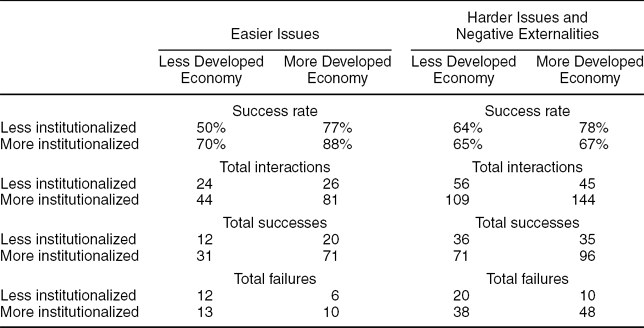
The sample includes 529 interactions between tribes and counties. Table 1 breaks down successes and failures. Appendix A presents additional descriptive statistics on tribal population and on the procedures used by county boards.
Descriptive Statistics on Tribes’ Successes in County Interactions

I sort interactions by institutionalization, economy, and type of interaction. I split the interactions into “easier” issues, “harder” issues, and negative externalities. Typical of the easier issues are requests for mini-grants or resolutions of support for tribal initiatives elsewhere. Typical of harder issues are tribal requests for larger-scale endeavors or increased power in county decision-making bodies. Negative externalities are cases with zero-sum tradeoffs between Indians and non-Indians: One group's gain is the other's loss. The main pattern in this view of the data is that tribes having greater potential for expertise were involved in more interactions with county boards and enjoyed higher rates of success for easier issues but not for harder ones. Putting the two trends together, we see that better-endowed tribes achieved a notably higher number of victories than did tribes with less expertise. The pattern of total success is about as strong for easier issues as for harder ones.
However, these patterns vary by region, government context, tribal population, and, above all, levels of conflict between Indians and non-Indians. Multivariate analysis in the next section will delineate this variation. Results in Table 1 nonetheless convey the basic structure of the data.
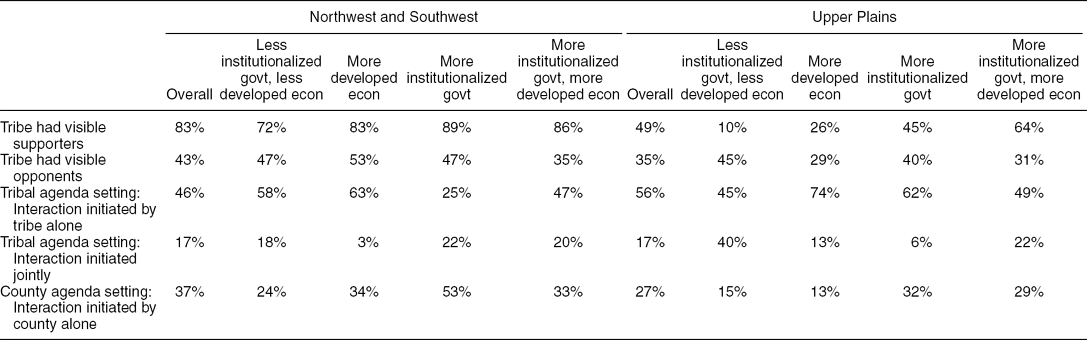
Table 2 shows a few more patterns in these interactions. It appears that Upper Plains tribes faced a less cooperative environment. In 83% of interactions in the Southwest and Northwest, someone else endorsed the tribe's position, versus 49% for the Upper Plains. Yet, to a great degree, tribal governments in all regions set the agenda of which issues came up for consideration. About half of all interactions began solely at tribes’ instigation. Another one-sixth of these interactions were begun by the counties but required tribal participation before they could be resolved. For example, if a county wanted to start a joint initiative—such as when one county proposed the development of a share solid waste facility—the tribe was in a position to end consideration of the issue easily and completely. In around one-third of interactions, it was possible for counties to begin and resolve a matter unilaterally, but often tribes did speak up in these decision-making processes.
Descriptive Statistics on Key Features of Tribe–County Interactions

A note of caution about interpreting success rates: Keep in mind that my analysis captures a particular subset of tribe–county interactions. The patterns in these data do not necessarily support a normative conclusion that all is well in tribe–county relations. Here, I want to assess the strategic deployment of scarce resources. Multivariate analysis will allow more thorough explanation of these trends.
VARIABLES FOR STATISTICAL ANALYSIS
Institutionalized Government and Developed Economy
I examine the effect of tribal institutions and development on expertise and on success in interactions with county governments. My expectation is that better-endowed tribes, as indicated by high levels of government institutionalization or economic development, will succeed more often.
Checkerboarding
As noted before, checkerboarding is rare in the Southwest and Pacific Northwest but commonplace in the Upper Plains. I use the extent of checkerboarding as a measure of Indian–White conflict. To assess the extent of checkerboarding for the four counties where it exists, I measured the percentage of the county population that consists of non-Indians living within the reservation boundaries.Footnote 14 Among the checkerboarded counties in the sample, there was substantial variation in the magnitude: The average was 19% and the upper bound was around 40%. For two of the counties, the degree of checkerboarding changed over the sample decade.
Measuring Court Conflict
I also measure the participation of tribes in lawsuits with county and state government. Specifically, I measure the number of legal disputes with states and localities that are in the appeals process, and whether the tribe (a) is arguing an appeal in the given year, (b) has an appeal that is upcoming, and/or (c) is currently between appeals on a case.Footnote 15 There was substantial variation in the magnitude of exhaustion: The average number of suits was 1.4, the upper bound was nearly 10, and the standard deviation was around 2. My expectation is that participation in legal appeals exhausts a tribe's resources, making a tribe less effective in legislative interactions with county boards. To control for noise in this measure, I generate a dichotomous threshold for whether number of suits at a given moment is especially high.Footnote 16
Every tribe in the sample had at least one year when the number of suits was below average. Six tribes had at least one year that was above average. Were the tribes with exclusively low numbers of suits or with occasionally very high numbers of suits unusual in other ways? They were not. These tribes were spread across variables of interest such as government institutionalization, economic development, rates of checkerboarding, tribal population, and region.
Are legal disputes simply a duplicate measure of baseline conflict? The question is natural, but correlation coefficients suggest that legal disputes are not just a barometer of county–tribe tensions. First, the measures of legal disputes and baseline conflict of checkerboarding are scarcely correlated, at .04. Also, if legal disputes simply reflect overall conflict, perhaps they are correlated with the most acrimonious of county interactions—interactions over negative externalities. In fact, there is nearly no relationship: The variables correlate at .04. Finally, if legal disputes are an indicator of overall conflict, surely they should correlate strongly with the number of legislative interactions with county government. After all, if they measure a moment of intense, conflict-ridden engagement, then county legislative interactions and lawsuits should rise together. But they do not. The correlation is .005. These patterns suggest that although legal disputes affect tribes, lawsuits and legislative interactions unfold in distinct venues.
Control Variables
I include the following control variables.
Log of Tribal Population. I control for the tribal population in each of the twelve counties in the sample: I take the log of the population of American Indians living on the reservation in Census 2000.Footnote 17
Easy Issues, Hard Issues, and Negative Externalities. as described in Section III.
Stages in Participation. I control for the average number of stages in decision-making in tribe–county interactions for each county. In some places, a greater proportion of intermediate decisions were made in closed proceedings or by the county bureaucracy, and county commission hearings were more apt to be reserved for final, up-or-down decisions. In other places, more decision making is vested in the county commission than in the county bureaucracy.
Regression Results: Success in Interactions
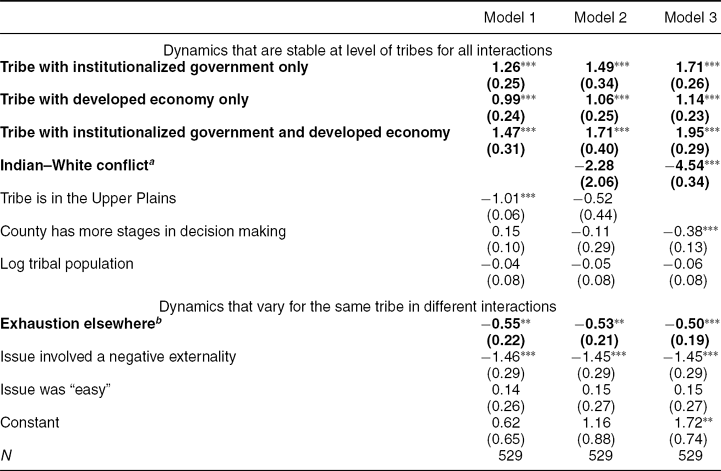
Table 3 presents analyses of tribal success or failure in the 529 interactions with county boards in my dataset. The three models show that all types of tribes with some sort of endowment were more successful than tribes with both less economic development and less government institutionalization; the effects are statistically significant. Consistently, tribes with both government institutionalization and economic development fared the best; in second place were the tribes with government institutionalization but not economic development. The differences between these and the three tribes that had both government institutionalization and economic development are statistically significant.Footnote 18 One implication of these differences is that dollars helped to build governments with more effective performance, but wealth did not compensate for impoverished institutionalization.
Logistic Regression Predicting Tribal Success in Interactions

Notes: Robust standard errors are below the coefficients in parentheses and are adjusted for clustering by tribe. Significance at the 1%, 5%, and 10% levels is indicated by ***, **, and *, respectively.
a Indian–White conflict = If checkerboarded reservation, percent of county population that is non-Indians living within reservation bounds per year. Varies considerably over time for a small set of tribes.
b Exhaustion elsewhere = At least three ongoing legal disputes with states and/or localities in appeals process per year. Does not vary over time for some tribes.
The qualitative analysis and the descriptive statistics suggested that Upper Plains counties are more hostile to tribal aims; here, I want to consider whether we can explain Upper Plains uniqueness by including the measure of underlying Indian–White conflict. Indeed, the two effects substitute for one another with statistically significant effects. The quantitative findings demonstrate that conflict is not an immutable characteristic of the Upper Plains. Rather, differing ingredients make racial conflict more pronounced in some specific locales but not in others.
Finally, in years when tribes were involved in more court appeals, tribes’ success also dipped. The effects were statistically significant. In other words, when tribes’ capacities were especially taxed, they were less successful in interactions with county councils. It was not enough to have greater expert capacity or a less hostile environment. Tribes also needed a reprieve from deploying their expert capacity in other venues.
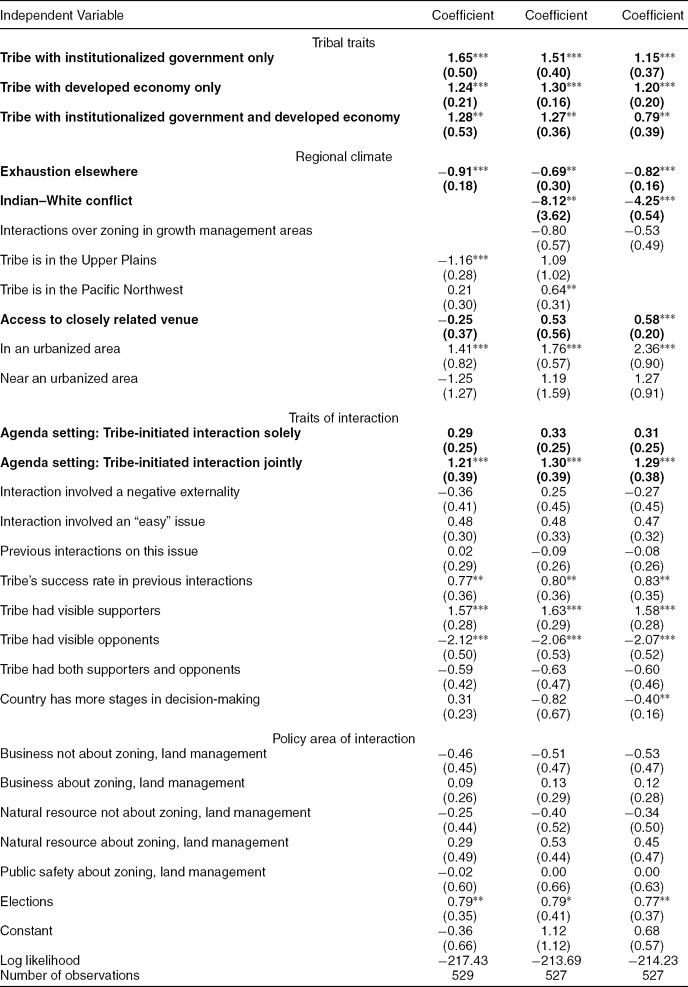
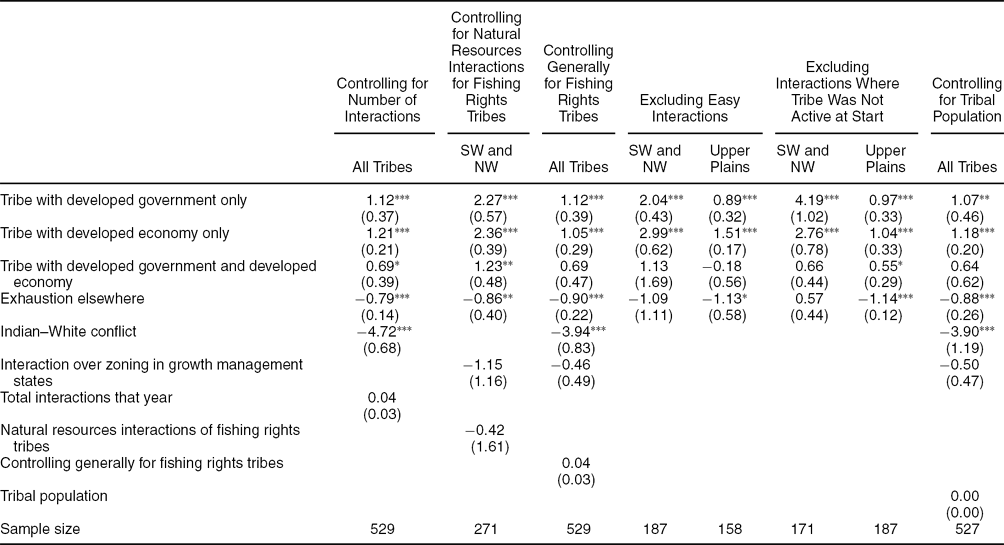
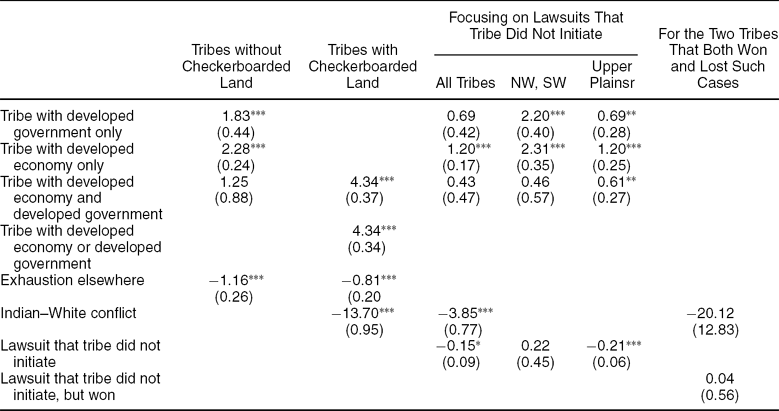
These findings hold up under a variety of alternate specifications. Appendix B examines whether key effects endure with the inclusion of additional features of the county, past dynamics on an issue, patterns of support and opposition, who set the agenda, and policy areas. The key effects persist. There is change in the rank ordering of the impacts from various combinations of institutionalization and development, but all effects remain positive and significant.Footnote 19 Some new variables are also significant. Agenda-setting power matters: It helps if tribes can choose the timing and topic of interactions. Other statistically significant features are whether the nearest locality is incorporated or urbanized, whether there is support or opposition from other players in county politics, and whether the tribe has an established track record of favorable county interactions. Finally, key results persist when exhaustion is measured as a dichotomous variable. Appendix C includes further checks. I reran the analysis to exclude easy interactions and interactions that the tribe did not start. To be sure that outcomes were not driven by the particular circumstances of tribes with treaty-based fishing rights, I inserted controls for these kinds of tribes. I also controlled for the total number of interactions and for tribal population. Appendix D considers alternate specifications of conflict and exhaustion. I split the sample by the presence of checkerboarding. As a final robustness check, I considered several alternate specifications of investment in lawsuits.Footnote 20
Predicted Probabilities
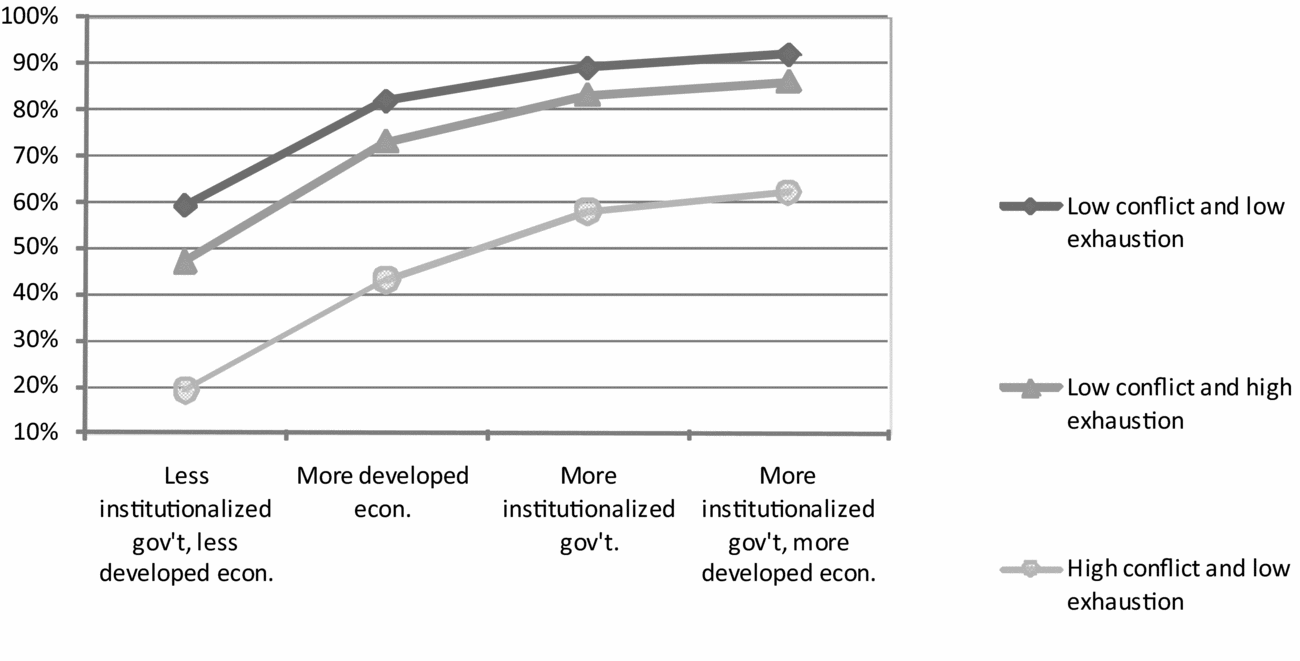
Figure 1 graphs predicted probabilities from the model in Table 3, to translate the regression results into marginal effects. In the calculation, I included most variables at their means or at the most common value for noncontinuous variables. The predicted outcomes presented here are for “hard” issues.
Predicted Probabilities for Success Rate in Interactions

As we have seen in Table 3, both institutionalization and development improve success rates. Also, success rates fall if court activity is intense. In this model, high conflict can cause success rates to tumble as much as 40 percentage points. Heavy involvement in appeals can knock as many as 12 percentage points off of success rates. Even when conflict and exhaustion are low, tribes with neither high institutionalization nor high development have success rates that are at least 23 percentage points behind better-endowed tribes.
REGRESSION RESULTS: FURTHER TESTS OF EXPERTISE
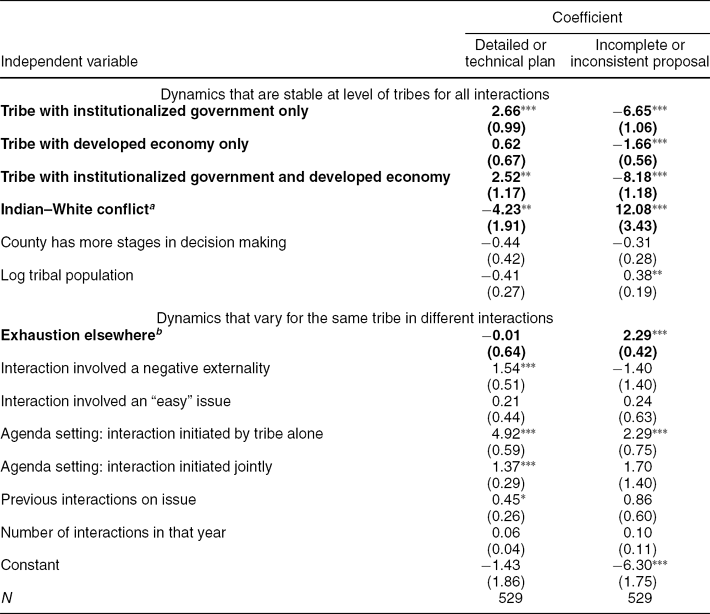
Table 4 first considers when tribes present a detailed or technical plan when interacting with counties. Who displays skills through thoroughly crafted proposals?Footnote 21 The answer is that moderately and most endowed tribes are more likely to do this. The effect is statistically significant for tribes with government institutionalization as well as for tribes with both government institutionalization and economic development. Also, conflict has negative, statistically significant effects. Exhaustion's effects are near zero and nonsignificant. In sum, expert proposals come from tribes with better endowments and more favorable contexts.
Logistic Regression Predicting Features of Tribes’ Proposals

Notes: Robust standard errors are below the coefficients in parentheses and are adjusted for clustering by tribe. Significance at the 1%, 5%, and 10% levels is indicated by ***, **, and *, respectively.
a Indian–White conflict = If checkerboarded reservation, percent of county population that is non-Indians living within reservation bounds per year. Varies considerably over time for a small set of tribes.
b Exhaustion elsewhere = At least three ongoing legal disputes with states and/or localities in appeals process per year. Does not vary over time for some tribes.
The absence of an effect from exhaustion is surprising; it raises questions that merit further investigation. Perhaps a tribe that is momentarily exhausted can pull an old proposal off the shelf—or pull out a boilerplate proposal—dust it off, and change a bit of verbiage here and there. How do we distinguish between good plans and bad ones—plans that may be poorly matched to specific circumstances?
One approach is to run a model that predicts incomplete or inconsistent proposals by tribes. When proposals are out of date, generic, and assembled by careless or inexpert authors, it should be more likely that plans have holes in them or that the tribe will later regret and repudiate them. Table 4 presents the results. In regression models predicting incomplete or inconsistent proposals, the effect is positive and highly significant for years when suits are high.Footnote 22 As would be expected, the effects are negative and significant when tribes have some sort of development and/or institutionalization, and the effect is of much greater magnitude for tribes with institutionalization. Also, conflict has a negative, statistically significant effect.
In sum, tribes with better government or economy—especially with better-endowed government—are doubly advantaged: They present proposals that are both more detailed and more consistent. Similarly, tribes in contexts with more underlying Indian–White conflict—which is a fairly persistent dynamic over time—present proposals that are both less detailed and less consistent. Tribes experiencing momentary exhaustion are still able to offer detailed plans, but they are more likely to make flawed proposals. This result is consistent with varying exhaustion: Exhausted tribes may have background familiarity with an issue and thus a lot to say, but their experience from a prior moment does not translate into careful or effective execution in the present moment.
Table 4 includes the control variables from Table 3. Also, I employ a few additional variables that account for some unique dimensions of authoring detailed plans.
Agenda Setting. I consider whether an interaction occurred at tribes’ instigation. It should be easier for tribes to produce technical and high-quality analysis when the tribes choose the timing and the topic. The prediction holds up: Agenda-setting power has a positive and statistically significant effect on presenting detailed or technical plans and a negative and statistically significant effect on presenting incomplete or inconsistent proposals.
Previous Interactions. I consider whether the tribe and the county have interacted on an issue before. It should be easier to produce a detailed or technical plan—or dust off an old plan—for familiar issues. The prediction holds up; prior interactions have a positive and statistically significant effect. But experience alone does not mean that the detailed plan is a good one—the effects on incomplete or inconsistent proposals are nonsignificant.
Number of Interactions. I consider the frequency with which a tribe and county are interacting in a given year. If the number of interactions is largely due to county priorities, it should be harder for tribes to develop good plans when more items are placed on their agenda. If the number of items on the agenda is largely due to tribes’ priorities, the prediction is uncertain—presumably, tribes ought to choose the number of interactions that they feel capable of sustaining, being more ambitious when able and more targeted when less able. The effect turns out to be nonsignificant.
CONCLUSIONS
In the end, marginalized governments have certain capacities to change their circumstances. Learning about politics, policy, and programs can change outcomes. For example, groups can learn how to craft proposals better and to shepherd their measures through the legislative process. Even when there are limited means at hand to scratch out expertise, leaders still manage to do so. American Indian tribal governments with moderate capacities appear to be channeling those resources into cultivation of expertise, because they behave in ways that rely on a good deal of knowledge. Most notably, government institutionalization allows stable specialization and economic development allows independent, fungible capacity. Tribes with these opportunities develop more sophisticated proposals and fewer regrettable ones. My findings from qualitative analyses show that tribes’ skills are essential in initiatives that serve tribal interests. Also, tribes’ successes in outside relations require careful, strategic allocation of tribes’ limited capacities. Quantitative analyses show that tribes are more successful in circumstances that can support the development of expertise—specifically, when they possess government institutionalization and economic development.
Even in environments where tribal interests are usually neglected or actively resisted, cultivation of expertise makes a difference. There are important exceptions, however, that stem from intense racial conflict. Expertise falters in two conditions: in places where Indian–White conflict is greatest and at moments when disputes flare in other distinct venues that cannot generate portable skills. Tribal governments in such circumstances do not exhibit as many of the expertise-centered behaviors as seen in other instances. Instead, marginalized governments end up depleted. Qualitative analyses demonstrate that in environments of overall hostility, and in moments when the demands from outside conflict are high, tribes’ capacities are overtaxed. As a result, tribes have less deliberation and energy for legislative relations. Quantitative analyses illustrate that tribes’ success declines when conflict and exhaustion are high. Yet the data also suggest that conflict is not an immutable or unalterable force. Racial conflict varies within regions because of specific local conditions. Exhaustion is not a permanent deficiency; it can quickly rise and fall. Exhausted tribes display erratic behavior—effective tactics in one time period, problems in the next, and a return to earlier performance when exhaustion subsides.
These findings suggest new dimensions to consider in the study of advocacy by marginalized groups and marginalized governments. The ingredients in cultivation of expertise—and the forces acting against it—merit careful consideration. Modest government resources can be channeled into building expertise, with impressive results. Furthermore, because expertise is a vital resource, exhaustion can be a formidable obstacle. Government may provide better means of cultivating particular resources and allow specific channels of effective advocacy. A more enduring institution offers better means to provide stability, protect autonomy, and demand a seat at the table. But stability, autonomy, and access do not exist in isolation. Outside forces still threaten and impede. A stable institution might also be an easier target, where it is harder to shift, reorganize, or mask the organizational core of a community. Leaders of marginalized governments must manage the benefits of structure along with their strategic need for adaptability.
ADDITIONAL FEATURES OF SPECIFIC TRIBES

Models of Success Rates

Notes: Robust standard errors are below the coefficients in parentheses and are adjusted for clustering by tribe. Significance at the 1%, 5%, and 10% levels is indicated by ***, **, and *, respectively. Exhaustion elsewhere = At least 3 ongoing legal disputes with states and/or localities in appeals process per year. Indian–White conflict = If checkerboard reservation, percent of county population that is non-Indians living within reservation bounds per year. Access to closely related venue = Reservation is adjacent to incorporated city or town.
Robustness Checks on Effects of Features of Interactions on Success

Notes: Robust standard errors are below the coefficients in parentheses and are adjusted for clustering by tribe. Significance at the 1%, 5%, and 10% levels is indicated by ***, **, and *, respectively. The models include all the control variables from the full model contained in Appendix A. When the sample is split, and especially when it includes four or fewer tribes, however, many of the measures of other time-invariant tribal features fall out of the model.
Robustness Checks on Effects of Conflict and Exhaustion on Success

Notes: Robust standard errors are below the coefficients in parentheses and are adjusted for clustering by tribe. Significance at the 1%, 5%, and 10% levels is indicated by ***, **, and *, respectively. The models include all the control variables from the full model contained in Appendix A. When the sample is split, and especially when it includes four or fewer tribes, however, many of the measures of other time-invariant tribal features fall out of the model. The model for the two tribes that both won and lost lawsuits that they did not initiate includes only controls for negative externalities, easy issues, and stages of participation. A more elaborate model showed similar patterns; but given the relatively small sample size, I present the simpler model here.



Comments
No Comments have been published for this article.