INTRODUCTION
Human rights compliance is a notoriously difficult area of study for social scientists and non-government agencies alike. Scholars and professionals have both struggled to predict a country's compliance once they have signed major conventions on human rights. Of particular interest is the case of Muslim countries where scholarly literature finds that Islamic values are in direct conflict with Western conceptions of human rights (Afshari Reference Afshari1994). In fact, many scholars argue that it is due to these conflicts that we should expect Muslim countries to not improve their human rights protections (Cooke and Lawrence Reference Cooke, Lawrence, Bloom, Martin and Proudfoot1996; Hassana Reference Hassana1996). However, we only see this phenomenon in few cases. For example, while some Muslim states behave in expected ways, like Saudi Arabia, which ratified the Convention on the Elimination of All Forms of Discrimination Against Women (CEDAW) in 2000 but continues to enforce laws that impede women's rights, other states like Mali and Bangladesh have records of improving women's rights after ratifying the CEDAW (Dief Reference Dief2008). Indeed, of the 45 Muslim countries in the world, only three have refused to sign the CEDAW (Iran, Sudan, and Somalia), indicating a distinct desire to improve women's rights, yet there are wide disparities on whether these countries expand women's rights or not.
In this article, we seek to explain why some Muslim countries expand women's economic, political, and social rights while others do not or even regress on those rights. Thus far, scholarship has found that Islamic culture seems to be at odds with the Western conception of human rights pitting culture against rights (Afshari Reference Afshari1994). Others have found that the regime explains the expansion of women's rights in which democratic regimes expand rights (Bueno De Mesquita et al. Reference Bueno de Mesquita, Downs, Smith and Cherif2005). Still others find that economic factors like income and development lead to expanded rights (Poe, Tate, and Keith Reference Poe, Tate and Keith1999; Henderson Reference Henderson1991), while others find that oil resources lead to contracted rights (Ross 2008). We seek to expand on this literature by arguing that given the differences between Islamic culture and the Western conception of women's rights, Muslim countries that limit the influence of religious factions on government processes will expand women's rights while Muslim countries that do not limit religious influence will either remain stagnant or weaken women's rights.
Using data from the Cingranelli and Richards (CIRI) Human Rights Data Project and the Religion and State project, we find that there are varying determinants for increased economic, political, and social rights. Primarily, we find that controlling religious incursion into the political sphere promotes economic and social rights. We proceed as follows: we begin with a brief historical description of the CEDAW. We follow with a discussion of the existing literature on Muslim countries and human rights compliance with a specific focus on the CEDAW. We also discuss the relevant literature, which attempts to explain when countries comply with human rights treaties. We then discuss our data and methodology followed by a presentation of our results. We conclude with implications and suggestions for future research.
CEDAW AND THE MUSLIM WORLD
The CEDAW was adopted by the United Nation (UN) General Assembly in 1979 and contains 30 articles defining what constitutes discrimination and creates an agenda for domestic action against such discrimination against women (UN Overview). According to the convention, discrimination against women is defined as:
Any distinction, exclusion, or restriction made on the basis of sex which has the effect or purpose of nullifying the recognition, enjoyment or exercise by women, irrespective of their marital status, on a basis of equality of men and women, of human rights, and fundamental freedoms in the political, economic, social, cultural, civil, or any other field.
The convention obligates signatories to “condemn discrimination against women in all its forms, [and] to pursue by all appropriate means and without delay a policy of elimination of discrimination against women.”Footnote 1 Furthermore, Articles Two, Three, and Four outline legal measures that member states must engage in to promote gender equality (Evatt Reference Evatt2003).
In addition to basic changes in domestic jurisprudence, Article Five calls for a modification of cultural and traditional attitudes that may be prejudicial against the role of women.Footnote 2 The remaining articles outline specific means for reducing discrimination, many of which caused concern among member states, especially among Muslim states, with many signing the convention with reservations invoking conflicts with Shari'a (Evatt Reference Evatt2003).
Still, according to the UN overview of the convention, states that accept and ratify the convention commit themselves to:
• Incorporate the principle of equality of men and women in their legal system, abolish all discriminatory laws and adopt appropriate ones prohibiting discrimination against women;
• Establish tribunals and other public institutions to ensure the effective protection of women against discrimination;
• Ensure the elimination of acts of discrimination against women by persons, organizations, or enterprises.
As demonstrated, the CEDAW contains a number of substantive provisions that are far reaching prescriptions to improve women's rights. Again, of the 45 Muslim countries in the world, 42 have ratified the CEDAW, yet only a handful of the countries have sustained positive changes in women's economic, political, and social rights.
Numerous studies in the social science scholarship on human rights have focused on treaty compliance providing a deep theoretical explanation behind treaty compliance. However, scholars have found that Muslim countries are particularly unique in terms of human rights because of the potential and realized differences between Shari'a and Western conceptions of human rights (Ahmed Reference Ahmed1987; An-Na'im Reference An-Na'im1990; Baker Reference Baker2003; Joseph Reference Joseph and Suad2000; Reference Joseph2002).
Citing differences between Shari'a and the Western definition of women's rights, Afshari (Reference Afshari1994) finds that while Muslim countries ratify human rights treaties, they frequently make reservations to their agreements. In the case of these reservations, the Muslim countries opt to rule by the law in their land rather than what is mandated by the convention itself (Brandt and Kaplan Reference Brandt and Kaplan1995). Other studies find that Muslim countries ratify the CEDAW yet legislate very little in terms of improving women's rights (Cooke and Lawrence Reference Cooke, Lawrence, Bloom, Martin and Proudfoot1996; Hassana Reference Hassana1996).
More recent work on CEDAW compliance indicates that while grassroots efforts to improve women's rights exist in many Muslim countries, few have been successful in attaining a sustained improvement in rights with many countries falling back on their reservations that they made while signing (Afary Reference Afary2004; Baderin Reference Baderin2001).
Still, it is difficult to fully dismiss the chance for rights improvements in Muslim countries. Waltz (Reference Waltz2004) finds that a number of Arab and Muslim diplomats were present in determining the language set in international human rights standards, concluding that while many of their efforts were not necessarily liberal, their efforts on expanding human rights should not be discounted. Shari'a itself, while popularly defined as Islamic law, is much more than a simple codebook of laws to follow; it goes beyond jurisprudence and focuses more on a way of life (An-Na'im Reference An-Na'im2008; Euben Reference Euben1997). Typically, government expectations of the implementation of Shari'a are vague and vary from one country to another (An-Naim 2008; Abukhalil Reference Abukhalil1994). Making the issue more complex, studies have found that most Muslim clerics do not agree on whether the Western conception of women's rights is in fact against the teachings of Shari'a (Bielefeldt Reference Bielefeldt1995; Mayer Reference Mayer1999).
Despite this, there is much evidence to suggest that Shari'a, or the belief in the legitimacy of Shari'a as codebook to follow, may explain the lack of compliance with the CEDAW. Mayer (Reference Mayer1999) finds that Muslim countries with authoritarian rulers “Islamized” the state and society, using Islam as political justification for their repressive policies, going as far as to say that their repression was to protect the state from “the tampering of Satan” (Mayer Reference Mayer1999, 31). As a highly religious group that is likely to follow religious leadership, Fish (Reference Fish2002) finds that Muslims may be more susceptible to such claims. Others argue that Muslim countries suffer from the process of power consolidation and nation building and as a result develop national identities based on their roots in Islam (Baskan Reference Baskan2011; Charrad Reference Charrad and Suad2000; Freedman Reference Freedman2009; Joseph Reference Joseph and Suad2000; Moghadam Reference Moghadam1999; Reference Moghadam2003; Al-Mughni and Tetreault Reference Al-Mughni, Tetreault and Suad2000).
Still others believe that highly active Islamic subconstituencies influence government in ways that force the government to continue to discriminate against women (Al-Mughni and Treteault 2000; Cherif Reference Cherif2010). Carle (Reference Carle2005) argues that there is a deep reluctance for Muslim countries to implement human rights as defined by the UN due to an effort to claim Islamic heritage for human rights. This is likely due to a need to respond to concerns that Muslim countries are yielding too much to Western values (Carle Reference Carle2005). Indeed, scholars have found evidence to support the finding that strong Islamic culture worsens women's rights. Salwa Ismail (Reference Ismail2006) argues through case studies of Egypt, Tunisia, and Algeria that when Islamists are active both socially and politically, women's rights are significantly worsened.
We focus the bulk of our attention on this topic. We argue that Islamic fundamentalism, through either subconstituency pressures or authoritarian means is a major factor that affects how Muslim countries adhere to the CEDAW. Based on the scholarship on Islamic society, we hypothesize that countries that restrict the influence of Islam in either institutional or participatory form will have improved records on women's economic and social rights. It is important however, to distinguish between Islam and Islamic fundamentalism. As the literature demonstrates, it is the strict adherence to the Islamic holy law of Shari'a that is at odds with the Western conception of women's rights and not simply Islam as a religion. As a result, we hypothesize that limiting Islamic fundamentalism will yield improved rights for women on economic and social issues.
BEYOND ISLAM: STATE COMPLIANCE WITH HUMAN RIGHTS TREATIES
While much of the social science scholarship on Muslim countries cites the differences between Western conceptions of human rights and Shari'a as the main explanation behind a lack of progress in women's rights in the Muslim world, Ross (Reference Ross2008) argues that Shari'a alone does not explain the lack of advancement on women's rights. In this section, we discuss other explanations behind why some Muslim countries expand women's rights while others do not after ratifying the CEDAW.
As mentioned, enforcement mechanisms are likely not the cause behind increased compliance. In fact, much of the human rights scholarship argues that compliance can be explained by normative pressure applied by a large number of states that have adopted and complied by the international agreement (Finnemore and Sikkink Reference Finnemore and Sikkink1998; Hawkins Reference Hawkins2004; Hill Reference Hill2010). That is, states comply with human rights treaties to demonstrate that they are within the mainstream. The converse, demonstrating that one's country is out of the mainstream, may lead to condemnation from International Non-Governmental Organizations (INGOs) that may be embarrassing enough to change practices (Keck and Sikkink Reference Keck and Sikkink1998; Chong Reference Chong2009). Others argue that international legitimacy is intimately related to domestic legitimacy in that countries that lose international legitimacy risk losing the support of their citizenry (Finnemore and Sikkink Reference Finnemore and Sikkink1998).
Other possible explanations revolve around the progressive advancement of democracy. While democratic theorists posit that an increase in democratic values fundamentally increases participation and equality (Dahl Reference Dahl1971), Bueno de Mesquita et al. (Reference Bueno de Mesquita, Downs, Smith and Cherif2005) find that only multiparty competition reduces human rights violations. In addition, they find that only highly democratic regimes improve their human rights records. Simmons (Reference Simmons2009) also finds that stable democracies may hinder compliance since rights saturation may weaken citizen mobilization to demand rights improvement. While these explanations revolve around factors that impact human rights records positively, other studies have found other possible explanations that are based on negative factors. State involvement in civil wars seems to increase the state's use of repressive behavior (Poe and Tate Reference Poe and Tate1994; Poe, Tate, and Camp-Keith 1999).
Another possible explanation to this puzzle is economic development. Scholarship on human rights indicates that higher income has led to a reduction of violations in many forms of human rights (Poe, Tate, and Keith Reference Poe, Tate and Keith1999; Henderson Reference Henderson1991). Furthermore, survey data shows that gross domestic produce per capita is positively correlated with negative perceptions on torture and other human rights violations (Carlson and Listhaug Reference Carlson and Listhaug2007; Miller Reference Miller2010). In addition, increased economic development frequently leads to changes in values that emphasize critical views on civil rights violations and the denigration of personal integrity and human dignity (Inglehart and Norris Reference Inglehart and Norris2003; Inglehart and Welzel Reference Inglehart and Welzel2005; Inglehart Reference Inglehart1997).
Yet another possible explanation for the lack of change in women's rights in Muslim countries is the resource curse (Ross Reference Ross2008; Reference Ross2009; Reference Ross2012). In his work on women's rights and Muslim countries, Michael Ross (Reference Ross2008) argues that it is not necessarily Islam that is at fault for poor gender equality but oil production. That is, Ross posits that oil production yields fewer economic opportunities for women in the labor force which then reduces the political influence of women in Muslim countries.
We seek to build on these explanations with a unique focus on Muslim countries by adding another explanation that distinguishes these countries from others: the impact of Islamic fundamentalism on public policy adversely affects women's rights expansion. We test this in the following sections.
DATA AND METHODS
To test these hypotheses, we gathered data from multiple sources on Muslim countries. We exclude any countries that have not ratified the CEDAW including Iran, Sudan, and Somalia. We also exclude Afghanistan and Iraq, as their human rights records have fluctuated and become very unstable since the United States led regime changes in 2002 and 2003, respectively.
Dependent Variables
Our dependent variables focus on the change in a country's human rights record since they have ratified the CEDAW. To do this, we use data from the Cingranelli-Richard Human Rights Dataset. This dataset contains measures of human rights practices for 195 countries coded annually from 1981 to 2009. We focus our analysis on three of their variables: women's economic rights, women's political rights, and women's social rights.
The data on economic rights includes a number of internationally recognized rights that are traditionally categorized under economics. They include: equal pay, free choice of profession without the need of a male's consent, the right to gainful employment without consent, equality in hiring and promotion practices, job security, non-discrimination by employers, the right to be free from sexual harassment in the workplace, the right to work at night, the right to work in occupations classified as dangerous, and the right to work in the military and police force. This variable is coded on a scale of zero to three, where a zero corresponds to no economic rights guaranteed by law and a three corresponds to all or nearly all economic rights guaranteed by law.Footnote 3
The data on political rights also consists of a number of internationally recognized rights that are conventionally categorized under politics. These include: the right to vote, run for political office, hold elected and appointed government positions, join political parties, and to petition government officials. Like the economic scale, the variable is coded on a scale from zero to three, where a zero corresponds to no political rights guaranteed by law and a three corresponds to guaranteed political equality by the law.Footnote 4
Finally, data that is coded under the social rights category consists of the right to: equal inheritance, enter into marriage on a basis of equality with men, travel abroad, obtain a passport, confer citizenship to children or a husband, initiate divorce, own, acquire, manage, and retain property brought into marriage, participate in social, cultural, and community activities, an education, the freedom to choose a residence, freedom from female genital mutilation of children and of adults without their consent, and the freedom from forced sterilization. The data is coded on a zero to three scale where a score of zero corresponds to a country which has no social rights for women under the law and a three corresponds to a country that has all or nearly all social rights guaranteed under the law.Footnote 5
Because we are concerned most with how Muslim countries have responded since they have ratified the CEDAW, we use the difference in these scores from before the country signed the CEDAW to the 2007 score, which was the last year that data was available for each country in our dataset. As a result, we use three dependent variables: the change in economic rights, the change in political rights, and the change in social rights. Since we use an ordinary least squares regression model and check the results against an ordered probit model, we recode the change in economic rights variable to a one to four scale where a one corresponds to a “one point” decrease in economic rights and a four corresponds to a “two point” increase in economic rights. Accordingly, the political rights variable is recoded on a one to three scale where a one corresponds to a “one point” decrease in political rights and a three corresponds to a “one point” increase in political rights.Footnote 6 Finally, we recode the social rights variable to a one to five scale where a one corresponds to a “two point” decrease in social rights while a five corresponds to a “two point” increase in social rights.
Independent Variables
To test our hypotheses, we require data that systematically measures restrictions that governments put on Islamic fundamentalism. To do this, we use data from the Religion and State Project. We use a composite variable that measures the regulations and restrictions that the government puts on the majority religion. The variable is coded on a scale from zero to 33 where a zero corresponds to no regulations or restrictions on religion and a 33 corresponds to maximum regulations or restrictions on religion. According to the Religion and State Project, the variable measures political restrictions on parties, religious organizations, public religious speech, public access to places of worship, the publication or dissemination of written religious material, public gatherings, or public display of religious symbols, dress, or icons. The variable also measures the harassment of religious leaders and practitioners of religious activities. Since we limit our analysis to Muslim countries, this variable will provide a measure of how much the government limits the influence, or potential influence of Islamic fundamentalism on domestic policy.
We also control for a number of factors. As mentioned, Bueno de Mesquita et al. (Reference Bueno de Mesquita, Downs, Smith and Cherif2005) find countries with multi-party, participatory democracies improve women's rights. To control for this we use data from the POLITY IV project. Specifically, we use the POLITY IV variable to measure the quality of democracy in each country. Data is coded on a scale of negative ten to ten, where a score of negative ten corresponds to a strongly autocratic government and a score of ten corresponds to a strongly democratic government. We however, do not include this variable in the political rights model as it would be tautological to include a measure of democracy to measure democratic rights.
Human rights scholars have found that in conditions of economic scarcity, governments may respond to threats to their sovereignty with repression (Poe, Tate, and Camp-Keith 1999). As a result, we control for the state's economic development rate by using the state's per capita gross domestic product data from the International Monetary Fund World Economic Outlook Database for 2007. The data is recorded in United States dollars.
We also control for oil and natural gas revenues and the percentage of women in the workforce as Ross (Reference Ross2008) points out that oil and natural gas revenues do indeed impact women's rights negatively. We use data from Ross' Reference Ross2012 book entitled, The Oil Curse: How Petroleum Wealth Shapes the Development of Nations.
Other scholars have found that civil wars can increase the repressive behavior of countries (Poe and Tate Reference Poe and Tate1994; Poe, Tate, and Camp-Keith 1999). As a result, we include a control variable for countries that were involved in civil wars in the time period between them ratifying the CEDAW and 2007. Large populations have also been found to increase the number and severity of repressive measures taken by governments (Henderson Reference Henderson1991). As a result, we control for the population of each country as well.Footnote 7 Here, we are less interested in explaining the impact of these variables on human rights but instead more concerned with the potential impact civil wars and population may have on changes on human rights so as to make the explanatory regression model more conservative. As a result, we only control for the total population when the country ratified the treaty and whether there was a civil war during the time period measured.
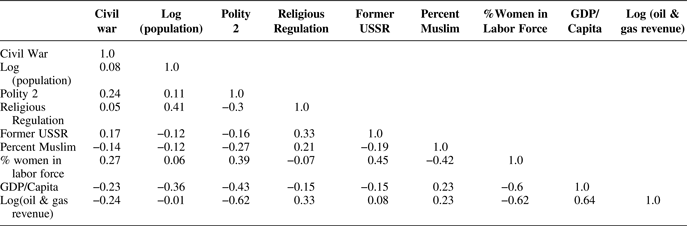
We also include a variable controlling for the percentage share of Muslims in a country. Cherif (Reference Cherif2010) suggests that the number of Muslims in a country is negatively correlated with gender equality. We also control for whether the country is a post USSR country. Since many of these variables measure very similar aspects of how governments operate, we consider collinearity issues as well and note that almost every variable is not significantly correlated to another other than gross domestic product per capita and the oil and gas revenues variable. A correlation matrix of the variables used in the models is presented in Appendix A.
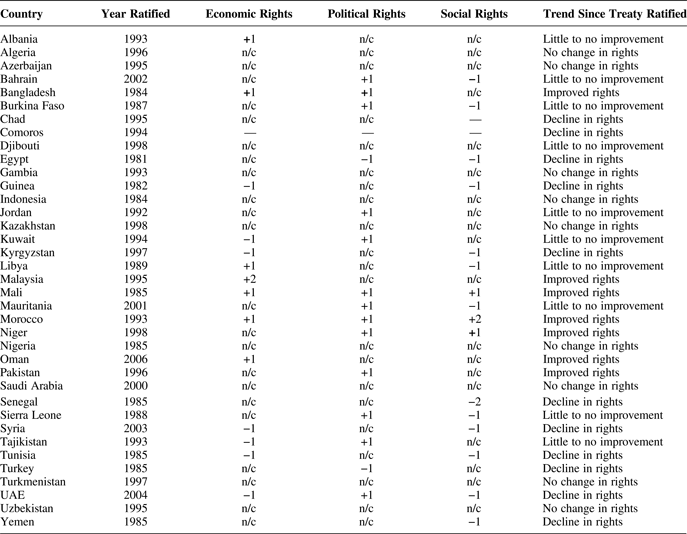
Table 1 provides a brief, descriptive cut at the data and the advancement or decline or women's economic, political, and social rights. As Table 1 indicates, post-USSR countries tend to have relatively stagnant human rights records, possibly due to economic crises or cultural factors that have to do with their communist histories. Smith (Reference Smith2007) also indicates that post-USSR countries tend to behave differently from out countries in terms of human rights compliance.
Change and Trend in Women's Rights after Ratifying or Acceding the CEDAW

Source: Cignarelli-Richards Human Rights Database.
Note: we omit Afghanistan and Iraq because of instability due to the U.S. led military activity. We also omit Iran, Somalia, and Sudan as they have never ratified the CEDAW.
RESULTS
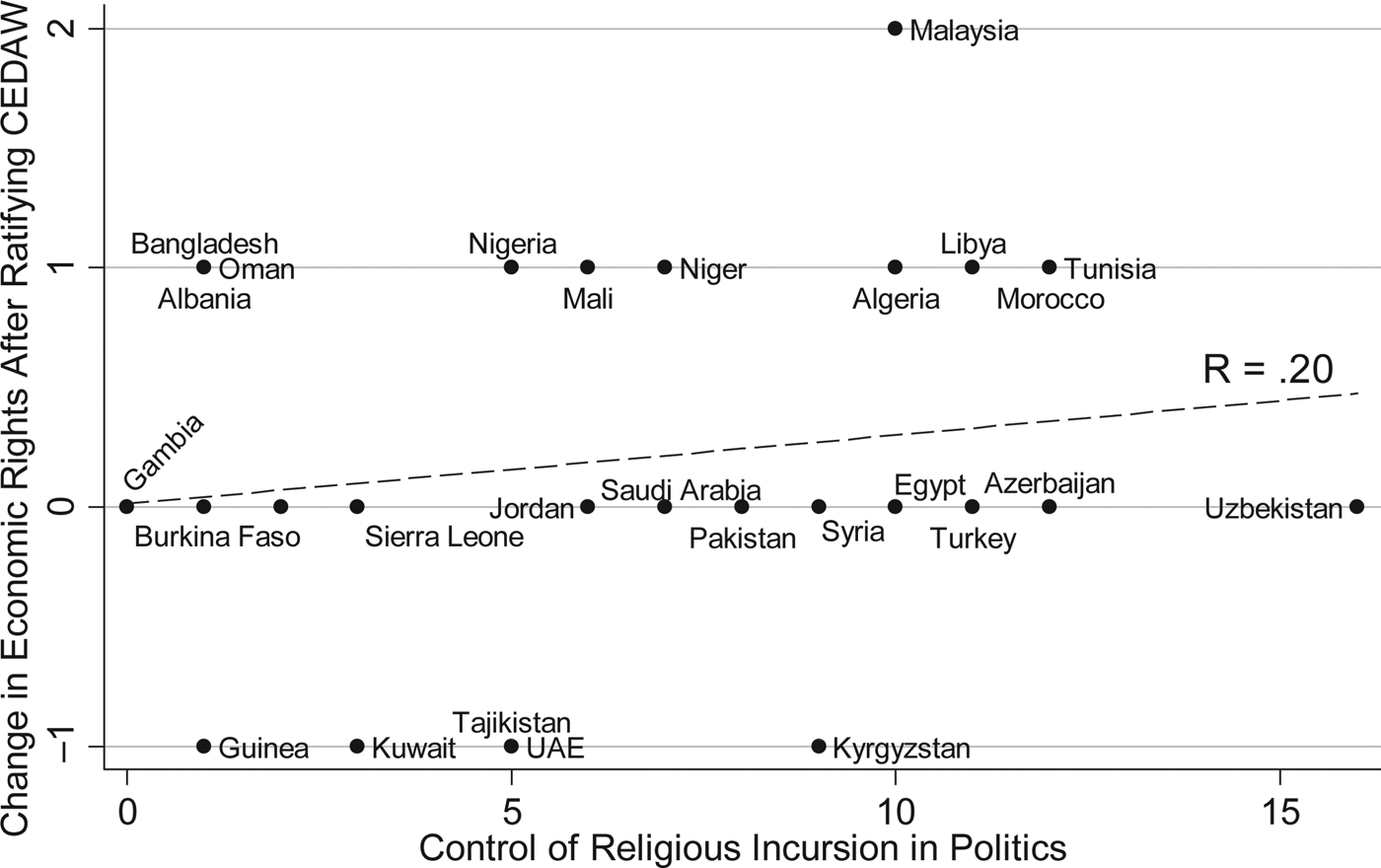
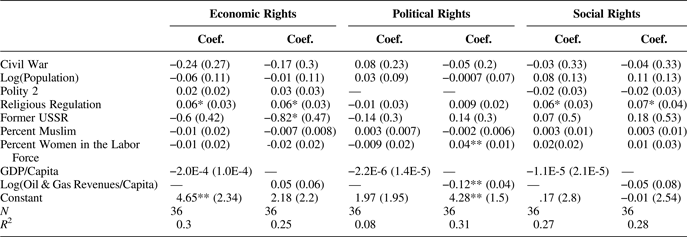
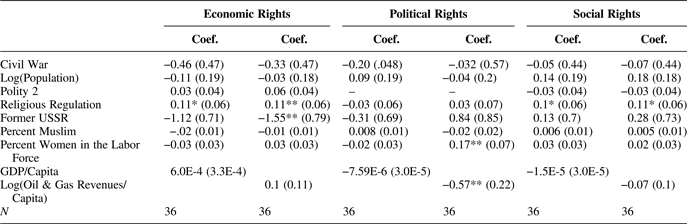
We test our hypotheses using ordinary least squares regression models. Table 2 presents the results of these three models.Footnote 8 Given that the gross domestic product and the oil and gas revenues per capita measures are highly correlated (at 0.66) we do not include them in the same model. Instead we run separate models for each dependent variable. In the first model, testing for what affects whether a Muslim country's record on women's economic rights improves, worsens, or stays the same, reveals that controlling religious participation in government significantly leads to an improvement of women's economic rights. Interestingly, in the first model that contains gross domestic product per capita, there are no other significant predictors. In the second model however, post-Soviet countries are less likely to improve economic rights for women. Given that there are no other significant predictors in this model, we examine the variable of interest in graphical form for simplicity. Figure 1 illustrates the bivariate relationship between the change in economic rights for women and control for religious incursion in government.
Change in Economic Rights vs. Control of Islamic Fundamentalism.
OLS Regression Model on Changing Women's Rights in Muslim Countries
Standard errors presented in parentheses.
*P < 0.1, **P < 0.05.
As the figure demonstrates, there is a linear relationship between controlling religious incursion in government and expanding economic rights for women. Furthermore, the relationship is positive and statistically significant at the 0.1 level. This suggests that countries that control their religious population, be it in government or the population, fare better on economic rights for women after ratifying the CEDAW. Surprisingly, none of the other control variables demonstrated a statistically significant relationship to a change in economic rights for women. We surmise that this is likely due to the unique, non-political nature of many of the rights that are measured in the CIRI variable.
In the second model, we examine what affects to what extent a Muslim country expands or contracts political rights for women. Based on the model, Ross's (2008) findings on women's political rights holds true, as larger percentages of women in the labor force yields greater change in political rights and higher oil and gas revenues per capita yield less change or even regression in political rights. Again, since the number of women in the labor force has a direct impact on their political participation and rights, these findings are indeed in line with previous findings.
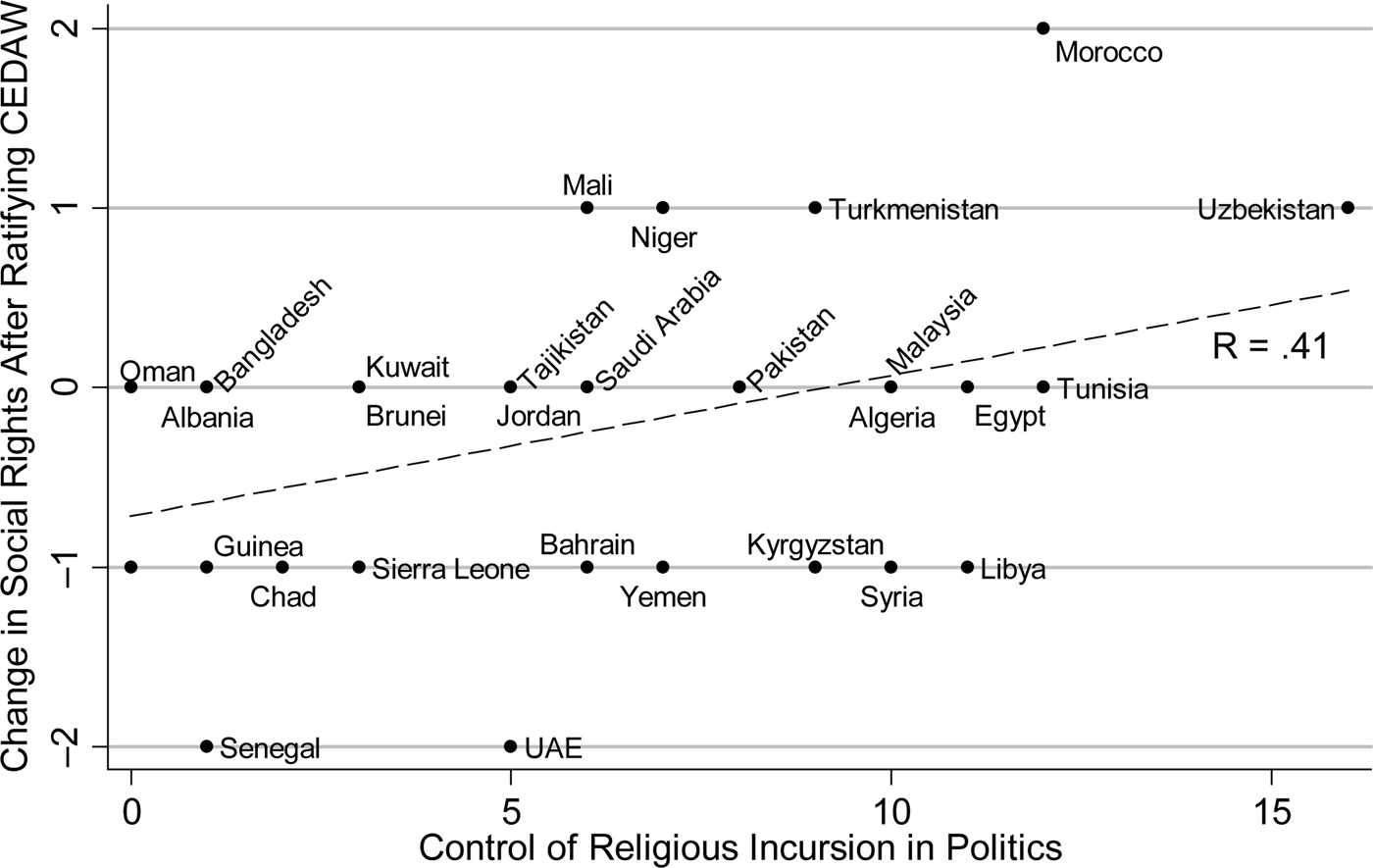
The third model, examining women's social rights in Muslim countries, finds that controlling religious incursion has a statistically significant effect on expanding social rights. This is likely because of the effect that controlling fundamentalism has at the micro level, where much of the social discrimination of women takes place. By controlling not only religious parties and politicians but fundamentalist activity as well, governments prevent or reduce atrocities and other social problems that occur outside of the government's legislative powers. Again, given the nature of the model and that no other variables had a significant effect; we examine this more in depth using a bivariate graphical presentation. Figure 2 illustrates the relationship between controlling religious incursion in government and the change in social rights for women.
Change in Social Rights vs. Control of Islamic Fundamentalism.
Here we see that there is a strong linear relationship between controlling for fundamentalist religious incursion and the expansion of women's social rights.
Interestingly, in all three models, the percent Muslim in a country had no effect on whether a country's human rights record on gender equality improved or worsened. While this may suggest that dynamic representation occurs less in Muslim countries, it is difficult to make this claim without public opinion data or without including non-Muslim countries into the analysis.
Furthermore, post-Soviet countries are exceptional only on economic rights, which supports what Smith (Reference Smith2007) finds. Finally, as mentioned earlier, due to the fact that many countries in the Middle East are exceptional in terms of their gross domestic product per capita due to large oil reserves and general prosperity, economic development's effects on human rights compliance are largely overshadowed.
CONCLUSIONS
To summarize what we found in the statistical models used to examine CEDAW compliance in Muslim countries, we find that controlling Islamic religious influence on government significantly increases women's economic and social rights, while regimes that have higher percentages of women in the labor force and lower oil and gas revenues have higher increases in political rights. At the surface this may seem counterintuitive. Controlling Islamic religious incursion involves using extremely autocratic and anti-democratic measures which limit free speech, equality, and participation. However, as the literature on Shari'a law and human rights demonstrates, Islamic fundamentalism can be at odds with the basic tenets of democracy of equality and participation. As a result, it makes sense to see that countries that limit the effects of anti-democratic forces, such as Islamic fundamentalists who wish to impose Shari'a, possess better human rights records than countries that allow these groups to have an equal say in the policy process.
Still, democracy is not to be dismissed. When it comes to participation, our models indicate that controlling fundamentalists does little to expand political rights for women. Instead, indicators of strong democracies like the percentage of women in the labor force do lead to strong political rights for women. Moreover, while the relationship is weak, it is positive and statistically significant. This finding is consistent with Hathaway's (2010) findings on treaty commitment in democracies and Simmons' (2009) findings that democratic states may want to avoid committing to human rights treaties because rights saturation while those in transitional states may be more likely to improve their rights records.
Normatively, it is difficult to argue however that the best way to expand women's rights is through repressive regimes. However, this is not the argument in this paper. To explain more thoroughly, Muslim countries that restrain religion are similar to Madison's fear of the tyranny of the majority, or in the case of Muslim countries, tyranny of the Islamic fundamentalists. As a result, we feel this is an emerging topic of research. Specifically, it is unclear whether Muslim countries that limit fundamentalism are simply protecting the minority, or putting themselves on a path of repression, similar to Egypt's old regime and the Muslim Brotherhood. In any case, limiting the influence of religion, and as a result the influence religious fundamentalism, seems to be the key to the expansion of women's rights in Muslim countries.
Correlation Matrix of Variables
Ordered Probit Predicting Change in Women's Rights in Muslim Countries