





Introduction
Sufficient supply of medical equipment is essential to perform medical care for sick and wounded in crisis, disaster, and war. 1–Reference Marsh and Hampton3 Contingency planning for the health care system includes large-scale storage, the ability to scale-up production, and robust logistics. 1,Reference Ann-Sofie Stenerus, Lindgren and Larsson4–6 Shortage of medical supply is a major problem for the health care system in wartime. Reference Dzhus and Golovach7–Reference Haque, Naeem and Wang9 During the COVID-19 pandemic, health care systems were compelled to rapidly adopt methods for cleaning and reusing medical supplies. 10 In contrast, Sweden maintained extensive emergency stockpiles and had a well-prepared capacity to transition to domestic production of critical medical supplies during the Cold War. In light of the deteriorating global security situation, Sweden and other countries rebuilt the civil defense, including enhancing the health care system’s resilience and operational endurance. Reference Kullgren2,11 Despite adequate preparedness planning, single-use medical equipment may still become depleted during crises or armed conflicts. Reference Chevalley, Zimmerman and Mittendorf5,10 Changes in clinical protocols, strict prioritization, rationing, and the repurposing of applicable equipment may be required. Reference Kullgren2,12 In the face of an impending disaster, reprocessing and reusing single-use items may become the only viable option. Reference Kullgren2,10–12 During wartime, such practices might need to be carried out under rudimentary and field-like conditions - even within hospital settings.
The practice of reprocessing single-use medical devices (SUDs) has historical roots in resource conservation and cost-efficiency measures dating back to the 1950s. In the United States, the Food and Drug Administration (FDA; Silver Spring, Maryland USA) permits reprocessing under strict regulatory conditions, requiring third-party reprocessors to adhere to the same standards as original manufacturers. 10,Reference Ubaldi13 Within the European Union, reprocessing is allowed but regulated under the Medical Device Regulation (MDR) 2017/745, which requires national legislation to define responsibilities and safety criteria. Advantages of reprocessing include significant cost savings, reduced environmental impact, and extended utility of high-cost devices. However, concerns persist regarding the safety, functionality, and risk of cross-contamination, especially in the absence of standardized validation protocols. Common reprocessing methods include manual or automated cleaning, chemical or steam sterilization, and functional testing. The effectiveness of these processes depends on the material, design, and intended function of the device. 10
There appears to be a lack of scientific evidence supporting simple, field-adapted techniques for the decontamination of single-use medical equipment. This study aims to compare various basic cleaning methods that could serve as emergency alternatives in disaster or wartime scenarios.
Method
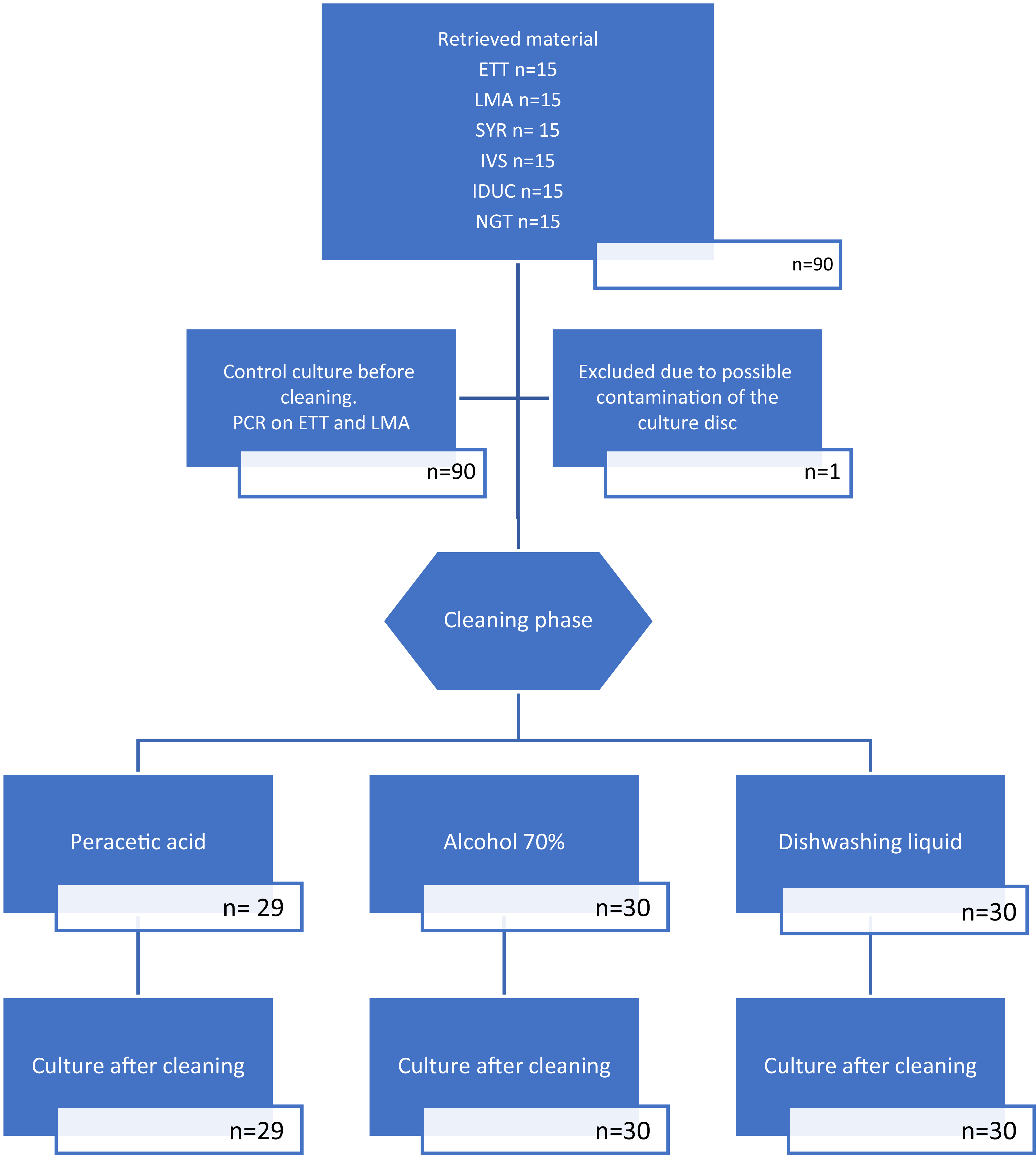
Single-use medical devices were collected after clinical use on patients who had undergone general surgical, orthopedic, urological, or gynecological procedures in the operating theatres of a regional hospital. Cleaning procedures were conducted in a soiled utility room adjacent to the operating unit, simulating realistic crisis- or wartime-like conditions, and were performed by three study-team members without prior training to further reflect contingency environments. The study evaluated three cleaning methods: over-the-counter dishwashing detergent, peracetic acid (PAA), and 70% ethanol. Six commonly used SUDs were selected: endotracheal tubes (ETT), laryngeal mask airway (LMA), syringes (SYR), infusions set (intravenous administration sets [IVS]), indwelling urinary catheters (IDC), and nasogastric tubes (NGT). Ninety single-use items were collected and cleaned, distributed equally among the three cleaning method groups (Figure 1). The sample size of the study was based on the available project funding.
Study Outline.
Abbreviations: ETT, endotracheal tube; LMA, laryngeal mask airway; SYR, syringe; IVS, intravenous administration set; IDC, indwelling urinary catheter; NGT, nasogastric tube.

Figure 1. Long description
The flowchart begins with the retrieval of various medical materials, including ETT, LMA, SYR, IVS, IDUC, and NGT, each with 15 units. A control culture is performed before cleaning, with PCR on ETT and LMA, involving 90 units. One unit is excluded due to possible contamination. The process then moves to the cleaning phase, where the materials are divided into three groups for different cleaning methods: Peracetic acid, Alcohol 70 percent, and Dishwashing liquid. Each group undergoes a culture after cleaning, with 29 units for Peracetic acid and 30 units each for Alcohol 70 percent and Dishwashing liquid.
Pre-cleaning microbiological samples were obtained using a standard microbiological swab, which was swabbed repeatedly across both the internal and external surfaces of all devices. Items were then manually brushed with a dish brush for 30 seconds in a 10-liter plastic container filled with the designated cleaning agent. Following brushing, the devices remained immersed in the cleaning solution for ten minutes. The washed equipment was then left to air dry in the room for ten minutes before post-cleaning samples were collected.
The primary outcome measure was the change in viable bacterial load, determined semi-quantitatively, comparing the pre-cleaning and post-cleaning cultures. Secondary outcomes included analysis of 28 known human airway pathogens by Polymerase Chain Reaction (PCR) testing in airway devices before and after cleaning and device function following use and cleaning. Function and structure integrity of the cleaned devices were controlled by three members of the study team.
Peracetic Acid (PAA)
Peracetic acid is a strong oxidizing agent that acts by denaturing proteins and disrupting the cell wall, leading to rapid microbial inactivation. It is effective against a broad spectrum of micro-organisms including bacteria, viruses, fungi, and spores, even in the presence of organic material. Peracetic acid is a highly effective option for reprocessing a range of semi-critical medical devices, especially when heat sterilization is not feasible. It is primarily used for high-level disinfection and sterilization of heat-sensitive, immersible medical devices, for example flexible endoscopes. Reference Juwarkar14–Reference Sabir and Ramachandra17
Ethanol 70%
Ethanol at a 70% concentration acts by denaturing proteins and disrupting microbial cell membranes, resulting in rapid inactivation of most vegetative bacteria, fungi, and enveloped viruses. However, it is not sporicidal and exhibits limited efficacy against non-enveloped viruses. It is classified as a low-level disinfectant and is primarily used on non-critical items that contact intact skin or environmental surfaces. Reference Juwarkar14–Reference Sabir and Ramachandra17 Ethanol is widely available, has a broad range of applications beyond disinfection, and could likely be produced in large quantities locally in the event of a crisis or war.
Dishwashing Detergent
As the third cleaning method, an over-the-counter dishwashing detergent was chosen due to its wide-spread availability, making it a potential option in dire emergency situations when no other cleaning agents are accessible for reprocessing single-use items. For this study, YES dishwashing detergent, manufactured by a major international producer (Procter & Gamble; Cincinnati, Ohio USA), was selected. According to the manufacturer’s recommendations for manual dishwashing, a dilution of 4.0 mL detergent per 10-liters of warm water was used. Reference Rutala and Weber18 The wash water was maintained at a temperature between 40°–60°C. It was replaced if the temperature dropped below 40°C or if the water appeared visibly turbid.
Culturing, Sampling, and Microbiological Analysis
Samples were collected from each device before and after cleaning in a standardized manner using eSwab (Copan; Brescia, Italy).
Samples were transported to the microbiology laboratory within four hours of collection, where they were stored at 8°C for a maximum of 16 hours before culturing. All samples were inoculated on chocolate agar, a lysed blood agar used for cultivating fastidious bacteria: (40g Columbia agar [E&O Laboratories Ltd.; Bonnybridge, Scotland] in 1L deionized water was sterilized at 121°C for 15 minutes; at 60°C, 82ml defibrinated horse blood [Håtunalab AB; Bro, Sweden] was added, the solution was heated to 69°C for 10 minutes, and cooled to 42°C before 100ml horse serum [Håtunalab AB] was added). Samples from devices where strictly anaerobic bacteria may be present (ETTs, LMAs, and NGTs) were also cultured on Fastidious Anaerobe Agar (FAA): (46g FAA [E&O Laboratories Ltd] in 1L deionized water was sterilized at 121°C for 15 minutes; at 42°C, 53ml defibrinated horse blood [Håtunalab AB] was added). The chocolate agar plates were incubated aerobically with the addition of 5% CO2 for 48 hours and the FAA plates were incubated anaerobically for 48 hours.
Semi-quantitative assessment of bacterial growth was performed using 10-fold concentration intervals. The actual bacterial load was calculated as Colony-Forming Units (CFU)/ml. No species identification was done.
Extraction of bacterial and viral nucleic acid was performed on an EZ1 advanced XL or EZ2 connect MDx, using EZ1&2 virus mini kit (Qiagen; Hilden, Germany). The input volume was 200µl, with the addition of 10µl PhHV and 60µl EAV (Equine Arteritis Virus; internal PCR positive controls) and the output volume was 90µl. The PCR testing was performed in a viral reaction containing 2.9µl molecular grade water, 4µl reaction mix (LightCycler Multiplex Ribonucleic Acid [RNA] Virus Master – Roche; Basel, Switzerland), 0.1µl polymerase (LightCycler Multiplex RNA Virus Master; Roche), and 3µl primer and probe-mix (LightMix ModularDX Kit; Roche) as well as a bacterial reaction containing 3µl molecular grade water, 4µl reaction mix (LightCycler Multiplex Deoxyribonucleic Acid [DNA] Master; Roche), and 3µl primer and probe-mix (LightMix ModularDX Kit; Roche) on a LightCycler480 (Roche). The PCR-program was initiated with a reverse transcriptase step at 55°C for five minutes and an initial denaturation at 95°C for five minutes, followed by 45 cycles comprising 95°C for five seconds, 60°C for 15 seconds, and 72°C for 15 seconds.
For Staphylococcus aureus (S. aureus), Klebsiella pneumoniae, Hemophilus influenza (H. influenza), and Streptococcus pneumonia, the cut-off value for positivity was cycle threshold (CT) 33. To determine positivity for the remaining targets, an expert laboratory technician evaluated the combination of the shape of the PCR-curve, the CT-value, and the internal positive control.
Statistical Analyses
Comparisons of cleaning efficacy (defined as pre-cleaning culture minus post-cleaning culture) across the three different cleaning methods (PAA, ethanol 70%, and dishwashing detergent) were carried out using non-parametric tests suitable for comparing more than two independent groups with ordinal data. The overall difference in median cleaning efficacy across the three groups was assessed using the Kruskal-Wallis H-test. In the event of a significant overall finding, Wilcoxon rank-sum tests were employed for subsequent pairwise comparisons. The resulting P values from the pairwise comparisons were adjusted using the Benjamini-Hochberg (BH) procedure (False Discovery Rate control) to account for multiplicity. The effect size, r (rank point-biserial correlation), was calculated and the 95% Confidence Interval (CI) for r was estimated using the Percentile Bootstrap method (1,000 resamples). A significance threshold of P < 0.05 was applied to determine statistical significance.
All statistical analyses were performed using IBM SPSS Statistics, version 29 (IBM Corp.; Armonk, New York USA). Data entry, storage, and preliminary data handling were performed using Microsoft Excel (Microsoft Corp.; Redmond, Washington USA). Visual figures were made in Microsoft Word and GraphPad Prism version 8 (Dotmatics; Boston, Massachusetts USA).
Ethical Approval
This study was conducted in accordance with the ethical principles and regulatory requirements stipulated under Swedish law. The devices had been used during routine clinical care before disposal, but no information about the patients or procedures was collected, linked, or analyzed. Formal ethical review was therefore not required. As the research did not involve any intervention on human participants, collection of human biological specimens, or use of identifiable personal data, it was classified as non-human subject research by the Swedish Ethical Review Authority (Government Offices of Sweden; Stockholm, Sweden).
[Editor’s Note: The Director of the Centre for Disaster Medicine at the University of Gothenburg (Sweden) has confirmed that no patient contact occurred, no patient data were recorded or accessible, and no traceable human biological material was collected, stored, or analyzed. The Director has provided written confirmation that the authors contacted the Swedish Ethical Review Authority, which confirmed that under Swedish law, the research is considered non-human subject research and exempt from need for formal ethical approval.]
Results
Ninety single-use items, distributed equally among the three cleaning method groups, were collected and cleaned. The overall efficacy of the cleaning methods demonstrated a statistically significant reduction in bacterial load: r = −0.87; P < 0.001; 95%CI (−0.92 to −0.81). No statistically significant differences were found when comparing the cleaning methods with one another. Ethanol versus PAA showed no significant correlation: r = −0.06; 95%CI (−0.24 to 0.12); adjusted P = 0.85. Ethanol versus dishwashing detergent also showed no significant correlation: r = −0.00; 95%CI (−0.18 to 0.17); adjusted P = 0.85. Finally, PAA versus dishwashing detergent resulted in a non-significant correlation: r = 0.06; 95%CI (−0.13 to 0.23); adjusted P = 0.85 (Figure 2).
Viable Bacterial Growth Before and After Cleaning Across All Tested Cleaning Methods and Single-Use Device Types.
Note: Results are expressed as colony-forming units (CFU).

Prior to cleaning, PCR analysis revealed that slightly more than one-half of the airway device samples (16/30) were negative, while the remaining samples (14/30) were positive. The most frequently identified pathogens were H. influenzae (30%) and S. aureus (23%), alongside a few other common upper respiratory tract pathogens. Several samples contained multiple microbial agents. After cleaning, all PCR tests were negative across all cleaning methods.
Following cleaning and microbiological culture, each item underwent macroscopic inspection and functional assessment. All reprocessed single-use devices were deemed unremarkable and fully functional upon inspection.
In the analysis of infusion sets and syringes, indications of potential cross-contamination from the washing fluid were observed, although this finding was likely of limited or no clinical relevance. To address this concern, the experiment was repeated using a new set of used syringes and infusion sets, which were cleaned separately, without concurrent reprocessing of other equipment such as airway devices in the same container. The underlying patterns appeared consistent, and potential cross-contamination was not evident, with low or no viable colony counts observed across all cleaning methods (Figure 2).
Discussion
The principal finding of this exploratory study is that used single-use emergency equipment, even when subjected only to pragmatic cleaning procedures with easily accessible agents under field-like conditions, demonstrated a marked reduction in microbial viability. All three tested methods significantly reduced the bacterial load, with no substantial differences observed between them. These results collectively suggest that simple and readily implementable cleaning strategies to enable reuse of single-use emergency equipment may provide a feasible, though limited, contingency option for mitigating microbial contamination when access to new equipment is severely constrained.
These findings are consistent with previous reports demonstrating microbial reduction on reprocessed single-use devices under experimental conditions. Reference Ubaldi13,Reference Rutala and Weber15,Reference Rutala and Weber18 This study extends the existing literature by employing a pragmatic design that simulated real-world conditions and by including equipment collected following genuine clinical use, thereby strengthening ecological validity. Importantly, the observed effects align with earlier studies on common cleaning agents. Ethanol at concentrations of 60%-90% has repeatedly been shown to effectively inactivate bacteria and enveloped viruses, albeit without sporicidal capacity. Reference McDonnell and Russell19 Similarly, PAA has demonstrated broad antimicrobial activity, including sporicidal effects, and has long been employed for high-level disinfection of semi-critical equipment such as endoscopes. Reference Rutala and Weber15,Reference Rutala and David16 Even simple detergent-based cleaning has been reported to substantially reduce microbial burden through mechanical removal, although it lacks sterilizing capacity. Reference Juwarkar14,Reference Sabir and Ramachandra17 Taken together, these prior findings support the present study’s observation that basic cleaning interventions can markedly lower contamination, even though they cannot be equated with sterilization.
Given that IVS and SYRs have direct access to the bloodstream and are therefore subject to exceptionally high demands for sterility, the observation of potential cross-contamination when these items were cleaned together with airway devices warrants consideration. Although the clinical significance of this finding remains uncertain, it underscores the importance of reprocessing such high-risk devices separately, whenever possible, to further reduce the likelihood of inadvertent contamination.
The implications of these results must be situated within the broader context of perioperative practice and health system preparedness. In Sweden, as in many high-income health care systems, perioperative care currently relies heavily on single-use equipment, having largely replaced reusable devices that were designed for repeated cleaning and sterilization cycles. While this shift has enhanced workflow efficiency and sterility assurance, it has also created a vulnerability: reliance on uninterrupted supply chains. The COVID-19 pandemic starkly highlighted this fragility, with shortages of essential disposable items emerging within days of disrupted logistics. 1 Similar concerns have been raised in national inquiries on health care preparedness, underscoring the need for resilient supply strategies. Reference Kullgren2,10 From an international perspective, both military medicine and humanitarian response literature highlight the critical role of supply resilience and the potential necessity of improvisational measures during large-scale conflicts. Reference Marsh and Hampton3,Reference Dzhus and Golovach7,Reference Haque, Bukhari and Fiedler8
It is important to emphasize that reprocessing of single-use equipment should be regarded only as a last-resort measure in extraordinary scenarios. Before considering reprocessing, health care systems should first exhaust other strategies, including modification of treatment guidelines, rationing and prioritization of materials, and substitution with available multi-use equipment. Only once these measures have proven insufficient might temporary and carefully supervised reprocessing of single-use devices be considered as a crisis-driven contingency to maintain basic care capacity. 10
Strengths of this study include its pragmatic design, its realistic simulation of field conditions, and the use of equipment collected after actual patient care, thereby enhancing both clinical relevance and external validity. Collectively, these findings provide novel insight into the feasibility and limitations of reprocessing single-use equipment as an emergency measure, while underscoring the need for robust preparedness planning.
Future studies should investigate the influence of different cleaning agents and protocols, manufacturer-specific designs, material characteristics, and the cumulative effects of repeated reprocessing on both microbiological safety and device performance. Priority should also be given to establishing standardized protocols and evaluating patient-centered outcomes. Ultimately, strengthening preparedness requires balancing innovation and pragmatism with evidence-based safeguards, ensuring that emergency reprocessing of single-use equipment remains an exceptional rather than routine practice.
Limitations
This investigation is subject to several limitations that warrant careful consideration. First, the tested materials were unlikely to harbor biofilm. Given that biofilm formation substantially alters microbial resilience and disinfection efficacy, the findings may not be directly extrapolated to clinical scenarios involving indwelling devices with prolonged dwell times, such as ETTs used in intensive care. Second, the study did not incorporate patient-related outcome measures, thereby precluding conclusions regarding the clinical effectiveness or safety of the examined cleaning procedures. Third, viral contamination was assessed only for a limited subset of viral species, which constrains the generalizability of the results to a broader virological spectrum. Finally, each device underwent only a single use-clean-test cycle. The study therefore cannot assess the cumulative effects of repeated reprocessing, including progressive material degradation, changes in mechanical performance, alteration of device surfaces or lumens, residual chemical build-up, or residual biological material that might accumulate after multiple cleaning cycles. Such cumulative effects may be particularly relevant in prolonged crises, disasters, pandemics, or wartime settings, where single-use devices may be reused repeatedly because of supply shortages.
Conclusion
This exploratory study demonstrates that simple cleaning procedures with readily available agents can substantially reduce microbial burden on used single-use emergency equipment under field-like conditions. However, such reprocessing should not be considered a substitute for conventional sterilization or validated infection control practices. Reference Rutala and Weber15,Reference Rutala and Weber18 Rather, it must be viewed strictly as a last-resort measure in crisis, disaster, or armed conflict - only to be implemented once alternative strategies such as modified clinical guidelines, rationing of supplies, and the use of multi-use devices have been exhausted. Reference Kullgren2,10
Acknowledgement
The authors thank the staff of the Departments of Anesthesiology, Microbiology, and Molecular Biology at Ryhov County Hospital (Jönköping, Sweden) for their valuable contributions to item collection and microbiological analyses.
Author Contributions
All authors contributed in the study design. Karl Chevalley (KC), Knut Taxbro (KT), and Göran Sandström (GS) collected single-use medical items, performed pre- and post-cleaning sampling, and carried out the cleaning procedures. Functional and structural integrity of the cleaned devices was assessed by KC, KT, and GS. Microbiological analyses were performed by Sara Mernelius (SM) and Peter Sigfridsson (PS). Statistical analysis and data compilation were conducted by KC and KT. KC drafted the manuscript, and all authors contributed to the interpretation of data, manuscript revision, and approval of the final version.
Competing Interests/Funding
Karl Chevalley - No conflicts of interest. Knut Taxbro - No conflicts of interest. Sara Mernelius - No conflicts of interest. Peter Sigfridsson - No conflicts of interest. Göran Sandström - No conflicts of interest.
This work was supported by Futurum – The Academy for Health and Welfare, Region Jönköping, Sweden; the Centre for Disaster Medicine, University of Gothenburg, Gothenburg, Sweden; and The Swedish Military Medical Association.
Use of AI Technology
AI were not used for constructing the manuscript.


 Open access

