Introduction
This article is an exploration of some of the strategies used in Iranian art to combat censorship: it takes as its focus the paintings of a recently deceased contemporary artist Alireza Espahbod (1951‒2007). Some of these strategies can be traced to the practice of surrealism, which, as I have argued elsewhere, has been influential in the modern Iranian art milieu.Footnote 1 The appeal of surrealism is primarily that it promises social and sexual emancipation, which is something Iranians have long been taught to treat as specifically forbidden. It hardly needs saying that censorship has always been present in modern Iranian history, but a particular emphasis has been put on this since 1979.Footnote 2 Of all revolutions in history, this was perhaps one of the most intrusive invasions of the intimate psychological and physical space of the person: Espahbod’s work displays a range of styles and techniques that have been developed over decades as a reaction to the pressures and restrictions of proscriptive state censorship.
When surrealism arrived in Iran it took on a life of its own, and developed with a character distinct from the French form of surrealism that had started in Paris in the 1920s. It was Iranian literature, not visual art, that had first been affected by the European surrealist movement, mainly through The Blind Owl, the novel by Sadegh Hedayat, first published in India in 1936. However, the seeds of surrealist ideas in Iran did not arrive until the early 1950s, with the formation of the avant-garde “Cock Fighting Society”;Footnote 3 and it was not until the 1960s and 1970s that they blossomed in visual art and cinema. The common metaphors of the process of cultural reception and development are largely inadequate: to speak of it as an “importation” or “borrowing,” for example, is misleading. Perhaps a horticultural metaphor of transplantation or hybridization gives a clearer image of this abstract phenomenon, as it reflects the fact that there was a long time-lag between first germination, when there was contact with surrealist ideas in Europe, and its subsequent growth. From a comparison of Iranian surrealist art with that of the surrealist movement in Paris, one can see that Iranian artists were predisposed to understanding European surrealism according to their previously established Iranian traditions and styles.Footnote 4 In contemporary Iran, surrealism is now one among many different artistic styles which are thought of as translated importations from abroad. It is found as honar-e elteqāti (“eclectic art”). Surrealism is part of the palette of a new art, even though it is often unacknowledged by the artist. Its significance is that it is arguably the most dynamic and expressive element in postmodern Iranian art.
As has just been said, the reception of surrealism should not be thought of in terms of an importation, i.e. in the metaphor of cargo. As with the concept of “modernity,” it is much too easy to reify what is already an abstract concept into meaninglessness. Surrealism is perhaps best understood as an artistic language, with a body of work (i.e. the art of the surrealists), that may be “translated”—rendered into the Iranian cultural context. This is because, whereas there may be a sense of cultural ownership of a commodity, languages are recognized as existing in a state of equivalence with one another: that is, there is a ready condition of translatability between languages. Speaking between cultures precedes trade of commodities, and thus facilitates trade: language per se is not necessarily implicated in a politics of cultural superiority and inferiority. It is true that dominant languages exert power over minority languages, but that is not relevant to the point here, which is that surrealism is not a copyrighted intellectual property registered by an Apollinaire or a Breton. It is not a commodity at all, but a language of expression. Thought of in this sense, the pitfalls of essentialism may be avoided.
To return to the specific subject of this essay, one of the chief characteristics of Alireza Espahbod’s works, according to his contemporaries, speaking at the time of his death, was that he had been inspired by current social realities, and that he represented them in his figurative forms. It was specifically said that most of his paintings were surrealist with a human aspect.Footnote 5 Part of the attraction of the genre of surrealism for Iranian artists is that it provides a complex coded language, or encryption, of messages. Espahbod was a master of this coded artistic language that could encrypt information in such a way that only certain parties could read it. Throughout history, art has played an active role in conveying messages to select parties by the very fact of its imagery being, like instrumental music, non-verbal and largely non-conceptual. However, unlike music, its imagery offers the sender of such messages a rich language of metaphorical encoding. There is one other important element in painting that gives it an enhanced functionality to combat censorship, in the very ambivalence of its medium being silent but visually articulate. Like poetry, in which verbal metaphors convey a greater range of meaning than literal language, so painting also uses the ambiguity and polysemic capabilities of images to act as visual metaphors. This fact alone also gives painting an affinity to poetry that is well documented in the history of Iranian culture. Such an affinity to poetry is one of the most striking aspects of Espahbod’s work, as will be discussed below.
Censorship and Art in Iran
Although state censorship has attempted systematically to filter and control creativity in the arts in Iran since the revolution, paradoxically it has had the effect of spawning and even stimulating artistic creativity. The artist circumvents censorship of art by art, and so the Islamic Republic of Iran has unintentionally nurtured the growth of artistic expression, including its surrealist manifestations.Footnote 6 As new codes are needed to outwit and outmaneuver the censor, artists use multiple forms of ambiguity in their work to convey their messages. They may have been unable radically to change the state system, but some have navigated their way around censorship through the use of surrealist elements in their art works. In recent decades, artists have been obliged to deal with the phenomenon of state censorship in a number of different ways. Typically their work is either displayed in “legitimate” exhibitions in a censored form, or it is not exhibited at all. A third response, which is beyond strict control, is that artists take the risk of expressing themselves freely and exhibit where they choose—either in “independent” galleries, or “underground,” that is unofficially, bypassing direct government controls, and nowadays also through the Internet. This rebellious response by certain Iranian artists somewhat resembles that of the European surrealist writers and artists of the early twentieth century and of the counterculture of later decades around the world. This is not to say that surrealism in Iran is the same as Western surrealism. In Iran, it must be said emphatically, surrealism is found as just one among several different artistic influences, some indigenous to Iran, some imported from the West. Pragmatism is the watchword in Iran today, not idealism. Surrealist approaches and techniques offer the artist an extensive palette of opportunities to evade and confuse the censor but, perhaps more importantly, they also convey an attitude of contempt for authoritarianism.Footnote 7
From the early period of the Islamic Republic, June 1980 to be precise, artworks in all genres had to be submitted to the office of the Ministry of Culture and Islamic Guidance (MCIG), in Persian Vezārat-e Farhang va Ershād-e Eslāmi, for scrutiny and monitoring. (The exception to this is dance, which has been removed altogether as an art form in Iran, judged to be illegitimate, corrupting and decadent.) After receiving their permit (mojavvez) from the MCIG, which might take from a week to a year or more to obtain, the artwork can be displayed: for example, a book or music album may be published, a public exhibition, theatrical or musical performance may take place or, in the case of a film, shooting may commence. If the MCIG denies such a license, work must stop. In the case of visual art exhibitions, it is now the responsibility of private galleries to check the works before an exhibition is permitted to commence. If it were judged that there was a possibility of a problem arising in the future, in respect of the acceptability of the works, the blame would be put on the gallery by the MCIG. This procedure first started during the reform period (1997‒2004), although the matter was revisited after the period 2005‒14. In comparison with theater and cinema in particular, visual art has a much better chance of realization, since it is more likely to find an audience, whether or not it has a license, so long as one does not wish to exhibit in an official state-authorized show. In the case of an artist as well known to the authorities as Espahbod, once his work was banned, the nature of the content became less important a consideration than the fact of his notoriety as a dissident. Although censorship guidelines seem to have changed periodically over the past thirty-five years, as the temperature of Iran’s political circumstances has fluctuated, censorship has exerted a constant pressure on Iranian artists in respect of how they can express themselves. The lack of clear and precise published guidelines, it would seem, is itself part of the strategy of the authorities in dealing with artists in any medium—for non-declaration of precise criteria allows the MCIG to have a freer hand to condemn or approve works of art or productions and performances. Conversely the very vagueness of the criteria allows the artist to push back the boundaries of what can be depicted and put on display.Footnote 8 Comparison with the situation of Iranian cinema might be thought relevant here, but in fact each medium is answerable to its own particular type of censorship. In the case of cinema, because by definition it is a moving medium, the director can much more easily allude to things that happen in the imagination, whereas painting is commonly seen as graphically more fixed, and therefore more explicit and obvious in its allusions—though surrealist strategies have helped such artists combat a literalistic interpretation.
In terms of their negotiation with censorship there are three distinct groups of Iranian artists:
-
1. Those who have adjusted themselves to the prevailing climate of censorship, and work according to the regulations, so far as they can be ascertained.
-
2. Those who have not been prepared to abide by restrictions at all, and therefore put themselves into a state of self-exile by leaving the country.
-
3. Those who circumvent censorship, whilst remaining in Iran.
This last group operates primarily in two ways: (a) by concealing their “real” messages and using misleading elements as camouflage; and (b) by keeping a distance from official audiences, while expressing themselves freely to “alternative” audiences. If these artists were living in a free society they would not necessarily be seen as outrageous or controversial, and thus become politically “hot.” The context of the work is everything: a photograph of a nude female or male in a London gallery is unremarkable. In a Tehran gallery the same picture is not unthinkable, but it would very likely close the show and put the gallery owners and curator in jail. This point has been made in another way by Mahmood Karimi-Hakak:
In “solitary art,” such as painting, writing, and photography … [t]he painter may paint, the writer may write, and the photographer may photograph whatever they like; as long as the work is not publicly exhibited they probably will not be censored. But in collective work like the theatre, censorship takes place at all three stages.Footnote 9
This may be true, but few artists, whether painters, writers or photographers, would wish to have their works concealed from the public gaze and kept as “solitary.”
A Veiled Society
The subject of veiling features strongly as a political symbol in Iranian art. When a society’s laws stipulate that women must be more or less completely concealed by clothing, it suggests not only that that society is oppressive of women’s rights, but also it raises the question of why men should be prevented from seeing, and in all respects separated from, women. According to Afsaneh Najmabadi, “if we use gender analytically, sources about men are also sources about women.”Footnote 10 The reverse is also true in the analysis of sources about women: they are true of men too. And this reveals, as some scholars have shown, that society is suffering from forms of sexual anxiety that go beyond merely relations between men and women. The woman is a secret to be discovered, unveiled and revealed, or on the contrary, covered, veiled and concealed. This legislation, therefore, does not affect merely women’s physical bodies: it is symbolic of control over society’s imagination about women and, by extension, over many other aspects of life which must be kept secret and concealed.Footnote 11 According to Mary Douglas, women are an index of society’s control over its members, for “women are the gates of entry to the caste. Female purity is carefully guarded … Male sexual purity does not carry this responsibility.”Footnote 12 On the other hand, Farzaneh Milani has commented on how men are being veiled, not physically but metaphorically: “A society that veils its women is a veiled society. In other words, women are not the only ones veiled. Men are veiled, too.”Footnote 13 It might then be said that veiling of women is a major element in a more comprehensive attitude of censoring or concealing reality: the woman is transformed into a forbidden ideal, which must be either revealed for display, as a symbol of the opening up of society and its values, or concealed for the sake of protection (ostensibly of female modesty), as a symbol of control over society and its mores.
In the twentieth century both unveiling and re-veiling were successively imposed upon Iranian society and had an intrusive effect on several aspects of Iranian public and private life. In this period other objects of legislative control affected individual and collective life (such as alcohol, the media). However, the combined effect of the experience of Iranian women being forced by the edict of unveiling (in 1936), and then into re-veiling by revisionist edicts in the aftermath of the Islamic Revolution, would seem to be the creation of a complex social psychology which has had repercussions beyond the domain of Iranian women alone. Individuals of both genders, the family, the workplace and the city and society at large, have all been affected: the double reversal of the rules of propriety for women over the past half-century in Iran, in its extent and suddenness, is perhaps unparalleled in other societies. It has contributed to the phenomenon that has been described by the Iranian cultural theorist Dariush Shayegan as “cultural schizophrenia.”Footnote 14 It gives rise to the dilemma of the body being seen and unseen at the same time. Iranian visual art was enriched and developed by the need for the concealment of meaning in symbols and meanings that do not need to be censored: the veil, for example, can be a symbol of restraint, secrecy and suppression, but is also interpreted, by religious authorities and groups, as protection, modesty, innocence and virtue. The veil is the most significant index of the division of society into public and private domains: this division is reflected in contemporary Iranian art, as the symbol moves its referent between the two domains. It is a primary metaphor of concealment, and therefore of censorship also. It will be seen that in Espahbod’s works veiling and concealment are not concealed but displayed, and veils feature in many forms in his paintings—indeed there is in his work a certain frankness about the widespread practice of concealment and censorship that is normally denied, or is frowned upon, as an invention of those hostile to the authorities. In Iran there is no official term for “censorship”: it is called “guidance” (ershād). In the following discussion, examples will be given of how Espahbod has come to terms with the fact of this “guidance.”
The Response to Censorship in the Art of Alireza EspahbodFootnote 15
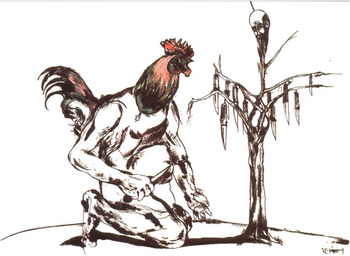
Alireza Espahbod was an extremely prolific artist, who ranged over a variety of styles, in a career of more than thirty years from the latter period of the Pahlavi monarchy to the most politically convulsive years of the Islamic Republic in Iran.Footnote 16 The significance of selecting a deceased artist for discussion in the present essay will not be lost on readers, considering the difficulties that may ensue from drawing attention to aspects of the work of contemporary artists living in Iran. It is appropriate to discuss him as a historical figure, to understand his strategies for evading censorship and restrictions in Iran. After he graduated from the Tehran Faculty of Decorative Arts in 1975, Espahbod studied for a postgraduate degree at Goldsmiths College, London in the late 1970s. According to one prominent Iranian art critic, he found his own particular surrealist way of painting, moving between social realism and conceptual art.Footnote 17 As an artist he remained in touch with his roots in fine art, rather than moving into populism and propagandist art. He is a good example of one who followed in the styles, but not the actual footsteps, of two artists related to each another, Bahman and Ardeshir Mohassess who each went into self-exile outside Iran. Bahman took refuge in Italy and Ardeshir in New York, but Espahbod remained in post-revolutionary Iran. He followed them in different ways, namely Bahman Mohassess in his mythological and theriomorphic iconography,Footnote 18 and Ardeshir Mohassess in his witty and expressive graphic style.Footnote 19 Espahbod’s work Untitled (Bedun-e ‘onvān—Figure 1, 1983), for example, shows several elements of this surrealist legacy in Iran: with its kneeling, twisted, muscular human torso, it is as bleak as any of Bahman Mohassess’ theriomorphic hybrids, and it is topped not by a human or bovine head but by a whole cockerel whose body has pierced through the back of the neck and is there in place of a human head.Footnote 20
Alireza Espahbod, Untitled (Bedun-e ‘onvān), 1983, ink on paper, 25×32 cm.
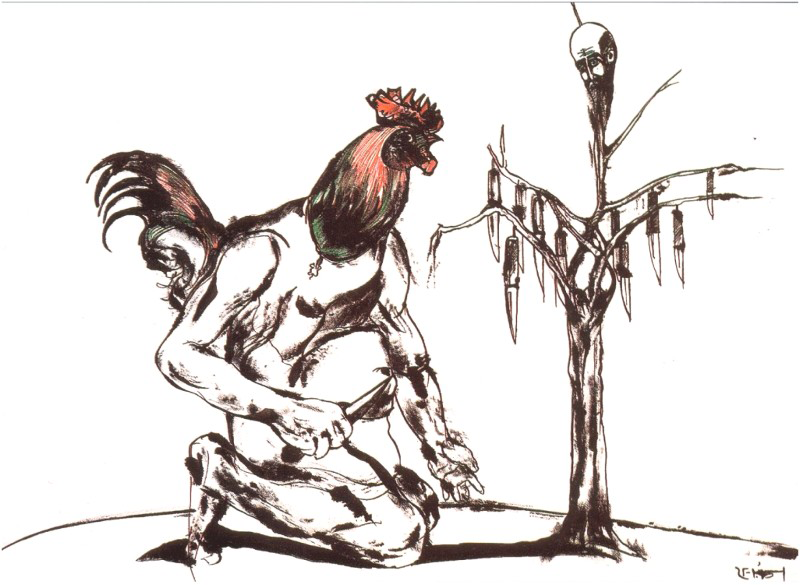
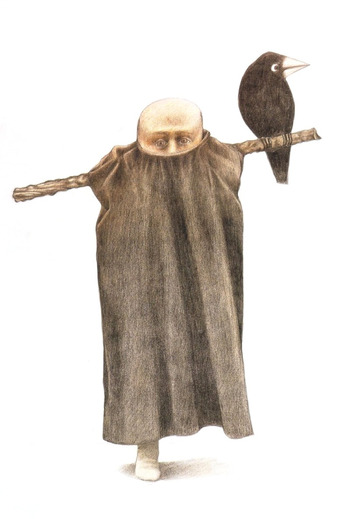
This painting is a graphic reference to the ground-breaking avant-garde group and cultural journal “Fighting Cock” (Khorus Jangi) of the late 1940s.Footnote 21 The figure grasps a dagger torn from a tree of daggers, with which it self-mutilates, inflicting many wounds on its limbs and torso. As a motif, the tree of many knives is a graphic inversion of the mythological Zoroastrian “Tree of All Seeds.”Footnote 22 Topped by a bearded severed head, pierced by its topmost branch, the tree resembles a standing figure casting its shadow over the kneeling one. Whereas fighting cocks wound with their claws, this mutilation is self-inflicted by a dagger taken from the tree. The ink medium and the narrative sequence (note the hanging threads left by the dagger torn from the tree) recall Ardeshir Mohassess’ cartoons. The knot of meaning is tied up tightly in the drawing to maximize political and satirical force. The picture was done during the time of the severest repression, at the beginning of the Iranian cultural revolution,Footnote 23 in the face of greatly increased censorship. Other comparable works originate from the decade before the revolution (for example, the 1971 sketches and a painting Scarecrow from 1977) that are structurally similar. In the sketches, a bird’s head more or less perches on the human form to make a single creature, like Bahman Mohassess’ Boy or the Egyptian Horus, whereas Scarecrow (Matarsak—Figure 2) is a visual pun, in which the bird perches on the scarecrow simulacrum of a man. This is an example of what might be termed surrealist inversion as an encryption of satirical/political intent.
Alireza Espahbod, Scarecrow (Matarsak), 1977, pencil and pastel on cardboard, 50×60 cm.

There is another excellent example in a detail of his 1991 painting Freedom (Āzādi) where the man stands above a cock’s head.Footnote 24 His use of birds, like that of Bahman Mohassess’, is coded. The cockerel refers to the surrealist artist who calls to awakening. Crows are spies khabarchin and they are featured very widely in certain periods of Espahbod’s works. Crows stimulated much discussion, such as the following, from an essay by Aghdashloo, which is very likely commenting on the painting shown in Figure 2:
Espahbod’s “crows period”Footnote 25 is an explicit approach to a current conventional idiom: the telltale-informer crow. It is omnipotent and, in a wider allegorical sense, it is an intruding, annoying, and troublesome outsider. Symbols like this visualize an era when the intellectual-artist loses all hope of taking refuge in a safe corner; and finds himself, vulnerable, defenseless, and alone, facing a massive assault from all direction.… In some of these paintings, one notices the crows’ dominance: they are either triumphantly perched, all by themselves, on a branch, or scattered here and there on the canvas, as if a dialogue or a narrative is going on.Footnote 26
In this painting, the juxtaposition of crow and scarecrow does indeed seem to designate the latter’s dominance over the inanimate scarecrow, but in other works the use of animals and birds in juxtaposition with human figures is theriomorphic—i.e. in combination with the human—and designates some kind of metamorphosis or transformation taking place, at least in the psychological interpretation offered by Mojabi in the same volume:
In some works, beasts like wolf and hyena are transformed into humans; in some others, one can see a bird or a deer with human organs. Human-bird versus human-hyena. This division and Manichean outlook has its roots in one’s childhood and the age-old affinity for the animal kingdom; and also in realities of current life—where man is abused and stripped of his dignity (rather than in mythology, history, or prehistory).Footnote 27
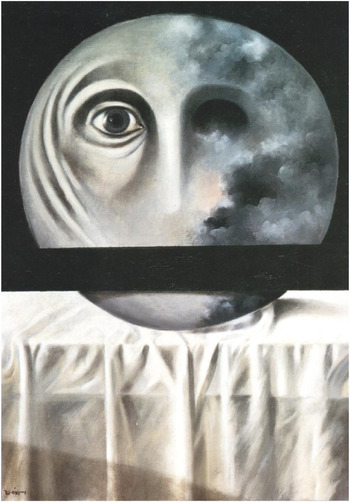
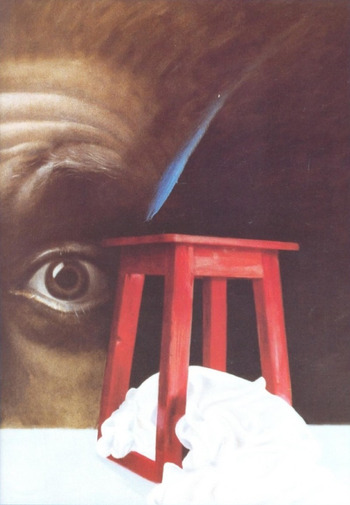
These symbols mean something in a picture, but another distinctive feature of his work is in the serialization of meaning in a sequence of several pictures, over a period of years. Whereas symbolic content and structural inversion in a single painting create a sense of immediate narrative continuity, this symbolism is made more powerful by being extended in a sequence of works which the historian can juxtapose and make explicit. An illustrated example will suffice to demonstrate this point. The suffering of repression is depicted in two related pictures, Untitled 1986 (Bedun-e ‘onvān— Figure 3), and Escape 1987 (Rahāyi—Figure 4). In the first, Untitled 1986, which is a monochrome, moon-like painting, the mouth is censored by a black line, the open eye is expressionless, and where the other eye should be there is just a crater on the other side of the moon, shrouded in clouds: folds, resembling both a veil and lines of stress, enfold the open eye, as a cloth enfolds the table on which the moon is placed.
Alireza Espahbod, Untitled (Bedun-e ‘onvān), 1986, oil on canvas, 100×70 cm.

Alireza Espahbod, Escape (Rahāyi), 1987, oil on canvas, 100×70 cm.

In Escape, on the other hand, the open eye of Espahbod’s own face in self-portrait is seeing, staring in apparent surprise, illuminated by one of the artist’s signature swooshes of iridescent blue color; a tablecloth has been removed from a brightly colored table and lies beneath it like a crouching animal.
There are three clues to interpreting these two enigmatic paintings. First, just before the Iranian revolution, in late 1978, a sensational rumor spread across Iran that the image of Ayatollah Ruhollah Khomeini’s face could be seen appearing on the surface of the moon.Footnote 28 Second, Escape seems to allude again to the collective illusion of the phenomenon of Khomeini, for he always spoke from a chair that was covered by a white cloth, which has here been removed and is revealed as blood red. Admittedly, it is a table not a chair, but this difference is part of the subtlety of the allusion: if he had put a chair in, it would have been too obvious, and the work would have been banned. It is an instance of his using veiling to reveal something concealed. Third, it would seem the artist alludes to Buñuel’s film Chien Andalou, in which, famously, a razor blade is held before a girl’s eye instantly followed by footage of a cloud passing in front of the moon as if it slices the moon and, by metaphorical association of the image, the girl’s eye.Footnote 29 Here, in Espahbod’s two paintings separated by a year, the artist refers to a similar but inverted metaphorical sequence, in which the blind right eye of the earlier painting is opened and surprised by the unveiled chair in Escape. The blue swoosh is a symbol of this enlightenment, as a bolt from the blue. However, and significantly for this consideration of censorship, with hindsight our juxtaposition of the paintings reveals the full story that would previously have been available only to those few who could somehow read the meaning at the time: the two pictures form a collage of two canvases of identical size separated by a year: the elapse of time and the “buriedness” of the symbolic meaning in each picture are the encrypting factors, as their subversive meaning emerges only if they are juxtaposed as a narrative sequence.
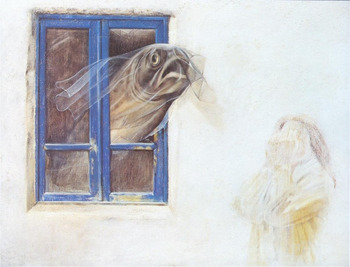
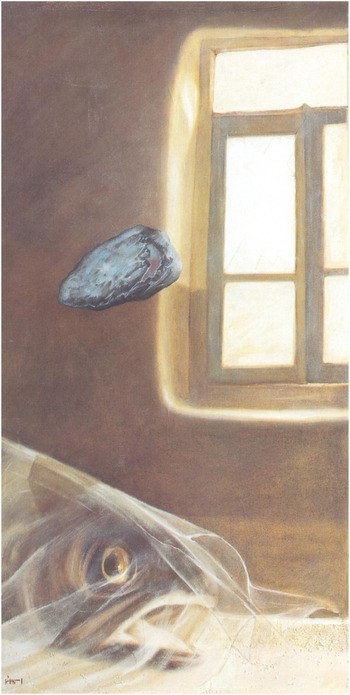
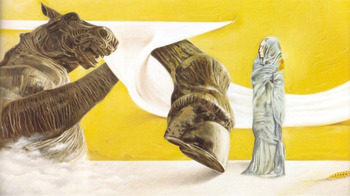
There are similar repeating patterns and graphic themes throughout the range of his paintings and drawings; some can be identified from their titles as referring to certain social issues, such as Freedom, Hunger, Thirst (Āzādi, Gorosnegi, Teshnegi).Footnote 30 Elsewhere there are clear metaphors of strong social or philosophical comment: the suppression of women in Sneer (Zahr-khand) and their innocence in Maryam; the brutality of the social order in Origin of Species (Asl-e anvā’); and oppression and danger from “above” in Molten (Mozāb).Footnote 31 Nobody who sees Molten can avoid thinking of Magritte and his many umbrellas. Similarly, other works of his have enigmatic titles that provoke curiosity and suggest a certain mood, such as Nightmare (Kābus—Figure 5, 1987), Turquoise Blue (Ābi firuze-yi— Figure 6, 1988) and Ghazal (Figure 7, 1991).
Alireza Espahbod, Nightmare, 1987, oil on canvas, 130×110 cm.

Alireza Espahbod, Turquoise Blue, 1988, oil on canvas, 120×65 cm.

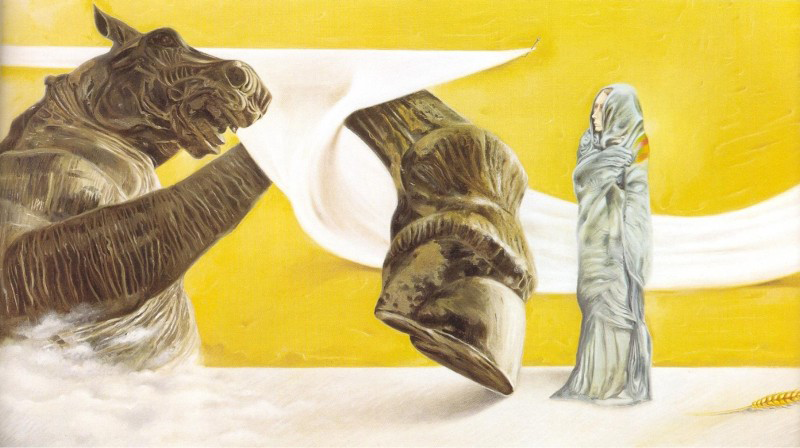
Alireza Espahbod, Ghazal, 1991, oil on canvas, 150×110 cm.
So far, two types of encryption have been identified—those with strongly characteristic symbols and inversions of symbols on the one hand (for example, the theriomorphic figures, cocks and crows), and on the other hand those in sequences of individual works whose meaning is only disclosed in the successive windows of a strip cartoon. There is a variant of this second type which combines the thematic (symbolic-inverted) and the sequential aspects, making the encryption even more enigmatic.Footnote 32 The enigma of what the symbol means is first complicated by the fact of its not taking place in a single work: as with Untitled and Escape, one can see a correspondence in the pictures, even a narrative sequence, which raises the question not of what the paintings mean, but of “what is happening?” In this type of work there can also be the question of what the symbol means in the first place. Let us now consider Nightmare and Turquoise Blue in more detail.
In the first, Nightmare, the view is from outside a house, as a giant fish bursts out through the blue casement of an external window towards the pale, ghostlike figure of a woman who covers her face (in horror?). The fish, not the woman, is veiled, by a net curtain (not a fishing net). In the second, Turquoise Blue, painted in the following year, the fish is on the floor of an interior, with an identical casement window in the background: a bluish rock is poised in space above the still veiled fish, and the glass of the upper left window is broken as if the rock has just smashed through it. Seeing the two pictures together the viewer is teased and tempted to imagine a temporal sequence, as if we are being asked “What is going on?” For the Iranian “reader” of these images, certain meanings are suggested, considering that this was the period when many Iranian cities were regularly being bombed—windows were very vulnerable. But this “local” explanation may not be sufficiently persuasive, for indeed both window and a fish-out-of-water are potent psychological symbols expressing vulnerability.Footnote 33 Aghdashloo has shed some light on this enigmatic practice of Espahbod’s when he comments, making reference to the two paintings just discussed, that there is a universal dimension to the imagery he uses, and that this is redolent of surrealist practice at work in his paintings:
Now Espahbod’s grim terrified human faces, like that unearthly, strange, and gaping face looking at us from behind a lace curtain—like that fish?—have not local dimensions anymore; they have become universal, and have changed into lasting entities by going beyond personal whims and caprices. Here, the idiom of painting, with its boundless inherent potentials for communication, is properly utilized by the artist who wants to express his grief and solitude in an allegorical poetic way, and with strong touches of severity.… The exclusion of logic and subject, or, more precisely, the unity of subject, put Ali Reza Espahbod and his works among the surrealists: a categorization not far from reality. It would not be wrong to say in his so-called “conceptual” works the general composition reaches a calculated metaphor, which conveys not a definite meaning but a general sense and feeling. The choice of these personally felt means of communication may eventually remove the still prevalent touch of graphic art, and show the artist’s social challenge as being less vigorous and apparent.Footnote 34
With reference to Aghdashloo’s last sentence of the quoted passage, I would suggest this supports the point that the subtlety of such surrealist allusions may mute and conceal the social challenge of the artist.
As mentioned in a previous section, a major feature of several of Espahbod’s paintings is his use of veiling objects and persons. This is done both realistically, with the actual depiction of a veil or cloth, or with other techniques, such as by smearing or wiping the paint to create a gauze-like effect, or such as by obscuring the image in shadow or by making it faint and ghostlike (see e.g. Nightmare, Figure 5, and Turquoise Blue, Figure 6). However, in none of his works does Espahbod appear to be moralizing to the viewer: rather, as with his other strategies of encryption, he is asking a question, setting a puzzle for the viewer to solve. Espahbod’s literary sensibilities, Iranian and European, are as finely tuned as those of Bahman Mohassess, as his visual and titular references to literary works suggest. The two paintings called Metamorphosis (Maskh) link Espahbod immediately back to Hedayat and Kafka, whose Metamorphosis Hedayat translated. This is just one of many subtle references to literature in his works.Footnote 35 A discussion of this subject would require copious illustration and is therefore beyond the scope of this essay.
One the greatest Iranian literary figures of the twentieth century, Ahmad Shamlu, was a close friend and intellectual companion of Alireza Espahbod.Footnote 36 In fact, he is also considered to have been his spiritual father (pedar-e ma’navi),Footnote 37 as witnessed by a letter Shamlu wrote to Espahbod dated October 1994 in which he addressed him as “my beloved son” (pesar-e nāzaninam). Although both men had been in London until just after the revolution, it is not known whether the two were in touch there. Both had returned to Iran soon after the revolution. Sometime after July 1979, when Shamlu became the editor-in-chief of the political-artistic weekly Ketāb-e jom’e (Friday Book), Espahbod began to work for that journal and the two began to form close ties.Footnote 38 Both men suffered similar experiences of censorship, for ten years at a time in different decades. Shamlu had been silenced as an active poet and public voice from just after the revolution until 1993 when at last he received a publication permit. Espahbod was blocked from exhibiting as an artist from 1991 until 2001 (coincidentally the year after Shamlu died). It is clear that Shamlu was a great inspirational figure for Espahbod, not just because he was one of Iran’s greatest contemporary poets, but also as the prophetic voice of inspiration for all left-leaning intellectuals of the time. It was Shamlu, after all, who in 1968 had translated into Persian Bodas de Sangre (Blood Wedding), the most famous work of Federico García Lorca, the martyred Spanish Republican hero.Footnote 39 For his part, on the other hand, Shamlu was certainly deeply moved by Espahbod’s paintings, as he says in a letter to the artist:
and now that I browse the collection of your paintings, I suffer from the same grief. I look at the blank space of those paintings of yours that I have loved so much and see in them the disastrous experience of some of the most painful years of my life, and my soul is filled with bitter sorrow.Footnote 40
That their views of the political climate of the time were in agreement is evidenced by a joint interview they did for the German magazine Der Spiegel in 1995.Footnote 41 Together Shamlu and Espahbod openly declared to this world-renowned foreign publication the difficulties artists inside Iran were facing with censorship, in an internal exile of, respectively, silence and invisibility.
Espahbod shows his own love for Persian poetry most graphically in his painting Ghazal (Figure 7), which just predates the period when he was completely banned from exhibiting his works. Here he confronts the viewer with a puzzle no less challenging than one of Hafez’s ghazals: in fact it appears to refer to the last line of one of his ghazals:
Hafez, our party’s chant is your fair memory,
Be quick, I’m sending you a horse and robe!Footnote 42
The setting of the image is above a cloud line on the left that becomes a flat surface to the right, in front of a golden background. A long white cloth is visibly pinned to the background. A gigantic horse appears from the clouds, its outsized foreleg presented to a diminutive, female figure facing the horse (who could indeed be the recipient of the gift in the quoted verse of Hafez). Yet the head of the horse has been flayed to reveal a visceral, skeletal substructure, and its body is wrapped in some translucent amniotic membrane. An obscure and almost unnoticed element of the painting is the ear of wheat in the bottom right corner of the painting: in the Quran wheat was received by Eve from Satan, and is almost as iconic a symbol in Islamic culture as is Eve’s apple in the Biblical account of Eden. In this painting, Espahbod leaves a set of strong impressions on the canvas but refrains from any moralism. Generally, his mythological creatures, theriomorphic figures and outlandish scenes are not depicted for phantasmagorical effect, but are placed there deliberately to encrypt allusions.Footnote 43 Here the two dominant motifs, the oversized stallion and the apparently petrified woman, encounter one another. The woman is tightly veiled in a strangely drawn chador: the horse reared up and viewed from below is not dominant, as it too is swathed (i.e. also veiled!) in the membrane and is entangled in the winding sheet of white cloth. The monstrously disproportionate hoof is most delicately placed in the foreground. The folds of the woman’s chador reveal things only half-suggested. It is an exemplary image of the artist’s technique of encryption of meaning in paint, using the imagery of veiling. The ear of wheat may be the key to the reading of the painting—a sign of humanity—but there is no conceptual message: rather it is a tableau that conveys a poetic meaning, suspended in mid-air, as it were, like these figures.
If there is a theme that runs through all of his paintings, it is the graphic depiction of mystery and concealment. Animal heads obscure and replace the human (e.g. Metamorphosis I and II); figures are not fully painted in (Thirst, Metamorphosis II), or are smeared (Maryam, Sneer, Origin of Species) and subjects are mysteriously veiled (Turquoise Blue, Nightmare, Hunger I and II). The signal that is conveyed throughout the artist’s oeuvre seems to be that these things are hidden just as art is itself hidden from public view by censorship—the artist is reflecting the reality of his society.
Conclusion
In sum, it is reasonable to say that, like many contemporary Iranian artists, Espahbod is a humanist painter. It is probably truer to say that he used surrealism in his art, rather than that he was specifically a surrealist artist. Largely, his surrealist techniques imitate literary and theatrical art: on the one hand he incorporates the metaphorical power of poetry in his use of imagery and combination of symbols in forms; on the other hand his works are dramatic and cinematic, using the serialization of scenes to allow viewers to make sense of the whole according to their reading. His techniques of drawing and painting were formed by his intention to outwit the censor and to stimulate the art viewer. He himself had directly suffered censorship, and he was for a long period prohibited from exhibiting his work, from 1991 to 2001.Footnote 44 His legacy, however, is perhaps more than that endeavor to outwit the censor: it is an expression of a wish to grant artistic freedom for the audience as much as for the artist alone, and thus it is a positive response to censorship, not just the avoidance and circumvention of it. There seems to be a quiet didacticism in Espahbod’s work. It is reflected in his avoidance of celebrity, his seclusion and disconnectedness from the artistic community and his implicit lack of sympathy with the tendencies of the contemporary culture of Iranian society around him.Footnote 45 His artistic style, like that of many Iranian artists, modern and classical, is both literary and related to Persian literature, especially after his collaboration and friendship with Shamlu. His art manages deftly to evade censorship, but at the same time to pose questions and enigmas poetically, rather than by prosaic assertions of ideology in imagery. His conceptual collage is realized as a metaphorical sequence that may work forwards or backwards. The knots of meaning he presents in his work are comprised of puns, inversions, juxtapositions and other encryptions with which the literate Persian reader of his paintings is well able to engage. Espahbod had a rare technique that was deeply influenced by literature; thus his methods of “encryption” were poetic, and happily blended with his liking for the element of sequence in his paintings so that, taken together, they have the potential to suggest a reality different from what the individual works appear to depict when viewed separately. Indeed his work can be understood better by “reading” it, sometimes on the individual canvas, or at other times serially in the narrative sequence of more than one work.
Finally, to illustrate Alireza Espahbod’s painting as poetry, and as a postscript to this essay, it is best to attend to the loudest voice in literature of his time, the poet Ahmad Shamlu, in my new translation of the entire poem “Interpretation of Disaster.” Shamlu dedicated this poem, which was published in 1992, to Espahbod’s paintings of the period of the Iran‒Iraq war.Footnote 46 Indeed, it could well stand as an epitaph to the artist and his art in Iran.
Honar shahādatist az sar-e sedq (Art is a sincere martyrdom) is a line from a poem Tarjomān-e fāje’e by Ahmad Shamlu quoted in full at the end of this article. Previously this was given as a short paper presented at the conference “The Visual World of Persianate Culture: From Antiquity to the Present,” at the University of Edinburgh, 24‒26 October 2014, with the title “Decoding Meaning in a Contemporary Surrealist Iranian Painter: Sequence and Inversion as Encryption in the Work of Alireza Espahbod.”