The rise of China is a major international development and will play an important role in shaping the future of global politics. This article aims to understand the extent to which Beijing has translated its growing capabilities into reshaping the norms of international politics. The inquiry focuses empirically on voting dynamics on resolutions at the United Nations General Assembly (UNGA) regarding the norms of sovereignty, international order, human rights, non-interference, and democracy. It finds evidence that during the first decade of the twenty-first century states moved disproportionately into alignment with China on resolutions in these areas that were repeated over multiple UNGA meetings. This article tests these patterns statistically and finds that states with higher exports to China and more diplomatic interactions with Beijing were more likely to switch their votes to move into alignment with Chinese positions. The article presents four qualitative case studies that further investigate the causal connections underpinning movements into normative alignment with China.
Scholars have begun in earnest to analyse vote alignment with China in the UNGA.Footnote 1 This article complements and advances these efforts in three main ways. First, it takes advantage of the fact that numerous UNGA resolutions are repeated in multiple years. We are therefore able to evaluate states that changed their vote into alignment with China on the same resolution from one year to the next. This is an advance on the aforementioned studies, which examine changes in the overall vote alignment with China’s positions. While the previous approach is an excellent first step, it suffers from the fact that while some resolutions are repeated, many others are ‘one-off’ in a given UNGA session, and that changes in the overall alignment with China may be driven by the potentially coincidental (non-)alignment on these one-off resolutions. The approach adopted here is able to pinpoint the specific instances when a state changed its previously established voting behaviour on a particular resolution to move into alignment with China on that same resolution. In this sense, the article advances on previous studies of UNGA voting behaviour by considering vote dynamics on specific resolutions over time instead of changes in overall vote coincidence. We argue that our approach is more conducive to the identification of strategic behaviour. Second, while some studies focus on China’s relationship with one geographical area such as Africa or South America, this article considers all countries.Footnote 2 Third, where some existing studies use exclusively quantitative methods,Footnote 3 this article consists of both a statistical test of China’s influence and four qualitative case studies designed to further interrogate established correlations. The article therefore has the advantages of a mixed-method ‘nested’ research design insofar as it brings diverse forms of evidence to the research question and puts those forms of evidence in conversation with one another.Footnote 4
Theoretically, this inquiry bears on at least three larger debates found in International Relations literature on the spread and influence of international norms. China’s growing international influence has taken place and continues to unfold within a post-Second World War and post-Cold War international architecture crafted and led by the United States and its allies.Footnote 5 A rising China thus first allows for an opportunity to empirically examine a rising state with some aspects of its outlook at odds with the structure of international norms constructed and bolstered by Western powers.Footnote 6 Norms, understood as agreed-upon standards of behaviour, structure and shape the behaviour of states, but the behaviour of states also helps to create norms and privilege some norms over others.Footnote 7 It must be stressed at the outset that states can support or undermine particular international norms for instrumental reasons and that self-interested dispositions toward norms can still influence the broader normative structure over time.Footnote 8
Second, examining China’s behaviour in challenging international norms is relevant to debates about the nature and consequences of polarity, balancing behaviour, hegemonic transitions, and the security implications of China’s rise.Footnote 9 Neorealist logic would dictate that hard balancing against the United States unipole would be unlikely because of the costs and risks of confronting overwhelming US power, but secondary states in a unipolar system would be prone to ‘soft’ balancing by subtly undermining the norms and values of the unipole. From this perspective, delegitimation of the unipole’s normative authority may be a ‘leading’ indicator of the intentions of a rising power.Footnote 10 Hence, the idiom in this article’s title, which is a reference to miners that used to employ canaries to test the toxicity of gases in a mineshaft before workers entered. A ‘canary in a coal mine’ is an early warning system for impending danger. This article suggests that Beijing sought to gradually erode a set of norms in relatively quiet and indirect ways via the UNGA from 1999 to 2009, which raises the question of whether this earlier behaviour may have been the proverbial canary indicating future Chinese assertiveness. Given that many specialists in East Asian international relations are sceptical of Chinese revisionism and balancing,Footnote 11 or associate China’s revisionist foreign policy more with Xi Jinping’s current administration,Footnote 12 this represents an important question both empirically and theoretically.
Third, this article contributes to debates about the extent to which a powerful autocratic state would be likely to undermine norms associated with support for democracy. Many worry that China’s success functions as a model that is attractive to leaders of other developing countries.Footnote 13 While the claims of some analyses in this vein are perhaps overblown,Footnote 14 it is nonetheless useful to ask and empirically assess the extent to which China is undermining global norms with regard to human rights, international order, sovereignty, non-interference, and democracy.Footnote 15 Even if some evidence suggests that China does not directly promote authoritarianism beyond its borders,Footnote 16 it is worth testing whether China’s rise provides a more enabling normative environment for non-democratic governance.Footnote 17
In sum, the central question is how, if at all, has China sought to leverage its increasing capabilities to undermine existing international norms via the UNGA? To answer this question, the article proceeds in four subsequent sections. First, it locates Chinese foreign policy toward international institutions generally and relevant international norms specifically. Second, the article presents a statistical picture of voting shifts pertinent to Chinese normative stances in the United Nations General Assembly. Third, the statistical findings are examined qualitatively in the cases of Uzbekistan, South Africa, Nicaragua, and Equatorial Guinea. Finally, the article concludes with a summation and remarks about the implications of this research.
Chinese foreign policy and international norms
Many of the overarching goals of Chinese foreign policy relate to the security and stability of China’s internal politics. China organises its foreign policy to achieve its ‘core interests’: the stability of the political system, national security and sovereignty, and safeguarding and nurturing the conditions necessary for continued economic development.Footnote 18 These priorities and interests can be understood as consistent with a perspective that sees China’s foreign policy as driven primarily by rational reactions to minimise its perceived internal and regional vulnerabilities.Footnote 19
Yet, beginning in the late 1990s, debates proliferated within China about what kind of great power it should be, ranging from nationalist discourses about China standing up to the West to cosmopolitan perspectives advocating China’s participation in mechanisms of global governance.Footnote 20 Central to these debates is the interpretation of Deng Xiaoping’s famous injunction that China should ‘observe clearly, secure [its] position, and cope with affairs calmly’, and the related aphorism that China should ‘bide its time, hide its brightness, not seek leadership, but do some things’.Footnote 21 There is an ambiguity inherent in this advice that revolves around the extent to which it is meant to be transitional: does it imply that China should maintain a low profile until it is strong enough to assert itself or is it that China should always maintain a low profile and continue to be focused on internal policies?Footnote 22
China has an ambivalent view of international institutions and the norms they help create or entrench. On the one hand, China’s rise has coincided with its increasing embeddedness in the institutions of global governance, including the UN, APEC, and the WTO. These actions seem to cohere with China’s stated preference for a multilateral world order based on equal standing and respect. Even if China expressed unease at the way international institutions were organised, evidence suggests that the Western strategy of ‘socialising’ China into the international system had some effect on influencing the thinking of Chinese policymakers.Footnote 23 On the other hand, many Chinese leaders are wary of existing institutions of global governance precisely because they perceive them as part of a strategy by Western powers and the United States specifically to tie China down by embedding it in institutions that it did not create and committing it to rules that it did not write. China has resisted some of these perceived strategies by establishing alternative institutions that give it a greater voice and by attempting to undermine certain norms associated with United States authority.Footnote 24 Beijing maintains that it will ‘never seek hegemony’, which functions as a euphemism to highlight American dominance.Footnote 25 Indeed, David Shambaugh has argued that since 2000 China has entered a ‘system altering’ phase in its engagement with the institutions of global governance and has staffed international organisations with skilled diplomats who pursue changes from within the system to reflect Chinese interests.Footnote 26 Likewise, in their recent study of Chinese foreign policy, Andrew Nathan and Andrew Scobell find that China has made its presence felt in international relations beyond its immediate region ‘in a big way only since the late 1990s’.Footnote 27
The UNGA provides a useful venue to evaluate these claims. First, it is a venue in which China can pursue change without confronting the United States too directly and without provoking the counterbalancing behaviour that Beijing so clearly wishes to avoid. Second, China views the United Nations, and the UNGA in particular, as important.Footnote 28 The UNGA is a venue in which China can express its perspective that states are sovereign equals and that Western normative consensus should not be taken as a given.Footnote 29 Votes in the UNGA generally can be seen as expressing a state’s normative preferences precisely because resolutions are often symbolic expressions of values.Footnote 30
Furthermore, Chinese foreign policy patterns suggest the possibility that it may bring economic and diplomatic leverage to bear to shape international norms. China pursues specific goals, including support for its positions on multilateral norms, and its primary means of leverage are in the commercial and diplomatic realms.Footnote 31 Its relations with non-great power states beyond its neighbourhood are characterised by a transactional quality: ‘China provides material and symbolic support and diplomatic backing, and it expects to receive economic access and diplomatic cooperation in return.’Footnote 32 As discussed further below, a working hypothesis is that these practices apply to China’s interactions in the UNGA specifically.
China’s foreign policy priorities with regard to the United Nations specifically during this period are elaborated in its 2005 Position Paper of the People’s Republic of China on the United Nations Reforms. The document emphasises ‘sovereign equality, non-interference in internal affairs, peaceful resolution of conflicts and strengthening international cooperation’, and a preference for development issues and the priorities of developing countries. Chinese policy maintains that the national conditions of each country are unique and sovereignty needs to be respected through the principle of non-interference.Footnote 33 With regard to human rights, the paper calls for ‘depoliticizing human rights issues, rejecting double standards, reducing and avoiding confrontation and promoting cooperation’ and giving equal weight to economic, social, and cultural rights alongside civil and political rights. Reflecting China’s preference for self-determination regardless of regime type, the document notes ‘China disagrees with the classification of countries into “democratic” and “non-democratic” nations.’Footnote 34 These preferences are consistent with the Five Principles of Peaceful Coexistence that have been the bedrock of China’s foreign policy since the 1950s as well as China’s voting record in the UNGA during the 1970s.Footnote 35
China therefore prefers norms associated with strong state sovereignty and is hesitant to promote norms of international human rights accountability, election monitoring, or external involvement in domestic practices unless the relevant state consents. This position is at odds with widely accepted norms of international human rights that result in pressures to commit to standards and to incorporate them into domestic law as well as the increased prevalence of norms associated with election monitoring.Footnote 36 Furthermore, at least rhetorically, China favours norms associated with multilateralism and sovereign equality between states.Footnote 37
In sum, China has a robust vision of national sovereignty, a cautious but engaged disposition toward norms that bear on sovereign prerogatives, and has arguably been in a system-altering phase of international diplomacy since at least 2000. Combined, these factors suggest that one would expect to see Beijing using its economic and political clout to seek norm change in relatively subtle ways during this period. Compared with other dimensions of its global capabilities China’s economic power is its most consequential lever to pursue norm revision.Footnote 38 One would therefore expect China to attempt to translate this leverage not only into beneficial economic arrangements but also into subtly tilting the international normative structure to reflect its vision.
China and vote switching in the UNGA
Voting in the United Nations General Assembly has received considerable scholarly attention, with Erik Voeten arguing that studying the forum ‘should reveal changes in the behavior of states and in the dimensionality of global conflict’.Footnote 39 Much of the inquiry has focused on if and how powerful states attempt to influence the votes of less powerful members. Although this argument was first advanced by Robert Keohane almost fifty years ago,Footnote 40 recent scholarship has focused on the prevalence of ‘vote-buying’, where powerful states use foreign aid to reward or punish the voting behaviour of less powerful states. While several authors have found evidence of vote buying to a greater or lesser degree, most studies have focused on the US as the dominant power and, crucially, examined overall vote-correlation with the US position instead of changes in vote-alignment on specific resolutions.Footnote 41
This article contributes to the literature on influencing UNGA votes in two ways. First and most importantly, it takes advantage of the fact that resolutions are often repeated in the UNGA, most often to reaffirm or expand international norms.Footnote 42 By charting voting dynamics on these repeated resolutions one can determine which states move into (or out of) alignment with China on specific resolutions. This is a distinct conceptual advance over previous studies that focus on changes in percentages of overall voting coincidence in the UNGA. Vote switching requires an explicit change from a previously expressed position, while measures of overall voting coincidence may merely be capturing the coincidental alignment on the set of resolutions tabled in any particular year. Second, this article adds to an emerging literature that shifts focus on the powerful actor in the UNGA from the United States to China. Gustavo Flores-Macia and Sarah Kreps’s findings suggest countries with close trade ties to China are more likely to share UNGA positions on country-specific human rights resolutions with China.Footnote 43 Georg Strüver takes a broader look, both with respect to UNGA votes and potential explanations, finding mixed evidence of explanatory power for voting coincidence across a range of variables in trade, diplomatic engagement, and aid.Footnote 44 We build on these findings to further investigate avenues of persuasion beyond the traditional UNGA influence mechanism of aid.Footnote 45
Hypotheses
This article fine-tunes and modifies existing hypotheses about China’s pursuit of normative change in the UNGA. At the most general level it draws on Nathan and Scobell’s analysis of Chinese foreign policy to propose diplomatic and economic engagement as key independent variables. More specifically, existing work suggests that market access and diplomatic engagement are important drivers of alignment with China.Footnote 46 In the context of normative shifts on UNGA votes, the logic behind these arguments is straightforward. Countries that rely heavily on the Chinese market for Exports will be inclined to move into normative alignment with China in the UNGA in order avoid any disruption in market access. This movement may be driven by a domestic political economy situation where export-oriented elites push for (sustained) market access.Footnote 47 This relies on an implicit calculation where states, recognising that their interests may be harmed by misalignment with China, move to harmonise their UNGA positions. Andreas Dür is suggestive of firms and business associations influencing governmental trade positions and we concur with this political economy logic.Footnote 48 As organising for market access is likely tied to the number of export-oriented interests, we expect the larger the value of exports to China, the larger/stronger the firm pressure will be on governments to secure or retain the market access.Footnote 49
We temper this expectation, however, by noting that three categories of China’s trade partners are less likely to change their normative positions in the UNGA based on their reliance on the Chinese export market. First, incorporating Julia Bader’s main result,Footnote 50 we expect that democratic countries will be less likely to shift their positions in the UNGA regardless of trade exposure and, as such, we control for this by including a measure of Democracy. Footnote 51 Second, we recognise that our export logic holds most convincingly for countries that depend on the Chinese export market. While a traditional measure of trade dependence is an export share, this may be problematic when considering China since, due to its size as the world’s second largest economy, many countries cannot avoid exporting to China.Footnote 52 Indeed, China is the top export destination for Australia, South Korea, and New Zealand; the second largest export partner for Japan and the EU, and the third largest partner for the US.Footnote 53 It is unlikely that these states would change their normative positions into alignment with China in the UNGA based on trade dependence. Accordingly, we include both the natural log of, and per capita, gross domestic product (GDP and GDPpc) to control for income levels of other states, suggesting that richer states will be less susceptible to pressure from China to change their position based on their exports to China, ceteris paribus. These variables also capture the findings from Samuel Brazys and Diana Panke that suggested that both larger and richer states are less prone to changing their voting position in the UNGA, ceteris paribus, and thus are less likely to change their position in response to pressure from any state.Footnote 54 The logic is that larger and wealthier states have more resources and power that they can use to insulate themselves from Beijing’s diplomatic or economic pressure. Comparatively poor and autocratic states are therefore likely to be more responsive to Chinese influence to change their position when their exports to China are large. Finally, as also suggested by Brazys and Panke,Footnote 55 regime changes may alter voting positions in the UNGA and so we also control for this measure to more accurately measure whether vote switching is due to Chinese influence and not to other factors, such as the priority of an incoming government.
With respect to diplomatic engagement, it has been shown that states frequently engage in explicit lobbying towards other states in the UNGA to gain support for positions on resolutions.Footnote 56 China, likewise, may attempt to convince states to adopt its normative positions through lobbying efforts, which become more effective with increased, or high-level, diplomatic interaction. High-level diplomatic engagement is a form of ‘prestige diplomacy’ that can be used to entice states to move into alignment with China and/or reward states that have aligned themselves with the Chinese normative vision. As discussed by James Reilly and Wu Na, domestic elites can use these visits from Chinese leaders to bolster their legitimacy and image at home.Footnote 57 They document how, in Africa, China has dispensed these visits on leaders of those states who have found their favour, and thus this measure is likely to be associated with instances of mutual praise rather than recrimination.Footnote 58 There is considerable Diplomacy in the run up to, and during, high-level visits when Chinese diplomats can attempt to influence the normative commitments of their counterparts. Lobbying efforts surrounding high-level diplomatic engagement provide opportunities for Chinese diplomats to explain and secure commitments for alignment on key issues in the UNGA. The high-level visit is an observable marker of these talks and may come either before or after the vote alignment as visits are unlikely to be precisely contemporaneous with UNGA votes. However, in either case, it is the reward or promise of the visit that induces the vote alignment, along with the accompanying diplomatic lobbying.
There is a caveat to this logic as well. Panke has suggested that UNGA voting behaviour is dependent on diplomatic capacity, with low capacity countries less able to meaningfully participate in UNGA sessions.Footnote 59 As such, we include a measure of the number of Diplomats assigned to the UN by each member state.Footnote 60 We would expect that China’s persuasive efforts are more fruitful when engaging with states with a higher level of diplomatic capacity because they are better able to assess various dimensions of their foreign policy. These two logics are both predicated on the kinds of soft-balancing discussed above. Rather than overtly coercing or even ‘bribing’ states to support its normative vision, we contend that China is instead using its economic and diplomatic influence to subtly erode the existing international normative landscape. These arguments also draw on the logic of asymmetric complex interdependence.Footnote 61 While partner countries indeed need China for market access and diplomatic prestige, China, as an emerging power, also has need for resources and for countries to join its sphere of influence. Or, as Stefan Schirm describes, emerging powers like China are ‘leaders in need of followers’.Footnote 62 Thus, partner countries can leverage their normative support for market access and high-prestige diplomatic visits. This discussion leads to three testable hypotheses:
Hypothesis 1: Controlling for levels of democracy and income, the larger a state’s exports to China, the more likely the state is to move into alignment with China in the UNGA.
Hypothesis 2a: The more high-level diplomatic encounters with China, the more likely the state is to move into alignment with China in the UNGA
Hypothesis 2b: More high-level diplomatic encounters with China are more likely to move a state into alignment with China in the UNGA when that state has more diplomatic capacity.
Data
As discussed above, we focus on resolutions at the UNGA concerning norms related to human rights, sovereignty and international order. We identify 35 unique resolutions concerning these norms from 1999 to 2009 (GA Sessions 54 to 64). Of these, just over half (18) are repeated in at least one, and up to ten GA sessions.Footnote 63 Of these repeated resolutions, China broadly supported those that emphasised sovereignty and non-interference, while voting against, or abstaining from, resolutions that targeted human rights abuses in specific countries.Footnote 64 Thus, China’s UNGA voting record reveals its broad opposition to expanding international norms of human rights monitoring, oversight, and accountability and highlights its preference to emphasise norms of state sovereignty and non-interference.
To assess China’s success in altering international norms we consider the extent to which other member states changed their votes to move into alignment with China on normatively relevant resolutions. As there are four voting options in the UNGA: ‘Yes’, ‘No’, ‘Abstain’, or ‘Absent’ we stack the deck against confirming our hypotheses by considering alignment to occur only when votes are an exact match.Footnote 65 Data details can be found in Table I.1 in Appendix I, but out of 2,554 vote switches, 664 saw states moving into alignment with China, compared to 477 moves out of alignment, a proportion statistically discernible at the 99.9 per cent level.Footnote 66
Quantitative analysis and discussion
We use logistic regression to model a first-order Markov chain of the transition probability of a member state transitioning into or out of alignment with China on a particular resolution in a given GA session. Johan Elkink describes these models in greater detail,Footnote 67 but ours captures the probability of a country being in (or out of) alignment with China at time t given that it was out of (or in) alignment at time t-1. The two probabilities we capture are the probability of survival of the t-1 state in t or the probability of a transition in t from the state in t-1. We can capture everything in one model by interacting all of the independent variables with both values of the lagged dependent variable (alignment/non-alignment with China). We recognise that the propensity to move into, or out of, alignment with China may depend on temporal resolution or member-state specific factors. Accordingly, we use recently developed multidimensional techniques to cluster standard errors across all three dimensions when calculating robust standard errors.Footnote 68
We operationalise our independent variables using existing data sources. We use the Correlates of War (COW) data on dyadic trade for Imports from, and Exports to, China.Footnote 69 We run models that consider trade flows both in the current period (t) and in the previous period (t-1) to help mitigate the potential endogeneity that China grants (maintains) market access to (for) those who have moved into alignment with it as a shift into alignment with China in t is unlikely to be the cause of market access in t-1. For Diplomacy, we use Bader’s diplomatic encounter data.Footnote 70 While it is unlikely that UNGA votes and high-level visits occur simultaneously, high-level visits will be likely associated with vote-alignment in the same year, as the low-level diplomatic interaction and lobbying that accompanies those visits (and induces the shifts) is likely to be ongoing in the lead-up to the visit and vote. Our general model specification is given below:
 $$P\left( {Y_{{rit}} {\equals}1} \right){\equals}{\rm \Phi }(Y_{{ri\left( {t{\minus}1} \right)}} {\mib{\bibeta }} ^{{\mib{D}} } {\mib{X}} _{{{\mib{ti}} }} {\plus}Y_{{ri(t{\minus}1)}} {\mib{\bibeta }} ^{{\mib{A}} } {\mib{X}} _{{{\mib{ti}} }} )$$
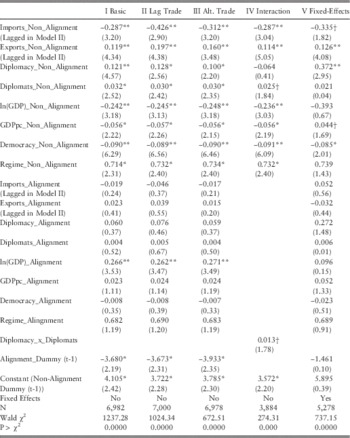
Where Y is a binary variable indicating a member state’s alignment with China on resolution r at time t for country i, X is the vector of independent variables and controls described above, β D is the vector of coefficients explaining the survival (non-)alignment, β A is the vector of coefficients explaining transitions into(out of) alignment, and Φ is the cumulative logistic distribution function. Results are presented in Table 1, below.
UNGA member survival and transition of (non-)alignment with China.

Notes: Logistic regression with robust standard errors clustered by country, UN resolution and time. Absolute z scores in parentheses. ** significant at 1 per cent level, * significant at 5 per cent level, † significant at 10 per cent level. ‡ N is larger in Model II than Model I as some countries had observations for trade in 1999 but not 2000.
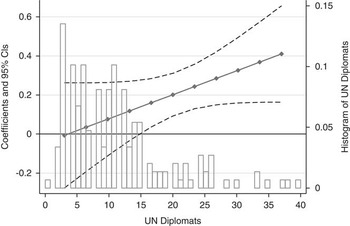
Hypotheses 1 and 2a are supported by the results in Table 1. As shown by the ‘non-alignment’ coefficients, the β A coefficients explaining the probability of transitioning from non-alignment in t-1 to alignment in t, increased levels of exports increase the probability that countries will move into alignment with China, but there is no statistically significant relationship between trade and the probability of moving out of alignment with China.Footnote 71 This result is consistent with the trade finding in Flores-Macia and Kreps who only considered combined trade flows.Footnote 72 This result is robust in considering exports in either the t (model I) or t-1 (model II) periods. The hypothesis holds in its entirety as larger economies are less likely to transition at all, either into or out of alignment, while richer countries are less likely to move into alignment with China. We also find that democratic countries are less likely to move into alignment with China and that countries which experience a regime change are more likely to move into alignment with China. Likewise, high-level visits from Chinese diplomats increase the probability of moving from non-alignment into alignment with China, but there is no effect on moves out of alignment with China. The number of UN diplomats is positively correlated with shifts into alignment with China, but shows no relationship with shifts out of alignment with China. We test the interaction hypothesis, 2b, in model IV and plot this relationship in Figure 1, below.
Coefficient on diplomacy for the probability shift to China alignment from any.

The interaction term is positive, but only statistically significant at the 10 per cent level in model IV in Table 1. However, Figure 1 reveals that the impact of China’s diplomacy increases with the number of UN diplomats in the target state. The figure further indicates there is a minimum threshold of target recipient diplomatic capacity that is necessary for any statistically significant impact from China’s diplomatic efforts, as the Diplomacy coefficient is statistically significant at the 5 per cent level only at a threshold of 15 UN diplomats. This result meshes well with existing understandings of the importance of capacity in the UNGA.
Interestingly, there is a statistically significant negative relationship between imports from China and moving into voting alignment. A simple explanation might be that this result is capturing that China’s major export markets are in the West, and that these countries may be less likely to move into alignment with China. However, while adding an OECD dummy variable does show a negative and statistically significant relationship with moving into alignment with China, inclusion of this measure does not change the result on imports as shown in Appendix I, Table I.3, models II, IV, and VI. Likewise, accounting for those states that have diplomatic relations with Taiwan also does not alter this (or any) of the results, nor is this measure statistically significant in its own right, as shown in Appendix I, Table I.3, models III, IV and VI. An alternative explanation is that trade deficits with China may engender nationalist sentiments or resentment, that is, import dependence does not ‘endear’ countries to China. This result differs from Strüver’s, which found a positive relationship between import dependence and alignment.Footnote 73 We suspect some of this difference stems from the potential of omitted variable bias in Strüver’s published results. Indeed replicating the results from table two of that study including all relevant variables from that table yields an insignificant relationship between imports and foreign policy similarity, as can be seen in Appendix I, Table I.2, model III. As shown in model III in Table 1 above, the trade results are also robust to the use of the COW ‘alternative’ China trade flows, although the statistical significance of the diplomacy result decreases. The robustness of this finding on imports to different model and specification choices, as well as its difference from earlier work, suggests that further exploring this relationship would be a fruitful avenue for future research. The main results are also robust to inclusion of country, GA session (time) and resolution fixed effects, as shown in model V.Footnote 74
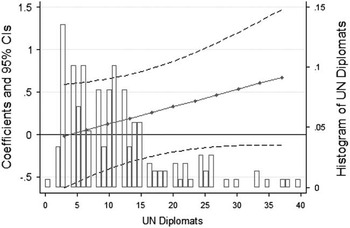
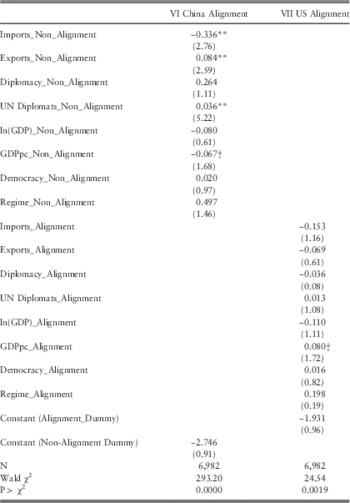
As discussed above, in many instances China’s normative vision in the UNGA is at odds with that of the United States. Accordingly, as a further robustness check, we consider only those moves into (out of) alignment that correspond to a move out of (into) alignment with the US. Our data indicates 132 instances where states moved from alignment with the US to alignment with China, and 95 instances where states moved from alignment with China to alignment with the US. This proportion of shifts into alignment with China is statistically significant at the 95 per cent level.Footnote 75 To capture the Markov transition logic we formulate dependent variables that equal ‘1’ only when a state moves into (out of) alignment with China and out of (into) alignment with the US in the same t-1 to t periods. The results of this specification in models VI and VII in Table 2 below suggest our core economic hypothesis holds as exports remain positively signed and statistically significant for shifts into alignment with China, but show no relationship for shifts out of alignment with China (and into alignment with the US). However, while the Diplomacy variable remains positively signed in Model V, it is no longer statistically significant, although the Diplomats variable remains positive and statistically significant. Figure 2 shows the Diplomacy and Diplomats interaction term for moves into alignment with China and suggests that the impact of Diplomacy on shifts into alignment with China increases for countries with a large number of Diplomats, but unlike Figure 1, this result is not statistically significant.
Coefficient on diplomacy for the probability shift to China alignment from US.

UNGA transition of (non-)alignment between China and the United States.

Notes: Logistic regression with robust standard errors clustered by country, UN resolution and time. Absolute z scores in parentheses. ** significant at 1 per cent level, * significant at 5 per cent level, † significant at 10 per cent level.
Thus, these findings suggest that economic leverage may be more influential than diplomacy for China pursuing normative change, at least when considering moving states from the US to the Chinese sphere of influence. These results suggest that foreign policy positions in normative areas are less driven by the ‘winning of hearts and minds’ in convincing countries to adopt norms via diplomatic engagement, and more driven by instrumental or material logics. Normative alignment, therefore, may simply follow markets. One aligns with the norms of the country with the dominant economy.
Qualitative analysis: Chinese influence and UNGA vote switching
The previous section found evidence to suggest that from 1999 to 2009 China’s increasing trade and diplomatic reach was associated with states moving into alignment with Beijing on normative issues. This section examines the circumstances of vote switching at the UNGA to understand in more detail the causal processes underpinning the results of the previous section. Specifically, this section focuses on Chinese relations with four states in different regions with different regime types and economic structures – Uzbekistan, South Africa, Nicaragua, and Equatorial Guinea – on four UNGA resolutions about issues related to human rights norms, democracy, sovereignty, and international order.
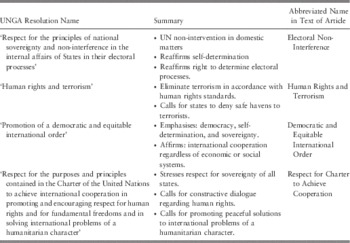
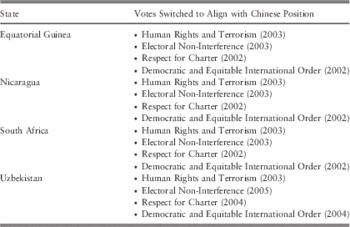
Some of the language found in these resolutions is either very similar or verbatim to that found in the 2005 Chinese UN position paper discussed above. The push for the Democratic and Equitable International Order resolution, for example, began with Cuba presenting a version to the Human Rights Commission in 2001 that prioritised a conception of global democracy very much in line with China’s international normative preferences. The Respect for Charter to Achieve Cooperation resolution emphasised state sovereignty and a refraining of the threat of the use of force in humanitarian and human rights emergencies that cut against American understandings of these issues. The Electoral Non-Interference resolution stressed that member states should be free to choose their own electoral systems without pressure from other states. The relevant resolutions are summarised in Table 3 and the vote switches are summarised in Table 4.
Summary of four UNGA Resolutions.

Summary of vote switching in four cases.

Cases were chosen with two logics in mind. First, Uzbekistan, South Africa, and Equatorial Guinea were selected according to the logic of nested analysis.Footnote 76 According to this strategy, cases should be chosen that are ‘typical examples of some cross-case relationship’ in order to probe the large-N relationship. After a large-N model that yields robust and satisfactory results the researcher selects ‘on the line’ cases for small-N analysis.Footnote 77 This is consistent with what Jason Seawright and John Gerring call ‘on-lier’ cases that conform to large-N findings.Footnote 78 The logic is ‘confirmatory’ insofar as the researcher wishes to investigate if the proposed causal relationship is borne out by qualitative evidence.Footnote 79 In nested analysis, if examination of small-N cases conforms to expectations, then the analysis is complete. If the small-N analysis does not fit the original model, then further model building or testing can refine the theory.Footnote 80 The three cases largely conform to expectations and therefore from a nested analytic perspective the findings can be considered robust.
Second, the case of Nicaragua was selected according to the logic of ‘deviant’ cases as outlined by Seawright and Gerring.Footnote 81 Here a case is selected that does not conform to the large-N analysis; Nicaragua did indeed switch its votes but does not export significantly to China nor does it enjoy diplomatic relations. By selecting an ‘outlier’ case one can engage in an exploratory inquiry to probe for new explanations or hypotheses.Footnote 82 In this sense we go one step further than a standard nested analytic research design by considering not only confirmatory, on-the-line cases, but also a deviant case. In the spirit of outlier case analysis, we suggest some factors that may account for Nicaragua’s divergence from expectations, which may provide suggestions for further research avenues.Footnote 83
Uzbekistan
Uzbekistan is Central Asia’s most populous country, a major energy producer, China’s largest cotton supplier, and a partner in squelching the anti-government activities in Central Asia that Beijing finds threatening given its restive western region.Footnote 84 As such, Uzbekistan has become a major target of Chinese economic and diplomatic efforts. Between 2003 and 2005, Uzbekistan shifted its position in the UNGA to reflect China’s vote on all four resolutions under consideration. High-level Chinese leaders made diplomatic visits to Uzbekistan in 2000, and in every year from 2005 to 2008. In May of 2005 the two states signed the Treaty on Friendly and Cooperative Partnership, which provided the foundation for a 2007 meeting in which the two sides pledged to ‘support each other’s policies and actions on … independence, sovereignty and security’.Footnote 85 Specifically Uzbekistan reiterated its recognition of the one China policy while China affirmed that it ‘is against any interference into Uzbekistan’s internal affairs under the pretext of “human rights”.’Footnote 86 The latter was particularly important for Uzbekistan as it was the subject of a ‘one-off’ UNGA human rights resolution for its security services massacring several hundred protesters in Andijan on 12 May 2005.Footnote 87 The timing of diplomatic visits and the signing of the partnership agreement suggests that Uzbekistan was either being encouraged to align its votes with China in the lead-up to a potential agreement or understood that doing so would help its chances of securing a beneficial partnership with Beijing. Prior to 2004, Uzbekistan was not necessarily aligned with China’s viewpoint on issues of international governance, as in 2003 it called for Japan to have a non-veto permanent seat at the Security Council, something which Beijing opposes.Footnote 88 China, for its part, achieved not only additional economic and energy cooperation, but also a partner in helping to subtly shift global norms.
Chinese interest in Uzbekistan is also driven to a large degree by securing energy resources. While Uzbekistan is one of the largest natural gas producers in the world, ‘a lack of investment … resulted in most of Uzbekistan’s gas being used for domestic consumption’.Footnote 89 Uzbek policymakers were wary of turning to Russian companies, which already controlled a large share of the Uzbek energy sector,Footnote 90 and some Western companies were hesitant to invest in Uzbekistan given its human rights abuses and unreliable business environment.Footnote 91 Uzbekistan may thus have seen great opportunity in the Chinese market while simultaneously hedging against Russian influence. The Chinese-Uzbek relationship has deepened as the two states signed a strategic partnership agreement and exchanged state visits since 2010. In their post-meeting communiqués from a 2013 visit, Uzebk leader Islam Karimov used the preferred Chinese language of ‘mutual respect, equality, mutual support and non-interference’ while the two sides pledged ‘support each other’s position on issues concerning core interests’.Footnote 92
South Africa
If the alignment of Uzbek voting behaviour on these resolutions is relatively easily explained, the South African case is more puzzling at first glance. In the post-apartheid era, South Africa had been a key promoter of international human rights norms, most obviously by working to transcend decades of racist oppression and electing Nelson Mandela as its first president. South Africa’s post-apartheid constitution, judiciary, and foreign policy have shown a strong commitment to human rights. In contrast to Uzbekistan, the country has remained democratic, although only the African National Congress (ANC) has had a serious chance of winning nationwide elections. South Africa’s moves into alignment with China on a number of issues related to human rights and sovereignty in the mid-2000s thus appear difficult to explain given its self-identity as a human rights respecting and promoting state.
The shifts took place amidst a more general deepening of relations between China and South Africa throughout the decade.Footnote 93 The two states had high-level diplomatic visits in 1999, 2000, 2001, 2007, and 2008 and would have engaged at meetings of the newly-formed Forum on China-Africa Cooperation in 2000, 2003, 2006, and 2009, which is a key venue for China to counter US power in the region. Furthermore, the CCP and the ANC had active and annual party-to-party exchanges throughout the period.Footnote 94 While there were tensions between South Africa and China regarding China’s support of authoritarian regimes in Sudan and Zimbabwe, the trade and diplomatic relationships expanded rapidly during this period. Trade between the two states increased more than ten-fold in the ten years after the establishment of diplomatic ties in 1998 and talks on a bilateral free trade agreement began in 2005, although they stalled after objections from trade unions in South Africa.Footnote 95
Early in this growing relationship the two states signed the Declaration on Partnership Between China and South Africa which hinted at future normative alignment on issues of international order: ‘the Government of China and South Africa will support … the principles of sovereign equality and non-interference in the internal affairs of other countries.’Footnote 96 In the subsequent years of 2002 and 2003 South Africa moved into alignment with China on these and similar issues by changing its UNGA votes on the four resolutions summarised in Table 3 and the rhetoric of its UNGA statements. Beyond protecting market access for its significant trade and investment in China, South Africa would wish to maintain close diplomatic ties and some degree of normative alignment with Beijing because it may aspire to assume a proposed permanent African seat on the UN Security Council.Footnote 97 More generally, South Africa has shown an interest in joining alternative international institutions, such as the BRICS, and so to some degree it may have been predisposed to China’s advances. The relationship between South Africa and China has continued to deepen, culminating in a comprehensive, strategic partnership agreed during a 2010 state visit by South African leader Jacob Zuma to Beijing.
Nicaragua
China’s recent emphasis on Latin America has seen it build diplomatic and economic relationships with a region historically subject to US dominance.Footnote 98 One of China’s goals in the region has been to undermine support for diplomatic recognition of Taiwan, as 11 of the 22 states that have diplomatic relations with Taipei are in Central America or the Caribbean. Nicaragua’s ten switches into alignment with China at the UNGA in 2002 and 2003, compared to just three moves out of alignment, is thus curious given that Managua maintains diplomatic ties with Taipei. Given the lack of official ties between Managua and Beijing, direct and public diplomatic moves cannot explain Nicaragua’s shift. Ideological affinity is unlikely to be a definitive causal factor because Nicaragua’s vote-switching occurred not under the leftist government of Daniel Ortega, but rather under the conservative government of Enrique Bolanos. Nor can enticements for a more substantial trade relationship with China explain the shifts as between 2000 and 2010 exports to China remained inconsequential. One possible explanation may relate to the fact that Daniel Ortega, who switched Nicaraguan recognition from Taipei to Beijing during his rule in the late 1980s (only for it to be overturned after he left power in 1990), won Nicaragua’s 2006 presidential election.Footnote 99 However, not only did the Ortega administration maintain recognition of Taiwan, but Nicaragua signed a bilateral free trade deal with Taipei in 2006. It might also be argued that Nicaragua has a longstanding scepticism – even antipathy – toward the US and could therefore be interested in using China as an alternative ‘pole’ to distance itself from Washington. However, public opinion suggests that more Nicaraguans have more positive views of the US than of China.Footnote 100
As an outlier case, Nicaragua’s vote alignment is thus difficult to explain but at least three possibilities exist. First, Nicaragua may have simply switched its votes independent of Chinese influence. Nicaragua is a member of the non-aligned movement and Bolivarian Alliance and has long prided itself on an independent foreign policy. Second, bilateral ties between China and Nicaragua may have been conducted at the non-state level, which is more difficult to observe. For example, the CCP’s International Department cultivates ties with political parties around the world and large state-owned enterprises maintain commercial, rather than direct diplomatic, links. The sudden emergence of an agreement between Nicaragua and Chinese business magnate Wang Jing in 2014 to begin construction on a $50 billion canal across southern Nicaragua suggests that ties were perhaps closer than publicly available data on diplomacy reveals. Third, the timing may suggest that Nicaragua was using vote alignment with China at the UNGA as a signal to Taiwan that Nicaragua had leverage over Taipei in trade talks and could pull its diplomatic recognition if the latter did not offer favourable terms for the agreement reached in 2006. Definitive evidence for any of these possibilities is difficult to marshal, but we present them in the spirit of deviant case analysis as potential avenues for further investigation.
Equatorial Guinea
In contrast, Equatorial Guinea’s vote shifts can be relatively easily explained. The small West African country is a major oil producer and has been ruled by the same man, Teodoro Obiang Nguiema Mbasogo, since 1979. Along with Spain, China and the United States represent two of Equatorial Guinea’s three largest trading partners with roughly 95 per cent of Equatorial Guinea’s exports coming in the form of oil. Given its energy demand, one would expect China to be keenly interested in cultivating closer ties to Equatorial Guinea. Yet given that it has competition for its oil, the Obiang regime also has leverage to resist the demands of outside powers to do their bidding. Nonetheless, Equatorial Guinea changed its vote twenty times to align with China and nine times to move out of alignment with China during the period under study. Some of this may be explained by the fact, highlighted in the previous section, that authoritarian regimes and states with lower capacity generally change their UNGA votes more than democracies and high capacity states. Equatorial Guinea may also wish to hedge against undue influence of either the United States or China by occasionally sending signals to each that it can court the other power.
While China and Equatorial Guinea had enjoyed positive diplomatic relations since 1970, and Obiang had made state visits to China in 1984 and 1990, the timing of Equatorial Guinea’s vote alignment with China can be explained by the discovery of offshore oil in Equatorial Guinea in 1995. This coincided with China’s renewed commercial and energy interest in Africa beginning in the late 1990s. Obiang again visited Beijing in 1996 and in 2001 at which time China gave Equatorial Guinea interest free loans, debt relief, and some support for improving the country’s road infrastructure. In addition to selling oil to China, in the next two UNGA sessions Equatorial Guinea moved to align its votes with Beijing on a number of sovereignty and human rights issues. This pattern continued throughout the decade with Obiang making a visit to China in 2005, and substantial development cooperation returning from China over subsequent years.Footnote 101 Such aid comes with no pressure from Beijing to democratise or respect human rights and does not have to compete with US assistance as USAID sponsors only several small projects in the country.Footnote 102 Nevertheless, it is likely to come with increased implicit or explicit pressure to ensure energy supplies and align normatively with Beijing. Thus while statistical tests of aid are limited by lack of reliable cross-national data, qualitative evidence suggests that aid may play an important role, in addition to market access and diplomacy. Equatorial Guinea’s normative alignment with China at the UNGA is thus relatively easily explained as a way to keep a major export partner and aid patron happy.
In sum, the three on-the-line cases lend qualitative support to the quantitative findings presented in the previous section. In the cases of Uzbekistan, South Africa, and Equatorial Guinea, increasing exports to China and intensified diplomatic interaction with Beijing led these states to align closer with China in the UNGA on matters related to the norms of human rights, sovereignty, non-interference, and international order. The deviant case of Nicaragua is less easily explained, although three logics were proffered that may help account for its vote switching.
Conclusion
This article has provided strong mixed-methods evidence to suggest that during the ten-year period from 1999 to 2009 China’s increasing power coincided with an effort to erode existing international norms with regards to human rights, democracy, sovereignty, non-interference, and international order at the UNGA. Regression analysis showed that states with greater export interests in China and states with more extensive diplomatic exchanges were more likely to switch their vote at the UNGA to align with China on issues of normative importance to Beijing. The qualitative evidence helped clarify the causal processes that deepening economic and diplomatic relationships accompanied movement toward China on the international normative issues under examination. We note, however, that this qualitative evidence does not provide any ‘smoking gun’ evidence of the causal processes. Primary data in the form of, for instance, first-hand interviews with high-level Chinese or partner country officials, would be an important advance in this direction.
The theoretical implications of these findings bear on the debates highlighted in the introductory section of this article. The evidence shows that while China may have been socialised into the international system to some extent in the last decades of the twentieth century,Footnote 103 the first decade of the twenty-first century saw Beijing using its newfound economic and diplomatic power to subtly erode some prevailing norms of that system. However, changing policy positions for instrumental reasons should not necessarily be mistaken for deeper normative persuasion or acculturation.Footnote 104 To realise robust normative change, China will have to present a vision that is appealing to other states at something deeper than a transactional level. Martha Finnemore suggests that under conditions of unipolarity secondary states are likely to attempt the sort of strategies that China has pursued at the UNGA, but for a state to be an attractive unipole it must have some set of ideas legitimating its disproportionate power in world affairs.Footnote 105 However, evidence that states have moved away from US, and towards Chinese, normative positions as a result of increasing market access in China perhaps suggests that the normative commitment of these states had been tenuous all along.
We interpret China’s attempts to pursue normative change as a leading indicator – or a canary in the coal mine – of its intentions to more directly challenge US normative power in the future.Footnote 106 China has been biding its time and hiding its brightness, but only on an overt level. More subtly, Beijing has worked to delegitimise the US-led normative structure at the UNGA and promote norms more in line with its own interests and vision of international politics. This can be seen as an effort to lay the foundation for more direct challenges to US hegemony, as can be seen, for example, with the recent development of the Asian Infrastructure Development Bank (AIIB) or China’s newfound military assertiveness in its ongoing maritime disputes. The AIIB, in particular, is suggestive both of China’s intentions to challenge the status quo and its ability to convince even US allies like the United Kingdom and South Korea to side with Beijing on some questions of international order. When put in the context of normative change at the UNGA from 1999 to 2009, the AIIB case suggests that Beijing may have been setting the groundwork for more overt challenges to the international order by first subtly eroding existing norms. This implies that a long-term strategy for asserting Beijing’s hegemony may be at work. If this is the case, then we expect China to move beyond undermining Western norms in venues like the UNGA and instead proffer its own norms and rules to shape normative structures consistent with its values and preferences.
Acknowledgements
The authors would like to thank Ben Tonra, Jos Elkink, Victoria Hui, Diana Panke, several anonymous reviewers, and participants of the School of Politics and International Relations seminar series at University College Dublin and of the 2015 Political Science Association Ireland conference for useful comments and suggestions on earlier drafts of this article. Special thanks to Julia Bader for sharing her data on Chinese diplomatic visits. All remaining errors are the authors’ own.
Supplementary material
To view supplementary material for this article, please visit https://doi.org/10.1017/S0260210517000067