Introduction
The larynx is subjected to various noxious stimuli, such as viral and bacterial infection and air pollution.Reference Chitose, Umeno, Hamakawa, Nakashima and Shouji1–Reference Nakashima, Umeno, Yonekawa, Kikuchi, Tsuda and Sato5 Recent advances in immunology and immunopathology have revealed that the larynx possesses an active mucosal immune system, as do other respiratory organs.Reference Mogi, Watanabe, Maeda and Umehara2 We have studied the development of glandular tissue within the mucosal defence system in the human adult and infant larynx. We have focused particularly on the development of the laryngeal glands.Reference Yonekawa, Fukunaga, Umeno, Mori and Nakashima3–Reference Nakashima, Umeno, Yonekawa, Kikuchi, Tsuda and Sato5 However, in spite of the laryngeal mucosal defences, human papilloma virus (HPV) often infects, and proliferates within, the laryngeal mucosa. In addition, high risk HPV types 16 and 18 play an important role in carcinogenesis within the larynx.Reference Bransma, Steinberg, Abramson and Winkler6–Reference Kiyabu, Shibata, Arnheim, Martin and Fitzgibbons8
In the present study, we assessed the presence of HPV within laryngeal cancer, and we analysed the laryngeal immune response to HPV by assessing the constitution of laryngeal secretions in HPV-DNA positive and HPV-DNA negative cancer patients. Immunoglobulin (Ig) levels were measured quantitatively in laryngeal secretions, using turbidometric immunoassay.
Patients and methods
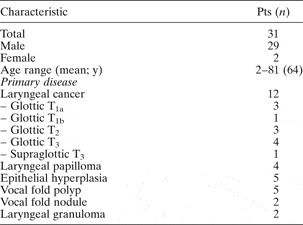
Laryngeal secretions and cytological samples were obtained from 31 patients (29 men and two women) admitted to the Kurume University Hospital between June 2006 and October 2008. These patients' characteristics are shown in Table I. Patients' ages ranged from two to 81 years (median age, 64 years). Twelve of the 31 patients had squamous cell carcinoma (glottic tumour stage (T) 1a in three patients, glottic T1b in one, glottic T2 in three, glottic T3 in four and supraglottic T3 in one). Four of the 31 patients had laryngeal papillomas. Of the remaining 15 patients, six had epithelial hyperplasia of the vocal fold, and nine had other benign laryngeal disease (e.g. vocal fold polyp).
Patient characteristics

Pts = patients; y = years; T = tumour stage
Human papilloma virus DNA testing was performed by the Hybrid Capture 2 assay method (Mitsubishi Chemical Medience, Tokyo, Japan).Reference Kulmala, Syrjänen, Shabalova, Petrovichev, Kozachenko and Podistov9, Reference Lörincz and Anthony10 During laryngeal microsurgery, cytological samples were taken from individual laryngeal lesions using a brush attached to a commercial Hybrid Capture 2 kit. Samples were analysed and classified according to the presence of low risk HPV types (i.e. 6, 11, 42, 43 and 44) or high risk HPV types (i.e. 16, 18, 31, 33, 35, 39, 45, 51, 52, 56, 58, 59 and 68).
Laryngeal secretions were collected using a modification of the method described by Mogi et al. Reference Mogi, Watanabe, Maeda and Umehara2 During laryngeal microsurgery, two 5 × 10 mm pieces of sponge strip were inserted into both laryngeal ventricles; after a minute, absorbed ventricular secretions were collected from the sponge strips. The concentrations of IgG, IgA and IgM in the collected laryngeal secretions were measured quantitatively using turbidometric immunoassay, according to the manufacturer's protocol (SRL Laboratories, Tokyo, Japan). Levels of secretory IgA were measured using an enzyme-linked immunosorbent assay (Medical & Biological Laboratories, Nagoya, Japan).
Statistically significant correlations between the mean immunoglobulin concentrations for each patient group were determined by the Cochran–Cox test, using the StatView software package (Abacus Concepts, Berkeley, California, USA). A p value of less than 0.05 was considered to indicate statistical significance.
Results
Human papilloma virus DNA
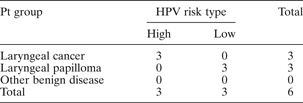
The results of HPV-DNA detection by Hybrid Capture 2 assay are shown in Table II. Human papilloma virus DNA was detected in six of the 31 (19.4 per cent) patients, comprising three of the 12 (25 per cent) laryngeal cancer patients, three of the four (75 per cent) laryngeal papilloma patients and zero of the 15 (0 per cent) other benign disease patients. High risk type HPV-DNA was detected in three laryngeal cancer patients, and low risk type HPV-DNA was detected in three laryngeal papilloma patients.
Detection of high and low risk HPV-DNA in different patient groups, using Hybrid Capture 2 assay

Data represent patient numbers. HPV = human papilloma virus; pt = patient
Laryngeal secretion immunoglobulins
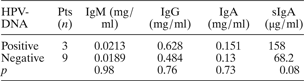
The mean laryngeal secretion concentrations of IgG, IgA, IgM and secretory IgA are shown in Tables III, IV and V.
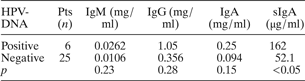
Mean immunoglobulin levels in HPV-DNA positive and negative patients*

* By Hybrid Capture 2 assay. HPV = human papilloma virus; pts = patients; Ig = immunoglobulin; sIgA = secretory IgA
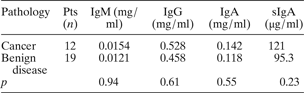
Mean immunoglobulin levels in patients with cancer and benign disease

Pts = patients; Ig = immunoglobulin; sIgA = secretory IgA
The mean concentrations of IgM, IgG, IgA and secretory IgA in HPV-DNA positive patients were more than twice those in HPV-DNA negative patients (Table III). A statistically significant difference in secretory IgA concentration was observed between the two groups.
Patients with laryngeal cancer had higher levels of all measured laryngeal secretion immunoglobulins, compared with patients with benign laryngeal disease (Table IV); however, this difference was not statistically significant.
In the 12 laryngeal cancer patients, mean immunoglobulin concentrations were compared for the HPV-DNA positive (n = 3) and HPV negative (n = 9) patients (Table V). The mean concentrations of IgM, IgG, IgA and secretory IgA in the HPV-DNA positive cancer patients were greater than those in the HPV-DNA negative cancer patients. Interestingly, although this difference was not statistically significant, the mean secretory IgA concentration in the HPV-DNA positive cancer patients was more than twice that in the HPV-DNA negative cancer patients, despite other immunoglobulins being at the same level.

Discussion
The HPV genome has been detected in more than 99 per cent of uterine cervical squamous cell carcinomas.Reference Walboomers, Jacobs, Manos, Bosch, Kummer and Shah11 High risk type HPV is frequently associated with invasive carcinoma of the oral cavity, oropharynx, larynx and nasal cavity.Reference Mineta, Ogino, Amano, Ohkawa, Araki and Takebayashi12 In the current study, we found high risk HPV in three of 12 (25 per cent) patients with laryngeal cancer, using the Hybrid Capture 2 assay method. We could find no previous report of HPV-DNA detection in the larynx using this assay method. In studies assessing the presence of HPV in laryngeal cancer using in situ hybridisation, the rate of HPV detection varied between 8.8 and 12.9 per cent, whereas studies using polymerase chain reaction reported detection rates of between 8 and 58.8 per cent.Reference Manjarrez, Ocadiz, Valle, Pacheco, Marroquin and De la Torre13–Reference Ma, Ueno, Pan, Hi, Ohyama and Eizuru16 Many factors have been suggested to explain the considerable difference between various studies' detection rates, including the sensitivity of the detection methods.Reference Melchers, van den Brule, Walboomers, de Bruin, Burger and Herbrink17 Kasperbauer et al. could not detect HPV-DNA in verrucous carcinoma using in situ hybridisation, but found that polymerase chain reaction revealed 85 per cent positivity.Reference Kasperbauer, O'Halloran, Espy, Smith and Lewis18 In general, polymerase chain reaction has a higher detection rate for high risk HPV, compared with Hybrid Capture 2 assay. In contrast, Kulmala et al. reported that both polymerase chain reaction and Hybrid Capture 2 assay had equal specificities and equal negative predictive values for HPV detection, but the sensitivity of the Hybrid Capture 2 assay was slightly better.Reference Kulmala, Syrjänen, Shabalova, Petrovichev, Kozachenko and Podistov9
It is well established that mucosal immunity is delivered by the secretions present in both the respiratory and gastrointestinal tracts. Locally produced secretory IgA is the predominant immunoglobulin involved in mucosal immunity.Reference Nakashima, Tomita, Chitose, Umeno and Sato4 Using an immunofluorescent method, we have previously demonstrated that IgA-producing plasma cells are numerous in the submucosal and preglandular areas of the human larynx, suggesting that a local immune system is active within this region.Reference Nakashima, Makishima, Komiyama, Takeda and Hiroto19 The laryngeal ventricles are richly supplied with laryngeal glands; therefore, the laryngeal secretions covering the vocal folds seem to be secreted mainly from the glandular epithelium and acini within the false vocal folds and ventricles. Our previous and current findings suggest that secretory IgA may have inhibitory activity against infection or carcinogenesis due to HPV. However, the development to HPV-related tumours (e.g. laryngeal papilloma) may be due to specific kinds of HPV receptor within the laryngeal mucosa.
• Recent advances in immunology and immunopathology have shown that the larynx has an active mucosal immune system, as do other respiratory organs
• This study aimed to clarify the local immune status in the larynx in the presence of infection or carcinogenesis associated with human papilloma virus (HPV)
• Results suggest that the local laryngeal immune response is activated by infection or carcinogenesis associated with HPV
• Secretory immunoglobulin A may have inhibitory activity against infection or carcinogenesis associated with HPV in the larynx
In the present study, the mean laryngeal secretion immunoglobulin concentrations in HPV-DNA positive cancer patients were greater than those in HPV-DNA negative cancer patients, suggesting that the laryngeal local immune system is activated by HPV-associated carcinogenesis. Sasagawa and colleagues have documented the serological response to HPV-DNA types 6 and 16 virus-like particles in patients with neoplastic lesions of the cervix.Reference Sasagawa, Inoue, Lehtinen, Zhang, Gschmeissner and Hajibagheri20, Reference Sasagawa, Yamazaki, Dong, Satake, Tateno and Inoue21 They found significantly greater positivity rates for both IgA and IgG antibodies in women with high grade squamous intraepithelial lesions and cancer, compared with healthy women. These authors' results support our findings that raised immunoglobulin antibody concentrations are good indicators of HPV infection and HPV-associated carcinogenesis in the larynx.
Further investigation is required regarding the association between laryngeal immunological responses, HPV-like particles within laryngeal lesions, and specific parameters of HPV infection.