Introduction
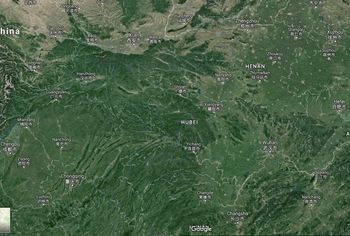
In recent decades, thanks in large part to an abundance of archaeological discoveries, scholars have made significant progress in the field of the history of ancient Chinese textiles and accessories. Archaeologists have unearthed numerous organic materials including textiles, bamboo, and wooden objects, dating from approximately the Warring States 戰國 (481–221 b.c.e.), the Western Han 西漢 (206 b.c.e.–8 c.e.), and the Eastern Han 東漢 (25–220 c.e.) periods, all found within the Yangzi 揚子 (also called the Changjiang 長江) River basin (see the bottom right part of Figure 1). These discoveries have filled many gaps in our understanding of what social elites wore in ancient China. But there remain other gaps waiting to be filled. First, there is a risk of reconstructing this history without properly evaluating the historical reliability of the artifacts on which scholars have been based their accounts. Furthermore, a full understanding of the production techniques of luxury textiles and accessories still await more detailed studies.
Map showing important cities. Retrieved from Google Maps, August 16, 2016.

This article investigates evidence from textiles, bamboo, and bronzes and attempts to approach the question of what elites wore in 500 to 300 b.c.e. China. But we need to first examine the reliability of the art historical evidence that is available to reconstruct this history. This article thus cautions the reader against certain past interpretations of the textiles and accessories of the period. It then delineates a brief history of how textiles and accessories developed and of how their producers interacted and exchanged ideas with producers of other sorts of artifacts. Finally, it proposes a methodology for building a more reliable and solid art historical basis for reconstruction. Textiles and accessories were symbols of the wealth, status, and power of individuals who wore them. This article will explain how a combination of the production techniques of textiles and accessories, together with a sharing of designs and techniques within the community of producers, contributed to the formation of those symbols.
Methodological Concerns
Reliability of Art Historical Sources
The textile examples discussed in this article are divided into two categories: actual textile pieces and artistic representations of the textiles. I suggest that arguments over artistic representations of textiles without cross-referencing actual pieces should remain hypothetical. We cannot launch concrete arguments without the corroboration of both sources. Previous scholars have made use of numerous artistic sources to reconstruct the history of textiles and accessories, but they often neglect the evaluation of the reliability of these sources as historical materials.Footnote 1 For instance, actual silk garments worn by individuals constitute a different historical source from similar garments as depicted in paintings or alternatively as made in miniature garments for use on figurines. Distinguishing between their historical differences will allow for the development of a more robust and reliable database of ancient Chinese textiles and accessories.
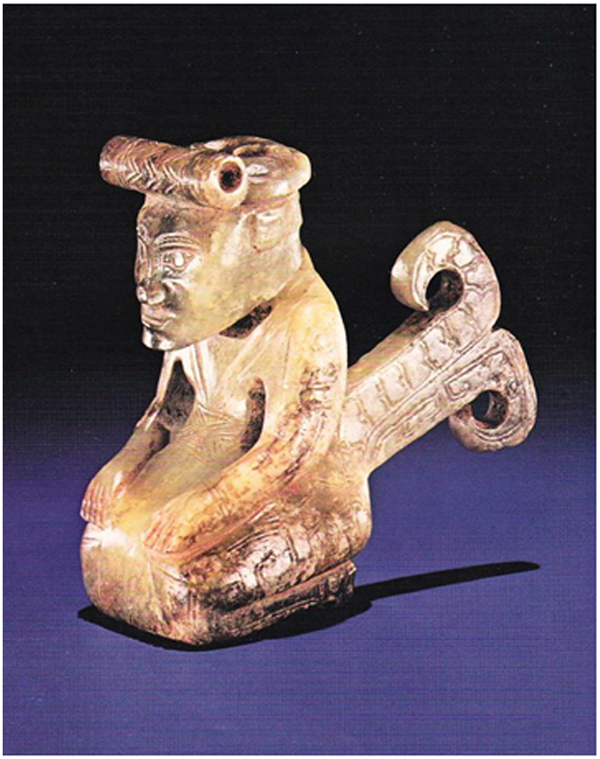
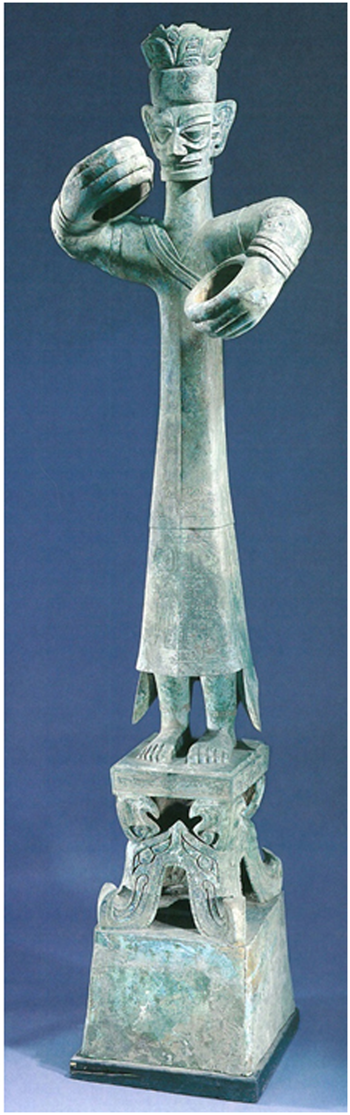
Intact clothes and textile pieces from pre-Qin 秦 China are extremely rare. Such perishable items have hardly ever survived the passage of time, although some have appeared as pseudomorphs on other, more permanent materials, such as jade and bronze. Artistic representations of clothes, on the other hand, are found on bronze and jade figurines, such as a jade figurine from Lady Fu Hao's 婦好 tomb in Henan Anyang 河南安陽 (Figure 2)Footnote 2 and a tall bronze figurine from Sichuan Sanxingdui 四川三星堆 (Figure 3),Footnote 3 both dating to approximately 1200 b.c.e. Anyang is located nearly 190 km north of Zhengzhou 鄭州 and Sanxingdui is 50 km north of Chengdu 成都 (see Figure 1). These artistic representations of clothes are undoubtedly useful reference points in the history of ancient Chinese textiles; but we should also be awake to the artistic manipulations of form, shape, and appearance involved in their creation. We may, for instance, never know with certainty to what extent religious or political forces altered the artistic representations. Actual textile fragments must also be viewed cautiously, because most have been obtained from burial contexts. These excavated pieces might indeed have been used by individuals during their lives, but we cannot rule out the possibility that they might have been specially designed for use by the deceased in the afterlife. All in all, we should be cautious of all artifacts we are referencing and always closely interrogate any superficial interpretations. Any citation of artistic representations without the support of actual examples is dangerous. It will be safer to use both the artifacts and their artistic representations to develop an argument. This article will use the actual textiles as points of departure.
Jade figurine from Fu Hao's tomb, Anyang, Henan. H. 6.9 cm. Ca. 1200 b.c.e. After The Great Bronze Age of China, 172, no. 39.

Tall bronze figure from Sanxingdui Pit 2, currently housed in the Sanxingdui Museum. Accession no. 00643. H. 260.8 cm. Ca. 1200 b.c.e. After Ancient Sichuan, 73, no. 2.

Geographical Differences
We should be aware of the geographical context of archaeological materials. Differences in burial contexts and geographical origins may complicate our understanding of the archaeological materials. For example, most of the textiles discussed in this article were excavated in the Yangzi basin. People living in the middle Yangzi basin could easily travel along the Yangzi River and this would have enabled them to exchange ideas and goods with each other.Footnote 4 But this does not necessarily imply that they had no interaction with people living in the Yellow River basin.
The Yangzi River basin provided a type of ideal condition for preserving perishable materials, and numerous silk textiles found in the middle Yangzi basin have survived for over 2,000 years. The textiles, made of highly perishable organic material, namely reeled silk thread, were tightly sealed in underground, water-logged tombs invested with very fine clay such as baigaoni 白膏泥, which prevented organic textiles from undergoing normal oxidation. These water-logged tombs were essentially sealed for two millennia because the Yangzi River basin has a high water table, an accident of nature that has markedly contributed to our knowledge of the history of art in the region. Perishable textiles and objects woven from bamboo have been instrumental in shaping contemporary understandings of the history of ancient Chinese textiles and accessories. Craftsmen living in the Yellow River basin may have produced similar products, but these did not last long in that relatively arid environment.
It is worth noting that each textile example from ancient China discussed in this article is associated with a specific archaeological context. Without these physical objects, we would likely only be able to see representations of clothes and accessories such as miniature garments on bronze figurines or clay molds or models. However, with the real artifacts in hand, we can investigate how they were created and eventually explore the thought processes embodied in the aesthetic decisions of their creators.
Design Exchanges
Since the 1982 excavation of tomb M1 at Mashan 馬山 in Hubei 湖北 Province (M referring to mu 墓 in Chinese meaning “tomb”), archaeologists have had at least a rudimentary understanding of how textiles were woven in approximately 300 b.c.e. This tomb belonged to a female elite and housed a large collection of textiles dating to approximately 300 b.c.e. However, how specific design patterns changed before this—between 500 and 300 b.c.e.—and how textile producers chose their sources of inspiration remain relatively unknown. Scholars such as Peng Hao 彭浩, Suzanne Cahill, Colin Mackenzie and others have indicated the close relationships between bronze mirrors and bamboo and textile weaving.Footnote 5 However, there is still much to be done.
This article thus traces the historical development of textile designs during the period 500–300 b.c.e. by using examples woven with specific patterns. Some textile pieces displayed a type of geometric patterns, usually referred to as the connected-T pattern, which is the focus of the examples discussed in the present article. Prior to 500 b.c.e., artistic exchanges might have occurred between the producers of bronze vessels for public ritual display and the producers of other objects such as bamboo boxes and silk textiles. Textile weavers after 500 b.c.e. would have been exposed to designs on objects made from other materials, especially those intended for personal use, and would have subsequently incorporated motifs from these other media into their own designs. When we analyze the artistic exchanges between textiles, bamboo, and bronze objects more carefully, we also discover a larger space for research in the history of textiles and accessories.
This article will establish that the connected-T pattern originated from patterns on bronze ritual vessels produced at a much earlier date, and that it may have its roots in textiles and objects woven from bamboo. By approximately 300 b.c.e. fragments of this pattern appeared on textiles, mirrors, and bamboo boxes, but rarely on ritual vessels. Similar patterns occurred on a variety of items primarily intended for personal use.Footnote 6 Designs on bamboo boxes, bronze mirrors, and silk mirror covers reveal a remarkably close relationship to patterns found on textiles.
Reasons for the Appearance of Luxury Textiles and Accessories
The following discussion considers concrete techniques of textile and bamboo weaving and bronze casting in ancient China, the design features of these media, and the question of how they deserve to be classified as luxury items. Previous scholars have provided a general categorization of the techniques used,Footnote 7 but they seldom gave any detailed explanation of techniques used on individual objects. Thus they missed the opportunity to explore the design approach of individual craftsmen. I believe that we can explore that approach even though these designers left no written records. This can be done by examining production techniques chosen for specific objects, and by considering the interaction between designers of a variety of artistic media. Taken together, the selection of production techniques and the execution of design ideas reflect how the designers thought about their objects. The choice of technique A rather than technique B can yield clues for an investigation of a specific designer's approach.
While we have sometimes discussed the interactions between designers of bronzes and textiles, we have seldom investigated exactly how specific techniques or designs interacted. More intriguing are questions around how and why weavers wove specific textiles. Given the array of choices available to them, why did they make these particular decisions? What problems did they encounter during the weaving process, and how did they solve them? A mere list of weaving techniques is insufficient to answer these questions and leaves out a discussion of the training and personal approach of individual weavers. If we can explain how luxurious the textiles and accessories were, and why they became luxuries, we can then also explain the rarity and difficulty of their particular techniques for production and design.
Development of the Designs of Textiles and Accessories
Given that surviving fragments of silk textiles produced before 500 b.c.e. are extremely rare, we can first examine some artistic representations of what elites wore. While the Anyang jade figurine and the Sanxingdui bronze figure appear to wear robes, it is difficult for scholars to use these two examples to reconstruct completely reliable examples of what elites actually wore around 1200 b.c.e. because their robes contain some very special features. For example, we do not quite know what the Anyang figurine's back protrusion represented or what function it served. The Sanxingdui figure's robe contains very intricate patterns but we lack evidence to prove whether the textile weavers or embroiderers of 1200 b.c.e. actually created such patterns. We simply do not have much corroborating proof to back up these reconstructions.
On the basis of known examples of both actual textiles and artistic representations of textiles, geometric patterns do appear to have been quite popular in the weavers’ design corpus. Angela Sheng suggests that this was because weavers could create repetitive geometric patterns on looms with a minimal draw-mechanism, as compared to the much greater effort required in creating curvilinear patterns.Footnote 8 Vivi Sylwan and Peng Hao have brought to our attention fabrics existing as imprints from a bronze axe and a jade dagger-axe from Anyang. From the reconstructed image created by the Suzhou Silk Museum, we can see that the fabric example cited by Peng Hao was a twill-patterned tabby with lightning patterns.Footnote 9 Dieter Kuhn defines “pingwen 平紋” (plain or tabby weave) as follows:
Tabby weave [is], one of the three weave structures in Chinese silks. The tabby weave is simple—one over, one under, represented by the ratio 1/1—so that each set of two warp and two weft threads makes up a complete woven structure. The grouping of warp and weft threads results in various types of tabbies, among them normal silk tabby (juan), thin open-weave silk tabby (sha), thick and heavy silk tabby (di), coarse silk tabby (chou), silk floss tabby (mianchou), and crêpe (hu). All of those weaves appeared by the Shang period.Footnote 10 On the basis of these geometric patterns on actual textiles, we can more confidently rely on artistic representations of fabric pieces with geometric patterns.
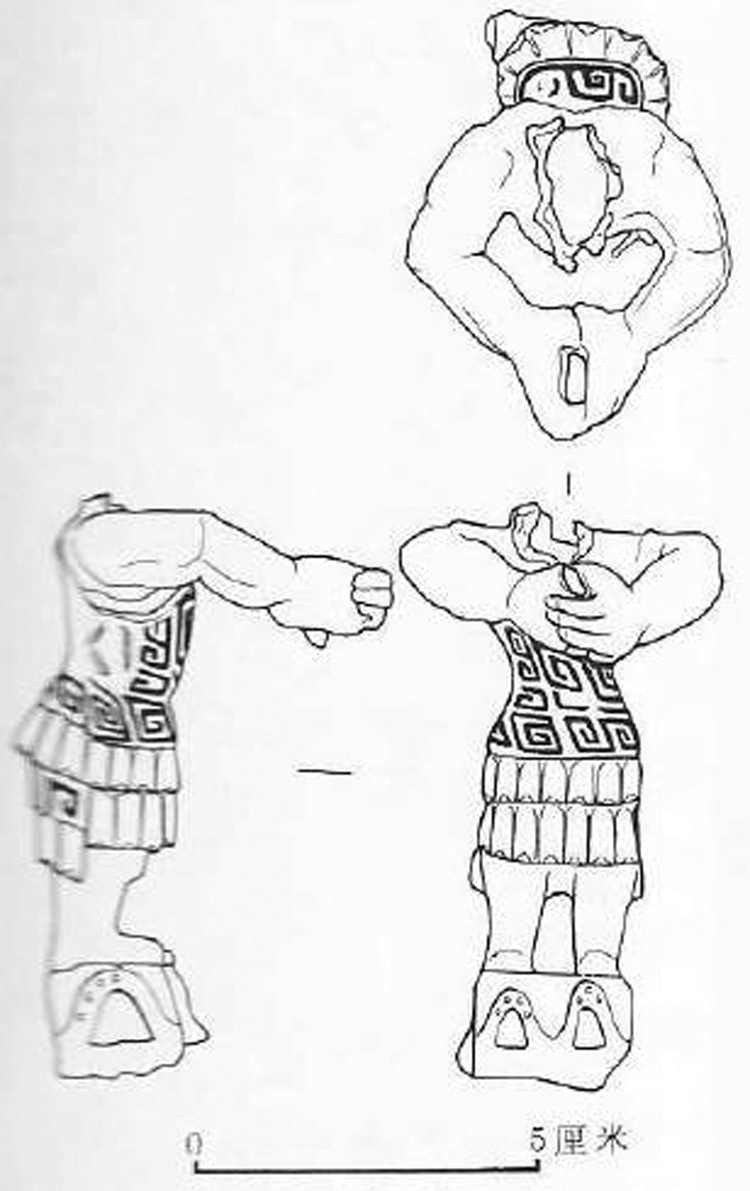
A small bronze figurine missing its head (Figure 4),Footnote 11 also from Sanxingdui, wears a robe decorated with a connected spiral pattern. This was a popular design element on bronze vessels dating from the same period of approximately 1200 b.c.e. Another type of connected pattern was the connected-T pattern, which may have been a derivative from the connected spiral pattern and will be discussed later. The connected spiral pattern on the figurine's robe shows what a warrior might have worn in that period. This is not definitive evidence for reconstructing textile patterns of the period, but it offers some useful clues.
Drawing of a small bronze figurine from Sanxingdui Pit 2, currently housed in the Sanxingdui Museum. H. 8.3cm. Ca. 1200 b.c.e. After Sanxingdui jisikeng, 167, fig. 83.

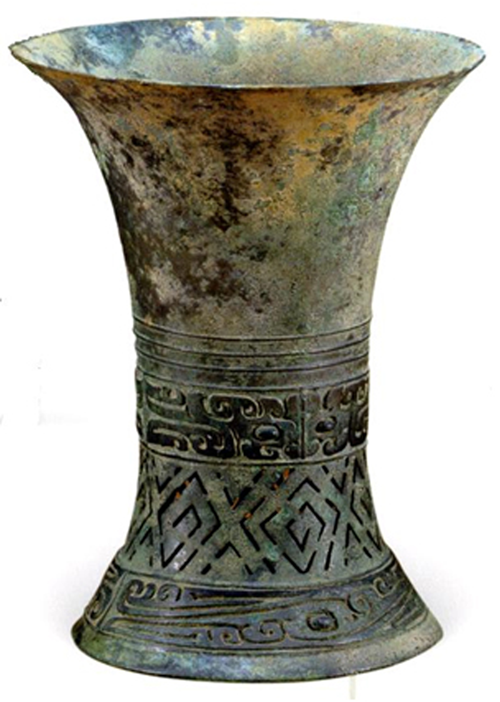
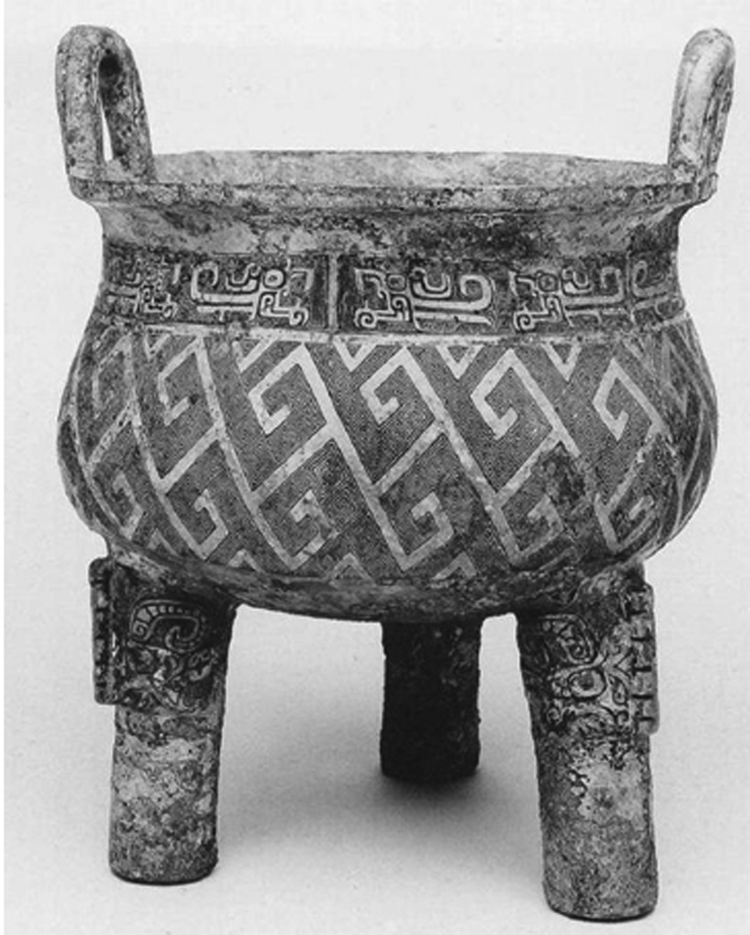
Connected geometric patterns similar to the aforementioned designs have been found on numerous contemporaneous bronze ritual vessels. A bronze gu 觚 from Hubei Wuhan Panlongcheng Lijiazui 湖北武漢盤龍城李家嘴 M1 displays a register of connected spiral patterns (Figure 5),Footnote 12 and continuous connected geometric patterns occupy the central register of the belly of a bronze ding 鼎 in the collection of the Royal Ontario Museum (Figure 6).Footnote 13 The background pattern of the ding is filled with interconnected spirals, and its singled-out empty bands constitute a design similar to numerous examples of connected-T patterns. The connected-T patterns join the beginning with the end and form a circle of continuous patterns. As pointed out by Angela Sheng, the pattern on the Ontario ding appears very similar to that on actual textiles. Wrapping bronze vessels with textiles was a popular practice back then.Footnote 14 The Ontario ding designer might well have transferred the textile pattern onto the bronze.Footnote 15
Bronze gu from Hubei Wuhan Panlongcheng Lijiazui M1. H. 16.8 cm. Ca. 1400 b.c.e. After Panlongcheng, 52, no fig. number.

Bronze ding in the collection of the Royal Ontario Museum. H. 33.9 cm. Ca. 1100 b.c.e. After Max Loehr, 163, fig. 44.

The connected geometric patterns shown on these bronze vessels, all of which date to approximately 1400–1100 b.c.e., may have appeared earlier on products made of materials readily available in the natural environment, such as textiles and objects woven from bamboo.Footnote 16 The methods used to weave bamboo strips and textiles would have facilitated the creation of such connected geometric patterns. However, we have scant evidence confirming this and so the notion will remain hypothetical until future discoveries provide validation.
We might surmise that the designers of these ritual vessels were familiar with connected geometric patterns and that they knew how to manipulate their final appearance on bronze. Casting these vessels required first of all the creation of clay models in the exact shape of the finished bronze products: designers carved the geometric patterns onto the models. The next steps were to form an outer mold of clay around the model, and then to slice that mold into sections. The original model was then removed or scraped down to the shape of a core stabilized within the mold formed by assembling the mold sections.Footnote 17 After the mold sections were bound tightly together, molten bronze was poured into the mold. Once the bronze had solidified, the caster would break the mold to reveal the bronze object in the desired shape.Footnote 18 Thus, the spiral pattern on the robe of the small Sanxingdui bronze figurine might have originated from a pattern carved by its designer onto the clay model. Alternatively, it is possible that this designer referred to an actual textile in designing the figurine's surface décor.
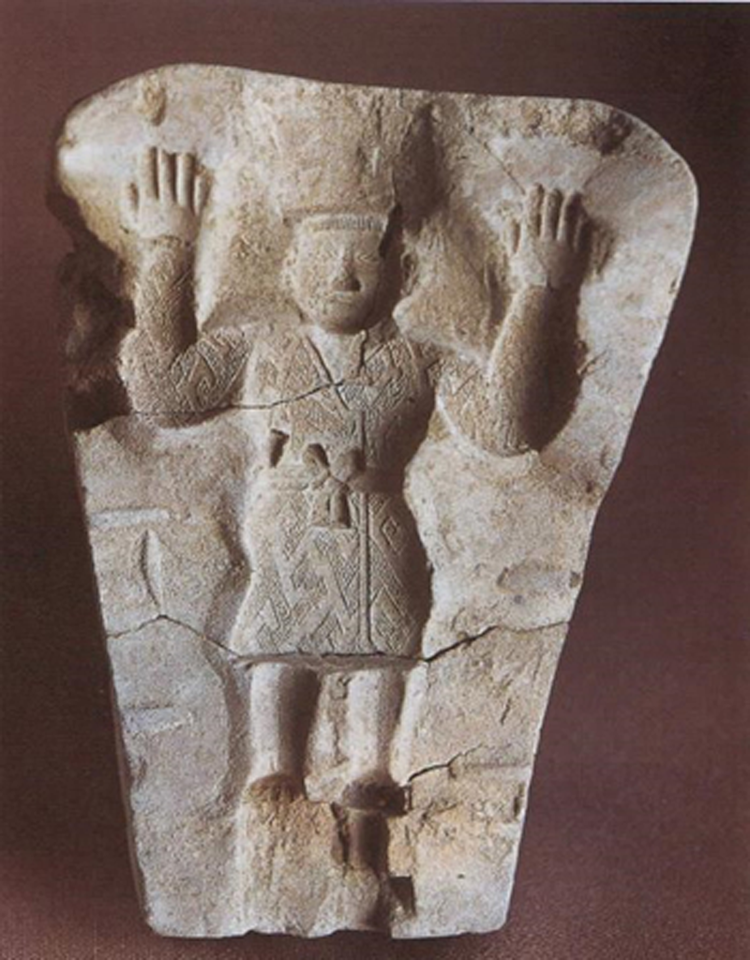
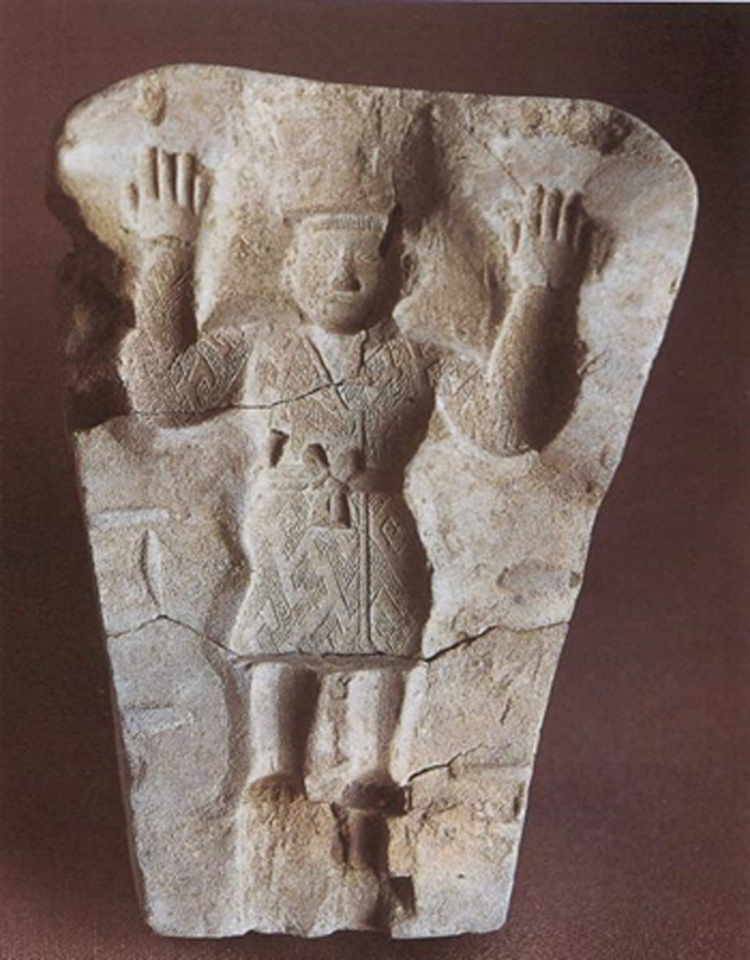
A similar connected-T pattern appears on a clay figurine in the shape of a mold piece for bronze casting, excavated at Shanxi Houma 山西侯馬 (Figure 7),Footnote 19 80 km north of Yuncheng 運城 (see Figure 1), dating to approximately 500 b.c.e. The shape of this figurine's robe does not differ substantially from those of the Fu Hao jade figurine or the tall Sanxingdui figure. As Colin Mackenzie has noted, the design of the robe can be traced to a marble carving found in Anyang.Footnote 20 The manner in which the robe was worn is also similar, requiring the wearer to put his or her arms into the long sleeves, and cover one side of the robe with the other (in both of the tall Sanxingdui and Houma figurines, the right side of the robe comes over the left). The robe on the Houma figurine has a soft sash wrapped around the waist, secured with a bow-knot. Multiple spirals are visible within the bands of the connected-T pattern. These details imply that the design of the figurine's robe might not have sprung solely from the designer's imagination or have been copied from patterns on bronzes. Instead, it was most likely based on real textiles and the ways in which they were actually worn and fastened.
Clay human figurine in the shape of a mold piece for bronze casting, from Shanxi Houma. H. 10.7 cm. Ca. 500 b.c.e. After Houma taofan yishu, 103, no. 1287. Viewers of this figurine in this photograph may mistake it as a model; it is in fact a mold.
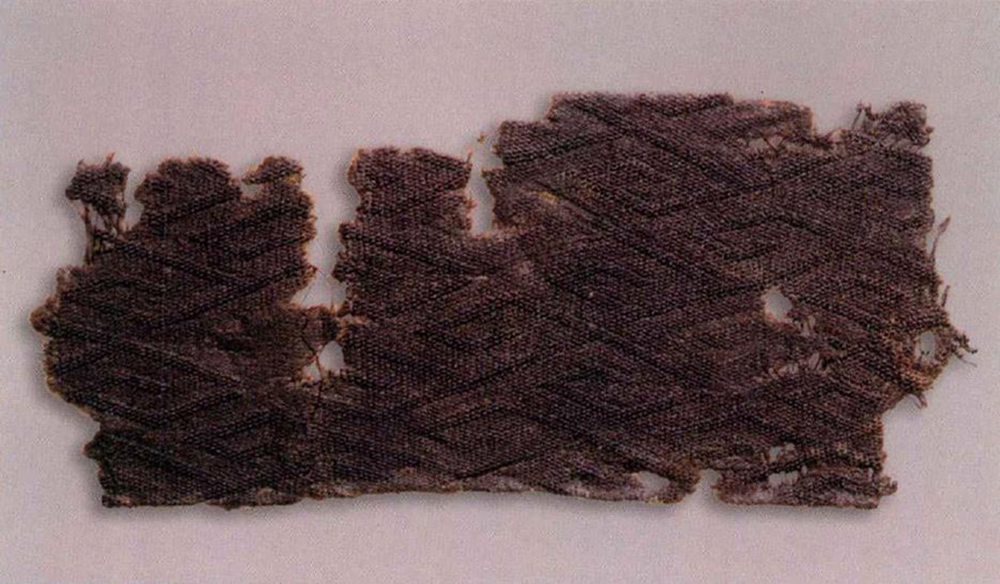
In the absence of any real, similar examples of textiles from the period, the speculation above was only a hypothesis until the discovery in 2007 of a piece of jin 錦 (patterned compound silk) fabric bearing the woven connected slanting-T pattern, which was excavated from a large tomb at Jiangxi Jing'an Lizhouao 江西靖安李洲坳 (Figure 8), 70 km west of Nanchang 南昌 (Figure 1 shows the location). This tomb, which dates to between approximately 500 and 400 b.c.e.,Footnote 21 has yielded more than three hundred textile pieces. This jin fabric is probably a fragment of a larger item, and its pattern corroborates the theory that the connected-T pattern on the Houma figurine stemmed from designs on real textiles. Although the colors have faded, we can see that the connected-T motifs were executed in a darker color, whereas the remaining background is of a contrasting lighter color. Unfavorable environmental conditions in Shanxi have precluded the survival of highly perishable textiles buried underground for many centuries. However, given the similarity of textile design to that depicted on the Houma human figurine, we must ask whether real textiles bearing the connected-T pattern could also very likely have been made in Shanxi. As yet, we lack the concrete evidence to prove or disprove this theory.
Jin fabric from a tomb at Jiangxi Jing'an Lizhouao. Measurement not provided. 500–400 b.c.e. After “Jiangxi Jing'an Lizhouao Dongzhou mu fajue jianbao,” 11, fig. 18.

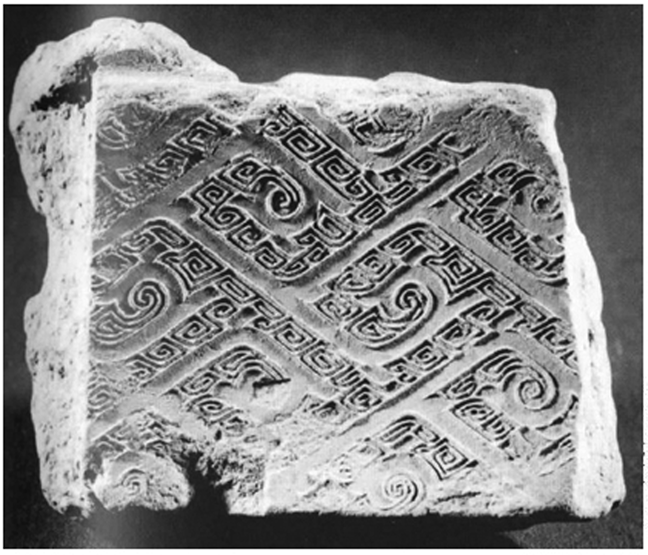
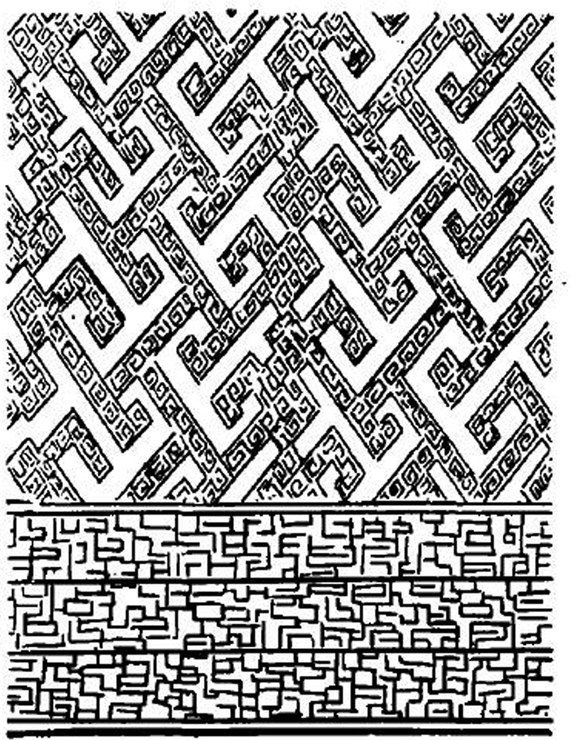
On a Houma clay model fragment, which might have served as a block for building a larger pattern, we see a similar connected-T pattern (Figure 9).Footnote 22 It is not clear whether this fragment was indeed part of a larger model for a ritual vessel, however. The connected-T pattern on the model fragment is not a common pattern on Houma bronzes; rather, popular Houma patterns incorporate taotie 饕餮 and interlaced dragon and serpentine motifs. The designers of the model fragment might have taken their inspiration from earlier designs on bronzes and on contemporaneous textiles such as the Lizhouao jin. Another source of inspiration may have been paintings, such as the lacquer painting on a box fragment excavated from Shanxi Changzi 山西長子 M2 (Figure 10).Footnote 23 In this example, some Ts are connected whereas others are not, creating a mixed pattern. This painter has followed the style of the previous bronze design by filling in the background with miniscule spirals and leaving the Ts blank in order to bring them into focus.
Clay model fragment from pit IIT47 at Shanxi Houma. L. 9.5 cm; w. 8 cm. Ca. 500 b.c.e. After Houma taofan yishu, 429, fig. 1060.

Drawing of the painting on a lacquered box fragment excavated in Shanxi Changzi M2. Measurement not provided. Ca. 500 b.c.e. After “Shanxi Changzi,” 522, fig. 17-2.

Pendants and belt hooks were utilized extensively from 500 to 300 b.c.e.Footnote 24 Jade pendants appeared as early as the Neolithic period and have continued in use up to the present time. As argued by Sun Ji 孫機, it appears that, after the late Spring and Autumn period (sixth to fifth century b.c.e.), jade pendant sets were no longer hung around the neck, but rather worn on waist belts.Footnote 25 Either because their stratigraphy had been disturbed, or because they apparently had no fixed assembly structure, it remains difficult to reconstruct the assembly of the jade pendant sets of this period. The working of jade was both assiduous and laborious. Jenny So provides a succinct description of how raw jades were acquired and worked.Footnote 26 The nature of the material meant that jade workers could not simply use metal tools to cut or work it; instead, they had to use abrasives to shape the jades and to create patterns. Consequently, the ownership of lavishly decorated jades was a clear demonstration of elite status.
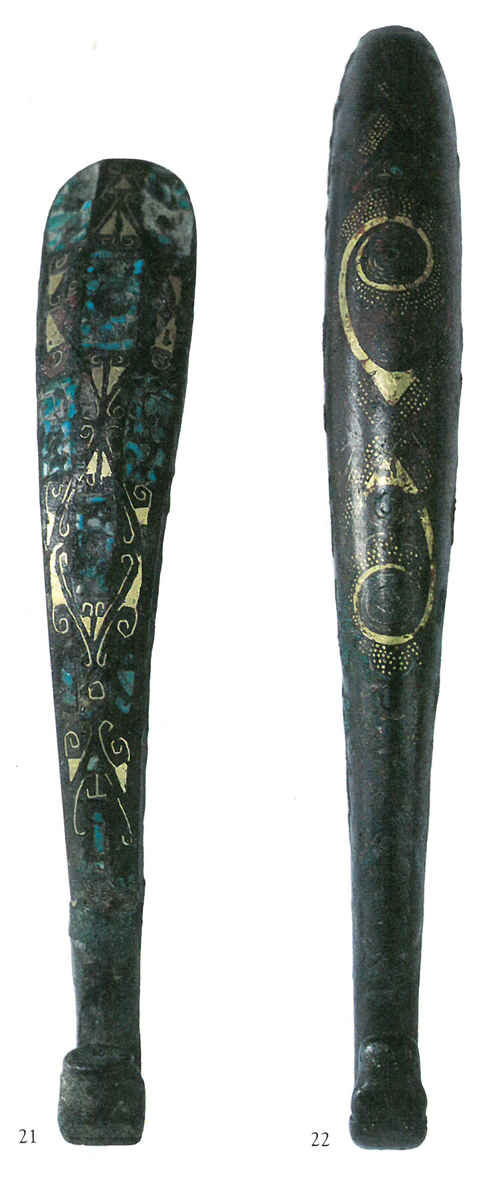
Belt hooks appeared in large numbers all of a sudden in the period from 500 to 300 b.c.e. For instance, we can make out a knot on the belt tightening the robe of the Houma figurine (Figure 7). Probably, by this time, a loose robe no longer appealed to popular fashion aesthetics. People used belts to tighten their robes and this in turn drew attention to their waistlines. There were various alternative ways to fasten the belt as well as just tying a knot. Similar to today's belt buckles, hooks were applied to help fasten the belts. Some of these belt hooks were lavishly embellished. Figure 11 displays two belt hooks with gold, silver, and/or turquoise inlays. These hooks from the Shanghai Museum are cast bronze with dented areas for inlaying the gold, silver, and turquoises. Some of the hooks are extremely large, advertising their owners’ wealth and status in addition to their practical function. The display element was derived from the highly reflective polished surfaces of the gold, silver, and bronze materials. Wearing robes made of fine textiles tightened by belts with metal inlays and adorned with jade pendants, wealthy individuals would certainly have attracted attention and awe.
Belt hooks with gold, silver, and turquoise inlays. Collection of Shanghai Museum. Measurement unknown. Ca. 300 b.c.e. After 5000 Years of Chinese Costumes, 22, fig. 21 and fig. 22. Image copyright: Shanghai Museum.

Popularity of Exchanges
The connected-T pattern appears on a range of objects including bronze ritual vessels and figurines, textiles, clay models and molds, and paintings on lacquer boxes. Colin Mackenzie and Suzanne Cahill have indicated the close relationship between textiles and other artifacts in the period from 500 to 200 b.c.e.Footnote 27 Although we do not know exactly how the fragments of the Lizhouao jin and other artifacts functioned, we do know that their producers had design tendencies and strategies similar to those of ritual vessel casters, because of their shared use of the connected-T pattern. Bronze vessels were also purportedly used for public display and ritual performances. The variety of their functions and the commonality of their decorative patterns indicate that artistic exchanges might have been common between these producers and designers.
Various and substantial changes can be observed in textiles produced between 500 and 300 b.c.e. Several textile pieces have survived from the period and they are evidence that new designs were flourishing and mixing with traditional ones. The connected-T pattern was occasionally broken into a fragmentary form, and took on various new manifestations, and it continued to be popular on textiles. Vegetal motifs emerged on textiles, paintings, and bronze mirrors,Footnote 28 and interlaced and animate creatures such as birds, dragons, and serpents also frequently appeared on such artifacts. Ritual vessel designers, however, rarely adopted these connected geometric patterns, instead favoring interlaced animal motifs and miniscule patterns. Additionally, producers of dresses, textile pieces, bamboo objects, and bronze mirrors were forming their own design tendencies and strategies separately from the casting tradition of sacrificial ritual vessels. They had convenient access to such materials they wished to consult. Materials from archaeological excavations demonstrate that these products were usually deposited in the same position in tombs and would probably have been in regular use in everyday life before interment.
New Designs on Bronze Ritual Vessels
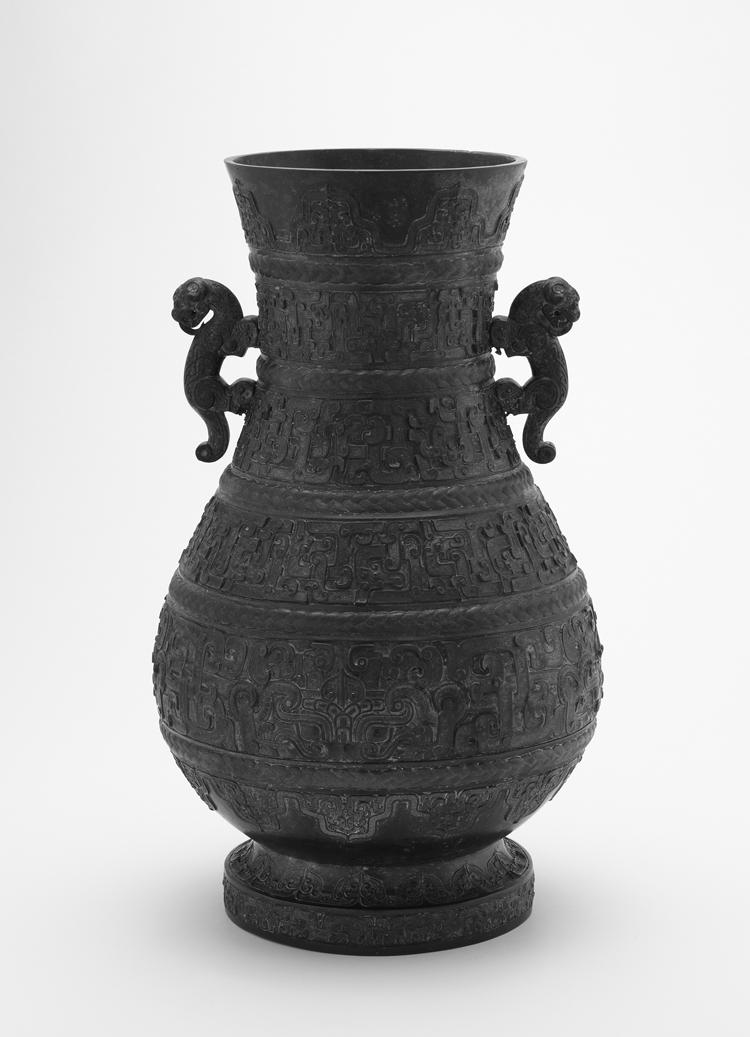
Ancient Chinese bronze ritual vessel designers were adopting a distinctive new approach from approximately 500 b.c.e. Casters no longer carved desired patterns on a clay model of the vessel. Specifically, the Houma casters used the newly invented pattern-block method to cast vessels such as the hu 壺 shown in Figure 12, housed in the Freer Gallery of Art.Footnote 29 They first created a large mold for casting, in the shape of the desired vessel. But they did not carve the patterns onto the inner walls of the mold in mirror-reversed fashion. To decorate the inner walls of the mold used to produce the desired patterns on the hu, producers instead first carved patterns on a clay block in the positive, then replicated multiple unit molds from this pattern block and pasted them onto the inner walls of the mold for casting. Finally, they poured molten bronze into the mold for casting and created the bronze hu. Accordingly, the decorative patterns on the bronze hu are not connected and continuous as seen on the Ontario ding. Instead, the decorative patterns on the various registers of the hu were formed by assembling multiple unit molds replicated from the same pattern blocks. Detailed investigations reveal that the interlaced dragons within one unit on the Freer hu remain unconnected to others within an adjacent unit.Footnote 30 This demonstrates the differences in production techniques between the Freer hu and the Ontario ding.
Bronze hu in the collection of the Freer Gallery of Art. H. 44.8 cm. Ca. 500 b.c.e. Freer Gallery of Art, Smithsonian Institution, Washington, DC: Purchase – Charles Lang Freer Endowment, F1957.22.

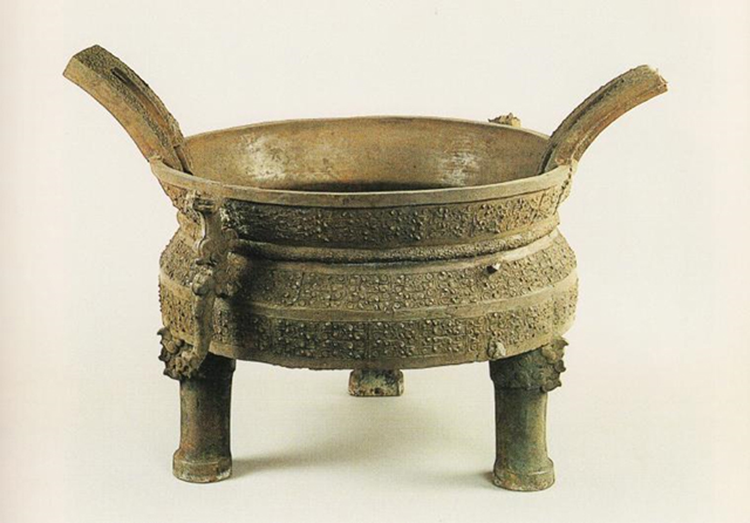
After approximately two hundred years, some interlaced patterns developed into increasingly miniaturized patterns, such as those displayed on the shengding 升鼎 excavated from Hubei Jingzhou Tianxingguan 湖北荊州天星觀 M2 (Figure 13), which dates to approximately 340 b.c.e.Footnote 31 Again, the decorative patterns on this vessel are divided into units and the miniscule patterns do not provide any visual focal points. These decorative patterns thus differ appreciably from the designs of ritual vessels dating from before 500 b.c.e. As reflected in the diversity of production techniques and design sensibilities, ritual vessel design from 500–300 b.c.e. had undergone a substantial shift in practice.Footnote 32
Bronze shengding from Hubei Jingzhou Tianxingguan M2. Report no. M2: 115. H. 45 cm. Ca. 300 b.c.e. After Jingzhou Tianxingguan erhao Chu mu, color pl. 11 (no pagination).

Producers of artifacts of other types followed a different track during this period. They maintained active exchanges with each other, and conversely tended to keep their distance from the ritual vessel designers. The designs displayed on textiles, bronze mirrors, and bamboo objects reveal that their producers shared tendencies towards particular patterns, among which the connected-T pattern maintained a high level of popularity.
New Designs on Bamboo Boxes
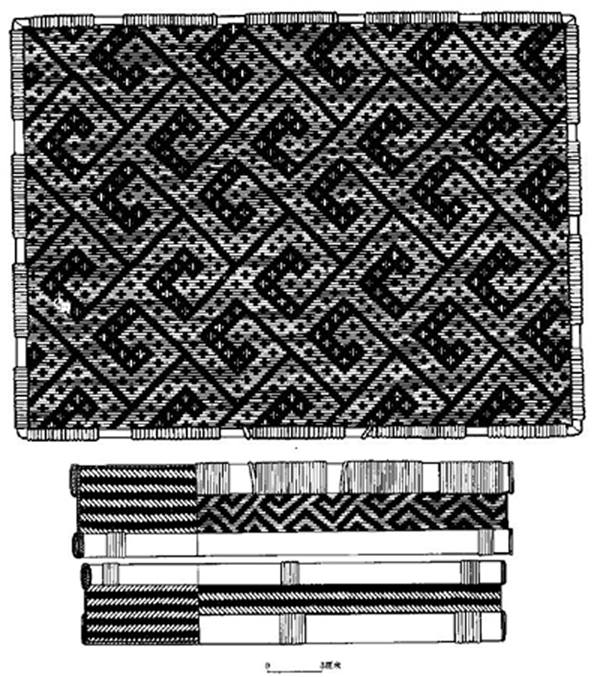
Mackenzie precisely describes the close relationship between a bamboo woven box and the connected-T pattern.Footnote 33 Both the lid and body of this box were excavated in Hubei Jingzhou Jiudian 湖北荊州九店 M410 (Figure 14).Footnote 34 The woven bamboo pattern consisted of sections of connected-T motifs, and the lines of the connected-T pattern are mainly black. The arms of each T motif widen so that they form broad black lines; within the broad black lines are tiny red crosses. The central column of each T motif is depicted by thin black lines, and the reserve areas are red, with many tiny black crosses running across them. The production process involved in weaving bamboo strips to create the connected-T pattern was completely different from that used in the production of clay molds and models. Although Mackenzie describes the visual aspects of the pattern, he does not explain how the bamboo strips were woven to create the pattern.
Drawing of the connected-T pattern on the lid, and a profile view of the Hubei Jingzhou Jiudian M410 box. One wooden comb is contained inside. Report no. 410: 24. Dimension of the lid: l. 24.6 cm; w. 18.9 cm; h. 5.2 cm. Ca. 300 b.c.e. The darker color in the image is originally black, while the lighter color is red. After Jiangling Jiudian Dongzhou mu, 320, fig. 215.

Here, we focus primarily on the making of the lid. First, the bamboo weaver carefully cut numerous long, thin strips of bamboo. According to the archaeological report, each strip was a mere 1 mm wide and 0.2 mm thick.Footnote 35 The ability to select the appropriate bamboo can be considered as a craft skill: the weavers needed to know what types of bamboo were best suited both to produce these long, thin strips and to maintain the structure of the box over the long term. Specialized knowledge of the optimal time to harvest the bamboo was likely obtained through long experience. Additionally, the cutting of the bamboo had to be regular and precise, lest strips of irregular sizes ruin the overall structure of the box. The strips were painted with red or black lacquer, allowing the main motifs to emerge through the juxtaposition of differently colored strips.
The weaver of the bamboo box also had to devise a plan in advance for every motif of the pattern. Thus, the weaver would have anchored the strips on a rigid frame, held one end of the long strip with one hand, and perhaps even used the toes of a foot to grasp the other end and hold it steady.Footnote 36 The next strip was added by placing it perpendicular to the first strip, which had to be anchored (also likely through the collaboration of fingers and toes). This process continued, with the strips forming a crisscross pattern, within a plain bamboo weave structure, one perpendicular strip over one horizontal strip, then under and then over again and so on (similar to one warp over one weft, then under and then over again, in the case of weaving fabrics). Notably, the black strips did not simply float over the entire surface to create the pattern; at necessary points they had to pass underneath the red strips to maintain the weave structure. Thus, the connected-T pattern formed by the black strips only appears at the places where the weaver caused them to float on the surface. This manner of pattern formation was comparable to fabric weaving techniques, and the overall design depended on the complex intersections of red and black lines, areas, and crosses. Throughout the weaving process, the bamboo weaver had to assiduously attend to the diverse coloration of the strips, concerned not only with the shape and structure of the lid, but also with simultaneously creating the array of the black connected-T patterns, the red background areas, and the miniature red and black crosses. Production of the box therefore involved not merely the repetitive movement of adding strips, but also the simultaneous coordination of the weaver's experienced mind and hands.
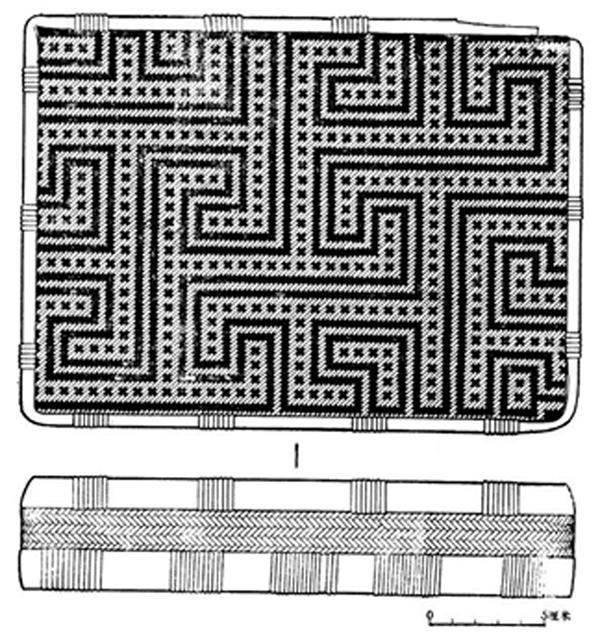
Another bamboo woven box from Baoshan 包山 M2 numbered 2: 417 (Figure 15) exhibits similar connected-T patterns, albeit with notable variations. Although this cannot be observed in the black-and-white drawing, its connected-T pattern was formed by yellow and black strips.Footnote 37 Unlike the connected-T pattern of the Jiudian M410 box, formed by thin black lines, the connected-T pattern of this box comprises broad bars running through with tiny crosses.Footnote 38 These two boxes from Jiudian M410 and Baoshan M2 display the connected-T patterns in an all-over design. Whereas the patterns of the Jiudian M410 box were created aslant in relation to the boxes’ rectangular frames, the Baoshan M2: 417 box's pattern was oriented in agreement with the rectangular frame. Nevertheless, the connected-T patterns were still presented as extending beyond the rectangular frames of the box. The bamboo weavers had planned for the termination of the connected-T patterns at the rims; to achieve this, they would have needed to bend the bamboo strips and conceal them in the joints between the patterned surface and the rim of the lid.
Drawing of the pattern on the lid of a lacquered bamboo woven box from Hubei Jingzhou Baoshan M2. Report 2: 417. L. 24.3 cm; w. 18.3 cm; h. 5 cm. Ca. 300 b.c.e. After Baoshan Chu mu, vol. 1, 160, fig. 98.

These bamboo woven boxes contained objects intended mainly for personal use. For example, the Jiudian M410 box contained a wooden comb.Footnote 39 Other bamboo boxes from Jiudian contained hair pins, combs, and bamboo woven fans. Bamboo boxes from the Baoshan tombs contained food remains and textile fragments.Footnote 40 Notably, a bamboo box from Jiudian M16 contained a bronze mirror, which suggests that mirrors might have been considered personal objects. In other instances, mirrors found in tombs were occasionally wrapped in cloth or placed underneath silk covers, and tomb designers could have planned their proximate locations; however, bronze ritual vessels often occupied their own prominent space in tombs. Elites normally used sets of ritual vessels for public ancestral worship. Toiletries including these bronze mirrors, bamboo boxes, hair pins, combs, and fans, along with the textiles, belt hooks, and pendants that decorated individuals’ bodies, served a very different function from that served by bronze ritual vessels.
New Designs on Bronze Mirrors
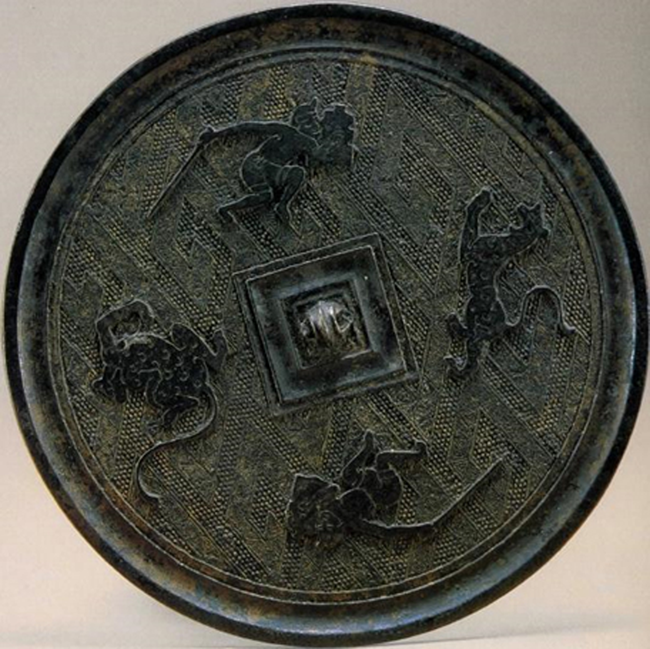
Although ritual vessel designers did not generally incorporate the connected-T pattern in their décor scheme, mirror designers adopted it in various forms between 500 and 300 b.c.e. Primarily, they used it as an obscure background pattern to bring main motifs into relief. For example, the mirror excavated from Hubei Xiaogan Yunmeng Shuihudi 湖北孝感雲夢睡虎地 M9 displays a lively scene showing two warriors engaged in combat with a tiger and an anthropomorphic monster (Figure 16).Footnote 41 Its user would have threaded a piece of cloth through the loop at the center of its back and held the mirror to his/her face by grasping the cloth. Because of their small size, the mirrors would have been used by only one person or a limited group of viewers at a time. Some mirrors have been discovered inside bamboo boxes, as in the Jiudian example discussed above; toiletries also often accompanied the mirrors.Footnote 42
Bronze mirror from Hubei Xiaogan Yunmeng Shuihudi M9. Report no. M9: 60. D. 10.4 cm. Ca. 300 b.c.e. After Zhongguo qingtongqi quanji, vol. 16, 35, pl. 35.

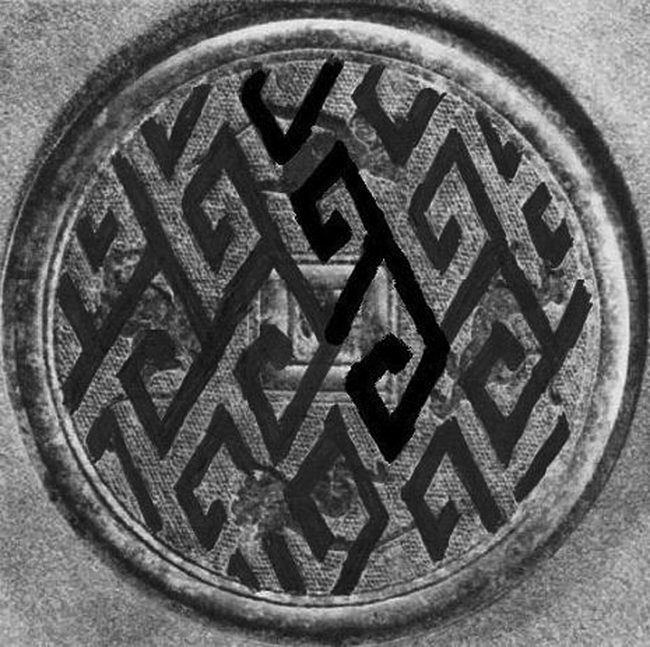
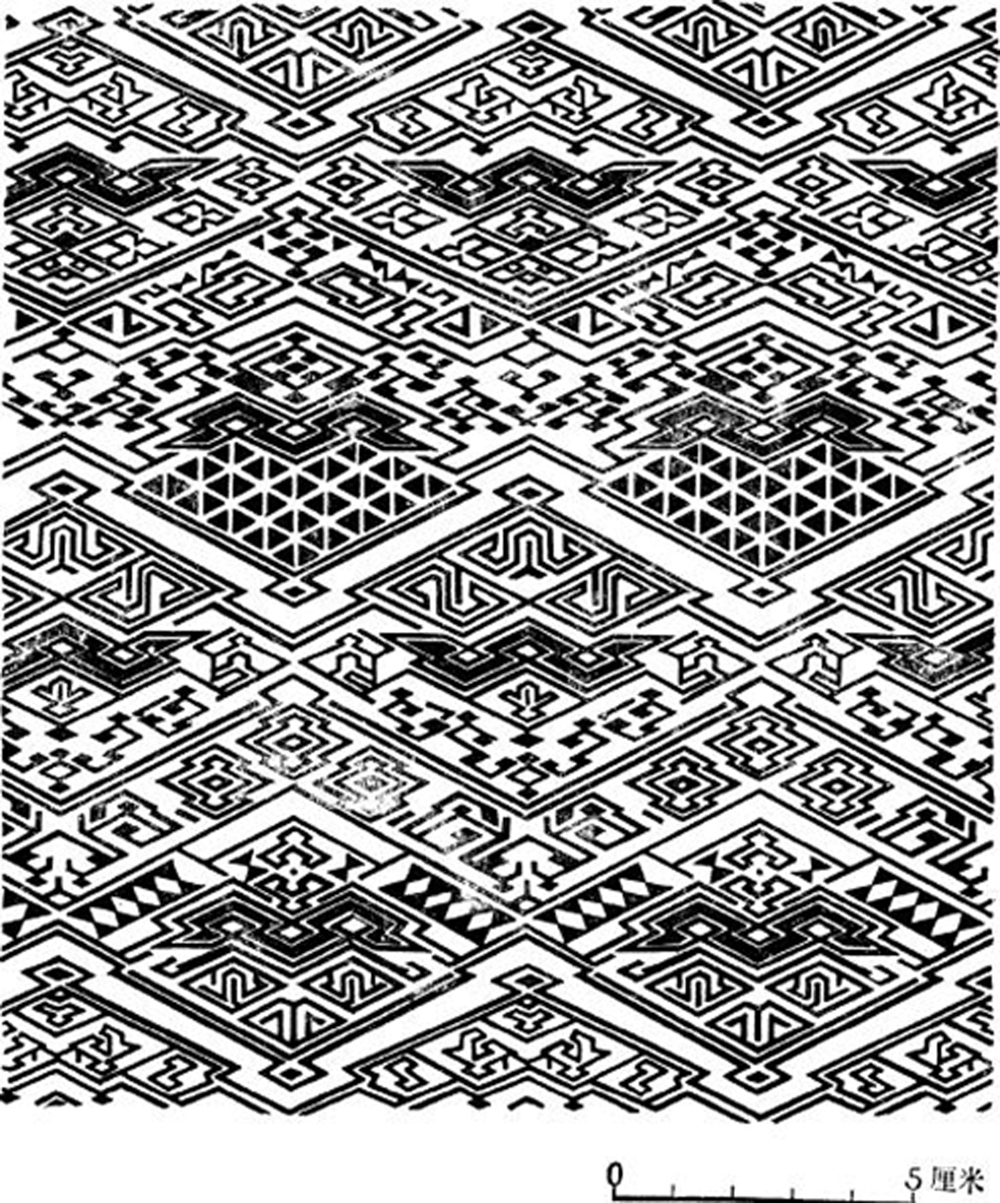
The background pattern that visually contrasts with the main figural and animal motifs on the mirror is the connected-T pattern, with angular spirals filling in the broad bands of the Ts and granules filling the remaining spaces.Footnote 43 The full background pattern is the connected-T pattern emphasized in thicker black lines, as can be seen in Figure 17. At least three horizontal bands of connected-Ts run across the mirror surface. The central band is the most conspicuous, beginning from beyond the mirror's edge and terminating at the opposite rim. This is reminiscent of the design on the Ontario ding (Figure 6). The impression of a continuous pattern is suggested by having the connected Ts seemingly start and finish at a point outside the mirror rim. The carver of the model for the Shuihudi mirror clearly did not use the pattern-block method; instead, the T motifs and the granules were carved freehand inch by inch into the clay model.Footnote 44 The mirror casters would then have invested the decorated model with clay to form a bivalve mold. Finally, they poured molten bronze into the tightly bound bivalve mold and cast the mirror. Because the Ts were not “assembled” as in the pattern-block casting method, there was no trace of assemblage between them.
The reconstructed connected-T background pattern of the Shuihudi mirror. One of the T motifs is darkened for emphasis. Original photo after Yunmeng Shuihudi Qin mu, pl. 30-1 (no pagination).

Changes in the Connected-T Pattern
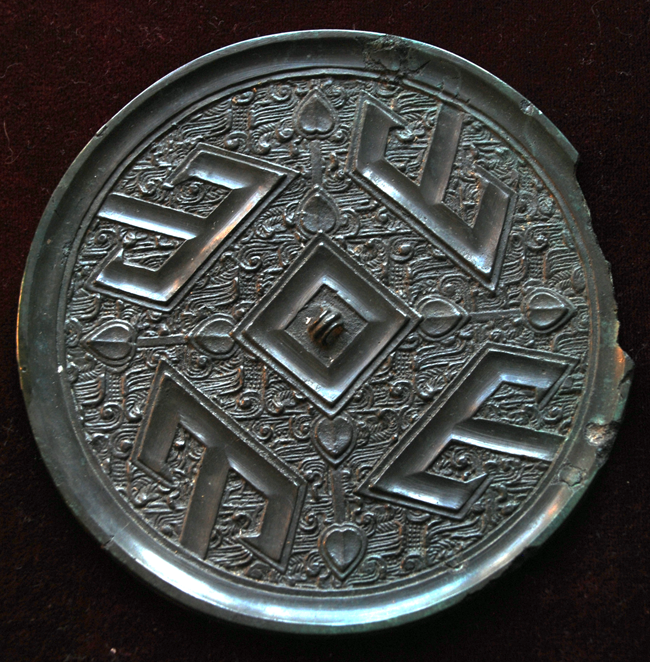
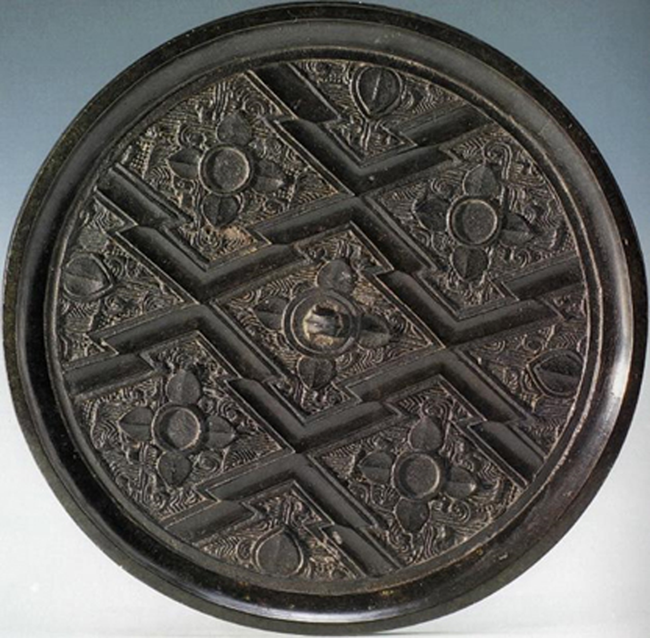
Other designers experimented with the connected-T pattern in this period. For example, on one mirror excavated from Hunan Changsha Yuanjialing Datong Xiaoxue 湖南長沙袁家嶺大同小學 M2 (Figure 18),Footnote 45 the Ts are disconnected, and four individual Ts are placed at the four corners of the mirror in a slanting form. On another mirror excavated from Changsha Liaojiawan 長沙廖家灣 M38 (Figure 19),Footnote 46 the Ts seem to lose their structural integrity and disintegrate even more. Each T contains three vertical strokes and one horizontal bar linking them; the central vertical stroke is longer, whereas the two peripheral strokes are shorter. Part of the horizontal bar and one shorter stroke from a T motif effectively form a V motif and are placed in a contiguous fashion. The many Vs on the Liaojiawan mirror are, accordingly, elements of the original Ts that have once again been connected and arranged in an alternative orientation.
Bronze mirror from Hunan Changsha Yuanjialing Datong Xiaoxue M2, currently housed in the Changsha Municipal Museum. (Accession no.) zongzhanghao 4817, fenleihao 1B313. D. 11.4 cm. Ca. 300 b.c.e. Photo by the author. Reproduced courtesy of the Changsha Municipal Museum.

Bronze mirror from Hunan Changsha Liaojiawan M38. D. 11.8 cm. Ca. 300 b.c.e. After Zhongguo qingtongqi quanji, vol. 16, 29, pl. 29.

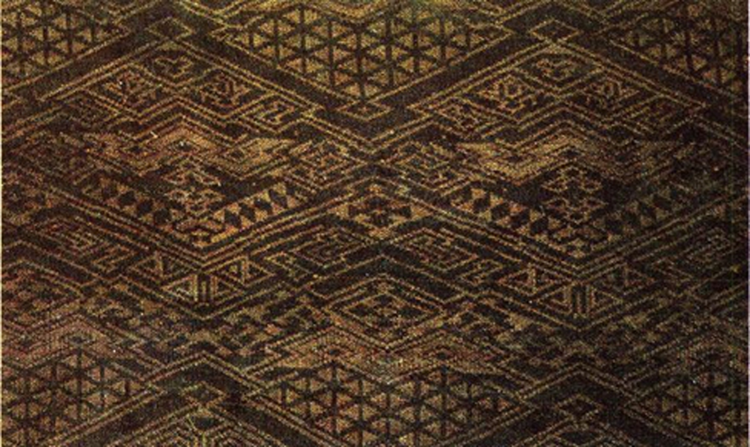
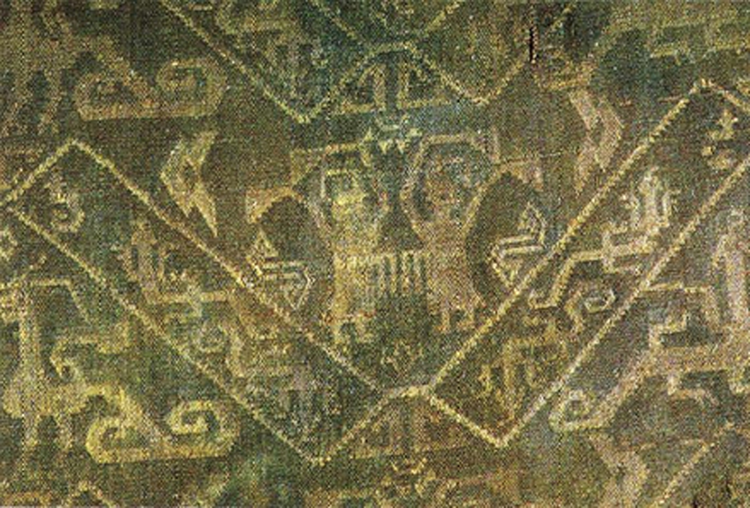
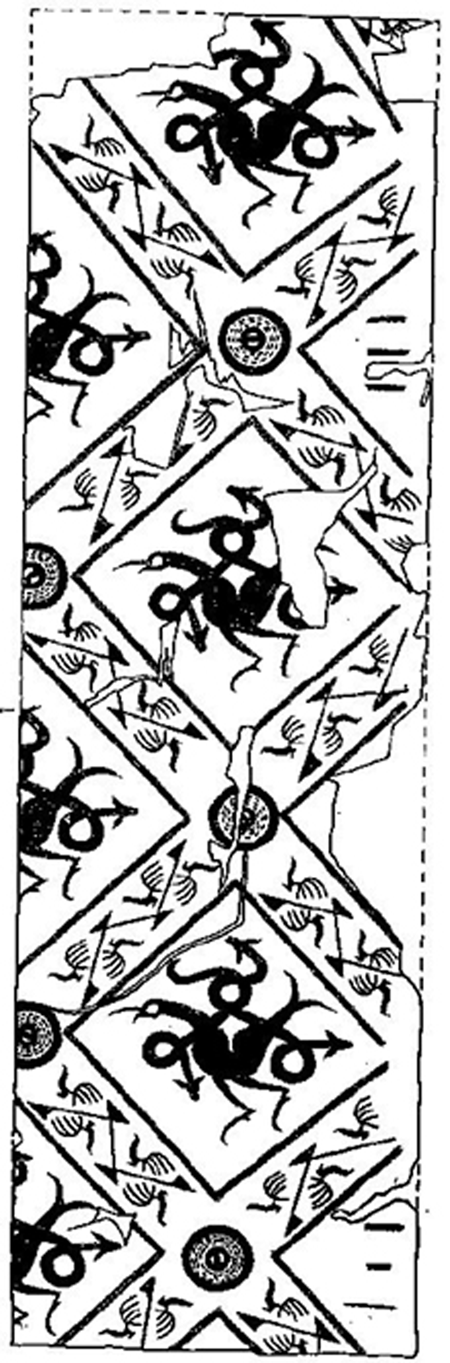
Similar designs can be found on textiles and on bamboo boxes. The above-mentioned Jiudian and Baoshan bamboo boxes have already shown these similar patterns. A textile example is a jin fabric excavated from Mashan M1 that features the woven connected-V pattern running across the fabric (see the motif at the top left corner of Figure 20).Footnote 47 The further disintegration of a V motif into single bars can be seen on another piece of jin fabric with splendid woven patterns, excavated from Mashan M1 (Figure 21).Footnote 48 In this example, coupled dancers and animals are situated between pairs of slanting bars. The slanting bars can be connected to form multiple Vs and run across the entire piece of fabric. Each single bar can be seen as one element disintegrating from a single T motif; consequently, the Vs and single bars emerge in a variety of combinations as they disintegrate from the original T motifs.
Jin fabric from Hubei Jingzhou Mashan M1. Report no. N9. Length of the jin fabric, 17.7 cm; w. 9 cm. Ca. 300 b.c.e. After Jiangling Mashan yihao Chu mu, color pl. 13-1 (no pagination).

Detail of the Mashan M1: N1 jin fabric. Report no. N1. Length of the jin fabric, 50.5 cm. Ca. 300 b.c.e. After Jiangling Mashan yihao Chu mu, pl. 26-2 (no pagination).

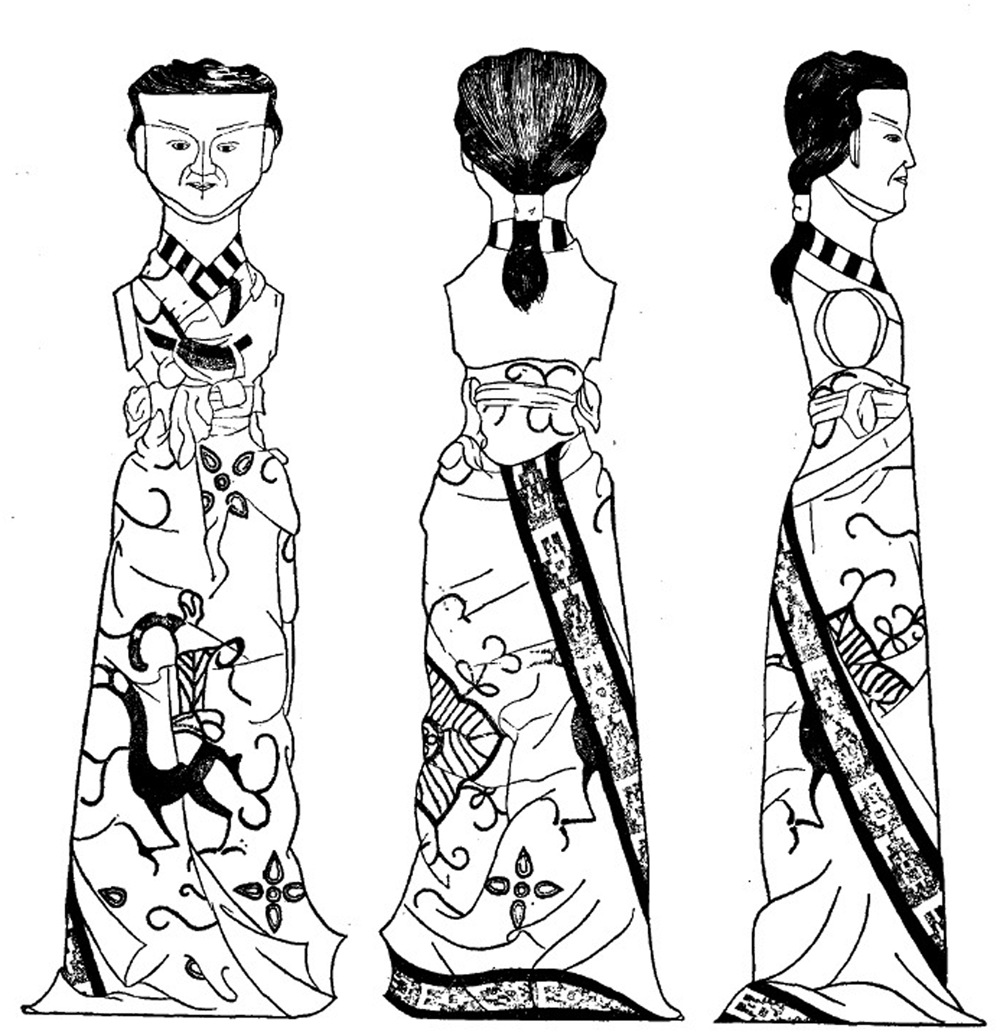
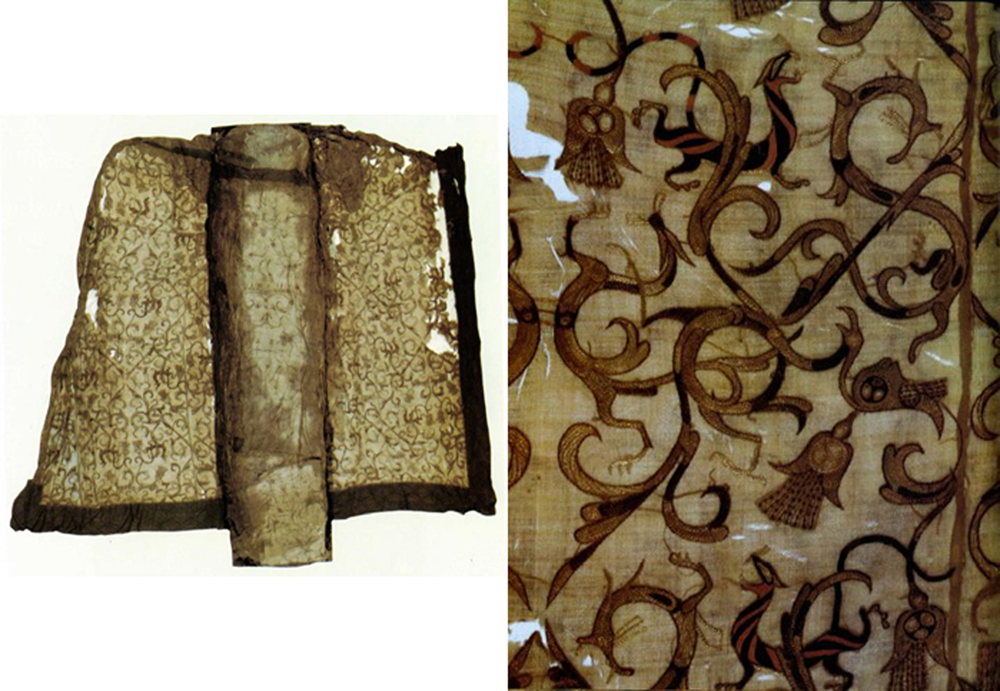
In addition to the connected geometric patterns, there were new designs that emerged on textiles and related products, which portrayed animated and lively scenes of birds, dragons, and snakes interacting and intertwining with each other. For example, the dress of a wooden figurine, excavated from Mashan M1 (Figure 22),Footnote 49 displays a large embroidered bird accompanied by vegetal motifs including quatrefoils (consisting of one central circle surrounded by four small leaves) and leaves. The combination of birds and vegetal motifs is one of the new artistic endeavors that arose during this period. This illustration of a dress is not merely an artistic representation: actual garments that are remarkably close to it in design have been discovered. A life-sized silk garment embroidered with interlaced birds, dragons, and tigers was found in the same tomb, Mashan M1 (Figure 23).Footnote 50 In the detailed photo of the silk garment, tigers, dragons, and birds with extended and twisting plumes and feathers can be seen to intertwine with each other and in complicated interactive scenes that cover the entire silk garment. The bird motifs on the dress of the wooden figurine find their correspondence on this Mashan garment.
Drawings of different views of a wooden figurine from Hubei Jingzhou Mashan M1. Report no. 2. H. 59.6 cm. Ca. 300 b.c.e. After Jiangling Mashan yihao Chu mu, 81, fig. 66.

(Left) silk garment from Hubei Jingzhou Mashan M1. Report no. N9. L. 192 cm. Ca. 300 b.c.e. After Yin ran zhi xiu, 30, no. 24. (Right) detail of the silk garment. After Yin ran zhi xiu, 31, no. 24.

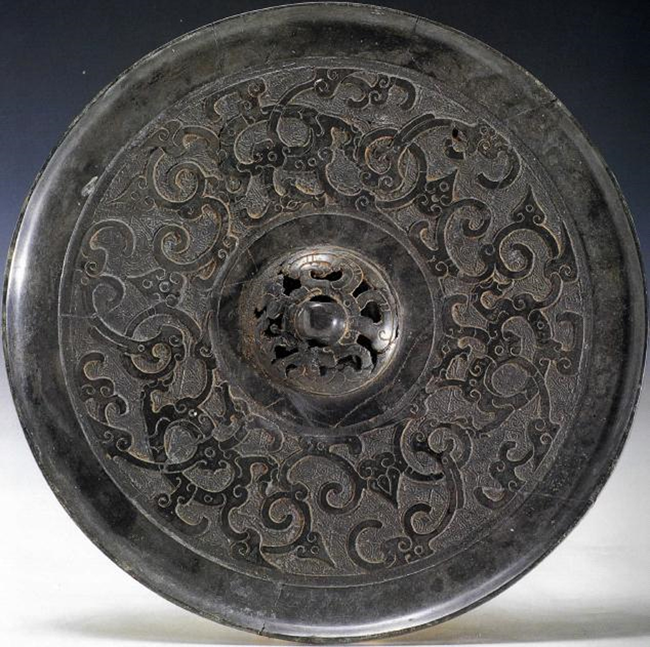
Similar interlaced patterns are displayed on bronze mirrors. A mirror excavated from Changsha Zidanku 長沙子彈庫 M15 (Figure 24) displays the twisting bodies of three dragons,Footnote 51 which resemble those of the above-mentioned birds. Artifacts from Mashan M1 continue to surprise us with their astonishing designs. It seems that this twisting-body pattern became prevalent across diverse media during the era when this tomb was constructed.
Bronze mirror from Hunan Changsha Zidanku M15. D. 16.5 cm. Ca. 300 b.c.e. After Zhongguo qingtongqi quanji, vol. 16, 9, pl. 9.

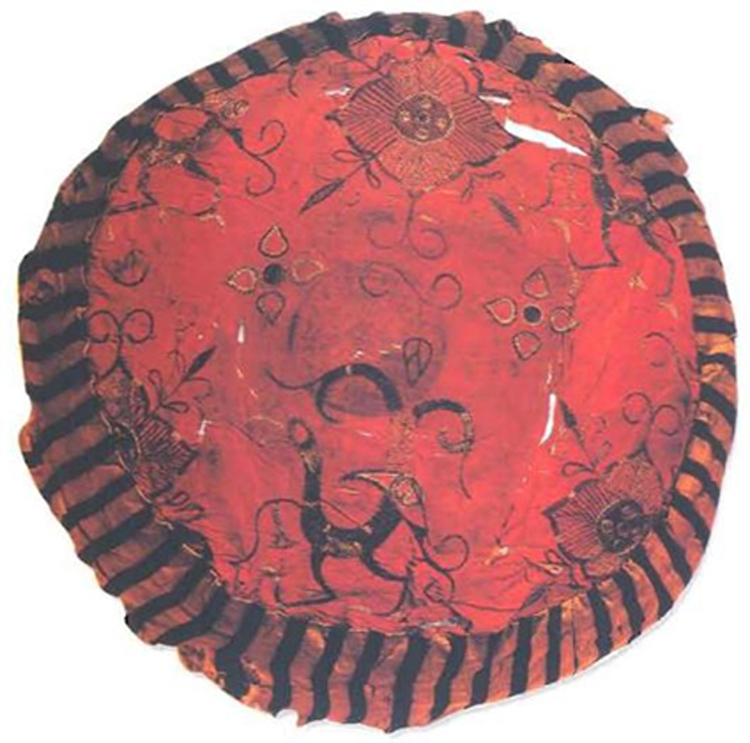
Other fabric pieces present more twisting bodies and interlaced patterns with multiple variations. For example, the Jingzhou Jiudian M410 juan 絹 fabric displays multiple scenes of birds intertwining with dragons or serpents (Figure 25).Footnote 52 A silk mirror cover, used to protect the reflective surface of a bronze mirror (Figure 26), features motifs of birds and vegetal motifs.Footnote 53 The birds and vegetal motifs on these textiles closely resemble those on the cloth of the Mashan M1 figurine.
Drawing of the embroidered pattern on the Jiudian M410 juan fabric. Report no. 410: 40. Measurement not provided. Ca. 300 b.c.e. After Jiangling Jiudian Dongzhou mu, 337, fig. 227-1.

Silk mirror cover from Hubei Jingzhou Mashan M1. Report no. 8-4A. D. 17 cm; h. 5 cm. Ca. 300 b.c.e. After Chu wenhua, 252, fig. 395.

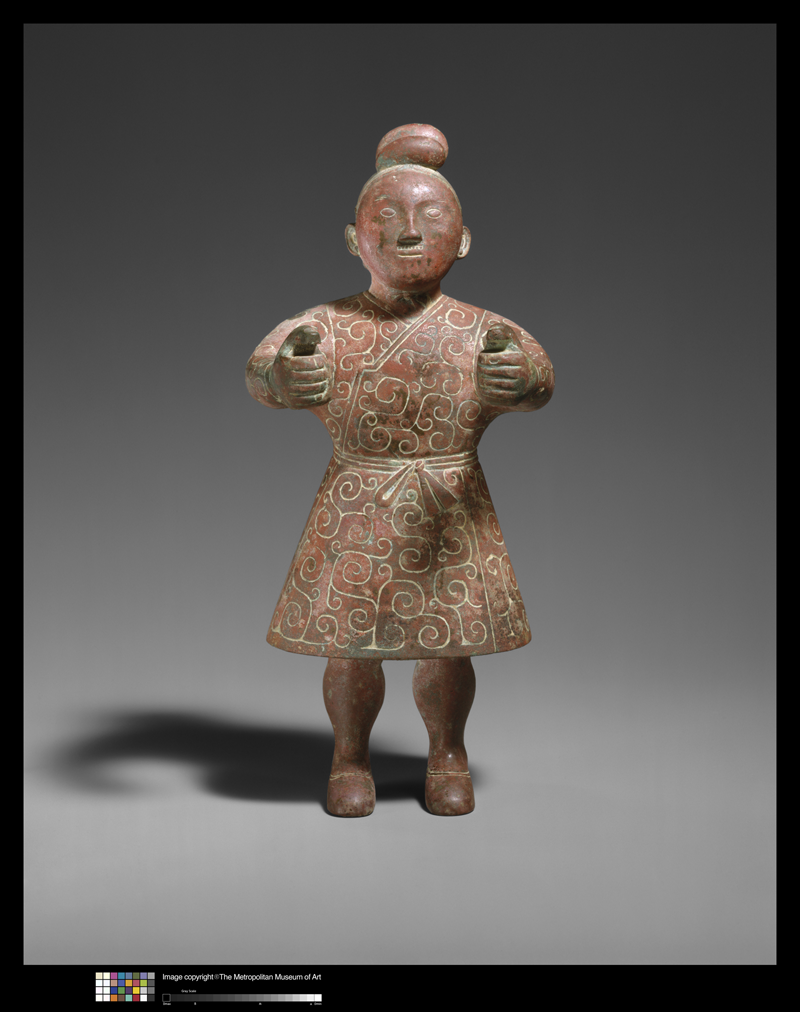
Furthermore, through more detailed examination of the formation of quatrefoils that represent flowers on the Mashan mirror cover, we can see that they comprise a single central dot and four leaves radiating outward from it. The leaves resemble those identified on the Datong Xiaoxue mirror (Figure 18), and the quatrefoils, separated by the V motifs, resemble those identified on the Liaojiawan mirror (Figure 19). These examples strongly indicate that designers of mirrors and textiles worked in close proximity to one another. Against this art historical backdrop, it is unsurprising to find similar patterns on a bronze charioteer dating to approximately 300–200 b.c.e., housed in the Metropolitan Museum of Art (Figure 27).Footnote 54 Its robe decoration of connected curls resembles those interlacing lines on the aforementioned textile pieces and hence can hardly be viewed as purely an isolated invention by its designer. Nevertheless, although the way in which the charioteer's robe was cinched with a tie around its waist that resembles that of the Houma clay mold figurine, their patterns remain conspicuously distinct.
A bronze charioteer figurine in the collection of the Metropolitan Museum of Art. Accession no. 1993.387.15. H. 19.4 cm. Ca. 300–200 b.c.e. Gift of Enid A. Haupt, in honor of Philippe de Montebello, 1993. Image copyright © The Metropolitan Museum of Art. Image source: Art Resource, NY.

Complicated Weaving Techniques
When scholars have discussed the luxuriousness of textiles, they have mainly cited textual sources to corroborate the notion that textiles represented the wearers’ status and wealth.Footnote 55 But we should first attempt to find direct evidence in actual examples of textiles, which the following section will demonstrate. Although the aforementioned birds and animals were embroidered onto the surface of the fabrics,Footnote 56 the connected geometric patterns were woven. The weaving of such complicated geometric patterns required that the producers possess sophisticated weaving skills combined with an ability to execute designs from basic ideas. The Lizhouao jin, and other jin fabrics unearthed in Hubei and Hunan, provide an initial picture of how the textile patterns emerged. The next step is to investigate how the patterns were woven into the textiles.
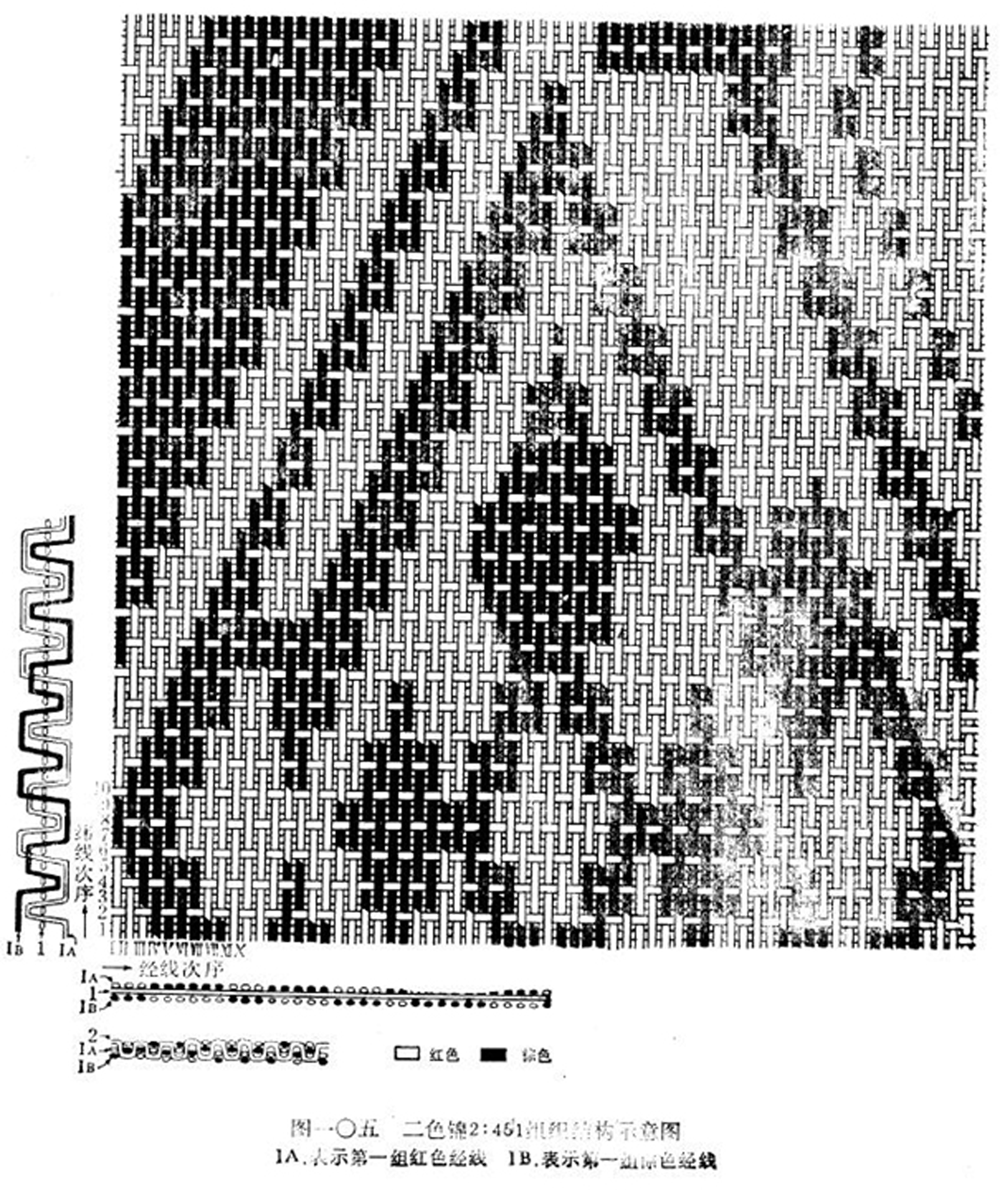
The example chosen here is a jin fabric from Jingzhou Baoshan M2 (Figure 28 and Figure 29).Footnote 57 This piece of jin, numbered 2: 451 in the tomb, is 43 cm long and 0.2 mm thick, and was used as the edge of a blanket covering the coffin placed in the central chamber of the tomb.Footnote 58 This was work of a high quality and the patterns can still be made out. The fabric included two colors, red and brown; a line drawing of its pattern is shown in Figure 28. Notably, the method used to weave the Baoshan 2: 451 jin pattern is extremely complex and hence difficult to explain in a written text (see also footnote 61 below). The process by which the reeled silk threads were produced and prepared has been discussed in previous articles and reports.Footnote 59 The silk threads were subsequently dyed with the desired colors and, like the bamboo strips discussed above, were then used to create a variety of colored motifs against a background of another color.
Drawing of the pattern on a jin fabric from Hubei Jingzhou Baoshan M2. Report no. 2: 451. Ca. 300 b.c.e. After Baoshan Chu mu, vol. 1, 174, fig. 108.

Diagram of the weave structure of the Baoshan M2: 451 jin fabric. After Baoshan Chu mu, vol. 1, 171, fig. 105 (original photo quality).

According to the archaeological report on Baoshan M2, the 2: 451 jin is a warp-faced compound tabby weave (translated directly from the Chinese term “平紋經二重組織” pingwen jing erchong zuzhi).Footnote 60 The jin was likely made on a loom that carried the longitudinal threads, or warp threads, while the weft or “filling threads” were shuttled laterally through the warp ends to create the structure of the fabric. However, the warp-faced Baoshan M2 2: 451 jin was woven with compound warps in two series; one brown and the other red. The two series of warp ends were separated so that one was raised and the other lowered. Only the brown warp ends were raised to create the pattern consisting of many V motifs. The binding structure and the pattern structures are all tabby weave.
Figure 29 illustrates the manner in which the warps and wefts intertwined. The warps are identified by Roman numerals, I, II, and III etc., whereas the wefts are identified by Arabic numerals, 1, 2, and 3 etc. In this diagram, the red color appears white and the brown color appears black. The largest sub-diagram in Figure 29 presents how the jin was generally woven and how the brown pattern structure was created. To the left is a smaller sub-diagram showing how the two ends of Warp I were intertwined (IA is the red warp end and IB is the brown warp end); additionally, the profile view of the many weft threads is visible in between the two warp ends. Notably, the warp end that is raised reveals the color of that end in the woven pattern. For example, at the binding point of Warp I and Weft 1, the red warp end crosses over the weft, and the brown warp end is under the weft; consequently, the binding of Warp I and Weft 1 appears red. Conversely, at the binding point of Warp I and Weft 2, the red warp end passes under the weft and covers the brown warp end; as a result, the binding appears red. The consecutive weaving binding points of the jin continue in a similar fashion.
The brown warp end starts to cross over the red warp end and the red weft at the binding point of Warp I and Weft 7. Because it floats over the bindings between Warp I and Wefts 7, 8, and 9, these bindings appear brown. The numerous V motifs of the brown pattern were similarly created by overlaying the brown warp ends entirely.
The two small sub-diagrams under the largest sub-diagram in Figure 29 provide an alternative profile view of the jin. The upper sub-diagram presents the binding of Weft 1 and the many compound warps. At the binding points of Weft 1 and Warps I to X, the weft is sandwiched between several compound warps. The straight line between the red and brown warp ends represents the red weft, whereas the red and brown warp ends alternatively cross over and pass underneath; additionally, Weft 1 always lies between, serving as the lateral support of the weave. The lower small sub-diagram displays the relationship between Weft 2 and the compound warps. In contrast with Weft 1, Weft 2 floats completely unobstructed over the compound warp at one binding, and passes underneath at the successive binding; the red and brown warp ends alternate as they cross over each other, and the brown and red patterns on the jin in the largest sub-diagram are eventually clearly conveyed.Footnote 61
Specifically, Weft 1 always lies between the compound warps; Weft 2 alternates floating over and passing under; Weft 3 follows the pattern of Weft 1; Weft 4 alternates passing under and floating over; Weft 5 begins the process again. Thus, the binding and pattern structures were created as the weft threads were shuttled through the warp threads in an alternating fashion, so that they form a crisscross pattern.
The jin was an extremely complicated fabric that was even more costly than other expensive fabrics such as the juan and sha 紗. It necessitated more silk threads, occasionally double or triple sets of warp, careful dying of the silk color, and meticulous calculation and weaving of the warps and wefts on the looms. These types of fabric were used by political and social elites, whereas commoners could only afford to use hemp (ma 麻) fabrics.Footnote 62 Although this article discusses the detailed weaving technique only of the Baoshan M2 bi-colored jin fabric, there was in fact a wide variety of polychrome jin, all of which required the use of a greater number of warp threads than weft threads. As for the Baoshan M2 jin pieces, they consisted of 26 to 47 weft threads and 92 to 174 warp threads for every square centimeter. The jin was relatively thicker and more durable than other juan and sha fabrics, and was typically used for the edging or the outermost layer of dresses and blankets.Footnote 63 The thick structure of the jin stabilized and protected the edging of dresses and blankets, and simultaneously the jin served as a conspicuous symbol of display, appealing to both the wearer and their audience.
Among the juan pieces found in Baoshan M2, there were 31 pieces whose warp threads ranged from 39 to 50, and 7 pieces whose warp threads ranged from 60 to 104 per square centimeter. Their weft threads ranged from approximately 10 to 50 per square centimeter.Footnote 64 According to the Baoshan archaeological report, the juan pieces whose warp thread counts fell in the under-50 range were usually vessel covers,Footnote 65 whereas the pieces that comprised over 60 warp threads were primarily used as the background fabrics for embroidery and for the inner or outer layers of clothing.Footnote 66 The structural and functional differences between the juan and jin were obvious.
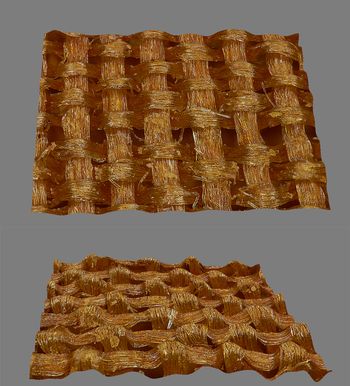
Previously, we had to rely on diagrams created by scholars who had studied the actual textiles closely in order to analyze the weaving techniques employed. On the assumption that reconstruction diagrams could possibly contain errors arising from insufficiently detailed examination of the original fabrics, we have been experimenting to provide more accurate and reliable images of the weave structure of these fabrics. We have used the Leica DVM6 3D Digital Microscope to take detailed pictures of fabric pieces at a variety of depth. In turn we have used these pictures of different depth information to generate 3D models of the weave structure. Figure 30 shows two images of a reconstructed 3D model of the detail of the weave structure of a fragmentary juan tabby weave fabric, unearthed from a tomb at Hubei Jingmen Baoshan, dating to approximately 300 b.c.e. The ups and downs of the warps and wefts clearly show that this fragmentary juan is a tabby weave. Each warp consists of dozens of fibers; such high numbers of fibers provide more concrete proof of how the strong warps consolidated the weave structure.
Details of a juan tabby weave fabric, from a tomb at Hubei Jingmen Baoshan. Accession number of the fabric 5.28874. L. 11 cm, w. 7 cm. Approximately 300 b.c.e. Images taken by the Leica DVM6 3D Digital Microscope. Photo by Chen Zifan.
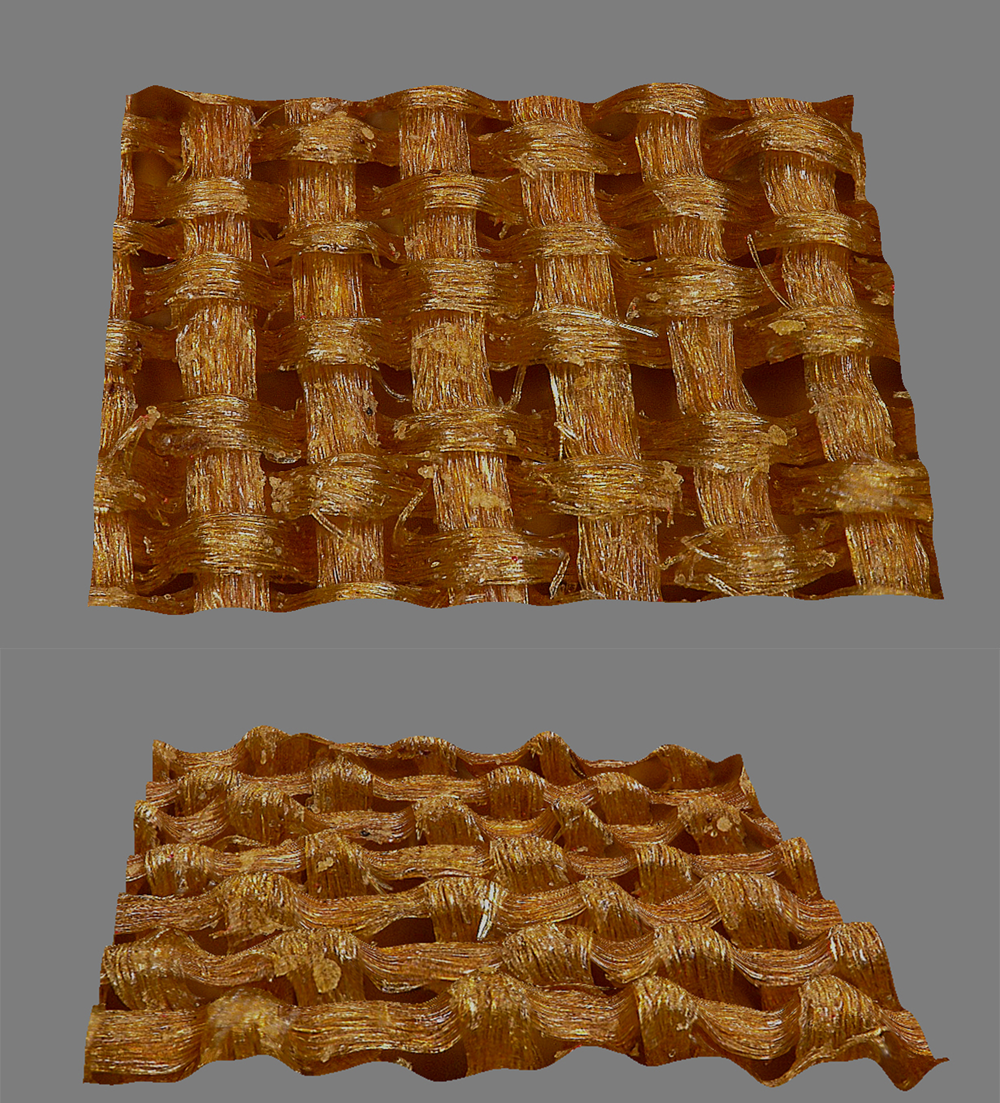
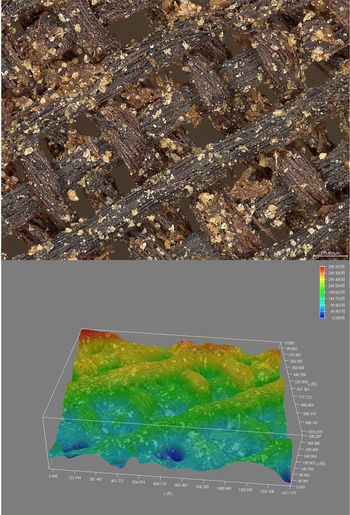
Figure 31 shows images captured from 3D models of the details of a fragmentary fabric piece. This fabric piece has a different weave structure compared to that shown in Figure 30. Several warps float above the wefts at several bindings. One warp even crosses all wefts in the image shown above. We will have to capture more pictures in order to identify the exact weave structure of the fabric piece. The small yellow grain-like objects are sand or dust. The decaying warp and weft threads have already lost their original hue and color. The bottom image in Figure 31 is a 3D heat map: the red, yellow, and green parts (in color in online version of this article) show the ups of the warps and wefts, while the light and deep blue parts indicate the downs (in the black-and-white version, parts of different degrees of darkness indicate the ups and downs). These images of the 3D models conspicuously demonstrate the weave structure of the fabric piece and leave no room for mistakes arising from insufficiently close observation. Scholars can thus have first-hand contact with the material and no longer need to rely on diagrams to distinguish the relationship between the design motifs and the weave structure, although diagrams can still be read as a type of visual interpretation. We will, however, have to generate numerous 3D models of the weave structure of more fabric pieces to be able to create a comprehensive database that will allow more scholars to benefit from this technology.
Details of a piece of fabric from a tomb at Hubei Jingmen. Accession number and measurement unknown. Approximately 300 b.c.e. Images taken by the Leica DVM6 3D Digital Microscope. Photos by Chen Zifan.

As readers can postulate from the extremely complex production process of the Baoshan M2 jin, the weavers invested substantial amounts of time, energy, and resources into designing and creating the jin. The jin was the most costly fabric at that time, and was, not coincidentally, considered the most desirable and beautiful. Use of the jin for edging garments, sleeves, and collars, and for the outermost layer of blankets, reflected the owners’ status and wealth.Footnote 67
The Lizhouao jin with the connected-T pattern seems to be polychrome, although the colors have faded considerably. The weaving process of the Baoshan M2: 451 jin was similar to that of the Lizhouao jin, as evidenced in the connected-T and connected-V patterns. Additionally, as with the weaving of patterns on the bamboo boxes, the jin pattern had to be planned, because careless calculations or impatience could lead to failure.
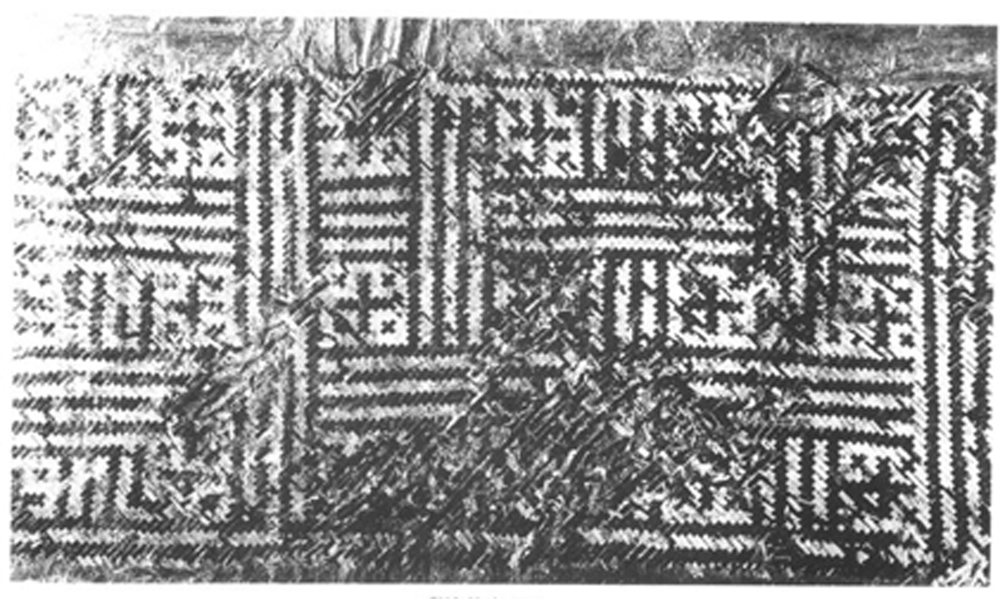
It seems that the technique of creating a pattern through the strategic interlocking of colored warp and weft threads was thoroughly understood by bamboo weavers and bronze mirror casters alike. The examination below of a lacquered bamboo woven mat and a bronze mirror indicates that their producers had knowledge of weaving techniques. The mat was unearthed in Hubei Jingzhou Shazhong 湖北荊州沙塚 M1, near the large Baoshan, Wangshan 望山, and Jiudian tombs (Figure 32).Footnote 68 On it, red lacquered strips intersect with black lacquered strips at 90-degree angles. As the authors of the archaeological report describe, the two colored sets of bamboo strip were woven in a similar method to the warp-and-weft structure of the jin fabrics discussed in this article.Footnote 69 The red strips served as the background, whereas the black strips created the pattern; additionally, the weaver of the Shazhong M1 mat displayed the woven structure as a decorative pattern on the mat.
Lacquered bamboo mat from Hubei Jingzhou Shazhong M1. Report no. SM1: 56. L. 51 cm, w. 24 cm. Ca. 300 b.c.e. After Jiangling Wangshan Shazhong Chu mu, pl. 108-1 (no pagination).

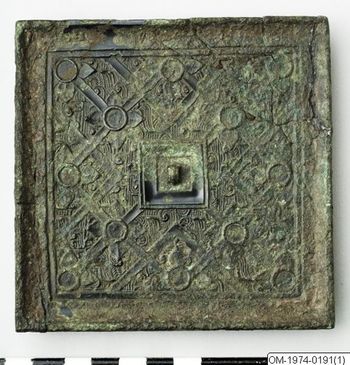
One square bronze mirror carries a similar pattern that imitates a woven structure. It was formerly in the collection of Einar Lagrelius, and is now in the Museum of Far Eastern Antiquities (MFEA, Figure 33) in Stockholm, Sweden.Footnote 70 This mirror portrays the feather-and-curl pattern in the background with quatrefoils/flowers serving as the main motifs; notably, these flowers resemble those on the Mashan M1 mirror cover except that they are linked by broad threads that cross over and pass underneath other threads rather than by stems. The designer of the mirror incorporated an up-and-down weave structure into the design.
Square bronze mirror formerly in the collection of Einar Lagrelius, currently housed in the MFEA. Accession no. OM-1974-0191. L. 11.3 cm. Ca. 300 b.c.e. Photo courtesy of the MFEA.

Similar weaving techniques were applied to the production of several fabric pieces discussed in this article, but variations certainly existed and further analysis is required. We have so far obtained only an initial understanding of how the bi-colored fabrics of 500–300 b.c.e. China were woven. This article explains the production process of the connected geometric patterns woven on the textiles worn by figurines and humans, whereas the designs of birds and animals embroidered on other textiles were executed in a different manner and required different skills.
Artistic Exchanges and Designers’ Communities
From the few examples of extant textiles dating from 1200–500 b.c.e. we hypothesize that the connected geometric patterns were prevalent during this period. These patterns appeared on various types of objects, including textiles and bronze ritual vessels. Then, after 500 b.c.e., designers’ choices underwent marked transformations. The Freer hu and the Tianxingguan shengding were part of an assemblage of ritual paraphernalia; however, they did not serve as artistic references for textile makers. Instead, textile makers (including weavers and embroiderers) created their own circle of exchanges by compiling artistic and technical references from products that were not sacrificial ritual vessels. These products, including bronze mirrors, textiles, and bamboo boxes, were objects intended for personal use by the tomb occupants. Wooden hairpins and combs often accompanied the mirrors in the bamboo boxes, as seen in the Jiudian M410 box. The small sizes of the mirrors would have limited the number of users at any time. Mirrors were often wrapped in precious textiles, such as the Mashan M1 silk mirror cover, and other textiles were used to wrap the bodies of the tomb occupants and covered the lids of the coffins. Textiles that adorned the living and the deceased were personal and physically close to the wearers. The textile producers who appropriated a specific set of designs and techniques and incorporated them into their own production had formed their own distinct, though not impervious, community.
Luxuriousness of the Products
Bamboo and textile weaving were likely developed much earlier than bronze casting, because their raw materials were readily available in nature and people began to use them long before they invented the bronze casting process. However, very little has survived of these early woven objects, and the aforementioned sites in the middle Yangzi basin provide the only large corpus of such perishable objects produced as early as 500 to 300 b.c.e. The examples provided here have both illuminated the artistic exchanges that took place between the producers of these various artifacts and also demonstrated the close affiliations between designs in several media.
Weaving methods of the period enabled the creation of many types of repeated geometric patterns. The simple lines incorporated into geometric designs could also have been altered and turned into vegetal or animal motifs, such as the dragons and snakes that were frequently depicted with long and thin bodies. Textile weavers and embroiderers likely deliberated the complex nuances of these designs when they created these sophisticated fabrics for clothes that served both the people and the figurines.
Textile weavers had first to dye the silk and then prepare the appropriate colored silk threads to be laid on the looms. This work was laborious and also required great skill and experience. Design motifs were then carefully woven into cloth on the looms. A small mistake in either the preparation or the weaving could spoil the design. Bamboo weavers also carefully planned for design motifs on boxes and other bamboo objects. Through their choice of appropriate bamboo types, and the coloring of the thin and slender bamboo strips, they demonstrated their expertise and experience.
Bronze casting was no exception. The selection and transportation of mineral ores, construction of furnaces, preparation of fuel, and the procedures of melting reflect how complicated the production process was. The material and labor resources invested in the production process were enormous and the casting of bronze mirrors was no easier than the casting of vessels. The pattern block method used on the Freer hu, and probably on the Tianxingguan shengding, was already very complicated. But, given their extremely fine detail, the production of the Shuihudi, Datong Xiaoxue, Liaojiawan, and Zidanku mirrors, including the preparation of their clay models and molds, can be counted as a crowning achievement of the bronze industry, in China or anywhere.Footnote 71 The advanced technical knowhow, precious raw materials, careful and laborious preparation, and considerable investment of time, energy, and effort in the actual production process constituted the luxuriousness of the textile, bamboo, and bronze objects.
What Did Elites Actually Wear?
The elites living in the Yangzi River basin from 500 to 300 b.c.e. wore these beautiful and luxurious textiles and accessories, which were symbols of status, wealth, and power.Footnote 72 The textiles and accessories were the outcome of considerable investment by producers, who actively exchanged ideas, designs, and production techniques with their counterparts in a variety of industries. The choice of design and technique made by textile weavers and embroiderers represented their own artistic community; but this community also commingled with communities of bamboo weavers and bronze mirror producers.
The textiles and accessories of these elites reflect a mastery by the same elites of material and labor resources, design communities, and the exchange of ideas and designs. As represented by the textiles and accessories shown in this article, the prevailing patterns were unrelated to the popular designs on ritual vessels. Instead, they related to designs on objects intended for personal use, including bronze mirrors, textiles, and bamboo boxes. The exchanges of ideas and designs among the producer communities seemed to favor a certain set of motifs. The exchanges developed as a result of interaction between the elite wearers, designers, and producers. The elites put their entire social circle on their bodies.