1. INTRODUCTION
Biologically inspired design (BID) is the discipline where inspiration is taken from the natural world to solve technical problems or challenges. An increased interest in BID during the last two decades caused a strong rise in the number of academic papers (Lepora et al., Reference Lepora, Verschure and Prescott2013) on a wide range of topics, such as robotics, artificial intelligence, multifunctional materials, and sensors. In addition, a growth in patented inventions is observed (Bonser, Reference Bonser2006). While the growth in academic output is an indicator of overall research activity and interest in BID, the increase in patent output suggests that many of the resulting bioinspired solutions are deemed commercially viable and that new technologies are derived from biological examples (Bonser & Vincent, Reference Bonser and Vincent2007). Today BID is even becoming an important paradigm for disciplines like robotics and materials science (Lepora et al., Reference Lepora, Verschure and Prescott2013).
Many of the challenges posed upon organisms in their natural environments (e.g., making strong materials, moving efficiently through fluids, implementing shock absorbency, and regulating temperature) are similar to the problems humans face. One common rationale motivating BID recognizes the relevance and proven performance of biological solutions (Bar-Cohen, Reference Bar-Cohen2006, Reference Bar-Cohen2011): why reinvent the wheel when there are millions of different species around us that adopt time-tested solutions? A second important motivation for nature as a source for inspiration is the general increase in environmental consciousness (Bonser & Vincent, Reference Bonser and Vincent2007), supported by academic research (Bajželj et al., Reference Bajželj, Allwood and Cullen2013) and slowly influencing governments (Intergovernmental Panel on Climate Change, 2007). Organisms rely on renewable resources for their “production processes,” and nature does not generate ever-growing waste piles. Although bioinspired products are not inherently sustainable (Vandevenne, et al., Reference Vandevenne, Kellens, Banck, Clijsters, Verhaegen and Duflou2012), nature is regarded as a promising source of inspiration for environmentally friendly products and processes (Gebeshuber et al., Reference Gebeshuber, Gruber and Drack2009) and, by some, even regarded as a measure or ecological standard to judge the “rightness” of innovations (Benyus, Reference Benyus1997). A third argument for BID claims that drawing inspiration from a largely unused biological knowledge domain entails a higher probability of identifying leapfrog innovations. In an experimental setup, exposure to biological examples has been found to increase novelty without decreasing variety in idea generation (Wilson et al., Reference Wilson, Rosen, Nelson and Yen2010). Other possible advantages of bioinspired products are their enhanced marketability and financial savings through efficient use of energy and other resources.
These high expectations of BID are currently not met with adequate methods and algorithms that enable designers to systematically leverage nature's potential. Although it is hard to obtain trustworthy information about the specific mechanisms behind the bioinspiration for many bioinspired designs, it is commonly accepted that spontaneous, accidental inspiration plays an important role. A frequently used example is Velcro. Its inventor is claimed to have serendipitously observed the ability of the cocklebur to attach to the fur of his dog, which then inspired him to study this phenomenon in detail and to develop the well-known innovation.
In the last decade, a number of research efforts have focused on providing support in the BID process by developing tools and methods that facilitate cross-domain search and knowledge transfer. Many successes and insights are reported (see Section 2), although there is one unresolved challenge: the scalability of these systematic BID ideation tools and methods. About 1.7 million species are named currently, and the total number is estimated to be between 5 and 30 million (Purves et al., Reference Purves, Sadava, Orians and Heller2001). Although only a fraction of these 1.7 million identified organisms has been studied in detail, many sources exist, such as books, journals, and online resources, where biological knowledge is documented. Considering the large work that lays ahead for biologists to completely describe and comprehend all of nature's phenomena, these sources are expected to keep on expanding. To leverage this ever-growing source of biological inspiration in natural-language format, the authors of this paper developed a series of methods and algorithms that support systematic and automated identification of biological information relevant to specific design problems. These methods and algorithms are jointly referred to as scalable search for systematic BID (SEABIRD). In Section 2 the state of the art in the systematic search for bioinspiration is listed and discussed. Next, SEABIRD's architecture and functionalities are detailed in Sections 3 and 4, respectively. Thereafter, the proposed approach for scalable search is validated in Section 5 and discussed in Section 6, and conclusions are drawn in Section 7.
2. RELATED RESEARCH
BID has been studied from a number of different perspectives, focusing on application domains (Bhushan, Reference Bhushan2009; Bar-Cohen, Reference Bar-Cohen2011), on sustainability of biomimetic products (Benyus, Reference Benyus1997), on understanding bioinspired design by analogy (Mak & Shu, Reference Mak and Shu2008; Helms et al., Reference Helms, Vattam and Goel2009; Vattam, Helms, et al., Reference Vattam, Helms and Goel2010; Cheong et al., Reference Cheong, Hallihan, Shu and Gero2012), and on developing ideation systems for systematic BID (SBID; see Section 2.2). This paper focuses on function-based BID to solve technical problems, not on the mimicry of form or structure for, for example, aesthetic purposes. The remainder of this section summarizes the four general phases of the typical scalable systematic BID (SSBID) process and then presents the state of the art in the search phase to illustrate a common challenge.
2.1. SSBID process phases
A comparison of different contributions describing the encountered phases of the BID process, identifies four ubiquitous phases (Sartori, Reference Sartori, Pal and Chakrabarti2010): formulating search objectives, searching for biological analogues, analyzing biological analogues, and knowledge transfer. These four phases are applied to the SSBID process, which draws inspiration from large biological repositories in a natural-language format (Vandevenne et al., Reference Vandevenne, Verhaegen, Dewulf and Duflou2011):
• Formulate search objectives: The specific design problem at hand needs to be captured in a form allowing launching a search in the next phase.
• Scalable search: Searching large repositories of biological strategy documents requires a scalable, automated approach that allows the identification of a number of candidate biological strategy documents to be considered in the next phase.
• Filter and analyze: An automated search method unleashed on large repositories is expected to generate more than a few candidate descriptions of biological strategies. Therefore, methods and algorithms are required to guide the designer in selecting one or more candidate solutions. The retained biological candidates should be analyzed in detail to enable the designer to transfer the biological principles in the next phase.
• Knowledge transfer: In order to transfer knowledge from the biological source domain to the technological target domain in a systematic way, assistance to the designer is required for identifying the cross-domain analogy and to coming up with a feasible, biologically inspired technical concept.
The above SSBID process is expected to be iterative. For example, after attempting knowledge transfer based on a first set of search results, users might change their problem formulation to perform a search again. To support one or more of the four general BID process phases, a number of systematic BID approaches have been proposed. The next section summarizes these approaches, while focusing on scalability of the search phase because this is where SEABIRD's main contribution currently lies. A more detailed description of these approaches, positioning each in the above four SSBID process phases, is available in Vandevenne, Verhaegen, and Duflou (Reference Vandevenne, Verhaegen and Duflou2014).
2.2. Searching for biological strategies
As a summary of the state of the art in the SBID search phase, this section details three keyword-based search methods, then two approaches supporting on the classification of biological strategies, and finally three contributions that require complex model instantiation for each corpus entry.
Starting from a functional keyword search, an iterative and interactive methodology extracts new biological keywords from the obtained results for future searches (Lenau et al., Reference Lenau, Dentel, Ingvarsdóttir and Guðlaugsson2010). In this way, biological search words, initially not known to be relevant to the problem, are identified. A contribution aimed at automating the identification of biologically relevant search words (Chiu & Shu, Reference Chiu and Shu2007; Shu, Reference Shu2010) bridges the terminology gap between the engineering and biological domain by means of a systematic, semiautomatic search method that requires the design problem to be expressed in functional keywords; and then generates biological meaningful bridge verbs and text passages containing them. Another WordNet-based contribution (BIOscrabble) performs a search on and with PubMed, a very large biomedical research article database, by entering keyword combinations and inferred keywords (synonyms, variations, and negations) in PubMed's search engine that is used as a block box (Kaiser et al., Reference Kaiser, Farzaneh and Lindemann2012). Besides function, the approach also formally investigates property- and environment-related search words (Kaiser et al., Reference Kaiser, Farzaneh and Lindemann2014).
Two contributions require positioning each biological strategy into a classification scheme. First, BioTRIZ (Vincent et al., Reference Vincent, Bogatyreva, Bogatyrev, Bowyer and Pahl2006) aims at integrating biological knowledge in the TRIZ methodology (Altshuller, Reference Altshuller1984) by interactively positioning biological strategies in the BioTRIZ contradiction matrix. To identify bioinspiration, the problem needs to be formulated as a classical TRIZ contradiction, which is then reformulated into a BioTRIZ contradiction. This BioTRIZ contradiction then leads the designer to inventive principles learned from the manual analysis of 2500 contradictions in 500 biological phenomena. Second, AskNature interactively classifies biological strategies in a functional, hierarchical taxonomy called the Biomimicry Taxonomy (Deldin & Schuknecht, Reference Deldin, Schuknecht, Goel, McAdams and Stone2014). Designers looking for bioinspiration need to formulate their design problem in this taxonomy. A classification algorithm was recently proposed that automatically positions biological strategies in the functional categories of AskNature's Biomimicry Taxonomy (Vandevenne, Verhaegen, et al., Reference Vandevenne, Verhaegen, Dewulf and Duflou2014).
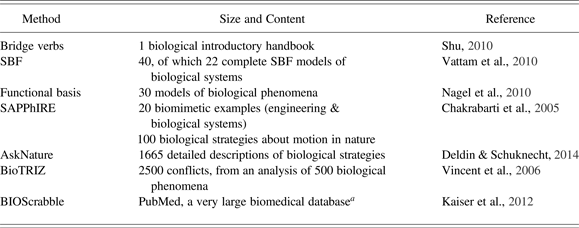
Three approaches can be found in the literature that require human interaction to instantiate detailed models for each biological phenomenon to be integrated in a structured knowledge base. To enable searching, the technical problem is also expressed by instantiating at least part of these models. Next, matching of the technical problem model to the biological system models in the knowledge base generates candidate stimuli for design by analogy. Such a methodology has currently been reported for structure–behavior–function (SBF) models (Vattam, Wiltgen, et al., Reference Vattam, Wiltgen, Helms, Goel and Yen2010; Goel et al., Reference Goel, Vattam, Wiltgen and Helms2012), for functional basis (FB) models (Nagel et al., Reference Nagel, Nagel, Stone and McAdams2010; Nagel & Stone, Reference Nagel and Stone2012), and for SAPPhIRE models of causality (Chakrabarti et al., Reference Chakrabarti, Sarkar, Leelavathamma and Nataraju2005; Sartori et al, Reference Sartori, Pal and Chakrabarti2010). These three model-based approaches have been recently extended in the following ways. Biologue, a social citation cataloging system, is developed (Vattam & Goel, Reference Vattam and Goel2011) to involve more people in the process of manual creation of SBF models. An Engineering to Biology Thesaurus (Cheong et al., Reference Cheong, Chiu, Shu, Stone and McAdams2011; Nagel & Stone, Reference Nagel and Stone2012), a lookup table that translates the FB terms into biological corresponding terms, is proposed to extend the FB approach. This way, model instantiation, requiring interactive work by humans, for large biological databases is avoided because the biological corresponding terms can be used as search words in natural-language texts. The SAPPhIRE approach is extended by an ontology aimed at providing extra stimuli during bioinspired ideation. The ontology consists of manually derived, biological and engineering term clusters for each of the SAPPhIRE model constructs (Srinivasan et al., Reference Srinivasan, Chakrabarti and Lindemann2012). In order to illustrate the corpora integrated into the above systems, for each contribution, the number of reported biological sources is given in Table 1.
Overview of existing database sizes and content

Note: SBF, Structure–behavior–function.
aThis source contains, besides biological strategies, many articles that are not useful for bioinspiration (drug testing, mapping genomes, genetically modified organisms, biomedical research methodologies, etc.). The authors state; “a useful knock-out criterion was, e.g., the paper is treating a medical application” (Kaiser et al. Reference Kaiser, Farzaneh and Lindemann2014).
While these systematic BID approaches differ in many ways, they all assign a central role to function: functional problem formulation and function driving search. A second observation is the increasing interest in natural-language resources. Pioneered by researchers from the Biomimetics for Innovation and Design Laboratory (Chiu & Shu, Reference Chiu and Shu2005), later the interactive functional keyword search approach (Lenau et al., Reference Lenau, Dentel, Ingvarsdóttir and Guðlaugsson2010), the Engineering to Biology Thesaurus keyword search (Nagel & Stone, Reference Nagel and Stone2012), and BIOScrabble (Kaiser et al., Reference Kaiser, Farzaneh and Lindemann2012) were reported. Using natural-language resources avoids the immense interactive work of populating structured databases, that is, model instantiation or strategy classification. Therefore, the SEABIRD search system described in this article uses natural-language biological and patent texts as corpora to respectively represent biological and technical systems.
2.3. Challenges for scaling search
All of the above methodologies struggle in one way or another with scalably integrating large numbers of biological systems; these challenges are the following:
• Interactive result filtering: For the above natural-language keyword search methods, interactive result relevance filtering does not scale well for large repositories. For the bridge verb approach, it was stated: “Even with a single text used as the source, there can be an unmanageable number of matches” (Shu, Reference Shu2010). For BIOscrabble, students performed an interactive analysis of 3416 research articles. The large effort analyzing these results concludes that 115 articles, or 3.36%, were considered inspiring (Kaiser et al., Reference Kaiser, Farzaneh and Lindemann2014). A recent approach to identify causally related functions could assist here to return proportionally more relevant results (Cheong & Shu, Reference Cheong and Shu2014).
• Interactive classification: This translates to the positioning of biological strategies into the Biomimicry Taxonomy for the AskNature approach, or to the identification of the relevant contradiction for the BioTRIZ approach. These interactive tasks are again proportional to the size of the biological databases.
• Interactive model instantiation: Model-based approaches are inherently difficult to scale because they require a detailed analysis of both the engineering and the biological systems to express them on a common abstraction level.
• Crowdsourcing: The SBF-based approach developed a social citation cataloging system for annotating research articles with model instantiations. In theory, crowdsourcing can tackle the scalability of any BID ideation system. However, the successful creation of a large manually annotated database has not yet been reported. AskNature is demonstrating constant growth of about 100 biological strategies a year. Although most of the strategies in their database are added by paid staff (Deldin & Schuknecht, Reference Deldin, Schuknecht, Goel, McAdams and Stone2014), a number of qualified scientific curators are also able to add content.
• Completeness of thesaurus or ontology extensions: Questions rise about the completeness of the relatively short biological word lists, which in turn make it difficult to estimate how much of the biological inspiration in natural-language texts is retrievable.
• Reference corpus building: Automated classification of biological strategies into the Biomimicry Taxonomy requires a certain amount of reference strategies to be manually annotated for each functional category. Achieving adequate reference corpus support for each of the 162 functional categories is feasible but still requires a significant interactive effort (Vandevenne, Verhaegen, et al., Reference Vandevenne, Verhaegen, Dewulf and Duflou2014).
3. SYSTEM ARCHITECTURE
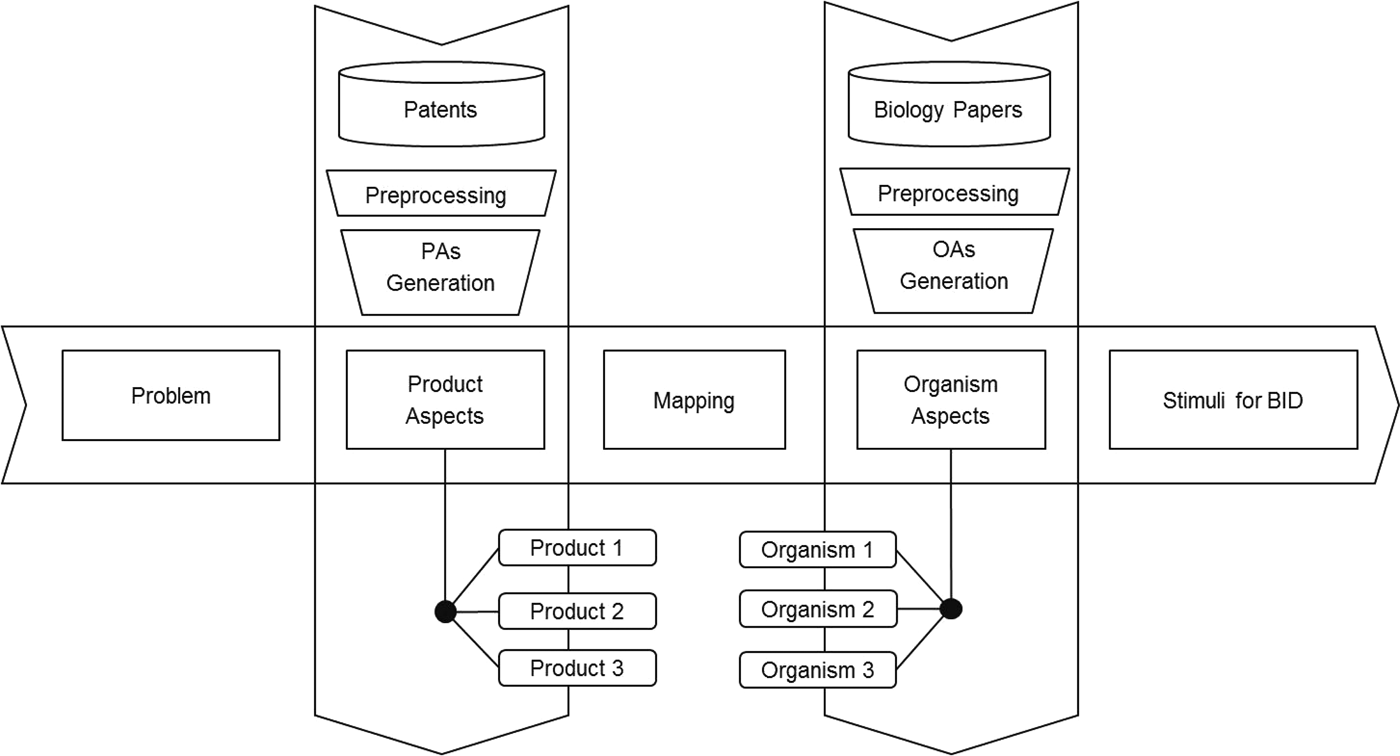
The proposed scalable search approach leverages the knowledge about technical systems captured in patents and biological systems documented in academic papers. These two databases allow the generation of two domain-specific concept sets, named product aspects (PAs) for technical systems and organism aspects (OAs) for biological systems. These aspects are generated by the analysis of word co-occurrences in, respectively, a patent and a biological document set. For example, the word hovering co-occurring together with flying in one document can be linked to the word gliding co-occurring in another document with the common word flying. Flying could be an OA in this simple example, associated with the words flying, hovering, and gliding. Large-scale application of this principle to both corpora results in technical and biological concepts, where each concept is associated to a number of co-occurring words. These concept sets (PAs and OAs) are central to the proposed approach, as illustrated by Figure 1. They represent a common abstraction level that enables technical systems to be linked to biological systems.
Overview of the proposed system.
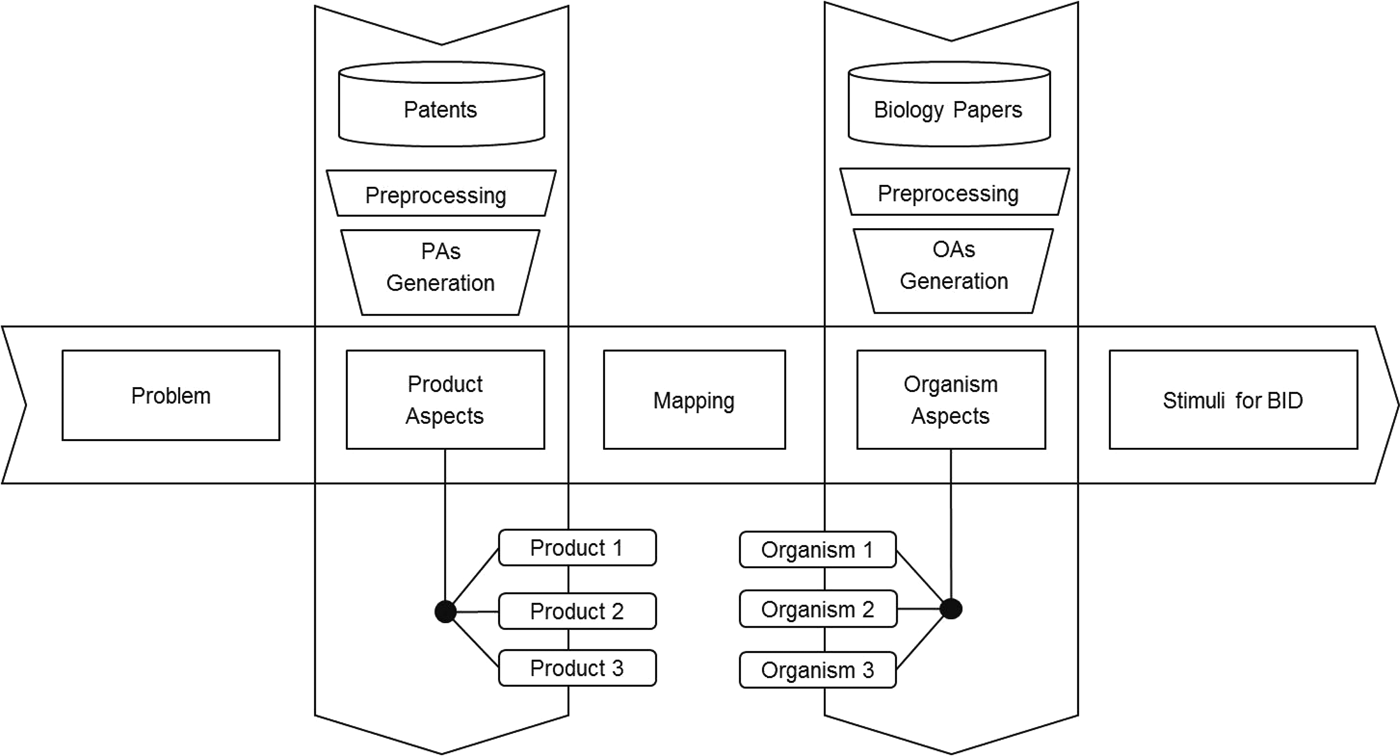
The extraction of PAs from a patent database is fully described in Verhaegen et al. (Reference Verhaegen, D'hondt, Vertommen, Dewulf and Duflou2009) and Verhagen, D'hondt, et al. (Reference Verhaegen, D'hondt, Vandevenne, Dewulf and Duflou2011). PAs support the Product Aspects in Design by Analogy (PAnDA) tool that identifies candidate products for design by analogy. Using PAnDA, a product, for example, carburetor, can be associated to the most relevant PAs, for example, for the carburetor case combustion, inflow/outflow, and rotate. Based on a selected PA, for example, inflow/outflow, candidate products are depicted as stimuli for the redesign of the carburetor product; for example, strainer, faucet, and euphonium are suggested as candidate products for design by analogy. The PAnDA tool has been shown to increase the variety and novelty of ideas (Verhaegen, Peeters, et al., Reference Verhaegen, Peeters, Vandevenne, Dewulf and Duflou2011).
Analogously to the extraction of PAs from a patent database, OAs are extracted from a biological database. Because OA extraction is inspired by PAs extraction, there is quite some high-level similarity in the involved processes. Nevertheless, it is necessary to detail the different algorithms because there are a number of necessary implementation differences. Section 3.1 details the technical and biological knowledge bases. Thereafter, Section 3.2 explains the preprocessing algorithms that transform the biological corpus into a document-term matrix (DTM). Next, in Section 3.3, OAs are generated from this DTM, and in Section 3.4, an algorithm for automated mapping between PAs and OAs is presented that allows linking biological solutions to technical problems. Finally, in Section 3.5, the product and OAs are used to characterize products and organisms.
3.1. Corpora
The corpus representing the technical domain consists of 155,000 patents, randomly drawn from the 21 million patents of the EPO Worldwide Patent Statistical Database. The full-text descriptions of these patents are used for DTM generation (see Section 3.2) because it has been shown that the inclusion of significantly large text fragments of the description can be beneficial for text mining in a patent environment (Larkey, Reference Larkey1999; Fall et al., Reference Fall, Törcsvári, Benzineb and Karetka2003). Starting small and doubling the database size each time while comparing the generated PA sets has shown that the extracted concept sets change very little once a significant sample corpus is reached (Verhaegen & Duflou, Reference Verhaegen and Duflou2013). In the case of PAnDA, 155,000 patents were found to be sufficient to form a stable conceptual representation of the technical domain. After PA generation and system setup, new patents can be integrated by applying folding-in (Deerwester et al., Reference Deerwester, Dumais, Landauer, Furnas and Harshman1990) to update PAnDA. This folding-in procedure allows positioning new document vectors in a previously created, stable PA vector space. The mathematical procedure is the multiplication of the document vector with the term-PA matrix.
The corpus representing the biological domain, for the tests reported in this paper, is a set of 8011 full-text biological papers from the Journal of Experimental Biology. As many as possible of the available papers from this journal were taken as the test set, and no further selection was made. In this paper, the term strategy refers to the biological phenomenon with potential for knowledge transfer. The term strategy document refers to a single document describing a strategy. Hence, it is possible to encounter multiple strategy documents discussing different aspects of the same strategy. Although the current number of strategy documents is not high enough to confidently claim that a representative subset of human's knowledge about nature is gathered, the research presented here found the resulting OA set to be useful and detailed enough to allow testing and validation of the proposed approach. More details about corpus expansion are discussed in Section 6.
3.2. DTM generation
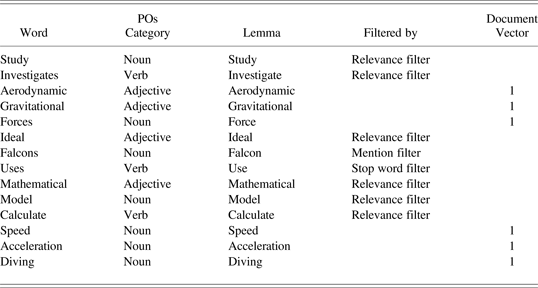
Five preprocessing steps transform each corpus into a DTM. The DTM is the vector space model (VSM; Salton et al., Reference Salton, Wong and Yang1975) representation of the corpus. A VSM representation was, for instance, also used to develop a patent-based analogy search tool for innovative concept generation (Murphy, Reference Murphy2011). This algebraic model (VSM) represents documents as vectors, where each dimension corresponds to a unique corpus word or feature; and each feature value corresponds to the importance of the word in the document. A DTM consists of a collection of document vectors (see Table 2 for a simple example of a document vector). An overview of the DTM generation preprocessing steps, which are detailed in the following subsections, is shown in Figure 2.
Preprocessing, from corpus to document-term matrix.
Preprocessing example: From corpus document to document vector
3.2.1. Organism filtering
To avoid that OAs would represent parts of the Linnaean taxonomy, a particular form of biological classification created by Carl Linnaeus (Linnaeus, Reference Linnaeus1767), the occurrences of organism names in the texts are filtered. Organism name filtering is comparable with filtering words related to products (Verhaegen, D'hondt, et al., Reference Verhaegen, D'hondt, Vandevenne, Dewulf and Duflou2011) because in both approaches interdocument links are removed to bring out structure relevant for design by analogy. Omitting organism name filtering could result in, for example, an OA that represents the order of Araneae, or spiders, caused by the many mentions of different spider species that tend to co-occur in biological papers. Generating such OAs would be useless for the envisaged mapping of PAs to OAs.
Organism name detection is performed by LINNAEUS (Gerner et al., Reference Gerner, Nenadic and Bergman2010), an open-source species name identification system. Its database, containing only names at the species level, is expanded to include all scientific and common organism names of the National Center for Biotechnology Information taxonomy. Because biological strategy documents often contain mentions of ranks higher than the species level, all 26 biological ranks are included (Vandevenne et al., Reference Vandevenne, Verhaegen and Duflou2015). For the biological corpus of 8011 documents, on average 128 organism mentions are detected per document and 19,782 unique organisms are found in the full corpus. Organism mention filtering eliminates a large number of nouns and therefore reduces the dimensions of the DTM and a significant part of the effort of manual filtering (see Section 3.2.5).
3.2.2. Part of speech tagging
A standard Trigrams'n'Tags tagger (Brants, Reference Brants2000) annotates each biological text with part of speech (POS) information (Charniak, Reference Charniak1997), and only verbs, adverbs, adjectives, and nouns are retained for further processing. These are the same POS categories as used for the PAnDA tool (Verhaegen & Duflou, Reference Verhaegen and Duflou2013). These POS categories contain terms about function, properties, and environment, all relevant for search in SBID as motivated by Kaiser et al. (Reference Kaiser, Farzaneh and Lindemann2014). Table 2 illustrates the POS tagging results of the following sentence: “This study investigates the aerodynamic and gravitational forces on ideal falcons and uses a mathematical model to calculate speed and acceleration during diving.” The table lists all words of the sentence that received one of the above-mentioned POS categories and their grammatical function in the sentence, or POS category. After POS tagging, corpus documents are treated as bags of words, meaning that their content is represented as an unordered set of words, ignoring word order and lexical relationships.
3.2.3. Lemmatization
After POS tagging, each remaining word is reduced to its lemma by WordNet-based lemmatization (Fellbaum, Reference Fellbaum1998) assisted with the words' POS tags. Table 2 illustrates lemmatization for the running example. For example, the word investigates is lemmatized to investigate. By eliminating all words that are not inflections of a WordNet lemma, this step is also a thesaurus filter that ignores wrongly spelled words. Lemmatization further summarizes the document vectors by summing word frequencies of inflections of the same lemma. Hence, the final DTM is reduced. For example, the word swimming occurring 8 times in a document can be linked to the word swims occurring 4 times in the same document through the association of both words with the lemma swim, and the frequencies of the two features swimming and swims can be summed to 12 for the lemma swim. In order to enable the use of standard terminology like DTM, instead of a document-lemma matrix, from here on, the concept term will refer to lemmas.
3.2.4. Stop word filtering
Stop words (Fox, Reference Fox1989) are removed in the fourth filtering step, because they do not represent relevant document content. Examples of stop words are the, and, a, that, and was. The full list used in the proposed system can be consulted in (Fox, Reference Fox1989).
3.2.5. Relevance filtering
All previous preprocessing steps have reduced the number of terms, and hence they have decreased the size of the DTM. Manual filtering identifies those terms in the remaining corpus dictionary that are interesting for knowledge transfer from the biological source domain to the technical target domain. Term filtering is performed by considering the terms independently; hence, no context in the form of sentences or documents is provided. Four term categories are immediately dismissed: a small number of remaining organism mentions, all terms representing academic language (e.g., study, pose, hypothesis, and objective), all terms representing structure (e.g., wood, body, larva, droplet, oil, wing, and antenna), and all terms that belong to nonrelevant topics (typically related to the technical domain, medicine, and genetics). From the remaining terms, only those that are interesting for describing a biological strategy for knowledge transfer to the technical domain are retained. For the running example, study, investigate, mathematical, model, and calculate are examples of words used in academic language that can be dismissed, as illustrated in Table 2.
Because such manual term relevance filtering is a subjective process, its repeatability needs verification. Therefore, a chance-adjusted measure of agreement is calculated. The free-marginal multirater κ (Randolph, Reference Randolph2005) is used because coders are not forced to mark a specific proportion of the terms as relevant. The free-marginal birater κ is calculated to be 0.73. The κ values range from –1 to 1, where –1 indicates perfect disagreement below chance, 0 indicates agreement equal to chance, and 1 indicates perfect agreement above chance. A κ value of 0.7 or above is normally considered proof of good agreement (Randolph, Reference Randolph2005).
Only a relatively small number of words in the English language covers most of the written text. Zipf's (Reference Zipf1932) law confirms this by stating that few words occur very often while most words occur rarely. This Zipf function is a negative exponential: see Figure 3 for the term frequencies of the remaining corpus terms after stop word filtering. The most frequent term, not filtered by one of the previous preprocessing steps, is reference, occurring 7974 times, which is nearly once per document. Because it can safely be assumed that sporadically occurring terms contribute little to the formation of the principal components (PCs) for OA generation (see Section 3.3), only the terms occurring more than 10 times in the corpus are interactively evaluated. This way 49% of the dictionary is eliminated, almost halving the required interactive work. Relevance filtering further reduces the term dictionary, resulting in a DTM with 8011 rows (documents) and 4055 columns (terms). The six remaining words indicated in the last column of Table 2 represent the document vector for the one-sentence example document. For this very short document, the vector only has six attributes (one for each word) and the term frequencies are all one because every word occurs exactly once in the sentence.
Illustration of Zipf's law for the corpus dictionary term frequencies.
3.3. PA and OA generation
The OAs generation process is depicted in Figure 4. The DTM obtained from preprocessing is a matrix where each element a ij corresponds to the frequency with which term j occurs in document i. This matrix is weighted with a term frequency inverse document frequency (tf-idf) scheme (Salton & Buckley, Reference Salton and Buckley1988) and normalized to account for different document text lengths. The tf-idf weighted DTM is subjected to principal component analysis (PCA; Berry et al., Reference Berry, Dumais and O'Brien1995; Skillicorn, Reference Skillicorn2007). This analysis allows extracting a predefined number of PCs, of which the first PC is the dimension oriented in such a way that it explains the maximum amount of variance in the data set. Each succeeding PC represents as much of the remaining variability as possible, taken into account that all PCs are orthogonal to each other. The authors currently calculate 300 PCs (Landauer & Dumais, Reference Landauer and Dumais1997; Verhaegen & Duflou, Reference Verhaegen and Duflou2013), which is an arbitrarily chosen number for proof of concept purposes. This dimensionality reduction results in two smaller matrices: a term-PC and a PC-document matrix.
The organism aspect generation process.
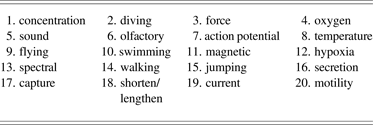
In a tf-idf weighted DTM, term frequencies are correlated variables. For example, documents containing a high frequency of the term eating are more likely to contain terms like feeding or ingesting than random documents. In a term-PC matrix, all terms are expressed in a smaller number of uncorrelated variables or PCs. Furthermore, for the PAnDA tool it has been demonstrated (Verhaegen et al., Reference Verhaegen, D'hondt, Vertommen, Dewulf and Duflou2009; Verhaegen, D'hondt, et al., Reference Verhaegen, D'hondt, Vandevenne, Dewulf and Duflou2011) that Varimax rotation (Kaiser, Reference Kaiser1958) facilitates the interpretability of the resulting PCs. After rotation, the PCs are called OAs, which are represented by a number of ranked terms. Figure 5 illustrates the highest scoring terms for an example OA: buoyancy, descent, ascent, buoyant, depth, density, ascend, and descend. Manual labeling interprets such ranked groups of terms; for example, the OA label buoyancy is given to this group of terms. Table 3 details the OA labels for the first 20 OAs. Because such labeling is subjective, the process is repeated with two raters who have 93.33% agreement. All 300 generated OAs are labeled, and 30 random OAs were selected for estimating the interrater reliability. Although the raters could use any labeling they seemed fit, most of the OA labels were chosen by picking one of the high-loading terms, or a modified form of one of these terms, on the OAs. For this interrater reliability test, the number of possible labels is very large; hence, there is no need to adjust for chance. OAs generation results in a term-OA and an OA-document matrix that allow the positioning of terms and documents in the new set of labeled OA dimensions. These two matrices are important information structures that support the functionalities described in Section 4.
Term loadings for an example organism aspect.
The first 20 organism aspects
3.4. PA and OA mapping
In order to link technical and biological systems for potential knowledge transfer, a similarity measure between the PAs as specified by Verhaegen, D'hondt, et al. (Reference Verhaegen, D'hondt, Vandevenne, Dewulf and Duflou2011) and the above calculated OAs is necessary. The multiplication of the term-PA and the term-OA matrices, with the term indices as common dimensions, results in a PA-OA matrix that expresses the similarity between the technical and biological concepts. The more the PA and OA vectors share common term loadings, the higher their similarity value will be in the PA-OA matrix. One can distinguish three types of relationships between PAs and OAs:
1. (Near) identical concepts: The (near) identical concepts are represented by the largest values in the PA-OA similarity matrix. Some examples are rotation, fluorescence, solar, and inflation/deflation. Each of these concepts exists in both the OA and PA set and a high value links them in the similarity matrix. The automated mapping of (near) identical concepts still allows domain-specific terminology to be mapped because it is not necessary that all the terms or features in the (near) identical PA and OA vectors are identical.
2. Semantically related concepts: Some links between PAs and OAs express a semantic relation less obvious than for identical concepts. These links can represent a cross-domain bridge on the conceptual level because, for instance, the PA drilling that has a strong link to the OA digging and the PA humidify has a strong link to the OA transpiration. Of course the cross-domain bridge on the terminology level is also present here, connecting domain-specific terms related to both concepts.
3. Unrelated concepts: As can be expected, most links between PAs and OAs are meaningless, which results in a zero or near zero value in the PA-OA matrix.
Aspect mapping associates concepts from the technical domain to the biological domain and, hence, patents to biological papers. In the next section, products are linked to patents and organisms to biological papers.
3.5. Characterization of products and organisms
The tasks of characterizing products with PAs and organisms with OAs are similar. The occurrences of products in patents and of organisms in papers need to be identified and expressed in product–patent and organism–paper matrices. Next, the document vectors in these matrices are folded in (Deerwester et al., Reference Deerwester, Dumais, Landauer, Furnas and Harshman1990) to obtain product and organism characterization matrices.
3.5.1. Product identification
The product identification used by the PAnDA tool (Verhaegen, D'hondt, et al., Reference Verhaegen, D'hondt, Vandevenne, Dewulf and Duflou2011), which consists of 1011 single-word products extracted from the Google product taxonomy (Google Merchant Center, 2014), is improved by a new multiword product identification algorithm, detailed in the paragraphs below. Motivation is twofold: this way much more products are detected (151132), and products can be characterized more precisely. For example, products like air bag and plastic bag, which would be mapped to the single-word product bag, are distinguished by the new multiword product identification algorithm. Such more refined product search improves product characterization results. For example, the most important PAs for air bag and plastic bag are inflation/deflation and conveying and feeding, respectively, whereas the most important PA for bag is packaging and sealing. Without multiword product identification, some of the validation cases presented in Section 5 would not be possible, that is, for the air conditioning system and car body products.
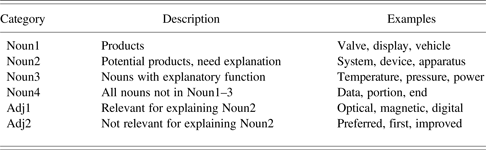
To identify products, the following POS sequence is detected in the title and abstracts of patents: zero or more adjectives followed by one or more nouns. Next, unique nouns occurring in the title and abstracts are manually categorized into four categories (see Table 4). The first category represents nouns that are products by themselves, for example, valve, display, and vehicle. The single-word products from the Google taxonomy are also placed in this category. A second noun category groups words that need explanation to be products, for example, system, device, and apparatus. These are not discarded because the language used in patents often is indirect, such as communication apparatus or packaging system. A third category contains nouns that have an explanatory function, for example, temperature, pressure, and power; these can explain the words in the previous category, for example, temperature regulation system. All other nouns are considered not relevant and placed in the fourth noun category. Adjectives are labeled relevant (e.g., optical, magnetic, and digital) or not relevant (e.g., preferred, first, and improved) to reflect their capability of providing useful information about a product. Manual annotation of the 10% most frequent nouns and 20% most frequent adjectives (in total 2568 words) resulted in the identification of 151,132 multiword products, which allowed performing validation tests for proof-of-concept purposes (see Section 5). This way, rarely used nouns and adjectives (e.g., thromboembolism, saussurea, arrhenius, gratuitous, and sovereign) are filtered because the large majority of these infrequently encountered words would be labeled nonrelevant anyway. Noun and adjective categorization is a subjective process; hence, rater agreement is measured. The free-marginal multirater κ (Randolph, Reference Randolph2005) is calculated for noun categorization to four categories and for adjective categorization to two categories. The κ scores for two raters are 0.82 and 0.87, both indicating proof of good interrater agreement (Randolph, Reference Randolph2005).
Noun and adjective categories
For multiword product identification, the four noun and two adjective category labels are applied to the retrieved POS sequences as follows:
• If the last word is categorized as nonrelevant (Noun4) or as an explaining noun (Noun3), the full POS sequence is ignored.
• If the last word is a product by itself (Noun1), the full POS sequence is labeled as product.
• If the last word is a noun that needs explanation (Noun2) and this explanation is given by either an explaining noun (Noun3), a product noun (Noun1), or a relevant adjective (Adj1), the POS sequence is retained as product.
A final processing step lemmatizes the last words of the retrieved multiword products (e.g., transforming magnetic strips to magnetic strip) and the frequencies of these lemmatized multiword products in patents are recorded in a product–patent matrix.
3.5.2 Organism identification
Organism identification is performed in the same manner as for mention filtering in Section 3.2.1. The algorithm detects both single- (e.g., Lotus) and multiword organism names (e.g., Lotus japonicus), as well as common (e.g., gyrfalcon) and scientific names (e.g., Falco rusticolus), and is applied to the titles of the biological documents to record organism occurrences in an organism–paper matrix (Vandevenne, Verhaegen, et al., Reference Vandevenne, Verhaegen, Dewulf and Duflou2014).
3.5.3. Positioning products and organisms in PA and OA space
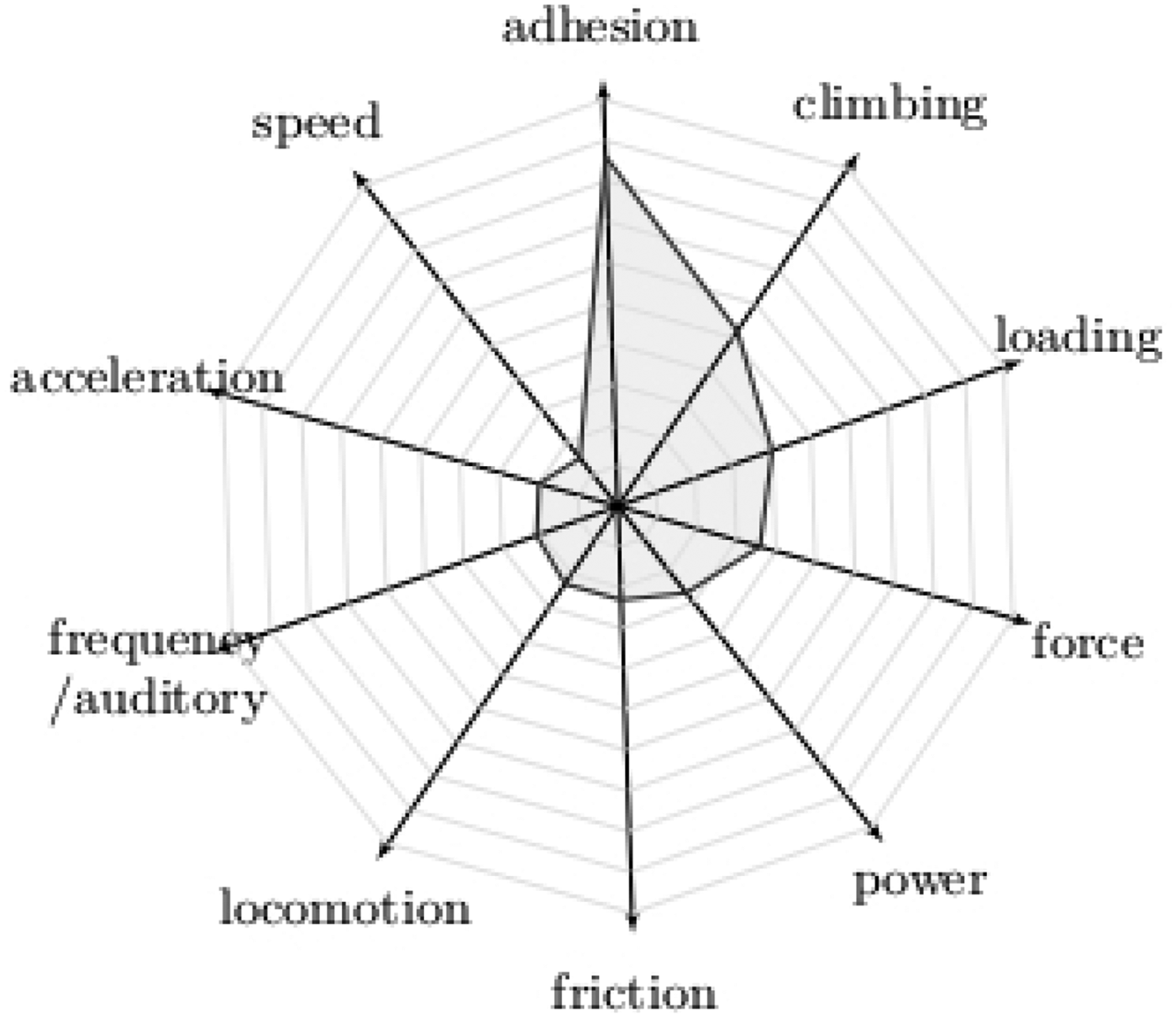
Following the folding-in procedure (Deerwester et al., Reference Deerwester, Dumais, Landauer, Furnas and Harshman1990), the product–patent and organism–paper matrices are multiplied with, respectively, the patent-PA and paper-OA matrices calculated in Section 3.3 to obtain two characterization matrices: product-PA and organism-OA. Figure 6 illustrates organism characterization for geckos in a radar plot. The visualization shows the most important OAs (highest organism loadings in OA space, obtained from the organism-OA matrix) for the selected organism. This characterization is a reflection of the eight documents currently present in the database that contain a reference to geckos in their title. In general, the more documents associated to an organism in the database, the more the radar plot becomes spiral shaped as more topics can be addressed. Of course, it is possible that a large fraction of documents for an organism focuses on one specific strategy. One example in the current corpus is the set of 17 documents associated to cuttlefish. Because most of them discuss camouflage, this results in a spike in the radar plot for the OA camouflage. If there is only one document stored for a specific organism, the radar plot typically spikes for one or a few OAs.
Radar plot of automatic organism characterization of geckos.
4. SEABIRD FUNCTIONALITIES
The algorithms described in the previous section are used to implement the back-end architecture of SEABIRD, as shown in Figure 1. To allow users to interact with the system while moving through the different BID process phases, a number of front-end or user interface elements have been developed, which are detailed below.
4.1. Network browser
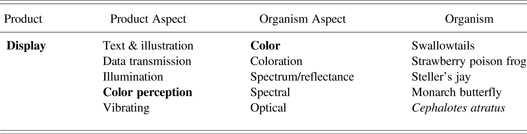
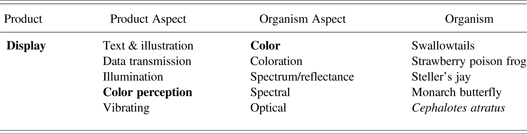
The information structure created with the algorithms described in Section 3 represents a large network containing four types of nodes: products, PAs, OAs, and organisms. Links are formed between these nodes by consulting the characterization and mapping matrices, that is, the product-PA, PA-OA, and organism-OA matrices. This way, products are connected to PAs, PAs to OAs, and OAs to organisms. A central user interface element, network browser, is developed to assist navigation through this network. The network browser contains four columns, from left to right: products, PAs, OAs, and organisms. Table 5 illustrates with an example where the product display is characterized with PAs. The selected PA color perception maps to OAs from which the OA color results in the listed organisms. For the problem-oriented bioinspired design process (Helms et al., Reference Helms, Vattam and Goel2009), the user navigates from left to right in the network browser.
Representation of the network browser
4.2. Supporting problem formulation: BID process phase 1
Problems are often formulated as How can we improve our product? In the context of BID, this question translates to How can nature inspire us to improve our product? To capture this problem formulation, SEABIRD has a search functionality to select one or more products from the large product database (see Section 3.5.1). A direct search allows searching for multiword products. One can search for the exact product or for products starting, ending, or containing a specified character string. The results, which easily contain 10s to 100s of multiword products, are visualized as a word cloud, where the font size reflects the importance (frequency) of the products in the patent database. For example, the most important products for bag are bag, air bag, plastic bag, packaging bag, golf bag, and so forth. These results also contain product parts; for example, when searching for air bag, air bag cover and air bag gas are also found. Another indirect search finds products that are mentioned in the same patents as a selected product. Continuing the same example, the most important products linked to air bag with indirect search are vehicle, steering wheel, gas generator, door, fabric, seat, and so forth. This list contains product synonyms (e.g., air bag apparatus), elements of the super system (e.g., vehicle), and elements of the subsystem (e.g., fabric). Because this indirect search also has the potential to generate hundreds of product names, again a frequency-weighted word cloud is used as a visualization method. Product search and selection is an important step in problem formulation, because different but related products are likely to offer distinct characterizations. For example, the product car body is characterized with the PA aerodynamic, but if one would select the product car, this PA is suppressed by other PAs. Indirect search facilitates the identification of the most relevant product. Product selection adds it to the first column of the network browser, and SEABIRD characterizes the product with PAs, as explained in Section 3.5.3). Problem definition ends with the user selecting the PA that best expresses the desired function or aspect of the product to improve.
Another possible way to formulate a problem is How can we realize a specific functionality? or How can nature inspire us to realize a specific functionality? Because there is no product to start from, a direct selection is made from the set of PAs. For example, for the question How can we realize acceleration? the PA acceleration and deceleration can be selected. SEABIRD has a search function for PAs that, like for products, can search for exact PAs or for PAs starting, ending, or containing a specified character string. For example, searching for heat results in the following two PAs: heating/cooling and heat treatment. These search results are positioned in the second column of the network browser. Independently of which problem formulation strategy is taken, the output of problem formulation is a set of PAs from which the user selects one or more to continue to the next BID process step, explained in the following section.
4.3. Supporting scalable search for biological strategy documents: BID process phase 2
For each selected PA, an ordered list of relevant OAs can be generated in the third column of the network browser. To obtain this list, the PA-OA similarity or mapping matrix is consulted, as explained in Section 3.4. Continuing the running example, the most important PA for air bag is inflation/deflation and the most relevant OA that maps to this PA is volume (inflation/deflation).
4.3.1. Search for relevant organisms
After selecting an OA in the network browser, the fourth column of the network browser is populated with an ordered list of organism names that reflects the organism loadings stored in the organism-OA matrix. The organisms put forward for the OA volume (inflation/deflation) are mute swan, walking goby, American grasshopper, locusta, rana nicobariensisnicobar island frog, ribbed mussel, bearded seal, and so forth. Immediate understanding of which strategies these organisms implement that are relevant for the selected OA is not evident for this example, and further analysis is necessary in the following BID process steps. A second example, generating a list of organisms for the OA bioluminescence, is easier to directly verify, because the retrieved organisms are glowworms, Lampyris noctilucacommon, dinoflagellates, Suberites domuncula, fireflies, brittle stars, Photuris, and so forth.
4.3.2. Search for relevant strategy documents
For a selected OA, SEABIRD consults the OA-document matrix to identify the most relevant strategy documents with the highest OA loadings. A strategy document explorer is developed for SEABIRD that presents the information in table format. Each line contains the strategy title and involved organism name for a quick overview of the results. In addition, by clicking on a strategy document line, the biological paper's abstract is shown together with a link to the full text, for further analysis in the next BID steps. Continuing the running example, high-scoring strategy documents for the OA volume (inflation/deflation) discuss volume changes of the lung, the swim bladder, and individual cells.
4.4. Supporting filtering: BID process phase 3
With scalable search allowing the integration of very large biological knowledge repositories, a new challenge emerges. The more strategy documents SEABIRD integrates, the more relevant results become retrievable and measures need to be taken to avoid information overload. The presentation of ordered lists of organisms and strategy documents is a first important filtering method. In this way, the user can retrieve as many ordered results as he or she wants to process. A second functionality that deals with growing database size is the organism-oriented view that SEABIRD provides. Besides organism characterization, it also presents all strategy documents for the specific organism in a separate table. This way, related studies about similar biological strategies of the same organism are grouped. For example, the organism view not only contains the characterization as illustrated by Figure 6 but also presents a strategy document table containing eight entries for geckos. Seven of these strategy documents discuss the strategy of gecko adhesion in the context of locomotion, climbing, or static hanging. One strategy document focuses on high-frequency gecko communication. Because database expansion will pose new challenges, extra filtering measures are considered, as detailed in Section 6, Discussion and Future Work.
4.5. Supporting analysis and knowledge transfer: BID process phases 3 and 4
After having narrowed down the set of potential biological strategy documents to a manageable number, the retrieved biological knowledge needs to be analyzed and transferred to the technical domain by identifying cross-domain analogies. These are cognitive processes. The main information unit that SEABIRD returns are academic papers, which, intuitively, is a too bulky representation to use as stimuli for knowledge transfer. Therefore, initially only the title and abstract are shown with text-highlights for the high-loading terms of the selected OA. Term loadings are retrieved by consulting the term-OA matrix obtained from OAs generation (see Section 3.3). Figure 7 illustrates annotation for an example title and abstract of a strategy document scoring on the OA adhesion. The highest loading terms for this OA are adhesive, attach, glue, detach, and so forth. These terms and their inflections (e.g., adhesives, adhesiveness, adhesion, and adhesions for adhesive) are marked in the text to catch attention. The same annotation process can be applied to the full text if the user requires more background information. Automated text annotation, as described above, builds on the assumption that the terms scoring high on the relevant OAs are interesting to focus on during knowledge transfer.
Annotation for an example strategy document for the organism aspect adhesion (Autumn et al., Reference Autumn, Dittmore, Santos, Spenko and Cutkosky2006).
5. VALIDATION OF SCALABLE SEARCH
The main contribution of this paper is presenting an approach for scalable cross-domain search. Therefore the authors validate SEABIRD's implementation of the first and second BID process phases. After searching with SEABIRD, other research contributions can be integrated to complete the BID process phases. For example, the integration of automated extraction of causally related functions from natural-language text (Cheong & Shu, Reference Cheong and Shu2014) could be considered to facilitate knowledge transfer. More opportunities for combining research efforts are discussed in Section 6.
In order to objectively validate the search functionality, a set of search questions and an accompanying set of desirable results are required. This translates to identifying a set of existing bioinspired concepts and testing if SEABIRD's problem formulation and search functionalities are able to return relevant stimuli for knowledge transfer. For the selection of validation cases, well-known bioinspired designs are taken, often used as examples for introducing BID, for example, the butterfly-inspired Mirasol display technology (Mirasol, 2009). By taking widely accepted examples of BID as validation cases, the authors aim at maximizing the likelihood of readers being familiar with the presented validation cases and at minimizing doubt whether the bioinspired design was really inspired by nature.
As explained in Section 3.1, SEABIRD currently integrates a relatively small database compared to a human's knowledge about nature. This entails that the biological strategies relevant for the chosen validation cases are possibly not represented in this corpus by one or more strategy documents. In such cases, one or more relevant biological papers are added to SEABIRD and automatically positioned in the OA space with folding-in (Deerwester et al., Reference Deerwester, Dumais, Landauer, Furnas and Harshman1990). Adding biological strategy documents this way does not impede validation because it is not database completeness but the search functionality that is verified. At the same time, folding in extra biological strategy documents illustrates that corpus expansion is possible for SEABIRD without the need to repeat any of the interactive labeling or classification tasks detailed in Section 3 and without the need to regenerate the OAs.
5.1. Validation case 1: Butterflies and Mirasol display technology
For the development of a new display technology, power consumption is an important parameter. When resource efficiency is a primary goal, nature is an interesting source of inspiration (Bar-Cohen, Reference Bar-Cohen2006). The Mirasol display technology (Mirasol, 2009) is inspired by the structural coloring of butterflies. According to Vukusic (Reference Vukusic2006),
Structural colour utilizes the wave-nature of light. As a wave, light can experience wave superposition; that is, groups of waves may add together to reinforce or diminish their combined effect. For this to happen effectively and therefore to produce a distinct colour effect, there must be a definite structural order in the system; importantly, the physical dimension of this order, the period, must be on a par with the wavelength of light. This phenomenon is often referred to as interference and is identical to the mechanism that produces the iridescent colours in soap bubbles; other names for it include Bragg diffraction or coherent scattering.
Besides power savings, a second competitive advantage of this technology is sunlight viewability (Mirasol, 2009). For the butterfly-inspired displays, the structure is created with microscopic machines that consist of different material layers and a variable-size air gap manipulatable with applied voltage (Mirasol, 2009).
SEABIRD's multiword product search is used to initiate problem formulation. The product word cloud returns display as the most important product in the patent corpus for the search key display. Other high-ranked results are display device, display screen, display apparatus, and so forth. Display is taken as the product to characterize, which results in the following ordered PAs: text and illustration, data transmission, illumination, color perception, vibrating, and so forth. The other high-ranking product synonyms are confirmed to have similar characterizations, mainly differing in the order of the PAs. For the problem at hand, the PA color perception is chosen to map to OAs. SEABIRD's PA-to-OA-mapping suggests in decreasing order of importance: color, coloration, spectrum and reflectance, spectral, optical, illumination, camouflage, and so forth, and the first OA color is selected to explore for relevant organisms. A list of organisms is generated that, in order of relevance to the selected OA, are swallowtails, strawberry poison frog, Steller's jay, monarch butterfly, cephalotes atratus, Graphium sarpedon, budgerigar, butterflies, Nymphalini, eastern nosquitifish, and so forth. Based on SEABIRD's current corpus, 5 of the top 10 results are a member of the superfamily Papilionoidea with common name butterflies. The Linnaeus classification of the identified Papilionoidea ranges from the species level (monarch butterfly) to the super family (butterflies). Next, the SEABIRD strategy document explorer's results are scanned to verify the presence for one or more specific biological strategies that have the potential to trigger the design of the Mirasol display technology. For the OA color, the 11th strategy document is titled “Significance of a basal melanin layer to production of noniridescent structural plumage color: Evidence from an amelanotic Stellers jay,” discussing structural coloration for birds. For the OA coloration, the 9th result is titled “Spectral reflectance and directional properties of structural coloration in bird plumage” and for the OA spectrum/reflectance the 2nd, 8th, and 14th result are titled “Glass scales on the wing of the swordtail butterfly Graphium sarpedon act as thin film polarizing reflectors,” “Blue integumentary structural colors in dragonflies (Odonata) are not produced by incoherent Tyndall scattering,” and “Anatomically diverse butterfly scales all produce structural colors by coherent scattering,” respectively. Each of these titles describes a biological strategy strongly related to the Mirasol technology. Therefore, for this validation case, the search results can be said to provide useful strategy documents as input to the fourth BID process step, knowledge transfer, to lead to the conceptual design of the successful display technology.
As illustrated above, SEABIRD makes it possible to identify similar solutions in nature for taxonomically distant species. Structural coloring is not a strategy exclusive to butterflies: “The non-pigmentary source of colour, referred to as structural colour, is a very important component in the appearance of many different animal systems; examples are found in many other orders of insects, as well as in birds and aquatic animals” (Vukusic, Reference Vukusic2006). SEABIRD, only relying on the biological papers of one journal, retrieves two strategy documents describing structural coloring for birds, two for butterflies, and one for dragonflies.
5.2. Validation case 2: Boxfishes and the Mercedes-Benz bionic concept car
A key focus point in new car development is energy consumption, in which aerodynamics plays an important role. During product search with SEABIRD, as a part of problem formulation, it soon becomes clear that there are a large number of multiword products in the patent database containing the word car. The most important are car, elevator car, electric car, railway car, motor car, and so forth. Hence, product search is focused on the part of the car most relevant to aerodynamics, being the car body. This product is found with an indirect product search, see Section 4.2, locating products that frequently co-occur with the product car. SEABIRD's characterization of car body places the PA aerodynamic on the second place, right after rigidity/deformation/elasticity. Mapping to OAs identifies the OA vortex on the fourth place, and the retrieved organisms are in order of relevance: mullets, swimming frogs, boxfishes, Sarsia tubulosa, thrushes, mayflies, blackcap, swift, and so forth. The strategy document explorer finds one relevant strategy document discussing boxfishes for the OA vortex titled “Body-induced vortical flows: A common mechanism for self-corrective trimming control in boxfishes.” In this study, “flows around the bodies of three morphologically distinct boxfishes” are investigated, and it was found that “carapaces of boxfishes, which vary in cross-sectional shape, longitudinal features, and ornamentation, play an important role in hydrodynamic stability” (Bartol et al., Reference Bartol, Gharib, Webb, Weihs and Gordon2005). Hence, SEABIRD's problem formulation and scalable search have made the link from aerodynamics of the car body to the shape of the body of boxfishes.
5.3. Validation case 3: Termite mound and air conditioning for buildings
Temperature regulation in large office buildings is conventionally realized with air-conditioning and heating systems. The Eastgate Centre in Harare, Zimbabwe, has a temperature regulation system inspired by self-cooling termite mounds. At the time of inspiration,Footnote 1 the biological understanding of temperature control in termite mounds had two main components: less dense, warm internal air rises and is exchanged in the chimneys with denser cooler air that moves downward; and an induced-flow mechanism (Venturi effect) causes air to enter through the cavities near the ground (lower wind velocity) and to exit through the chimneys (higher wind velocity). Application of this strategy causes the Eastgate Centre to save up to 90% in energy costs.
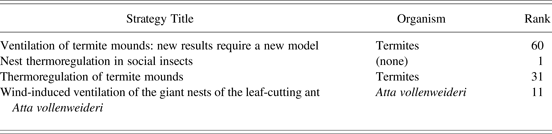
Unlike the previous two examples, SEABIRD's current corpus did not contain any strategy document that could function as a valid search result. As explained in Section 6, in such a case, the corpus is extended with one or more relevant strategy documents to validate the search functionality. As a bonus, at the same time, the folding-in process for corpus expansion is tested. For this validation case, four biological strategy documents were folded-in OA space (see Table 6). The second strategy document in this list does not mention an organism name; hence, it will not contribute to the organism lists generated for OAs. It can, however, be retrieved via the strategy document browser because this functionality does not require an identified organism in the title.
Biological strategy documents for air conditioning of buildings, and their rank on the organism aspect temperature
SEABIRD's multiword product search returns a number of candidate products, for example, air conditioning system, air conditioning apparatus, and air conditioning device. The most important PA for these products is heating/cooling/temperature. Mapping this PA to OAs results in the OA temperature on the fourth place, and termites are placed fourth in the organism list for this OA. This can motivate the user to explore all strategy documents of termites, which returns the three validation strategy documents linked to termites and two more already present in the corpus about unrelated topics. The strategy document ranked first by SEABIRD's strategy browser is “nest thermoregulation in social insects,” and the ranks of the other strategy documents are detailed in Table 6. Hence, the folded-in strategy documents are retrievable by SEABIRD's search functionality. Therefore, again for this case, SEABIRD's search is able to retrieve stimuli that have the potential to trigger a bioinspired invention.
6. DISCUSSION AND FUTURE WORK
Although eventually SEABIRD aims at effectively supporting the designer in all four SSBID phases, in this paper, the contribution of adding scalability to the search phase is the main focus. Therefore, SEABIRD's search is validated with three well-known BID cases. For each case, the proposed system was able to identify relevant stimuli with the potential to lead to the development of bioinspired innovations. The confidence about SEABIRD's search functionality obtained from these validation tests, combined with extensive corpus expansion and further development of algorithms to support the problem formulation, filtering, analysis, and knowledge transfer phases, will allow testing the ideation tool in controlled outcome-based experiments in which new design challenges are presented to a large group of participants.
Table 1 indicates that, compared to related research, SEABIRD's biological strategy corpus is large. However, compared to the end goal of leveraging human's knowledge about nature, significant corpus expansion is required. SEABIRD sets itself apart by its inherent scalability, eliminating any limit for increasing the supporting biological database while still facilitating efficient search. The interactive operations reported in Section 3 (filtering and categorization steps) take place during system setup and need to occur only once for each unique term in the corpus dictionary that survived the automated term filtering steps. These interactive tasks required together approximately 40 h to set up SEABIRD. Adding new documents to the corpus gradually has less and less influence on dictionary size; that is, fewer new terms are introduced to a growing dictionary by extra documents. Although the stability of the current dictionary is not yet claimed in this contribution, the current corpus and corpus dictionary already allowed validation of the presented BID cases. Future work will include a second iteration for SEABIRD's setup to increase the corpus until the critical mass is reached that delivers a stable dictionary. Thereafter, no more interactive labeling or categorization tasks are required to integrate as many new sources as there are, or become, available. Of course, after a number of years, the dictionary stability should be reevaluated because language itself evolves. If necessary, a small effort can integrate new terms. A similar reasoning holds for the interactive labeling of OAs. By comparing the OA set for a gradually increasing database, a minimal corpus size will be determined where the OA set becomes stable, as previously illustrated for the PA set of the PAnDA tool (Verhaegen, D'hondt, et al., Reference Verhaegen, D'hondt, Vandevenne, Dewulf and Duflou2011). Thereafter, more biological strategy documents will be folded in (Deerwester et al., Reference Deerwester, Dumais, Landauer, Furnas and Harshman1990) in OA space without any human interaction besides selecting the corpus and running the scripts. Compared to the state of the art, the above interactive labeling or classification tasks occur on the corpus level, not the document level; hence, they only need to be performed once for a stable corpus and dictionary. Because these tasks require a relatively small human effort during SEABIRD's setup, they are not the focus of future automation attempts.
The above interactive tasks during SEABIRD's initial setup require human judgment and are thus subjective and even error prone. Although the confirmed repeatability gives some confidence about the execution of these tasks, it also indicates that opinions for term labeling or classification can differ. The effect of this, however, is limited because of the key role of dimension reduction (PCA) in SEABIRD's design. This technique combines correlated original variables (term frequencies) to uncorrelated variables (PAs and OAs). Take, for example, the OA depicted in Figure 5. If one of these terms (correlated variables) would be mislabeled, there would still be a set of correlated variables representing a concept in the data for PCA to reveal. As the corpus dictionary grows, the potential number of terms behind the concepts grows, and the technique becomes more and more resistant to such errors. Of course, there is a limit to this appealing property, but the validation cases illustrate that the execution of the interactive, repeatable tasks on a corpus of 8011 documents already results in a functional bioideation tool. A further illustration of the resistance of the functioning of the proposed tool to changes in the retained dictionary is that only the terms that occur at least 10 times in the corpus are interactively evaluated; the rest do not take part in dimension reduction. The central role of semantic concepts linking the technical to the biological domain during search, as opposed to direct search with keywords, has the advantage that the identification of cross-domain links is not dependent on finding the right keywords, but on choosing the right concepts from the offered product characterization.
With further corpus expansion, the need for more support in search result filtering and grouping will increase (SSBID Phase 3). Therefore, measures like clustering-related strategy documents discussing the same strategy, biological scale detection, and taxonomic visualization of search results are envisaged. Related strategies could, for instance, also be grouped by detecting enabling functions (Cheong & Shu, Reference Cheong and Shu2014).
Further expansion of the PA and OA sets will increase the ability to specify a technical problem and to find matches with OAs on the conceptual level. For example, there is an OA adhesion that scores high on the characterization of many organisms like geckos, carnivorous plants, spiders, and mussels; and in the patent database, many products that have a functionality related to adhesion or attachment are identified (fastener tape, adhesive tape, paper glue, fastener, etc.). However, the most relevant concept in the set of 300 PAs for attachment functionality currently is soldering, clearly linked to a subset of products, while a semantically more general concept currently is missing. This example illustrates the potential benefit of generating more product and OAs than the currently arbitrarily chosen sets of 300. Another feature that would benefit SEABIRD is the ability of multiple selection of products, PAs or OAs. This way synonymous products (e.g., computer screen and computer display) could be characterized as one, or multiple PAs could be combined to map to OAs, or multiple OAs could be selected to generate relevant organism or strategy document lists.
In this contribution, the authors have split the validation of access to relevant biological strategies from testing how the natural-language stimuli should be represented for efficient ideation by facilitating the recognition of cross-domain analogies. The former is an information retrieval problem, the latter a cognitive science problem which the authors hope to address in future research. For the information retrieval problem, it is validated that SEABIRD offers relevant stimuli via a logical path. How many users would recognize these solutions is not yet tested because this task requires solving the second important challenge of effective stimuli representation for supporting knowledge transfer. Identifying valid analogies in natural-language text resulting from search is not a trivial task (Cheong & Shu, Reference Cheong and Shu2013), even if relevant biological text is presented. Section 4.5 details current efforts to support knowledge transfer, and related contributions suggest more measures can be taken to increase SEABIRD's support for this BID process phase. These range from training users in BID to adding extra knowledge transfer supporting functionality to the ideation tool. Nelson et al. (Reference Nelson, Wilson and Yen2009) found that training BID students helps them to develop more novel and more diverse design ideas in a test setup without biological strategies as stimuli. To counteract cognitive bias, the abstraction of nouns to their hypernyms in biological texts is proposed (Cheong & Shu, Reference Cheong and Shu2013), a process close to automation; and another contribution identifies causally related verbs (Cheong & Shu, Reference Cheong and Shu2014) to support structural mapping (Gentner & Markham, Reference Gentner and Markman1997). Furthermore, it is likely that instantiating knowledge transfer models (FB, SBF, and SAPPhIRE) for both the biological systems as for the formulated technical problem will benefit the recognition of cross-domain design by analogy opportunities. For SBF models, a pilot study indicates that some designers benefit from SBF model instantiation for understanding biological articles (Vattam & Goel, Reference Vattam and Goel2011). Although manual model instantiation does not scale well for a large biological database, this is an opportunity to leverage these academic insights in knowledge transfer when a limited set of relevant biological strategies have been identified by SEABIRD.
7. CONCLUSION
To eliminate the element of chance in discovering new bioinspired solutions to technical problems, a number of systematic BID approaches have been proposed. However, all approaches struggle with integrating the ever-growing body of biological knowledge in a scalable way. Therefore, SEABIRD is proposed, a bioideation methodology that leverages large natural-language biological databases in the search for relevant biological stimuli for design by analogy.
Central to SEABIRD are product and OAs, two concept sets extracted from, respectively, a patent and biological paper database. Problem formulation is supported by combining an advanced multiword product search with product characterization, resulting in one or more PAs to focus on. A mapping of product to OAs results in an ordered strategy document and organism lists, which are initial stimuli for the filter analysis and knowledge transfer phases.
SEABIRD's search functionality is validated by demonstrating its capability to provide relevant stimuli with the potential to inspire three well-known BID cases. During validation, SEABIRD's ability to easily expand the biological corpus is also illustrated. No interactive tasks, that have been found to encumber the scalability of existing systematic BID approaches, are required during corpus expansion. After demonstrating a novel approach for scalable search, focus needs to be shifted to increase support for the other SSBID phases. By combining findings from existing research with the development of extra supporting functionalities, SEABIRD needs to be extended to effectively support bioinspired concept generation.
Dennis Vandevenne is a Postdoctoral Researcher on methods and algorithms for BID at the Centre for Industrial Management and a Researcher at Katholieke Universiteit Leuve (KU Leuven). He obtained three information and communications technology (ICT)-related master's degrees: electronics–ICT, artificial intelligence–engineering and computer science, and industrial management–ICT. Dennis previously performed research on identity management and biometrics in the Department of Computer Security and Industrial Cryptography.
Paul-Armand Verhaegen is a Postdoctoral Researcher in the domain of systematic innovation, product development, and data mining at KU Leuven. He holds a master's degree in applied science and engineering, with a specialization in electrotechnical and computer science. Paul-Armand is a graduate in complementary studies in business administration; he attained an MBA from Vrije Universiteit Brussel and a PhD in engineering from KU Leuven. Dr. Verhaegen founded Stocks, a company specializing in printer supplies. He worked as an external consultant for 3E on green energy certificates; as a consultant at the Bureau van Dijk Management Consultants; and as a Research Assistant at Vrije Universiteit Brussel, Erasmushogeschool Brussel, and KU Leuven.
Simon Dewulf is Founder of CREAX. CREAX developed Creation Suite (http://www.creationsuite.com), a web-based open innovation interface. CREAX Creation Suite is used in companies like Dow Corning, SKF, P&G, Philips, Kraft, L'Oreal, Johnson & Johnson, and GlaxoSmithKline to provide a direct access to out-of-domain knowledge for technology transfer and open innovation opportunities.
Joost R. Duflou is a Professor in the Department of Mechanical Engineering at KU Leuven. He holds master degrees in architectural and electromechanical engineering and a PhD in engineering from KU Leuven. His principal research activities are situated in the field of design support methods and methodologies, with special attention for systematic innovation, ecodesign, and life cycle engineering. Dr. Duflou is a member of CIRP and has published over 200 international publications.