Introduction
Recalcitrant seeds are usually shed at water contents greater than 0.40 g H2O per g dry matter (g g− 1) (Pammenter and Berjak, Reference Pammenter and Berjak1999), and are metabolically active even when in a relatively quiescent phase of development (Berjak et al., Reference Berjak, Farrant, Pammenter and Taylorson1989; Farrant et al., Reference Farrant, Pammenter and Berjak1989). While orthodox seeds can withstand dehydration to water contents as low as 0.05 g g− 1, recalcitrant seeds lose vigour with relatively little drying (Chin and Roberts, Reference Chin and Roberts1980; Hong and Ellis, Reference Hong and Ellis1996), although slight, short-term dehydration is tolerated by recalcitrant seeds of some species and, paradoxically, can enhance metabolic activity (Pammenter et al., Reference Pammenter, Greggains, Kioko, Wesley-Smith, Berjak and Finch-Savage1998). However, desiccation tolerance sensu stricto never develops (Finch-Savage, Reference Finch-Savage1992; Vertucci et al., Reference Vertucci, Crane, Porter and Oelke1994), and any further drying always results in rapid loss of vigour and viability (Berjak and Pammenter, Reference Berjak, Pammenter, Benech-Arnold and Sánchez2004).
However, the accumulation of damage resulting from aqueous-based deleterious reactions in recalcitrant seeds can be reduced when water is removed sufficiently rapidly (Berjak et al., Reference Berjak, Farrant, Mycock and Pammenter1990, Reference Berjak, Pammenter and Vertucci1992; Pritchard, Reference Pritchard1991), and generally the more rapid the dehydration, the lower the water content – within limits – to which these seeds can be dried without viability loss (Pritchard, Reference Pritchard1991; Potts and Lumpkin, Reference Potts and Lumpkin1997; Pammenter et al., Reference Pammenter, Greggains, Kioko, Wesley-Smith, Berjak and Finch-Savage1998). Even though production of large seeds is common amongst recalcitrant-seeded species, extremely rapid drying rates can be achieved when the excised embryonic axes are dehydrated, as originally shown by Normah et al. (Reference Normah, Chin and Hor1986).
Even though the majority of known recalcitrant-seeded species are dicotyledonous trees of tropical origin, several monocotyledonous species, e.g. Cocos nucifera (Chin, Reference Chin1978), Zizania palustris (Probert and Longley, Reference Probert and Longley1989) and Scadoxus membranaceus (Farrant et al., Reference Farrant, Pammenter and Berjak1989), also produce recalcitrant seeds. The monocot family Amaryllidaceae appears to include many species that produce non-orthodox seeds (Berjak and Pammenter, Reference Berjak, Pammenter, Benech-Arnold and Sánchez2004; Sershen et al., Reference Pammenter and Berjak2008). The ephemeral nature of amaryllid seeds, non-sustainable harvesting of their bulbs for traditional medicinal purposes and habitat loss have led to the endangered or near-threatened status of over half of the 210 species endemic to South Africa (Snijman, Reference Snijman and Leistner2000). Since the desiccation sensitivity of amaryllid zygotic embryonic axes has not previously been investigated, their amenability to cryopreservation, which demands partial dehydration, for long-term conservation of genetic resources is unknown.
It is extremely difficult to quantify and compare desiccation sensitivity in non-orthodox seeds (e.g. Dussert et al., Reference Dussert, Chabrillange, Engelmann, Anthony, Louarn and Hamon2000; Liang and Sun, Reference Liang and Sun2002; Pammenter et al., Reference Pammenter, Naidoo, Berjak, Nicolás, Bradford, Côme and Pritchard2003), since response to drying is not only species specific (Farrant et al., Reference Farrant, Pammenter and Berjak1989; Hong and Ellis, Reference Hong and Ellis1990), but influenced by the rate (Finch-Savage, Reference Finch-Savage1992; Pammenter et al., Reference Pammenter, Greggains, Kioko, Wesley-Smith, Berjak and Finch-Savage1998, Reference Pammenter, Naidoo, Berjak, Nicolás, Bradford, Côme and Pritchard2003; Walters et al., Reference Walters, Pammenter, Berjak and Crane2001) and temperature (Bradford, Reference Bradford, Kigel and Galili1995) of dehydration, as well as provenance (Dussert et al., Reference Dussert, Chabrillange, Engelmann, Anthony, Louarn and Hamon2000; reviewed by Dickie and Pritchard, Reference Dickie, Pritchard, Black and Pritchard2002). Also, compounding the problem are seed characteristics (e.g. seed size, structure, chemical make-up and properties of the testa) that vary within species intra- and inter-annually (Pritchard, Reference Pritchard1991; Finch-Savage, Reference Finch-Savage, Ouédraogo, Poulsen and Stubsgaard1996; Dickie and Pritchard, Reference Dickie, Pritchard, Black and Pritchard2002).
Flash-drying of excised embryonic axes (see Berjak et al., Reference Berjak, Farrant, Mycock and Pammenter1990; Pammenter et al., Reference Pammenter, Berjak, Wesley-Smith, Vander Willigen, Black and Pritchard2002) ameliorates these problems somewhat, as the drying environment is constant and tissue pieces are small. None the less, inter-species differences in drying rates do remain (Pammenter et al., Reference Pammenter, Naidoo, Berjak, Nicolás, Bradford, Côme and Pritchard2003). Flash-drying does not mimic the natural environment, but it does give a more ‘objective’ or ‘reproducible’ measure of desiccation sensitivity. Thus, we used flash-drying to:
(1) assess the degree to which desiccation sensitivity of the excised embryonic axes differs among species within the same family or genus;
(2) assess the degree to which desiccation sensitivity of the excised embryonic axes of amaryllid species changes with developmental stage;
(3) investigate whether parent environmental characteristics and year of harvest have any influence on seed characteristics, such as axis shedding water content (SWC), seed fresh weight (SFM) and desiccation sensitivity.
The studies were conducted on axes excised from the seeds of Amaryllis belladonna, Boophane disticha, Brunsvigia gregaria, Brunsvigia orientalis, Crinum bulbispermum, C. macowanni, Haemanthus coccineus, H. bakerae, H. deformis, H. humulus humulus, Nerine bowdenii, N. humulus, N. huttoniae, N. filifolia, Scadoxus puniceus and Strumaria discifera.
Materials and methods
Plant material
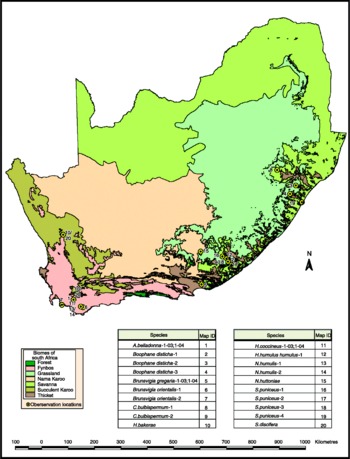
Fruits were harvested from a variety of habitats in South Africa (Fig. 1) and conveyed, in plastic bags to minimize water loss, to the laboratory in Durban, within 48 h of collection.
Provenances of amaryllid seeds used in the present investigation (refer to Table 2). Mapping by S3 Technologies, Pietermaritzburg, South Africa.

Water content determination
Ten whole seeds of each species were weighed individually to determine seed fresh mass (SFM). Axis shedding water contents (SWC) were determined gravimetrically by weighing individual axes using a microgram balance before and after oven-drying for 48 h at 80°C. Water contents were expressed on a dry mass basis (dmb; g H2O per g dry matter; g g− 1).
Axis dehydration and viability assessment
Axes were excised and accumulated on filter paper moistened with a 1:1 aqueous solution of 1 μM CaCl2·2H2O and 1 mM MgCl2·6H2O (CaMg solution) (Mycock, Reference Mycock1999) within a closed Petri dish, before flash-drying (see Berjak et al., Reference Berjak, Farrant, Mycock and Pammenter1990; Pammenter et al., Reference Pammenter, Berjak, Wesley-Smith, Vander Willigen, Black and Pritchard2002) for various times. At each drying interval, water content of ten embryonic axes was determined gravimetrically, while 20 axes were rehydrated immediately after dehydration by direct immersion in sterile CaMg solution. After rehydration, axes were surface sterilized in 1% (v/v) sodium hypochlorite (NaOCl) for 5 min, washed with sterile CaMg solution (three times) and plated (five axes per Petri dish) on full-strength Murashige and Skoog medium (Murashige and Skoog, Reference Murashige and Skoog1962) containing 3% (w/v) sucrose. Cultures were maintained in a growth room with an 18 h photoperiod, at c. 23°C. Twenty axes were not dehydrated, but plated as described above immediately after excision. Germination was scored as positive upon normal (i.e. callus-free) root plus shoot production.
Assessment and comparison of desiccation sensitivity
Desiccation sensitivity was assessed in embryonic axes excised from seeds prior to protrusion of the cotyledonary body (‘pre’) and, where seed numbers permitted, post-protrusion (‘post’) as well. In some species, the cotyledonary body protruded within days in storage, restricting desiccation-sensitivity determination to the post-protrusion phase only. Slowly drying whole seeds by burial in silica gel was abandoned, since seeds of all 16 species investigated here germinated after 1–3 d in silica gel, and thereafter lost viability.
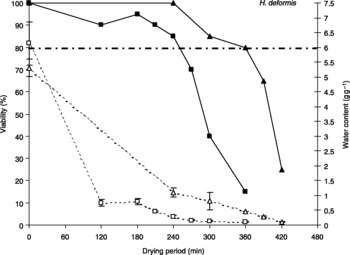
Curves of water content and viability versus drying time (illustrated for H. deformis in Fig. 2) were used to interpolate the water content (WC) and drying time (DT) values corresponding to 80% viability (referred to as WC/DT V = 80 from here on) for individual amaryllid species. The WC values corresponding to V = 80 (WC V = 80) were used to compare desiccation sensitivity between developmental stages, i.e. pre- and post-protrusion of the cotyledonary body, and among years, provenances, species and genera. The potential effects of drying time on desiccation sensitivity were investigated using the drying time corresponding to WC V = 80 (DT V = 80).
Changes in viability (V, solid lines) and axis water content (WC, broken lines) with drying time of excised Haemanthus deformis embryonic axes. Pre (■/□), excised prior to protrusion; Post (▲/△), excised after protrusion of the cotyledon. (–·–), Viability = 80%. For viability (%), n = 20. Water content values represent means ± SD (n = 10).

The use of 80% viability (V = 80) as a standard for assessing desiccation sensitivity was based on the fact that the decline in axis water content during dehydration was initially very rapid, and by the time viability had dropped to 50%, axis water content had almost come to equilibrium with drying conditions. Thus, there were often very marked changes in viability with very small changes in axis water content. Consequently, it was difficult to identify an unambiguous axis water content corresponding to V = 50, but the extent to which this problem arose at V = 80 was not as great. There were insufficient data points for an analysis using probit transformation.
Data analysis
Correlations between WC V = 80 and axis shedding water content (SWC), seed fresh mass (SFM), DT V = 80 and seed storage longevity were tested independently using Pearson's correlation test (SPSS for Windows, version 11.0; SPSS Inc., Chicago, Illinois, USA). To test for a correlation between SWC or SFM and WC V = 80, data for all species, across all years and provenances, were pooled for analysis, and where WC V = 80 values for pre- and post-protrusion were available for any one species, the lowest value was selected. When testing for a correlation between axis water content at V = 80 and drying time at V = 80, data for all species, across all years and provenances were pooled for analysis, irrespective of seed developmental stage. Seed storage longevity was assessed as part of another study (Sershen et al., Reference Pammenter and Berjak2008) on amaryllid seeds in our laboratory, and measured in terms of the time taken for viability of whole seeds to decline to < 50% (V < 50) when stored under hydrated conditions at 6°C. To test for a correlation between seed storage longevity and WC V = 80, only WC V = 80 pre-protrusion values were used, and where more than one value was available, an average was taken.
V = 80 pre- and post-cotyledonary protrusion values for any particular species were compared only when determined using seeds from the same population and harvest. Desiccation sensitivity (in terms of WC V = 80) of seeds from different provenances were compared within species, only when the different populations were sampled within the same year. Seeds of a single species from different provenances are labelled 1–5, while seeds collected from the same population in different years are labelled either ‘03’ (for the year 2003) or ‘04’ (for the year 2004). Where possible, the GPS (global positioning system) co-ordinates (WGS 84: degrees, minutes, seconds) of the populations sampled were used to extract environmental characteristics of the amaryllid parent plants using a GIS (global information system) based software package called SurGeo, that allows one to extract mean monthly rainfall, temperature, altitude, geology, lithology, biome and vegetation type data for areas (the locations of which need to be specified using GPS co-ordinates) within the boundaries of South Africa (developed by our laboratory in conjunction with S3 Technologies: Postnet Suite 226, Private Bag X9118, Pietermaritzburg, 3200, South Africa).
Results
Assessment of desiccation sensitivity in excised embryonic axes
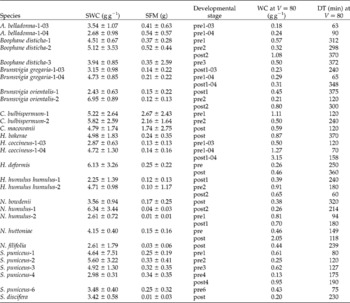
The embryonic axes of all 16 species investigated here were shed with high axis water contents, ranging from 2.25 ± 1.39 to 6.95 ± 0.89 g g− 1 (Table 1). Except for post-protrusion H. coccineus-1-04 and post-protrusion N. huttoniae axes, the excised embryonic axes of all the amaryllids investigated here tolerated dehydration to below 1.30 g g− 1 before viability declined to below 80%, both pre- and post-protrusion of the cotyledonary body (Table 1). The axes of 10 out of 16 species could be dehydrated to below 0.40 g g− 1 with ≤ 20% viability loss for at least one provenance (Table 1). However, except for B. gregaria, N. filifolia and S. puniceus-4, axis dehydration to below 0.15 g g− 1 was always accompanied by a severe loss in viability (70–85%), and the axes of all 16 species lost viability after dehydration below 0.10 g g− 1 (data not shown). There were intra- and inter-species differences (even within the same genus) in desiccation sensitivity (Table 1).
Water content (WC) and drying time (DT) values corresponding to 80% viability for amaryllid species interpolated from water content and viability versus drying time curves

SWC, Axis shedding water content (means ± SD; n = 20); SFM, seed fresh mass (means ± SD; n = 10); pre, axes excised prior to protrusion of the cotyledonary body; post, axes excised after protrusion of the cotyledonary body; 1–5, different provenances; 03 and 04, different years.
There was no correlation across species between WC V = 80 and drying time (DT V = 80) (r 2 = 0.11; P = 0.52). However, drying rates under similar conditions vary among species, and this relationship should be sought within, rather than across, species. In this regard, sample numbers were very low, but for each species for which there were three or more data points, correlation analyses between WC V = 80 and DT V = 80 revealed no significant relationships (r 2 < 0.5 and P>0.5, for all species analysed).
Developmental status, drying time and desiccation sensitivity
Of the nine species where desiccation sensitivity was determined prior to, and after, protrusion of the cotyledonary body, the axes of six species (B. disticha, B. orientalis, H. coccineus, H. deformis, N. huttoniae and S. puniceus) were more sensitive post-protrusion. The axes of two species (B. gregaria and N. humulus) were equally sensitive, and those of only H. humulus humulus were less sensitive post-protrusion (Table 1).
Of the six species where axes were more sensitive to desiccation post-protrusion, those of five exhibited higher DT V = 80 values (dried more slowly) post-protrusion, and one displayed a higher DT V = 80 pre-protrusion (Table 1). The species with axes that were more sensitive pre-protrusion had a lower DT V = 80 value (i.e. dried faster) in this earlier developmental state (Table 1). Of the two species wtih axes that were equally sensitive, pre- and post-protrusion, one had a higher DT V = 80 post-protrusion, while the other exhibited a lower DT V = 80 at this stage (Table 1).
Seed and axis characteristics and desiccation sensitivity
Within any single harvest, all species exhibited significant seed-to-seed variation in axis shedding water content (SWC) (Table 1). There were also large differences in SWC among species within the same genus, and maximum differences (highest absolute mean – lowest absolute mean) corresponded to 3.88 g g− 1 for the genus Haemanthus; 3.73 g g− 1 for Nerine; 1.03 g g− 1 for Crinum and 3.80 g g− 1 for Brunsvigia (Table 1).
For B. gregaria, A. belladonna and H. coccineus, SWC differed within individual populations inter-annually; this difference being 1.85 g g− 1 for H. coccineus; 0.86 g g− 1 for A. belladonna and 1.58 g g− 1 for B. gregaria (Table 1). Additionally, axis SWC for individual species differed with provenance, with maximum inter-provenance differences (highest absolute mean – lowest absolute mean) of 4.52 g g− 1 for B. orientalis; 1.52 g g− 1 for N. humulus; 2.46 g g− 1 for H. humulus humulus; 1.18 g g− 1 for B. disticha and 0.60 g g− 1 for C. bulbispermum (Table 1). There was no significant correlation between desiccation sensitivity and axis SWC (r 2 = 0.16; P = 0.43); neither were there trends between DT V = 80 and SWC.
Seed fresh mass (SFM) varied widely across species, and even within the same genus, ranging from as low as 0.01 ± 0.01 g for N. humulus-2 to a high of 2.67 ± 2.43 g for C. bulbispermum-1 (Table 1). Of the 16 species investigated here, 14 exhibited seed fresh masses (SFMs) < 0.50 g, while only two species (both in the genus Crinum) produced seeds with SFMs >1.0 g (Table 1). S. discifera, N. filifolia and N. humulus were the only species with a SFM < 0.1 g (Table 1).
Maximum inter-species differences in SFM (highest absolute mean – lowest absolute mean) within any particular genus were not great, and ranged from 0.93 g for Crinum through 0.15 g for Haemanthus and Nerine, to 0.07 g in Brunsvigia (Table 1). Except for N. humulus, SFM appeared to be relatively similar over consecutive years (Table 1), and was essentially comparable within individual species across different provenances. There was no correlation between the degree of desiccation sensitivity and SFM (r 2 = 0.05; P = 0.52).
Provenance and desiccation sensitivity
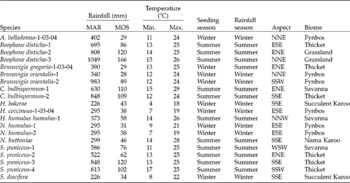
The parent plants of the seeds of 6 out of 20 amaryllid populations (e.g. B. orientalis-1; H. humulus humulus-1; B. gregaria-1; A. belladonna-1 and S. puniceus-1 and -2) occurred in areas where the mean annual rainfall (MAR) was between 300 and 600 mm, while the habitats of the parent plants of eight of these populations (e.g. C. bulbispermum-1 and -2; B. disticha-1, -2 and -3; S. puniceus-3 and -4 and B. orientalis-2) were characterized by MARs of between 600 and 1049 mm (Table 2). The parent plants of S. discifera, H. bakerae, N. humulus-1 and -2, H. coccineus-1 and N. huttoniae, however, all occurred in areas where the MAR was < 300 mm (Table 2).
Environmental characteristics for parent plants of a selection of the amaryllid species investigated in this study. GPS co-ordinates (degrees, minutes, seconds) of the populations sampled were used to extract environmental characteristics using SurGeo software. Temperature data pertain to the month of seeding

MAR, mean annual rainfall; MOS, rainfall in the month of seeding.
Parent plants of all populations seeded in either summer (12 out of 20) or winter (8 out of 20) and, except for B. gregaria-1, the seeding season always coincided with the rainfall season (Table 2). Average rainfall in the month of seeding (labelled MOS in Table 2) ranged between a low of 28 and a high of 166 mm, but was below 50 mm in 9 out of 20 cases, and, except for H. bakerae, did not actually coincide with the wettest month during the rainfall season.
Biome type differed for plants of individual species and genera (Fig. 1; Table 2). Parent plants were found to occur in savanna (C. bulbispermum-1; S. puniceus-1 and H. humulus humulus-1), grassland (B. disticha-2 and -3), fynbos (H. coccineus-1; N. humulus-1 and -2; B. orientalis-1 and -2 and A. belladonna-1), thicket (B. gregaria-1; C. bulbispermum-2; B. disticha-1 and S. puniceus-2, -3 and -4), succulent Karoo (H. bakerae and S. discifera) and even the relatively arid Nama Karoo (N. huttoniae) biomes (Fig. 1; Table 2).
In 15 out of 20 populations, minimum temperatures during the month of seeding ranged between 11 and 17°C, while maximum temperatures ranged between 24 and 29°C (Table 2). However, H. bakerae, S. discifera, N. humulus-1 and -2, and H. coccineus-1 parent plants occurred in areas with slightly lower minimum (4–9°C) and maximum (18–22°C) temperatures (Table 2).
There was no correlation between desiccation sensitivity and MAR, MOS rainfall or temperature, even when winter and summer seeding species were analysed separately (r 2 < 0.2; P>0.1). Differences in desiccation sensitivity, including inter-provenance differences within S. puniceus, B. orientalis, H. humulus humulus, B. disticha, C. bulbispermum and N. humulus, could also not be related to any of the other environmental characteristics extracted here (e.g. seeding season, rainfall season, landform, aspect and biome). Additionally, altitude, landform, soil and geology did not appear to be a determinant of parent plant location or seed characteristics/responses (data not shown).
Storage life span of whole seeds and desiccation sensitivity
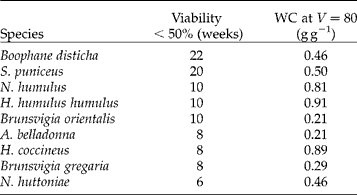
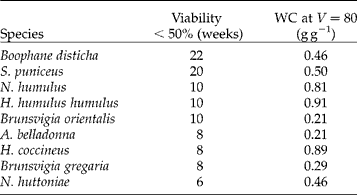
Seed storage longevity data were determined (Sershen et al., Reference Pammenter and Berjak2008) for only nine of the amaryllid species investigated here, and there was no significant correlation (r 2 = 0.26; P = 0.42) between this parameter and desiccation sensitivity (Table 3).
Storage times at which viability had declined to <50% in whole amaryllid seeds and water content (WC) values corresponding to 80% viability for excised embryonic axes. Viability <50% is the time taken for seed viability to decrease to <50% (n=10) when whole seeds were stored under hydrated conditions at 6°C. WC at V=80 values represent average water content for pre-axes, interpolated from water content and viability versus drying time curves at 80% viability
Discussion
Assessment of desiccation sensitivity in excised embryonic axes
Although the embryonic axes of all the amaryllids investigated here were desiccation sensitive, they could be dried to water contents (between 0.10 and 0.40 g g− 1) that may be sufficiently low to allow survival of cooling to cryogenic temperatures (Sershen et al., Reference Pammenter, Berjak and Wesley-Smith2007), with potentially minimal loss in viability. However, the partially dehydrated recalcitrant embryonic axes did not survive for longer than a few hours under ambient conditions, if not rehydrated (data not shown).
Although some families, such as the Dipterocarpaceae, have a high proportion of species producing recalcitrant seeds (Tompsett and Kemp, Reference Tompsett and Kemp1996), generally, there appears to be little pattern among families with regards to the occurrence of recalcitrant seed behaviour. The occurrence of seed recalcitrance does appear to be far more common among amaryllid species than has been reported for other families. Prior to this publication, one amaryllid species, Scadoxus membranaceous (Farrant et al., Reference Farrant, Pammenter and Berjak1989), and one member of the closely related Ruscaceae family (Suzuki et al., Reference Suzuki, Daws and Pritchard2007) have been shown to produce recalcitrant seeds, but the present study suggests that this trait may well be widespread in the order Asparagales.
Developmental status, drying time and desiccation sensitivity
Drying kinetics of the amaryllid axes differed among species, provenances and harvests, and was probably influenced by factors such as the developmental status of the tissue, axis surface area:volume ratio and the chemical nature of the axis outer coverings. The lack of a significant correlation between WC V = 80 and drying time across the entire data set suggests that the variation in estimated desiccation sensitivity was not simply a matter of different drying rates.
There were clear intra- and inter-species differences (even within the same genus) in desiccation sensitivity and, as in other studies on recalcitrant seeds (e.g. Berjak et al., Reference Berjak, Pammenter and Vertucci1992; Fu et al., Reference Fu, Jin, Peng and Xia1994), this parameter changed with developmental status. The predominantly greater tolerance to desiccation earlier in development (prior to protrusion), displayed by the amaryllids investigated here, is in keeping with most recalcitrant seeds that are generally the least desiccation sensitive just before, at, or shortly after natural shedding, when their metabolic rate is at its lowest (Berjak et al., Reference Berjak, Pammenter and Vertucci1992; Fu et al., Reference Fu, Jin, Peng and Xia1994). Metabolic rate generally increases with storage in recalcitrant seeds (Berjak et al., Reference Berjak, Pammenter and Vertucci1992; Finch-Savage et al., Reference Finch-Savage, Blake and Clay1996; Tompsett and Pritchard, Reference Tompsett and Pritchard1998). When the partial dehydration protocol for any of the species investigated here is to be established in preparation for subsequent cryopreservation (as long as they are germinable), the developmental stage at which the axes are most amenable to dehydration must be considered.
Desiccation sensitivity could not be correlated with seed storage longevity, supporting Pammenter and Berjak's (Reference Pammenter and Berjak1999) suggestion that even though it is difficult to quantify, desiccation sensitivity and storage longevity do not appear to be related. While both phenomena appear to be a consequence of metabolic activity, desiccation sensitivity can be ameliorated by protection mechanisms that may not affect storage life span.
Axis shedding water content (SWC), seed fresh mass (SFM) and desiccation sensitivity
The large differences in SWC among species within the same genus observed here appear to be typical of most recalcitrant-seeded species (Connor et al., Reference Connor, Bonner and Vozzo1996; Berjak and Pammenter, Reference Berjak, Pammenter, Ellis, Black, Murdoch and Hong1997; Daws et al., Reference Daws, Gaméné, Glidewell and Pritchard2004a, Reference Daws, Cleland, Chmielarz, Gorian, Leprince, Mullins, Thanos, Vandvik and Pritchard2006b). Inter-annual variation in SWC, as observed in this study, has also been reported for other recalcitrant-seeded species, such as Camellia sinensis (Berjak et al., Reference Berjak, Mycock, Wesley-Smith, Dumet, Watt, Normah, Narimah and Clyde1996), Quercus robur (Finch-Savage, Reference Finch-Savage, Ouédraogo, Poulsen and Stubsgaard1996) and Trichilia dregeana (Berjak and Pammenter, Reference Berjak, Pammenter, Benech-Arnold and Sánchez2004). Shedding water content, at least for the amaryllids investigated here, may not be a reliable indicator of the degree of desiccation sensitivity. Shedding water content has been suggested to be a reliable predictor of tolerance to desiccation in the Meliaceae (Hong and Ellis, Reference Hong and Ellis1998), but this is not always the case (Dussert et al., Reference Dussert, Chabrillange, Engelmann, Anthony, Louarn and Hamon2000; Pritchard et al., Reference Pritchard, Daws, Fletcher, Gaméné, Msanga and Omondi2004; Daws et al., Reference Daws, Garwood and Pritchard2006a), and some desiccation-tolerant seeds are borne in fleshy fruits and shed at high water contents, e.g. papaya (Wood et al., Reference Wood, Pritchard and Amritphale2000) and tomato (Hong et al., Reference Hong, Linington and Ellis1996).
Seed mass varied widely across species but was surprisingly small for recalcitrant seeds. Dickie and Pritchard (Reference Dickie, Pritchard, Black and Pritchard2002) reported that the mean seed mass of 205 desiccation-sensitive species was 3958 mg versus 329 mg for 839 desiccation-tolerant species. Hong and Ellis (Reference Hong and Ellis1998), in investigating patterns of response to seed desiccation in 40 species from the Meliaceae, found that the seeds of desiccation-sensitive species were generally in excess of 1.0 g in weight. Pritchard et al. (Reference Pritchard, Daws, Fletcher, Gaméné, Msanga and Omondi2004) reported seed size in excess of 500 mg for several tropical African dryland tree species, while the seeds produced by recalcitrant-seeded species in a semi-deciduous forest in Panamá averaged 3383 mg (Daws et al., Reference Daws, Garwood and Pritchard2005). Unlike those studies, seed mass was expressed here on a fresh mass and not dry mass basis, yet SFM across the 16 amaryllid species investigated was < 0.50 g in 14 species and >1.0 g in just two.
Provenance and desiccation sensitivity
Despite the fact that the seeds of all the amaryllid species investigated here were recalcitrant, the parent plants came from a range of biomes (Fig. 1). Habitat has been proposed as a correlate of desiccation sensitivity in recalcitrant seeds of tropical and temperate provenances (Dussert et al., Reference Dussert, Chabrillange, Engelmann, Anthony, Louarn and Hamon2000; Pritchard et al., Reference Pritchard, Daws, Fletcher, Gaméné, Msanga and Omondi2004; Daws et al., Reference Daws, Cleland, Chmielarz, Gorian, Leprince, Mullins, Thanos, Vandvik and Pritchard2006b). However, in the amaryllid seeds investigated here, mean annual rainfall, rainfall and temperature in the month of shedding, or any other of the environmental characteristics investigated here, appeared not to be a determinant of the degree of desiccation sensitivity. However, except for B. gregaria-1, seed shedding did coincide with the rainy season, which supports the suggestion of Pritchard et al. (Reference Pritchard, Daws, Fletcher, Gaméné, Msanga and Omondi2004) and Daws et al. (Reference Daws, Garwood and Pritchard2005) that species with desiccation-sensitive seeds may minimize the risk of seed desiccation within dry environments by timing the seed shed to the period of maximum rainfall. As an alternative strategy, the desiccation-sensitive seeds of nine species of Coffea (of tropical provenance) are shed at the beginning of the dry season, with the level of desiccation tolerance related to the duration of the dry period after seed shed (Dussert et al., Reference Dussert, Chabrillange, Engelmann, Anthony, Louarn and Hamon2000). Seeds of the tropical Virola sebeifera are also dispersed at the beginning of the dry season, but it appears that the seeds may be dispersed into microsites of high water availability (Daws et al., Reference Daws, Garwood and Pritchard2005). It would be interesting to determine whether seeds of B. gregaria-1, which are shed at the beginning of the dry season, have a similar strategy. In the temperate recalcitrant-seeded species Aesculus hippocastanum and Acer pseudoplatanus, seed characteristics and responses have been strongly correlated with latitudinal provenance and heat sum (and hence available energy) during development (Daws et al., Reference Daws, Lydall, Chmielarz, Leprince, Matthews, Thanos and Pritchard2004b, Reference Daws, Cleland, Chmielarz, Gorian, Leprince, Mullins, Thanos, Vandvik and Pritchard2006b).
Fourteen out of 20 amaryllid populations sampled here also occurred on east-facing slopes that tend to be cooler, particularly in the afternoons, than west-facing slopes, suggesting that adequate energy is available for the completion of seed development in the more tropical species.
Desiccation-sensitive seeds are comparatively infrequent in dryland environments (Tweddle et al., Reference Tweddle, Dickie, Baskin and Baskin2003; Pritchard et al., Reference Pritchard, Daws, Fletcher, Gaméné, Msanga and Omondi2004), and Murdoch and Ellis (Reference Murdoch, Ellis and Fenner2000) suggested that, in the tropics, desiccation-sensitive species do not occur in arid or savanna habitats. However, like other studies (e.g. Gaméné et al., Reference Gaméné, Pritchard and Harris1999; Tweddle et al., Reference Tweddle, Dickie, Baskin and Baskin2003; Pritchard et al., Reference Pritchard, Daws, Fletcher, Gaméné, Msanga and Omondi2004), the present investigation on amaryllids has shown that some species that occur naturally in drylands, like the fynbos, Karoo and Nama Karoo, produce recalcitrant seeds. Recalcitrant seeds from dryland species must have other adaptations to desiccation tolerance that permit survival, such as large seeds or impermeable coverings that reduce rates of water loss, an ability to germinate rapidly, and shedding at the appropriate time or into a suitable micro-habitat (Pritchard et al., Reference Pritchard, Daws, Fletcher, Gaméné, Msanga and Omondi2004; Daws et al., Reference Daws, Garwood and Pritchard2005). Except for one population of B. gregaria, all the amaryllid species investigated here shed seeds during the rainy season, and all germinate rapidly. However, the fresh seed mass of 14 out of 16 species was uncharacteristically low ( < 0.50 g) for recalcitrant seeds.
It is possible that the amaryllid species inhabiting areas with < 300 mm MAR are actually relict populations from a period when the region was more mesic. The species do propagate vegetatively, and it is not known how successful regeneration by seed is in these populations. The results described here certainly call for an appraisal of the costs and benefits of seed recalcitrance for species such as the amaryllids.
Conclusion
Species within the same family can exhibit commonalities in terms of drying rates and developmental stage at which their embryonic axes are least desiccation sensitive, but the degree of this sensitivity (in terms of indicators like WC V = 80) appears to be species characteristic. Seed characteristics (e.g. SWC and SFM) and parent plant environmental characteristics were not useful in predicting the degree of desiccation sensitivity across a number of species within the same family, suggesting that the basis of the inter- and intra-species variability in desiccation sensitivity observed here is far more complex.
Acknowledgements
This research was supported by the National Research Foundation (South Africa) and the Darwin Initiative (Defra), UK, in conjunction with the Millennium Seed Bank Project, Royal Botanic Gardens, Kew, UK.