I. INTRODUCTION
In recent years, ‘sandwich’ laminate sheets have attracted a great deal of attention due to their excellent properties Reference Bachmaier and Pippan1–Reference Viswanathan, Laha, Balani, Agarwal and Seal4 which make them ideally suited for diverse functions such as ballistic protection, heat exchange, blast mitigation, and vibration damping. Reference Vecchio5,Reference Grujicie, Snipes and Ramaswami6 Roll-bonding techniques have been successfully applied to fabricate multi-component materials with tailored properties by reinforcement or grading, such as Al/Ti, Reference Yu, Lu, Tieu, Li, Godbole and Kong7–Reference Luo and Acoff12 Cu/Ti, Reference Hosseini and Danesh Manesh13,Reference Yu, Tieu, Lu, Liu, Godbole, Li, Kong and Qin14 Al/Mg, Reference Kim, Lee, Jung, Lee, Kim, Kim, Lee, Chang, Yuh and Lee15,Reference Kim, Lee, Kwon, Lee, Chang and Lee16 Al/Cu, Reference Reihanian and Naseri17,Reference Lee, Lee, Sung, Lee, Kim, Chang, Lee and Kwon18 and Al/steel. Reference Akramifard, Mirzadeh and Parsa19,Reference Beygi and Kazeminezhad20
For laminate sheets, rolling temperature generally affects the interface bonding quality and mechanical properties of the product. Reference Jamaati and Toroghinejad21–Reference Yan, Zhao, Wang, Wang, Wang and Yang23 It has been observed that to obtain good interface bonding quality, it is better to raise the deformation temperature. Reference Yu, Liu, Li and Godbole24 For ferrous metals, rolling at a high temperature (>1273 K) is required to achieve good interface bonding. Reference Yan, Zhao, Wang, Wang, Wang and Yang23,Reference Yu, Liu, Li and Godbole24 Interfaces of nonferrous metals can be bonded well under moderately high-temperature rolling (∼473 K). Reference Quadir, Al-Buhamad, Bassman and Ferry25,Reference Göken and Höppel26 The bonding strength of metals at room-temperature roll bonding (∼293 K) is related to the reduction ratio. Reference Li, Nagai and Yin27 It is seen that when the reduction ratio is larger than 70%, the metals can bond well. Reference Yu, Lu, Tieu and Kong28,Reference Jamaati, Toroghinejad, Amirkhanlou and Edris29 Compared to symmetric roll bonding, the bonding quality between layers can also be improved by asymmetric roll bonding. Reference Yu, Tieu, Lu and Godbole30,Reference Li, Zu, Ding, Mu and Wang31 However, there are no reports on the fabrication of laminate sheets by cryogenic roll bonding technique.
Cryorolling (<173 K), in which the samples are generally cooled by liquid nitrogen, has been considered as a severe plastic deformation technique that can improve both the strength and the ductility of ultrafine-grained materials. Reference Göken and Höppel26–Reference Yu, Lu, Tieu, Li, Godbole, Kong and Zhao32 Recently, Yu et al. Reference Yu, Wang, Lu, Tieu, Li, Godbole, Liu, Kong and Zhao37 found that the cryorolling can suppress the dynamic softening of UFG Al sheets subjected to accumulative roll bonding (ARB) at room temperature. Sheets subjected to (ARB + cryorolling) show improved mechanical properties compared to ARB-processed sheets. However, to the best of the authors’ knowledge, there have been no reports on the mechanism of interface bonding of laminate sheets subjected to cryogenic roll bonding.
There are some reports that Al/Ti/Al laminate sheets fabricated by room-temperature roll bonding. Reference Yu, Lu, Tieu, Li, Godbole and Kong7–Reference Luo and Acoff12 Yu et al. Reference Yu, Lu, Tieu, Li, Godbole and Kong7 fabricated a trimodal laminate sheet combined with coarse-grained Al, ultrafine-grained Ti, and TiAl3 particles combined using room-temperature roll bonding and annealing. Luo and Acoff Reference Luo and Acoff12 fabricated multilayered Ti/Al laminate sheets by room-temperature roll bonding and annealing. They found that the TiAl3 layer forms at a low temperature in the Al-rich layer after just a few hours at a temperature of 923 K. In this study, the Al/Ti/Al laminate sheets were fabricated by using cryogenic roll bonding for first time. The qualities of laminate sheets by cryogenic roll bonding such as edge cracks, mechanical properties, and interface bonding were compared with these by room-temperature roll bonding. Finally, we discussed the improvement in edge quality and mechanical properties as well as the mechanism of interface bonding of Al/Ti/Al laminate sheets during cryogenic roll bonding.
II. EXPERIMENTAL
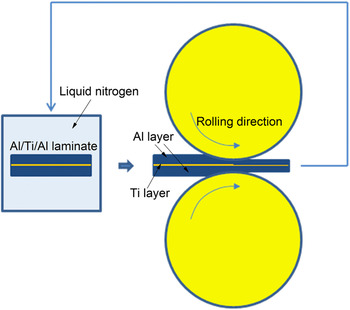
In this study, Al/Ti/Al laminate sheets were produced by cryogenic roll bonding and room-temperature roll bonding separately. Commercial pure aluminum alloy 1060 (AA1060) and commercial pure titanium sheets were used. Before rolling, the thicknesses of the AA1060 sheets and Ti sheets were 1.0 mm and 25 μm, respectively, and the surfaces of sheets were cleaned by alcohol. The laminate sheets were stacked as Al/Ti/Al laminate sheets. Before rolling, the front end of laminate was welded by spot welding to prevent slipping. Then they were processed by both room-temperature roll bonding and cryogenic roll bonding separately. A 4-high multifunction rolling mill with 50 mm diameter work rolls was used. The thicknesses of laminate sheets were 0.9, 0.5, 0.25, and 0.125 mm after the first, second, third, and fourth rolling pass, respectively. Figure 1 shows an illustration of the laminate subjected to the cryogenic roll bonding technique. During cryogenic roll bonding, the laminate sheets were cooled by liquid nitrogen for at least 8 min before the rolling commenced.
Illustration of Al/Ti/Al laminate sheets during cryogenic roll bonding.

After rolling, the edge quality of laminate sheets was analyzed. The tensile tests were carried out for both kinds of laminate sheets with tensile test samples with 25 mm gauge length and 6 mm gauge width with a strain rate of 1.0 × 10⁻³ s−1 on an INSTRON machine (Instron, Norwood, Massachusetts) to determine the engineering strain versus engineering stress characteristics. To study the interface bonding behavior, we used the focused ion beam technique to prepare transmission electron microscope (TEM) film samples on an FEI xT Nova Nanolab 200 Dual-beam workstation (FEI, Hillsboro, Oregon). The details of the interface between the Ti and Al layers were analyzed by a Philips CM200 field emission gun TEM operating at 200 kV (Philips, Eindhoven, the Netherlands).
III. RESULTS
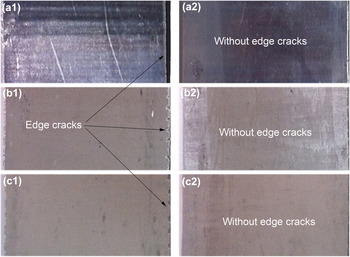
Figures 2(a1)–2(c1) show the Al/Ti/Al laminate sheets produced by room-temperature roll bonding. In the figure, there are some edge cracks which occur in the lamiante sheets after rolling. However, there are no edge cracks in the laminate sheets produced by cryogenic roll bonding, as shown in Figs. 2(a2)–2(c2). It is obvious that the cryogenic roll bonding can enhance the quality of laminate edge compared to that by room-temperature roll bonding.
(a1, b1, and c1) for room-temperature roll bonded sheets, (a2, b2, and c2) for cryogenic roll bonded sheets. (a1), (a2) the second pass; (b1), (b2) the third pass; (c1), (c2) the fourth pass.

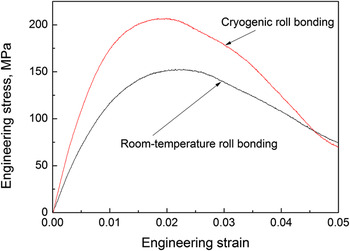
Figure 3 shows the engineering strain versus engineering stress curves of Al/Ti/Al laminate sheets after the fourth pass subjected to room-temperature roll bonding and cryogenic roll bonding, respectively. For the laminate sheets subject to room-temperature rolling, the ultimate tensile stress is 150 MPa, which reaches 205 MPa for the laminate sheet subject to cryogenic roll bonding. The ultimate tensile stress increases up to 36.7% by cryogenic roll bonding compared to that by room-temperature roll bonding.
Engineering strain versus stress of Al/Ti/Al laminate sheets by cryogenic roll bonding and room-temperature roll bonding.

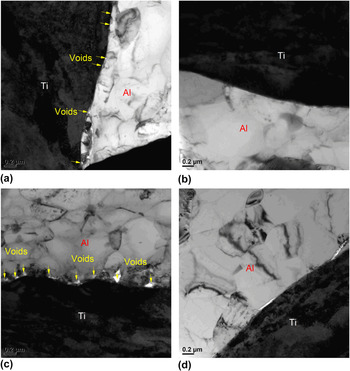
Figures 4(a) and 4(b) show the TEM images of the interface between the Ti and Al layers after the second and the fourth pass of room-temperature roll bonding. After the second pass, some small voids are visible at the interfaces, although over most of the interface, the Al and Ti layers bond well. After the fourth pass, the interface between the Ti and Al layer shows good bonding. Figures 4(c) and 4(d) show TEM images of the interface between the Ti and Al layers after the second and the fourth passes of cryogenic roll bonding. Compared to the samples produced by room-temperature roll bonding, the residual voids are much larger at the interface, and the grain sizes of Ti and Al layers near the interface are much finer after the second pass of cryogenic roll bonding. This is relevant to the finding that the bonding between interfaces becomes difficult with reduced temperature. Reference Li, Nagai and Yin27 With a higher number of rolling passes, the grains near the interface grow during rolling, and then the interface between Al and Ti layers also shows a good bond, as seen in Fig. 4(d).
TEM images of the microstructure near interface between Al and Ti layers. (a) and (b) for room-temperature roll bonding after the second and fourth passes, (c) and (d) for cryogenic roll bonding after the second and fourth passes.

IV. DISCUSSION
A. Edge cracks
Edge cracks are the main defects in laminate products. Reference Tsuji, Saito, Lee and Minamino38–Reference Yu, Su, Lu, Tieu, Li, Li, Godbole and Kong41 These edge cracks must be trimmed before subsequent processing. For some metals such as Mg and steel, the ductility decreases at lower temperature. However, the ductility of Al alloys at cryogenic temperature is higher than that at room temperature. Glazer et al. Reference Glazer, Verzasconi, Sawtell and Morris42 studied the tensile curves of AA2090 at 298, 77, and 4 K and found that the ductility of this Al alloy increases at reduced temperature. Park et al. Reference Park, Choi, Kim and Lee43 also studied the stress–strain curves of AA5052, AA5086, AA6061, and AA6082 sheets at temperatures ranging from 293 to 110 K. They found that the fracture strain increases with reduction in deformation temperature.
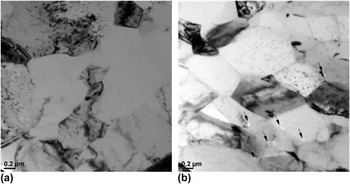
Figures 5(a) and 5(b) show the TEM images of the microstructure of Al layers after the fourth pass subjected to cryogenic roll bonding and room-temperature roll bonding, respectively. In Fig. 5(a), there are no voids in the sample. However, there are a number of nanoscale voids in the sample subjected to room-temperature roll bonding, as shown in Fig. 5(b). This means that the Al layer will have higher ductility during cryogenic roll bonding compared to that during room-temperature roll bonding. Thus it suggests that a much lower deformation temperature can potentially be applied to reduce the edge-cracking tendency of Al laminate sheets, as shown in Fig. 2.
TEM image of microstructure of Al layers after the fourth pass of (a) cryogenic roll bonding and (b) room-temperature roll bonding. Arrows show nanoscale voids.

B. Mechanical properties
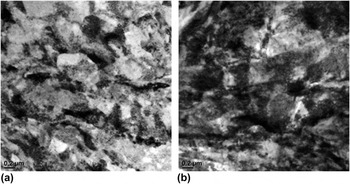
Cryorolling has been reported that it can improve the mechanical properties of single metal sheets. Reference Yu, Lu, Tieu, Liu, Sun, Yu and Kong44,Reference Yu, Tieu, Lu, Liu, Godbole and Kong45 Zhang et al. Reference Zhang, Li, Kang, Chen, Wang, Zou, Li and Wang46 found that the ultimate tensile stress of cryorolling + aging processed Cu–1Cr–0.1Zr alloy strips increases to 690.1 MPa compared to that of 478.2 MPa by room-temperature rolling, which increases 44.3%. For the alloy fabricated using cryorolling + aging processing, the twin/matrix lamellar thickness reduces 55% compared to that fabricated using room-temperature rolling. Reference Zhang, Li, Kang, Chen, Wang, Zou, Li and Wang46 Naga Krishna et al. Reference Naga Krishna, Ashfaq, Susila, Sivaprasad and Venkateswarlu47 found that the mechanical properties of cryorolled Al–Mg–Si alloy improved greatly compared to that of room-temperature rolled samples. The enhanced properties of cryorolled sheets are due to the high dislocation density, increased microstrain, and a reduced crystallite size compared to room-temperature rolled sheets. Reference Naga Krishna, Ashfaq, Susila, Sivaprasad and Venkateswarlu47 In this study, we also believe that the finer grain size by cryogenic roll bonding improves the mechanical properties of laminate sheets compared to that by room-temperature roll bonding. In Fig. 5, we can find that the grain size of the aluminum layer subjected to cryogenic roll bonding is much finer than that subjected to room-temperature roll bonding. Figures 6(a) and 6(b) show the TEM images of microstructure of the Ti layer after the fourth pass subjected to cryogenic roll bonding and room-temperature roll bonding, respectively. In Fig. 6, it is obvious that the grain size of the Ti layer subject to cryogenic roll bonding is much finer than that subjected to room-temperature roll bonding. According to Hall–Petch formula, the yield strength of metal materials improves with finer grain size. Thus the strength of Al/Ti/Al laminate sheets by cryogenic roll bonding is much higher than that by room-temperature roll bonding, as shown in Fig. 3.
TEM image of microstructure of Ti layers after the fourth pass of (a) cryogenic roll bonding and (b) room-temperature roll bonding.

C. Interface bonding
Interface bonding is one of the important factors that determine the final quality of the product. There are many factors that determine the bonding quality such as rolling temperature and reduction ratio. Reference Li, Nagai and Yin27 In this study, the rolling reduction ratio per pass by cryogenic roll bonding is the same as that by room-temperature roll bonding. Thus, the rolling temperature results in the difference of interface bonding behavior as shown in Fig. 4.
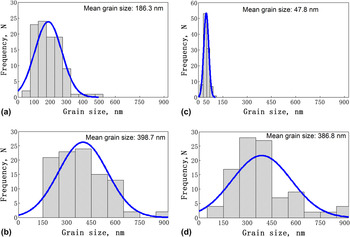
Figure 7 shows the distribution of grain size of the Al layer and Ti layer after different processing. As shown in Fig. 7(a), the grain size of Al near the Al/Ti interface is 186 nm for samples rolled at room temperature, while the grain size is refined to 48 nm for the cryorolled samples as shown in Fig. 7(b). In addition, the grains in the Al layer near the interface grow significantly under the action of stress. As shown in Figs. 7(c) and 7(d), the grain size increases to 398 and 386 nm after the fourth pass of room-temperature roll bonding and cryogenic roll bonding, respectively. It is obvious that the grain growth affects the bonding between the Al and Ti interfaces.
Grain size distribution in Al layer. (a) and (b) for room-temperature roll bonding after the second and fourth pass; (c) and (d) for cryogenic roll bonding after the second and fourth pass.

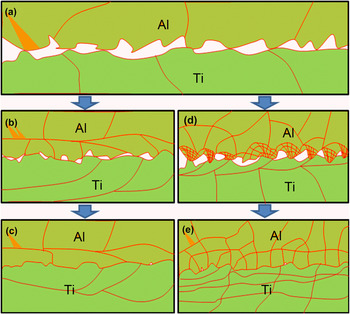
To date, some mechanisms for room-temperature roll bonding have been presented, such as the film theory, energy barrier theory, and diffusion bonding theory, which are reviewed in Refs. Reference Jamaati and Toroghinejad21 and Reference Li, Nagai and Yin27. Here, we propose a new bonding mechanism based on grain refinement and grain growth of the soft layer. Figure 8 shows the mechanisms of interface bonding between the Al and Ti layer subjected to room-temperature roll bonding and cryogenic roll bonding. Before rolling, the Al and Ti surfaces are separate, and the grains are coarse, as shown in Fig. 8(a). During rolling, firstly, the surfaces come into contact and the grains near the interface are refined greatly. There is a great deal of sliding between the Al and Ti sheets before the bond begins to form. The difference in mechanical properties results in a severe shear deformation in the surface layers, and then the grains are refined greatly. Due to the suppression of the dynamic recovery behavior at cryogenic temperature, compared with room-temperature roll bonding, cryorolling is more conducive to grain refinement, Reference Yu, Lu, Tieu, Li, Godbole, Kong and Zhao32–Reference Yu, Wang, Lu, Tieu, Li, Godbole, Liu, Kong and Zhao37 as illustrated in Figs. 8(b) and 8(d). In addition, during sliding, the underlying regions of the fresh metal are exposed, firming additional bonds. Rolling with greater reduction in thickness, results in the growth of ultrafine grains/nano grains (UFG/NG). This facilitates the interfacial bond, as shown in Figs. 8(c) and 8(e). With further reduction in thickness, most regions of the interfaces bond and there is no sliding between the layers. The UFG/NGs near the interface grow under shear stress. There are many reports that UFG/NG grow during room-temperature deformation. Reference Yu, Lu, Tieu, Li, Godbole, Kong and Zhao32,Reference Legros, Gianola and Hemker48,Reference Liao, Kilmametov, Valiev, Gao, Li and Mukherjee49 Liao et al. Reference Liao, Kilmametov, Valiev, Gao, Li and Mukherjee49 reported that the grains grow from 30 ± 7.5 to 129 ± 43 nm in electro-deposited NG Ni during high-pressure torsion. For ARB-processed Al sheets, abnormal grain growth during asymmetric rolling can result in elimination of the interface between layers. Reference Yu, Tieu, Hadi, Lu, Godbole and Kong50 Here, it is seen that the grains grow in the soft layer under severe shear stress both at room temperature and cryogenic temperature, which also contributes to the interfacial bonding.
Illustration of the interface bonding during rolling. (a) Before rolling; (b) and (c) for the interface with higher reduction by room-temperature roll bonding; (d) and (e) for the interface with higher reduction by cryogenic roll bonding.

V. CONCLUSIONS
-
(1) Al/Ti/Al laminate sheets were fabricated by cryogenic roll bonding for the first time. Edge cracks appear in the laminate sheets produced by room-temperature roll bonding, while they do not appear in the laminate sheets produced by cryogenic roll bonding. This is due to the improvement in ductility of Al alloys at reduced temperature.
-
(2) The ultimate tensile stress of Al/Ti/Al laminate sheets subject to cryogenic roll bonding is 36.7% higher compared to that subject to room-temperature roll bonding.
-
(3) At reduced temperature, the interface bonding between Al/Ti becomes difficult. When the reduction ratio is lower, there are many residual voids near the interface between Al and Ti in the laminate produced by cryogenic roll bonding. As the rolling reduction is increasing, the interface between the Al and Ti bonds well both for room-temperature roll bonding and cryogenic roll bonding. For the cryogenic roll bonded laminate, initially the surfaces come into contact, and grains near the interface of the soft layer are refined to 48 nm. In the second stage, they grow dynamically and the interface bonds well.
ACKNOWLEDGMENTS
This research was supported by National Natural Science Foundation of China (Grant No. 51674303) and the Open Research Fund of the Key Laboratory of High Performance Complex Manufacturing, Central South University, China.