Introduction
This special issue sheds light on social and political processes taking place in the borderlands of Myanmar and confirms that ‘processes of bordering, debordering and rebordering are central to any understanding of the social’.Footnote 1 At the same time, it cannot be forgotten that borders are not only zones of flows of people and goods (which in Myanmar includes drugs and arms), but are also crucial for processes of political ordering within the nation-state. Inside the country, borders take the form of administrative boundaries, which lie at the core of the organization of electoral processes. No other formal exercise shapes political life more than elections. This includes processes of inclusion and exclusion that take place on the basis of particular electoral boundaries, as this article will show.
The 2015 general elections were considered a hallmark of Myanmar's transition from an authoritarian regime towards a new form of government. However, the elections did not take place in all parts of the country, and significant portions of the population were excluded from the vote, including voters in areas of contested sovereignty, those who experienced displacement by conflict, and people whose right to citizenship was disputed. Many aspects of exclusion from the electoral process, however, pertain to administrative and legal boundaries in the margins of the state.
Against the background of the regulatory framework for elections in Myanmar and its electoral system, this article looks first into a particular understudied element of the electoral process—the cancellation or postponement of elections in areas affected by conflict, which is little understood by voters, election administrators, and outside observers alike. Second, the article examines the conditions necessary for internally displaced persons (IDPs) to participate in elections in the conflict-affected borderlands of Myanmar. Third, the article recapitulates the gradual legal disenfranchisement of voters and candidates who self-identified as Rohingya, which preceded their mass exodus to Bangladesh in 2017. While in 2015 the underlying conditions for these developments were arguably of lesser priority for the election administration, which facilitated the first credible elections in Myanmar in decades, they have not altered significantly since then and are likely to affect the electoral participation of disadvantaged communities—and with that the legitimacy of elections in the margins of the state—again in the future. The continuation of these processes of exclusion leave unexplored the potential for national elections to contribute to Myanmar's peace processes and risk protracting conflict rather than contributing to its transformation.
Elections, peacebuilding, and boundaries
Many scholars have examined the nexus between elections and peace processes.Footnote 2 In Myanmar, these two have hardly been studied together, and, rather, have been dealt as separate issues by the national authorities in charge as well as by the international community supporting these processes.Footnote 3 There is an underlying assumption that the pursuit of democratic elections is a tool of conflict management, while electoral processes, which are inherently competitive, can be rather divisive.Footnote 4 To explore the peacebuilding potential of elections in full, elections must not only satisfy the divergent needs for electoral representation of the majority population and the country's elite, but must also take into account the needs of minorities and under-represented groups. In that regard, many scholars have studied the adverse or beneficial effects of ‘institutional engineering’, in particular of electoral systems,Footnote 5 and various models have been proposed for Myanmar,Footnote 6 with some going as far as to proscribe and propose a particular electoral system as the best for the country.Footnote 7 It is commonly understood that forms of proportional representation are better suited to countries that are home to a multitude of ethnic groups, particularly in post-conflict situations, than majoritarian systems such as the first-past-the-post variant in Myanmar.Footnote 8 However, electoral systems cannot be imposed from outside, but must be the outcome of processes of national dialogue to ensure the buy-in of key political actors as well as the recognition of minorities. It is therefore surprising that the electoral system—including the administrative boundaries that it rests upon—has not yet been discussed in detail in the context of Myanmar's structured national dialogue process.Footnote 9
The electoral system in Myanmar and its administration is inherently based on particular boundaries, namely the townships, which are not changed very often and which are embedded in larger administrative units such as districts, self-administered areas, and states or regions. Townships are the most important unit of administrative organization, and Myanmar inherited this type of administration from British colonial rule. This coincides with Myanmar's electoral system, for which townships are commonly used as core units to demarcate electoral constituencies.Footnote 10 The same boundaries that form the basis for the transferral of votes to elected seats, and thus lie at the core of the electoral administration, are the boundaries within which the cancellation of elections for security reasons takes place. Shedding light on this practice reveals the opacity of the processes that lead to disenfranchisement.
As the right to vote is tied to residence at a particular location within given boundaries, the exclusion from the vote of IDPs who had to leave their homes in conflict-affected parts of the country can be explained in the same vein:
Elections where significant elements of the electorate are disenfranchised or intimidated will inevitably generate strong feelings of exclusion from both the peacebuilding process and the resulting governance structures. As a result, the political and societal fissures that were originally exposed and exacerbated by conflict are almost certain to deepen, risking the renewal of hostilities. (…) IDPs right to electoral participation exists irrespective of the cause of their displacement, whether conflict, natural disaster, or any other factor.Footnote 11
This finding can hold equally true for voters disenfranchised by partial election cancellations, as evidence from Myanmar demonstrates and will be shown in detail.
By extending the argument from administrative to legal boundaries, the framework for elections and recent practices reveal further dimensions of exclusion, which can be subsumed as processes of ‘legal denial’. During the 2015 general elections this predominantly concerned the Rohingya population whose right to citizenship has been disputed in Myanmar.Footnote 12 Combined, all of these factors illustrate how various marginalized ethnic minorities, often situated in the borderlands of the country, become subject to further marginalization during the electoral process, coined by an electoral system based on particular administrative boundaries. In the past, legislators and election administrators found ways to alter laws and procedures to steer inclusion or exclusion in the electoral process for political ends. However, the choice not to include IDPs and other vulnerable groups in the electoral process reveals not only a lack of awareness and sensitivity for voters who suffer the consequences of conflict, but a lack of political will to recognize the rights of all potential voters equally, notwithstanding their ethnicity and location. Increasing awareness in that regard, and facilitating procedures to enhance electoral inclusion on the basis of existing administrative boundaries, could contribute to peacebuilding and reverse this trend.
Background to the 2015 elections
The 2015 general elections in Myanmar were remarkable in many ways. They were the first credible elections conducted in the country in decades, leading to the peaceful handover of power from a military-led regime to a civilian government. Millions of voters turned out to vote for Aung San Suu Kyi and her National League for Democracy (NLD). Despite ongoing peace negotiations and conflict in parts of the country, as well as rising anti-Muslim sentiment ahead of the polls, the elections took place largely without physical violence. The operational conduct of the elections was applauded by the international community, despite substantive criticism for the legal framework under which they took place.Footnote 13 Nevertheless, the elections were not as inclusive as they could have been. Those excluded from the polls for technical and operational reasons extended to people without civic documentation and internal migrants as well as millions of refugees and guest workers residing in Thailand, in other neighbouring countries, and overseas. This article sheds light on three, partly interrelated, phenomena of exclusion which are commonly overlooked: approximately half a million potential voters did not take part in the elections due to election cancellations in conflict-affected areas; tens of thousands of IDPs lost their right to vote; and another half a million, predominantly Rohingya in Rakhine state, were deliberately disenfranchised. Although the non-participation of these voters did not change the election results at large, their exclusion constitutes a human rights violation;Footnote 14 if not addressed, similar exclusion(s) will take place again in the future.
Shape of the legislature
Any elaboration of inclusion or exclusion in the elections requires a brief recapitulation of the framework for elections.Footnote 15 The 2008 constitution establishes a bicameral parliament—the Pyidaungsu Hluttaw—at the national (or Union) level, consisting of the Amyotha Hluttaw (Nationalities Assembly or Upper House) and the Pyithu Hluttaw (People's Assembly or Lower House). The constitution gives substantial power to the armed forces in the governance of the country, with 25 per cent of seats in all legislative assemblies reserved for them. Since amending the constitution requires approval by 75 per cent of the members of the Pyidaungsu Hluttaw, it effectively gives the armed forces the power to veto constitutional amendments.
The 2008 constitution further establishes a multi-tier administrative structure. At the sub-national level, the territory comprises 14 administrative units (seven states and seven regions), each with a region/state assembly. The constitution takes a step towards decentralization by creating these directly elected assemblies, but at the sub-national level executive power remains in the hands of the central government. This is illustrated in particular by the nomination of the region/state chief minister by the president, and, until 2018, the reliance of the regions and states on officers of the General Administration Department (GAD), a department of the Ministry of Home Affairs, for their administration.Footnote 16 Quite remarkably, almost all state institutions are formed directly or indirectly out of the same general elections that every five years return the national and region/state level legislative assemblies. As a consequence, the entire governance structure of the country is at stake in a single electoral event.
Electoral system
The electoral system largely derives from the provisions of the 2008 constitution, according to which the two houses of the national parliament and the region/state assemblies are elected for five-year terms.Footnote 17 The Amyotha Hluttaw consists of 224 members, 168 directly elected (12 per region/state) and 56 reserved for the military. Where there are self-administered zones/divisions of ethnic minorities in the region or the state,Footnote 18 one of the 12 seats is designated to represent each of them. The Pyithu Hluttaw consists of 440 members, 330 of whom are directly elected, with 110 seats reserved for military personnel nominated by the commander-in-chief.
Under section 109(a) of the constitution, the 330 directly elected Pyithu Hluttaw members are elected ‘on the basis of township as well as population or combining with an appropriate township which is contiguous to the newly formed township if it is more than 330 townships’. This wording is somewhat unclear, but its reference to ‘townships’ prescribes a majority system whereby candidates run in single-member constituencies that follow township boundaries. This has been implemented through a first-past-the-post electoral system, under which the candidate elected is the one obtaining the highest number of votes. There are no references in the law regarding the number of voters per constituency or any reference to a need to conduct a review of the relative sizes of constituencies with a view to ensuring equal suffrage.Footnote 19 Great variations between the population of the country's townships result in highly unequal constituencies (malapportionment) for lower house seats, in contradiction with the principle of equal suffrage.Footnote 20
The 168 directly elected members of the upper house are elected ‘in an equal number of 12 representatives from each region and state’. The constitution is silent regarding how this should be implemented. The choice of a majority system is made in the Amyotha Hluttaw election law, which provides for 12 single-member constituencies designated per state and region by the Union Election Commission (UEC). While the delineation of Pyithu Hluttaw constituencies usually follows township boundaries, for Amyotha Hluttaw constituencies, townships can be split (along the line of existing wards or village tracts) or merged to form 12 such constituencies, depending on the number of townships in a given state or region. Similar to the Pyithu Hluttaw constituencies, Amyotha Hluttaw constituencies are also unequal in voting powers, but this appears to be the result of institutional design and is more acceptable than in the case of the Pyithu Hluttaw.
To delineate the electoral constituencies that are the basis of the state/region legislatures, townships are usually split into two parts on the basis of existing ward and village tract administrative boundaries.
Election administration
The administration of elections in Myanmar lies in the hands of the UEC. The 2008 constitution vests the Commission with responsibility for general elections and the registration and supervision of political parties. It enjoys broad, and largely unchecked, powers in the implementation of both of these competencies. For the conduct of the elections, the UEC, inter alia, adopts rules and regulations; appoints election sub-commissions at the state/region, district, and township levels; designs electoral constituencies; prepares voter lists; certifies results; and decides on election-related complaints and appeals. It can also postpone or cancel elections in areas affected by natural disaster or threats to security (see below).
At the sub-national level, election commissions are essentially composed of civil servants belonging to the GAD, the Ministry of Immigration and Population (MoIP), and the Advocate General Office. Consequently, the election administration is, to a large extent, functionally dependent on the structures of the executive branch across the country for running the elections.
As set forth in the constitution and regulated in the electoral laws and by-laws, many crucial aspects of the electoral process are left for the UEC to decide, with an unusual margin of discretion. These include the time frame for candidate and voter registration, access for observers, ballot printing, and the transparency of results consolidation, among others. These matters are not mere technical points, but can adversely affect the integrity of the process as well as the rights of voters and candidates.
Voter registration
The law provides that citizens, associate citizens, and naturalized citizens who have reached the age of 18 and have registered may vote. However, there are deficiencies in the legal protection and administrative implementation for full participation and inclusion in the electoral process, undermining universal suffrage.Footnote 21
Myanmar uses a passive voter registration system based on existing population data. From December 2014 to the end of July 2015, UEC township sub-commissions entered eligible voter data from the GAD and MoIP household lists and logbooks into an electronic database. This was the first time the voter list had been computerized in Myanmar. It was widely acknowledged that these initial lists were not entirely accurate, which created challenges for the registration process. Inaccuracies in voter lists may lead to voters being disenfranchised, political controversies, accusations of manipulation, and blockage or discreditation of the electoral process.
The UEC established mechanisms to allow for inclusions, corrections, and deletions in the voter lists, and provisions were made to facilitate voter transfers between constituencies. In order to update and correct the list, several rounds of public verification exercises were conducted between March and October 2015, with lists displayed for voters to check their names and request corrections or additions. During the display periods, the UEC organized a nationwide voter education campaign, with pamphlets and posters in some 16 different ethnic languages distributed throughout Myanmar. Despite remaining uncertainties concerning the voter register, the final voter lists were more accurate than expected, based on the relatively small number of voters turned away on election day, marking a notable improvement over the lists used in past elections.Footnote 22
Cancellation or postponement of electionsFootnote 23
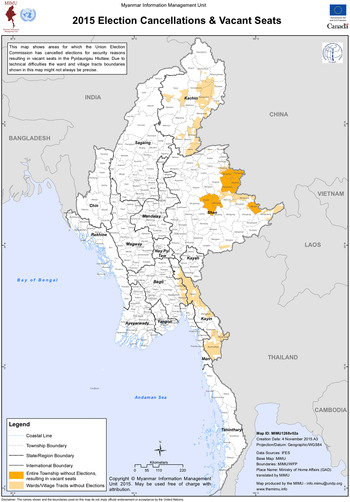
The 2015 elections did not take place in all parts of the country. Out of 330 townships, elections were cancelled or postponed entirely in seven and partially in 29 townships in 416 additional wards or village tracts in conflict-affected areas. This was announced by the UEC in two rounds, on 12 and 27 October 2015.Footnote 24 The first of these announcements came three days before the signing ceremony of the Nationwide Ceasefire Agreement (NCA) on 15 October 2015. The geographical areas concerned lay largely in conflict and ceasefire zones and in areas of contested sovereignty.Footnote 25 Although it became evident that both the breaking and signing of bilateral ceasefires since the general elections in 2010 had had an impact on the overall electoral space, and that some election cancellations were a consequence of deteriorating security conditions, it appears that there is one main reason for not holding elections in some areas of the country: the absence of the state in particular administrative boundaries that form the basis of electoral constituencies. This is further elaborated on below.
The cancellations have different consequences, depending on the size of the administrative units concerned. Vacant seats occur only where elections are cancelled for an entire constituency. Shan state is the only state or region where cancellations also led to vacant seats in the legislature, resulting in seven vacant seats in the Pyithu Hluttaw and 14 in the Shan state Hluttaw, but not in the Amyotha Hluttaw or any other state or region Hluttaw. Contra to this, the cancellation of elections in specific wards and village tracts smaller than a constituency does not translate into vacant seats in the legislature, but leads to the disenfranchisement of voters as the election goes ahead regardless of their involvement, as well as the coming to power of a candidate in a seat without their constituents having universal suffrage (see Figure 1).
Map of 2015 election cancellations. Source: http://themimu.info/sites/themimu.info/files/documents/22-Sector_Map_Gov_IFES_2015_Election_Cancellations_Vacant_Seats_MIMU1268v02_04Nov2015_A3.pdf

The number of wards and village tracts outside the constituencies where elections were entirely cancelled does not exceed 2.5 per cent of all wards and village tracts in the country. All in all, it is estimated that 500,000 voters (less than 1.5 per cent of all registered voters) were disenfranchised by this measure.Footnote 26 The exact figure is difficult to ascertain as the 2014 census was also not carried out in full in many of these areas (see below).
Legal framework
The legal framework for elections foresees cancellations or postponements for security reasons or if natural disasters do not allow for the holding of elections.Footnote 27 The authority to cancel and postpone elections lies with the UEC, and the postponement of elections is based on UEC law section 10(f) and sections 50 and 51 of the electoral laws: Footnote 28
Under Chapter XI, Powers of the Commission, the electoral laws for the election of Amyotha, Pyithu and State/Region Hluttaw Representatives, the Union Election Commission may: Section 50: (a) Postpone the election in the constituencies in which elections could not be held due to any natural disaster till such a time as such disaster is over; (b) Postpone the election in a constituency where preparation of the voting roll or balloting is not possible due to lack of security situation; (c) Decide to hold election in some areas within a constituency where the situation permits, decide not to hold election in some areas therein where the situation does not permit or decide to transfer the polling booths to secure places. However, if 51 percent of all voters have cast the votes, it may be designated as completed election. Should it be the opinion of the Commission that free and fair elections cannot be held, it may postpone the election in the entire constituency. Section 51: The Commission may delegate to sub-commissions the power to postpone elections and to transfer the venue of polling booths to secure places as appropriate.Footnote 29
As with other elements of the legal framework, the language pertaining to the cancellation of elections is ambiguous and open to interpretation. The security situation referred to in section 50 is not further clarified in the legal framework. Section 50(b) contains two elements regarding the lack of security—the ‘preparation of the voter role’ and ‘balloting’. These two elements relate to different phases of the electoral timeline and can have different implications, but they are usually treated as the same by the UEC according to the law.
Preparing the voter list takes place several months ahead of election day. As described above, in 2015, the establishment of the Myanmar voter list was, at first, a largely passive exercise that took place inside UEC offices, based on existing data from the MoIP and the GAD. In a second step, voters could make corrections, amendments, or objections during the preliminary and national voter list displays. However, this was only possible where a voter list had been developed. The lack of a voter list cancels elections ex ante, and it is possible to predict these cancellations where they concern entire constituencies.
The reference to ‘balloting’ in section 50(b) refers to the holding of elections on election day, but could be interpreted to include preparations that take place immediately before elections such as the setting up of polling stations, the deployment of electoral personnel, and the transport of electoral material. In both phases, the definition of a security situation is ambiguous and lies in the authority of the UEC. Non-state actors might not agree with the definition applied by the UEC to cancel elections. A prominent previous example of this was the UEC's cancellation of by-elections for three constituencies in Kachin state in 2012, even though the Kachin Independence Organisation (KIO) had declared these areas secure enough to hold elections and had said they would not obstruct the process. In retrospect, many armed group representatives also argue that elections in 2010 were cancelled in their areas for political reasons. In other words, the decision to hold elections or not might be interpreted as dependent on political will.
Section 50(c) also contains several elements that are worth analysing: ‘decide to hold election in some areas within a constituency where the situation permits, decide not to hold election in some areas therein where the situation does not permit’ is interpreted as referring to both the preparation of the voter list and security conditions on election day, as discussed above. Therefore, partial cancellations within a constituency can relate to both, but with different consequences relating to the provision that ‘if 51 percent of all voters have cast the votes, it may be designated as completed election’. It can be interpreted in the following way: if segments of the population are not included in the voter list, they cannot be counted among the 51 per cent of all voters required to establish a valid election result. However, if a voter list exists and elections do not take place, this can have an impact on the legitimacy of the election results based on the law. Excluding eligible voters in conflict areas and requiring only 51 per cent of registered voters to establish a valid result in a given constituency also increases already existing malapportionment, with the potential of creating easy-to-win seats.
The language of section 50(c) and section 51—‘decide to transfer the polling booths to secure places’ and ‘to transfer the venue of polling booths to secure places as appropriate’—is again ambiguous. The possibility of transferring polling stations is not spelled out further in the legal framework for elections, nor does the UEC have any relevant procedures in place. However, this practice is likely to have occurred in the 2010 elections, as indicated by both UEC representatives and representatives of ethnic armed actors. The inclusion of voters who would move ‘from unsecure to secure areas’, but are not included in the voter list in the first place is questionable and seems operationally unrealistic. Furthermore, this provision raises questions concerning the practicalities of moving polling stations and informing registered voters and other stakeholders at short notice.
The legal framework does also not provide a time frame for when the declaration of cancellations or postponements should occur prior to the elections.
Disputed decisions
The law establishes that the UEC has the authority to postpone elections in constituencies where a natural disaster precludes elections being held, or where the security situation makes updating the voter list and polling impossible. The loss of life and property as well as the massive temporary displacement suffered by many as a consequence of floods and landslides during the 2015 rainy season did not affect the electoral process in terms of election postponement, although this was considered at some point by the UEC chairman.Footnote 30 Instead, all cancellations that occurred in 2015 were declared for security reasons, but UEC public communications did little to clarify the reasons for cancellations beyond a simple reference to security. The ambiguity of this language and the lack of public communications and transparent decision-making on the part of the UEC, combined with past experiences of cancelled elections, led to speculation about the potentially arbitrary or politically motivated nature of these decisions. Allegations like this occurred in ceasefire areas where, from the perspective of the voters affected by the cancellations (for example, in Kyainseikgyi), there were no obvious security threats preventing elections being held. One area where the partial cancellation was disputed locally was Kyainseikgyi township in Kayin state, an area of mixed control under the influence of several ethnic armed organizations which have bilateral ceasefires, but have not all signed the NCA. Here, civil society groups doubted the integrity of the cancellations process and alleged them to be politically motivated.Footnote 31 They experienced a peaceful environment and did not understand why the elections were cancelled for security reasons. This reveals both a situation where bilateral ceasefires proved to have an impact on state outreach and the participation of local communities in the affairs of the state, but also the great fragility of this situation.
While the authority to cancel and postpone elections lies with the UEC, the decision-making process is informed by lower levels of the election administration. Administrative personnel with electoral duties at the ward and village tract levels inform the township and district sub-commissions of the UEC whether conditions are conducive for holding elections. Where applicable, the state and region sub-commissions then provide any recommendation to postpone elections to their superiors in Naypyitaw. While the administration internal to this process involves several hierarchical levels, the decision-making process for cancellations is little understood outside the involved apparatus. Although preparations for the NCA and for the elections remained largely unrelated, in some instances negotiations took place about whether to hold elections under conditions of volatile ceasefires, for example, in Kayin state's Kyainseikgyi township or in northern Shan state's Mongmit township. However, if these negotiations occurred at all, they usually took place at the local level between village administrators and members of armed groups, with higher level sub-commissions and the UEC potentially entirely unaware of the considerations involved.
Variations in time and scale
The geographical scope of the partial cancellations in 2015 revealed that electoral space—here understood as the areas for which a voter list exists and where elections are effectively held—has grown since 2010 in the southeast, following the advancement of bilateral ceasefires under President Thein Sein's administration; has stayed approximately the same across Shan state (with the exception of the second round of cancellations—see below); and has apparently shrunk in Kachin state.Footnote 32
Relative to 2010, as a result of new or renewed bilateral ceasefires, Myanmar's southeast witnessed significant improvements to its 2015 electoral space. Most of the townships of Kayah state were affected by cancellations in 2010, but none was in 2015. In Mon state, nine village tracts had no elections in 2010; five years later, this was reduced to only one. In Kayin state, the electoral space has increased by approximately a third over this period.Footnote 33 In Shan state, the areas affected by election cancellations would have been consistent with 2010 had a second round of cancellations not occurred on 27 October. In Kachin state, the number of partial cancellations increased after 2010, but this did not lead directly to increased disenfranchisement. Here, the ceasefire with the KIO broke in 2011 and has led to intensified local conflict since then. The cancellations, however, do not necessarily imply a higher number of voters being absent from the polls, as many of the areas where elections were cancelled were those where villages had been destroyed or voters had left during the years of conflict. In that regard, the comparison between 2010 and 2015 cancellations in Kachin state illustrates the impact of conflict on the demographic landscape, while administrative boundaries used to delineate constituencies remained unchanged.Footnote 34
The cancellations must be understood in their respective geographical context, but, with few exceptions, they have one element in common—the absence of the state. In most situations where elections were cancelled, a voter list had never been established. As outlined above, compiling a voter list requires data provided by local offices, namely the Department of Immigration at the township level and GAD offices at the ward and village tract levels. In addition, the GAD fulfils electoral functions at the lower levels of the election administration, thus if it has no presence at the local level, there is no voter list and no office to organize elections in that area. Therefore, partial election cancellations seem to relate to the absence of the state's administrative capacities in most cases, for instance, in areas under the administrative and military control of non-state ethnic armed organizations. This is particularly evident in the areas under the control of the KIO in Kachin state; in those parts of Hpa'pun township under the control of KNU Brigade 5 in Kayin state; and in territories controlled by the United Wa State Army (UWSA) in the Wa Self-Administered Division and by the National Democratic Alliance Army (NDAA) in Mongla township in Shan state, formerly termed Special Regions 2 and 4 respectively. Only a few of the cancellations declared on 12 October 2015 concerned areas that were assessed as having the potential for actual violence on election day or that saw physical disruptions to earlier phases of the electoral cycle, such as the voter list displays. These exceptional cases included the conflict-ridden township of Mansi in southern Kachin state and Kawkareik township in Kayin state, where tensions between the state security apparatus and several ethnic armed groups caused insecurity along the Asia Highway during the voter list update period earlier in 2015.
The first UEC announcement of cancellations on 12 October 2015 for locations where there was a voter list was long prepared. The second UEC announcement, however, took place less than two weeks before election day and seemed to occur more as an ad hoc response to real security concerns.Footnote 35 On 27 October, elections were entirely cancelled by the UEC for the two townships of Monshu and Kyethi as well as for eight additional village tracts in neighbouring Tangyan township in Shan state.Footnote 36 The announcement of these cancellations by the UEC followed the recommendation of the responsible UEC district sub-commission to partially cancel elections in their area of responsibility after fighting broke out between the Tatmadaw and the Shan State Army North (SSA-N). The sub-commission later argued that they could not ‘send the ballots’ and had genuine concerns about the safety of electoral personnel and materials if elections went ahead in this conflict situation.Footnote 37 Political spectators disputed the legitimacy of this decision. Unlike many areas where elections had been cancelled before, a voter list update process had taken place in Monshu and Kyethi, with approximately 105,000 voters affected. Representatives of ethnic armed organizations understood the escalation of fighting in this area to be a consequence of the SSA-N's non-participation in the NCA signing ceremony on 15 October 2015, and the Tatmadaw's attacks as a punishment for their absence.Footnote 38 Political parties took opposing positions on whether elections should be held in these townships or not, based on their estimates for their prospects at the ballot. The Shan National League for Democracy (SNLD) accused the UEC of being politically motivated, as they saw the affected constituencies as potentially safe wins for their party. Meanwhile, the Shan National Development Party (SNDP), the SNLD's direct political opponent, encouraged and welcomed the UEC's decision to safeguard campaigners’ safety and voters’ rights, which, from their perspective, were under real threat.Footnote 39
All cancellations in 2015 were security related, but that alone does not explain why and how the cancellations took place. The first set of cancellations was largely foreseen; most of the areas where elections were cancelled at this stage did not have active security problems, but rather shared a common denominator: the absence of the state and state authorities. A voter list, which is based on pre-existing logbooks and household lists, was not established in these locations and the absence of governmental administrators also disallowed the holding of elections.
While the UEC might have had good reason to cancel elections, due to past electoral experiences and a general lack of trust in the UEC prior to the 2015 elections, few stakeholders had confidence in their motivations when elections were cancelled shortly before the polls. The UEC's decisions were also interpreted as synonymous with decisions of the Tatmadaw and other state institutions, when in reality they might not have been related. The collective positive experience of the 2015 elections and the generally well-trusted results may lead to increased confidence in this particular institution in the future, although allegations of political bias might remain for as long as the UEC is appointed by the president and not perceived as an inclusive body. Enhanced and detailed explanations as well as a more participatory and transparent approach to decision-making when it comes to postponing elections, should this be necessary, might help to further increase trust and overall electoral participation in the future. Furthermore, greater clarity in the election laws and subordinate rules and regulations would help to avoid the potential for politically motivated, contrasting interpretations of partial election cancellations. Currently, these suspensions remain a more complex phenomenon related to different reasoning, motivations, and opinions than a simple reference to security conditions might suggest.
Electoral versus census space
In the discussion about election preparations in 2015, confusion remained among various stakeholders over whether the 2014 Population and Household Census would be related to, or produce, the voter lists. A census collects socio-economic and demographic data but not the names and addresses of individuals. Data were collected by interviewing heads of households, not individual members. For these reasons voter registration and the census need to be understood as two fundamentally separate exercises.Footnote 40 However, when looked at from the perspective of the state's access to its peripheries, it is interesting to compare the 2015 partial election cancellations with the 2014 census. There are apparent overlaps in areas where neither the census nor the elections were conducted, where census enumerators experienced hindrances, or where data for the census were provided by the local administration of armed actors, rather than by governmental enumerators.
The census reports share some information about accessibility and collaboration between the state and ethnic armed actors in ceasefire areas. Apart from Rakhine state, where the government's refusal to allow the name ‘Rohingya’ as self-ascription led to a situation where the census was not fully conducted in ten out of 17 townships (see below), the population count also faced accessibility constrictions in Kachin and Kayin states. In Kachin state, the KIO did not allow enumerators to count people in villages under their control, leaving 25 village tracts (97 villages) out of the census. In parts of Hpa'pun township of Kayin state, KNU Brigade 5 denied access to enumerators and provided their own data about the total number of households and population by gender. As a consequence, the populations in these areas were estimated and included in the overall census results, but not in the analysis and presentation of detailed information.Footnote 41
The Kachin and Hpapun situations during the census resemble the accessibility experiences surrounding the establishment of the voter list in these areas. However, conducting the census seems to have been possible in other locations where a voter list was not established, in particular in the Wa SAD townships under UWSA control and in Mongla, which is under NDAA control. One interpretation could be that the leaders of these armed groups might have had an interest in knowing how many people reside in their realm, for purposes of recruitment or taxation, but had no interest in their populations participating in the affairs of the state by way of voting.
Voting of IDPs
According to international principles for credible elections, IDP voting should be organized in the spirit of enfranchising all eligible voters.Footnote 42 In situations of conflict and peacebuilding, ‘translating general guarantees for the electoral participation of displaced populations into practice can be a complex task. It typically requires addressing a range of issues and obstacles—legal, administrative, practical, and sometimes political—that are specific to or exacerbated for displaced voters.’Footnote 43 The organization of IDP voting demands special considerations and measures to recognize the particular vulnerabilities of IDPs, such as their lack of freedom of movement and experience of violence and loss; their lack of civic documentation and registration requirements; the regulatory framework, with implications arising from the electoral system; special considerations for voter registration, polling, and counting, including security and protection; access to voter education and political party exposure; and the impact of IDP populations on election results and elected representation.
During the 2015 elections in Myanmar, the problems of IDPs were not well understood and the special needs of IDPs were barely recognized by the UEC at the central level, despite the fact that IDPs were mentioned under pillar nine of its 2014–2018 strategic plan on the promotion of inclusive participation. Understandably, the Commission was often overwhelmed with the immediate tasks at hand, such as voter registration, and therefore did not dedicate its time and resources to an issue that concerns a comparatively small number of voters. The UEC was also reluctant to consider special measures for IDPs as most of them were located in highly sensitive border areas—either in Rakhine state, where most IDPs were disenfranchised as voters during the pre-electoral process (see below), or in other areas ridden by conflict and, from a Naypyitaw perspective, on the margins of the state. This stood in contrast to verbal commitments made by the UEC and, in Rakhine, by the state government to enable voting for IDPs.
Depending on the source, in 2015 Myanmar had around 636,000 IDPs,Footnote 44 not counting those who fled their homes due to the floods in July and August of the same year. However, the figure is inflated as different sources define IDPs in different ways. For the purpose of elections and for the consideration of special measures for voter registration, voting, and counting, it is helpful to make a distinction between IDP voters who reside in camps and those who do not.Footnote 45 With few exceptions, this applied only to Rakhine state, Kachin state, and northern Shan state. Across the southeast, thousands of villagers had seen consecutive waves of displacement and resettlement for at least two decades, but lived in villages or with relatives.Footnote 46 The only two known IDP camps—Halockhani and Eee Tu Hta—were located in areas under ethnic armed group control. IDPs were also usually not recognized by governmental agencies if their camps were located in areas of mixed control. This was true for four IDP camps in eastern and southern Shan state that are under the mixed control of the UWSA and the RCSS.Footnote 47
IDPs in Rakhine state
Waves of violence in Rakhine state caused massive displacement in 2012 (see further details below), with the Rohingya population being most affected—but they were not the only group concerned. Since then, for most of the internally displaced, the situation has turned into a prolonged humanitarian crisis to which their disenfranchisement as voters has added yet another layer. Notwithstanding some resettlement in February and March 2015, UN agencies still counted 147,424 IDPs across 10 out of 17 townships in Rakhine state in April 2015, of which 101,500 were located in Sittwe alone, followed by 18,792 in neighbouring Pauktaw township.Footnote 48
Most of the IDPs in Rakhine state did not have freedom of movement, which, in the eyes of the security apparatus, contributed to diffusing potential tensions around the elections. Not all these IDPs were stateless Muslims. There were over 4,000 ethnic Rakhine IDPs in Sittwe and approximately 900 in other townships. In addition, the Kaman population, mostly from Kyauk Phyu township, were citizens who were eligible to vote, but had been displaced to IDP camps in Kyauk Phyu, Ramree, Myebon, and Pauktaw townships. Most of them had lost their documentation and were not included in the voter list updates. The overall figure of Kaman in Rakhine is estimated to be around 22,000, with many living in the southern Rakhine township of Thandwe. Those Kaman remaining in Kyauk Phyu and Ramree were considered to have received expedited citizenship status, but those in Pauktaw were not, as they were categorized as stateless Muslims and were thus not registered as voters. Several thousand Kaman voters who were citizens but had been displaced also lost their right to vote.
There were also some Rohingya in IDP camps and elsewhere who held citizenship documents. The overall number of Rohingya with identity cards relevant to voting was estimated at around 4,000 (but below a hundred in northern Rakhine state). In 2015, this number rose in the camp of Taung Paw in Myebon township, where 560 IDPs who had gone through the 2014 pilot citizenship verification process received identity documents that rendered them eligible to vote. This camp was also the only known exception in the country where IDP voters were included in the preparation of the preliminary voter list, which was subsequently displayed inside the camp. After the announcement of election day in June 2015, the UEC sub-commission in Sittwe still planned to verify IDP eligibility to vote on the basis of the GAD figures below. However, the sub-commission took a step back from their approach to verifying IDP voter eligibility, presumably based on the understanding that Rakhine IDP voters enjoyed freedom of movement and therefore could return to polling stations at the places where they were registered, and that Rohingya would not be entitled to vote in any case.
Despite the fact that the issue of IDP voting in Rakhine state appeared too politically charged for the UEC to risk the perception that they might undertake measures to enable the voting of ‘Muslim foreigners’, some IDPs were nevertheless eligible to vote. The possibility of voting was made known to a small number of IDPs in Sittwe (around 200), Kyauktaw (around 115, presumably all Kaman), and in Myebon (around 1,000). The number in Myebon was significantly higher as the IDP population there had gone through the pilot citizenship verification process in 2014, which had not taken place in other areas. Although election authorities seem to have followed due process concerning the inclusion of these voters in the voter list, their vote took place inside the IDP camp in a secluded manner.
IDPs in Kachin state and northern Shan state
Unlike in Rakhine state, IDPs in Kachin state and northern Shan state usually had freedom of movement unless they were camp-bound by fear. The state administration was confident that it had up-to-date IDP figures, including their registration status, as well as information on IDPs who were displaced from Kachin state into Namhkan township of northern Shan state. IDP camps were usually hosted by faith-based institutions, which largely relates to the church compounds of the Kachin Baptist Convention (KBC), but also the Roman Catholic and Anglican churches.
Prior to the 2015 elections, displacement in Kachin state and northern Shan state had largely been caused by the breaking of the KIO ceasefire in 2011 and subsequent localized warfare. New displacement usually occurred when fighting escalated. According to UN figures from May 2015, there were about 97,000 IDPs in Kachin state and northern Shan state.Footnote 49 In Kachin state, about half of the IDP population was clustered around urban centres in government-controlled areas and the other half along the international border with China in KIO-controlled areas. It was not expected that elections would take place in KIO-controlled areas. In northern Shan state, IDPs were also found in areas under the control of the Ta'ang National Liberation Army (TNLA) and local militia, but most of the IDPs lived in camps in government-controlled areas. The number of IDPs in camps beyond the reach of the state—which here equates to their disenfranchisement as voters—was close to 47,000 in both states mentioned. This leaves a population of approximately 50,000 IDPs—those who were 18 or older on election day—who could have been registered to vote.
UEC approach
In July 2015, the UEC sub-commissions in Myitkyina and Lashio were simultaneously preparing for the registration of IDP voters without having received detailed instructions from their superiors in Naypyitaw. However, they did so on the basis of December 2014 UEC guidelines for registration for ‘transferred voting’. With the exception of Myebon in Rakhine state, IDPs were not usually part of the regular voter list update, but were generally considered by the UEC as part of the ‘floating population’, similar to civil servants, students, or migrant workers. On this basis, voters who are away from their original homes for longer than 180 days prior to election day can transfer their votes to their place of residence. This implied that displacement had to be proven for at least 180 days prior to election day, and those affected had to exercise their vote for their constituency of current residence, rather than having the choice to vote for their constituency of departure. Those who were displaced for less than 180 days before election day, either through conflict or through natural disasters, fell through the cracks in the system. Even with this narrow approach to IDP voting, and despite requests from relevant state and sub-state sub-commissions in Kachin state and northern Shan state, the UEC failed to provide clearer guidance for a more inclusive solution.
In early August 2015, the UEC was ready to send out instructions to all its sub-commissions concerning the registration of IDPs as voters and the preparations for polling stations. It was thought that polling could take place inside or outside IDP camps, and polling stations would be separate or merged with others, depending on the number of voters. The UEC said that the relevant form to transfer a vote (Form 3-A) would be flexibly handled for IDPs and that the sub-commissions would liaise with the GAD and with camp management committees regarding this process. The relevant directive was not sent out, however, and the UEC stated that for IDPs, voting would be possible on the basis of Form 3-A only and in Kachin state alone.
In early September, the Myitkyina sub-commission forwarded a request from IDPs to the UEC that demanded an option to vote for their places of origin, which was denied. Despite the fact that most IDPs in Kachin state and northern Shan state were unlikely to return to their places of origin any time soon, if, indeed, these places still existed, not allowing them the choice to vote for their places of origin was likely to further disrupt IDPs’ links to their home communities. The option of transferring the vote could also have direct effects on results in a given constituency if IDP voters participated in the process in considerable numbers. In this situation, for IDPs, much of the management of voting was left to township sub-commissions, with different levels of commitment and implementation. Nevertheless, for IDPs voter registration and voting took place in Kachin state and, to a limited degree, in northern Shan state, but left out those IDPs who stayed in areas beyond state control where elections were cancelled.
‘Through the conduct of elections, national authorities and the international community have a unique opportunity to guarantee, both in law and in official practice, that displaced populations have a say in the political and economic decisions affecting their lives.’Footnote 50 This opportunity was not grasped in Myanmar. Despite demands from relevant sub-commissions for further clarification, the UEC failed to develop a consistent policy for IDP voting during the 2015 elections. The UEC shied away from this issue, as it was either contentiously related to the voting rights of the Muslim population in Rakhine state or to ethnic armed conflict in Kachin state and northern Shan state. IDPs were conceptualized as a largely floating population, and their special circumstances (in particular relating to registration) were not fully understood.
This was a lost opportunity not only for the electoral process, but also for peacebuilding. The issue also demonstrates a lack of communication between the election and the peace processes, leaving the relevant authorities responsible for one largely unaware of the tasks of the other. By giving due attention to the needs and rights of IDPs, this could have provided an opportunity to connect the two processes. During a national post-election conference, recommendations included that the UEC should consider leaving the choice of constituency (place of departure or temporary residence) to IDP voters, should consider reducing the displacement time frame of 180 days, should put in more effort and be more consistent in IDP voter registration and polling arrangements, and should provide more voter education to IDPs.
Disenfranchisement in Rakhine stateFootnote 51
Apart from disenfranchisement through cancelled elections and the absence of procedures to implement the voting rights of IDPs, particular population groups on the peripheries of the state were also excluded from the vote a priori. This concerned, in particular, Muslim voters in Rakhine state. Their electoral disenfranchisement can be described as a longer process of legal denialFootnote 52 and as a chapter in rising anti-Muslim sentiment which re-escalated in 2012 and resulted in a mass exodus to Bangladesh in 2017, related to accusations of crimes against humanity, war crimes, and genocide.Footnote 53
Despite many concerns, (electoral) violence was not a widespread problem in Rakhine state in 2015 and election day took place without disruptions, as elsewhere in the country. However, the absence of violence was related to the disenfranchisement of the majority of the Muslim population. The legal status of Rakhine state's Muslim population had long been disputed. The 1982 Citizenship Law—establishing different categories of citizenship based on ancestry—followed by its 1983 Procedures and a citizenship inspection process in 1989 had rendered many former citizens stateless. Since 1995, increasing numbers of temporary identification cards (so-called ‘white cards’) were issued, both to those who had previously held national registration cards and to those who were undocumented. In 2010, the outgoing military regime distributed more white cards to increase the turnout for the Union Solidarity and Development Party (USDP) at the ballot. All in all, 760,000 white cards were issued under the 1982 Citizenship Law.Footnote 54
Following the rape of a Rakhine Buddhist woman by Muslim men and the retaliation for this act with a revenge killing of Muslim travellers in May/June 2012, violence erupted in and around the state capital of Sittwe and led to the subsequent displacement of 145,000 people.Footnote 55 The great majority of the displaced lived in Sittwe and neighbouring townships. While many were stateless Muslims, ethnic Rakhine and Kaman—who are officially Myanmar nationals—were also included. For most of these people, a return to their place of origin was not expected any time soon. As a result of the 2012 violence and displacement, the March/April 2014 census could not be fully carried out from Sittwe northwards, thus affecting ten out of Rakhine state's 17 townships.
The census results proclaimed an estimated total population of over three million inhabitants, making Rakhine state the second-most populated ethnic state after Shan state. Of the total, nearly 2.1 million were enumerated, but an estimated 1,090,000 were not.Footnote 56 It is believed that these were largely Muslims without citizenship. The continuation of the process was also in a stalemate over which identity label was to be used: ‘Rohingya’ or ‘Bengali’. The term ‘Rohingya’ had gained increasing political currency in Rakhine state during the previous years, while the term ‘Bengali’ is seen as pejorative and implies foreign origin. The government had previously committed to allowing self-identification as Rohingya as a response to the question on ethnicity in the census questionnaire. Following pressure from Buddhist nationalist groups, this possibility was revoked just prior to the start of the count. This last-minute decision led to a variation in the enumeration practice across the townships concerned, and households where people decided to self-identify as Rohingya were not taken into account. The disputes around this led to new outbreaks of violence in Sittwe.
In mid-2014, the USDP-led government sought to verify the citizenship status of white card holders, starting with a voluntary pilot project in Myebon township. However, the process was halted when it became evident that more of the Muslim population could receive a citizenship status than had been anticipated. The ethnic Rakhine had thought the verification process would end allegedly illicit Muslim claims to citizenship. However, more applications resulted in at least ‘naturalized’, if not full, citizenship than was expected.Footnote 57
The lack of a compromise term, such as ‘Rakhine Muslim’, rendered both the 2014 census and pilot citizenship verification impossible to execute fully—or at least very difficult to implement. Citizenship verification stopped (or at least did not proceed to other townships) over this controversy. When it resumed at the beginning of 2015, few applications were received. In informal conversations, MoIP employees said this would be the Rohingya's ‘last chance to register’ and that ‘the conditions after this will be very different, especially with a new government in place’, without specifying the reasons for this perception.Footnote 58 In this situation, the franchise was linked to citizenship, constituting a departure from past practices and ‘concerted efforts arose to ensure that the Rohingya would not be able to vote’.Footnote 59
The debate about the legal status of the population concerned—and, with that, their fundamental rights to political participation and representation—entered the electoral process with an amendment to the political party registration law in September 2014, which deprived white-card holders of the right to found or be members of political parties. As a consequence, the UEC required all parties to change their membership lists. This process exceeded UEC-specific policy and approaches, as anti-Muslim sentiment was widely shared within the pre-elections legislature and across all political camps.
The next controversy arose at the beginning of 2015, with a Pyidaungsu Hluttaw draft national referendum bill, stimulating a new debate about the right of temporary identity certificate holders to vote.Footnote 60 Buddhist nationalist leader Ashin Wirathu said in a press statement, ‘I warn [parliament] not to betray the over 50 million national people by giving priority to the over one million illegal people. If you allow them to vote in the coming election, I will lead the people to fight against them all.’Footnote 61 Other press statements called for public protests in Rakhine state and Yangon. The president turned the situation around by declaring that white cards would expire altogether by 31 March 2015. The two-month period for collection started on 1 April, and the cards were handed in without much resistance. As a consequence, white-card holders were not included in the voter list updates, which started at around the same time as these decisions were made. The electoral laws (Section 6(a)) were later amended accordingly; it was estimated that half a million voters were disenfranchised by these changes in the legal framework.Footnote 62 The formerly eligible voters did not exercise open opposition to the legal changes; the right to vote came second to the right to citizenship, and many appeared resigned to the situation.
Further disenfranchisement occurred with the nomination deadline for candidates in August 2015. The scrutiny of candidate nominations (conducted by UEC sub-commissions) by the end of August led to the disqualification of several candidates based on their ancestry. The candidate nomination process revealed intensified scrutiny to verify candidate eligibility based on the 2010 electoral laws, in particular in relation to candidates’ citizenship. As of 2 September 2015, 88 candidates had been rejected by the UEC, with the majority coming from Rakhine state (28) and Yangon Region (24). Following massive criticism of these decisions, including from the international community, several candidate rejections were later revoked. What is more, against the background of increased anti-Muslim sentiment and in a break from the past, neither the USDP nor the NLD fielded a single Muslim candidate in the electoral race, resulting in a situation where there was no Muslim representative in the Pyidaungsu Hluttaw. The Muslim communities of Rakhine state lost all remaining political representation.
Following the expiry of white cards, Muslim voters hardly participated in the electoral process in Rakhine state, with the exception of Kaman voters in Thandwe and some dozen remaining Muslim voters in Maungdaw, Sittwe, and a small number of IDP camps where electoral arrangements were made for a few voters who legally qualified as citizens. Kaman voters who were caught up in the violence of 2012 and had been displaced (for example, from Kyauk Phyu to Pauktaw or Sittwe) and had lost their identity documents also lost their right to vote. In Myebon, as a consequence of the 2014 pilot citizenship verification, around a thousand people who had accepted being called ‘Bengali’ and who were rewarded with citizenship in return, regained their voting rights. However, deprived of the freedom to move, they cast their ballots secluded from other voters inside their settlement, and expressed fears about possible retaliation if their votes stood out as different from the overall township results.Footnote 63 Based on the combined effects of restrictions to political parties, voter disenfranchisement, and increased candidate scrutiny, Muslims effectively lost—with the exception of a few remaining voters who might have voted for the NLD—any electoral representation. However, it would have been short-sighted to believe that anti-Muslim sentiment and the potential for religiously inspired violence would disappear after the relative calm of election day and the NLD victory.Footnote 64
Conclusions
A detailed look at borderlands and at the administrative boundaries within which they are governed reveals interrelated levels of exclusion from the electoral process in Myanmar, as demonstrated by the example of the 2015 general elections.
The practice of partial election cancellations, which predominantly concerns areas affected by conflict, pertains to border making within and across townships in particular, touches upon areas of disputed hegemony and mixed control, and is little understood. An analysis of these cancellations illustrates that a simple reference to security does not suffice to grasp this phenomenon. A closer look reveals not only a lack of clear regulations and procedures, as well as the vulnerability of this situation to arbitrary manipulation, but also the absence of the state within many of the boundaries concerned—that is, the absence of an administration to produce the voter list and organize the polls—in most of the areas under consideration. This also sheds light on the electoral process itself.
The exclusion of IDPs from the electoral process demonstrates that special measures and political will by state institutions are required to organize truly inclusive and credible elections. As shown for other locations,
(a)uthorities need to first ensure that citizenship issues are addressed in a legal and constitutional framework that is non-discriminatory and meets human rights obligations. The electoral framework must then provide specific rules regarding residency requirements, with an emphasis on ensuring that the displaced will still be able to vote for their home electoral district, should they so choose, or in the district of their place of displacement, and that procedural mechanisms will be established that allow them to do so. As a general rule, all displaced voters should be provided the opportunity to vote for their pre-conflict electoral constituency (…) but without prejudice to their right, as citizens or habitual residents, to change their place of permanent residence and thus their electoral district.Footnote 65
This statement applies very well to Myanmar—not only to IDP voters, but also to those disenfranchised by partial election cancellations. As shown in this article, the special circumstances of IDPs, in particular relating to their registration as voters, were not fully understood and the UEC failed to develop a consistent policy for IDP voting during the 2015 elections. The UEC shied away from this issue, as it was either contentiously related to the voting rights of the Muslim population in Rakhine state or to ethnic armed conflict in Kachin state and northern Shan state. This was a lost opportunity, not only for the electoral process, but also for peacebuilding.
In 2015, the numbers of disenfranchised voters in their respective electoral constituencies might have been too small to alter election results; however, if conflict widens and internal displacement increases, their participation—or not—might, in fact, have an impact on results in the future, especially under the conditions of the existing first-past-the-post system. As the legal framework under which partial election cancellations and IDP exclusions occurred has not changed since 2015, similar situations are likely to happen again in the future if the country remains in a situation of political instability and the political rights of disempowered communities remain neglected. Furthermore, the non-inclusion of IDPs and other vulnerable groups in the electoral process not only neglects their political rights and role, but is a missed chance for peacebuilding, as the recognition of their right to participate—together with legal and administrative efforts to facilitate their participation—could be a tool of reconciliation. Fixing these shortcomings by developing clear policies and procedures for any necessary election cancellations as well as IDP voting would not only safeguard the franchise of the voters concerned, but could enhance the credibility of the electoral process on the margins of the state and fill the gap between elections and the peace process.
Related to this, but revealing the vulnerability to strategic manipulation of the legal framework on a larger and more dramatic scale, the disenfranchisement of stateless Muslim voters in Rakhine state—predominantly Rohingya who had been historically encouraged to take part in elections—documents a tragic prelude to their mass exodus two years later and can hardly be repealed. The process of legal denial has most likely changed the demography of the country forever. However, as their infringement of political rights was argued on the basis of lack of citizenship and was seen through with determination by the highest executive, legislative, and judicial bodies, this could potentially be turned against others in the future.
All this combined shows that minorities and vulnerable communities are variously excluded from elections in Myanmar, and that the divisive environment of elections can further exacerbate exclusions in a somewhat arbitrary manner, either through partial election cancellations, a lack of political will and procedures to include displaced persons, and processes of legal denial. It is vital to understand the mechanisms of electoral boundaries in that regard. As recommended by international election observers, addressing the inequality of the vote across electoral constituencies in Myanmar is long overdue. However, this cannot be done without a review of the township-based electoral system as such, which could also be discussed in the national dialogue process and would be a worthy undertaking to enhance minority inclusion and democratic practices. In the lack of constitutional changes, signing and ratifying the ICCPR to further safeguard, enshrine, and implement good democratic principles, including for minority protection, could be a sign of life in Myanmar's commitment to democracy and might have also positive effects on its protracted peace process.