Introduction
Worldwide, 47 million people are living with dementia and because of increasing longevity this is expected to triple by 2050 (Prince et al., Reference Prince, Wimo, Ali, Wu and Prina2015). Dementia is now the third commonest cause of death in higher income countries (World Health Organisation, 2017), and one-third of the UK population aged over 65 years will die with dementia (Xie et al., Reference Xie, Brayne and Matthews2008). Most people with dementia in the UK will die in a care home (Sleeman et al., Reference Sleeman, Davies, Verne, Gao and Higginson2016) and require a palliative care approach, underpinned by careful assessment of symptoms and a holistic approach to care (van der Steen et al., Reference van der Steen2014; World Health Organisation, 1990).
In the UK, more than 420,000 people aged over 65 years live in residential care, of which approximately 220,000 reside in care homes with nursing (referred to henceforth as “nursing homes” [NHs]) (Laing and Buisson, 2017). Staff working in NHs face considerable challenges. They may have few qualifications, are poorly paid, and may be migrant workers (Skills for Care, 2019). There are recruitment challenges and high staff turnover (Orellana, Reference Orellana2014). Interventions developed to improve the quality of end-of-life care received by NH residents often require high levels of external facilitation (Froggatt et al., Reference Froggatt2006) and skilled (and thus costly) staff for implementation (Moore et al., Reference Moore2017a). These may not be feasible, cost-effective, or scalable in the UK NH sector. In addition, most interventions address a range of problems, rather than focusing on specific issues such as agitation (Smets et al., Reference Smets2018).
Agitation is one of the most common neuropsychiatric symptoms of dementia and includes restlessness, pacing, shouting, and verbal or physical aggression. It occurs in over 50% of NH residents (Livingston et al., Reference Livingston2017) and may be related to neurodegeneration or unmet needs, such as pain, boredom, hunger, or thirst. Agitation and distress are very common toward end-of-life, when people with severe dementia may struggle to communicate their needs, affect 75% of people with dementia, and persist even in the last month of life (Aminoff and Adunsky, Reference Aminoff and Adunsky2006; Mitchell et al., Reference Mitchell2009). Essential components of palliative care such as adequate pain management and attention to psychosocial and spiritual factors are often neglected (Sampson et al., Reference Sampson2018). Interventional research on providing palliative care for people with dementia is scant and has been criticized for lacking a strong theoretical basis (van der Steen and Goodman, Reference van der Steen and Goodman2015).
Underpinning theory for intervention development
This study is part of the Managing Agitation and Raising Quality of Life program, which aimed to better understand causes of agitation across care settings and develop interventions to improve care. Work was underpinned by a conceptual framework viewing agitation as usually being a manifestation of unmet needs, which we have demonstrated are strongly linked to lower quality of life (QoL) (Livingston et al., Reference Livingston2014a, Reference Livingston2017). Needs can be unmet because the person with dementia has difficulties in knowing, or making these known. Unmet needs encompass enjoyable activities, stimulation (Rapaport et al., Reference Rapaport2018), comfort, pain relief (Husebo et al., Reference Husebo, Ballard, Sandvik, Nilsen and Aarsland2011), or physical contact. External factors include the degree to which staff are available, aware, and skilled in providing activities, physical and emotional comfort (Livingston et al., Reference Livingston2014b). Further theoretical development highlighted the importance of staffs’ own sense of valued personhood (Kadri et al., Reference Kadri, Rapaport, Livingston, Cooper, Robertson and Higgs2018; Sampson et al., Reference Sampson2019).
To develop our intervention, we refined our theory in the context of end-of-life. We conducted nonparticipant observations (observing care without actively participating) in NHs and hospitals of people with severe dementia or those with moderate dementia with acute physical illness or chronic comorbidity, which may indicate they were near end-of-life. Some staff saw agitation as a signal of need, others felt it was purposeless behavior; their reactions included fear and a sense of “not knowing what to do” (Sampson et al., Reference Sampson2019). Staff who saw agitation as purposeless often withdrew, focusing on tasks and avoiding social interaction or identifying and managing the cause of agitation. This increased loss of personhood, reduced interaction, and further worsened agitation. This theory informed a staff training intervention to improve care for agitation in people with severe dementia residing in NHs.
Aim
To test intervention feasibility and acceptability to inform whether a randomized controlled trial is indicated. Specific objectives were to:
-
1) describe recruitment and consent rates for NHs, residents, family carers, and staff to inform a larger trial
-
2) assess feasibility of intervention delivery as whether at least 60% of staff attend at least three of the four sessions
-
3) assess whether the intervention was acceptable
-
4) assess the feasibility of collecting measures of QoL and use of health and social care resources
-
5) explore potential outcome measures for a further study
-
6) estimate the costs of delivering the intervention and associated health and social care costs
Methods
Training development
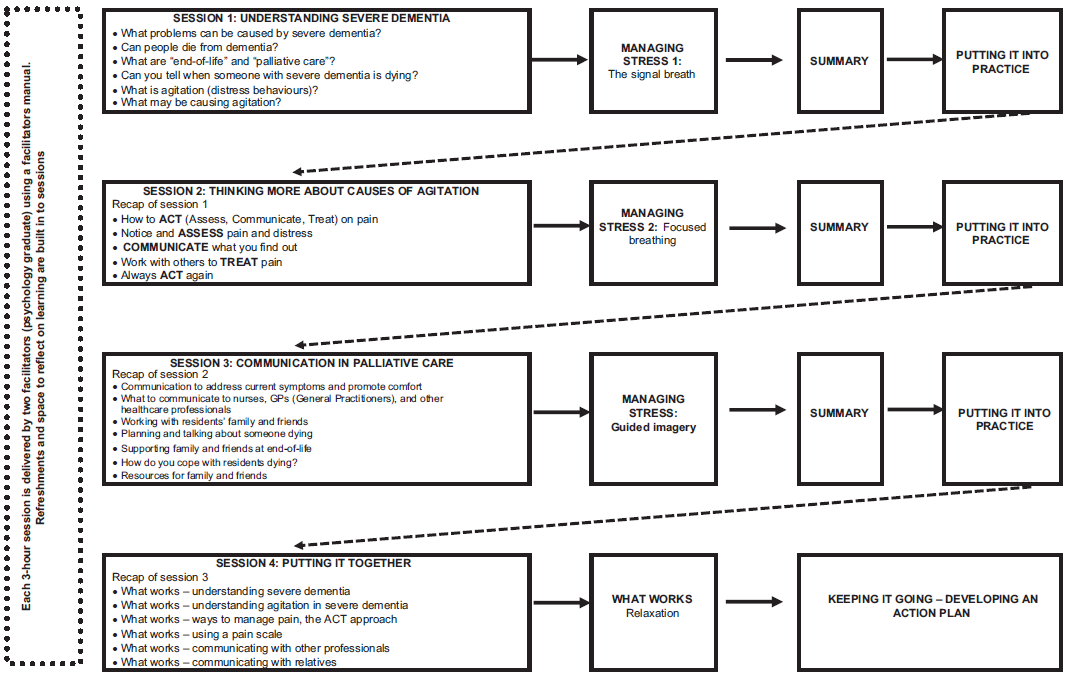
The study team, including experts in dementia care, palliative care, and NH staff drafted the manuals, based on theory described above, with topics informed by longitudinal data on unmet needs in NH residents with severe dementia and their family carers (Moore et al., Reference Moore2017b; Sampson et al., Reference Sampson2018). Each topic was framed in the holistic palliative care model encompassing physical, psychological, social, and spiritual domains (Clark, Reference Clark1999). The four session themes were (1) understanding severe dementia, (2) pain and discomfort in severe dementia, (3) working with others during the severe stages of dementia, and (4) what works? Using new skills and strategies for the future. Our prior work and theory highlighted how neglect of staff personhood leads to burnout and emotional exhaustion. We therefore supported staff to reflect on their emotional response to caring for people with severe dementia who were agitated. Sessions included reflection on experiences, a recap of previous session(s), validation of existing knowledge and expertise, interactive group tasks, talking points, and ended with a relaxation exercise (Figure 1).
Intervention content and delivery.

Training delivery
We designed the intervention to be sustainable and facilitated by two supervised nonclinical psychology graduates, trained to deliver the intervention. We piloted manuals with five NH staff amending them to improve clarity and delivery style. We wrote a companion facilitator manual for each session. We delivered sessions between two and four times in each NH so all eligible staff could attend.
Study type and setting
We conducted a non-randomized feasibility study in three NHs. We planned to recruit three NHs with distinct dementia units, sampled for diversity in terms of size, ownership status, and location. We required them to commit to the training being compulsory for all day staff. We excluded homes due to close in the next 12 months or located more than 60 minutes’ travel from the study base.
Ethics and consent procedures
The London – Queen Square Research Ethics Committee (17/LO/1400) approved the study. NH managers gave consent for their NH to participate. Potential resident participants had severe memory problems and did not have capacity to consent for themselves. Using the Mental Capacity Act (2005), we used a key family member or friend as a “personal consultee” and obtained written assent for the resident. For the observation of the quality of staff–resident interactions, we obtained collective consent from the NH manager. The NH manager informed staff, who were given information sheets, that they could opt out of being observed at any time and the researcher would cease observations. We approached individual NH staff via their manager and they gave individual signed informed consent to participate in the focus groups. Family carers of residents recruited to the study were invited to participate and gave signed informed consent for this.
Study population
Residents had a diagnosis of dementia or a score ≥2 on the Noticeable Problems Checklist which has been validated against clinical diagnosis (Levin et al., Reference Levin, Sinclair and Gorbach1989; Moriarty and Webb, Reference Moriarty and Webb2000) and were rated “3-severe” on the Clinical Dementia Rating Scale (Morris, Reference Morris1993). Eligible staff were permanently employed healthcare assistants, activity coordinators, and qualified nurses who worked at least some day shifts (enabling them to attend training) on the NH’s dementia units. We aimed to recruit 60% of all eligible staff.
Intervention implementation
The study ran in three NHs over 14 weeks (pre-intervention data collection weeks 1–6, intervention period weeks 7–10, and follow-up during weeks 11–14). We invited staff to attend the four sessions, which lasted 2 hours each, including a break. In addition, we offered catch-up sessions at each NH for those who were ill or on leave. We documented the number of group intervention sessions delivered, number of staff at each session, the proportion of staff who attended at least three sessions, and who attended additional catch-up sessions. We explored intervention feasibility and acceptability with staff and family carers using semi-structured qualitative interviews. We asked what they thought of manual layout, content, and practical tasks. We asked staff how effectively facilitators managed group conversations, whether the program was sustainable and deliverable by nonprofessional facilitators.
Data collection
Data were collected by research assistants prior to intervention (weeks 1–6) and at follow-up after intervention delivery (weeks 11–14).
Resident data
At baseline, we collected demographic data. At baseline and follow-up, we assessed residents via proxy interviews with staff using:
-
Cohen-Mansfield Agitation Inventory (CMAI). Scores >45 indicate clinically significant agitation (Cohen-Mansfield et al., Reference Cohen-Mansfield, Marx and Rosenthal1989).
-
Pain Assessment in Advanced Dementia (PAINAD) (Warden et al., Reference Warden, Hurley and Volicer2003). To assess pain during a care task and at rest. Scores ≥2 indicate pain.
-
Symptom Management at the End-of-Life in Dementia (SMEOLD), range 0–45, higher scores indicating greater comfort (Kiely et al., Reference Kiely, Volicer, Teno, Jones, Prigerson and Mitchell2006).
-
If a resident died during the study, we aimed to rate comfort around the time of death with the Comfort Assessment in Dying with Dementia (CAD-EOLD) (range 14–42, higher scores indicating better comfort when dying) (Kiely et al., Reference Kiely, Volicer, Teno, Jones, Prigerson and Mitchell2006).
-
DEMQOL-Proxy (range 31–124, higher score indicates better QoL) (Smith et al., Reference Smith2007). We also used the quality of life in late-stage dementia (QUALID) scale (range 11–55, lower scores indicate better QoL) (Weiner et al., Reference Weiner, Martin-Cook, Svetlik, Saine, Foster and Fontaine2000), and EuroQol EQ-5D 5 (EQ-5D-5L-Proxy) (Rabin and de Charro, Reference Rabin and De Charro2001) with the associated UK tariff (Devlin et al., Reference Devlin, Shah, Feng, Mulhern and van Hout2017; Herdman et al., Reference Herdman2011).
-
The modified Client Service Receipt Inventory recorded health and social care resource use from resident files and NH staff (Beecham and Knapp, Reference Beecham, Knapp and Thornicroft2001).
Family carer data
Prior to intervention, we collected data on age, sex, relationship to resident, and number of visits per month. Prior to intervention and at follow-up, we assessed family carer satisfaction using the Satisfaction with Care at the End-of-Life in Dementia Scale (SWCEOLD) which has 10 items, score range 10–40 with higher scores indicating greater satisfaction (Kiely et al., Reference Kiely, Volicer, Teno, Jones, Prigerson and Mitchell2006).
Staff data
We collected staff demographic data at baseline; sex, ethnicity, highest level of educational attainment, English as a first language, years working in the NH and the sector, working pattern, and whether they held a UK-recognized nursing qualification. Prior to intervention and at follow-up they, completed the Sense of Competence In Dementia (SCID) Scale (Schepers et al., Reference Schepers, Orrell, Shanahan and Spector2012) a self-report of staffs’ subjective competence, with four subscales (professionalism, building relationships, care challenges, and sustaining personhood, range 17–68, with higher scores indicate greater competence).
NH data
We collected data from NHs on management and ownership (private or charity), Care Quality Commission (CQC) registration type (dementia registered, dementia specialist, mental health registered, and physical disability registration), number of beds, CQC rating domains (safe, effective, caring, responsive, well led, and overall), and whether or not there was a specialist unit for residents with behavioral issues. We documented numbers of staff rostered during days and nights, agency staff and permanently registered staff, the number of residents and staff in dementia training in the previous 6 months.
Staff–resident interactions
We collected data at baseline and follow-up on the quality of interactions between residents and staff using the Quality of Interactions Schedule (QUIS), an observational tool rating staff–resident interactions on an ordinal scale as “positive” (2), “neutral” (1), or “negative” (0) (Dean et al., Reference Dean, Proudfoot and Lindesay1993).The QUIS has good inter-rater reliability (Dean et al., Reference Dean, Proudfoot and Lindesay1993) and reasonable test–retest reliability (McLean et al., Reference McLean, Griffiths, Mesa-Eguiagaray, Pickering and Bridges2017).
Qualitative interviews
We held focus groups with a variety of NH staff to explore their views on the training program, manuals, facilitators, and barriers to the implementation of the training and triangulate data. We showed family carers the manuals and gave an overview of the training program prior to their interviews. These were audiotaped and transcribed verbatim and entered onto a qualitative software program (Nvivo) for coding, management, and retrieval of data.
Sample size
No formal power calculation was carried out for this feasibility and acceptability study. Informed by our previous NH research (Livingston, Reference Livingston2019), we aimed to recruit three NHs which we expected to include approximately 60 paid carers, 51 residents with dementia (Livingston et al., Reference Livingston2019), and 15 family carers. We anticipated this sample size would provide sufficient information to address our objectives.
Analysis
Quantitative
We described participant flow using a consort-type diagram, the number of intervention sessions attended by staff, and the proportion of staff attending at least three sessions. We summarized staff, family carer, and resident characteristics and questionnaire scores at baseline and follow-up using means with standard deviations or medians with interquartile ranges (IQRs) for continuous data (as appropriate) and frequency (%) for categorical data. We tabulated NH characteristics. We compared baseline and follow-up questionnaire scores to obtain an estimate of average change (mean difference) with 95% confidence intervals. We described missing data for each outcome. Analysis was conducted using Stata version 14 (StataCorp, 2015).
Cost estimation
We estimated health and social care costs; the intervention cost (including costs of training and delivery) was based on the number and length of sessions delivered and unit costs using published sources (Curtis and Burns, Reference Curtis and Burns2017). We explored the feasibility and implications of using the EQ-5D-5L proxy version, DEMQOL proxy version, and QUALID to calculate QoL.
Qualitative
We coded transcripts into meaningful themes using thematic analysis (Braun and Clarke, Reference Braun and Clarke2006). We adopted a rigorous approach to data analysis using methods described by Spencer et al. (Reference Spencer, Ritchie, Lewis and Dillon2003). Throughout the analytic process, researchers used ongoing reflection with the use of memoing and reflective diaries to engage with the data and refine emergent themes.
Results
Recruitment and consent
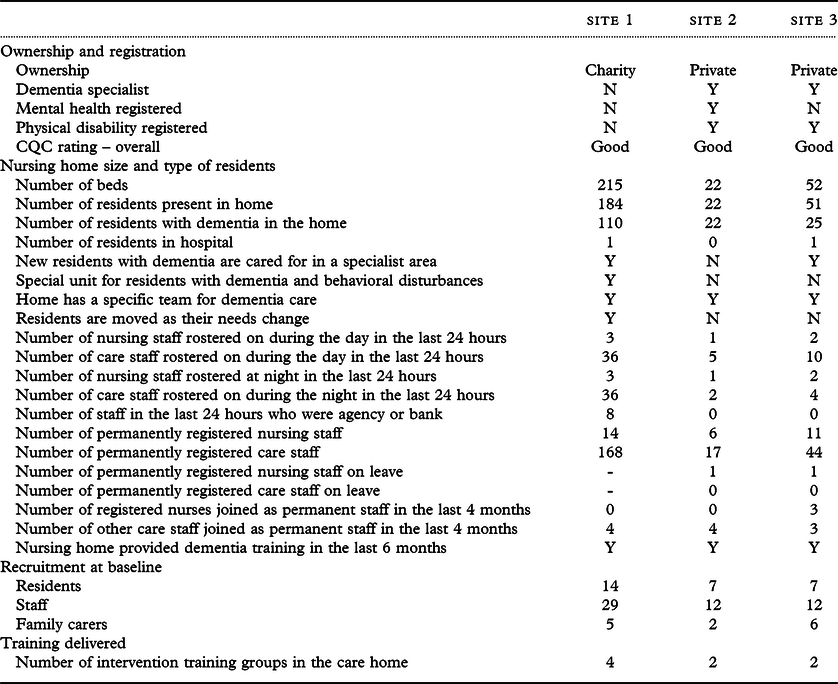
We approached 12 NHs, 6 responded and 3 agreed to participate. Reasons for NHs not wishing to participate were having too many other challenges or believing they did not have enough residents with dementia. Recruited NHs varied from 22 to 215 beds. Two were private and one was a charity. At baseline, all were rated by the CQC as “good” and had provided staff with dementia training in the prior 6 months (Table 1).
Characteristics of participating nursing homes

Y, yes; N, no.
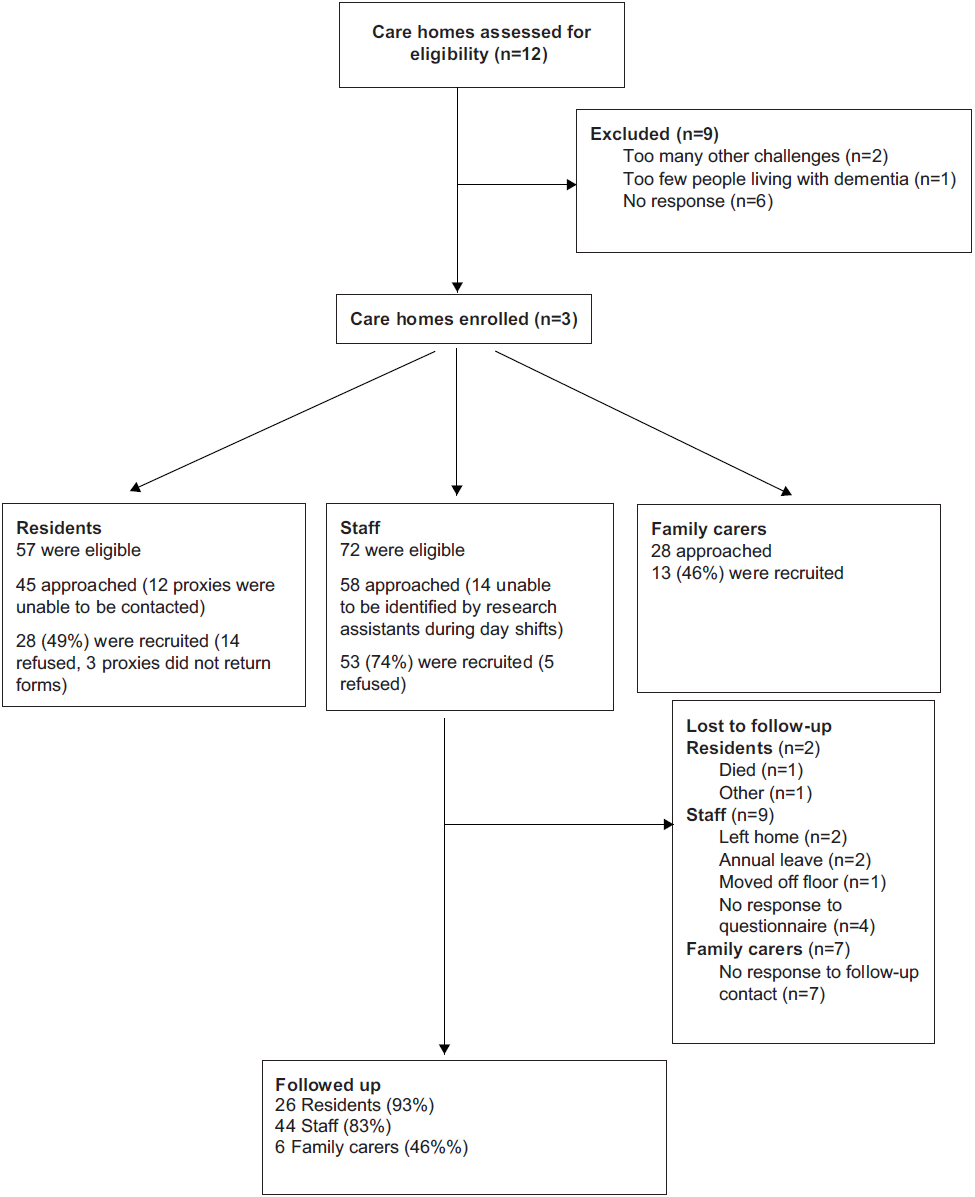
A total of 72 staff were working in NH dementia units and were eligible to participate, 58 of whom were approached by research assistants for informed consent. Fourteen staff were uncontactable by research assistants due to absence, leave or their shift patterns, leading to 74% of eligible staff approached consented and received the intervention.
Across the 3 NHs, 57 residents were eligible, 45 had contactable proxies and were approached, and 28 proxies provided assent for the resident to participate (49%). Thus, over half of eligible proxies were not recruited as they either did not respond to the invitation or declined. We approached 28 family carers of residents participating in the project and 13 (46%) were recruited into the study. We were able to collect post-intervention questionnaires on 26 residents, 44 staff, and 6 family carers (Figure 2).
Recruitment flow chart.

Participant characteristics
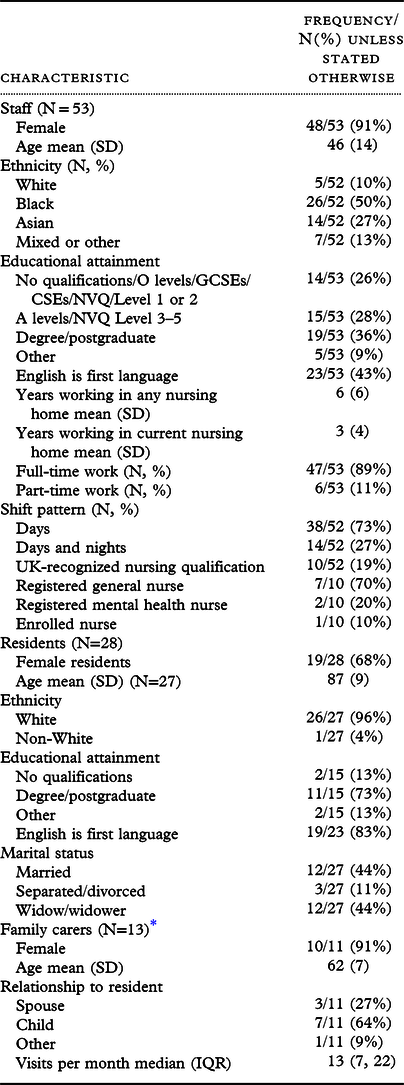
Staff were predominantly female with mean age of 46 years, less than half spoke English as a first language and 19% had a UK-recognized nursing qualification. Residents had a mean age of 87 years and were mainly female. Family carers had a mean age of 62 years and were mainly children of the residents (Table 2).
Characteristics of participants

IQR, interquartile range; SD, standard deviation.
* Two family carers did not provide demographic information.
Feasibility
Staff attended a median of four sessions including catch-up sessions where necessary (IQR 3, 4), 79% of staff attended three or four group intervention sessions and including catch-up sessions this rose to 84% of staff (Table 1).
Potential outcome measures
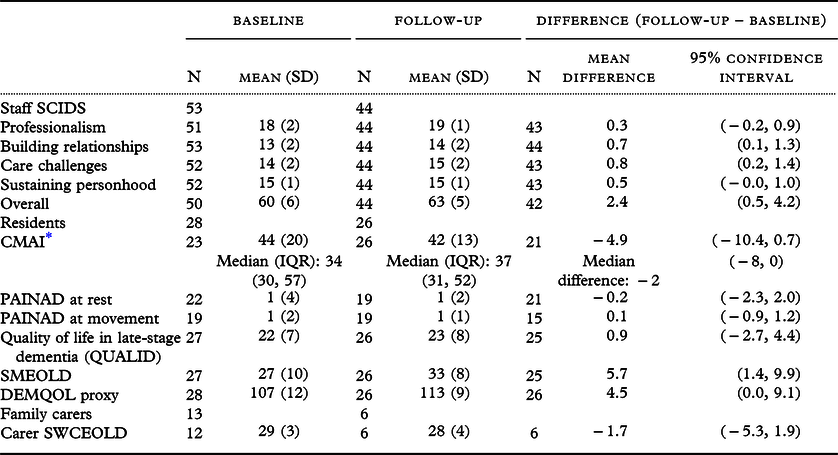
Table 3 presents potential outcome measures for a main trial with baseline and follow-up average scores and the numbers who completed these. CMAI, QUALID, SMEOLD, DEMQOL proxy, and EQ5-D were completed for at least 89% of residents at baseline and follow-up. The PAINAD at rest was completed for 78% of residents at baseline and 73% at follow-up. Completion of the PAINAD at movement was lower. SWCEOLD data were collected from 92% of family carers at baseline but only 46% at follow-up. At baseline, the SCID was completed by 94% of the 53 recruited staff, and all 44 staff who were contactable for follow-up. The SCID, SMEOLD, and CMAI showed evidence of a positive change between baseline and follow-up.
Study measures

SD, standard deviation; SCIDS, Sense of Competence In Dementia; IQR, interquartile range; CMAI, Cohen-Mansfield Agitation Inventory; PAINAD, Pain Assessment in Advanced Dementia; QUALID, quality of life in late-stage dementia; SMEOLD, Symptom Management at the End-of-Life in Dementia; SWCEOLD, Satisfaction with Care at the End-of-Life in Dementia Scale.
* Median and median difference also given as the score has a skewed distribution.
Pre-intervention on the QUIS, over 10 hours and 53 minutes, we observed 174 interactions with 27 residents. There was a median of 5 (IQR 3, 12) interactions per resident, of which 7% were negative, 51% neutral, and 42% positive. Post-intervention, over 12 hours and 40 minutes, we observed 126 interactions with 24 residents. There was a median of five interactions per resident (IQR 3, 8), of which 8% were negative, 46% neutral, and 46% positive.
Feasibility of cost estimation
All residents pre-intervention and 93% of residents post-intervention had complete data for health and social care resource use. Pre-intervention, all residents had complete data for EQ-5D-5L proxy and QUALID and 96% on DEMQOL proxy. At follow-up, 93% of the residents had complete data for EQ-5D-5L proxy and QUALID. The total cost of intervention implementation was £6,891.9. The average cost per resident was £246, assuming this is the cost required to deliver the intervention to the 28 residents on whom we collected outcome data. There was a slight increase in health and social care costs and QoL measured by DEMQOL proxy and QUALID, and a statistically significant increase in QoL measured by EQ-5D-5L proxy (see appendix 1 published as supplementary material online attached to the electronic version of this paper).
Qualitative evaluation
We interviewed 10 family carers in 8 interviews (one with two family carers). All were women (nine daughters, one wife, and one niece), aged 50–73 years who visited between 7 and 30 times per month. We held five staff focus groups, two in two of the NHs, and one in the other. Staff members (17 females, 2 males) attended in groups varying in size from two to seven staff members. There were 13 healthcare assistants, 2 senior healthcare assistants, 1 each of assistant nursing practitioner, unit manager, clinical lead, and NH manager.
Creating a shared learning space and enhancing communication
Facilitators built rapport with staff who reported feeling listened to, understood, and appreciated. The training kept staff engaged and brought those with different roles together to share experiences.
“…they [facilitators] were interested in listening to us… asking us questions…” “…they were giving us new tools, ways of looking at pain, doing things differently…” “I liked them very much…It was their way of teaching,., it was like communication.”(focus group HCA1)
“And it was good that we had nurses and senior healthcare assistants as well [in the training]… they will be more informed…if we were in the sessions and sharing something out, like for instance palliative care, you find that the nurse or the senior healthcare assistant will have different input than we healthcare assistants coming up with. So, it did help to get everybody together.” (focus group HCA2)
Investing in staff
Staff reported the training helped them feel valued, reflect on their work, and increased quality of care. The training was relevant to their day-to-day practice and was easy to apply. It was preferred to “learning on the job.”
“…it’s more practical…for instance… I’m new and haven’t been in a dementia facility, and I get introduced to the sessions. I think it would be more beneficial…I’m reflecting back to the sessions. This is what I’ve learned., so I am just going to put it into practice…Even though I’ve been here for three years, it’s still beneficial to me, and it would be beneficial for a new person as well,.” (HCA2)
“… we reflect back to your training… probably we need to do more training to exercise our minds.” (HCA5)
Manuals helped staff to follow the progression of the sessions, to make notes and provided written material for the future. The person-centered approach was valued by carers:
“…we can go back to the manuals, and when we reflect, it’s something we can go back to and read, and then, we can reflect back on what we talked about in the training.” (HCA2)
“Because they think person-centred means that this person likes trees and they don’t like strawberries, you know. I think person centred means looking at somebody in a room and saying why are they agitated or why, what can I do to make their care, make them more comfortable?” (family carer 3)
Linking sessions through the introduction, recap, and between-session tasks helped put it all together.
“…from one session to next session, we reflect on the first one, then we carry along. So it’s more covered and go round like a ball throughout…We tend to understand better because it’s broken down to four sections. If… everything together, probably we would not.” (HCA3)
Relaxation techniques were regarded as valuable, enjoyable, and useful for relieving stress.
“…[relaxation exercises] are excellent…staff stress is hugely important…[their work] is immensely difficult and distressing… [staff] cope with enormous amount of stress…” (family carer 1)
“I think the relaxation side…that was the best part. Because I work in the dementia unit, sometimes can be a bit challenging, so I find that very good, using that is helpful.” (HCA6)
Family carers felt the training encouraged better communication and interaction between staff and relatives.
“ …the training you are doing, is about making something that is often not implicit, but unvoiced, voiced.” (Family carer 3)
Family carers judged the training as useful and valued the focus on agitation:
“…how to handle it [agitation], or what to do, or what would help…that is crucial…” “…that’s [aggression] is really one of the most difficult things to deal with, for them [staff]…my dad gets very aggressive, and I’m sure they find that very difficult. I think also, if people can’t communicate…not knowing what to do and not knowing if things are helping…” (family carer 2)
Culture and implementation in practice
Staff understood that implementation and change takes time.
“…when you learn something new and you want to put it into practice, it takes a while…You know, people have habits.” (HCA1)
A family carer was concerned about the “culture of blame.” Staff may hesitate to raise issues, afraid of accountability. The carer felt that the training would help this.
“…if a care home creates a culture where it’s everybody’s job to think about the person and their comfort level, I think that would translate into better care.” (family carer 4)
There was some concern about training costs but the delivery by nonprofessional facilitators was appropriate, suitable, and implementable.
“If you go for training, they [NH] have to put on more staff which is more money for them…it’s time consuming… but I don’t think they will say no to it… we are learning something…” (HCA2)
Applying skills in practice
Many staff put new skills into practice at work, sometimes immediately after the sessions.
“We really put it into production more, is like asking the daughter, did your mum love music? Do you think she preferred to listen to music in the background… We know about these things, but sometimes we don’t really put it into action, but after listening to the end-of-life training, then yes, we did.” (HCA1).
Discussion
Using a palliative care approach, underpinned by theory and ethnographic work, we designed a four-session manualized training intervention to improve the care of people with severe dementia and agitation. We recruited our target of three NHs, 74% of eligible staff and 89% of family carers. We had aimed to recruit 17 residents with severe dementia from each NH (total of 51) but only recruited 28 in total (49% of eligible residents). Most (84%) staff attended at least three sessions.
We explored potential outcome measures for a full trial. In terms of feasibility, nearly all data on agitation, symptom management (SMEOLD), and QoL (DEMQOL, QUALID, and EQ-5D-5L) were collected although other scales including the PAINAD, particularly at movement, were less consistently measured.
We wanted to explore the quality of interactions between NH residents and staff. We chose the QUIS as previous studies show utility in NHs (Proctor et al., Reference Proctor1998) and with cognitively impaired NH residents (Paudel et al., Reference Paudel, Resnick and Galik2019). We were able to assess daytime resident–staff interactions for 96% of residents at baseline and 92% at follow-up. Thus, it was feasible to observe staff interactions with residents with severe dementia. Dementia Care Mapping is used more frequently to assess person-centered care but requires extensive training, which may be less practical. The median number of interactions and the type of interaction did not change between baseline and follow-up.
The SCID (staff competency) scale and the symptom management scale (SMEOLD) showed positive change between pre- and post-intervention phases, indicating they may be useful outcome measures for a future study. It was feasible to estimate intervention costs using DEMQOL proxy and the EQ-5D-5L, suggesting a potential cost of £246 per resident. Health and social care costs and utility values showed slight increase post-intervention.
Analysis of qualitative data allowed triangulation with quantitative findings. The training was acceptable to staff who appreciated multi-professional learning, interactions with facilitators who listened to them, the ability to put their learning quickly into practice and the focus on their wellbeing and personhood through reflection and relaxation exercises.
There are a number of limitations to this feasibility study. The NHs in which the study was conducted may be atypical. Participating NHs were rated as “good” by the regulator and thus likely to be more willing and able to participate in research; they may not be representative. We did not formally assess how well NH managers engaged with the intervention and their support is vital for implementation (Chenoweth et al., Reference Chenoweth, Jessop, Harrison, Cations, Cook and Brodaty2018) We recruited a relatively high proportion of eligible staff but did not recruit residents or their carers to target. Relatively few residents fulfilled the criteria, despite these being quite broad and crucially, few had proxies who could participate to allow collection of family carer data. It may be challenging to recruit enough dyads for a full-scale trial. We did not collect data on the level of intervention fidelity achieved by the facilitators. Focus group participants may have been wary of criticising the intervention; however, we did ensure these occurred after the intervention finished enabling time for reflection, and they were conducted by researchers who did not deliver the intervention. Cost estimates are conservative and interpreted with caution because of small sample size and lack of control arm.
This feasibility study informs future work in this area. We did not aim to detect differences pre- or post-intervention but found signals of improvement in staff competency (SCID scale) and resident symptom management (SMEOLD). More work is required to understand whether these are true changes, underlying mechanisms of change and the “active ingredient” of the intervention. While improving factual knowledge is important, it may be that engagement of the facilitators and attention given to staff wellbeing and personhood were actually the mediators of change. Future research should assess staff wellbeing, exploring emotional distress, anxiety, and job satisfaction. We do not have data on longer-term implications of the study including lasting culture change within the NHs.
There has been an increase in recent research on interventions to improve end-of-life care for NH residents, particularly those with dementia. Many of these interventions are complex, for example, the UK “Gold Standards Framework” (Gold Standards Framework, 2008) or the Palliative Care for Older People Steps to Success Program, a multicomponent intervention aiming to integrate basic nonspecialist palliative care in NHs (Van den Block et al., Reference Van den Block2019). While palliative care takes a broad and holistic approach, it is challenging for complex interventions to achieve their desired outcomes such as improved resident comfort or staff knowledge (Van den Block et al., Reference Van den Block2019).
NH residents with severe dementia have complex needs requiring specialized support from external health and social care services (Sampson, Reference Sampson2018). Many multicomponent interventions involve expensive external facilitation from senior staff, training, and multidisciplinary input. It may be more feasible in the current climate to implement focused interventions on agitation, advance care planning (Livingston et al., Reference Livingston2013), or pain management (Petyaeva et al., Reference Petyaeva2018). However, we still lack evidence for the effectiveness of these approaches (Murphy et al., Reference Murphy2016).
Conclusion
This is the first feasibility study of an intervention designed to improve agitation in NH residents with severe dementia underpinned by a palliative care approach. The training was acceptable, positively received by staff and family carers, and inexpensive. Further studies will be required to understand implementation and how the intervention promotes change in practice.
Conflict of interest
None.
Description of authors’ roles
GL and ELS obtained funding and designed the study and protocol. LM, JB, and MP designed and conducted the quantitative data analyses. AL, AS, FLaF, KL, JG, LW, MM, and KM were involved in intervention design, delivery, and data acquisition and analysis. AL was study manager. All authors were involved in data interpretation and drafting the paper.
Acknowledgments
The study is funded by the UK Economic and Social Research Council and National Institute of Health Research (NIHR/ESRC ES/L001780/1). ELS and KM are supported by Marie Curie core grant (grant number MCCC-FCO-16-U). GL and ELS are supported by National Institute for Health Research (NIHR) University College London Hospital Biomedical Research Centre. GL received funding from the NIHR Collaborations for Leadership in Applied Health Research and Care North Thames at Barts Health National Health Service (NHS) Trust. GL is an NIHR senior investigator. Views expressed are those of the authors and not necessarily those of the NHS, the NIHR, or the UK Department of Health. We thank all participating NHs, residents, families, and staff.
Supplementary material
To view supplementary material for this article, please visit https://doi.org/10.1017/S1041610220001647