On March 11, 2011, a magnitude 9 earthquake (the Great East Japan Earthquake) occurred off the east coast of Japan, followed by a massive tsunami and the Fukushima Daiichi Nuclear Power Plant accidents. Reference Hasegawa, Tanigawa and Ohtsuru1 Due to the accidents, residents living within a 20 km radius of the plant were ordered to evacuate, and those living within a 20- to 30-km radius of the plant were advised to evacuate voluntarily by the Japanese government. Reference Hasegawa, Tanigawa and Ohtsuru1 As of 2016, people were not allowed to live in the 6 districts (Tomioka, Okuma, Futaba, Namie, Katsurao, Iidate) because of residual radiation in the environment. Displaced people in Fukushima Prefecture have not only experienced mental health problems, Reference Fukasawa, Kawakami and Umeda2,Reference Yabe, Suzuki and Mashiko3 but have had difficulties in reconstructing social relationships because of both self-stigma or stigma from others. Reference Hasegawa, Tanigawa and Ohtsuru1
To estimate the impact of disasters, all-cause mortality is thought to be a useful measure of public health monitoring. Reference Kishore, Marqués and Mahmud4,Reference Santos-Burgoa, Sandberg and Suárez5 In addition, although most previous studies have focused on the immediate health effects of disasters, the long-term effects are being increasingly reported. Reference Petkova, Beedasy and Oh6,Reference Ripoll Gallardo, Pacelli and Alesina7 According to the systematic review and meta-analysis conducted by Ripoll Gallardo et al., at the 12-month follow-up point, all-cause mortality rates were 2% higher for study participants who were exposed to earthquakes than for those not similarly exposed. Reference Ripoll Gallardo, Pacelli and Alesina7 Following these research trends, the importance of long-term monitoring after disasters is emphasized in the Sendai Framework for Disaster Risk Reduction, which was adopted at the third United Nations World Conference in 2015. 8 However, despite the huge impact of the Great East Japan Earthquake on the world, reports on displacement that assessed all-cause mortality are limited, especially in Fukushima Prefecture.
The primary objective of the current study was to evaluate the long-term effects of displacement on all-cause mortality after the Great East Japan Earthquake, focusing on the differences in trends between the displacement area and the other areas in Fukushima Prefecture. Taking into account that the displacement has lasted for longer than 5 years for some people, it is hypothesized that the all-cause mortality of people who lived in the 6 districts (mentioned above) before the earthquake, and were subsequently displaced, is continuously higher than that of the residents of other areas in Fukushima Prefecture. Our hope is that the current study can provide new insights to foster the efficiency of future planning for recovery and preparedness.
METHODS
Several governmental statistics were used to calculate all-cause mortality from 2009 to 2016. The number of deaths due to all causes was obtained from vital statistics published by the Ministry of Health, Labour, and Welfare. The population data were obtained from reports of the Ministry of Internal Affairs and Communications, referring to the Basic Resident Registration Network System. The Ministry of Health, Labour, and Welfare reports the vital statistics with reference to the registered address in the Basic Resident Registration Network System. It is worth noting that the registered addresses in that system are self-reported by citizens. Therefore, if people move but do not change their registered addresses by themselves, the government continues to report the population or vital statistics using the registered addresses that remain unchanged. Therefore, although no one actually lives in some areas following the forced evacuation, the government continues to report the population or vital statistics of those areas because some registered addresses remain unchanged. This feature of the system allows us to conduct an epidemiological study including the displacement area in Fukushima Prefecture after the Great East Japan Earthquake.
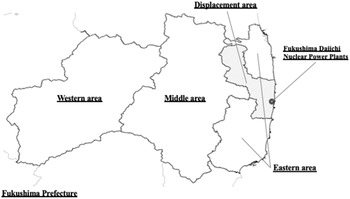
Fukushima Prefecture is composed of 59 districts, and as shown in Figure 1, it is divided into 3 areas by mountains or highlands; the Eastern area, the Middle area, and the Western area. After the Great East Japan Earthquake on March 2011, the Japanese government was forced to order the residents in the areas surrounding the nuclear power plants to evacuate from their living place as mentioned above. Although the evacuation orders have been gradually lifted, the 6 districts (Tomioka, Okuma, Futaba, Namie, Katsurao, Iidate) remained evacuation areas as of 2016. In the current study, these 6 districts were defined as the Displacement area. Although the Displacement area is a part of the Eastern area, we separated it from the Eastern area to compare the Displacement area with other areas.
The Geographical Outline of Fukushima Prefecture.

Data pertaining to population and numbers of all-cause deaths were used to examine and compare the 4 areas of Fukushima Prefecture from 2009 to 2016. Age-adjusted all-cause mortality were used to analyze the differences in the risk of all-cause deaths between the Displacement area and the other areas. The 1985 model population of Japan was used as a standard population when calculating the age-adjusted all-cause mortality from 2009 to 2016. All statistical analyses were conducted using STATA (version 13.1 for Mac; Stata Corp, College Station, TX).
RESULTS
The population in Fukushima Prefecture decreased year by year, from 2,063,769 in 2009 to 1,953,699 in 2016. The population of the Middle area was the largest, followed by the Eastern and Western areas throughout this period. The population of the Displacement area was 64,279 in 2009, and 57,382 in 2016. The changes in population were most significant in the Displacement area, with a decline of 11% from 2009 to 2016, compared with the overall decline in Fukushima Prefecture of 5% in the same period.
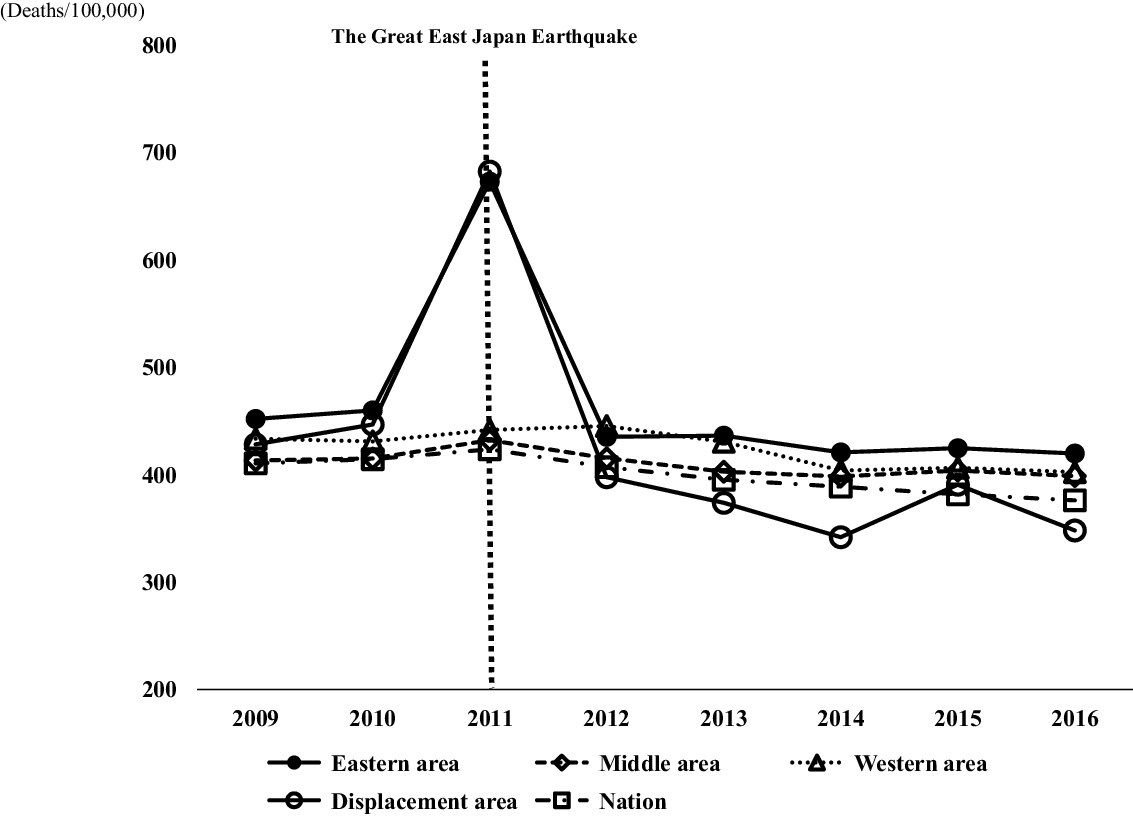
The trends of the national age-adjusted all-cause mortality, and those of the 4 areas in Fukushima Prefecture from 2009 to 2016, are shown in Figure 2. The age-adjusted all-cause mortality rates in all 4 areas in Fukushima Prefecture were higher than the national rates in 2009 and 2010. The Eastern and Displacement areas had a relatively higher age-adjusted all-cause mortality than the other 2 areas from 2009 to 2011. From 2012 to 2016, the age-adjusted all-cause mortality in the Displacement area changed to the lowest in Fukushima Prefecture, and was lower than the national rate from 2012 to 2014, and again in 2016. In contrast, the mortality in the Eastern area was highest from 2013 to 2016.
The Trends of National Age-adjusted All-cause Mortality Rates, as Well as by area in Fukushima Prefecture, From 2009 to 2016.

DISCUSSION
The current study is the first to report that the all-cause mortality in the Displacement area in Fukushima Prefecture was continuously lower than those of the rest of Fukushima Prefecture after the Great East Japan Earthquake in 2011. However, the all-cause mortality in the Eastern area, where the mortality was equally high in the Displacement area in 2011, remained consistently high after the earthquake. Against all expectations, the area which seems to need more health-care support to reduce all-cause mortality has been the Eastern area, rather than the Displacement area, after the earthquake in Fukushima Prefecture. These findings strengthen the importance of long-term monitoring in decision-making regarding public health interventions following disasters. Reference Ripoll Gallardo, Pacelli and Alesina7 Policy-makers should organize a long-term monitoring of residents to allocate limited health-care resources to meet their needs for health care efficiently after disasters.
Further study is necessary to determine the reasons why the all-cause mortality in the Displacement area was lower than the rest of Fukushima Prefecture. The health-care resources in Fukushima Prefecture are known to have been relatively poor since before the earthquake occurred. Reference Fukuma, Ahmed and Goto9 It is possible that mortality decreased immediately after displacement if: said displacement was from poor health-care areas to richer areas; and accessibility to health-care services was improved. This explanation is not contradictory to the finding that all-cause mortality in the Displacement area decreased immediately after the earthquake. In addition, the positive effects of enhanced health check-ups and health advocacy after displacement should not be dismissed. Unfortunately, the current study lacks both data on the use of health-care services and accessibility to them. More studies are needed to shed light on the potential causes of this fortunate result that the all-cause mortality was suppressed.
On the other hand, further study of the Eastern area is also required; research into which specific causes of death led to the increase of all-cause mortality and what drove such an increase. Because age-adjusted mortality is affected more by the death of a young person than the death of an old person, an age-based analysis should be conducted. The extent to which mortality is directly associated with the earthquake and the aftermath (ie, self-stigma and stigma from others) remains unclear. The temporal lag of the association between mortality and the earthquake and the aftermath should be considered as well. In addition, the evacuation order in the Displacement area has been partially lifted since mid 2016. Thus, the health effects associated with the recovery process in the Displacement area should be continuously monitored in future.
There are several limitations to the current study. First, information bias should not be omitted: especially in the Displacement area, 11% of the population decreased from 2009 to 2016, and the health status of that 11% remains unknown. This uncertainty might have affected the results of the current study. Lack of information, including health-care resources, accessibility to health care, or actual living addresses of the displaced people, is another limitation of our study.
CONCLUSIONS
Against all expectations, after the Great East Japan Earthquake in 2011, the all-cause mortality in the Displacement area in Fukushima Prefecture was continuously lower than that in the rest of the prefecture. In contrast, the all-cause mortality in the Eastern area, where the mortality was equal to that in the Displacement area in 2011, was continuously higher after the earthquake. With regard to Fukushima Prefecture after the earthquake, the area that seems to need more health-care support to reduce all-cause mortality has been the Eastern area, rather than the Displacement area. It is necessary to prepare a long-term monitoring system to follow the victims of a disaster.
Acknowledgments
We thank Sam Murchie (Shokei Gakuin University) for English proofreading.
This research did not receive any specific grants from funding agencies in the public, commercial, or not-for-profit sectors.
Conflicts of Interest
The authors declare that they have no conflicts of interest.
Ethical Approval
This article does not contain any studies with human participants or animals performed by any of the authors.