Epidemiological data show that substance misuse, antisocial behavior, and health-risking sexual behaviors (HRSBs) are prevalent in emerging adulthood, both in the US–the setting for the PROSPER study–and internationally. For example, in 2014, the US annual prevalence estimates for any illicit drug use were highest among 19–22 year olds (41%; Johnston et al. Reference Johnston, O'Malley, Bachman, Schulenberg and Miech2015a ). Especially noteworthy is the 6.7% annual prevalence estimate of narcotic use, including heroin and non-medical use of prescription opioids, which is higher among young adults (aged 19–26) than any other age group. As an example of the prevalence of HRSBs, in the US approximately 24% of young adults have more than one sex partner annually and 30% of unmarried respondents report never using a condom (Johnston et al. Reference Johnston, O'Malley, Bachman, Schulenberg, Patrick and Miech2015b ). Concerning antisocial behaviors, offending behavior (violence and theft) peaks at around 10–12% between ages 17–19, although it then begins to decline (Piquero et al. Reference Piquero, Farrington and Blumstein2007; Loeber et al. Reference Loeber, Farrington, Stouthamer-Loeber and White2008).
Internationally, surveys of 18–29 year olds in several major countries in Europe, Africa, Asia, and the Americas have been conducted by the World Health Organization and other international agencies. They show pervasive substance misuse among young adults, albeit with a high degree of variability in the drugs of choice across countries. For example, while 44.1% of 22–29 year olds living in France reported that they used cannabis, only 13.7, 1.8, and 1.9% of those living in Italy, China, and Nigeria, respectively, reported such use (Degenhardt et al. Reference Degenhardt, Chiu, Sampson, Kessler, Anthony, Angermeyer, Bruffaerts, de Girolamo, Gureje, Huang, Karam, Kostyuchenko, Lepine, Mora, Neumark, Ormel, Pinto-Meza, Posada-Villa, Stein, Takeshima and Wells2008).
Substance use and associated health-risking behaviors have health, social, and economic consequences, at both the individual and societal levels. These problems can lead to later substance abuse and dependence (Swendsen et al. Reference Swendsen, Conway, Degenhardt, Glantz, Jin, Merikangas, Sampson and Kessler2010); marijuana use has been linked to later addiction, altered brain development, diminished achievement, and ongoing mental health difficulties (Fergusson & Boden, Reference Fergusson and Boden2008; US Department of Justice, Drug Enforcement Administration, 2014; Volkow et al. Reference Volkow, Compton and Weiss2014; Fischer et al. Reference Fischer, Clavarino, Plotnikova and Najman2015; Coffey & Patton, Reference Coffey and Patton2016); alcohol misuse is associated with multiple health-related disease and injury conditions (Rehm, Reference Rehm2011); and deaths from prescription drug overdose in the US included 1741 young adults in 2014 (National Institute on Drug Abuse, February, 2016a ). HRSBs can lead to sexually-transmitted diseases, unplanned pregnancy, and early parenthood (Van Ryzin et al. Reference Van Ryzin, Johnson, Leve and Kim2011). Socially, emerging adults who exhibit substance misuse and other health-risking behaviors may not transition into positive adult roles; they may show interpersonal difficulties, drop out of school, become parents while relatively young, or take on undesired full-time employment (Sussman, Reference Sussman2013). The costs of tobacco, alcohol, and illicit drug use to the US economy has been estimated at over $700 billion annually (National Institute on Drug Abuse, February, 2016b ); the costs of sexually transmitted infections (STIs) have been estimated at $16 billion in lifetime direct medical costs alone (National Center for HIV/AIDS, Viral Hepatitis, STD, and TB Prevention, 2013).
The primary adolescent socializing environments (family and school/peer) exert substantial influence on risk and protective factors for substance misuse and other health-risking behaviors during adolescence. Protective factors include family relationship quality, monitoring, and parent-child warmth and affection; positive peer relationships distinguished by trust and affection; and school engagement, along with school task completion (Murray & Farrington, Reference Murray and Farrington2010; Stone et al. Reference Stone, Becker, Huber and Catalano2012). For this reason, preventive interventions designed to influence family-, school-, and peer-related risk and protective factors have been developed and tested with positive results (NRC-IOM, Reference O'Connell, Boat and Warner2009). The literature emphasizes the importance of providing preventive intervention during the developmental window when adolescents are just beginning to use substances and conduct problems are escalating (Offord & Bennett, Reference Offord, Bennett, Rutter and Taylor2002; Anthony, Reference Anthony2003; Chen et al. Reference Chen, Dormitzer, Gutierrez, Vittetoe, Gonzalez and Anthony2004; Spoth et al. Reference Spoth, Guyll and Shin2009a ).
There is an emerging literature on effects of universal preventive interventions implemented during young adolescence, especially effects on young adult substance misuse (Hawkins et al. Reference Hawkins, Kosterman, Catalano, Hill and Abbott2005; Poduska et al. Reference Poduska, Kellam, Wang, Brown, Ialongo and Toyinbo2008; Riggs et al. Reference Riggs, Chou and Pentz2009; Spoth et al. Reference Spoth, Trudeau, Shin, Ralston, Redmond, Greenberg and Feinberg2013b ; Botvin & Griffin, Reference Botvin and Griffin2014a ; Kellam et al. Reference Kellam, Wang, Mackenzie, Brown, Ompad, Or, Ialongo, Poduska and Windham2014). A subset of articles report on substance misuse outcomes among young adults for the same interventions that were implemented through the PROSPER delivery system (detailed in the Methods section, Spoth et al. Reference Spoth, Trudeau, Guyll, Shin and Redmond2009b , Reference Spoth, Trudeau, Redmond and Shin2014b , Reference Spoth, Trudeau, Redmond and Shin2016). The pattern of positive, long-term findings across multiple trials is noteworthy, especially considering that effects persist even after students leave the settings in which the interventions were implemented and setting-related factors are no longer operative (e.g. reduced negative peer influences, see Osgood et al. Reference Osgood, Feinberg, Gest, Moody, Ragan, Spoth, Greenberg and Redmond2013).
There is evidence that interventions addressing multiple risk and protective factors, designed to reduce substance misuse, also have crossover effects on other young adult health-risking behaviors or problems (e.g. conduct problem behaviors or internalizing outcomes)–even when no intervention content directly addresses those behaviors or problems (Trudeau et al. Reference Trudeau, Spoth, Randall, Mason and Shin2012; Kellam et al. Reference Kellam, Wang, Mackenzie, Brown, Ompad, Or, Ialongo, Poduska and Windham2014; Oesterle et al. Reference Oesterle, Hawkins, Kuklinski, Fagan, Fleming, Rhew, Brown, Abbott and Catalano2015). Specifically, a number of randomized controlled trials have demonstrated long-term crossover effects on emerging adult HRSBs (Botvin & Griffin, Reference Botvin and Griffin2014b ; Kellam et al. Reference Kellam, Wang, Mackenzie, Brown, Ompad, Or, Ialongo, Poduska and Windham2014; Spoth et al. Reference Spoth, Clair and Trudeau2014a ; Perrino et al. Reference Perrino, Pantin, Huang, Brincks, Brown and Prado2016).
The use of community-based delivery systems guided by key stakeholders in a community can create high quality implementation and sustainability of universal preventive interventions. In addition to the PROSPER model, Communities That Care (CTC) is a well-recognized community-based decision-making and program delivery model (Hawkins et al. Reference Hawkins and Catalano1992). In a multi-state prevention study of 24 small to moderate sized communities targeting youth ages 10–14, their families, and their schools, outcomes evaluated at age 19 showed a significant overall intervention effect across lifetime measures of substance use for males but not for females, nor for the full sample. ‘Lifetime abstinence’ from delinquency in the full sample was significantly higher in CTC communities; however, significant intervention effects were not found for specific delinquent or violent behaviors, or for recent substance misuse, substance use disorders or sexual risk behaviors (Oesterle et al. Reference Oesterle, Hawkins, Kuklinski, Fagan, Fleming, Rhew, Brown, Abbott and Catalano2015).
Here we examine long-term emerging adult outcomes of PROSPER, a delivery system that utilizes the outreach arm of the land grant university, the Cooperative Extension System (CES), to catalyze community teams to deliver school-based and family-focused interventions targeting middle school students. The PROSPER delivery system model (described in detail elsewhere; Spoth et al. Reference Spoth, Greenberg, Bierman and Redmond2004) consists of: (1) teams of community stakeholders linked with public schools and led by local CES staff, (2) Prevention Coordinators (PCs) connected with the land grant university's CES, and (3) a team of state-level university researchers and CES faculty. PCs serve as liaisons between the community and university teams, providing ongoing, proactive technical assistance to community teams to optimize team functioning and program delivery. (See online supplement for more detail about the PROSPER model).
Effectiveness of the PROSPER model (Spoth et al. Reference Spoth, Greenberg, Bierman and Redmond2004, Reference Spoth, Redmond, Shin, Greenberg, Clair and Feinberg2007c ) throughout middle and high school has been documented in earlier reports on this cluster randomized controlled trial, which began in 2001. Previously reported findings include effective participant recruitment (Spoth et al. Reference Spoth, Clair, Greenberg, Redmond and Shin2007a ), maintenance of high quality implementation (Spoth et al. Reference Spoth, Guyll, Lillehoj, Redmond and Greenberg2007b ), and sustainability of intervention delivery (Welsh et al. Reference Welsh, Chilenski, Johnson, Greenberg and Spoth2016). Earlier analyses of program impact on youth, parent, and family skills and behaviors–hypothesized to mediate impact on longer-term substance misuse–have shown significant effects on a range of outcomes. These include parenting and family outcomes (e.g. general child management, parent-child affective quality, parent-child activities, family environment), and youth outcomes (e.g. problem solving, assertiveness, association with antisocial peers, perceived substance use norms; see Redmond et al. Reference Redmond, Spoth, Shin, Schainker, Greenberg and Feinberg2009). Analyses have demonstrated significantly lower levels of substance misuse for the intervention group, relative to controls, for past month, past year, and growth trajectory slopes, especially for potentially more serious illicit substance misuse (e.g. marijuana, methamphetamine, prescription drug misuse), at both 4.5 and 6.5 years past baseline (grades 10 and 12, Spoth et al. Reference Spoth, Redmond, Clair, Shin, Greenberg and Feinberg2011, Reference Spoth, Redmond, Shin, Greenberg, Feinberg and Schainker2013a ). Further, these analyses showed that intervention effects for higher risk youth were comparable with or stronger than effects for lower risk youth. Finally, effects also were demonstrated on associated adolescent conduct problem behaviors through 6.5 years past baseline, with positive effects through 12th grade (Spoth et al. Reference Spoth, Trudeau, Redmond, Shin, Greenberg, Feinberg and Hyun2015).
Since youth have left high school our research focus has shifted to examining whether effects are sustained. Although a failure to sustain effects during the post-secondary follow up period would not negate beneficial effects at earlier ages (given the detrimental impact of adolescent substance misuse on relationships, disruptive behaviors, and academic functioning–as well as potential long-term brain and health effects of use during adolescent development), findings supporting sustained effects would provide further evidence of long-term benefits of universal prevention initiated during early adolescence. We also further explore whether intervention effects for higher-risk participants differ from lower-risk participants, as has been found in earlier reports.
Based on the literature cited above and the demonstrated PROSPER effects on proximal mediators and adolescent substance misuse, we hypothesized that effects on substance misuse would be sustained as study participants progress into emerging adulthood, during their first post-high school year, with additional intervention effects hypothesized for ancillary outcomes, including associated risk behaviors (antisocial behavior, HRSBs) and their consequences (STIs).
Methods
Community selection and assignment
A total of 28 rural communities were recruited from Iowa and Pennsylvania (14 in each state). Eligibility requirements included a community school district enrollment of 1300–5200 students and relevant stakeholder (extension and school district) agreement to random assignment, as well as a willingness and capacity to support PROSPER model implementation if assigned to the intervention condition. Following their enrollment, school districts were blocked on the basis of size and location, then randomized and informed of their assignment to the intervention condition. The participating universities’ Institutional Review Boards approved the study procedures. Additional details related to recruitment procedures are available in Spoth et al. (Reference Spoth, Clair, Greenberg, Redmond and Shin2007a ).
Sample and data collection
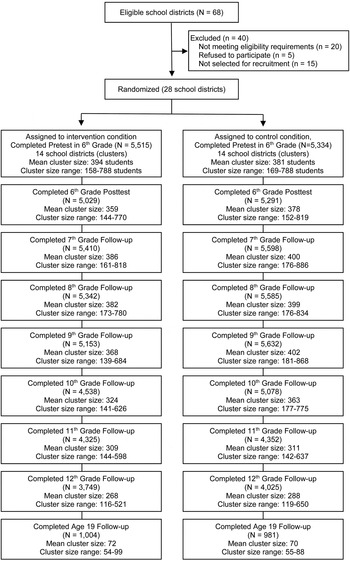
The study began with two successive cohorts of 6th graders enrolled in the 28 participating school districts. Figure 1 summarizes sample tracking over the waves of data collection. All enrolled 6th graders from the two cohorts were recruited for participation. Approximately 90% of the eligible sample provided baseline data. Most students were White (85%), 51% were female, 64% lived with both biological parents, and 31% received free or reduced-cost school lunchesFootnote † Footnote 1 . The average age of participants was 11.8 years at baseline and 19.5 years for the current report.
In-school survey and emerging adult follow up assessment: total participation by wave. *Note: Reported participation rates include all students in both study cohorts completing the in-school survey at the indicated wave through 12th grade. All students enrolled in the project school districts and in the targeted grades were eligible for participation, regardless of their participation in earlier survey waves, as a result, participation at later waves may exceed participation at pretest. Emerging adult assessments were conducted with randomly selected participants from the in-school assessment sample that completed 6th grade pretest assessments and were still enrolled in their baseline school district in the 9th grade.

In-class pretest self-report assessments were conducted with 6th graders during the fall semesters of 2002 (for Cohort 1) and 2003 (for Cohort 2). Follow-up assessments through high school were conducted annually in the springs of 6th–12th grade (i.e. from 0.5 to 6.5 years past baseline). On average, 88% of all eligible students completed in-school surveys across the eight data points, with slightly higher rates of participation at earlier data collection points.
Because of the high cost of following the entire sample into adulthood, after the spring of 12th grade, a randomly selected subsample of 1985 youth were recruited for continued follow-up. Participants who completed the 6th grade baseline assessment and were still enrolled in the same school district in the 9th grade were eligible for participation. Subsample selection was stratified by school district, gender, and risk status. Risk status was based on how many of the following five factors were reported by participants at baseline: lifetime gateway substance use (alcohol, cigarettes, or marijuana); conduct problem behaviors (at least 2 of 12); eligibility for the free/reduced cost school lunch program; lower family cohesion (dichotomized); and living with only one or no biological parents. Students were classified as higher-risk if they reported (a) any three or more of the five risk factors or (b) two risk factors, if gateway substance use and/or conduct problems were among the two. In order to have sufficient statistical power to investigate risk-related moderation effects when applying multilevel analytic models, higher-risk participants were oversampled. They comprised 37.4% of the participating subsample, v. 29.2% of the eligible sample. At age 19, participants could complete assessments either through a computer-assisted telephone interview or a web-based survey (16% and 84%, respectively). Sample and survey participation by school district and risk level is available online.
PROSPER partnership delivery system
In the communities assigned to the intervention condition, stakeholder teams of 8–12 individuals were formed, including the local CES-based team leader, a public school co-leader, representatives of local human service agencies (e.g. mental health, substance abuse), and parent and youth representatives. Teams selected a sequence of two interventions from a menu of evidence-based programs to be delivered, beginning with a family-focused intervention for 6th graders and their parents, followed by a school-based intervention implemented for the same cohort of youth in 7th grade. As part of the trial, communities administered these programs for two successive cohorts of students. (See the detailed description online.)
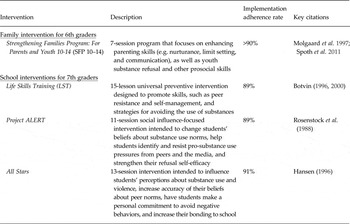
For their family-focused intervention, all 14 community teams selected the Strengthening Families Program: For Parents and Youth 10-14 (SFP 10–14). For their school-based intervention, four community teams selected Life Skills Training (LST), four selected Project Alert, and six selected the All Stars curriculum. Brief information on each program is in Table 1 (for more detail, see Spoth et al. Reference Spoth, Redmond, Shin, Greenberg, Clair and Feinberg2007c ).
Brief description of PROSPER universal preventive interventions

Family intervention for 6th graders
Across the two successive cohorts of families of 6th graders, there were 142 SFP 10–14 program groups offered in the 14 intervention communities. A total of 1064 families attended at least one session, representing 17% of all eligible families. Of these, 90% attended at least four of the seven sessions and 63% attended at least six.
School interventions for 7th graders
The school-based program was implemented with Cohort 1 7th grade students in the second year of model implementation and with the Cohort 2 7th grade students the following year. Each school-based program was delivered in a class normally taken by all 7th grade students, generally by a trained classroom teacher (Spoth et al. Reference Spoth, Guyll, Lillehoj, Redmond and Greenberg2007b ).
Measures
Outcomes evaluated at age 19 were selected to (a) provide continuity with prior outcome reports, and (b) encompass developmentally-relevant young adult problem behaviors that have the potential for significant social-, health-, and economic-related harm. Measures were informed by those reported in previous studies (e.g. Spoth et al. Reference Spoth, Redmond and Shin2001) and included self-reported substance misuse, conduct problems in the form of antisocial behavior, HRSBs, and STIs. Substance misuse outcomes include lifetime use of illicit or non-prescribed drugs, drug- and alcohol-related problems, along with current use and frequency of use of more commonly used substances. Substance misuse questions were adapted from Monitoring the Future items (Johnston et al. Reference Johnston, O'Malley, Bachman, Schulenberg and Miech2015a ); items assessing antisocial behaviors were adapted from Elliott et al. (Reference Elliott, Huizinga and Ageton1985). Multi-item measures in the current report are count indices designed to assess cumulative numbers of risk behaviors or negative outcomes (in contrast to scales representing latent constructs assessed via multiple indicators); for this reason, alpha reliabilities were not calculated.
Lifetime substance misuse and related problems
Lifetime substance misuse measures included use of marijuana, cocaine, ecstasy, methamphetamine, LSD, non-prescribed narcotics, and amphetamines, scored as any use (1) vs. no use (0). The Illicit Substance Use Index includes lifetime use of five substances (dichotomized and summed); methamphetamine, ecstasy, LSD (or other hallucinogens, including mushrooms), cocaine, and GHB or Rohypnol. The Prescription Drug Misuse Index measured ‘overall’ prescription drug misuse and included three items (dichotomized and summed) addressing lifetime non-prescribed use of narcotics (e.g. Vicodin, Oxycontin, Percocet), amphetamines, and barbiturates.
Current use and frequency
More commonly used substances were measured with a, 1-month time frame; a 1-year time frame was applied for those substances less frequently used. These dichotomous measures indicated past-month drunkenness, past-month cigarette smoking, past-year marijuana use, and past-year use of narcotics not prescribed by a doctor. Past-year frequency of use was assessed for cigarette use, drinking, drunkenness, driving after drinking, marijuana use, and narcotic use. Frequencies were truncated at 150 times in the past year to prevent undue influence of outliers.
Drug- and alcohol-related problems
Indices were constructed to assess problems resulting from drug use and from alcohol use. Each index consisted of 15 dichotomous items adapted from the Short Inventory of Problems: Alcohol and Drugs (Blanchard et al. Reference Blanchard, Morgenstern, Morgan, Lobouvie and Bux2013) and addressed a range of substance-related problems and issues. Adaptation for the current study involved constructing measures to address drug- and alcohol-related problems separately, in contrast to the original measure, which assessed drug and alcohol problems jointly. Examples include: ‘You have failed to do what's expected of you because of your [drug/alcohol] use,’ and ‘You have had money problems because of your [drug/alcohol] use.’
HRSBs and STIs
HRSBs were assessed as an index of 11 dichotomously scored items. Examples include: lifetime intercourse, lifetime anal intercourse, number of intercourse partners (three or more), number of anal intercourse partners (more than one), past-year intercourse with someone they did not know well, and early onset of first intercourse (before age 14). STIs were assessed as an index of seven dichotomous items assessing lifetime diagnoses of gonorrhea, syphilis, herpes or warts, chlamydia, Hepatitis B, AIDS/HIV, and any other STI.
Antisocial behaviors
A count of antisocial and delinquent or illegal behaviors, adapted from Elliott et al. (Reference Elliott, Huizinga and Ageton1985), was constructed using 13 dichotomously-scored self-report items concerning past-year behaviors (behavior present v. absent). Example behaviors include: ‘Steal money or take something that did not belong to you,’ ‘Beat up or fight with someone because you were mad at them,’ ‘Drive a car recklessly,’ and ‘Sell stolen goods.’
Analyses
Multi-level ANCOVAs were conducted to test for intervention effects on outcomes. Binary outcomes were analyzed using SAS PROC GLIMMIX; other outcomes were analyzed using SAS PROC MIXED. These analytic procedures were selected to accommodate this study's cluster-randomized design and address relevant variance components across model levels. Analyzed models included the design factors of block (school district size and location), experimental condition, cohort, and state. An intent-to-treat approach was applied for all analyses. Effect size estimates are based on Cohen's d. In the last report on PROSPER high school outcomes, one-tailed significance levels and related p-values were applied because all intervention-control differences were in the expected direction at each earlier wave of data collection. For the current report, because less evidence was available to definitively support unidirectional hypotheses of effects at this developmental stage and for new measures of health-risking and other behaviors not previously tested with this sample, two-tailed p values are reported. Risk status was included as a post-hoc factor; Risk × Condition was included in order to assess risk moderation effects (conducted using the CONTRAST statement in SAS PROC MIXED and GLIMMIX). Risk-related moderation analyses were conducted to evaluate whether intervention effects for higher-risk youth were comparable to or stronger than effects for lower risk youth, as has been found in earlier analyses of PROSPER data. Although this risk measure is slightly different than the one used in earlier reports (Spoth et al. Reference Spoth, Redmond, Clair, Shin, Greenberg and Feinberg2011, Reference Spoth, Redmond, Shin, Greenberg, Feinberg and Schainker2013a ), it was selected because it is the measure that was used to stratify the young adult sample. Notably, 85% of those classified as higher- or lower-risk using this measure would be in the same risk classification category using the prior measure (which was based exclusively on gateway substance initiation at the baseline assessment).
Model-based relative reduction rates (RRRs) were calculated for binary outcomes to illustrate the practical significance of findings; they indicate the proportional reduction in behaviors in the intervention group relative to controls; that is, how much lower the estimated prevalence of a behavior is for those in the intervention group than in the control group, expressed as a percentage of the control group prevalence (e.g. if the estimated prevalences in the intervention and control groups were 40% and 50%, respectively, the RRR for the intervention group would be 20% [i.e.: (50–40%) ÷ 50% = 20%].
Results
Sample quality
Pretest equivalence of the two conditions was assessed; there were no significant differences on any sociodemographic measure (e.g. gender, age, race, school lunch status) or on any outcomes. Differential representation in the age 19 sample was assessed by examining whether the two-way interaction of Condition × Outcome pretest score predicted participation at age 19. No significant interactions were found.
Intervention effect estimates
Intervention main effect estimates (IMEE)
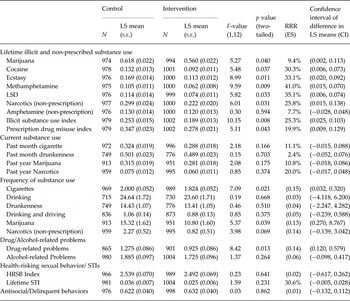
IMEEs are reported in Table 2. Results show significant IMEEs indicating lower levels of substance misuse in the intervention group across a range of substance use outcomes: Significant IMEEs were found for lifetime use of most individual illicit drugs (marijuana, cocaine, ecstasy, methamphetamine, LSD, non-prescription narcotics), as well as for the illicit and prescription drug misuse indices. In addition, significant IMEEs were found for the drug-related problems index and for the frequencies of cigarette and marijuana use. RRRs for significant binary outcomes favored the intervention group in all instances, and ranged from 9.4% (lifetime marijuana use) to 41.0% (lifetime methamphetamine use). There were no significant findings for current use measures, nor for HRSB or STI indices, or for the antisocial behavior index.
Intervention-control differences for emerging adult outcomes

LS Means are model-based means. Analytic models include Block (school district size and location), State, Intervention Condition, and Cohort as design factors and Risk Status as a post-hoc factor. Analyses of binary outcomes were conducted using SAS PROC GLIMMIX; Relative Reduction Rates (RRRs) were calculated for binary outcomes. Analyses of continuous outcomes were conducted using PROC MIXED; Cohen's d was employed for effect size calculations.
To evaluate the sensitivity of results to the factors included the analytic model, we conducted analyses utilizing a simpler analytic model. Results were similar to those reported above.Footnote 2 In addition, to further evaluate whether effects observed during high school were sustaining, diminishing or increasing, post hoc analyses also were conducted to examine substance new user rates after the post high school time point. Results showed those rates were lower for the intervention group for all outcomes, with one exception, but that they did not attain statistical significance (two-tailed).Footnote 3 These supplemental analyses are consistent with the suggestion of sustaining effects evidenced when applying the full analytic model based on the experimental design.
Risk moderation of intervention effect estimates
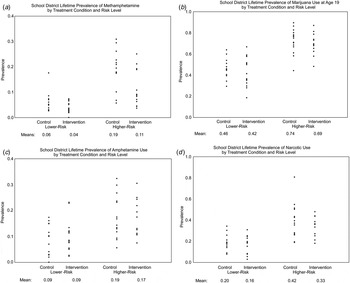
Risk moderation analyses found a significant Condition by Risk effect only for drug-related problems—the intervention effect estimate in this case was larger for the higher risk participants. However, that noted, the intervention-control difference was larger for the higher-risk participants than the lower-risk participants for most outcome variables (see online supplement for the table of risk moderation results). To illustrate the observed patterns of findings across study sites (school districts) by treatment condition and risk level, scatterplots for representative outcomes are provided in Fig. 2.
Illustrative outcomes for each school district by intervention condition and risk level: Life time prevalence of (a) methamphetamine use; (b) marijuana use; (c) amphetamine use; and (d) norcotics use.

Discussion
Results indicated that a CLEAR pattern of statistically significant PROSPER intervention effect estimates on primary substance misuse outcomes, previously found through the 12th grade, was still in evidence at age 19. These findings provide support for the utility of the PROSPER delivery system to provide preventive health benefits into emerging adulthood. It is noteworthy that, despite the changes occurring in participants’ social environments following high school, evidence of positive intervention impact remained.
Overall, evidence for positive intervention effects was most pronounced for the primary substance misuse outcomes targeted by PROSPER, particularly lifetime misuse of illicit substances and non-prescribed narcotics, drug use problems, and non-alcohol-related frequency measures. The reasons for the lack of significant results for current use outcomes are not entirely clear; in all cases the mean scores favored the intervention group, and the RRRs were in the 10–20% range in three of four cases. In the case of marijuana use, intervention effect tests were statistically significant for both lifetime and frequency outcomes, suggesting that the dichotomous, current use measures might have been less sensitive to intervention-control differences. There also may be different patterns of current use among subgroups of participants defined by college enrollment or other changes in physical and social environments (e.g. change to a non-rural residence). Following the next wave of data collection, when participants will be completing their college years, we will examine this possibility. Alcohol-related effects were non-significant at age 19. Current alcohol use and frequency outcomes continued to reflect the general pattern of findings in the high school waves of data collection; that is, outcomes were weaker than those concerning illicit or non-prescription drug use.
Although significant intervention effect estimates for antisocial behaviors were found through high school (Spoth et al. Reference Spoth, Trudeau, Redmond, Shin, Greenberg, Feinberg and Hyun2015), effect estimates for antisocial and illegal behaviors were non-significant at age 19, when developmental trends indicate that these behaviors in general populations begin to decline (Sameroff et al. Reference Sameroff, Peck and Eccles2004). The lack of significant intervention-control differences could be the result of a combination of factors, including developmental epidemiological trends toward lower prevalence of the types of behaviors assessed. The types of items included in the antisocial behavior index are representative of the behaviors that are prevalent during late adolescence; more serious forms of young adult antisocial or offending behaviors (e.g. arrest records) will be obtained and reported for a subsequent wave of data collection.
Because the low overall rates of both lifetime STIs (approximately 3%), and HRSBs (approximately 3%, with an approximate mean of 2.5 of 11 potential risk behaviors) constrained variability, our ability to detect intervention-control differences was limited; intervention effect estimates were non-significant for both outcomes. HRSBs were examined as a possible ‘crossover’ outcome of the interventions delivered, given that there was no instructional content directly addressing these behaviors.
In contrast to findings during the 11th and 12th grades (Spoth et al. Reference Spoth, Trudeau, Redmond, Shin, Greenberg, Feinberg and Hyun2015), risk moderation results at age 19 were considerably more limited. In part, this may be due to the smaller sample selected for longer follow-up. Nonetheless, the pattern showing generally stronger intervention effect estimates for the higher-risk group was consistent with the pattern in earlier analyses described in the introduction. One consideration is that, despite the originally large sample size, due to the modest number of clusters in the analysis (at level 2), this follow-up study was potentially underpowered. Analyses of main effects were likely underpowered in some cases, and the analyses of risk-related moderation effects, were likely underpowered in most cases.
The most recent major reports on the prevention of behavioral health-related disorders by the National Research Council and the Institute of Medicine (NRC-IOM, Reference O'Connell, Boat and Warner2009), and on addiction prevention by the US Surgeon General (US Department of Health and Human Services, Office of the Surgeon General, 2016) noted the important knowledge gap concerning the effects of adolescent-stage preventive interventions on young adult outcomes. The current findings add to a growing literature addressing this gap and indicate the potential benefits of developmentally well-timed interventions in early adolescence for substance-related outcomes during emerging adulthood, further substantiating results concerning substance misuse presented in our earlier reports from other projects (Spoth et al. Reference Spoth, Trudeau, Guyll, Shin and Redmond2009b , Reference Spoth, Clair and Trudeau2014a , Reference Spoth, Trudeau, Redmond and Shin b ), and from other research groups that have reported results into young adulthood (Oesterle et al. Reference Oesterle, Hawkins, Kuklinski, Fagan, Fleming, Rhew, Brown, Abbott and Catalano2015).
As described in the introduction, we hypothesized that intervention effects on putative proximal mediators of externalizing behaviors, including enhanced young adolescent skills, parenting, and family environment would lead to subsequent effects on substance misuse and associated, health-risking behaviors. Results from prior PROSPER reports on proximal mediators, including positive effects on peer social networks (Osgood et al. Reference Osgood, Feinberg, Gest, Moody, Ragan, Spoth, Greenberg and Redmond2013) and crossover effects on non-targeted behaviors, are consistent with these mechanisms of effects. Moreover, early initiation is one of the most powerful predictors of later substance misuse. In earlier reports, we found delayed initiation among intervention group youth; such delays typically are associated with reduced substance misuse in late adolescence and emerging adulthood (Grant & Dawson, Reference Grant and Dawson1998; Grant et al. Reference Grant, Stinson and Harford2001). This point highlights the critical importance of the developmental timing of preventive intervention. PROSPER community teams delivered the interventions when some students were beginning to experiment with substance use, but before they moved to more frequent or serious use. Nonetheless, prior reports also indicate that, for adolescents who began substance experimentation early, the progression to more serious use was dampened by the interventions (e.g. Spoth et al. Reference Spoth, Trudeau, Guyll, Shin and Redmond2009b , Reference Spoth, Trudeau, Redmond and Shin2014b ).
The reported RRRs provide one metric with which to gauge the potential public health significance of PROSPER. RRRs for the dichotomous outcomes significantly affected by the interventions ranged from 9.4% to 41.0%. To illustrate, the RRR for lifetime non-prescribed narcotics use (25.8%) suggests that, for every 100 general population young adults (i.e. from non-PROSPER communities/school districts) who have ever misused narcotics, approximately 74 young adults from PROSPER sites would have misused narcotics. The combination of positive outcomes and cost-efficiency of the PROSPER partnership model (Spoth & Greenberg, Reference Spoth and Greenberg2011; Crowley et al. Reference Crowley, Jones, Greenberg, Feinberg and Spoth2012) suggests its potential public health benefit, particularly in light of the likely long-term effects of reduced young adult substance misuse (e.g. Hawkins et al. Reference Hawkins, Kosterman, Catalano, Hill and Abbott2005, Reference Hawkins, Kosterman, Catalano, Hill and Abbott2008b ; Spoth et al. Reference Spoth, Clair and Trudeau2014a ; Trudeau et al. Reference Trudeau, Spoth, Mason, Randall, Redmond and Schainker2016). The National Research Council and Institute of Medicine Report (Reference O'Connell, Boat and Warner2009) and the recent US Department of Health and Human Services (HHS), Office of the Surgeon General Report (2016), along with other literature (Hawkins et al. Reference Hawkins, Catalano, Arthur, Egan, Brown, Abbott and Murray2008a , Reference Hawkins, Oesterle, Brown, Monahan, Abbott and Arthur2012), note the practical benefits of community-based prevention delivery systems for EBIs, particularly those embedded in national delivery systems and/or those supporting practitioner-scientist partnerships (Grumbach & Mold, Reference Grumbach and Mold2009; Spoth & Greenberg, Reference Spoth and Greenberg2011).
There are important limitations to keep in mind when considering the findings reported here. First, the sample was drawn from rural and small town populations; generalization to urban settings and/or populations that differ in relevant characteristics, such as ethnicity or geographic location, has not yet been established and will require additional research. Second, our outcome measures were based on self-reports. Self-reports may be susceptible to social desirability biases, although youth and young adult self-reports have been found to be valid in other studies (Murray et al. Reference Murray, O'Connell, Schmid and Perry1987; Smith et al. Reference Smith, McCarthy and Goldman1995). In this regard, it should also be noted that such biases, if present, would likely affect both the intervention and control groups in a similar manner, especially given the number of years that had elapsed between intervention delivery (in the 6th and 7th grades) and the age 19 assessments. Third, readers should be cognizant of the number of statistical tests conducted independently with similar types of outcomes; significance level adjustments to account for multiple tests are left to the discretion of the reader. Finally, this study is subject to the universally applicable threats to validity in experimental studies associated with the potential omission of relevant variables and the failure of randomization to balance all pertinent factors.
In conclusion, these findings support the hypothesis that implementation of the PROSPER delivery system reduces levels of substance misuse through age 19, sustaining the positive results found during adolescence, and thus further enhancing its potential public health value and supporting its evaluation and dissemination in additional communities. The practical benefits of community-based prevention delivery systems have been documented and supported in the literature (Grumbach & Mold, Reference Grumbach and Mold2009; US Department of Health and Human Services (HHS), Office of the Surgeon General, 2016). The PROSPER partnership model has potential to facilitate effective and efficient translation of preventive health interventions into community practice.
Supplementary material
For supplementary material accompanying this paper visit https://doi.org/10.1017/10.1017/S0033291717000691.
Acknowledgements
Work on this paper was supported by research grant DA13709 from the National Institute on Drug Abuse and co-funding from the National Institute on Alcohol Abuse and Alcoholism (R01 AA14702).
Declaration of Interest
None.
Ethical Standards
The authors assert that all procedures contributing to this work comply with the ethical standards of the relevant national and institutional committees on human experimentation and with the Helsinki Declaration of 1975, as revised in 2008.