Public attitudes and legal protections regarding lesbian, gay, bisexual, transgender and queer (LGBTQ)Footnote 1 identified persons are changing rapidly in many regions, including the United States, Europe and Latin America (Asal, Sommer, and Harwood Reference Asal, Sommer and Harwood2013; Ayoub Reference Ayoub2016; Brewer Reference Brewer2003; Kollman Reference Kollman2007). However, across Africa, the gay community continues to face physical and rhetorical threats.Footnote 2 Most of this backlash comes from government and religious leaders who claim that foreign, pro-gay norms are spreading across the continent. In response, governments frequently censor the mediaFootnote 3 to limit the marketplace of ideas and prevent exposure to pro-LGBTQ representation. For example, a governmental board in Kenya recently banned six cartoons for ‘glorifying homosexual behavior’(Dahir Reference Dahir2017). Critically, because a single cable company often provides services in several African countries, censorship in one country affects dozens of markets. At the same time, LGBTQ activists across Africa often view the media as an important tool to advance their cause. The Pan African International Lesbian, Gay, Bisexual, Trans and Intersex Association describes the media as a ‘key target group’ and conducts media training for member organizations (Lusimbo and Oguaghamba Reference Lusimbo and Oguaghamba2017). Activists often use online mediums to positively shift the national dialogue about same-sex rights, or to call attention to violence against LGBTQs. The persistent accusations about the media's role in spreading pro-gay attitudes, the prevalence of media censorship across the continent, and activists' use of media as a tool all raise important questions about the media's influence on public opinion of gays across Africa.
I study if, and how, media consumption explains individual support for homosexuality in thirty-three African countries. A robust literature argues that the media plays a role in shaping public opinion (Iyengar and Kinder Reference Iyengar and Kinder1987; McCombs and Shaw Reference McCombs and Shaw1972), partially because it exposes individuals to new information (Mutz Reference Mutz2002). However, others note that the media's effects may be limited to nonpartisan topics (Barberá et al. Reference Barberá2015), and that the media may not facilitate exposure to new information if its consumption is driven by ideology (Sunstein Reference Sunstein2001) or if it is easily manipulated by the government (Roberts Reference Roberts2018). More specific to LGBTQs, recent work by Ayoub and Garretson (Reference Ayoub and Garretson2016) shows that increased access to diverse media explains some of the growing global support of same-sex relations. However, there is scarce research on public opinion of LGBTQs in Africa, and virtually no research on the relationship between media use and gay support across the continent.Footnote 4
I develop a theory that accounts for the variety of ways in which pro- and anti- gay-rights actors engage with the media, which generates clear expectations about how different types of media create distinct effects on public opinion of LGBTQs. I argue that increased overall media consumption enhances support for LGBTQs, but that this effect is driven by consumption of newspaper, internet and social media. This is because government censorship of queer content is often directed at television programs that contain positive representations of LGBTQs. However, because governments actively promote their censorship of queer content, it may actually increase discussion of LGBTQs in other mediums such as newspaper and the internet. This effect is compounded by the fact that newspapers and the internet are more difficult to censor than radio and television (Cottle Reference Cottle2011; Lynch Reference Lynch1999), and that these mediums, particularly the internet, contain more international content.Footnote 5
My argument draws from, and contributes to, the literatures on political behavior, communications, social psychology and LGBTQ politics. I build on extensive research debating the connection between information exposure (Ferraz and Finan Reference Ferraz and Finan2008; Lupia and McCubbins Reference Lupia and McCubbins1998), including from the media (Farrell Reference Farrell2012; Iyengar and Kinder Reference Iyengar and Kinder1987), and political behavior and beliefs. I extend this debate to Africa and provide new evidence that the media can have an independent effect on beliefs, but that the effect varies across mediums. While some of this variation may be driven by how individuals select into media diets (Sunstein Reference Sunstein2001), government censorship also influences the media's effects on public opinion (Roberts Reference Roberts2018). However, while prior studies argue that governments intentionally conceal their censorship (Lorentzen Reference Lorentzen2014; Roberts Reference Roberts2018), I show that governments proudly publicize their crackdowns on queer content in TV, and develop a new theory of how this increases discussion of LGBTQ identity in other mediums. Finally, I contribute to an important debate about how exposure to out-groups affects prejudicial beliefs (Enos Reference Enos2017; Pettigrew and Tropp Reference Pettigrew and Tropp2006). While scholars have found mixed evidence on the effects of inter-ethnic exposure across Africa (Miguel and Gugerty Reference Miguel and Gugerty2005; Scacco and Warren Reference Scacco and Warren2018), I provide some of the first evidence on the effects of exposure to LGBTQs and explain why it is different than other types of out-group contact.
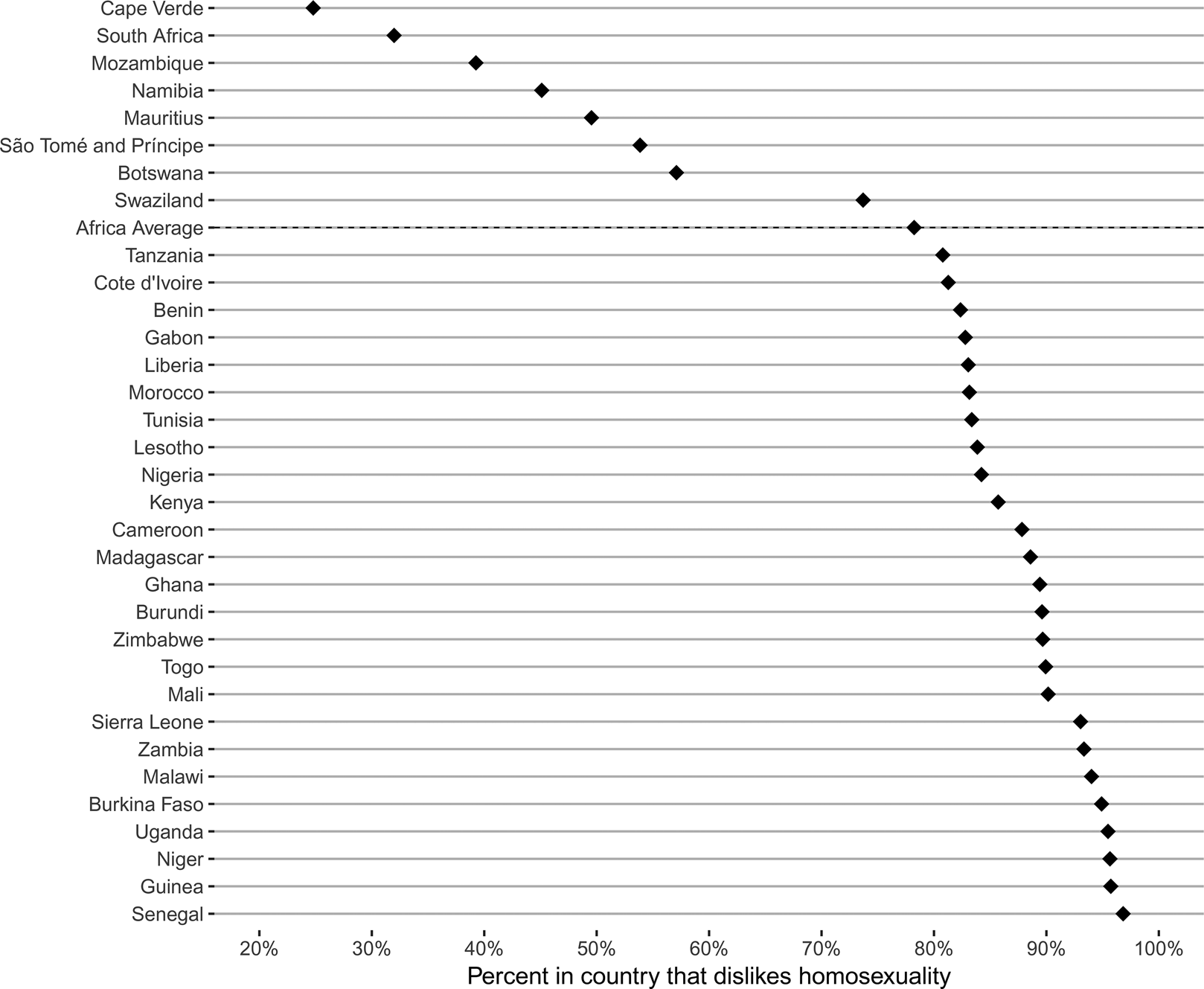
I apply these theories on the African continent, where gay rights are increasingly politicized and where there are rapid changes in media consumption habits (see Table 1). To test hypotheses, I use cross-national survey data from Afrobarometer Round 6 conducted in 2014 and 2015. At baseline levels, I find that 78 per cent of respondents report negative attitudes towards homosexuality. However, individuals who consume more media overall are 4–8 per cent more likely to express pro-gay beliefs. As expected, the size and significance of this effect differs across mediums. Radio and television have no, or a negative, significant effect on pro-gay attitudes, whereas individuals who consume more newspapers, internet or social media are significantly more likely to support LGBTQs (by approximately 2 to 4 per cent). These results are stable across a number of sensitivity analyses that address concerns such as selection effects. Finally, through content analysis of radio, newspaper and the internet, I provide preliminary evidence that the mechanism driving these effects is increased access and exposure to positive LGBTQ representation.
Percent of Afrobarometer respondents who consume media at least once per month

While existing studies have similarly found that out-group exposure, including from the media, reduces prejudicial beliefs, it is critical to understand how this finding translates to other settings. This is especially true for public opinions of sexual minorities because, unlike other forms of social diversity such as race or ethnicity, LGBTQs are a minority in every country. In addition, because LGBTQ identity does not determine political coalition formation, and because LGBTQ politics is not (yet) a partisan issue in most of Africa, I argue that increased exposure to queer identity is unlikely to spark the types of backlash or ideological retrenchment that are common with other forms of out-group exposure. Ultimately, my results suggest that, although governments may effectively suppress LGBTQ content from television, increased discussion of LGBTQ identity in other mediums alongside expanding internet access may help to increase public support of LGBTQs.
Theoretical Motivation
Media, Public Opinion and Support of LGBTQs
Prior studies have long argued that the media shapes public opinion (Iyengar and Kinder Reference Iyengar and Kinder1987; McCombs and Shaw Reference McCombs and Shaw1972), including on a number of socio-political issues such as the death penalty (Baumgartner Reference Baumgartner2008), civil liberties (Swigger Reference Swigger2013), and religion, gender and sexual activity (Norris and Inglehart Reference Norris and Inglehart2009). Increased usage of the internet and social media, in particular, creates new questions about the media's effect on political behavior. While many studies are optimistic about the internet's role in politics, including its positive effect on political engagement and intergroup trust (Jennings and Zeitner Reference Jennings and Zeitner2003; Kittilson and Dalton Reference Kittilson and Dalton2011; Lupia and Philpot Reference Lupia and Philpot2005; Robertson Reference Robertson2017), others have raised concerns about its negative effects on democracy (Persily Reference Persily2017; Sunstein Reference Sunstein2001). I discuss these arguments and identify two mechanisms through which the media may affect public opinion of LGBTQs: by exposing individuals to positive representations of LGBTQs, and by exposing individuals to new information in general.
First, increased representation of openly gay persons in television, movies and the news exposes viewers to LGBTQs and can induce positive attitudinal change. This builds on the idea that exposure to social out-groups reduces prejudicial attitudes towards those groups (Pettigrew and Tropp Reference Pettigrew and Tropp2006). While many studies on social diversity focus on the effects of interethnic (Kasara Reference Kasara2013; Scacco and Warren Reference Scacco and Warren2018) or inter-religious exposure (Raymond Reference Raymond2016), there is mounting evidence that exposure to LGBTQ persons via interpersonal contact has an especially strong effect on pro-gay attitudes (Broockman and Kallah Reference Broockman and Kallah2016; Flores Reference Flores2015; Flores et al. Reference Flores2017; Herek and Capitanio Reference Herek and Capitanio1996; Lewis et al. Reference Lewis2017; Lewis Reference Lewis2011; Tadlock et al. Reference Tadlock2017). Critically, exposure to LGBTQs via the media, or parasocial contact (Schiappa, Gregg, and Hewes Reference Schiappa, Gregg and Hewes2005), can produce similar positive effects on attitudes (Garretson Reference Garretson2015; Jones et al. Reference Jones2018; Schiappa, Gregg, and Hewes Reference Schiappa, Gregg and Hewes2006). Television shows such as Queer as Folk and Will and Grace are cited as examples of gay representation that helped shift the tide towards pro-gay attitudes in the United States (Gross Reference Gross2001). Today, several shows such as Pose, Empire and Sense 8 are lauded for providing representation of transgender and non-white LGBTQs.
While others have found that exposure to social out-groups can increase bias beliefs (Enos Reference Enos2014; Forbes Reference Forbes1997), leading to increased violence (Lim, Metzler, and Bar-Yam Reference Lim, Metzler and Bar-Yam2007) and the discriminatory (Lieberman Reference Lieberman2009) and inefficient (Habyarimana et al. Reference Habyarimana2007) provision of resources, there are at least two key reasons why exposure to LGBTQ identity may create different outcomes. First, many of the studies that predict negative effects from intergroup contact focus on social identities, such as ethnicity or religion, that are intertwined with the formation of political coalitions and, therefore, decisions regarding the distribution of scarce resources. However, LGBTQs transcend these ethnic and religious factions (meaning that all LGBTQ individuals are not either Catholic or Muslim, Kikuyu or Luo, etc.), and are not aligned with major political power centers in Africa. In other words, heterosexuals can adopt pro-gay attitudes without concern that LGBTQs will threaten their access to public goods. Secondly, the ways in which out-group exposure affects prejudiced beliefs is likely to be conditional on local levels of segregation. Enos (Reference Enos2017) shows that when segregation is high, exposure to an out-group is more likely to increase prejudice, whereas where segregation is low, exposure is likely to decrease prejudice. However, gay and non-gay identity is rarely, if ever, segregated in ways similar to other identities such as race, ethnicity or religion. Therefore, while increased politicization of LGBTQ rights is often framed as a moral threat, it is unlikely that increased exposure to LGBTQs will be seen as a threat to political and economic power, as is often the case with religious and ethnic groups.
Secondly, media consumption can induce attitudinal change by serving as a conduit of new information. Here, exposure still matters, but it is less about exposure to out-groups and more about exposure to information that contradicts existing beliefs. Exposure to new information often prompts additional information seeking (Marcus, Neuman and MacKuen Reference Marcus, Neuman and MacKuen2000), and has been shown to increase public discourse (Habermas Reference Habermas1989) and the diversity of political views (Manin, Stein and Mansbridge Reference Manin, Stein and Mansbridge1987; Mutz Reference Mutz2002). This argument assumes, first, that increased media consumption does expose individuals to new information and, secondly, that individuals update their beliefs when confronted with this new information. However, an individual's frequency and type of media consumption may not be orthogonal to their social attitudes. Research shows that individuals often select into information that confirms existing beliefs (Kroh and Neiss Reference Kroh and Neiss2009). This may be especially true among social media users and could create a situation in which increased media consumption actually leads to decreased contact between people with opposing views (that is, echo chambers) (Prior Reference Prior2007; Sunstein Reference Sunstein2001).Footnote 6 However, others have found that the presence of echo chambers varies by political topic and over time (Barberá et al. Reference Barberá2015), and that ideological segregation is much lower on the internet than it is among in-person social networks (Gentzkow and Shapiro Reference Gentzkow and Shapiro2010). Even if individuals select into homogeneous online communities, there is evidence that incidental exposure to cross-cutting views is common online (Flaxman, Goel, and Rao Reference Flaxman, Goel and Rao2016). Regardless, in the analysis, I take seriously this mixed evidence on media effects and include a number of robustness tests to guard against selection bias.
To fulfill the second assumption, individuals must not only be exposed to new information but must also be willing to update their beliefs. While experimental evidence suggests that citizens do change their opinions when presented with information that contradicts previously held beliefs (Gilens Reference Gilens2001; Kuklinski et al. Reference Kuklinski2000), others have found that citizens are resistant to new information. Nyhan and Reifler (Reference Nyhan and Reifler2010) find that when individuals are presented with corrective information about their political misperceptions, they often double down on their existing beliefs. This could be because individuals often interpret new information through an ideological lens (Taber and Lodge Reference Taber and Lodge2006). However, unlike recent years in the United States and in some European countries, LGBTQ politics is not a highly partisan issue across Africa. There are few, if any, major political parties in Africa that list LGBTQ rights as part of their platform. This makes it less likely that exposure to queer identity will motivate anti-gay attitudes.
Media, Norm Diffusion and Censorship of Queer Content
For either of the two mechanisms outlined above to influence LGBTQ-related attitudes, citizens must have access to media that contains gay representation and/or new information. Several factors, including the diffusion of international media, the capacity and strategy of government censorship, and the ways in which local gay-rights organizations utilize the media, all affect the degree to which this content is available across Africa. International relations scholars have long argued that a variety of instruments, including non-state actors (Keck and Sikkink Reference Keck and Sikkink1998), institutions (Finnemore and Sikkink Reference Finnemore and Sikkink1998) and epistemic communities (Adler Reference Adler1992), diffuse dominant norms around the world. Today, increased access to diverse mediums raises new questions about the ways in which norms spread. Scholars have argued that both television and the internet generate cross-border norm diffusion that facilitates democratic transitions (Huntington Reference Huntington1991; Linz and Stepan Reference Linz and Stepan1996) and the spread of progressive liberalism (Norris and Inglehart Reference Norris and Inglehart2009). Similarly, Ayoub and Garretson (Reference Ayoub and Garretson2016) find that LGBTQ representation, coupled with the diffusion of media across borders, has led to growing global support for homosexuality.Footnote 7
The degree to which pro-gay and/or diverse content is diffused across borders is also a function of government censorship. Despite important scholarly work on the strategic nature of government censorship (Lorentzen Reference Lorentzen2014), we know very little about how governments censor queer content in particular. Recent studies on censorship in authoritarian contexts show that, rather than apply sweeping restrictions, governments often target their censorship on information that is likely to spark mobilization (King, Pan and Roberts Reference King, Pan and Roberts2013), or choose more discrete approaches such as spreading propaganda and misinformation online (King, Pan, and Roberts Reference King, Pan and Roberts2017; Roberts Reference Roberts2018). Governments use these strategic, discrete approaches because when censorship is obvious citizens are more likely to find ways to circumvent the restrictions (Roberts Reference Roberts2018). This suggests that governments can employ sophisticated censorship of queer content and effectively prevent exposure across all mediums.
However, I argue that queer censorship in Africa differs from other forms of censorship in three ways. First, whereas much of the research on censorship is focused on explicitly political content that could undermine the regime (that is, negative information about political leaders), queer censorship tends to focus more on stories, images and other representations of gay life. In turn, the most obvious target for queer censorship is television. Secondly, unlike other forms of censorship where governments prefer that citizens not know about their actions (Roberts Reference Roberts2018), African politicians often make bold public statements about their crackdown on gay content. This can create the opposite effect by increasing newspaper, internet and social media discussion of LGBTQs – including positive coverage that is driven by LGBTQ activists – and encouraging citizens to find information online (Hobbs and Roberts Reference Hobbs and Roberts2018). Increased media coverage will not necessarily induce empathy for LGBTQs if citizens interpret the coverage through a partisan lens (Taber and Lodge Reference Taber and Lodge2006); however, because LGBTQ support is not a partisan issue across Africa, this type of ideologically motivated reasoning is less likely. Finally, governments in general have more power to censor traditional forms of media such as radio and television than they do to censor new media such as the internet (Cottle Reference Cottle2011; Lynch Reference Lynch1999). Although African governments do successfully manipulate online content, this censorship is typically focused on political content near elections (Matfess Reference Matfess2016). In sum, I argue that the media's effect on LGBTQ-related attitudes is conditional on the degree of norm diffusion and queer censorship, and that these conditions vary across mediums.
Setting: Media Censorship and LGBTQ Support in Africa
Expanding internet access, the persistence of government censorship and heightened politicization of sexuality make Africa an especially critical region for this study. Many believe that homophobia is rampant on the continent. Descriptive data, reported in Figure 1, confirms that support for homosexuality is low across Africa. However, there is extensive documentation of diverse same-sex practices over time, and across cultures and regions in Africa (Epprecht Reference Epprecht, Epprecht and Nyeck2013; Tamale Reference Tamale, Cole, Manuh and Miescher2007). Today, gay-rights groups are organizing social movements and pride events, pursuing litigation and lobbying their governments to end colonial-era anti-gay penal codes. Further, same-sex marriage is legal in South Africa, and public support for homosexuality is above 50 per cent in Cape Verde, Mauritius, Mozambique, Namibia and South Africa.
Support for homosexuality in thirty-three African countries

There has been little research on public attitudes regarding sexuality in Africa, mostly because of a lack of comprehensive data. Dionne, Dulani and Chunga (Reference Dionne, Dulani and Chunga2014) provide some of the first cross-national analysis of public opinion regarding homosexuality on the continent and report that baseline levels of support are low across all demographics. Others have focused on religion's effects, including the role that international religious groups play in shaping the political salience and public opinions of LGBTQs (Dreier Reference Dreier2018; Grossman Reference Grossman2015). Meanwhile, qualitative analysis shows that increased politicization of sexuality, including in the media, may actually diminish support for homosexuality (Awondo, Geschiere and Reid Reference Awondo, Geschiere and Reid2012). Finally, preliminary descriptive analysis has looked at the relationship between the media and social tolerance in general (Dulani, Sambo and Dionne Reference Dulani, Sambo and Yi Dionne2016). However, I am not aware of any study that uses cross-national, quantitative analysis to examine the degree to which individual-level media consumption explains individual attitudes regarding homosexuality in Africa. This is surprising both because scholars have long noted the important role that the media plays in attitude formation and change over time, and because of the changing dynamics of media consumption across Africa. Table 1 shows reported media consumption rates from Afrobarometer's Round 5 and Round 6 data. Although the percentage of respondents who consume radio, TV and newspapers is largely stable, the number of respondents who use the internet increased by nearly 50 per cent within just 2–5 years.
Meanwhile, the actions of both African political leaders and gay-rights activists signal a strong belief in the media's relationship to pro-gay attitudes. Political leaders argue that homosexuality is ‘un-African’, and that foreign norms are corrupting their citizens' views on sexuality. In turn, governments target what they believe to be the sources of these foreign norms, including a focus on censoring domestic and international media. For example, the Kenyan government banned a Kenyan-made film, Stories of Our Lives, about the country's LGBTQ community because it perceived the film to be a threat to ‘national values and norms’ (Vourlias Reference Vourlias2014). The same government has banned cartoons with gay characters and has threatened a total ban of Netflix. In Nigeria, two shows that focus on the lives of transgender individuals – I am Jazz and I am Cait – were recently banned from television. Importantly, because a single cable company often provides services in several African countries, censorship of TV creates especially large effects because the restrictions are applied to dozens of other countries. For example, censorship of the cartoons in Kenya and the transgender shows in Nigeria forced the cable provider to remove these shows from every sub-Saharan African country.
Although governments frequently censor radio, television and film, citizens and activists often find ways to evade censorship by creating and accessing online material. Organizations often use social media to combat negative stereotypes. For example, LGBTQ activists in Kenya, with the intent of correcting common misperceptions about the queer community, started a podcast in which they respond to anonymous listeners' questions about topics such as religion and sexuality and same-sex sexual practices. Similarly, a gay-rights organization in North Africa created an online campaign to highlight violence against LGBTQs in Egypt, Morocco, Sudan and Tunisia, reaching over 300,000 users (HRW 2018). Meanwhile, despite the focus on banning transgender shows from cable television, ‘authentic African transgender stories can live and thrive online’ (Chutel Reference Chutel2016). This is the case for The Pearl of Africa, a free web series that documents the transition of a Ugandan transgender woman. Internet search trends also suggest that many African citizens seek out gay-related content online. According to Google search trends from 2004–2017, five African countries – Uganda, Ghana, Kenya, Nigeria and South Africa – are among the top ten countries in the world where ‘homosexuality’ is the most popular search term as a fraction of all search terms (Google 2017).Footnote 8 Although African governments restrict internet access and content, these restrictions are typically related to suppressing political opposition and winning elections (Matfess Reference Matfess2016). Even with growing internet controls, citizens can turn to virtual private networks (VPNs) to access banned online content. For example, when the Ugandan government banned social media during the 2016 elections, 1.5 million citizens downloaded VPN software, and Tor (an anonymous browsing service) reported a spike in usage in the country (Phillips and Atuhaire Reference Phillips and Atuhaire2016).
Data
I test my hypotheses using cross-sectional survey data from Round 6 of the Afrobarometer collected in 2014 and 2015. The surveys, designed with a sampling technique that allows inferences to all voting-age citizens in a given country,Footnote 9 are based on face-to-face interviews conducted in local languages in thirty-three African countries.Footnote 10 Importantly, Round 6 is the first round of Afrobarometer data to include, in the majority of sampled countries, a question on attitudes regarding homosexuality. Therefore, this is the most current and comprehensive data available on Africans' attitudes regarding homosexuality.
My primary dependent variable is a question in the survey that asks how the respondent would feel about having a ‘homosexual’ as a neighbor.Footnote 11 There are limitations imposed by the use of the word ‘homosexual’ in the survey question, mainly because this phrasing may not represent the varied queer practices across Africa. Alternatively, the Afrobarometer could have used local derivations of ‘homosexual’. However, because surveys were conducted in over 100 unique languages, this approach would yield more imprecise measurements and introduce further discord about which word is appropriate in each language. Ultimately, though I recognize that ‘homosexual’ may not capture the diversity of non-heterosexual identities across Africa, I argue that this is the most precise, yet generalizable data available for the majority of African countries. The recorded responses to the question include: strongly dislike, somewhat dislike, would not care, somewhat like and strongly like. I bin these responses to create a binary variable that codes ‘strongly dislike’ and ‘somewhat dislike’ as 0 to indicate a negative attitude towards homosexuality, while ‘would not care,’ ‘somewhat like’ and ‘strongly like’ are coded as 1 to indicate an indifferent or positive attitude towards homosexuality.Footnote 12 I argue that this binned coding is substantively meaningful because ‘not caring’ about having a homosexual neighbor is a plausible progressive response. I also replicate my main models on the unbinned version of the dependent variable and get the same results (see Appendix Table A.4).
My primary explanatory variables are questions in the survey that ask how often the respondent gets their news from five different sources: radio, television, newspaper, internet and social media. The recorded responses include: never, less than once a month, a few times a month, a few times a week or every day. I code this as a continuous, numeric variable ranging from one to five, where five equals more frequent consumption of news. I also create a variable that aggregates an individual's consumption of all five media sources.Footnote 13
One concern might be that all of these media consumption variables are highly correlated and therefore not unique measures. A correlation matrix (Appendix Table A.2) shows that some variables such as internet and social media are highly correlated, but for the most part they appear to be distinct measures. To further address concerns about collinearity, when testing the effect of a single type of media, I control for consumption of all other sources of media. I also include a number of individual-level control variables to account for common alternative explanations, including, age, gender, income,Footnote 14 education, level of religiosityFootnote 15 and whether the respondent lives in an urban setting. To address concerns that socially tolerant individuals select into consumption of certain mediums, I also include a control for overall social tolerance by creating a new variable, Tolerance, that aggregates each individual's responses to every question in the battery of tolerance questions.Footnote 16 Each of these individual-level control measures comes from the same Afrobarometer survey data. Finally, I use the updated Konjunkturforschungsstelle (KOF) (Dreher Reference Dreher2006; Gygli, Haelg, and Sturm Reference Gygli, Haelg and Sturm2018) index of social globalization to run a set of models that include a country-level measure of press freedom and norm diffusion. Appendix Table A.1 shows the descriptive statistics for each of the primary variables used throughout the analysis.
Models and Results
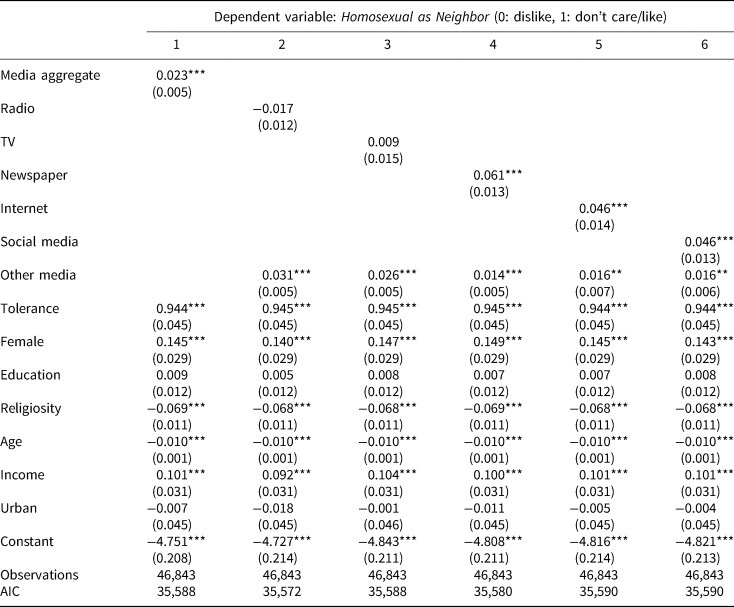
I begin by estimating six binomial logit models to test the relationship between media consumption and individual attitudes towards homosexuality. In the first model, the explanatory variable is an aggregate of the respondents' consumption of all five mediums. In Models 2–5, I look at the effect of each medium individually. In all models, I include country fixed effects, district-clustered standard errors and the individual-level controls. Country fixed effects help to account for within-country correlations resulting from country-level factors such as economic and institutional development. District-clustered standard errors help to account for further subnational correlations, including those caused by disparate access to some mediums. The individual-level controls account for common alternative explanations described above.
Results for the binomial logit models are reported in Table 2. Column 1 indicates that individuals who consume more media overall are also significantly (p < 0.01) more likely to say that they would not mind, or would like, living near a homosexual. Columns 2–6 show the effect of specific types of media, while keeping constant the aggregate consumption of other forms of media. As expected, newspaper, internet and social media consumption are all correlated with a significant (p < 0.01) increase in support for homosexuality, while radio and TV consumption have no significant correlation with LGBTQ support. Several individual-level control variables are also correlated with attitudes toward homosexuality. Increased social tolerance, identifying as female, and increased income level are all positively and significantly (p < 0.01) correlated with support for homosexuality in every model, while increased religiosity and age are negatively and significantly (p < 0.01) correlated with support for homosexuality.
Effect of media consumption on LGBT attitudes (logit models)

Note: *p < 0.1; **p < 0.05; ***p < 0.01
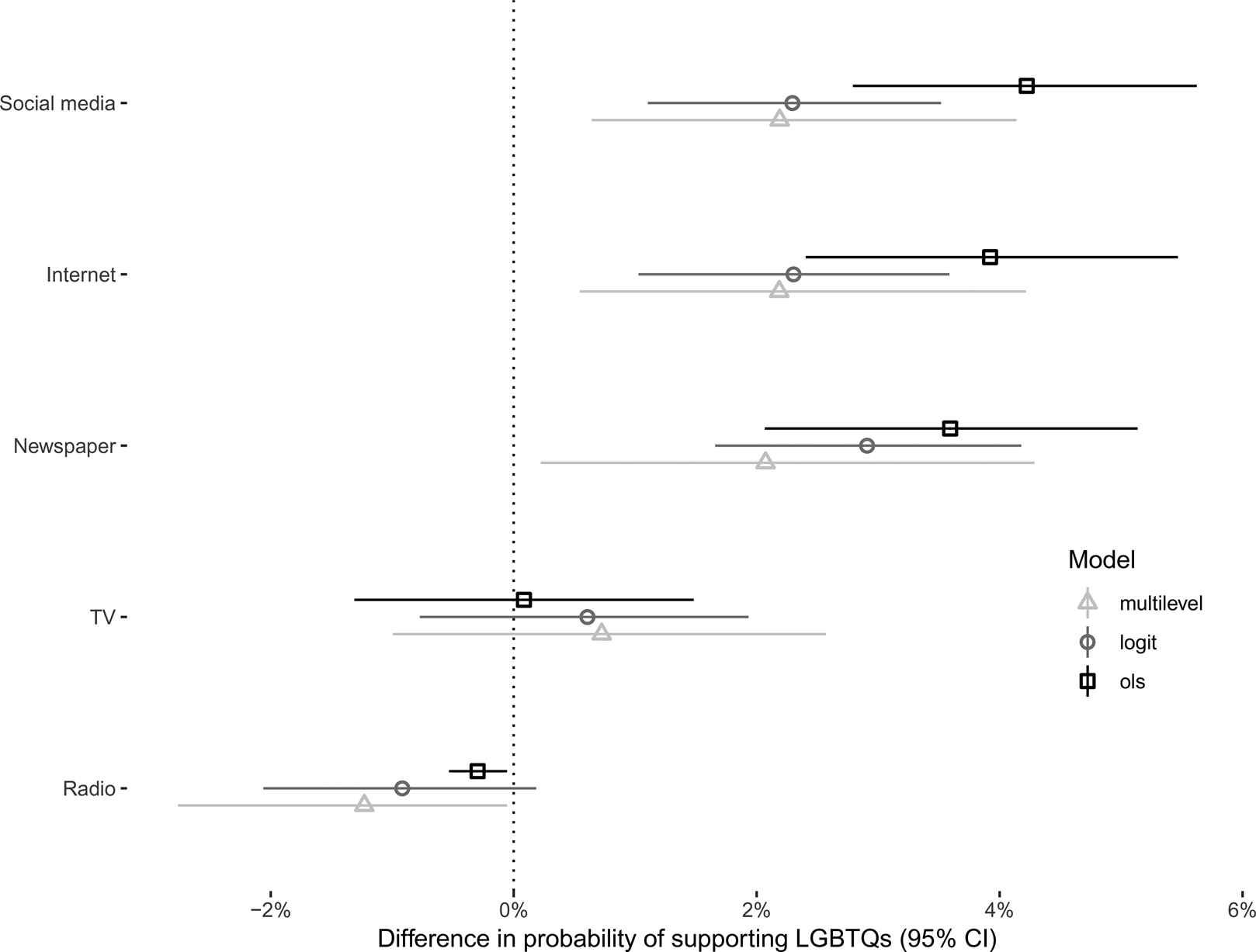
To interpret the substantive effect of these models, Figure 2 plots the expected change in support for LGBTQs when an individual moves from ‘none’ to ‘daily’ consumption of each medium. Individuals who consume more newspaper, internet or social media are about 2–4 per cent more likely to report a positive view of LGBTQs. This means that even the largest increase in media consumption results in a relatively small increase in support for homosexuality. However, as I discuss below, the finding is consistent across a number of robustness checks, suggesting that the effect is well estimated. These effects should also be considered in relation to the changing media consumption habits across Africa reported in Table 1. Most importantly, internet consumption increased by nearly 50 per cent in the past three years. If the effects reported in Figure 2 persist alongside the rapid expansion of internet usage across Africa, there is potential for meaningful changes in LGBTQ support across the continent.
Change in support of LGBTQs when moving from ‘none’ to ‘daily’ media consumption

Model Sensitivity
My main results hold when I replicate the binomial logit models with ordinary least squares (OLS) and ordered-probit models (see Appendix Tables A.3 and A.4). Each of these models reports the average effect of each medium, keeping constant country-level factors and correcting for clustering at the subnational district level. This fixed-effects method is useful when we are interested in the differences in average effects across units (countries) that may be correlated with the main covariate (media consumption) (Wooldridge Reference Wooldridge2010).Footnote 17 However, a downside to this approach is that it assumes each medium's effect is consistent across each country. Varying levels of censorship and norm diffusion may challenge this assumption. To account for this possibility, I follow Gelman and Hill (Reference Gelman and Hill2007) and estimate a multilevel model with varying intercepts and varying slopes for media's effect within each country and varying intercepts for each subnational district. The main effects from this multilevel model are reported in Appendix Table A.5, and the overall marginal effects are included in Figure 2.Footnote 18 My main results hold in this multilevel model and the marginal effects of each medium, reported in Figure 2, are similar to those from the logit model (though with slightly larger confidence intervals).
Placebo Tests
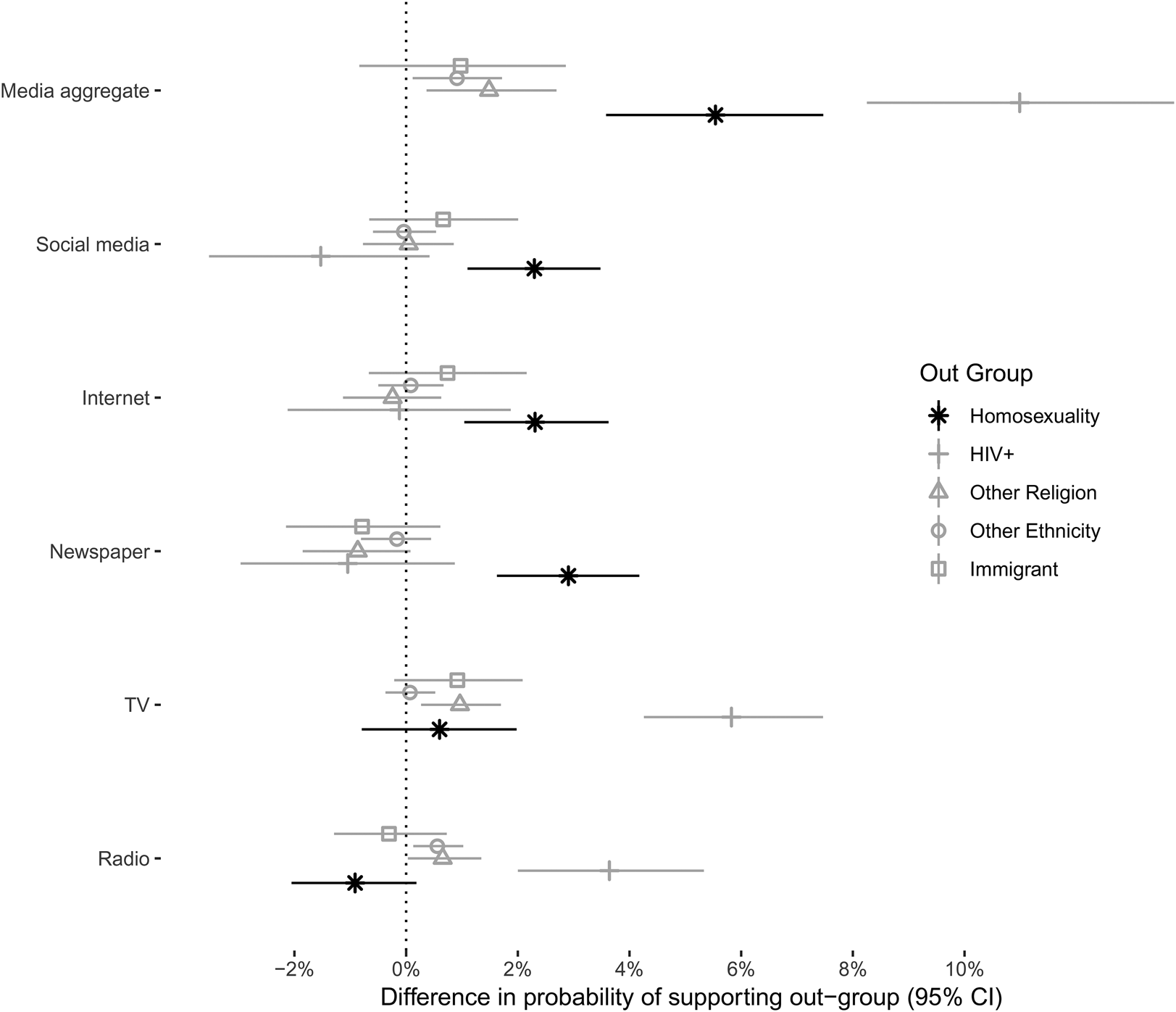
To interrogate whether my results are driven by an endogenous relationship between general social tolerance and media consumption habits, I perform placebo tests of media consumption on other measures of social tolerance. I replace the homosexuality dependent variable with four other demographic variables from the same battery of questions: religion, ethnicity, HIV/AIDs and foreigner/immigrant. If my results are driven by the fact that socially tolerant individuals tend to consume more of certain types of media, then we should expect this media consumption to have a similar relationship with other measures of out-group tolerance. Figure 3 shows the effect that each type of media consumption has on the different demographic out-groups. The effects reported in Figure 3 are derived from the same logit equation used in my main models and include all of the individual-level controls, country fixed effects and standard errors clustered at the district level. The only change is in the dependent variable.Footnote 19
Change in out-group support when moving from ‘none’ to ‘daily’ media consumption (logit)

Figure 3 reveals that there is clearly something unique about the relationship between media consumption and attitudes regarding homosexuality. Most notably, increased internet consumption – which is the media source that is most likely to be endogenous to socially tolerant individuals – does not correlate with a significant increase in support for any out-group other than homosexuals. The same is true for increased newspaper and social media consumption. Meanwhile, although increased radio and television consumption have no significant effect on LGBQT support, they do have a positive, significant effect on support of people living with HIV. This aligns with evidence that campaigns aimed at reducing the stigma of HIV are common on radio and television (Benton Reference Benton2015; Dionne Reference Dionne2017)Footnote 20 and provides further evidence that it is the content of these mediums that drives public opinion. Finally, the consistently small or null effect of media consumption on out-groups that typically form strong political coalitions (that is, religion and ethnicity) aligns with theories that I outlined above suggesting that any effects from increased exposure to these out-groups are conditional on partisan ideologies (Nyhan and Reifler Reference Nyhan and Reifler2010; Taber and Lodge Reference Taber and Lodge2006) and/or levels of segregation (Enos Reference Enos2017). In sum, the placebo tests reveal a unique relationship between certain mediums and support for homosexuality, lending support to the theoretical mechanisms outlined above, while also mitigating concerns that my results are driven by any systematic differences in the types of mediums that tolerant and intolerant individuals consume.
Free Press and Norm Diffusion
Finally, I add to the models a country-level indicator that captures both press freedom and globalization. Unfortunately, because this is a country-level measure, the dependent variable is also aggregated, leaving me with variation across only thirty-three countries. The KOF globalization index captures the economic, political and social components of globalization and has been used by others as a measure of the degree of diffusion of queer content.Footnote 21 I focus on the social globalization index of KOF, which includes measures of both de facto and de jure interpersonal (that is, international voice traffic, international tourism), informational (international students, press freedom, international internet bandwidth) and cultural (civil freedom) globalization.Footnote 22 The KOF social globalization index is a numeric variable in which a higher score represents a country that is more socially connected internationally.
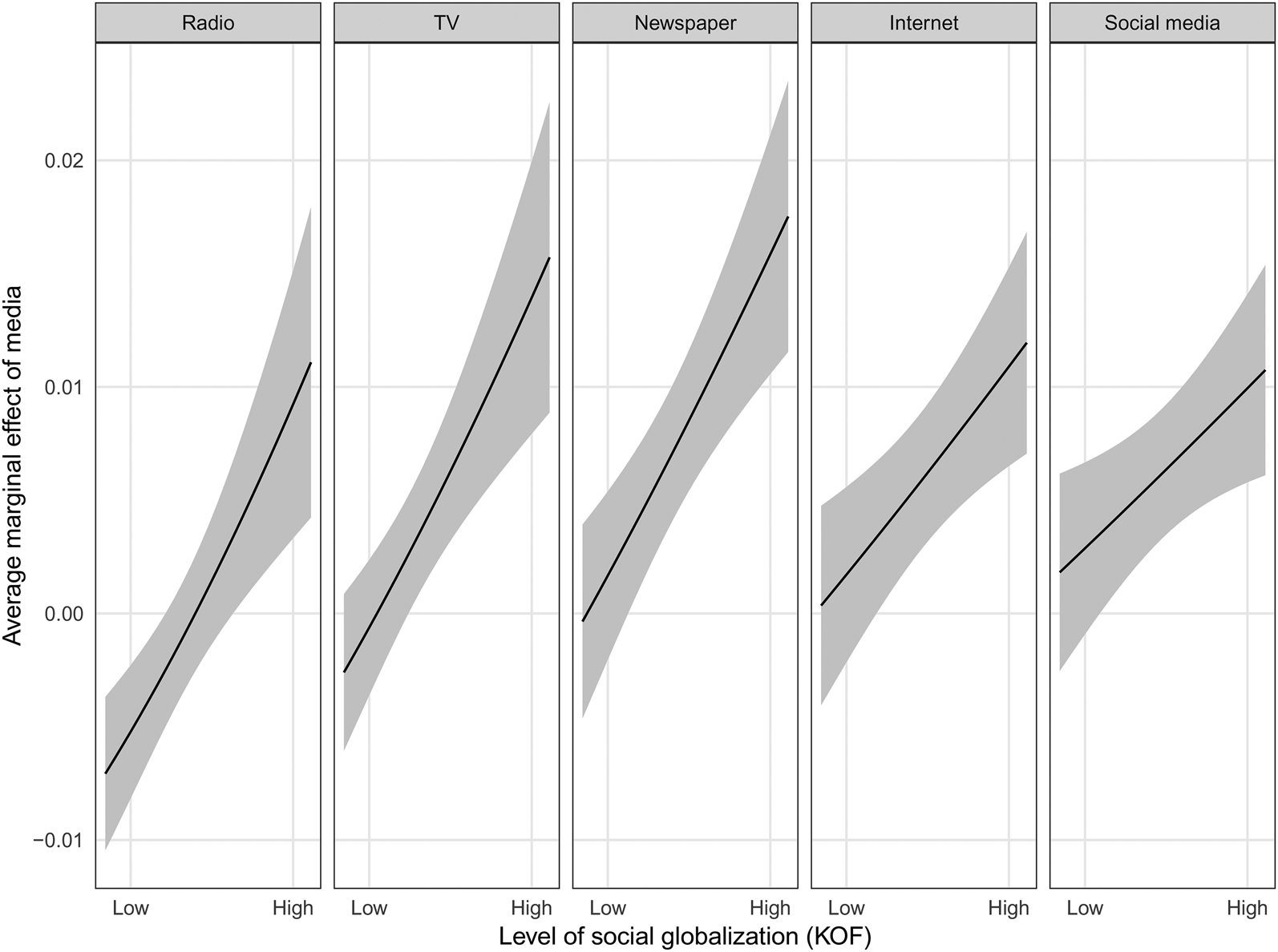
I replicate my main models with an interaction between media consumption and the KOF score. Figure 4 shows how each medium's effect on LGBTQ support changes across different levels of the KOF score.Footnote 23 The effect of increased media consumption on support for LGBTQs is greater in countries with higher levels of social globalization (KOF score) than it is in countries with low levels of social globalization. This trend holds across all mediums, but is more prominent for radio, TV and newspaper than it is for internet and social media (as shown by the variation in slopes in Figure 4 and the results in Table A.16). In other words, in countries where queer content is more easily diffused and less likely to be banned (that is, high social globalization), consumption of traditional media (radio, TV, newspaper) increases support for LGBTQs more than it would in countries with low social globalization. While this is also true for new mediums (internet and social media), the positive effect of internet and social media on LGBTQ support is less dependent on high levels of social globalization.
Average marginal effect of media on LGBTQ support across levels of social globalization
Note: 95 per cent CI. ‘Low’ represents lowest KOF score in the data (35); ‘High’ represents the highest KOF score in the data (73).

This finding supports my theoretical argument in two ways. First, it indicates that the media's effect on LGBTQ support is likely linked to the content that is available on each medium. Secondly, it upholds my contention that internet and social media are more difficult to censor of queer content, and therefore the effects of these mediums are less conditional on high levels of social globalization.Footnote 24
While the results in this section suggest that the media's positive effect on support for LGBTQs is connected to both a free press and norm diffusion, I urge caution in overinterpreting these results. More work needs to be done to ensure that measures of press freedom accurately capture the ways in which censorship of queer content differs from more traditional types of censorship.
Exploring the Mechanism
Radio, Newspaper and Internet Content in Kenya
To systematically test the mechanism driving my results, and to avoid the limitations of using media consumption as a proxy for media exposure (Fazekas and Larsen Reference Fazekas and Larsen2016), I would need data not just on the frequency of media consumption, but also on the media content. While content of some mediums is archived and relatively easy to access, other mediums, including radio and television, are rarely archived, making it difficult to conduct a systematic comparison. In turn, I leverage the data that is available and provide insight on the mechanism through a descriptive analysis of radio, newspaper and internet content.
In my data, radio is the most frequently consumed medium, with 71 per cent of respondents stating that they consume news from the radio at least a few times per week. Despite this, there is virtually no archived data on vernacular radio's content. A project in Kenya called RadioKikuyu attempts to fill this void by tweeting English translations of news shows on Kikuyu-language radio stations.Footnote 25 While these transcriptions are not a representative sample of the entire universe of radio content in Kenya, let alone across Africa, they do provide a rare opportunity to examine a snapshot of radio discourse.
I searched all RadioKikuyu transcripts between 23 January and 15 October 2017 for any dialogue regarding same-sex relations.Footnote 26 The only mention of same-sex activity is on 11 April 2017 on CORO FM radio. The transcript reads, in part: ‘Now that men have taken up with men and women with women, where will future generations come from? God said that men should marry women and yet these things are happening even in church.’Footnote 27
While I underscore the limitations of this data – it is a non-systematic and non-random sample of nine months of content from a subsection of Kenya's radio universe – the available data suggests that homosexuality is rarely mentioned on Kenya's Kikuyu radio stations. An interview with Nyambura Mutanyi, the owner of the RadioKikuyu account who listens to and transcribes radio content in Kenya, confirms this finding. Mutanyi reports that radio broadcasts rarely mention LGBTQ issues, and that the content overall tends to reinforce heteronormativity by encouraging reproduction and emphasizing the importance of large nuclear families formed by heterosexual marriage.Footnote 28
To compare this radio content to newspaper content from the same time period in Kenya, I conducted a search of the Daily Nation, Kenya's most widely circulated newspaper. I searched for any stories related to homosexuality for the period 23 January to 15 October 2017 (the same period for which I assessed RadioKikuyu transcripts). This search returned over fifty domestic and international LGBTQ-related stories, including coverage of the arrests of alleged homosexuals in Zanzibar, Tanzania and Chechyna, a Kenyan court order that the Anglican Church must reinstate priests accused of homosexuality, and the legalization of same-sex marriage in Germany.Footnote 29 Importantly, these results include coverage of both positive (legalization in Germany) and negative (arrests in Zanzibar, Tanzania and Chechyna) LGBTQ-related events, and the negative events are covered with largely factual statements. There are important limitations associated with any comparison between this newspaper content and the radio content – mainly that the Daily Nation provides data on the universe of the newspaper's stories for the given period, while RadioKikuyu only provides a snapshot of content for the same period. Still, the available data suggests that LGBTQs are covered more frequently and in a more neutral tone in Kenya's major newspaper than they are on its Kikuyu radio stations.
Finally, I compare this radio and newspaper content with internet search trends for gay-related content during the same time period. Google provides data on the relative popularity of searches for keywords over time, along with the most popular topics searched in association with the keyword. Scholars across multiple disciplines have used Google search trends as a measure of the information individuals seek out online (Askitas and Zimmermann Reference Askitas and Zimmermann2009; Ginsberg et al. Reference Ginsberg2008). Both Ripberger (Reference Ripberger2011) and Mellon (Reference Mellon2013) find evidence that Google search trends converge with other measures of issue salience, indicating that it can be a valid measure of public interest over time.Footnote 30
Data from these search trends show that, overall, there were internet searches for gay-related content between January and October of 2017, and that searches in Kenya follow the same temporal trend as those in the United Kingdom (see Appendix Figure A.8). To assess whether this online content provides positive representations of LGBTQs, I examine the most popular topics searched alongside ‘gay’. The most popular topic searched alongside ‘gay’ in Kenya is ‘black’. Not only is this the most popular topic, it is nearly two times as popular as the next most popular topic.Footnote 31 Other popular topics searched alongside ‘gay’ in Kenya during the study period include ‘Wattpad’ (an online storytelling platform where users can post non-fiction and fiction stories) and ‘Pride’. While some of these topics suggest that online searches for queer content are related to pornography, other topics suggest that individuals are seeking out information about gay pride and searching for stories about gay men who look like themselves. None of the top topics searched alongside ‘gay’ in Kenya suggest that internet users are seeking negative content about LGBTQs.
Internet Searches of LGBTQ Content across Africa
Finally, to provide more detail on the LGBTQ-related content individuals search for online outside of Kenya, I expand the analysis of internet search trends to include several countries included in the Afrobarometer data. Appendix Table A.19 shows the most popular topics and the rising topics searched alongside the word ‘gay’ over the past five years in a random sample of the countries included in my analysis.
As was true in Kenya, some of the topics indicate that internet searches of ‘gay’ content are tied to pornography. However, another important trend is that many of the rising topics include popular culture figures who have recently come out as non-heterosexual. Jussie Smollet, an actor who plays a black, gay character in the television show Empire and who also identifies as gay in real life, is the top rising topic in two of the sampled countries. Sam Smith, a singer and songwriter who publicly identified as gay in 2014, is also a rising topic in two of the sampled countries. Michael Scofield, the name of a character in the television show Prison Break that is played by actor Wenworth Miller who publicly came out as gay in 2013, was a rising topic in Senegal over the past five years. In other words, when popular cultural figures, including those from non-African countries, come out as non-heterosexual, internet searches for content related to those figures' sexual orientation surges in some African countries. Other notable topics indicating that internet users are seeking out positive representation of LGBTQs include: ‘same-sex marriage,’ ‘cartoon,’ ‘short film,’ and ‘pride’. Out of the 100 top and rising topics listed in Table A.19, only two (‘rape’ and ‘monster’) are explicitly negative.
In sum, despite limitations, I argue that the available data provides evidence that representation is the mechanism driving media consumption's differential effects on support for homosexuality. The fact that not all mediums correlate with increased social tolerance across the board (as shown in Figure 3) further suggests that it is representation, rather than exposure to new information in general, that drives my results.
Conclusion
It is important to understand if (and how) media relates to public opinion regarding diverse sexualities, especially in regions where governments consistently restrict LGBTQ representation while at the same time pro-LGBTQ activists leverage the media to reshape narratives about the queer community. In this article, I find that increased overall media consumption correlates with a significant increase in support for LGBTQs across Africa, but that newspaper, internet and social media consumption drive this relationship. I use a multi-methods approach, which combines cross-sectional survey data with content analysis and descriptive data from across Africa, to show that this effect is likely not driven by individuals selecting into certain types of media consumption. Rather, the evidence suggests that the media's effect on pro-gay support is driven by increased consumption of mediums that contain more exposure to LGBTQ identity.
These results are largely consistent with existing research in other contexts showing that the media affects public opinion (Iyengar and Kinder Reference Iyengar and Kinder1987; McCombs and Shaw Reference McCombs and Shaw1972), and that exposure to social out-groups can reduce prejudicial attitudes (Broockman and Kallah Reference Broockman and Kallah2016; Pettigrew and Tropp Reference Pettigrew and Tropp2006). However, I provide the first evidence of this at the individual level across the majority of African countries. My analysis also provides new evidence in support of the argument that, regardless of echo chambers, the media's effects on political beliefs are not explained solely by individuals selecting into media diets that align with their ideological beliefs. Finally, I deviate from research showing that governments always use sophisticated techniques to discretely manipulate information (Lorentzen Reference Lorentzen2014; Roberts Reference Roberts2018), and present a new theory of how governments' interest in publicizing their censorship of queer content may actually increase exposure to LGBTQ identity on some mediums.
Despite these contributions, my analysis suggests several areas for future research. As additional data on Africans' attitudes towards LGBTQs become available, scholars should examine how changes in media access affect LGBTQ support over time. Alternative empirical approaches, especially experimental designs, that do not rely on cross-sectional survey data would also provide a more precise investigation of the mechanism driving my results. In particular, more analysis is needed to determine how exposure to different types of content affects beliefs, and whether these effects are long-lasting or easily negated by counter-exposure. While existing research shows that in-person exposure to LGBTQs creates long-term, positive effects on individual beliefs (Broockman and Kallah Reference Broockman and Kallah2016), it is unclear whether these effects remain durable when exposure is not in person and in contexts where public opinion is not rapidly shifting towards the positive direction.
Ultimately, I do not claim that increased queer representation in the media is the only way to affect individual support for LGBTQs across Africa. However, the results suggest that there is some merit to the notion that the media plays a role in shaping pro-gay attitudes. On the one hand, this means that gay-rights activists who focus on using the media to demystify what it means to be queer could make meaningful strides to win over public opinion. On the other hand, and to curtail fears that government leaders may use these results to justify increased censorship, the results suggest that censorship may have limits. Although governments can often censor LGBTQ content from the radio and television, it is difficult to prevent citizens from accessing this content on the internet – a medium that is increasingly available across the continent.
Supplementary material
Replication data materials are available in Harvard Dataverse at: https://doi.org/10.7910/DVN/UWMHET and online appendices at: https://doi.org/10.1017/S000712341900019X.
Acknowledgements
I thank Jeffrey Arnold, Chris Adolph, Sarah Dreier, Mary Kay Gugerty, Meredith Loken, James Long, Beatrice Magistro, Nyambura Mutanyi, Vanessa Quince and Nora Webb Williams for helpful feedback on various drafts of this article. I also thank the editors and anonymous reviewers at the British Journal of Political Science for incisive and invaluable comments. All errors are my own. Support for this research was provided by the National Science Foundation (Grant No. DGE-1256082).