In 1591, the grand duke of Tuscany issued a set of privileges inviting merchants to settle in his port of Livorno. While these privileges were aimed primarily at Sephardic Jews, they were addressed to merchants from across the Mediterranean world. The city soon came to host the largest population of Jewry in southern Europe as well as notable communities of English and Dutch Protestants, Catholic merchants from Italy and France, and eventually Greek and Armenian Orthodox traders as well. Even Muslim traders did business in Livorno, although they never formed a stable community like other ethnoreligious groups. Livorno was a “universal caravansary where all nations are sure to find protection, liberty, and security.”Footnote 1
In the decades after 1591, the grand duke also liberalized the treatment of goods in Livorno, extending warehousing and transit rights in the port while protecting the trade in virtually all kinds of merchandise—even the traffic in stolen wares, victuals, and munitions. These policies culminated in a new customs regime, in 1676, which eliminated import and export duties entirely. Foreign merchandise did not pay more than domestic merchandise in Livorno, and the port enjoyed an “infinite capacity” for storing all manner of produce: its “immense public warehouses” were open to everybody upon payment of the stallage taxes.Footnote 2 Taken together, the program of foreign hospitality and the liberal treatment of goods made Livorno one of the most open port cities in the Mediterranean world.Footnote 3
Historians have adopted two approaches to explaining the economic growth of Livorno after 1591. The first emphasizes what one local official called “the three principal scourges of the human race”: plague, famine, and war.Footnote 4 This view treats Livorno as an exceptional marketplace inhabiting the interstices of the European economy. The port's unusual policies allowed it to exploit fractures in long-distance trade, such as armed conflict between the major trading powers or the cleavage between Christendom and the Ottoman Empire. A second view locates Mediterranean entrepôts such as Livorno within broader changes in the commercial environment. By this reasoning, Livorno was an integral player in the region's development during the seventeenth and eighteenth centuries; its rise was a close concomitant of the expansion of the Atlantic World.Footnote 5 These two approaches in turn may be framed as part of a broader debate between Karl Polanyi, who emphasizes the controlled status of long-distance commerce in the premodern world, and Fernand Braudel, who sees progressive commercialization as the fundamental fact of early modern economic life. Since Livorno's policies significantly influenced neighboring ports, at stake is a more general interpretation of the maritime economy of the central Mediterranean.
Polanyi's research interests spanned what might seem two unrelated inquiries. The first examined the “great transformation,” which saw the creation of markets for land and labor in nineteenth-century Europe. The second focused on markets in antiquity. This strand of research emphasized that the social regulation of the marketplace was ubiquitous in primitive and archaic economies. Exchange across political or cultural frontiers was mediated by the “port of trade.” The port of trade is hosted by a weak, small, or otherwise marginal polity as a place where foreign merchants can meet to do business; its neutrality is upheld by outside powers as an essential bulwark for exchange. Although native merchants may be present, they are incidental to the overall commercial profile of the port. Some scholars, building on Polanyi's analogy of the port of trade to an oasis town, have also suggested that the port of trade be situated as a broker between distinct ecological zones.Footnote 6 Only in his book on Dahomey did Polanyi come close to bridging these research programs, by examining the slave emporium of Whydah as a classic port of trade. The lesson is clear: for Polanyi, the creation of market institutions was part of a utopian project of political economy in the early nineteenth century. It had little to do with deeper historical or commercial forces. The great transformation unfolded as a violent irruption on the livelihood of man, upsetting the “natural” relation between ecology and humanity and replacing social norms of exchange with the vagaries of the marketplace.Footnote 7
Most historians (including this one) would agree with Polanyi that economic life is embedded in social and cultural structures. His historical narrative is more dubious, however. Braudel, for one, accused Polanyi of indulging “an almost theological taste for distinction,” referring to Polanyi's efforts to divorce premodern markets from the forces of supply and demand. Polanyi's procedure ignored “the concrete and diverse reality of history,” flattening out historical change into a dichotomy between market and nonmarket systems.Footnote 8 Braudel, by contrast, focused on the process by which markets were constructed from the Middle Ages to the dawn of the Industrial Revolution. Although his portrait of capitalism is complex to the point of obscurity—Braudel had a capacious interpretation of the capitalist system—he is relatively clear on how to characterize long-distance commerce in western Europe.Footnote 9 The seventeenth and eighteenth centuries were the age of the warehouse: of generalized wholesale markets or (as he characterizes them) permanent fairs. For Braudel, the proliferation of this new kind of commodity market was linked to more regular and intense market exchange.Footnote 10
So, was Livorno one of Braudel's new commodity markets, or was it one of Polanyi's ports of trade? It might seem that the theory of the port of trade was tailor-made for Livorno. The Tuscan port belonged to a neutral state that was an increasingly marginal player on the European stage. It hosted a large number of foreign merchants, and its most conspicuous economic role lay in brokering long-distance commerce between northwestern Europe and the Ottoman Empire—diverse cultural, political, and ecological zones. The city's role in predatory commerce such as corsairing further underscores its position at the interstices of Mediterranean commerce. And yet, taking Braudel's criticisms of Polanyi seriously suggests that the similarities between the port of trade and Livorno are as beguiling as they are misleading. If Livorno did resemble a port of trade around 1600, its subsequent commercial development reveals it to have been an integral part of European economic change. It functioned within a complex market system in which boundary zones played only a limited role in determining patterns of exchange.
This article begins by examining the evidence that Livorno served as a port of trade in the traditional Polanyian model. The first section criticizes the view that mediation across cultural and political frontiers was essential to the free port; instead, it connects the trajectory of Livorno to the general advantages of merchant hospitality. The second section examines the notion that Livorno joined distinct ecosystems. This variant on the Polanyian scheme dovetails with a broader ecological turn in Mediterranean scholarship (though it is quite different in detail). However, the evidence from Livorno suggests conceptual as well as empirical problems with the ecological approach. Rather, as Braudel argued, the rise of the commodity market was linked to the evolution of early modern capitalism. The final section examines the moral implications of the commodity market. The marketplace was not without its critics in the seventeenth century, especially elites steeped in the ideals of civic humanism. This narrow sphere of criticism confirms (in a backhanded way) one of Polanyi's core insights: that it was the development of markets in land and labor specifically that posed a threat to traditional social life, rather than the rise of commodity markets per se. Yet the dazzling achievements of markets such as Livorno helped inspire the intellectual outlook that motivated Polanyi's great transformation.
War, Piracy, and Plague: Assessing the Opportunities at the Borderlands
As a place where merchants and their wares were protected regardless of identity status, Livorno was effectively a neutral port by virtue of its free port privileges. For instance, when the customs director declared that “even our enemies the Turks have enjoyed and continue to enjoy the freedom of this port,” he meant that any merchant was welcome to trade in Livorno even amid war between that merchant's prince and the grand duchy of Tuscany. In theory, the ongoing conflict with Islam did not affect formal Muslim trading rights in the port; in practice, however, an atmosphere of pervasive hostility meant that most Muslims doing business in the port traded through intermediaries or (when interacting with the courts) through Christian proxies, usually Eastern Christians.Footnote 11 Nevertheless, by the standards of the Catholic Reformation, Livorno was an unusually hospitable place for non-Catholic merchants. Later jurists frequently emphasized how the program of foreign hospitality launched in 1591 entailed, almost surreptitiously, a commitment to neutrality in the port. Livorno's neutrality was promulgated formally during the First Anglo-Dutch War (1652–1654), when the grand duke declared that conflict in his coastal waters would not be tolerated. Neutrality was confirmed by the foreign merchant communities in 1691, by international treaty in 1718, and unilaterally by the grand duke in 1757 during the tribulations of the Seven Years’ War.Footnote 12
At a basic level, the port's neutrality owed to the diminished diplomatic stature of the grand duchy of Tuscany. This decline in power constituted an opportunity to fulfill interstitial economic functions. Some commentators have therefore emphasized the ability of merchants from belligerent nations to do business with one another in Livorno or to exploit the port's privileges to redistribute stolen merchandise. But while the role of neutrality in such functions is undeniable, neither trade occupied a commanding position in Livorno's commercial profile, suggesting that we should look elsewhere for an interpretation of the port's development. Instead, it is worth considering the larger imperatives for merchant hospitality during the period. By tracing the subtle influence of neutrality on commercial life, we can begin to appreciate how Livorno prospered not at the margins but at the center of early modern capitalism.
Braudel and Ruggiero Romano called Livorno a “second Algiers” for its role in sustaining involuntary exchange, and it is in its guise as corsair port that Livorno often appears in histories of early modern Europe.Footnote 13 Livorno was one of the best markets for the resale of predated goods and was second only to Malta as a center of Christian corsairing, that is, the predatory but (to contemporaries) legitimate assault on Muslim shipping. According to one Venetian ambassador, “for some years, many corsairs have appeared in Livorno with prizes taken in Levantine waters, or other people who bought prizes in Barbary or Sicily; and they are secure thanks to this privilege [of the city], taking however the name of ‘merchants’ rather than ‘corsairs.’”Footnote 14
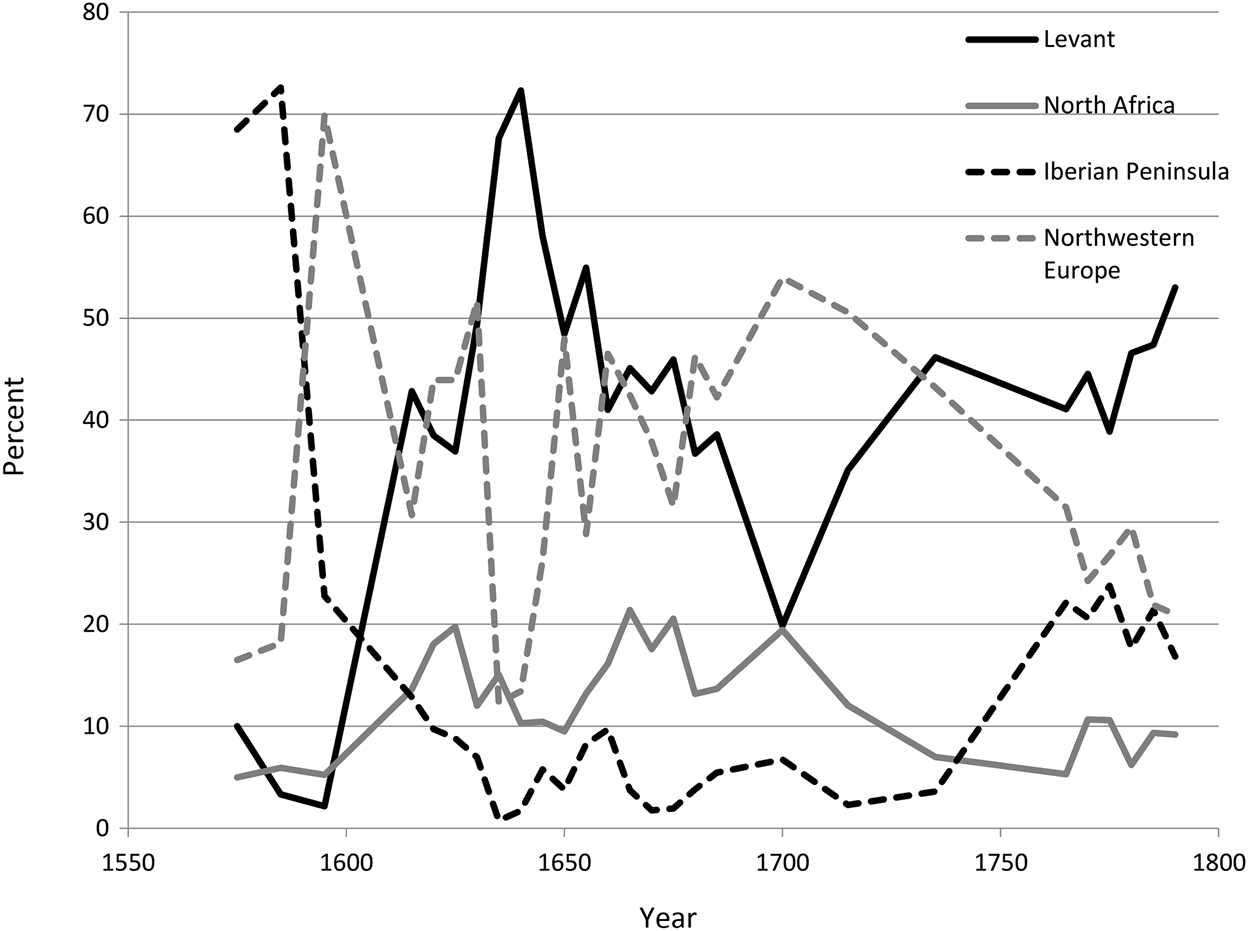
The direct sale of predated wares and the resale of predated goods from North Africa attracted a lot of notice and raised complicated legal issues, but it is best not to exaggerate the role of predation in Livorno's economic expansion. There is no way of documenting the size and fortunes of the “gray economy” in full, but a few oblique measures do show its declining stature over the seventeenth century. The proportion of Livorno's trade with North Africa is one indicator of indirect predation, which linked Livorno to the corsair markets in Tunis, Algiers, and Tripoli. As a percentage of total long-distance traffic, trade with the Barbary States peaked at 20 percent in 1625 and again around 1670; thereafter, it declined until it accounted for at best 10 percent of Livorno's long-distance trade by 1725 (Figure 1). In addition, most commerce with North Africa pertained to the produce of the region rather than the resale of predated wares: huge quantities of wax, leather, and wool and, at the luxury end, diamonds and gold from the Sahara. While predated goods were undoubtedly present in Livorno's commerce with North Africa, they were not an important component, with the exception of Spanish wool; some 72 percent of all wool imported from Algiers was Spanish wool, most of which must have been taken by Algerine corsairs.Footnote 15
Long-distance shipping in Livorno, 1545–1790 (by region). Note: The figures for the sixteenth and seventeenth centuries are based on ship provenance data; the figures for the eighteenth century are based on value estimates by French consuls in Livorno. The key assumption is that long-distance shipping reflected the value of commodities exchanges, and vice-versa. In addition, each data point for the sixteenth and seventeenth centuries represents an average of several years: 1575 is an average of 1573–1579; 1585 the average of 1580–1589; 1595 the average of 1590–1593. Seventeenth-century points are the quinquennial averages pegged around their midpoint (i.e., 1615 is the average of 1612–1616, and so forth). The exception to this rule is the figure for 1700, which is based on a single year of provenance data from the portate from May 1699 through April 1700. (Sources: Fernand Braudel and Ruggiero Romano, Navires et merchandises à l'entrée du port de Livourne (1547–1611) [Paris, 1951], 39–53; Renato Ghezzi, Livorno e l'Atlantico: I commerci olandesi nel Mediterraneo del Seicento [Bari, 2012], 34; Jean-Pierre Filippini, Il porto di Livorno e la Toscana (1676–1814), vol. 1 [Naples, 1998], 45, 56; Corey Tazzara, The Free Port of Livorno and the Transformation of the Mediterranean World [Oxford, 2017], appendix 12.)

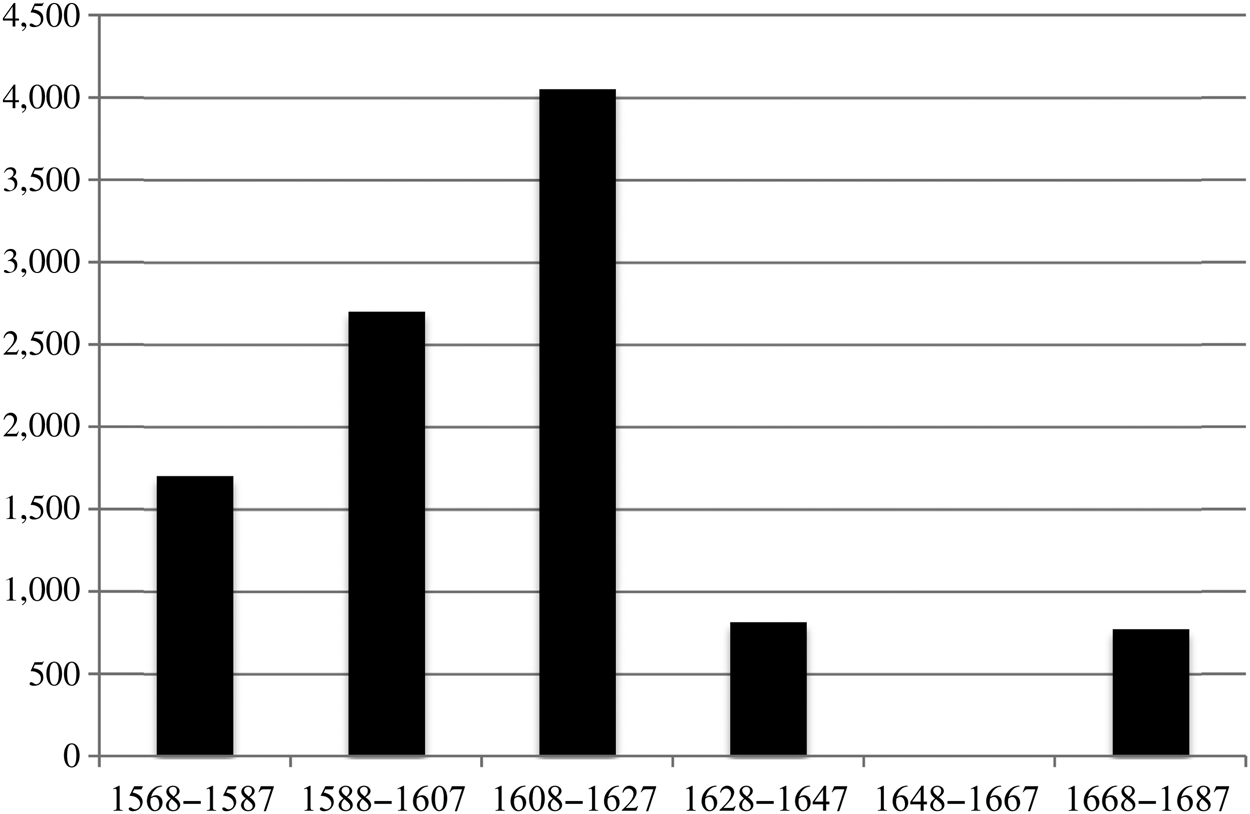
So much for indirect predation. What about Livorno's role as a corsair port in its own right? The number of slaves captured by Medici galleys offers a starting point for estimating the contours of direct predation in Livorno. Slave seizures grew throughout the late sixteenth century, culminating in over three thousand captures during the first decade of the seventeenth century and remaining high for the following two decades (Figure 2). In addition to Medici galleys, about six independent corsairs operated in Livorno during these early years. Their activity gave rise to a permanent market for redemptions between Livorno and Algiers.Footnote 16 In the early 1590s, before the demographic expansion of the town, most people in Livorno were probably unfree. In 1604, about 15 percent of the city's entire population (including soldiers) were slaves; that figure may have climbed to 25 percent by 1616. Thereafter the proportion of enslaved people declined. As other sectors of the economy expanded, Medici corsairing remained constant and, after about 1640, probably began to decline outright. By the last quarter of the century, about four corsairs were active in the city, and only some three commercial houses specialized in the redemption of slaves.Footnote 17 Slaves then constituted less than 5 percent of the urban population.Footnote 18
Slaves captured by Medici galleys, 1570–1689. Note: The figures undervalue the actual number of captives, because we do not have the capture records of some successful naval expeditions. There are no surviving data for the period 1648–1667. (Source: Vittorio Salvadorini, “Traffici con i paesi islamici e schiavi a Livorno nel XVII secolo: problemi e suggestioni,” in Livorno e il Mediterraneo nell'età medicea [Livorno, 1978], 218–22.)

Both direct and indirect predation peaked in the first two decades of the seventeenth century and declined thereafter. Nevertheless, none of the figures presented above include the ransoming of captives through the free port. Since slaves were pricey “commodities,” redemptions could be a lucrative activity. For instance, in 1652, some 152 slaves sold for twelve thousand ducats; a few years later, a number of captives were valued at 350 pieces of eight per head.Footnote 19 The real economic incidence of the slave market was therefore higher than our estimates indicate. Certainly, redemptions formed an integral part of the portfolios of some of the wealthiest merchants in the city. Livorno's role as a slaving port offers the clearest evidence of the city's stature in transcultural brokerage, lending some credibility to a Polanyian interpretation of the city until about 1650. But by then the corsairing industry was already being submerged by nonpredatory forms of commerce. However, the corsair market did support norms of reciprocity that sustained regular commerce between North Africa and southern Europe.Footnote 20
The role of predation in Livorno's economy remained modest even during the great wars of the eighteenth century, when privateers brought their prizes to the free port for public auction. During the War of Austrian Succession and the Seven Years’ War, for instance, prizes contributed about 4 percent to the city's commerce by value; during the American Revolutionary War, it amounted to 1 percent.Footnote 21 During peacetime, the prizes sold in Livorno were an infinitesimal part of its commerce: 0.01 percent in 1715.Footnote 22 All told, then, the role of predation in Livorno's commerce has been much overstated. Except in the early decades of the seventeenth century, when it was a substantial presence in the city's economy, predation was a fairly marginal activity.
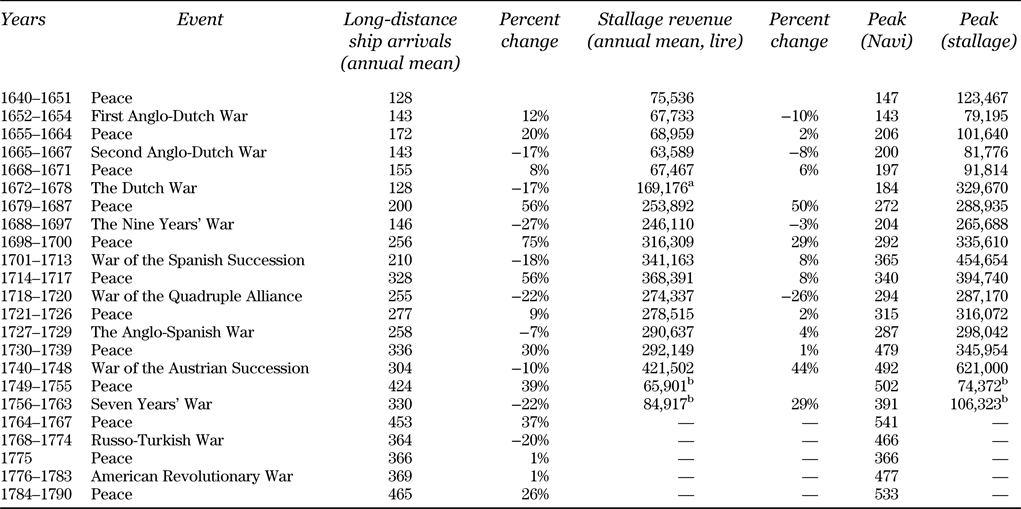
The neutrality thesis also emphasizes Livorno's status as a legitimate market during times of conflict (as distinct from its role in sustaining predation). A myth arose that years of naval or commercial war in the Mediterranean had brought a substantial rise in Livorno's commerce, only partially lost with the reestablishment of peace—that is, that war ratcheted Livorno's trade to ever-higher average levels.Footnote 23 The logic is simple: shippers from hostile nations used Livorno as a means of conducting forbidden trade, since goods could be exchanged in the free port and then shipped to their destination aboard neutral vessels. In addition, Livorno's insurance industry certainly did exemplify the “war effect,” growing vertiginously during times of conflict and retaining substantial gains during peace. But, given the relative independence of the financial sector from real commerce in the port, it should not be surprising if war affected the two sectors differently.Footnote 24 For while some merchants benefited from Livorno's services during wartime, the war effect as an interpretation of the city's growth appears to be false. Livorno's commerce generally declined during wartime in relation to each previous period of peace (Table 1).
The Effects of War and Peace, 1640–1790

Sources: Corey Tazzara, The Free Port of Livorno and the Transformation of the Mediterranean World (Oxford, 2017), appendices 9 and 13; Calogero Piazza, Schiavitù e guerra dei barbareschi: Orientamenti toscani di politica transmarina (1747–1768) (Milan, 1983), 180.
a A major reform of the customs regime in 1676 makes it impossible to compare stallage revenues during the Dutch War to the prior period of peace.
b The stallage revenue figures cease in 1748. Fiscal data for the later period are from the quarantine fees; these run from 1750 through 1763. The quarantine fees are biased toward long-distance shipping since regional trade was not generally subject to quarantine.
Why the myth? Possibly because war made some conspicuous fortunes; possibly, too, because the Wars of the Spanish and the Austrian Successions “have more than any other . . . benefited Livorno, which has regularly conserved a part of the gains made during war even after the return of peace.”Footnote 25 This quote by an anonymous official is wrong in general but correct in detail. Although average port traffic declined during the two succession struggles, traffic also reached new peaks; at the same time, stallage revenues increased during both conflicts, suggesting a greater flow of merchandise through the free port. Nevertheless, too much credence should not be placed in the stallage revenues, particularly during the War of Austrian Succession (which coincided with a period of exceptional administrative efficiency). A detailed examination of Marseille's use of the port during the Seven Years’ War reveals only a modest increase in the shipment of French silk cloth via Livorno. Only about 10 percent of French silk exports was diverted through Livorno, whose commercial services in turn were worth only about 2 percent of their overall export value: some 465,000 livre tournois out of 7 million livre tournois.Footnote 26 The most that can be said is that Livorno's commerce fared well during times of war in comparison with the ports of belligerents. War did not drive its growth or “form the intrinsic experience of the commerce of Livorno.”Footnote 27
While the Tuscan regime upheld Livorno's formal neutrality, it knew that the opportunities presented by conflict were evanescent compared with the port's structural dependence on English trade. Much of the vaunted discourse of neutrality served English interests in the Mediterranean, against those of the French. During the Seven Years’ War, for instance, the use of Livorno for victualing warships or outfitting privateers was of direct benefit to the English. France, with its long Mediterranean coastline, had no need for such services. The French were correct to complain about the “very real partiality” that the Tuscan authorities showed to the English. “The principles by which the [Tuscan] Regency justifies the complaisance which it shows to all the needs of the English is not at all followed in our regard,” observed the French consul in Livorno. “When it is a question of various kinds of assistance for us, it bases itself on a different jurisprudence.”Footnote 28 During times of war, the principle of neutrality aided the same English merchants who dominated Livorno's long-distance trade during times of peace.
Neutrality played a structural role in Livorno's development, operating during times of both peace and conflict. Small states like Tuscany could not pursue mercantilist strategies of capital accumulation, as Italian republics had done in the late Middle Ages and as the major maritime powers did during the early modern period; one need only think of the conflicts between England, France, and the Netherlands for control over distant markets to remember that violence offered attractive possibilities to those who could compete in the military arena. Italy, fragmented into several states and dominated by the Hapsburg Empire, was not capable of contending in the Americas or East Asia. For Italian states, a program of hospitality toward goods and merchants was a more viable path to participating in long-distance commerce. Although few Italian ports developed a regime as open as that of Livorno, general facilities for commerce expanded throughout many of the peninsula's port cities in the early modern era.Footnote 29 By the middle of the seventeenth century, Livorno was much more a second Izmir than a second Algiers.
Plague was endemic in North Africa and the Middle East. For that reason, controls on the movement between Christendom and Islam might be taken as a corollary of the ecological thesis, by which the port of trade connects disparate ecological zones. For cultural reasons, however, it is best seen as a variant of the neutrality thesis. Fear of plague was closely related to hatred of Islam among Italian governments; it was not based on a scientific assessment of ecological realities. When the Neapolitan political economist Carlo Antonio Broggia proposed selecting an uninhabited island to serve as a neutral zone for quarantine, he imagined it would be staffed solely by Christian magistrates and would serve the interests of Christendom: his plan “would do a great deal to protect Christian states from the horrible invasions and devastations of the plague.”Footnote 30 Broggia's project came to naught, but it reveals the spirit of plague controls in Italy.
Livorno had capacious infrastructure and a stringent bureaucracy for administering quarantine, and it undoubtedly played a principal role in sanitary mediation between East and West, that is, in certifying goods, ships, and people as free of plague and able to enter other western ports without delay.Footnote 31 Yet it is again easy to overstate the significance of these plague controls. Long-distance traders such as the Dutch and English were hostile to Livorno's quarantine regulations, which they mistakenly saw as a form of commercial espionage: “doubtless a manifest prejudice to our trade with Italy,” as one English consul put it, and a prejudice that appeared unwarranted given the quarantines imposed on shipping from the Islamic world.Footnote 32 For their part, Italian regimes, particularly by the last third of the seventeenth century, were sometimes willing to use the quarantine system as an instrument of commercial rivalry.Footnote 33 In any case, the fear of plague did not keep English and Dutch ships from alighting in Islamic ports. If they had any effect, Livorno's quarantine controls perhaps bolstered its role in mediating trade between the Levant and the Tyrrhenian region, where regimes were concerned about sanitary regulations. But the “plague effect” was probably small, since several ports in the central Mediterranean—including Civitavecchia, Genoa, and Marseille—also had quarantine infrastructure. Livorno's stature as a Levantine outpost owed to its overall commercial position and the presence of Levantine merchants in its midst, not to its rigorous quarantines.
These considerations show why it is problematic to treat Livorno as an Orient rapproché, a port of trade connecting two supposedly distinct civilizations.Footnote 34 Such a view treats Livorno as a frontier zone where religious enemies could trade with one another while remaining distinct. It suggests that the city's cocktail of policies facilitated an otherwise fragile commerce across cultural and political boundaries. In light of the past three decades of historiography, it is no longer plausible to see Christendom and Islam as two hostile blocs facing each other across a narrow sea.Footnote 35 The arrangements for trade between the two civilizations were so manifold, collaboration between them so endemic, that the port-of-trade model does not seem relevant to cross-cultural contact in the early modern Mediterranean.
The neutrality thesis attempts to connect the ethnoreligious diversity of Livorno to something outside of the regular pathways of long-distance commerce. It sees Livorno as a mediator between distinct civilizations, a neutral marketplace for belligerents, and a center for laundering predated goods. All of these interstitial functions were real, but they were not essential. In fact, the presence of foreign communities is explicable by reference to the nature of long-distance commerce in the early modern Mediterranean world. By making it possible for merchants of any ethnoreligious affiliation to do business in the port, Livorno was ideally situated to broker trade between North Africa, the Levant, and northwestern Europe. Since trading networks structured along ethnoreligious lines continued to dominate early modern commerce, foreign hospitality was crucial for connecting distant economies. Whether one speaks of Amsterdam, Izmir, or Livorno, foreign hospitality was a profitable strategy across the Old World—not because of Polanyian controls on the marketplace but because of the informational advantages that traditional trading networks had over corporate trading companies.Footnote 36 Livorno was neither a parasite on the economic system nor a commercial frontier. Its performance was profoundly linked to the general development of Mediterranean commerce.Footnote 37
From Granary of Italy to the Warehouse of the Mediterranean
The subtlest version of the Polanyian thesis sees the port of trade as a broker between distinct ecological zones. This view bears a certain resemblance to the old theme of universal economy, by which divine providence scattered the goods of the world across the globe. According to this theory, different natural endowments provided the main justification for international exchange.Footnote 38 Transferred into the ecological register, the theory suggests that interregional commerce should pertain to minerals and agricultural produce not available in the importing region. By implication, intraregional exchange should involve local surpluses, using trade to smooth out temporal variability. Such an optic treats commerce as a function of ecological realities rather than of economic patterns as mediated by the marketplace. The difficulties with the ecological approach can be seen in the cases of a few indicator commodities: grains, silk and other industrial raw materials, and manufactured goods. These cases suggest that the commercial profile of Livorno was linked only weakly to its role as ecological broker. Economic and political factors were more important.
Initially, the collection and distribution of grain was Livorno's main function. By the 1640s, Livorno served increasingly as a center linking Italian economies to those of northwestern Europe and the Ottoman Empire. As the English consul John Dick put it, Livorno became the “emporium or magazine general for English manufacturies and goods of all kinds.” It was from the Tuscan port “that not only the cities in Italy, but other countries were supplyd, sending the produce of their several countries to barter or exchange, for such English goods as they had occasion for.”Footnote 39 While the most conspicuous operators in the free port were the English, who used Livorno as an entrepôt for managing their distribution networks, Livorno became a key market in the central Mediterranean for the exchange of a panoply of commodities. Underlying its position were the low transaction costs and low taxes associated with its customs regime, its extensive infrastructural facilities, and the network externalities associated with its communities of foreign merchants. In addition, the free port benefited from access to a relatively wealthy hinterland in north-central Italy, which still offered some major industrial exports as well as a steady demand for raw materials and victuals.
Officials believed that famine was one of the “scourges” that drove Livorno's growth. Even more than plague or war, the demand for cereals played a critical role in the early development of the free port, between ca. 1590 and 1640. From an average of 19,000 hectoliters of grain per year in the period from 1580 to 1583, Livorno imported 170,000 hectoliters per year from 1590 to 1593. During the first three quarters of the seventeenth century, grain imports tracked Tuscan prices, indicating that imports in the free port were strictly linked to regional harvest behavior. Imports were less correlated to Tuscan prices by the late seventeenth century. Livorno continued to furnish grain to Tuscany when necessary, but merchants also used the free port to deposit grain for redistribution throughout Mediterranean markets.Footnote 40 Livorno's role in the international trade in cereals led to a paradox noted in 1710: “grains continue to rain here in abundance although they are not declining in price.”Footnote 41 Conversely, it was profitable to import grain into the Tuscan hinterland only when prices were 20 percent higher there than in Livorno (owing to import taxes, transport costs, and the high quality of Tuscan produce). The international market kept prices in Livorno sufficiently high that it was rarely worth shipping grain into Tuscany. Prices in Livorno's grain market were set by supply and demand, then, not by administrative fiat. Even when the Medici regime conducted huge purchases of cereals for public consumption, as it did whenever famine threatened, it paid market rates; a few attempts at more coercive purchases ended with hasty retreats.Footnote 42
These references to the market price of grain do not resolve the issue of ecology, however—although for Polanyi himself, they might have sufficed to show that Livorno was not a port of trade. Rather, we must ask a more fundamental question: When Italy imported raw silk from the Levant, fish from Newfoundland, or grain from the Baltic, was it exchanging ecological surpluses? Or, was it exercising economic dominance via market mechanisms (i.e., by high prices)? After all, Italy itself had access to impressive quantities of indigenous fish, grain, and other victuals. If the Italian peninsula's demand for such commodities outstripped its supply, it is because north-central Italy had an exceptionally large population, which in turn rested on a process of capital accumulation and urbanization that began in the Middle Ages. The notion of ecological surplus is problematic because it treats the size and activities of a human population as a given rather than as produced via historical process.Footnote 43
Decoupling of the grain trade from regional demand was linked to a fundamental transformation in the economic role of the free port: increasing centralization of trade in many commodities around Livorno. But, as with grain itself, the distinction between “natural” ecological produce and industrial raw materials is less than clear. Consider raw silk. Silk manufacturing was the greatest triumph of late Renaissance urban industry, coinciding with an increase in luxury consumption throughout Europe. Much of the demand for raw silk was satisfied through indigenous production, thanks to the success of domestic sericulture. Nevertheless, north-central Italy had to import notable amounts of raw silk from producers in southern Italy, North Africa, and the Levant. Between 1612 and 1666, Livorno absorbed an average of 163,161 Tuscan pounds per year from the Islamic world, and it imported roughly the equivalent in silk from southern Italy. In raw silk as in grain, then, the boundary between Italy and other regions in the Mediterranean was not very stable.Footnote 44
What was true of raw silk was true of other industrial raw materials, such as flax, wool, and cotton. Ecological brokerage certainly did take place in Livorno. Cochineal could come only from the Americas, via the major Atlantic entrepôts, just as base metals came only from northwestern Europe and camel hides only from the Levant or North Africa. But most of the raw materials that Livorno imported were products of Italy itself. The problem was that demand exceeded supply, not occasionally but regularly, owing to the relative wealth of north-central Italy and the success of its export industries.
The trade in manufactured goods raises the most searching questions about the ecological thesis. For Livorno did indeed import manufactured goods: thousands of wool garments arrived every year from northwestern Europe, most for transit to southern Italy and the Levant. The Ottoman Empire also shipped cloth—such as cordovans, calicoes, and dimity, as well as various kinds of rugs—to the Tuscan port. To the extent that there occurred trade in manufactured goods, we must ask ourselves why such products were not exchanged in their natural form, as so much raw wool, cotton, silk, and flax. This question turns our attention away from ecology and toward such factors as the occupational structure, the distribution of capital, and the nature of market demand—in short, to the economy.
The case of spun cotton is illustrative in this respect. Throughout the seventeenth century, when cotton textiles had not yet conquered Europe, Livorno imported much of its cotton in spun form. However, as the taste for cotton expanded, European producers increasingly demanded raw cotton so as to control the spinning process themselves. Accordingly, the demand for spun cotton collapsed in Livorno around 1715, not because of deindustrialization in the Ottoman Empire or ecological change in the Mediterranean, but because of a shift in market demand in Europe. The lesson is clear: exchange was determined by market rather than ecological forces, and the very same material could be exchanged in raw, semiworked, or manufactured form.Footnote 45
The examination of particular commodity flows suggests that market conditions were an integral aspect of Livorno's development. A synoptic look at Livorno's regional trade profile tells a similar story, revealing the economic landscape's heterogeneity rather than its neat division into ecological spheres. For what follows, I have sampled three years of trade records during the golden age of Livorno: 1675, 1699–1700, and 1734. Although the health board responsible for most trade statistics in Livorno was generally concerned solely with long-distance trade, during that period it also gathered brief statistics on ship arrivals from the Italian trading sphere, from the southern coast of France to the Adriatic. These records pertain only to imports, not to exports or to goods in transit. Moreover, with some exceptions, the documents do not allow us to gauge the quantities of regional trade, which probably amounted to about a third of the total value of goods. Of course, cabotage tied to local and regional economies has long been a fixture in our portrait of Mediterranean life.Footnote 46 Source difficulties as well as historiographic tradition have marginalized its role in our conception of Livorno's commerce. Nevertheless, the records vividly portray the nature of regional exchange in comparison to trade with other areas during the era when Livorno served as the “warehouse of Italy and of the Mediterranean.”Footnote 47
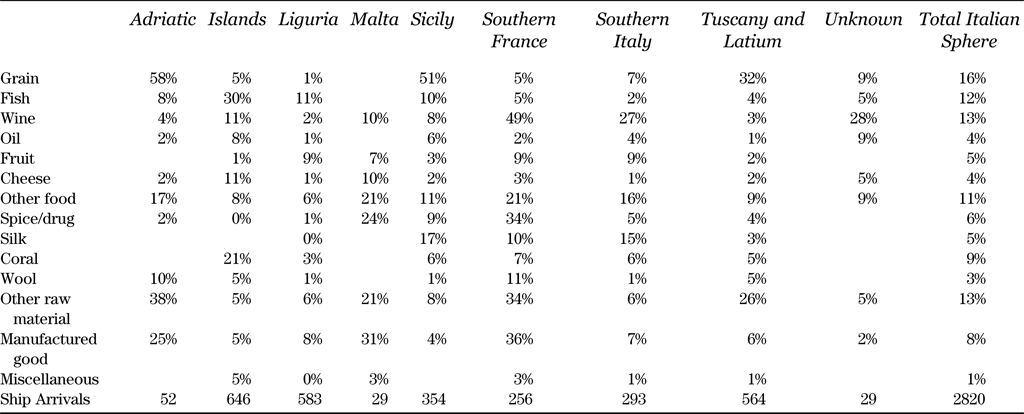
The diversity of Italian produce that Livorno imported is striking. Some kinds of commodities were overwhelmingly regional: grains, wine, olive oil, fruit, cheese, silk, and coral. While at first glance this profile might lend support to the ecological thesis, a closer look suggests that regional imports were quite differentiated by subregion (Table 2). Thus, most grains came from Sicily and Tuscany; most fish came from the Italian islands, which also provided the bulk of olive oil and cheese; and most manufactured goods came from Liguria or southern France, especially Marseille. Such ships as did arrive from the Adriatic carried manufactured goods as well, due to the industrial prowess of the Veneto. The profile of regional trade suggests a division of labor between core economies (those of north-central Italy), semiperipheral ones (southern Italy and Sicily), and peripheral ones (the islands). The forces at play were human rather than ecological. Underlying these patterns were the economic and political relations that had made southern Italy into a breadbasket for northern Italy as well as a major supplier of its industrial raw materials and that had turned many of the islands into virtual colonies of more important polities.
Regional Ship Cargos (1675, 1699–1700, and 1734)

Sources: Box 1612 (1675); box 1542 (May 1699–Apr. 1700); box 2308 (1734), Mediceo del Principato, Archivio di Stato di Firenze, Florence. These figures were compiled out of the avvisi da mare (sea reports) that survive for the late Medici period, which logged every ship that alighted in the port by provenance and contained qualitative information about their cargos.
Note: Percentages total more than 100 because ships often carried more than one good. Offering such percentages was more feasible than calculating actual import levels given the condition of the sources, which generally indicate only the quantity of grain and silk imports. “Fish” includes fresh as well as salted fish and all kinds of seafood. “Fruit” includes dried fruits as well as fresh fruit, principally lemons and oranges. “Other food” includes secondary cereals such as rice, nuts, beans, and salted meat. “Spice/drug” includes sugar, tobacco, cacao, and local products such as coriander or salt. Manufactured goods were mainly glass, metalwork, and textiles, but also such low-value products as spun cotton and stracci (scraps of manufactured silk).
Our look at the trade in victuals, raw materials, and manufactured goods has a common theme: market forces, ranging from demography to the vagaries of elite fashion, conditioned exchange. These market forces themselves were a product of history, of course—above all, the prior capital accumulation in north-central Italy that had made “Genoa the Rich, and Leghorne the free” the most important Italian ports on the Tyrrhenian.Footnote 48 Its wealth not only made the region one of the most populous in the Old World, capable of feeding more mouths than it could sustain on its own agriculture, but its industriousness also increased the region's demand for raw materials and its capacity to pay for manufactured goods.
In denying the role of the market, the ecological thesis in fact denies the historical development that created, sustained, and modified market forces. This denial has been influential beyond the specific question of the port of trade. Peregrine Horden and Nicholas Purcell's Corrupting Sea is the most influential study of Mediterranean life since Braudel's work in the mid-twentieth century. The Corrupting Sea treats trade largely as the exchange of surpluses, necessitated by the exceptionable variability of Mediterranean microecologies and made possible by the region's connectivity. Horden and Purcell ignore how concentrations of capital that were of extraordinary stability exerted systematic power over more peripheral regions, whether through violence or the marketplace. The thesis of the port of trade as ecological broker makes the same error as ecological optics more generally.Footnote 49
Braudel claimed that entrepôts functioned not simply as part of the market economy but also as a sphere of capital accumulation. For early modern Europe, one often thinks of the accumulation made possible by violence in the colonial sphere, the expropriation of peasant or native lands, or the use of navigation laws to engross commerce in specific locales. Free ports like Livorno worked differently, as the grain market sketched above suggests. They enabled merchants who possessed large stocks to exploit differences in prices between markets—for instance, a sudden rise in grain prices in Spain due to famine. The entrepôt rendered the old medieval ban on speculative engrossment not only legitimate but a pervasive aspect of economic life. The free port achieved this end not with violence but merely by investment in infrastructure, a liberal tax regime, and foreign hospitality. This was the basis whereby individual merchants made fortunes out of Livorno during the long seventeenth century. The free port's effect on capital accumulation within north-central Italy is a more controversial matter. On the whole, Livorno and its neighboring ports probably facilitated the modest reconversion of Italian capital away from the wool industry and the commercial sectors and toward agriculture, while minimizing net economic decline.Footnote 50 Achieving these ends required Tuscany to expose its port to foreign merchants and their capital, however, which might readily be withdrawn from the city's market. The rise of political economy in the eighteenth century provided a powerful new vocabulary for critiquing just such exposure.
Morality and the Commodity Market
Livorno resembled a port of trade in 1600. Corsairing was one of its principal industries and grain was its principal long-distance import. The Medici regime strictly supervised the activities of foreign settlers. While the presence of foreign merchants always remained under government scrutiny, foreign communities nonetheless came to enjoy greater autonomy as time passed. In addition, by about 1640 Livorno had become an integrated participant in the commercial landscape of early modern trade. This transformation was evident in its position in Italian commerce as well as in its role in brokering trade between northwestern Europe and the Levant. The foundations of the free port lay in its openness toward foreign merchants, its liberal treatment of goods, the freedom that merchants had in disposing of their wares without bureaucratic supervision, and the city's facilities for the warehousing of commodities. The rise of the free port offers clear evidence that the seventeenth century witnessed the rise of the international commodity market, resting on depôts such as Livorno and Izmir in the Mediterranean and London and Amsterdam in the North. Braudel was right: the link between markets and capital accumulation occurred well before the nineteenth century.Footnote 51
Yet Polanyi points to two aspects of the problem to which Braudel himself gave scant attention. First, he raises the question of the role of the marketplace in destabilizing and immiserating the lives of ordinary people, via the unmaking of traditional social structures. By contrast, Braudel generally links poverty rather than the mode of distribution to the productive limits of the premodern economy. Second, Polanyi suggests that the moral norms surrounding distribution are always worth examining—that the market in particular, through the dislocations it enables, may provoke criticism of the social order. The commodity market of Livorno offers an interesting glimpse at both issues, and it confirms—albeit somewhat obliquely—the utility of Polanyi's categories even when he got his history wrong.
The development of the commodity market provoked a certain amount of anxiety among Tuscan elites. This anxiety came to a head on the eve of the reform of 1676, which eliminated customs duties and simplified procedures. One official accused merchants of aspiring to “import and export despotically and without bridle any kind of merchandise.”Footnote 52 Such autonomy violated the proper order between the state and its merchants, and it subjected government powers to the dictates of the marketplace. Other officials complained about the regime's inability to control financial markets in Livorno; they wished to subordinate foreign credit networks to Florence but were forced to cede finance to the free port. Later, officials in the mid-eighteenth century emphasized that the norms of the free port prohibited the collection of trade statistics. Any investigation into the activities of merchants would have a chilling effect on commerce in the port. Ultimately, the grand duke himself conceded that encouraging traditional virtues such as parsimony and frugality among the freewheeling capitalists of Livorno was impossible. As one regime insider put it, Livorno had a “character of depravity” that was difficult to correct.Footnote 53
Most criticism was official in character. It linked the freedoms of the port to the moral laxity of its inhabitants and the domineering power of its merchant class. As this terminology suggests, disquiet about Livorno was tied to the discourse of civic virtue that remained vibrant in Florence long after the end of the republic. Originally this discourse was by no means anticommercial, but its most famous exponent, Niccolò Machiavelli, argued that private wealth was a threat to equality among citizens and hence to civic virtue. More importantly, while contemporaries elsewhere in Europe were elaborating ideas that treated commerce as a complement to landholding and a corrective to absolutism, the Florentines were adjusting to life as landowners with a fondness for flattering the Medici dynasty. They scarcely published anything on political economy after about 1600. While they had not forgotten the commercial achievements of their forebears, Florentines were increasingly skeptical of actively participating in trade and generally adopted the most absolutist interpretation of civic humanism.Footnote 54 When liberal mercantilism finally arrived with the demise of the Medici dynasty in 1737 and the advent of Hapsburg-Lorraine rule, Tuscans joined their contemporaries in lamenting the passive trade out of Livorno (whose commerce was conducted mainly by foreigners). By the 1750s, economic discourse in Tuscany was more in line with contemporary European political economy, especially the varieties inflected by the language of civic virtue.Footnote 55
The rise of the commodity market provoked anxiety not among society at large, then, but among elites anxious to preserve political arrangements in Tuscany or to promote the grand duchy's commerce. There was no attack on market norms analogous to the sense of protest associated with the moral economy of the English crowd.Footnote 56 And there is a good reason for this: the free port had only a modest impact on the hinterland economy. Insofar as the free port affected Tuscan peasants, it was as an opportunity for finding wage labor in the port, marketing one's surplus produce, or smuggling contraband into the grand duchy. The commodity market in Livorno did not lead to the incorporation of the countryside into the market system, although its immediate hinterland did become a major center of demographic growth in Tuscany.Footnote 57 The failure to marketize (and proletarianize) the countryside is sometimes taken as a signal failure of Renaissance capitalism, usually blamed not on Livorno but on the spread of sharecropping alongside the Florentine conquest of its hinterland.Footnote 58 This formulation is too claustrophobic, however, privileging as it does only one path to capitalism: the agrarian path. As we have seen, the development of the free port was one of the last gifts of Renaissance Italy to capitalism—even if, as contemporaries complained, its passive trade accrued as much to foreigners as to native Tuscans.
In a peculiar sense, however, the free port of Livorno accomplished the same work as the Polanyian port of trade. It was a space marked off from the rest of Tuscany by its unusual policies, foreign communities, and integrated commodity market. It connected the grand duchy to the currents of global commerce without undermining the fundamental social and political institutions of the realm. And yet the port encountered its limit not in the form of intensive government control, as one might expect from Polanyi's emphasis on social redistribution, but through the limitations of the marketplace itself in an age of high overland transportation costs. Waterways were not essential to growth in the early modern period, but port cities tended to grow more rapidly than other places (although capital cities did even better).Footnote 59 When waterways connected ports to the interior, the market could potentially play a greater role in reordering social relations. Such was the case of the Netherlands or England, at least, where canal building in the early modern period promoted the extension of the marketplace into the countryside, with profound social and moral dislocations.Footnote 60 But in Tuscany the only major river remained the Arno, and but for one canal built to connect Livorno to Pisa (completed in 1574), its navigability scarcely improved during the period. That is one reason why the criticisms of Livorno's commodity market, and of the culture of laxity associated with it, were those of regime elites preoccupied with statist control. The mass of peasants and urban artisans scarcely felt the effects of its market power.
It is not necessary to invoke the port-of-trade thesis to explain the limited transformative potential of Livorno; one need not deny Livorno's stature as a mature commodity market to explain its modest impact on the Tuscan economy. The two research programs that Polanyi pursued—ancient economies and nineteenth-century liberalism—do not link together seamlessly. His interpretation of the great transformation focused on the formation of markets in land and labor, contending that such “fictitious” commodities represented an unprecedented violation of social norms. Yet the theory of the great transformation implies nothing about the presence or absence of markets for “real” commodities. Even real commodities have their social and cultural foundations, as the history of Livorno suggests.Footnote 61 One could readily extend Polanyi's analytic categories to the commodity markets of seventeenth-century Europe. But such markets could flourish indefinitely without affecting arrangements in the hinterland. Their potential to corrode traditional ways of life depended largely on transportation infrastructure and technology.
The markets of early modern Europe do help connect the two orienting poles of Polanyi's project, in part because the incorporation of land and labor into the marketplace had a longer history than Polanyi supposed—one need only recall the debate about agrarian capitalism of the 1980s, which drew on an older body of research.Footnote 62 Important changes in the land-labor regime were underway long before the eighteenth century. More fundamentally, though, it is because the real commodity market itself was no more natural or autonomous than those for land and labor. Markets such as Livorno emerged out of a process of negotiation between political authorities, merchants, and other actors. The institutions they created made possible unprecedented levels of exchange, and if trade did not transform social relations everywhere, commercialization nonetheless had conspicuous effects on some societies in the ancien régime: almost all cities, for instance, and those areas animated by the industrious revolution.Footnote 63 There was probably no sharp historical caesura as Polanyi posited.
Commodity markets also contributed to changing ideas about society. Adam Smith, for one, believed that the whole of “Brittain should by all means be made a free port,” envisioning the wholesale elimination of customs and excise duties.Footnote 64The Wealth of Nations emphasized the right to devote one's land, labor, and capital as one preferred; indeed, humans had a “most sacred and inviolable” property in their labor, which to Smith ultimately meant the capacity to enter into contracts as one pleased.Footnote 65 Smith expounded at length on the social foundations of markets for labor, land, and capital (as well as commodities). He was well aware that history had not exactly conjured up the society of perfect liberty: markets had to be made. For the most insistent doctrine of The Wealth of Nations was the superior allocative power of the marketplace over prior social constellations as well as over mercantilist-style governance. These were lessons learned in part from the commodity markets of the long seventeenth century and generalized to the economy as a whole by theorists such as Smith. If markets like Livorno did not always have life-transforming effects on ordinary people, then, the liberalization of markets for land and labor they helped inspire certainly did touch people in the profoundest depths of their existence.