Patients with single ventricle CHD have highly vulnerable circulation and require multiple palliative surgeries in their lifetime. Despite improvement in survival with staged palliation, they have significant morbidity and healthcare utilisation throughout their lifetime. Reference Simeone, Oster, Cassell, Armour, Gray and Honein1–Reference Edelson, Rossano and Griffis3 In addition to cardiovascular disease, patients with single ventricle CHD are at increased risk for non-cardiac pathology and non-cardiac hospital admissions. Reference Huang, Schilling and Dalziel2,Reference Thomas and Seckeler4
Respiratory viral infections are the main cause of hospitalisation in young children. Reference Hall, Weinberg and Iwane5,Reference Shay, Holman, Newman, Liu, Stout and Anderson6 Simple and complex forms of CHD are risk factors for viral-related hospital admissions and increased hospital length of stay for viral-related admissions. Reference Friedman, Fryzek, Jiang, Bloomfield, Ambrose and Wong7,Reference Zurita-Cruz, Gutierrez-Gonzalez and Manuel-Apolinar8 Focusing on patients with single ventricle CHD, one recent study showed that upper and lower respiratory infections are the most common causes of non-cardiac hospital admissions. Reference Thomas and Seckeler9 However, few data exist on how respiratory viruses influence clinical presentations, hospital admissions, and hospital length of stay for patients with single ventricle CHD. To our knowledge, no data are reported examining respiratory viral infections at the different stages of single ventricle palliation, specifically comparing Glenn and Fontan circulation. Thus, the primary objective of this study was to identify the prevalence of respiratory viral presentations and admissions in patients with single ventricle CHD. As a secondary objective, we sought to compare the periods of Glenn and Fontan circulation by examining the number of respiratory viral admissions and markers of infection severity (admission to ICU, positive pressure mechanical ventilation, and length of stay).
Materials and methods
Patient selection
We conducted a retrospective chart review of patients seen at Children’s Wisconsin from 01 January, 2011 to 31 December, 2020. This time frame was chosen because of digital access to medical records. Inclusion criteria for our single ventricle CHD group included a history of single ventricle CHD and Glenn palliation during the study period. Inclusion criteria for a normoxic control group included a history of isolated atrial septal defect with surgical closure during the study period. Data regarding patient diagnoses and clinical variables were obtained from the medical record. Diagnosis of a genetic syndrome was restricted to chromosomal aneuploidy. Variants, deletions, and duplications of uncertain significance were not identified as a genetic syndrome. We defined the period of Glenn circulation as the time following Glenn palliation until either Fontan palliation, heart transplant, death, or censor at the end of the study period. We defined the period of Fontan circulation as the time following Fontan palliation until either heart transplantation, death, or censor at the end of the study period. This study was approved by the local Institutional Review Board.
Respiratory viral infections
Data regarding respiratory viral signs, symptoms, and admission characteristics were obtained from the medical record. Clinical encounters with any medical provider in our health system (cardiology, primary care, other subspecialty) were included. To identify a respiratory viral presentation, we included any documented clinical interaction (telephone, outpatient clinic, emergency department, inpatient) that reported viral symptoms and/or a positive viral test. To identify a respiratory viral-related admission, symptoms were required to be present at the time of admission. Presentations that led to escalation of care or hospital admission were counted as only one presentation. For example, a telephone encounter prompting an emergency room visit and hospital admission was counted as one presentation. New viral-related symptoms or positive viral tests that occurred during an admission were identified as a viral presentation but not a viral admission. Events (presentations or admissions) per patient-year were calculated by dividing the total number of events by the total duration of follow-up (sum of all patients’ follow-up duration) for each group or subgroup. Outcomes for the entire single ventricle group include the pre-Glenn stage unless otherwise specified. Outcomes for the pre-Glenn period are not separately reported because potential institutional-specific interstage monitoring and interstage discharge criteria may limit generalisability. Outcomes for the Glenn and Fontan circulation periods are restricted to those periods only, as previously defined. Outcomes for the atrial septal defect group include all outcomes that occurred both prior to surgical closure and after surgical closure.
Single ventricle age-matching
To compare how the periods of Glenn and Fontan circulation are impacted by respiratory virus infection, we examined the number of respiratory viral presentations, respiratory viral admissions, and markers of infection severity (admission to ICU, mechanical ventilation, and length of stay). Because age is an important potential confounding variable for differences between Glenn and Fontan circulation, we attempted to correct for age by age-matching two subgroups of patients with single ventricle CHD. Fontan palliation variably occurs between 2–5 years old, so we compared study outcomes that occurred between 3 and 4 years old in two subgroups: A) patients with Fontan palliation < 3 years old (i.e., Fontan circulation present 3–4 years old), B) patients with Fontan palliation > 4 years old (i.e., Glenn circulation present 3–4 years old).
Statistical analysis
Cohort data are expressed as median [interquartile range] for continuous data and N (%) for categorical data unless otherwise stated. We performed chi-Square or Fisher’s exact test to compare categorical variables. We performed Mann–Whitney–Wilcoxon test to compare continuous variables. A mixed model with random intercept was used to compare differences between Glenn and Fontan circulations. Kaplan–Meier method was used to estimate freedom from respiratory viral admission over time, and log-rank test was used to compare differences between two groups. Analyses were performed using SAS 9.4 (SAS Institute, Cary, NC), SPSS 26.0 (IBM Corp., Armonk, NY), and GraphPad Prism 9 (GraphPad Software, San Diego, CA). A p-value < 0.05 was considered statistically significant.
Results
Patient characteristics
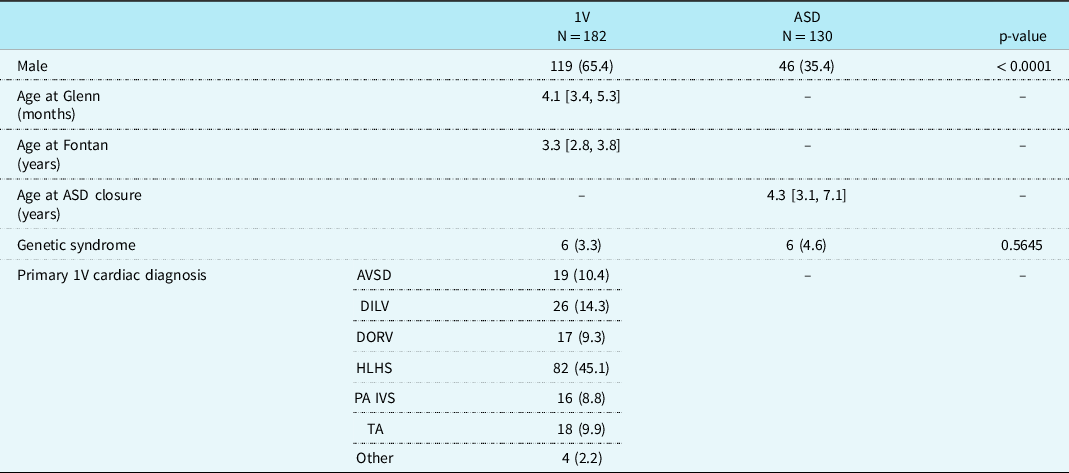
A total of 312 patients with CHD were included in this study, including 182 patients with palliated single ventricle CHD and 130 patients with surgically repaired isolated atrial septal defect. Of the 182 patients with single ventricle CHD, 112 (61.5%) patients underwent Fontan palliation prior to the end of the study period. Median follow-up after Fontan palliation was 2.8 [0.6, 4.8] years. Median follow-up after surgical atrial septal defect closure was 2.9 [0.6, 5.3] years. Patient demographics for the entire cohort are summarised in Table 1.
Patient demographics. Data are expressed as number (per cent) or median [interquartile range]. “Other” diagnosis includes congenitally corrected transposition of the great arteries (n = 1), double outlet left ventricle (n = 1), and Ebstein’s anomaly (n = 2). ASD= atrial septal defect, AVSD= atrioventricular septal defect, DILV= double inlet left ventricle, DORV= double outlet right ventricle, HLHS= hypoplastic left heart syndrome, PA IVS= pulmonary atresia intact ventricular septum, TA= tricuspid atresia, 1V= single ventricle CHD

Burden of respiratory viral presentations and admissions: Entire single ventricle cohort
To assess the overall burden of respiratory viral infections in patients with single ventricle CHD, we identified the number of presentations, admissions, and admission characteristics within the entire single ventricle cohort. For comparison, we also identified these data in a normoxic control group of patients with a surgically closed isolated atrial septal defect (Figs 1 and 2, Table 2).
Respiratory viral infections lead to frequent clinical presentations and hospital admissions for patients with single ventricle CHD. ( a ) Frequency distribution graph showing the number and age distribution of clinical presentations with respiratory viral symptoms. ( b ) Frequency distribution graph showing the number and age distribution of hospital admissions with respiratory viral symptoms. Both graphs include the pre-Glenn stage for patients with single ventricle CHD. ASD= atrial septal defect, 1V= single ventricle CHD.

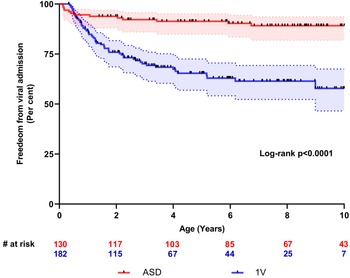
Patients with single ventricle CHD have decreased freedom from respiratory viral admission compared to patients with an isolated atrial septal defect. Kaplan-Meier survival curve excludes pre-Glenn admissions. ASD= atrial septal defect, 1V= single ventricle CHD.

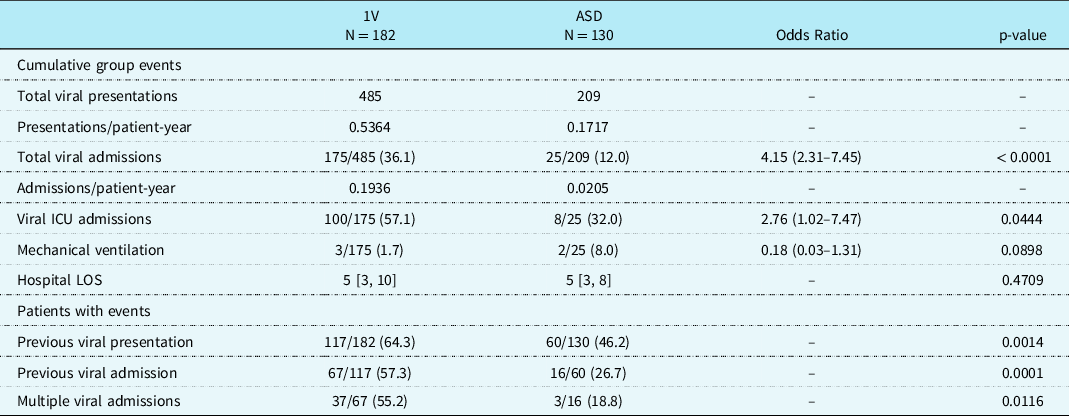
Respiratory viral outcomes for all patients with single ventricle (1V) CHD and isolated atrial septal defect, including the pre-Glenn stage for patients with single ventricle CHD. Data are expressed as raw number, number (per cent), or median [interquartile range]. Odds ratio indicates mean estimate (95% confidence limits). LOS= length of stay, 1V= single ventricle CHD

Frequency distribution graphs (Fig 1) summarise the frequency of respiratory viral presentations and admissions for patients with single ventricle CHD and isolated atrial septal defects. As expected, presentations and admissions occur more frequently at younger ages for both groups and more frequently in patients with single ventricle CHD. For single ventricle patients, 81.0% of respiratory viral presentations and 90.9% of respiratory viral admissions occur by 4 years of age. For patients with isolated atrial septal defect, 47.6% of presentations and 80.0% of admissions occur by 4 years of age (Fig 1a and b).
To account for differences in cohort number and follow-up duration, we calculated the number of presentations and admissions per patient-year of follow-up (Table 2). Presentations were 3.1 times more prevalent in the single ventricle cohort (0.5364 presentations/patient-year) compared to the atrial septal defect cohort (0.1717 presentations/patient-year). Even more pronounced, admissions were more than 9 times more prevalent in the single ventricle cohort (single ventricle: 0.1936 admissions/patient-year; atrial septal defect: 0.0205 admissions/patient-year).
Of those patients who were admitted, patients with single ventricle CHD were nearly 3 times more likely to be admitted to an ICU (odds ratio 2.76, 95% confidence interval 1.02–7.47). Despite the increased rate of admission to an ICU, there was no difference in the frequency of mechanical ventilation (p = 0.0898) and no difference in the total hospital length of stay (p = 0.4709).
After excluding admissions during the pre-Glenn period, patients with single ventricle CHD still had reduced freedom from respiratory viral admission compared to patients with isolated atrial septal defect (Fig 2). More reassuring, though, 64% of single ventricle patients and greater than 91% of atrial septal defect patients were free from viral-related admission at 5 years old.
Burden of respiratory viral presentations and admissions: Glenn and Fontan circulation
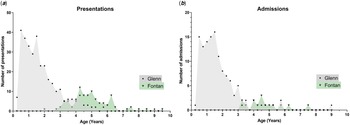
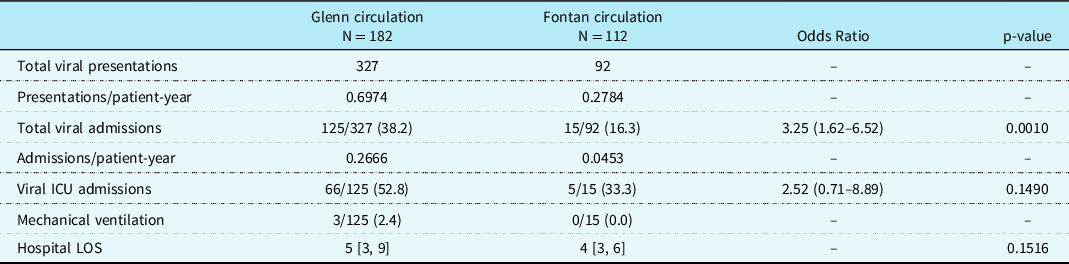
Next, to assess the burden of respiratory viral infections at different stages of palliated single ventricle CHD, we examined the number of presentations, admissions, and admission characteristics during the period of Glenn circulation or Fontan circulation (Fig 3, Table 3). Frequency distribution graphs (Fig 3) summarise the frequency of respiratory viral presentations and admissions during Glenn and Fontan circulation.
Respiratory viral infections frequently burden patients with Glenn circulation. ( a ) Frequency distribution graph showing the number and age distribution of clinical presentations with respiratory viral symptoms for single ventricle patients broken down by circulation type. ( b ) Frequency distribution graph showing the number and age distribution of hospital admissions with respiratory viral symptoms for single ventricle patients broken down by circulation type.

Respiratory viral outcomes for single ventricle patients during the period of Glenn circulation or the period of Fontan circulation. Data are expressed as raw number, number (per cent), or median [interquartile range]. Odds ratio indicates mean estimate (95% confidence limits). LOS= length of stay

To account for differences in cohort number and follow-up duration, we calculated outcomes per patient-year of follow-up (Table 3). Presentations were 2.5 times more prevalent in patients with Glenn circulation (0.6974 presentations/patient-year) compared to Fontan circulation (0.2784 presentations/patient-year). Admissions were nearly 6 times more prevalent in patients with Glenn circulation (0.2666 admissions/patient-year) compared to Fontan circulation (0.0453 admissions/patient-year). Including all respiratory viral presentations in patients with Glenn or Fontan circulation, patients with Glenn circulation were more likely to be admitted to the hospital when they presented compared to patients with Fontan circulation (Glenn: 125/327, 38.2%; Fontan: 15/92, 16.3%; p = 0.0010).
Of those patients who were admitted, there was no difference between Glenn and Fontan in prevalence of ICU admission (Glenn ICU: 66/125, 52.8%; Fontan ICU: 5/15, 33.3%; p = 0.1490), though this is likely underpowered due to the low total number of admissions in patients with Fontan circulation. Similarly, mechanical ventilation was rare in both groups (2.4% of Glenn ICU admissions, 0% of Fontan ICU admissions). Finally, hospital length of stay was similar during Glenn and Fontan circulation (Glenn: 5 [3, 9] days; Fontan 4 [3, 6] days; p = 0.1516). There were no deaths in either group related to respiratory viral presentations or admissions.
Age-matched comparison
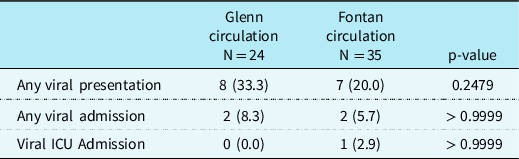
Last, we attempted to correct for age as a critical confounding variable for differences between Glenn and Fontan circulation. Because Fontan palliation occurs variably between 2–5 years old, we compared study outcomes that occurred between 3 and 4 years old in two subgroups: A) patients with Fontan palliation < 3 years old (i.e., Fontan circulation present 3–4 years old), B) patients with Fontan palliation > 4 years old (i.e., Glenn circulation present 3–4 years old). There were no differences between the two subgroups in presentations (p = 0.2480), admissions (p > 0.9999), or ICU admission (p > 0.9999) (Table 4). Although this subgroup analysis is likely underpowered, the total number of viral presentations, admissions, and ICU admissions were low. Two patients in each subgroup (4/59, 6.8%) were admitted for a respiratory virus, and only one patient (2.9% of Fontan subgroup) was admitted to an ICU.
Respiratory viral outcomes occurring between 3 and 4 years old for single ventricle subgroups. Glenn circulation subgroup includes 1V patients who had Fontan performed after 4 years old. Fontan circulation subgroup includes 1V patients who had Fontan performed before 3 years old. Data are expressed as number (per cent).

Discussion
In this study, our data indicate that patients with single ventricle CHD frequently present with respiratory viral infections, but complications are rare. Despite a high prevalence of respiratory viral presentations and admissions for patients with single ventricle CHD and Glenn circulation, hospital length of stay is relatively brief (median 5 days), and admissions very rarely require positive pressure mechanical ventilation (2.4% of ICU admissions and < 1% of all viral admissions). These data support that clinical providers and families can be reassured about vulnerability to respiratory viruses in patients with single ventricle CHD, including during the period of Glenn circulation.
Few data are published assessing the burden of respiratory viral infections in patients with single ventricle CHD. Thomas et al previously reported that an acute upper respiratory infection was the most common cause of non-cardiac admission for children with single ventricle CHD, and the admission rate was >4 times greater than the admission rate for children without CHD. Reference Thomas and Seckeler9 As expected, in our study we found that presentations, admissions, and ICU admissions were much more common in patients with single ventricle CHD than isolated atrial septal defect (Fig 1, Table 2).
Thomas et al also reported that non-cardiac admissions were most common in the first year of life for patients with single ventricle CHD. Reference Thomas and Seckeler9 When we included the pre-Glenn period in our analyses, we also found that presentations and admissions were most common in the first year of life for the entire single ventricle cohort (Fig 1). When we excluded the pre-Glenn period and focused on the period of Glenn circulation, we observed that presentations were most common in the first year of life, but admissions were most common from 1–2 years of age (Fig 3). Thus, our data support that patients remain at high risk for hospital admission following Glenn palliation, even after infancy, likely due to baseline hypoxia and obligate intracardiac mixing with right-to-left shunting.
Despite high rates of hospital admission, the median total hospital length of stay in our study for patients with single ventricle CHD (entire single ventricle cohort: 5 days, Glenn: 5 days, Fontan: 4 days) appears comparable to or less than previously published data (Table 3). Thomas et al report mean length of stay of ∼ 5.5 days for upper respiratory infection, ∼ 6 days for bronchiolitis from respiratory syncytial virus, and ∼ 10 days for bronchiolitis from non-respiratory syncytial virus. Reference Thomas and Seckeler9 In a large population study of 66,304 hospital admissions of children 1–24 months old, Zuritz-Cruz et al reported a mean length of stay of 4.1 ± 4.4 days for a respiratory viral infection. Reference Zurita-Cruz, Gutierrez-Gonzalez and Manuel-Apolinar8 Thus, hospital length of stay, a surrogate for illness severity, in our single ventricle cohort is comparable to previous studies and relatively brief during the periods of Glenn circulation and Fontan circulation.
Previous studies report conflicting data about whether Fontan palliation performed during respiratory viral season (November–March) increases risk of post-Fontan complications (length of stay, pleural effusions, survival). Reference Fedderly, Whitstone, Frisbee, Tweddell and Litwin10–Reference Ghimire and Moon-Grady14 Because of these data, it is common practice to schedule elective Fontan palliation outside of the respiratory viral season. In our age-matching comparison of Glenn and Fontan circulation, we found no differences in the frequency of viral presentation, hospital admission, or ICU admission in children 3–4 years with either Glenn circulation or Fontan circulation (Table 4). Additionally, our entire cohort of patients with single ventricle CHD had low rates of respiratory viral admission between 3–4 years old (Fig 1b, Fig 3b). Thus, from the perspective of vulnerability to respiratory viral infection and complications from infection, we speculate that Fontan palliation can be safely deferred until outside of the respiratory viral season for patients with single ventricle CHD who are between 3–4 years old.
Our study has several limitations given that it is a single-institution retrospective study. Although we have a relatively large paediatric cohort for this study, the rare prevalence of severe outcomes limits detailed analyses and identification of specific risk factors. Importantly, we cannot determine the true clinical severity of respiratory viral infections for each presentation and admission, and we cannot assess the influence that physician or caregiver biases may have on study outcomes (e.g., propensity to admit or avoid mechanical ventilation in one patient group with similar severity of viral infection). Additionally, our conservative institutional management of patients in the interstage (pre-Glenn) period includes a large percentage of infants remaining hospitalised during the interstage period. Thus, these patients would not have viral encounters represented in our data in the pre-Glenn period, and this may limit generalisability. Finally, the true prevalence of respiratory viral infections is likely underestimated because there was loss of follow-up in the cohort over time, there were likely many respiratory viral infections that did not result in a clinical encounter, and clinical encounters outside our health system were not included.
In conclusion, our data indicate that respiratory viral infections are prevalent but uncomplicated in patients with single ventricle CHD. Viral-related presentations and admissions are more prevalent during the period of Glenn circulation compared to Fontan circulation; however, rate of mechanical ventilation and hospital length of stay are similar. These results provide relevant data to help support clinical guidance for patients with single ventricle CHD.
Acknowledgements
None.
Financial support
This study was internally supported by the Department of Pediatrics at Medical College of Wisconsin. This publication was supported by the National Center for Research Resources and the National Center for Advancing Translational Sciences, National Institutes of Health, through Grant Number UL1TR001436 (ADS). Its contents are solely the responsibility of the authors and do not necessarily represent the official views of the NIH.
Conflicts of interest
None.
Ethical standards
This study was approved by the local Institutional Review Board.